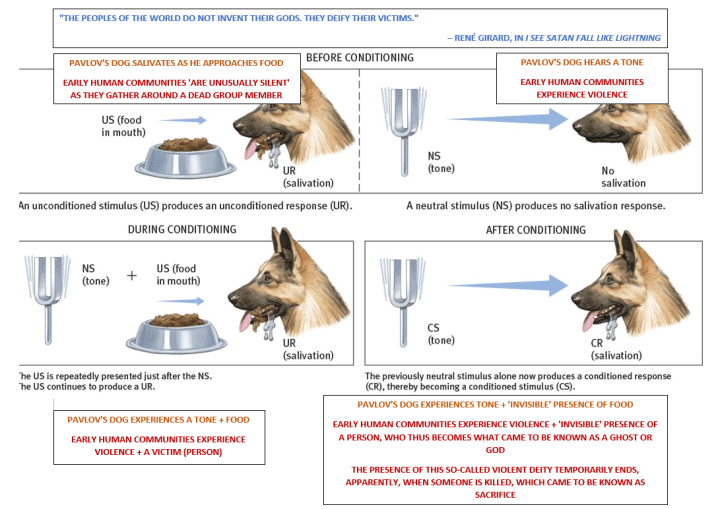
Mimetic Theory sure inspires interdisciplinary research on the origin and evolution of human culture from particular biological traits of the human species, especially the latter’s highly mimetic (i.e. imitative) abilities/tendencies. It is no coincidence that Michel Serres announced René Girard as the “Charles Darwin of the Human Sciences” when Girard was inaugurated as immortel of the Académie française. The basic hypothesis is this: in prehistoric groups, mimetic desire sometimes leads to an escalation of mimetic rivalries, which end by yet another mimetic mechanism, namely the mimetic bonding against one member or smaller assembly of the group. Today this type of event can also be observed in groups of animals that are close to humans, like apes and monkeys. The fundamental difference, however, is that this must have happened much more in groups of primitive humans (due to a higher mimetic capacity), which explains how certain associations originated around victims of collective violence (see the analogy with Pavlov’s experiment of classical conditioning).
 SCAPEGOAT SHADOWS