Mimetic Dynamics & Phenomenological Awareness in Dekalog (Krzysztof Kieślowski, 1989)
In September 1989, the Venice Film Festival saw the international premiere of Dekalog, a ten-part film series by Polish director Krzysztof Kieślowski (1941-1996), inspired by the Ten Commandments. Thirty-five years later, the series is regarded as a masterpiece of film history the world over.
[NEDERLANDSTALIGE VERSIE 1 & 2 pdf]
Erik Buys

Director Krzysztof Kieślowski saw film as the medium that can reveal the hidden aspects of reality.
“ALL PEOPLE HAVE TWO FACES”
Initially, Krzysztof Kieślowski mostly made documentaries. In his own words, in the early 1970s, he wanted to “describe what communist Poland and its people really looked like.”[1] Gradually, however, he came up against the limits of his method. The intimate face of people does not give itself away so easily. Kieślowski then approached feature film as the genre that better reveals the hidden aspects of reality. The ten films of his Dekalog series, each about an hour long, are a highlight in this regard.
“The big problem of a documentary is that it somehow falls into its own trap,” notes Kieślowski in a conversation with film critic Derek Malcolm (1932-2023).[2] “The closer the documentary filmmaker’s camera gets to a human object, the more that human object seems to disappear in front of the camera. When I’m making a film about love, I can’t enter a bedroom where a couple is having intercourse. When I’m making a film about death, I can’t film someone who is really dying. I’m even afraid of real tears. I don’t know if I have the right to film them. As a filmmaker, I cross boundaries and enter areas that are normally forbidden. That may be the main reason why I left documentary filmmaking.”
Stage
As You Like It, the famous comedy by William Shakespeare (1564-1616), describes the world as a “stage” on which people are “merely players”, suited for “many parts.”[3] The paradox, then, is that what is considered real life is often but a play. In the book Kieślowski on Kieślowski, the Polish filmmaker echoes the argument of the illustrious English bard. “I think that all people – and this is irrespective of the political system – have two faces,”[4] Kieślowski claims. “They wear one face in the street, at work, in the cinema, in the bus or car. That’s the appropriate face to wear on the outside, and the appropriate face for strangers.” Like a good play, Dekalog explores the other face of people, their veiled fears, dreams and motivations. In that sense, fiction reveals more of reality than what a reporter’s camera could ever capture.
Censorship
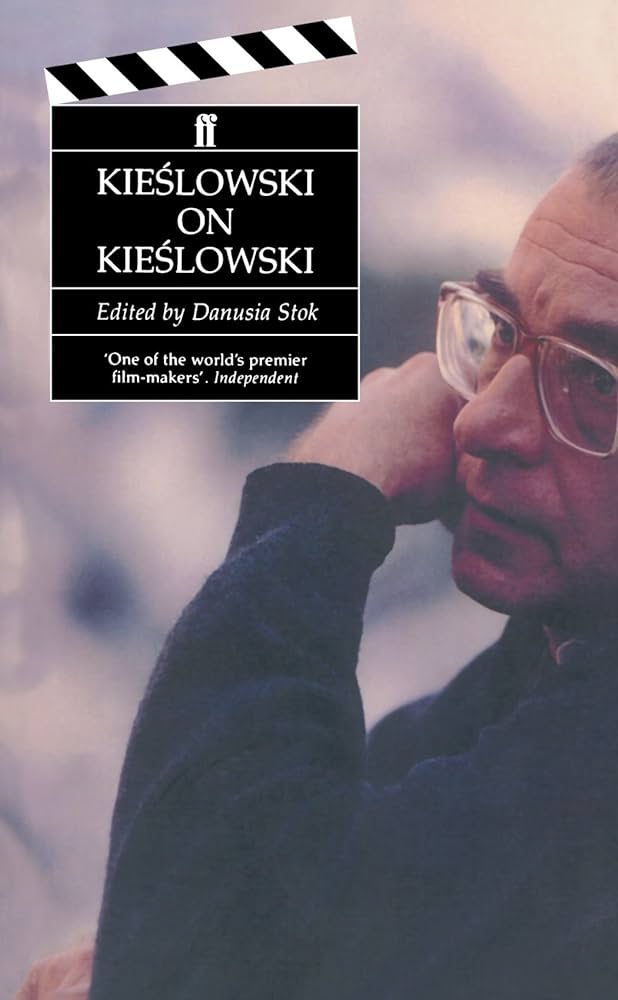
Communist censorship did not prevent collective film rituals in dark movie theaters from violating social taboos sometimes. “The public knew the rules by which censorship worked and waited for a signal that these rules had been by-passed,”[5] Kieślowski observes. “Today this basic reason for being together doesn’t exist anymore. We’re lacking an enemy.” And he rather surprisingly adds “it was easier to make films there then [in communist Poland] than it is under the economic censorship here in the West. Economic censorship means censorship imposed by people who think that they know what the audience wants.”
Housing Estate
Dekalog introduces characters caught between their fickle desires, the demands of society, and existential questions. The setting for their individual stories is a large housing estate, consisting of boring grey apartment blocks. “It’s the most beautiful housing estate in Warsaw, which is why I chose it,”[6] Kieślowski explains. “It looks pretty awful so you can imagine what the others are like. The fact that the characters all live on one estate brings them together. Sometimes they meet, and say, ‘May I borrow a cup of sugar?’.”
Prisoners
Apart from the area where they live and its social conventions, Kieślowski’s characters share a tendency to do injustice to a God who is understood as love and thus, by extension, a tendency to do injustice to humanity. “The concept of sin is tied up with this abstract, ultimate authority which we often call God,”[7] Kieślowski analyzes. “But I think that there’s also a sense of sin against yourself which is important to me and really means the same thing. Usually, it results from weakness, from the fact that we’re too weak to resist temptation; the temptation to have more money, comfort, to possess a certain woman or man, or the temptation to hold more power,”[8] the filmmaker continues. “I believe we’re just as much prisoners of our own passions, our own physiology, and certainly our own biology, as we were thousands of years ago. We’re constantly imprisoned by our passions and feelings. You can’t get rid of this. It makes no difference whether you’ve got a passport which allows you into every country or only into one and you stay there. It’s a saying as old as the world – freedom lies within. It’s true.”[9]
Stanley Kubrick
Film director Stanley Kubrick (1928-1999) did not hide his admiration for Dekalog. The American genius even wrote a foreword to the publication of the series’ screenplays, in which he wrote, among other things, “Krzysztof Kieślowski and his co-author, Krzysztof Piesiewicz, have the very rare ability to dramatize their ideas rather than just talking about them. By making their points through the dramatic action of the story they gain the added power of allowing the audience to discover what’s really going on rather than being told. They do this with such dazzling skill, you never see the ideas coming and don’t realize until much later how profoundly they have reached your heart.”[10]
A rarely unearthed interpretive key for Dekalog lies in a statement by Krzysztof Piesiewicz (b. 1945), a human rights lawyer and politician who became Kieślowski’s screenwriter companion: “At the basis of all my reflections lie the books of René Girard.”[11]
The French-American thinker René Girard (1923-2015) is known for his attention to the role of imitation or mimesis in interpersonal relationships, and of the scapegoat mechanism as violent foundation of culture.[12] Already in biological terms, the genetic code is a copy, but people also acquire a cultural identity thanks to mimetic processes. They adopt the habits, language and ideas of their environment.
Mimetic desire
There also is a desire that relies on imitation and that is influenced by role models in a positive or negative sense. Girard speaks of a mimetic desire in addition to physical needs. Everyone is born with the need for oxygen, but no one is born with the desire to become a lawyer. Mimetic desire also has a flip side. It sometimes leads to rivalry and even violence if individuals cannot or do not want to share the object of their desire.
Nonviolent imitation
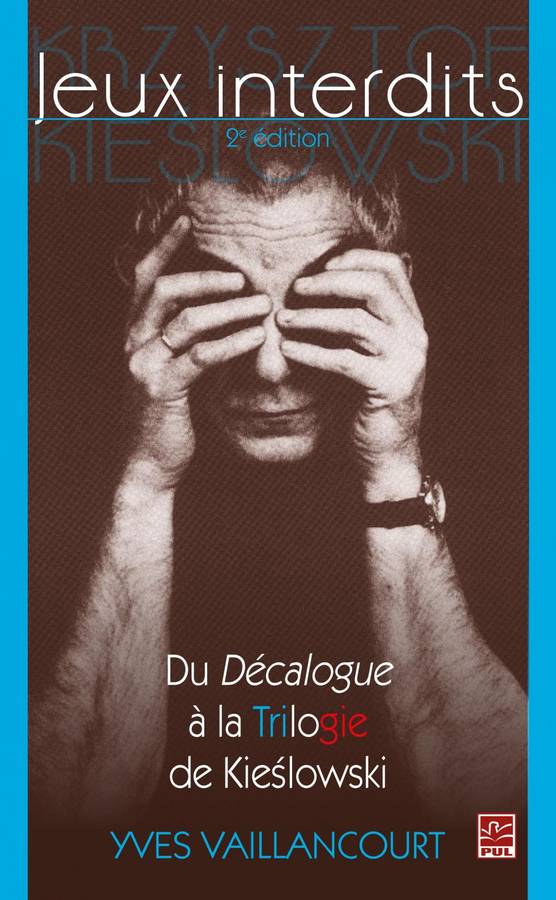
Dekalog follows the Catholic numbering of the Ten Commandments and shows how they relate to a variety of mimetic processes. Canadian philosopher Yves Vaillancourt (1960) is an apt guide to highlight that relationship, as he analyzed Dekalog in the light of Girard’s mimetic theory.[13] From that perspective, the neighborly love called for by the commandments materializes itself as an imitation of those who refuse to make violent sacrifices. In Dekalog, that kind of mimesis always creates the space where a vulnerable child can live fully. The lack of it, in turn, is deadly.
“YOU CAN ONLY SEE THINGS CLEARLY WITH YOUR HEART”
An intriguing constant throughout Dekalog is the appearance of a quiet, mysterious man. “I introduced the character whom some called ‘the angel’,”[14] Kieślowski recalls. “In the screenplays, he was always described as a ‘young man’. [He comes, watches and walks on.[15]] He doesn’t have any influence on what’s happening, but he is a sort of sign or warning to those whom he watches, if they notice him.”
In his symbolically rich films, Kieślowski claims to search for the “surplus” in reality.[16] That remains unnoticed by those who reduce the world to what is necessary to satisfy all kinds of cravings or to what is useful to fabricate a public face with social prestige. The young man in Dekalog symbolizes the surplus. He embodies what remains intangible to scientific measuring instruments and makes itself known only in the light of love. “You can only see things clearly with your heart,”[17] as is written in Le Petit Prince, the fairy tale by Antoine de Saint-Exupéry (1900-1944). Rarely has that truth been so bafflingly rendered as in the story of the first Dekalog film. In it, a father finds that science and technology, despite their promises of power and control, offer him no comfort after the loss of his child.
DEKALOG 1
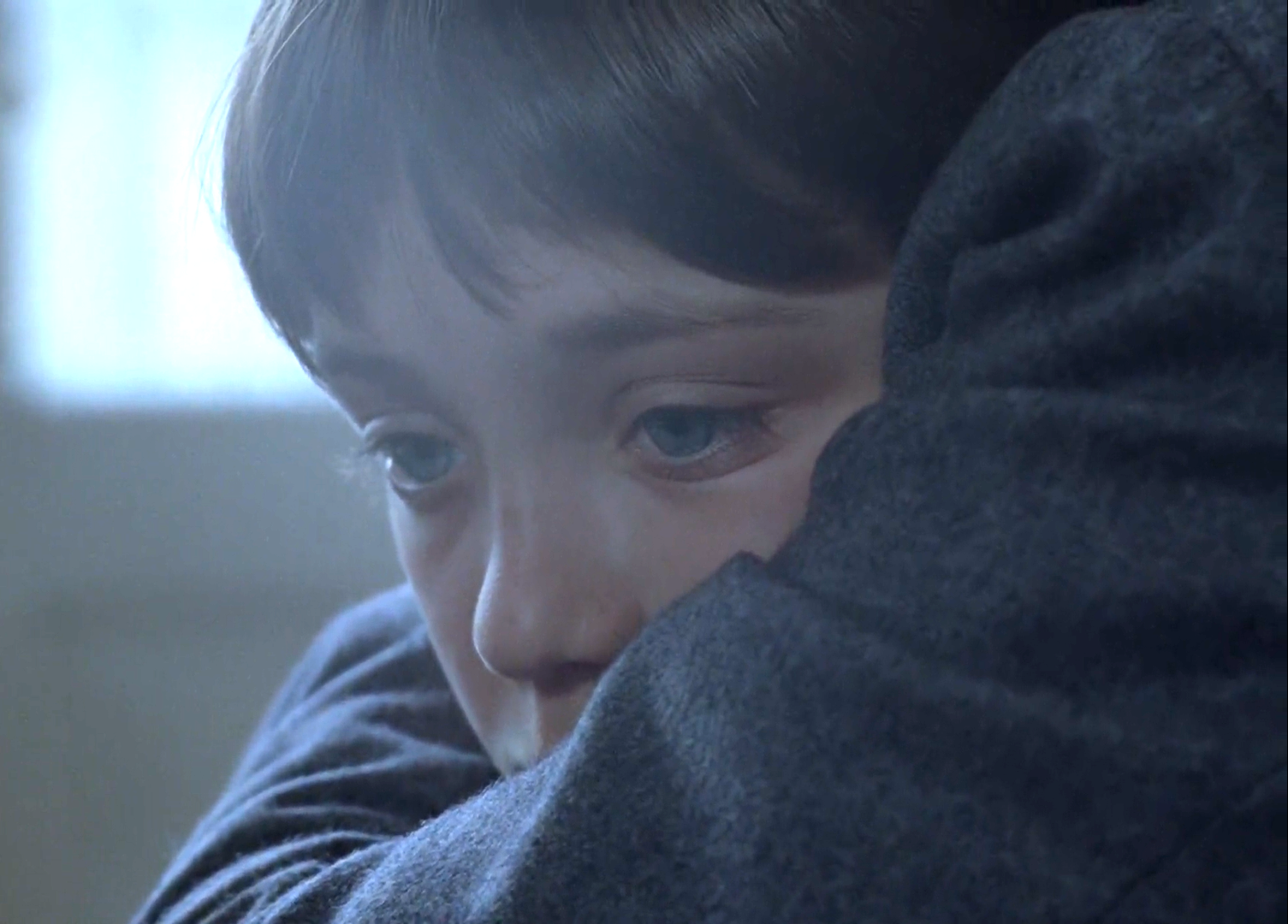
“I love you,” Paweł says as his aunt hugs him. “And this is what God is,” she replies.
“I am the Lord your God, who brought you out of the land of Egypt, out of the house of slavery; you shall have no other gods before me. You shall not make for yourself an idol, whether in the form of anything that is in heaven above, or that is on the earth beneath, or that is in the water under the earth. You shall not bow down to them or worship them” (Exodus 20:2-5a).
Krzysztof, a competitive professor of linguistics, relies on the power of digital intelligence to shape life with his 11-year-old son Paweł. “The professor seems to take pleasure in presenting the computer as an imitator of God,”[18] stresses Yves Vaillancourt. “But Paweł’s aunt will then sum up the attributes of God for the boy in one word: love – which Paweł is experiencing at that very moment. Love is not part of the positivist lexicon with which Paweł’s father describes the computer.”
Krzysztof places his obsession with the power of the computer above his concrete concern for Paweł, and his lecture on word associations foreshadows the fateful temptation to which he eventually succumbs. “Among the examples Krzysztof gives are the noun podjudzanie and the verb podjudzać, both constructed from the name Judas,”[19] Vaillancourt notes. “The noun means: the temptation of Judas. The verb means: to do as the devil does and tempt Judas. In the film, it is the computer that gives the father the green light and says, ‘Go ahead, do it. Give your child the skates and let him go out on the ice!’ The computer seduces the father like the devil.”
A graphic representation of the activity in the brains of those who mourn does not capture the tearing reality of grief at a sudden goodbye, nor the love for the deceased that underlies that grief. In the first Dekalog film, Krzysztof experiences how, in the love for his lost child, he finds a meaning that transcends him, a transcendence that cannot be manipulated and can never be fully expressed: the priceless value of a human life.
Technological instruments register only “bones, flesh and blood.” A more poetic language, on the other hand, expresses the moral weight of a human being, which does not allow itself to be weighed or created by man, but presents itself independently of any human decision. Krzysztof only finds a home for his grief and anger in a church. His computer abandoned him. Love in response to the unfathomable meaning of his child, tastes bitter to him, but continues to reveal itself indestructibly even through the suffering. And perhaps a tiny glimmer of hope lies therein.
Grace
Time and again, Dekalog suggests that the value of a human being does not depend on the value assigned to him by fellow human beings, or on such feelings as joy and sorrow. In the irreducible value of a human life, Kieślowski recognizes the hopeful trace of a God whose grace cannot be possessed or taken away by man. “I think that an absolute point of reference does exist,”[20] Kieślowski confesses. “As somebody once said, if God didn’t exist then somebody would have to invent Him. But I don’t think we’ve got perfect justice here, on earth, and we never will have. It’s justice on our own scale and our scale is minute. We’re tiny and imperfect.”[21]
Charity
Righteousness takes its full form in the Bible in the choice of charity, a love that brings life and to which the Ten Commandments also point. “The law of life – its continuation and preservation – constitutes the biblical foundation of all laws,”[22] writes Bible translator André Chouraqui (1917-2007). Obedience to the voice of charity – neighborly love – frees man from deadly addictions to power, prestige, pleasure and possession.
Truth
“We’re always fighting for some sort of freedom,”[23] Kieślowski asserts. In Dekalog, freedom lies in a conscience awakened by charity. Love as a concern for the other for the other’s sake, and not, for example, because of his political connections, liberates the human spirit to experience reality more completely: the other cannot be reduced to a mere means that should confirm one’s untruthful self-image. When one approaches the world in its entirety with this non-instrumental attitude, one’s horizons expand. In this sense, charity is not merely an ethical but also an epistemological principle, which Emmanuel Levinas (1906-1995) made the core of his phenomenology.[24] In short, the good has to do with what is true, and “the truth will make you free” (John 8:32).
Orientation
The respect for other people puts social conventions into perspective and gives all kinds of desires their orientation. The value of one’s life companion, for instance, is not diminished if that companion, due to circumstances, is no longer able to satisfy sexual needs. The sixth and ninth Dekalog film deals with that, among other things. And love for a deceptive, supposedly respectable social image does not negate the value of an innocent fellow human being who is sacrificed to maintain that image. The love of the other for the sake of the other thwarts the love of a deceitful reputation and its socio-political power. That motif plays an important role in the second, fourth, seventh and eighth film of Dekalog.
DEKALOG 2

“I am coming back from the other side,” Andrzej confides to his doctor after waking up.
“You shall not make wrongful use of the name of the Lord your God” (Exodus 20, 7a).
Dorota, violinist in a symphonic orchestra, is pregnant by her lover unbeknownst to her husband Andrzej, who is suffering from cancer. She asks the attending physician, as it were, to pronounce divine judgment on the outcome of the disease. If Andrzej dies, she will keep the child. If he survives, she will have an abortion.
The old physician recalls how he came home one day during World War II and found a large cavity, after a bombardment, instead of the house with his family. “Perhaps that painful memory influenced the doctor’s diagnosis,” Vaillancourt muses, “so that the child might live? The child is in danger of being swallowed up, and Dorota will have to live with a large cavity, just as the doctor had to after the bombing. Kieślowski introduces a foggy mimetism between the doctor’s story and that of the people who depend on his judgment. True, the doctor saves the child, but by declaring Andrzej dead, he commits perjury.”[25]
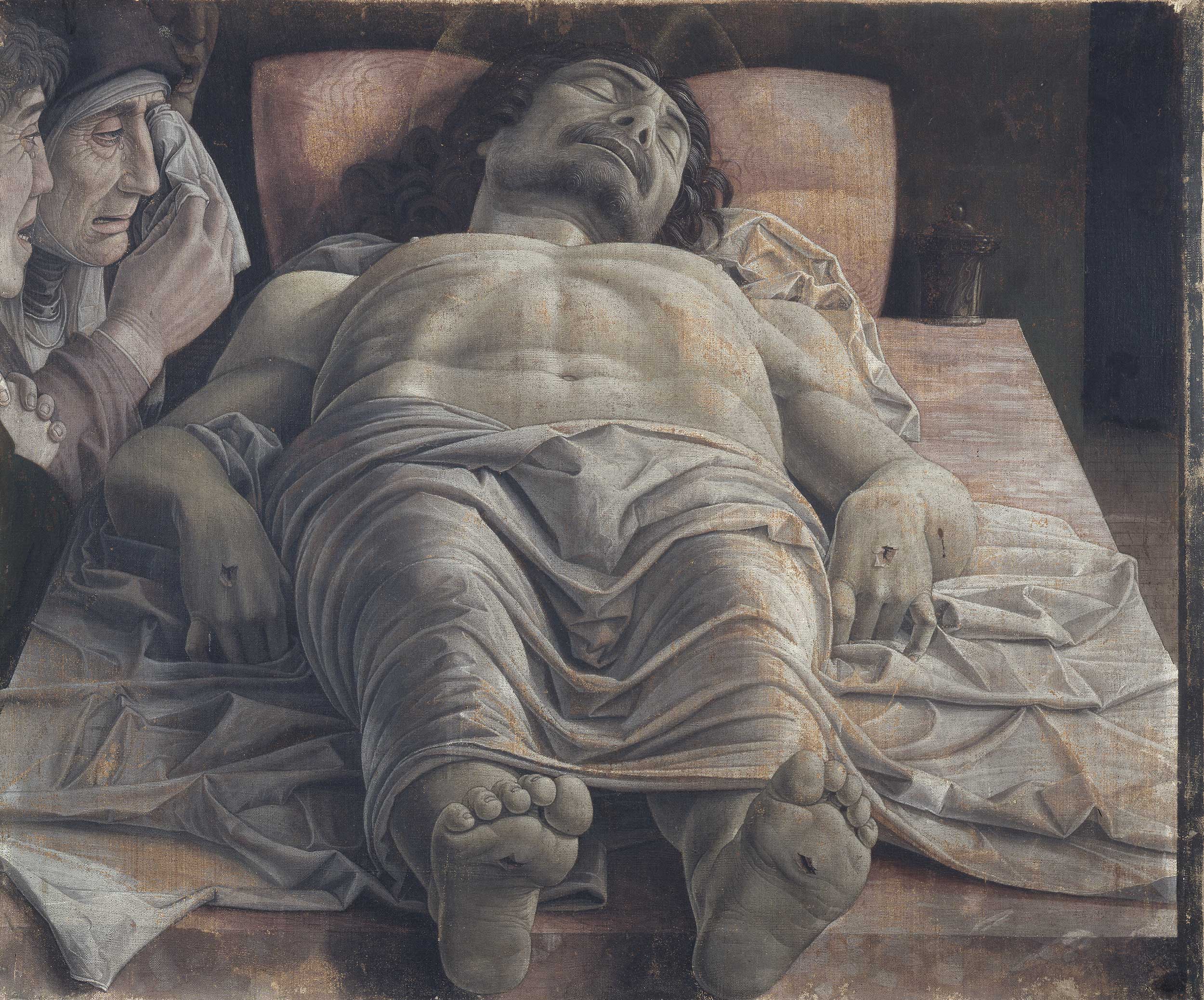
Andrzej survives. On his sickbed, he resembles the dead Christ from a famous painting by Andrea Mantegna (1431-1506), until he wakes up. In a nightly conversation with the doctor, he says of his awakening that he “returns from the other side.”
“YOU CAN NEVER BE ULTIMATELY HONEST”
In Dekalog, Kieślowski often depicts the workings of the Ten Commandments in an ironic way. After all, the love to which the commandments give room, makes use of the same human characteristics that sometimes get in the way of that love. For example, in a world marked by lies and keeping up appearances, you sometimes have to lie to tell the truth. This is especially evident in the second film of Dekalog.
The act of the old doctor in the second Dekalog film is reminiscent of the apostle Paul’s paradoxical speech, for instance in his first letter to the Corinthians. In that letter, Paul notes that love for the marginalized and weak appears as foolishness in a world obsessed with prestige and power. “Do not deceive yourselves,” Paul writes. “If you think that you are wise in this age, you should become fools so that you may become wise. For the wisdom of this world is foolishness with God” (1 Corinthians 3:18-19a).
Recalibration
The God to whom Paul and the Ten Commandments, among others, testify, and who can be identified as a dynamic of nonviolent love, does not destroy the human world in order to set His own laws. In fact, that would be nothing but the continuation of a violent process. On the contrary, the dynamic of nonviolent love dismantles and recalibrates the human endeavor from within, so that this endeavor no longer entangles and suffocates creation, but rather redeems and begets life, even if that happens through trial and error.
Honest about dishonesty
Kieślowski shows how even ethical choices are constantly exposed to fraudulent practices and corruption. You won’t find a moralistic division between good and evil, which ultimately does more harm than good because it remains blind to its own hypocrisy, in Dekalog. “I think integrity is an extremely complicated combination,” Kieślowski argues, “and we can never ultimately say ‘I was honest’ or ‘I wasn’t honest.’ In all our actions and all the different situations in which we find ourselves, we find ourselves in a position from which there’s really no way out – and even if there is, it’s not a better way out, a good way out, it’s only relatively better than the other options, or, to put it another way, the lesser evil. This, of course, defines integrity. One would like to be ultimately honest, but one can’t. With all the decisions you make every day, you can never be ultimately honest.”[26]
DEKALOG 3

Krzysztof, who lost his child Paweł, watches Janusz’s children awaiting their father dressed as Santa Claus, whom he had crossed moments before.
“Remember the sabbath day, and keep it holy” (Exodus 20:8).
Janusz, a cab driver, leaves his family during the holy moment of Christmas Eve to clandestinely meet his former mistress Ewa. “In this film, there is a reprise of the famous biblical scene with the forbidden fruit,” Vaillancourt notes. “Ewa imitates her biblical namesake.”[27] She comes “like a thief in the night” that throws Janusz off guard.
DEKALOG 4

Anka is about to open an envelope that may contain a secret regarding her identity and the relationship with her father.
“Honor your father and your mother” (Exodus 20:12a).
Anka, a student at an art school, lives with Michał, a widower and her father, about whom it is not known for certain whether he also is Anka’s biological father. Anka’s friend Jarek arouses Michał’s jealousy. “The looming union between Anka and Jarek fuels the incestuous desires between father and daughter,” Vaillancourt argues. “The women in Michał’s life, in turn, arouse Anka’s jealousy. Mimetic desire circulates as much between Anka and Michał’s wives as it does between Michał and Anka’s boyfriends.” And then there is the late mother as a complicated role model. “The mother had at least two lovers in the year before Anka’s birth,” Vaillancourt continues. “Michał points to an old photograph at one point and says to Anka about two men on it, ‘One of these two could be your father.’ Clearly, the mimetic rivalry existed before Anka was born.”[28]
Anka and Michał face the challenge of honoring a healthy difference between child and parent.
DEKALOG 5
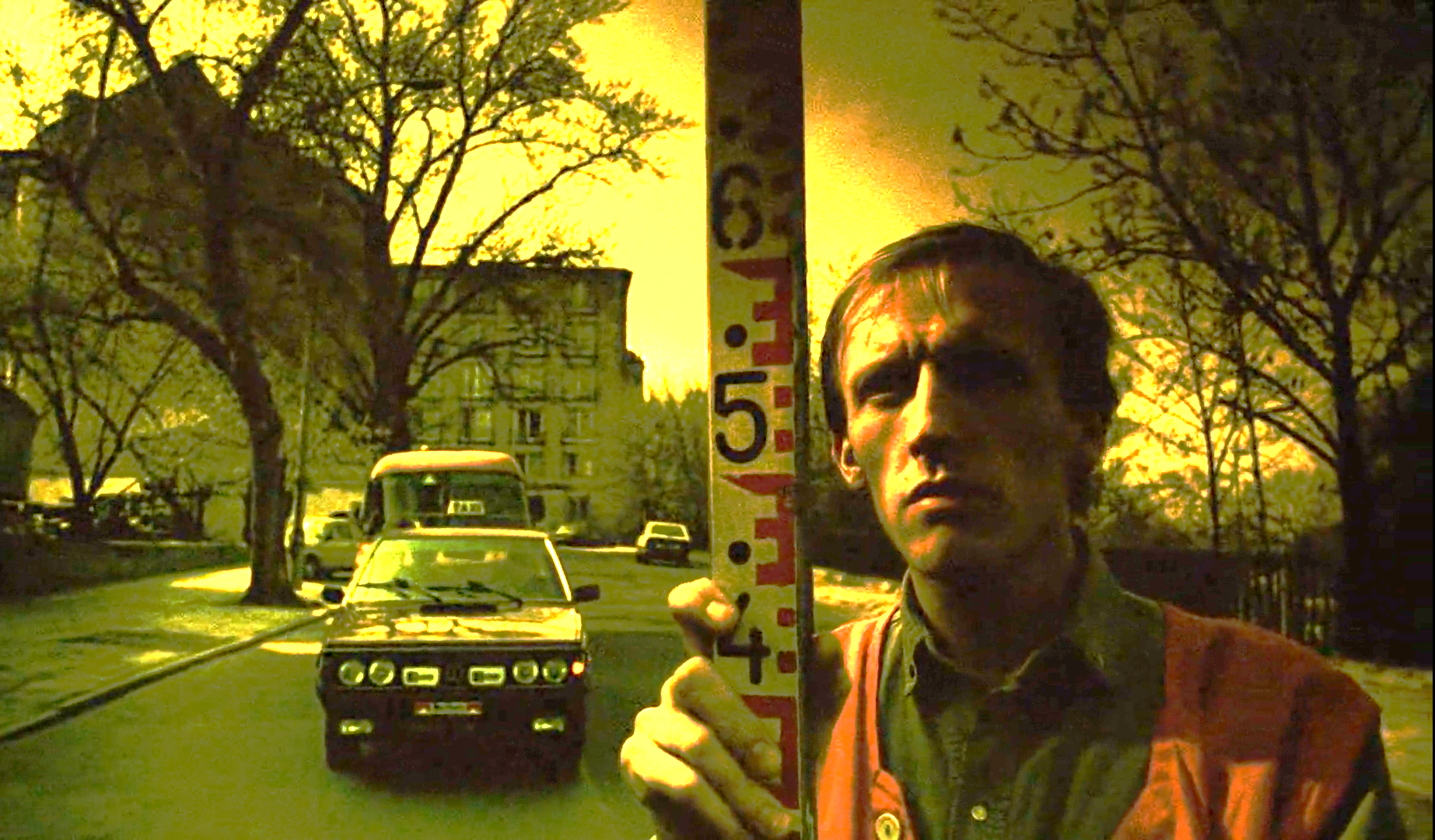
The so-called ‘angel’ shows up and, as a surveyor, brings into view the number of the fifth commandment, right in front of the cab with Jacek in it.
“You shall not murder” (Exodus 20:13).
Jacek goes through life as a confused young man since his 12-year-old sister died under the tractor of a drunk driver, one of his friends. He is sentenced to death for the murder of a cab driver, who functions as a scapegoat for his grief and frustrations. “The film announces itself as a reflection on the punishment that murderers must face,” Vaillancourt says. “Should the violation of the fifth commandment be met with the death penalty and thus with an imitation of the offense itself?”[29] Piotr, the young lawyer defending Jacek, argues in advance that “justice does not have to imitate nature.”
Kieślowski made a longer theatrical version of this film with A Short Film About Killing.
DEKALOG 6
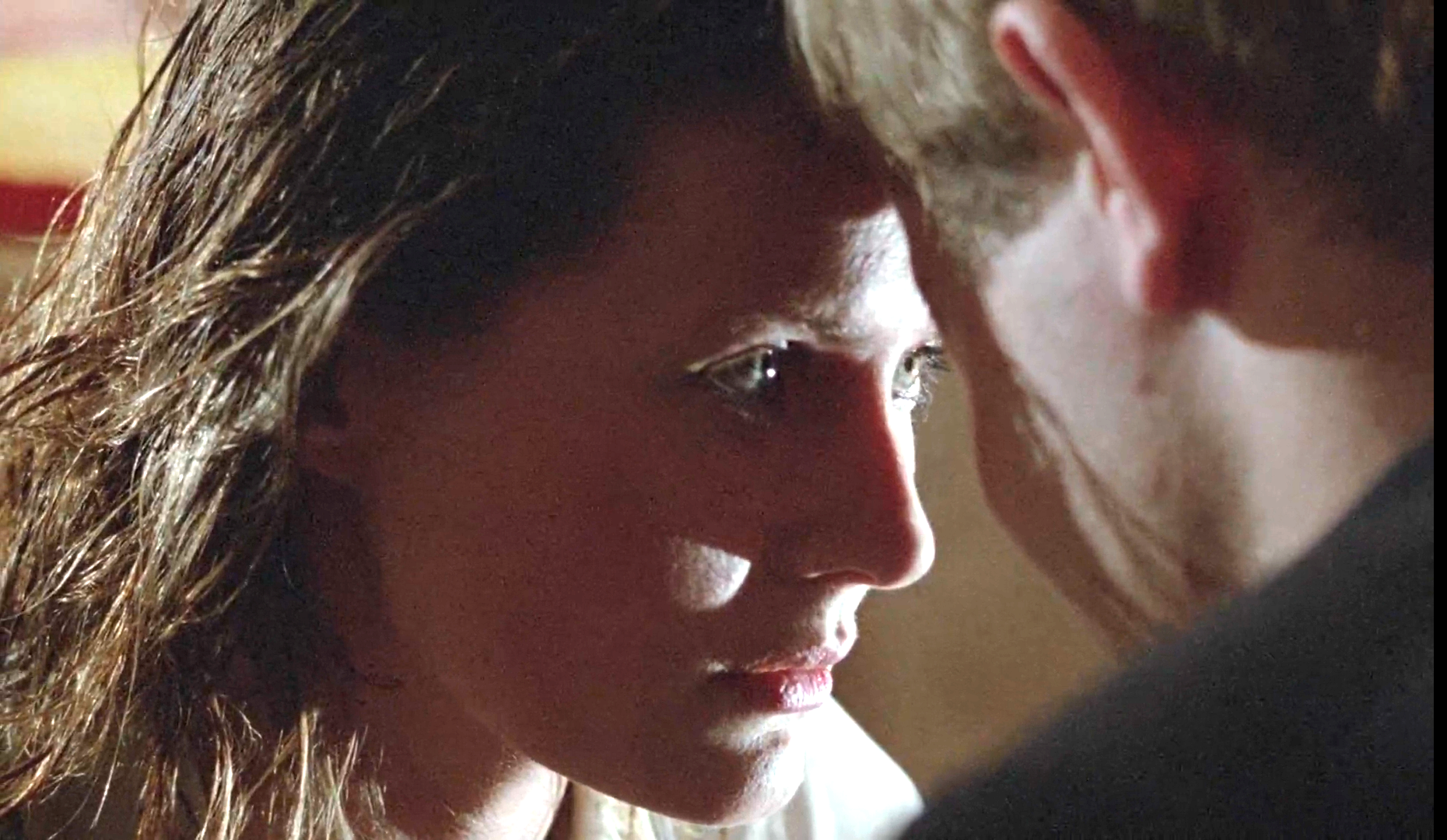
“Love is nothing more than this,” said Magda, who invited Tomek to touch her and aroused him sexually.
“You shall not commit adultery” (Exodus 20:14).
Tomek, a young postal clerk, regularly uses his binoculars to spy on the unmarried painter Magda and her many lovers. Eventually he meets her in person. “Magda stays in the register of mimetism and assumes that Tomek wants to kiss her, that he wants to sleep with her,” Vaillancourt clarifies. “She assumes that Tomek wants to follow in the footsteps of the lovers he has observed. But Tomek says no to every invitation.” Tomek, like a “believing Thomas,” seeks a tenderness that “will not touch or possess.” To her own surprise, Magda will emulate this noli me tangere motif like a contemporary Mary Magdalene.[30]
Kieślowski made a longer theatrical version of this film with A Short Film About Love.
DEKALOG 7

Ania finds herself torn between two mothers.
“You shall not steal” (Exodus 20:15).
Majka is pregnant with her teacher Wojtek at the age of 16. Majka’s mother Ewa is the principal of the school where Wojtek teaches and wants to avoid scandal. Ewa raises Ania, the child born from Majka’s pregnancy, as her own daughter and Majka’s sister. When Ania is six, Majka “steals what is hers” and kidnaps her daughter. “As in the biblical story of the judgment of Solomon, a mimetic desire concerning motherhood manifests itself, rather than unconditional love for the child,”[31] Vaillancourt clarifies. Ania is torn between the two women, until she discovers that the woman who withdraws herself from the rivalry is the “true” mother.
DEKALOG 8

“You won’t learn,” laughs an extremely lithe young man when Zofia tries to imitate him during her jogging session in the park.
“You shall not bear false witness against your neighbor” (Exodus 20:16).
Zofia is a professor of ethics and is visited by Elżbieta, a Jewish woman of Polish origin who lives in the U.S. and translated Zofia’s work. Elżbieta reveals herself as the child Zofia wanted to protect from the Nazis during World War II. Zofia’s rescue operation ran aground after Elżbieta’s intended adoptive father was falsely accused of collaboration. Elżbieta felt abandoned by Zofia and comes looking for answers. “Truth does not come without effort,” Vaillancourt points out. “To say false things, there are many examples to imitate, but to say true things, there are few.”[32]
DEKALOG 9
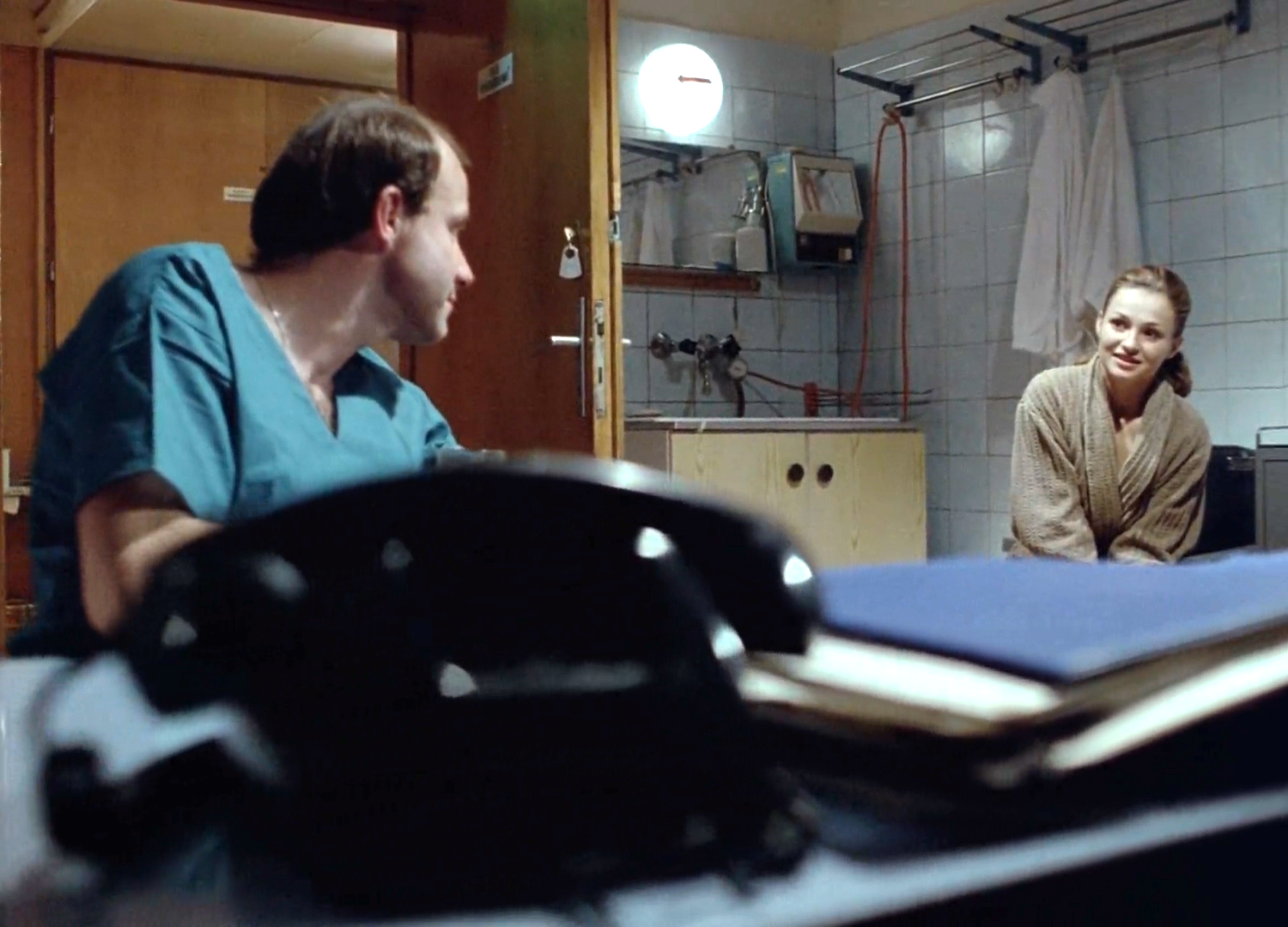
Roman talks to a patient of his, a singer, about Van den Budenmayer, a fictional musician behind whom Dekalog film composer Zbigniew Preisner (b. 1955) hides.
“You shall not covet your neighbor’s wife” (Exodus 20:17a).
Roman, a cardiologist, is told that his impotence is incurable and permanent. Thereupon he advises his wife Hanna to seek sexual satisfaction elsewhere. Young Mariusz, with whom Hanna previously had an affair, resurfaces. “Mariusz unwittingly reveals the mimetic structure of the violation of the prohibition,” Vaillancourt concludes. “He has lusted after another man’s wife. And Roman, in turn, does the same. He had presented Hanna’s lover as her legitimate sexual partner. So he is both victim and perpetrator of the violation of the prohibition.”[33] Hanna and Roman find each other again in their plans to adopt a child, with Ania from the seventh Dekalog film appearing on the scene.
DEKALOG 10

The stamp for which Jerzy gave up a kidney.
“You shall not covet anything that belongs to your neighbor” (Exodus 20:17b).
Jerzy and Artur inherit a stamp collection from their father. When they find that others praise and covet it, the desire to secure their prized possession takes on insane proportions. This is especially evident when they purchase a stamp to complete their collection. “That tragic-burlesque scene is unique in Dekalog,” Vaillancourt remarks. “The stamp is exchanged for a kidney. The mimetic lust for a trivial piece of paper results in an improbable payoff. In fulfillment of his ‘impure’ desire, Jerzy gives his kidney, the organ of purification.”[34] Nevertheless, this black comedy ends well and Kieślowski concludes his titanic effort on a cheerful note.
[1] Kieślowski, K. (1990, April 2). The Guardian Interview (D. Malcolm, Interviewer).
[2] Ibid.
[3] Shakespeare, W. (2024, May 20). As You Like It. The Complete Works of William Shakespeare. https://shakespeare.mit.edu/asyoulikeit/full.html
[4] Kieślowski, K., & Stok, D. (1993). Kieślowski on Kieślowski. London: Faber and Faber, 146.
[5] Ibid., 152.
[6] Ibid., 146.
[7] Ibid., 149.
[8] Ibid., 149-150.
[9] Ibid., 150.
[10] Kieślowski, K., & Piesiewicz, K. (1991). Decalogue: The Ten Commandments. London: Faber and Faber, vii.
[11] Amiel, V. (1997). Krzysztof Kieslowski: Textes réunis et présentés par Vincent Amiel. Albias: Jean-Michel Place, 167.
[12] Girard, R. (1978). Des choses cachées depuis la foundation du monde: recherches avec J.M. Oughourlian et Guy Lefort. Paris: Grasset.
[13] Vaillancourt, Y. (2016). Jeux interdits: Du Décalogue à la Trilogie de Kieślowski. Paris: Éditions Hermann.
[14] Kieślowski, K., & Stok, D. (1993). Kieślowski on Kieślowski. London: Faber and Faber, 159.
[15] Ibid., 158.
[16] Kleijer, P. (2023, January 11). Krzysztof Kieslowski liet in zijn films kleine gebeurtenissen het lot veranderen. Wat maakt hem zo goed? de Volkskrant online.
[17] De Saint-Exupéry, A. ([1946]/1999). Le Petit Prince. Paris: Gallimard, 76.
[18] Vaillancourt, Y. (2016). Jeux interdits: Du Décalogue à la Trilogie de Kieślowski. Paris: Éditions Hermann, 10.
[19] Ibid., 10.
[20] Kieślowski, K., & Stok, D. (1993). Kieślowski on Kieślowski. London: Faber and Faber, 149.
[21] Ibid., 150.
[22] Chouraqui, A. (2000). De tien geboden anno nu. Amsterdam: Meulenhoff, 34-35.
[23] Kieślowski, K., & Stok, D. (1993). Kieślowski on Kieślowski. London: Faber and Faber, 150.
[24] Levinas, E. ([1961]/1990). Totalité et infini: Essai sur l’extériorité. Paris: Le Livre de Poche.
[25] Vaillancourt, Y. (2016). Jeux interdits: Du Décalogue à la Trilogie de Kieślowski. Paris: Éditions Hermann, 15.
[26] Kieślowski, K., & Stok, D. (1993). Kieślowski on Kieślowski. London: Faber and Faber, 146-149.
[27] Vaillancourt, Y. (2016). Jeux interdits: Du Décalogue à la Trilogie de Kieślowski. Paris: Éditions Hermann, 71-72.
[28] Ibid., 20-21.
[29] Ibid., 25.
[30] Ibid., 35-37.
[31] Ibid., 40.
[32] Ibid., 48.
[33] Ibid., 54.
[34] Ibid., 58.
Bibliography
Amiel, Vincent (1997). Krzysztof Kieslowski: Textes réunis et présentés par Vincent Amiel. Albias: Jean-Michel Place.
Chouraqui, André (2000). De tien geboden anno nu. Amsterdam: Meulenhoff.
De Saint-Exupéry, Antoine ([1946]/1999). Le Petit Prince. Paris: Gallimard.
Girard, René (1978). Des choses cachées depuis la foundation du monde: recherches avec J.M. Oughourlian et Guy Lefort. Paris: Grasset.
Kieślowski, Krzysztof (1990, April 2). The Guardian Interview (Derek Malcolm, Interviewer).
Kieślowski, Krzysztof, & Piesiewicz, Krzysztof (1991). Decalogue: The Ten Commandments. London: Faber and Faber.
Kieślowski, Krzysztof, & Stok, Danusia (1993). Kieślowski on Kieślowski. London: Faber and Faber.
Kieślowski, Krzysztof (Director). (1989). Dekalog [Film Series]. UK: Arrow Academy 2016 DVD & Blu-ray Disc Box Set.
Kleijer, Pauline (2023, January 11). Krzysztof Kieslowski liet in zijn films kleine gebeurtenissen het lot veranderen. Wat maakt hem zo goed? de Volkskrant online.
Levinas, Émmanuel ([1961]/1990). Totalité et infini: Essai sur l’extériorité. Paris: Le Livre de Poche.
Shakespeare, William (2024, May 20). As You Like It. The Complete Works of William Shakespeare. https://shakespeare.mit.edu/asyoulikeit/full.html
Vaillancourt, Yves (2016). Jeux interdits: Du Décalogue à la Trilogie de Kieślowski. Paris: Éditions Hermann.
[The present article was first published in Dutch; Buys, Erik (2024, February 14). Dossier Dekalog. Tertio, 8-11; translation: Erik Buys.]
 SCAPEGOAT SHADOWS