Students of psychology would not be surprised by some of the key statements made by René Girard and his Mimetic Theory. Indeed, social psychology time and again shows how people’s social behavior and self-concepts are shaped by imitation processes and scapegoat mechanisms, as stressed by Mimetic Theory. For instance, Stanley Milgram’s obedience study and the Stanford Prison Experiment show how powerful individuals as well as socially established abstract norms of “role” models are easily obeyed (imitated). The attribution theory teaches how someone tends to “blame” circumstances to justify his or her own “bad” behavior, while, on the other hand, he or she tends to hold others personally responsible for their “loathsome” conduct. Apparently, others are not excused that easily and appear as convenient scapegoats. People who play the blame game consider their own behavior to be “very different” from similar behavior in others. Insights into social identities reveal how gaining an identity through conformity (again by imitating others, of course) leads to stereotyping of and competing with others (as common enemies and scapegoats of one’s group). Here also, there is a tendency to exaggerate differences between one’s own group and other groups. The conduct of one’s own group is easily justified, while similar conduct of a competing group is considered “unjust”. The problem, of course, is that competing groups imitate this reasoning for their own particular group and thus reinforce their mutual rivalry.
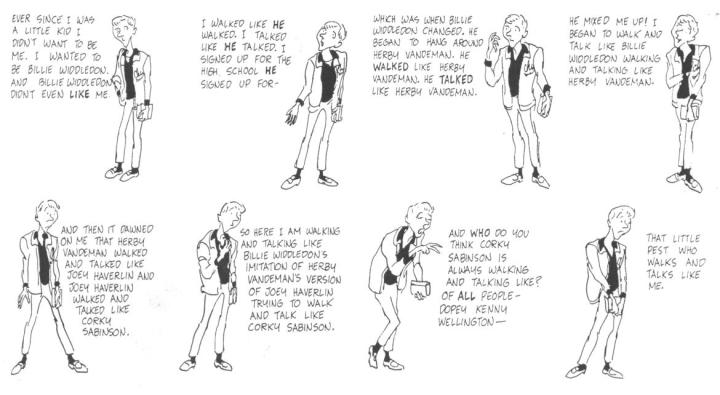
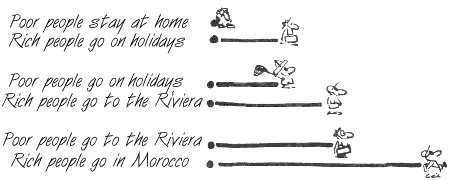
The following cartoons show how human behavior is shaped by mimetic dynamics…
 SCAPEGOAT SHADOWS