Dear guest, It all started with… dinosaurs. From an early age I was fascinated by those strange creatures that walked the earth millions of years ago. Not surprisingly, as a young boy I wanted to become a paleontologist. This initial plan concerning my future took a slight turn from the moment I met Michaël Ghijs (1933-2008), a Catholic priest and teacher at the high school I was attending. He was also the founding conductor of the boys’ and men’s choir Schola Cantorum Cantate Domino. He enabled his singers, me being one of them, to broaden their horizon on many levels: on the geographical and cultural level by literally travelling the world with us, but also spiritually by living out the message of the Gospel. Inspired by his example and my experiences within his choir, I decided to commit myself to a further exploration of The Christian Story. I hold a master’s degree in Religious Studies at the Catholic University of Leuven (Belgium). It was in Leuven I first encountered the work of René Girard (1923-2015), one of the great intellectuals of our time and immortel of the Académie française. A little book by a great theologian, Knowing Jesus by James Alison, set me on track to discover Girard’s further developed Mimetic Theory. For me, this became an anthropological and interdisciplinary starting point to challenge the richness of the Christian tradition. It affected me in a very profound way, and I’m convinced that the thought provoking power of Mimetic Theory can support our multi-layered human society on the road to ‘post-sacrificial’ peace. Eventually, I published several books and articles on René Girard, Mimetic Theory, culture and religion. I also became a member of the Dutch Girard Society and of COV&R (the Colloquium on Violence & Religion). In 2019, I became an elected member of the board of COV&R for several years. In 2011, I started Mimetic Margins, a blog to explore the work of René Girard (and many others) further. Scapegoat Shadows, this website, is a reboot of my first online activity in that regard. It contains the Mimetic Margins Archives (with lots of instructive debates under certain posts), as well as new material. I’m currently teaching at a Jesuit High School, Sint-Jozefscollege, in Aalst (Belgium). I am also a journalist and editor-at-large for Tertio, a weekly magazine. In my spare time I keep on singing, as an alto or countertenor, trained at Schola Cantorum Cantate Domino as I mentioned (I was a member from 1991-2010). I took part in several recordings, both as a choir member and as a soloist.

A WORLD WITHOUT RELIGION?

 The question is whether an atheist world would be a better world.

Religionless Christianity (Dietrich Bonhoeffer)Slavoj Zizek, atheist philosopher, refers to René Girard’s analysis of Christianity in God in Pain: Inversions of Apocalypse and concludes that Christianity, revealing the innocence of erstwhile sacrificial victims, “[undermines] the efficiency of the entire sacrificial mechanism of scapegoating: sacrifices (even of the magnitude of a holocaust) become hypocritical, inoperative, fake…” As this sacrificial mechanism is the cornerstone of religious behavior, Christianity thus indeed is “the religion of the end of religion” (atheist historian Marcel Gauchet). Zizek, still in the aforementioned essay, also briefly explains how Christianity potentially brings to an end the ever- present sacrificial temptation: “Following René Girard, Dupuy demonstrates how Christianity stages the same sacrificial process [of archaic religion], but with a crucially different cognitive spin: the story is not told by the collective which stages the sacrifice, but by the victim, from the standpoint of the victim whose full innocence is thereby asserted. (The first step towards this reversal can be discerned already in the book of Job, where the story is told from the standpoint of the innocent victim of divine wrath.)” This assessment of Christianity could also help to understand Dietrich Bonhoeffer’s call for a “religionless Christianity” (or maybe we should speak of a Christianity transforming religion rather than destroying it – click here for more).

In other words, Christianity is – in a profound sense – one of the main sources of secularization. Secular societies are challenged to build a world without “sacred sacrifices”. As Zizek notes, “the sacred sacrifice to the gods is the same as an act of murder – what makes it sacred is that it limits/contains violence, including murder, in everyday life.” Precisely because a secular society, heir to the dismantlement of “the archaic sacred” by Christianity, no longer possesses the traditional religious means to contain violence, it has to find other ways to deal with violence, or else destroy itself. Zizek quotes Jean-Pierre Dupuy in this regard: “Concerning Christianity, it is not a morality but an epistemology: it says the truth about the sacred, and thereby deprives it of its creative power, for better or for worse.” And Zizek continues: “Therein resides the world-historical rupture introduced by Christianity: now we know [the truth about the sacred], and can no longer pretend that we don’t. And, as we have already seen, the impact of this knowledge is not only liberating, but deeply ambiguous: it also deprives society of the stabilizing role of scapegoating and thus opens up the space for violence not contained by any mythic limit.”

(Quotes from Zizek in Slavoj Zizek & Boris Gunjevic, God in Pain: Inversions of Apocalypse [Essay] Christianity Against the Sacred, Seven Stories Press, New York, 2012, p. 63-64).

With these thoughts in mind, we can frame the question about the atheist world in another way. Can our world survive its own potential for violence without religion, without the traditional sacrificial mechanisms that try to limit violence?

 NEW ATHEIST RELIGION & AMORAL ATHEISM

four horsemen of new atheismAs it happens, we seem to regenerate the religious impulse. To this day we keep looking for scapegoats to be cast out of society in order to purify ourselves from the evils in our midst. It’s part of the way we build ‘the City of Man’. Richard Dawkins and Christopher Hitchens, two well-known spokesmen of the so-called ‘New Atheism’, clearly consider religion as one of the main sources of evil in the world. Hence, in their views, we would be better off without religion. But, precisely because of their tendency to blame theistic religion for “much of the evil in the world” and their attempts to expel or even sacrifice it, they create a new sacrificial religion, albeit an atheist one. How long before believers – without whom their theistic religion would not exist – no longer have the right to voice their views in the public sphere if the new atheists had their way?

The demonization of theistic religion by the new atheists is their way of suggesting the moral superiority of atheism. Their reasoning, however, is flawed and incomplete. Take, for instance, this challenge by Christopher Hitchens:

“Name one ethical statement made, or one ethical action performed, by a believer that could not have been uttered or done by a nonbeliever. And here is my second challenge. Can anyone think of a wicked statement made, or an evil action performed, precisely because of religious faith?”

Some people, thinking of the atrocities committed by Stalin, Mao and Pol Pot, try to make this a more balanced rhetorical statement by adding a question: Can anyone think of a wicked statement made, or an evil action performed, precisely because of atheism?

The new atheists already have their response to those who think that the crimes of Stalin et al. had anything to do with atheism. Richard Dawkins:

“What I do think is that there is some logical connection between believing in God and doing some, sometimes, evil things, but there’s no logical connection between them [Stalin, Mao, and Pol Pot] being atheists and doing evil things. It’s just incidentally true that, say, Mao Zedong and Joseph Stalin happened to be atheists, but that wasn’t what drove them. What drove them was a political ideology. It had nothing to do with atheism.”

Another atheist puts it this way:

“While Stalin and Mao were atheists, they did not perpetrate their atrocities because of their atheism. Atheism is simply the lack of belief in god. One cannot commit a crime in the name of ‘there is no god’. On the other hand, one can commit a crime in the name of ‘god’.”

This statement also implies that nothing good can be done in the name of atheism. Atheists can do good things like believers can do good things. The difference is that believers can do good things “in the name of god”. Atheists can do bad things like believers can do bad things. The difference is that believers can do bad things “in the name of god”. But, just like crimes cannot be done in the name of “there is no god”, good deeds cannot be done in the name of “there is no god”. Atheism is not immoral, neither is it moral. Atheism is amoral – it literally has no moral implications.

Therefore, it is not guaranteed that an atheist world would be a better world. It all depends on the ethics that will be developed in such a world. Moreover, theists and atheists alike can only believe that one ethical decision or even system is better than another. They can never prove this. Science observes and describes facts, it doesn’t morally judge them – we cannot move from what is to what ought. We’ve already seen the ethics of Stalin’s political ideology, to name but one example, and it’s highly questionable whether that was a good thing…  And if we would put some of the new atheist ideas into practice, we would regenerate a sacrificial system of potentially apocalyptic proportions. Sam Harris, for instance:

“Some propositions are so dangerous that it may even be ethical to kill people for believing them. This may seem an extraordinary claim, but it merely enunciates an ordinary fact about the world in which we live. Certain beliefs place their adherents beyond the reach of every peaceful means of persuasion, while inspiring them to commit acts of extraordinary violence against others. There is, in fact, no talking to some people. If they cannot be captured, and they often cannot, otherwise tolerant people may be justified in killing them in self-defense. This is what the United States attempted in Afghanistan, and it is what we and other Western powers are bound to attempt, at an even greater cost to ourselves and to innocents abroad, elsewhere in the Muslim world. We will continue to spill blood in what is, at bottom, a war of ideas.

sam harris condones murder (cartoon by blamethe1st)

Seen from the perspective of René Girard’s mimetic theory, these ideas of new atheists mirror the ideas of some of their fundamentalist counterparts (for more on this, click here to read and watch Religulous Atheism). The tiny proportion of theistic fundamentalists that take part in acts of violence justify their violence in a similar way. They think it is ethical to kill certain people in order to cleanse the world of evil. New atheists and theistic fundamentalists become mimetic (i.e. imitative) doubles – imitating each other’s ways of scapegoating. However, as a wise man once said, “Satan cannot cast out Satan”. We cannot destroy (the possibility of) violence by using violence. We cannot destroy fear if our politics of security justify themselves by constantly referring to the things we should be afraid of. We cannot destroy evil by using evil.

Dietrich Bonhoeffer on blindness to evil

In the end we’ll have to imagine a new peace, but not the (theist and atheist religious) peace of “this world”, which is based on sacrifice. It might be the peace this man speaks of:

“Peace I leave with you; my peace I give you. I do not give to you as the world gives. Do not let your hearts be troubled and do not be afraid.” (John 14:27)

Peace I leave with you

RoboCopMichael Meuleman, one of my students, briefly talked about his passion for brain imaging and brain imaging technologies. It’s his dream to further work on speech reconstruction for disabled persons, using and developing brain imaging technology himself. Michael referred to famous physicist Stephen Hawking as one of many who could benefit from this research. As a matter of fact, Hawking already participated in attempts to convert his brainwaves into speech. Soon, RoboCop won’t be science-fiction anymore!

On my way home from school, I kept thinking about what Michael had said, and decided to do some reading on the subject matter. In amazing times like these, when valuable information is just a few worldwide web clicks away, I discovered the research my student was referring to quite easily: click to read it here.

Speaking of Stephen Hawking I remembered how Oxford mathematician John Lennox responded to some of Hawking’s philosophical claims in a book called God and Stephen Hawking: Whose Design Is It Anyway? This again reminded me of something that same John Lennox said during a lecture – it actually blew me away at the time:

Applied to the research on brain activity for speech reconstruction, Lennox reasoning implies the following.

When we identify a person’s brain activity while that person is hearing or thinking about, for instance, the word jazz, we might see something like this:

brain activity

In order to enable people like Stephen Hawking to communicate more rapidly by using their brain activity, computers need to do two fundamental things (among many processes):

  1. Register the type of brain activity that is ignited by certain sounds – vowels, syllables, words…
  2. Interpret brain activity so it can be translated to certain sounds – vowels, syllables, words…

The thing is, brain activity as such does not give you any word. In other “words”, the full picture or complete reality of a word like jazz is not given in a scientific representation of brain activity. That activity needs to be connected to the word in question. Computers need to be programmed to decode certain brain activity and to recognize or interpret it as the word jazz. Brain activity itself is nor produces the word jazz. There already has to be meaning (and an entity which produces it) before we can ask ourselves what that meaning looks like in scientific terms. More broadly speaking, the things we can say in scientific terms don’t ever give us the essential reality of a particular phenomenon. Science can only begin to explore reality because of the mysterious fact that there is something to explore to begin with! It comes as no surprise then that science can be considered a highly spiritual activity, as it continuously refers to a reality which transcends its endeavors.

The tendency for scientism by the “secular fundamentalist” (see Chris Hedges) new atheist movement, as if science can answer all important or relevant questions, as if science can provide us full knowledge about the true nature of reality, should be discarded as a perversion of science. If phenomena would not reveal themselves to our eyes – whether we look through telescopes or microscopes -, we would not be able to gain any scientific knowledge at all. No scientific knowledge without the mystical realization of revelation. And no scientific or other knowledge that can ever “solve” the mysterious fact that there is something rather than nothing. In the words of theoretical physicist and mathematician Freeman John Dyson (born December 15, 1923, only ten days before René Girard :)):

“The public has a distorted view of science because children are taught in school that science is a collection of firmly established truths. In fact, science is not a collection of truths. It is a continuing exploration of mysteries.”

Freeman John Dyson

It’s amazing what science can do, but it’s even more amazing that there is anything to do at all. Hopefully we, human beings, learn to use scientific and technological knowledge for some good. At least one of my students seems up to it :), and I’m sure most of them are. And while we’re at it: science can never answer the question what goals it should help to accomplish – those questions are and remain philosophical and draw from many sources…

On a lighter note: there must be a reason why I like this beer so much… True, I liked it before I became a “Girardian” :), but since I got to know René Girard’s work I like it even better! Apparently, Girard’s name functions as a mediator that increases my desire for this beer. It sends out good associations, good vibrations…

gueuze girardin

To my fellow Girardians, I really hope you’ll get to taste this wonderful Belgian beer!

Cheers!

Shane Koyczan is a spiritual man. A man of poetry and gentle madness. A man of stories, a man of truth. A man of beauty. His poem To This Day would be a great way to end a first part of a journey with mimetic theory in high school, especially regarding what I’ve written so far on the film American Beauty. It could follow these posts:

  1. Mimetic Theory in High School (click to read)
  2. Types of the Scapegoat Mechanism (click to read)
  3. Scapegoating in American Beauty (click to read)
  4. Philosophy in American Beauty (click to read)
  5. Real Life Cases of Ressentiment (click to read)

quote A weed is but an unloved flower Ella Wheeler WilcoxTo This Day and Shane’s TED-talk contain many themes I’ve written about before, for instance in a post entitled Atheism: a lack of unbelief?:

A person’s worth cannot be determined solely by human perception and judgment. Man is not simply the child of a “social other”, i.e. the product of a man-made social environment in which he gains or loses a sense of (self-) worth. He’s also, following the thoughts of people like James Alison and Emmanuel Levinas, a child of “the other Other”, and we should postpone any final judgment on other people and ourselves.

It also reminded me of this famous quote: “Every finite spirit believes either in a God or in an idol” (Max Scheler, 1874-1928). I wrote about this in several posts before, for instance in a post entitled That is (not) the question, about rap star Diam’s conversion to Islam – it talks about how we have the tendency to sacrifice ourselves and others to the demands of a so-called admirable (self-)image that seeks confirmation and recognition:

quote Shane Koyczan Be the weedDiam’s discovered how she tried to live up to the expectations of her fans, and how this enslaved her. She was kneeling to an image of herself as the admirable idol her fans wanted her to be. Kneeling to Allah, on the other hand, apparently meant that Diam’s no longer bowed to the demands of the music and entertainment industry. It was a turning point in her life. It enabled her to free herself, and to criticize the priorities in her life. From now on, she would seek and explore another source of motivations for her life.

Finally, Shane Koyczan’s story is reminiscent of Peter Howson’s story in a post entitled Desert Moments with Peter Howson:

“I used to be very badly bullied at school and when I was a bouncer in a nightclub for quite a few years I changed in a false sense then, and became a bully myself.” In other words: Howson became the imitator of his persecutors… He followed the mimetic principle of vengeance.

CLICK TO WATCH the video To This Day (click here to read the lyrics in pdf):

I’d like to give some quotes from his TED-talk as well, because they illustrate some key insights from René Girard’s mimetic theory and they reminded me of those previous posts:

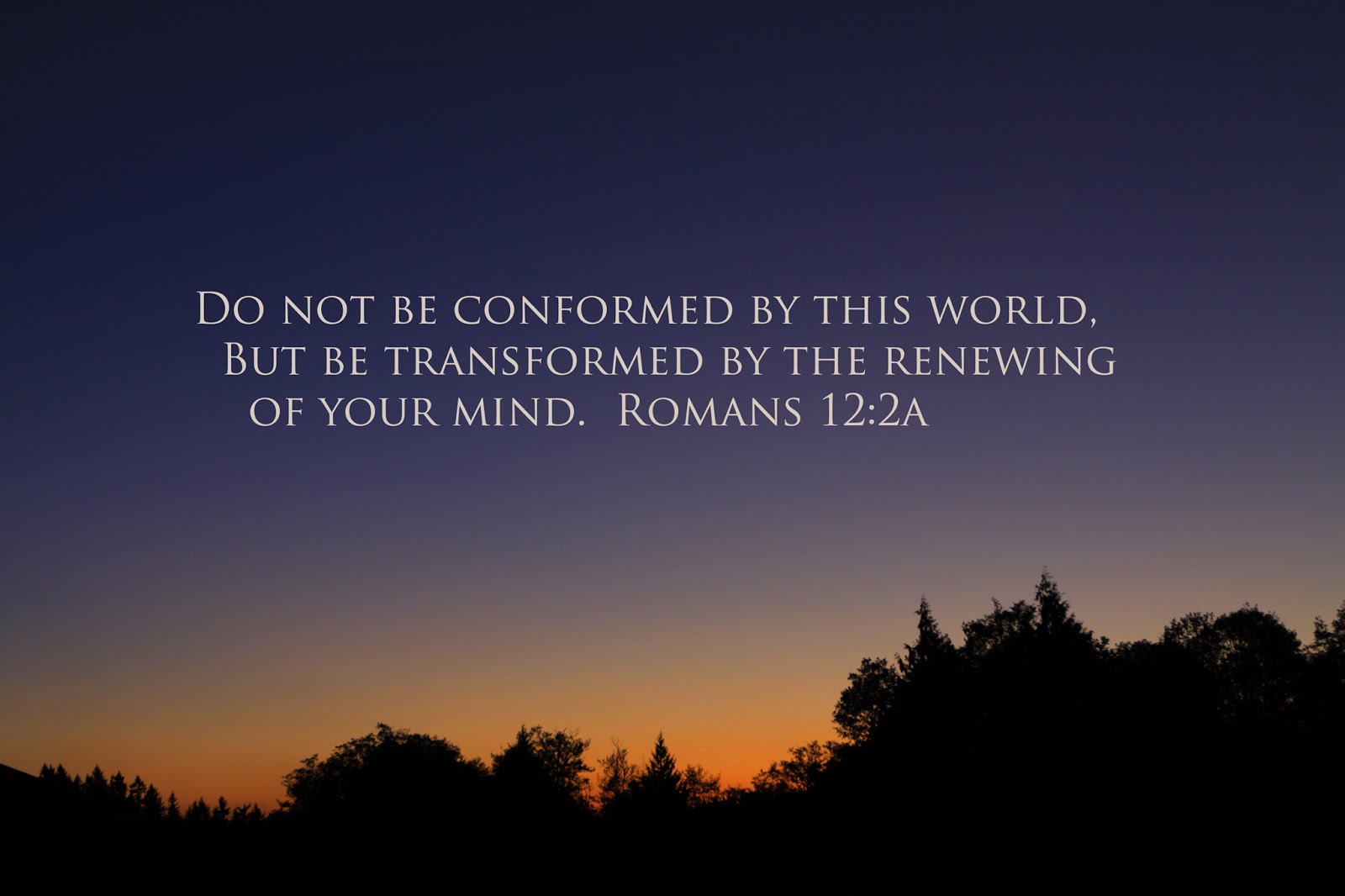
quote do not be conformed by this world RomansWe were expected to define ourselves at such an early age, and if we didn’t do it, others did it for us. Geek. Fatty. Slut. Fag. And at the same time we were being told what we were, we were being asked, “What do you want to be when you grow up?” I always thought that was an unfair question. It presupposes that we can’t be what we already are.

See, they asked me what I wanted to be, then told me what not to be. And I wasn’t the only one. We were being told that we somehow must become what we are not, sacrificing what we are to inherit the masquerade of what we will be. I was being told to accept the identity that others will give me.

quote be this guyOne of the first lines of poetry I can remember writing was in response to a world that demanded I hate myself. From age 15 to 18, I hated myself for becoming the thing that I loathed: a bully. When I was 19, I wrote, “I will love myself despite the ease with which I lean toward the opposite.

CLICK TO WATCH Shane’s TED-talk:

too cool for schoolBefore I continue posting material and suggestions for a high school curriculum on mimetic theory, I just have to report something way cool that happened at school today. Jozefien Meersschaut, one of my students who is new to our school this year, came up to me before class and simply said, “You know, sir, my aunt worked with professor René Girard at Stanford University for a PhD; he was her mentor.” I was like, “You must be kidding me…” She continued, “Well, her name is easy to remember, it’s Josephine like my name, Josephine Gross.” She also told me that her aunt’s brother, her uncle, knew the work of Girard quite well.

Well, I’ll be damned! Indeed, it’s a small world after all.

Of course you come across Girard while reading novelists and essayists like J.M. Coetzee and Milan Kundera. Kundera even claimed in his Testaments Betrayed that Mensonge romantique et vérité romanesque, Girard’s first major work, was the best book he ever read on the novelHe is but one of many in praise of this book. Well-known atheist philosopher Alain de Botton rates it five stars out of five on goodreads (click here to read more on Alain de Botton and Girard).

Further on in the intellectual world, other contemporary well-known philosophers, atheists like Gianni Vattimo or Slavoj Zizek, a socially oriented philosopher like Hans Achterhuis or the “Christian thinker of Modernity” Charles Taylor… were all heavily inspired by Girard. Vattimo wrote a book together with Girard. Hans Achterhuis constantly refers to Girard in most of his major works. Charles Taylor attended an important conference on Girard’s work at the University of Antwerp in 2001… Slavoj Zizek, as an atheist, agrees with Girard’s basic assessment on the nature of Christianity’s historical impact. Zizek writes (in a collection of essays, namely God in Pain: Inversions of Apocalypse):

slavoj zizek“[Quoting Jean-Pierre Dupuy] ‘Concerning Christianity, it is not a morality but an epistemology: it says the truth about the sacred, and thereby deprives it of its creative power, for better or for worse.’ [Zizek himself] Therein resides the world-historical rupture introduced by Christianity: now we know, and can no longer pretend that we don’t. And, as we have already seen, the impact of this knowledge is not only liberating, but deeply ambiguous: it also deprives society of the stabilizing role of scapegoating and thus opens up the space for violence not contained by any mythic limit.” (Quote from Zizek in Slavoj Zizek & Boris Gunjevic, God in Pain: Inversions of Apocalypse – [Essay] Christianity Against the Sacred, Seven Stories Press, New York, 2012, p. 64).

De Geruchten (Hugo Claus)And then we have not yet talked about renowned psychologists like Andrew Meltzoff or Vittorio Gallese, who set up a dialogue between their own work and René Girard’s mimetic theory. I could go on for hours I guess, talking about how Girard keeps on popping up in the humanities, even in the world of economy and finance (see for instance Peter Thiel, an entrepreneur who cofounded PayPal and set up Imitatio to promote Girard’s work; he’s also one of Girard’s former students). I could talk about Girard’s influence in many other fields and contexts, for instance about De Geruchten, a novel by Hugo Claus written with Girard’s work in mind…

Ah, well, none of that is as cool as Jozefien coming up to me saying, “My aunt worked on a PhD with professor René Girard…,” now is it?

I guess mimetic theory is right by claiming that our approach to reality is highly mediated by our social environment. That is true for our assessment of philosophical and scientific theories as well, hence also for mimetic theory. So I secretely hope that Jozefien likes her aunt and uncle. It will make access to what’s actually being said a lot easier :).

Perhaps we are often too much interested in an author’s identity to appreciate what is actually being written. To some people it is enough to know that René Girard is a Christian to dismiss his work (although they will often encounter similar content, albeit in different terms, in other contexts and appreciate it!). A shame, really, but all too human.

J.K. Rowling Robert Galbraith quoteThink, for instance, about the book J.K. Rowling wrote under the pseudonym Robert Galbraith. Before the general public knew that the crime novel The Cuckoo’s Calling was actually written by Rowling, who became famous for her Harry Potter books, the book only caught the favorable eyes of some critics. Just moments after the news of the author’s true identity broke, Harry Potter fan site The Leaky Cauldron reported that the book had only sold 1,500 copies up to that point, and that a second Galbraith book was to be published a year later. A few hours later, New Statesman reported that the book’s Amazon sales had gone up more than 150,000 %. Of course no one doubts Rowling’s talent for writing, but this story shows that not all gifted authors sell as much as their equally gifted colleagues. Still, “Robert Galbraith” wrote the exact same book as “J.K. Rowling”. People’s desire to buy The Cuckoo’s Calling was (mimetically) awakened by the name of Rowling, not just by the content itself or by the critics – who proved to be weak models for mediating the desire of potential readers…

American Beauty RoseOn the other hand, not everything that is hyped is worth the hype. It is not because a majority of people claim that “the emperor’s new clothes are beautiful” that there is actually anything to see at all. Our tendency to judge reality by looking at others (because of our mimetic tendencies) sometimes fools us. It may blind us for what’s truly worthwhile and beautiful. And so we’re back at one of the major themes of American Beauty, the film I wrote about in some previous posts :). Thinking of the roses in that movie, I’m reminded of that famous line in Shakespeare’s Romeo and Juliet:

What’s in a name? That which we call a rose by any other name would smell as sweet…”

In short, it’s been a really cool and inspiring day in this “small world” ;).

a rose by any other name would smell as sweet

This post follows some previous posts in the development of a high school curriculum on Mimetic Theory:

  1. Mimetic Theory in High School (click to read)
  2. Types of the Scapegoat Mechanism (click to read)
  3. Scapegoating in American Beauty (click to read)
  4. Philosophy in American Beauty (click to read)

This post will provide some real life cases of ressentiment that could be explored in different disciplines.

  • PSYCHOLOGY & MEDIA – real life cases of ressentiment and homophobia, similar to the story of Frank Fitts in American Beauty:

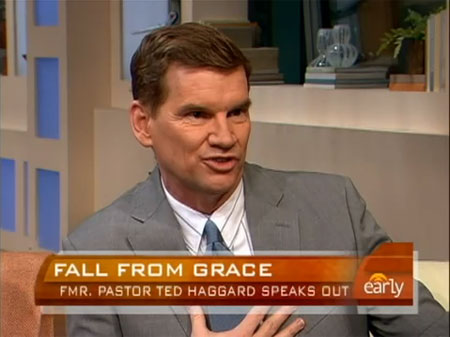
Ted Haggard's fallWell-known evangelical pastor Ted Haggard became the center of a scandal in 2006 when a certain Mike Jones, a homosexual prostitute, claimed that he had had a three-year sexual relationship with Haggard. Later on, Haggard admitted to sexual contact with Jones and other men. Haggard had always preached against homosexuality and to this day considers it sinful and problematic. He is still married to his wife.Ricky Martin GQ Australia

Pop singer Ricky Martin came out as a gay man back in 2010. However, the star has admitted he used to struggle with his sexuality. He even bullied gay men whilst growing up in Puerto Rico. ‘I look back now and realize I would bully people who I knew were gay,’ Martin told the September/October 2013 edition of GQ Australia. ‘I had internalized homophobia. To realize that was confronting to me. I wanted to get away from that.’

  • HISTORY – ressentiment and racism in Nazi Germany:

It can be argued that Adolf Hitler developed an attitude of ressentiment towards the Jewish people and that he nourished this attitude to a national German scale. One can say that Hitler distanced himself from the qualities he would hate about himself by projecting those qualities on ‘the Jews’. He considered them to be ‘totally different’ from him and other German or, more broadly, ‘Aryan’ people. By hating and scapegoating the Jews for having so-called loathsome qualities, Hitler established a sense of self-worth. It was his way to get revenge for not being confirmed as the man he desired to be. It was his way to get even with the ones he secretly envied but learned to despise. Here’s what Hitler writes in Mein Kampf on the so-called radical difference between his ‘objects of study’ (‘the Jews’) and ‘the Germans’:

“Yet I could no longer very well doubt that the objects of my study were not Germans of a special religion, but a people in themselves; for since I had begun to concern myself with this question and to take cognizance of the Jews, Vienna appeared to me in a different light than before. Wherever I went, I began to see Jews, and the more I saw, the more sharply they became distinguished in my eyes from the rest of humanity. Particularly the Inner City and the districts north of the Danube Canal swarmed with a people which even outwardly had lost all resemblance to Germans.”

For once, Hitler considered himself to be a talented artist and painter, whose work was not recognized by the main artistic forces of his time. It is known that he was not accepted at the prestigious Vienna Academy of Fine Arts. In his autobiographical work Mein Kampf, it becomes clear that he identifies Jewish art as an inferior but nevertheless dominant cultural expression, which supposedly prevents ‘real artists and real art’ to come to the fore. This becomes just one source of his resentment towards the Jews. Here’s what Hitler writes in Mein Kampf on the influence of Jews on artistic life:

“I now began to examine carefully the names of all the creators of unclean products in public artistic life. The result was less and less favorable for my previous attitude toward the Jews. Regardless how my sentiment might resist my reason was forced to draw its conclusions. The fact that nine tenths of all literary filth, artistic trash, and theatrical idiocy can be set to the account of a people, constituting hardly one hundredth of all the country’s inhabitants, could simply not be tanked away; it was the plain truth.”

Der Ewige JudeHitler allegedly was not always too confident of his own health and appearance. He wanted to be filmed or photographed from certain angles in order to ‘look good.’ Again in Mein Kampf, he projects his doubts and fears and his sense of inferiority onto ‘the Jewish people’ in order to create a sense of superiority:

“The cleanliness of this people, moral and otherwise, I must say, is a point in itself. By their very exterior you could tell that these were no lovers of water, and, to your distress, you often knew it with your eyes closed. Later I often grew sick to my stomach from the smell of these caftan-wearers. Added to this, there was their unclean dress and their generally unheroic appearance.”

The Plot The Secret Story of The Protocols of the Elders of Zion (by Will Eisner)Apart from Hitler’s particular psychological biography, Germany and Europe in general were susceptible to anti-Judaism and anti-Jewish feelings. The 1929 stock market crash marked the beginning of a worldwide economic depression. The image of Jews as rich merchants and money-grubbers who could not be trusted is but one of many negative images concerning Jews with a long history in Europe. Rich and intellectually refined Jews were envied and resented, especially during the difficult economic times of the 1930s. The Protocols of the Elders of Zion, an anti-Jewish hoax claiming to describe a Jewish plan for world domination, completed the anti-Jewish European paranoia. Thus the Jews once again became Europe’s scapegoats. In Hitler’s universe, the sacrifice of the Jews was considered necessary to free the world from its crisis and to establish a new peace and order. The Protocols of the Elders of Zion, first published in Russia in 1903, were used by the Nazis as part of their justification of the Holocaust. It would be interesting to explore the history of this document by reading The Plot: The Secret Story of The Protocols of the Elders of Zion, a masterpiece by Will Eisner, the ‘father’ of graphic novels.

image from The Plot (by Will Eisner)

  • POLITICS, SOCIOLOGY & RELIGION: ressentiment and sexism (among others in fundamentalist religious groups)

Find more background information regarding sexism as a transcultural (religious as well as non-religious) phenomenon in this previous post: click here for “Temptresses”.

sexismHans van Scharen, Belgian journalist, comes across a clear example of what Nietzsche and Scheler would describe as ressentiment in Pakistan. Writing about his experiences in Peshawar [capital of the area formerly known as North-West Frontier Province], van Scharen reports (translation by E. Buys):

“You can see the influence of fundamentalist Islamic parties in the streets of Peshawar. Even innocent commercials for tea are smirched by grey paint to cover the female face of a depicted couple. By June 2003, the Sharia was accepted as the highest law and is often interpreted strictly, although not (yet) as ruthless as the Taliban would have it. The Muttahida MajliseAmal (United Council of Action) proposed a bill to prohibit the depiction of women in advertising. Sami ul-Haq, leader of an important Madrassa, claims that this is done ‘merely out of respect.’ ‘If you depict women naked, you kill their honor and the honor of their families. That is totally unacceptable. Women are precious, like rare flowers, and you should treat them accordingly.’ Naked? Even tea commercials are already offensive, apparently. Our guide sneers, ‘Well, it’s them fundamentalist bearded men demanding burqas who secretly watch videos of lascivious female dancers, and those men are highly fascinated by what they see. Ul-Haq’s brother teaches here, at the Islamic University, and like his brother he has the reputation of being a womanizer.’ […] – Taken from Knack magazine, November 29th, 2006, De comeback van de Taliban, p.99-100, by Hans van Scharen.

This post aims at providing some more background information on a previous post regarding the film American Beauty (click to read “Scapegoating in American Beauty”). It explores the philosophical foundations of ressentiment.

In the world of philosophy there are two German names that automatically pop up regarding the discussion on ressentiment, namely Friedrich Nietzsche (1844-1900) and Max Scheler (1874-1928).

Zur Genealogie der MoralFriedrich Nietzsche discussed ressentiment primarily in his work Zur Genealogie der Moral (On the Genealogy of Morals/Morality – click here for pdf version of this book in English). In Nietzsche’s view, the Jewish-Christian foundation of morality grew out of the weaker men’s pride when these were confronted with a noble and aristocratic ruling group of stronger men. The weaker men, the slaves, reject the morals of the stronger men, the masters. The slave denies being envious of the master and develops a sense of superiority by claiming that the values the master lives by are not desirable at all. According to Nietzsche, Jewish-Christian slave morality triumphs over the master morality of Greco-Roman Antiquity when people start feeling guilty and ashamed about belonging to the group of masters. This is the ultimate revenge of the slaves for not being able to aspire to the same values as the masters. The slaves convince themselves and the masters that the slave morality (the inverse of the master morality) is the desirable model of life, and that the master morality is contemptible.

Das Ressentiment im Aufbau der MoralenMax Scheler critiqued Nietzsche on these issues in his work Ressentiment. According to Scheler, Nietzsche’s account of ressentiment is very convincing, but he is wrong to consider it as the main source of Judeo-Christian tradition.

This is not the moment to discuss Scheler’s critique on Nietzsche. Regarding a further reflection on the film American Beauty and other examples of ressentiment, it is useful to merely focus on the characterization of ressentiment by Nietzsche and Scheler. In an article entitled Ressentiment and Rationality for the online philosophical and anthropological magazine Paideia, Elizabeth Murray Morelli summarizes as follows:

“Drawing on Nietzsche’s and Scheler’s accounts of ressentiment, we can sum up its internal structure. It is a cycle with the following constitutive elements: an original sense of self-worth; the apprehension of and desire for certain values; the frustration of one’s desire for those values; a sense of impotence to achieve those values: a sense of the unfairness or injustice of not being able to attain them; anger, resentment, hatred towards the bearer of those values, and often a desire to seek revenge; the devaluation of the originally sought values; repression of the desire for the devalued values and of negative affects such as hatred, envy, desire for revenge; a feeling of superiority over those who seek and possess the now devalued values; and a confirmed sense of self-worth. Ressentiment is a cycle inasmuch as it recurs. The person of ressentiment relives the desires and feelings which constitute the condition even as these affects are repressed. The cycle of ressentiment, significantly, begins and ends with a sense of self-worth.”

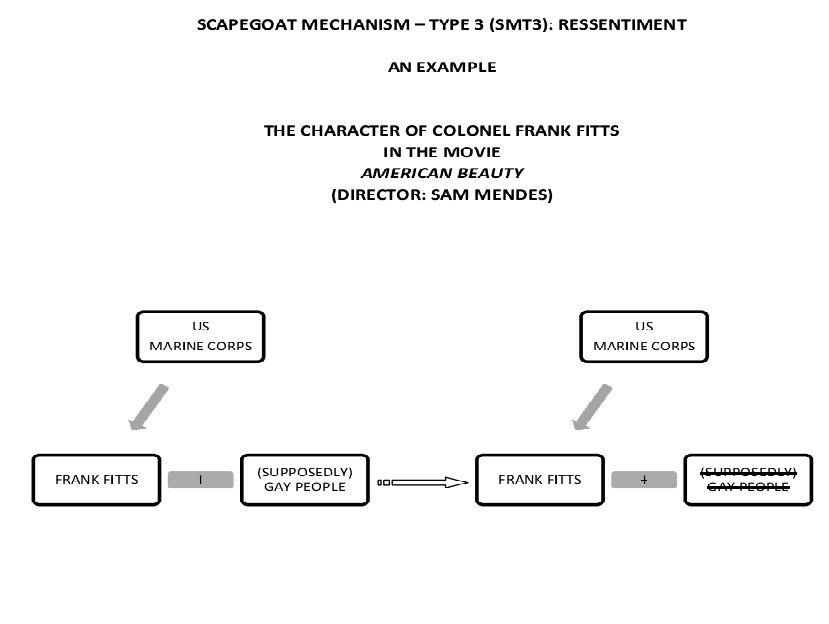
Applied to the character Frank Fitts in the film American Beauty, ressentiment is directed at the life of homosexual couples. The cycle of ressentiment then can be specified as follows: Frank Fitts gains his sense of self-worth by the social recognition he gets from the US Marine Corps (hence he presents himself continuously as “Colonel Frank Fitts, US Marine Corps”); he realizes that he actually desires certain relationships, namely homosexual relationships; he gets frustrated because he cannot fulfill this desire out of fear to lose his social recognition; he develops a sense of injustice: it’s not fair that certain people would enjoy a life as homosexuals and he seeks revenge for this injustice; he devaluates the originally desired life as a homosexual; finally he despises homosexuals in general and is convinced that they should feel ashamed; thus Frank Fitts develops a feeling of superiority over those who possess a life as homosexual couple, and this confirms his sense of self-worth.

Frank Fitts sad old man

From the point of view of René Girard’s mimetic theory, two important observations can be made:

  1. Ressentiment, as the result of envy, relies on mimesis and mimetic desire.
  2. When a mimetically ignited desire cannot be fulfilled, the resentful person justifies mental or physical violence towards a model who possesses what the resentful person secretly desires – this is a form of scapegoating. Hence, according to Cuong Nguyen in an article for the online philosophical journal Prometheus (October 19, 2008): Ressentiment is a reassignment of the pain that accompanies a sense of one’s own inferiority/failure onto an external scapegoat. The ego creates the illusion of an enemy, a cause that can be ‘blamed’ for one’s own inferiority/failure. Thus, one was thwarted not by a failure in oneself, but rather by an external ‘evil’. This issuing of ‘blame’ leads one to desire revenge, or at least believe in the possibility of revenge.”

Scapegoat Mechanism – Type 3 (SMT3): ressentiment

[see previous post “Types of the Scapegoat Mechanism”]


an example


THE CHARACTER OF COLONEL FRANK FITTS

IN THE Movie

american beauty

(DIRECTOR: SAM MENDES)


American Beauty Ricky Fitts FilmingAlan Ball, who wrote the story, said the following about the main theme of the movie:

“I think I was writing about … how it’s becoming harder and harder to live an authentic life when we live in a world that seems to focus on appearance … For all the differences between now and the [1950s], in a lot of ways this is just as oppressively conformist a time … You see so many people who strive to live the unauthentic life and then they get there and they wonder why they’re not happy … I didn’t realize it when I sat down to write [American Beauty], but these ideas are important to me.”

– Alan Ball in Chumo II, Peter N. (January 2000). “American Beauty: An Interview with Alan Ball”. Creative Screenwriting Magazine (Los Angeles: Creative Screenwriters Group) 7 (1): 26–35 (p.32).


The character of “Colonel Frank Fitts, US Marine Corps” certainly is one poignant example of someone who is “keeping up appearances” at a very high price. His situation can be summarized as follows:

CLICK TO SEE THE SCHEME (PDF)

Frank Fitts

American Beauty Rose Plastic BagThroughout the film it becomes clear that Frank Fitts is secretly gay and that he is jealous of gay people who “came out of the closet.” He dares not reveal himself as a homosexual, though, for fear of being cast out by the social environment whose recognition he has mimetically learned to desire. Frank Fitts always presents himself as “Colonel Frank Fitts, US Marine Corps” and apparently this self-concept considers homosexuality as “something to be ashamed of.” He can’t stand being around openly gay people, like his two neighbors Jim and Jim, because they awaken his hidden homosexual desires. Frank Fitts resents and hates what he actually desires. When he thinks that his son Ricky is in a gay relationship with his neighbor Lester Burnham, he threatens to throw him out of the house and to banish him forever. Frank Fitts constantly justifies his acts of terror by making his victims responsible for the violence they have to endure. He constantly applies some sort of scapegoat mechanism, his victims “should be ashamed!” They should feel guilty about something they actually shouldn’t feel guilty about…

Frank Fitts is willing to do anything to protect his socially mediated (self-)image. His scapegoating of openly gay people helps him to be somewhat  at peace with his own life, although he is a bitter man. Finally, he reveals himself as a homosexual to his neighbor Lester Burnham, whom he wrongfully considers gay. Frank tries to kiss Lester, but Lester turns him down. Afraid of what might happen, Frank ends up murdering Lester in order to prevent the loss of his so-called acceptable (self-)image. In other words, the sacrifice of Lester – in no ways responsible for what happened to Frank, hence a scapegoat – seems necessary for Frank to fulfill his desire for recognition. In still other words, eros – a mimetically ignited love for some image or social status – leads to thanatos (death) to put an end to some identity crisis.

BE SURE TO WATCH THE EXCERPTS FROM AMERICAN BEAUTY WITH ADDITIONAL NOTES TO SEE HOW THE DIFFERENT CHARACTERS DEAL WITH

“THE LOSS OF APPEARANCES”


– CLICK TO WATCH:

Click here to read Mimetic Theory in High School.

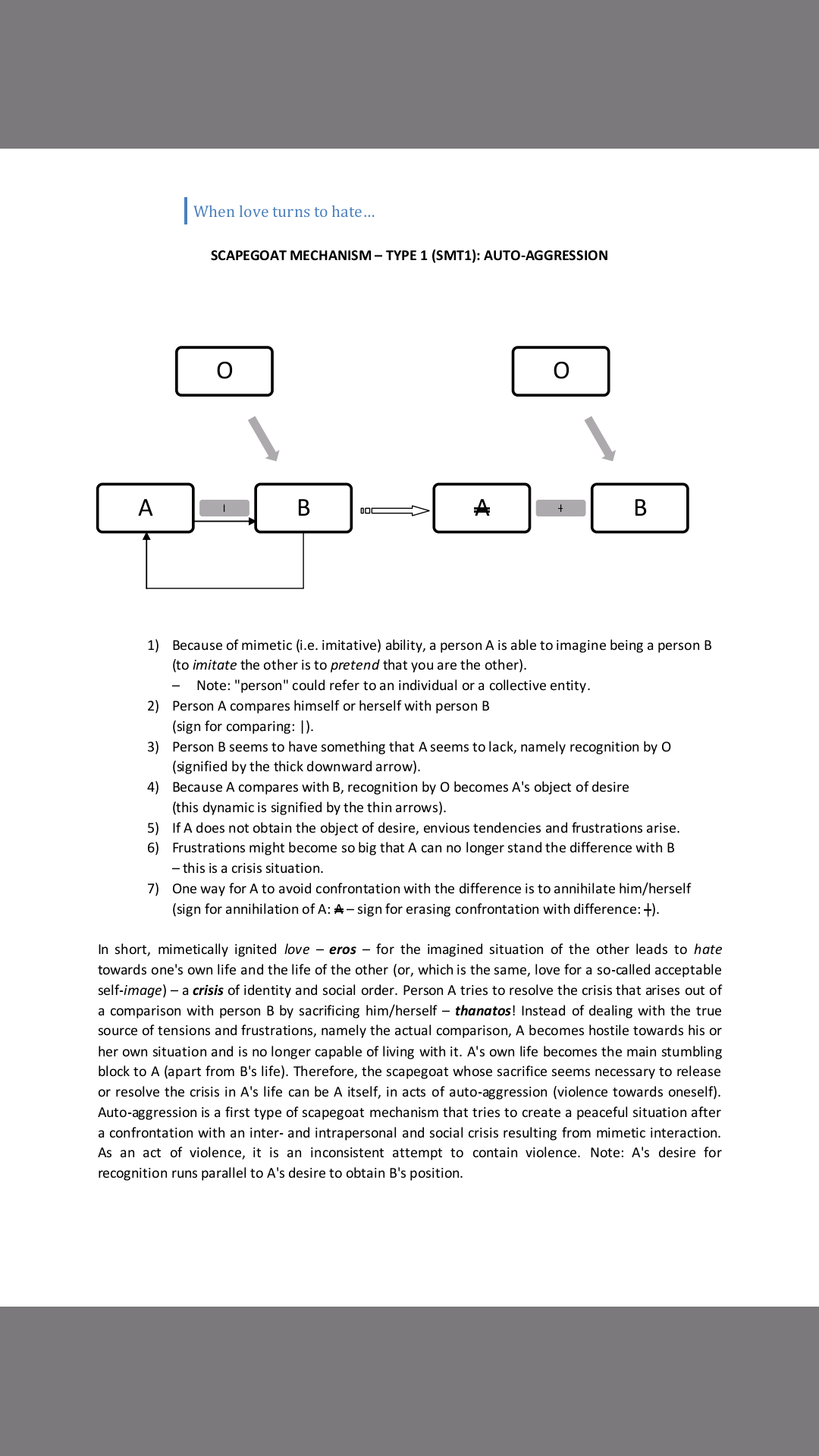
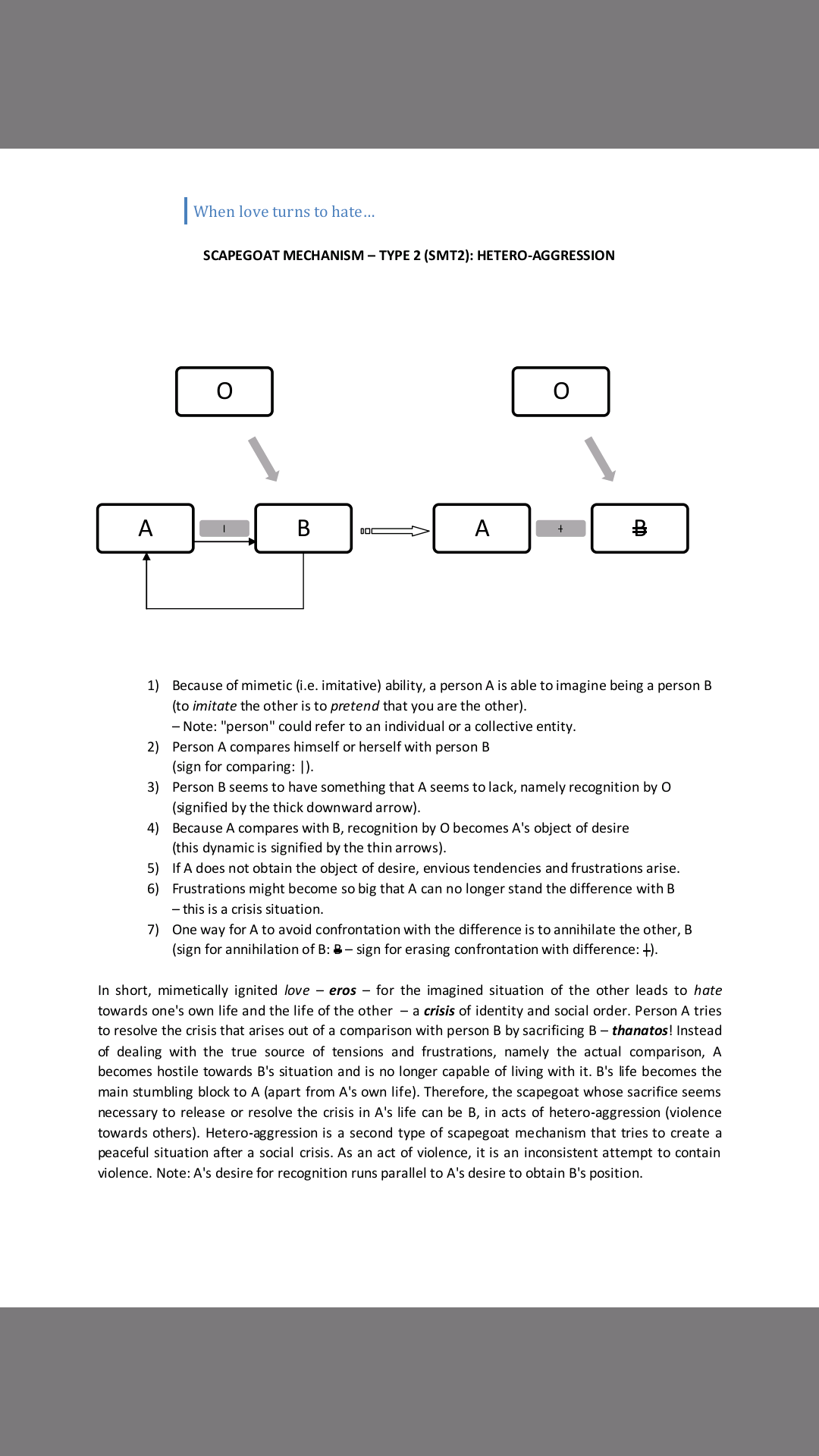
In this post I’d like to present three types of the scapegoat mechanism as it evolves out of mimetic interactions, in a formulaic way. The following weeks I’ll post examples of these types (rap song Stan by Eminem, the biblical story of Cain and Abel and one storyline from the movie American Beauty – I already worked on these examples in my book, published in Dutch: Vrouwen, Jezus en rock-‘n-roll). This will show how these types or ‘formulas’ can be used to analyze inter/intrapersonal and social situations.

CLICK HERE FOR A PDF VERSION OF THE THREE TYPES OF THE SCAPEGOAT MECHANISM

metaphysical mimetic desire

THREE TYPES OF THE SCAPEGOAT MECHANISM

Scapegoat Mechanism Type 1 AUTO-AGGRESSIONScapegoat Mechanism Type 2 HETERO-AGGRESSIONScapegoat Mechanism Type 3 RESSENTIMENT OR SHAMEShame (explanation)

Some of us working on mimetic theory would like to develop some material that could be useful in high school curricula, in different disciplines. I’ll be posting some ideas and present some possible content in the months to come. This is how an introduction to a high school course on mimetic theory could look like. Any suggestions are welcome!

CLICK HERE TO READ A PDF VERSION

A.      HUMAN BEINGS AS CRISIS MANAGERS

We all have to deal with crisis situations. A crisis happens when we are challenged to renew or change the order of things as we know it. Therefore it is always a threat, big or small, to the systems that bring stability to our lives. A crisis is a time to make decisions in order to preserve a given system of stability or to create a new one. As such it is not just an event which forces us to adjust to its course, but also an opportunity to imagine other ways of being in the world. A crisis is violent when it is primarily experienced as an assault on our personal integrity and our socially defined identity. On the other hand, a crisis might contain the promise of a better protected personal integrity and an enhanced social identity when it is experienced as an assault on systems of stability that actually suppress us. In short, the crisis situations that befall us and subvert the world as we know it are experienced either as a curse or a blessing, either as doom or chance.

Confronted with crisis situations, every human being is able to ask three clusters of questions, one scientific and two philosophical. Here’s what the crisis manager named human might think about:

  • SCIENTIFIC QUESTIONS:

How can a crisis situation be explained? What are its causes and consequences? How do we, people, deal with it and what explains our behavior?

To use a business analogy:

How do people behave within the company and what problems arise out of this behavior?

  • A FIRST SET OF PHILOSOPHICAL QUESTIONS (MEANING):

Where do we want to go from here, confronted with this crisis? What is the ultimate goal of what we are trying to do? What are we hoping for?

To use the business analogy:

What does this company stand for? What goals does it hope to accomplish?

  • A SECOND SET OF PHILOSOPHICAL QUESTIONS (ETHICS):

How should we behave ourselves if we want to accomplish our goal, dealing with this crisis? Should we deal with the crisis situation like we normally do, or should we change our behavior?

To use the business analogy:

How should people behave within the company in order to accomplish its goals?

Once the two sets of philosophical questions are answered, science of course functions as a means to make the fulfillment possible of thought-through goals which transcend (and therefore guide) the merely scientific endeavor.

B.      MIMETIC THEORY – INSPIRATIONAL THINKING IN TIMES OF CRISIS

I.                    CONSIDERING “CRISIS MANAGEMENT” QUESTIONS

As long as we are alive and well as human beings, we are mimetically connected to each other. It is because of our mimetic (i.e. imitative) ability that we are social creatures. Mimetic theory, as it was initially developed by René Girard, tries to understand and explain the possibilities and pitfalls of human social behavior by studying its mimetic interactions. It attempts to answer the three clusters of questions, identified previously, concerning “crisis management” as the condition humaine:

  • SCIENTIFIC QUESTIONS:

How do crisis situations in human life arise out of mimetic interactions? How are these mimetic interactions influenced by conditions of the natural environment? Or, on the other hand, how do mimetic interactions construct patterns of human behavior that influence the natural environment in negative or positive ways? How do we normally deal with crisis situations arising out of mimetic interactions?

  • PHILOSOPHICAL QUESTIONS (MEANING):

What goals are desirable for human life, considering the mimetic nature of human beings? What are we trying to accomplish by studying mimetic interactions?

  • PHILOSOPHICAL QUESTIONS (ETHICS):

How should we behave if we want to accomplish our goals? Should we deal with crisis situations, arising out of mimetic interactions, like we normally do – like our ancestors did, for instance? Should we accept certain morals (of which the origins can be scientifically explained)? Or should we try to change our behavior?

II.                  OUTLINE FOR A COURSE USING MIMETIC THEORY

  • MIMESIS AND EMPATHY

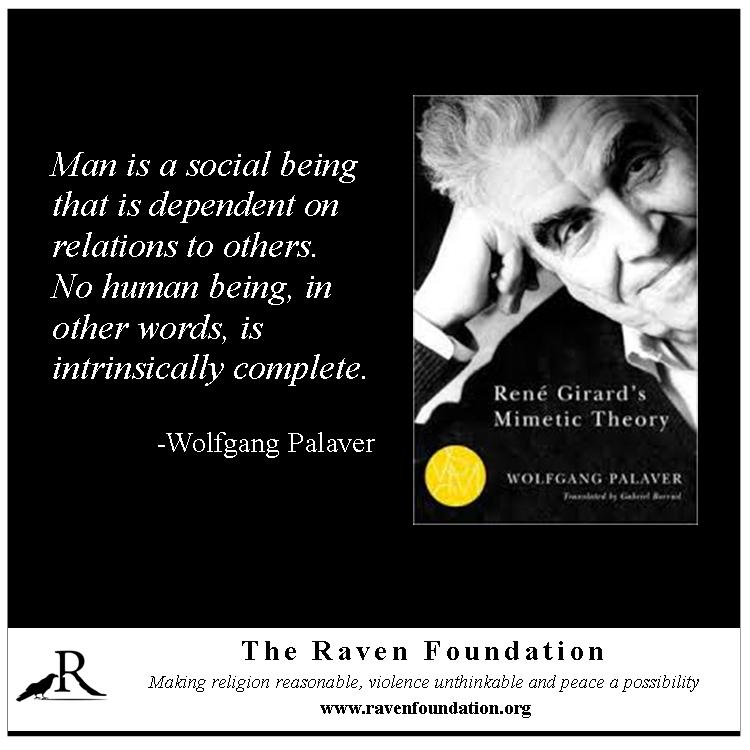
Any course using mimetic theory starts with a simple observation: the way we think about ourselves and the way we develop a sense of identity is always mediated by our social environment. And that which makes something like a social environment possible precisely is our – indeed mimetic – ability to put ourselves in each other’s shoes.

Man as Social Being (Wolfgang Palaver)

Neuroscientists have discovered that so-called mirror neurons in our brains play a very important role in this regard. These brain cells allow us to imitate others. They allow us to pretend that we’re someone else and to take another person’s point of view. And this allows us to imagine what others are experiencing, thinking, expecting or even desiring. In short, our mimetic ability is the conditio sine qua non to empathize and bond with others, and to develop a sense of self.

double mediation

Of course our imaginative projections about others can be wrong. That’s why we, rather unwittingly, constantly look for the confirmation of mutually established social expectations. The question “Am I doing this right?” seems to be the ever present subtext to our behavior. It really structures the interaction between ourselves and others. As it happens though, the recognition we get from one social group might be of more importance to us than that of another. We might empathize more with the members of the San Francisco symphony orchestra we’re part of than with the homeless of that same city. Or we might feel so close to our favorite football team that we become really hostile to its adversaries.

So our ability to empathize with others turns out to be a two-edged sword. It connects us with and disconnects us from others at the same time. It can connect us to the members of a group we want to be part of against a common enemy. Even more so, it can stir rivalry between members of the same group or the same social environment. That might be surprising, but on second view it will turn out to be quite logical. Our mimetic ability allows us to take other people as models for our behavior. It allows us to learn from them in all sorts of ways, but it also plays a significant role in structuring our desires and ambitions. For instance, there’s more than one twelve year old soccer player walking around with a shirt of Lionel Messi or some other soccer idol, secretly dreaming of being the next soccer sensation.

  • MIMESIS AND RIVALRY – THE PROBLEM OF MIMETIC DESIRE

There seems to be no harm in identifying with someone you admire and take as an inspiration for your own desires and ambitions in life. At first glance, that is. As long as the model you imitate belongs to quite another world than your own, as long as there is a significant distance between yourself and your model – in space, in time, or both –, chances of a conflictual relationship with the model are reduced. On the other hand, when that distance is no longer experienced, things might turn ugly, both for yourself and your model. As a twelve year old forward in a soccer team, it’s fairly easy to admire Lionel Messi, but it might be a hell of a lot harder to appreciate the talents of the new teammate who comes in and takes your spot. Identifying yourself as being the forward (or even “the Messi of the team”) immediately complicates your relationship with this newcomer, as he arouses the desire for your former status and the recognition it is supposed to bring. You might, for instance, try to get rid of the new guy by locking him out. Good coaches, though, know how to deal with these types of situations, even strengthening their team in the process. When two or more forwards imitate and thereby reinforce each other’s desire to be the best player on their position, it indeed can make them all better players in a consequently better team.

Mimetic Rivalry

Good coaches and managers are able to use mimetic rivalry in constructive ways, allowing their employees to recognize and respect that “the best has won.” However, all management efforts aside, mimetic rivalry remains a tricky thing. It is literally rivalry based on the imitation of desires for certain material and/or immaterial objects (e.g. a trophy, some sort of social recognition or status, power within a company, wealth, etc.).

Envy Pride Mimetic Desire

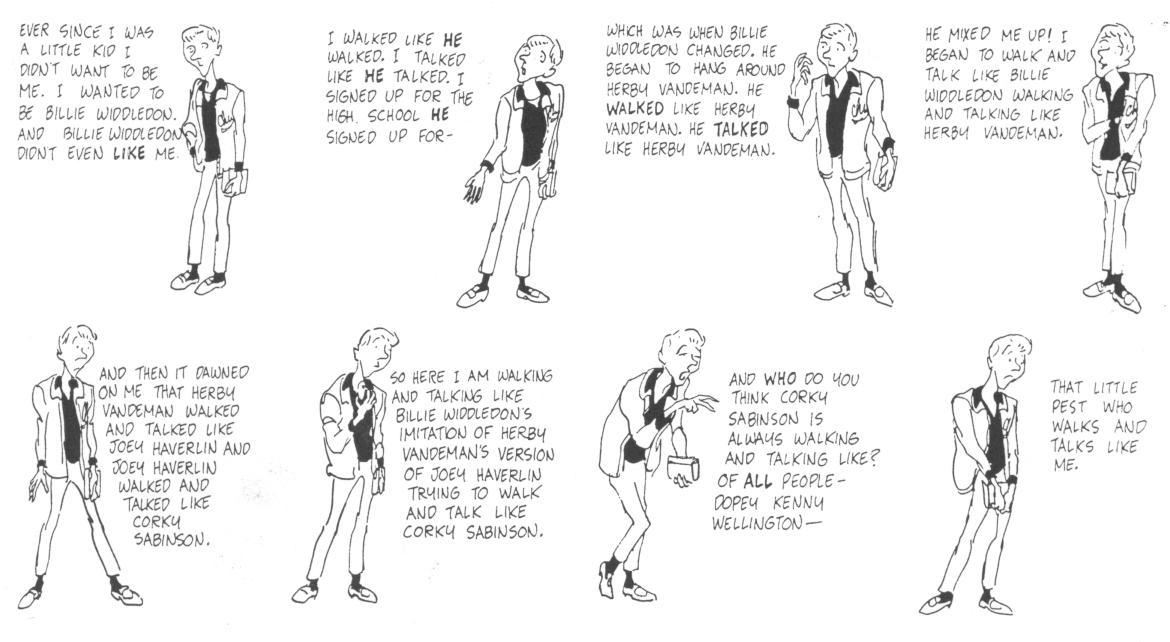
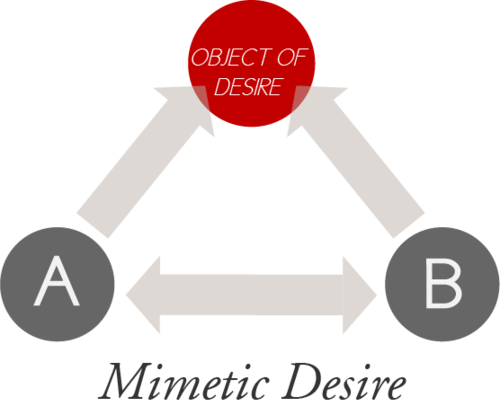
Human desire is, beyond instinctive needs and wants, highly mimetic (i.e. based on imitation). True, we’re all born with certain physical needs (for food, water, oxygen, etc.). But no one is born with the desire to become, say, a culinary chef. That is a socially (and therefore mimetically) mediated ambition that gets different cultural expressions. Mimetic desire and mimetically mediated ambition can easily lead to frustrations and destructive conflicts between people who take each other as model.

Mimetic Desire

When two or more people, consciously or more often rather unwittingly, imitate each other’s desire, they become each other’s annoying obstacle when they cannot or do not want to share the object of their desire. In short, they become antagonists because of mimetic desire. Paradoxically, it is because people are close to each other and can imagine what it is like to be in the other’s shoes, that they can become each other’s archrivals in the context of a mutually shared desire. As said, our mimetic ability connects and disconnects.

  • THE SCAPEGOAT MECHANISM AS RESPONSE TO MIMETIC CRISES

The mimetic building blocks of our psychosocial fabric are at once responsible for the preservation and disintegration of that very same fabric. One of the well-tried means to restore a social order that is in crisis because of escalating mimetic rivalry, is the so-called scapegoat mechanism. This restoration again rests on mimetic processes. Let’s turn to the example of the soccer team once more. When a team loses time and again, that’s normally no favorable factor for the group atmosphere. Teammates start blaming each other for bad results, maybe even sabotaging each other. There also might be ill-will towards the coach by players who feel they’re not given enough opportunities to play matches. And when the coach becomes part of the rivalry and frustrations within the team, that’s usually the end of his career there. As more players imitate the ill-will of some teammates towards their coach, the latter becomes the one held responsible for all the major problems within the team, and he’ll be fired by the board in the end. Instead of recognizing the mimetic origins of social disorder, people tend to blame one outsider or a group of outsiders. This scenario is well-known. Coaches indeed often function as convenient scapegoats, unjustly blamed for a crisis they’re not or only partly responsible for. Like other scapegoats they’re interpreted in a twofold manner by the group they’re expelled from: perceived as the main cause for the tensions, divisions and disorder within the group, and experienced as the main cure while being sacrificed (expelled, or worse) to restore unity and order within that same group. Scapegoats are at once villain and hero, monster and savior, hated and loved, unwanted and wanted, scorned yet needed. Think, for example, of dictatorial regimes who blame all their domestic problems on foreign enemies. As long as a dictator can unite his citizens against some outside enemy, he can at least prevent them from uniting against himself and remain in the saddle. This means that he cannot completely destroy the enemy he publicly loathes. Dictators need the periodic sacrifice of their scapegoat in order to preserve the social fabric on a very large scale, but human beings in general tend to use the scapegoat mechanism on a day-to-day basis, albeit often in smaller ways.

Scapegoat Team Building

  • GOALS OF THIS COURSE

Because of the widespread presence of the scapegoat mechanism and the sacrifices that go along with it in the preservation of social order and peace, it is a real challenge to imagine other ways of building human communities. The question is how to create communities where differences between people don’t lead to escalating rivalries that tend to leave no difference at all – except for the violently established difference between a group and its scapegoat or sacrificial victim. In other words, are there ways to create a social order and peace that leaves room for non-violent, creative conflicts that originate in the irreducible yet fascinating differences between ourselves and other human beings?

The goal of this course is, first, to become more aware of the psychological and social mechanisms this introduction already briefly touched upon. Among others, it will present three ways by which mimetic connections between ourselves and other human beings might become mentally and/or physically violent and destructive. Some stories, old and new and from different media, will function as mirrors that reveal some of those important aspects of who we are as human beings. It will allow participants to analyze actual events and to reflect upon their own life. For those interested, extracurricular background information is given, including some scientific and philosophical material. Secondly, this course invites participants to actively grow into a way of being that prospers non-sacrificial peace and a way of life that is giving and joyous.