Dear guest, It all started with… dinosaurs. From an early age I was fascinated by those strange creatures that walked the earth millions of years ago. Not surprisingly, as a young boy I wanted to become a paleontologist. This initial plan concerning my future took a slight turn from the moment I met Michaël Ghijs (1933-2008), a Catholic priest and teacher at the high school I was attending. He was also the founding conductor of the boys’ and men’s choir Schola Cantorum Cantate Domino. He enabled his singers, me being one of them, to broaden their horizon on many levels: on the geographical and cultural level by literally travelling the world with us, but also spiritually by living out the message of the Gospel. Inspired by his example and my experiences within his choir, I decided to commit myself to a further exploration of The Christian Story. I hold a master’s degree in Religious Studies at the Catholic University of Leuven (Belgium). It was in Leuven I first encountered the work of René Girard (1923-2015), one of the great intellectuals of our time and immortel of the Académie française. A little book by a great theologian, Knowing Jesus by James Alison, set me on track to discover Girard’s further developed Mimetic Theory. For me, this became an anthropological and interdisciplinary starting point to challenge the richness of the Christian tradition. It affected me in a very profound way, and I’m convinced that the thought provoking power of Mimetic Theory can support our multi-layered human society on the road to ‘post-sacrificial’ peace. Eventually, I published several books and articles on René Girard, Mimetic Theory, culture and religion. I also became a member of the Dutch Girard Society and of COV&R (the Colloquium on Violence & Religion). In 2019, I became an elected member of the board of COV&R for several years. In 2011, I started Mimetic Margins, a blog to explore the work of René Girard (and many others) further. Scapegoat Shadows, this website, is a reboot of my first online activity in that regard. It contains the Mimetic Margins Archives (with lots of instructive debates under certain posts), as well as new material. I’m currently teaching at a Jesuit High School, Sint-Jozefscollege, in Aalst (Belgium). I am also a journalist and editor-at-large for Tertio, a weekly magazine. In my spare time I keep on singing, as an alto or countertenor, trained at Schola Cantorum Cantate Domino as I mentioned (I was a member from 1991-2010). I took part in several recordings, both as a choir member and as a soloist.

One of today’s more popular philosophers, Alain de Botton, could easily have dubbed his TED-talk “A short history of  human self-understanding in the West according to René Girard”, but settled for “A kinder, gentler philosophy of success” instead.

alain-de-botton-on-rene-girardI accidently saw this talk on Belgian television (Canvas) and immediately suspected Girard’s influence. As it turns out, Alain de Botton rates Girard’s Deceit, Desire and the Novel: Self and Other in Literary Structure five stars out of five on goodreads. No coincidence there…

CLICK TO WATCH:

Error
This video doesn’t exist

Of course, both de Botton and Girard are intellectual omnivores, drawing from similar sources (for instance, de Botton mentions Émile Durkheim in his talk; according to Eric Gans, “In particular, Durkheim should be considered the principal theoretical ancestor of René Girard’s notion of the sacred”). Nevertheless, it’s easy to pinpoint the many parts in de Botton’s talk that correspond with Girard’s preoccupations, even on a structural level. Here’s a comparison…

1. GLOBAL SNOBBERY

blog snobberyOne of René Girard’s main concepts is mimetic desire, i.e. desire based on the imitation (or mimesis) of the desire of others. Beyond instinctive needs and appetites, human desire is highly structured by mimetic interactions. We desire and attach importance to certain aspects of our environment because those others whom we experience as meaningful to our lives attach importance to these aspects, and we tend to imitate them. We gain a sense of identity as subjects by comparing ourselves to others who function as models (or mediators) for our desires and ambitions. So, from this angle, objects (or objectives) of desire are not intrinsically important. They gain value because of certain mediators they’re associated with, and because of the sense of being this association promises.

social-media-snobbery-venn-diagramDue to our mimetic tendencies we are able to imagine others’ viewpoints, to mimic others and to pretend we are like them. It also enables us to discover what those others focus on and what they seem to consider important. Imitating and obtaining what others consider important gives us social recognition, which in turn indeed gives us a sense of identity. We often don’t want material goods per se, we only want them insofar as they evoke social recognition – in the shape of admiration or envy by others. Snobbery grows out of the triangular structure of desire (i.e. the mimetic interplay between subject, model and object). Consumed by envious vanity himself, the snob is someone who desires others to admire or envy (even hate) him. He is an imitator who secretly wants to present himself as a model. The snob is someone who desperately seeks social respectability, in whatever context (be it a sports club, a school, a law firm, a factory, a family, an opera house, a newspaper etc.). In a way, we’re all snobs. We do care about what ‘meaningful others’ think of us! René Girard puts it this way (Deceit, Desire and the Novel: Self and Other in Literary Structure – Translated by Yvonne Freccero, Baltimore: Johns Hopkins University Press, 1966; 24):

“The triangular structure is no less obvious in social snobbism than it is in love-jealousy. The snob is also an imitator. He slavishly copies the person whose birth, fortune, or stylishness he envies. … The snob does not dare trust his own judgment, he desires only objects desired by others. That is why he is the slave of the fashionable. For the first time, moreover, we come across a term in current usage, ‘snobbism,’ which does not conceal the truth of triangular desire. Just to call a desire snobbish is enough to underscore its imitative character. The mediator is no longer hidden; the object is relegated to the background for the very reason that snobbism is not limited to a particular category of desires. One can be a snob in aesthetic pleasure, in intellectual life, in clothes, food etc.”

COMPARE ALL THIS WITH Alain de Botton’s description of job snobbery and the main reason why we want certain material goods (indeed because we think they’ll reward us with social respectability):

beer snob“Snobbery is a global phenomenon. … What is a snob? A snob is anybody who takes a small part of you and uses that to come to a complete vision of who you are. That is snobbery. The dominant kind of snobbery that exists nowadays is job snobbery. You encounter it within minutes at a party, when you get asked that famous iconic question of the early 21st century, ‘What do you do?’ And according to how you answer that question, people are either incredibly delighted to see you, or look at their watch and make their excuses. … Most people make a strict correlation between how much time, and if you like, love – not romantic love, though that may be something – but love in general, respect, they are willing to accord us, that will be strictly defined by our position in the social hierarchy.

And that’s a lot of the reason why we care so much about our careers and indeed start caring so much about material goods. You know, we’re often told that we live in very materialistic times, that we’re all greedy people. I don’t think we are particularly materialistic. I think we live in a society which has simply pegged certain emotional rewards to the acquisition of material goods. It’s not the material goods we want. It’s the rewards we want. And that’s a new way of looking at luxury goods. The next time you see somebody driving a Ferrari don’t think, ‘This is somebody who is greedy.’ Think, ‘This is somebody who is incredibly vulnerable and in need of love.’ Feel sympathy, rather than contempt.”

Alain de Botton also refers to mimetic mechanisms and mimetic desire:

“The thing about a succesful life is, a lot of the time, our ideas of what it would mean to live successfully are not our own. They are sucked in from other people…

And we also suck in messages from everything from the television, to advertising, to marketing, etc. These are hugely powerful forces that define what we want and how we view ourselves. When we’re told that banking is a very respectable profession a lot of us want to go into banking. When banking is no longer so respectable, we lose interest in banking. We are highly open to suggestion.”

2. MODERN EGALITARIANISM AND THE SPIRIT OF ENVY

Envy between the DeadOne of the main problems in the course of human history has been the potential destructive outcome of mimetic desire. If a mediator is at a great distance, the risks of (violent) rivalry between subject and model are not that big. There will often be a sense of admiration (idolatry) from the part of the subject towards its model. René Girard calls this kind of mimetic interplay external mediation. However, if the mediator is a close neighbor, relative or friend, risks of conflict grow increasingly. This so-called internal mediation makes the model of desire also an obstacle. When two (or more) people mutually enforce each other’s desire for certain objects (by way of imitation the model also becomes the imitator of his imitator, his double), envious rivalry emerges.

Premodern societies developed systems of taboos and (sacrificial) rituals to guide mimetic interactions and to prevent mimetic rivalry (and everything it’s associated with) from destabilizing communities. Moreover, there was a hierarchy in society as a matter of principle. One could not just aspire to the positon of a king when one was not of noble birth. This type of hierarchy was eventually justified by reference to ‘higher powers’ – fate, fortune, the gods… Myths were basically tales that defended the way societies structured themselves. People were ultimately not responsible for ‘the way of the world’ and for their own and others’ lives. God (or Fate) was to be thanked or to be blamed for whatever happened. God was the convenient scapegoat. People could not imitate the position of their king because God wouldn’t allow it. Respecting the social hierarchy (enforced by divine, ‘natural’ law) was a way to prevent mimetic rivalry and violent conflict. The French and other revolutions basically destroyed premodern hierarchical principles and their justifications in the western world, making way for modern democracy.

Wolfgang Palaver points to the potential dangers of modern equality in his book on René Girard’s mimetic theory (René Girard’s Mimetic Theory – Translated by Gabriel Borrud, Michigan State University Press, 2013; 61-62):

“Girard’s insight into the potential for conflict that accompanies internal mediation can help us better understand our modern, increasingly egalitarian world. As the metaphysical distance between desiring subject and model diminishes – the key component of internal mediation – the potential for rivalry and violence increases. The more negligible this distance becomes, the more probable it is that mimesis will end in rivalry and violence. The ancient proverbial truth found in mythical texts, primitive practices, and even the Bible, that brothers or sisters are much more prone to rivalry and conflict than others, can be easily understood with the help of Girard’s insight.

The development of mimetic desire from Cervantes to Dostoyevsky reflects the emergence of the modern world, one in which the spread of democracy and equality have meant the vanishing of rigid hierarchical differences. The limits on mimesis have essentially disappeared, as internal mediation increasingly takes the place of external mediation. The modern world has in turn seen a surge in competition, envy, and rivalry. In Girard’s eyes, this development is described most precisely by the French sociologist Alexis de Tocqueville in his work Democracy in America:

‘When all the privileges of birth and fortune are abolished, when all professions are accessible to all, and a man’s own energies may place him at the top of any of them, an easy and unbounded career seems open to his ambition and he will readily persuade himself that he is born to no common destinies. But this is an erroneous notion, which is corrected by daily experience. The same equality that allows every citizen to conceive these lofty hopes, renders all the citizens less able to realize them; it circumscribes their powers on every side, which it gives freer scope to their desires. … They have swept away the privilege of some of their fellow-creatures which stood in their way, but they have opened the door to universal competition.’

James on EnvyTocqueville is cognizant of the dangers posed by the modern phenomenon of equality. The strength of his analysis lies merely at the political level, however, in that he avoids pursuing the deeper anthropological roots of modern egalitarianism and the dangers it poses to society. Girard’s insight into the effects of mimetic desire allows one to understand why the phenomenon of equality – or the disappearance of social differences – poses these dangers. Reactionary or anti-egalitarian movements, in their attempt to maintain social differences, are aware of the conflictual potential of equality. 

One gains a sense of this from the contemporary struggle between the sexes, and the phenomenon of democracy. On the one hand, the equality of the sexes and political equality enhance moral quality in human relations, but, on the other hand, they also increase the possibility of rivalry, competition, and violence. Antje Vollmer, for one, points out in her book Heisser Frieden [Hot Peace] that modern equality is one of the major factors responsible for this increase in social violence.

The workings of mimetic desire, meanwhile, explain the problematic consequences of equality. We will see in the following sections that Girard’s theory of mimetic desire only offers an initial and preliminary answer to modern social dynamics. In his eyes, social differences are not God-given or a product of nature – as Aristotle and his conservative followers contend – but rather a product of mimesis. Just as Heraclitus saw social differences as a product of war – ‘the father and king of all, … some it makes gods, others men; some slaves, and others free’ – Girard also maintains that these distinctions result from the violence of mimetic rivalry.”

Envy the Sin No One ConfessesGirard also refers to Max Scheler in describing the dominant feelings that arise from the idea that anyone can achieve as much as everybody else, and the confrontation with the reality that this is practically impossible: ressentiment and envy. René Girard in his own words (A Theater of Envy: William Shakespeare, New York: Oxford UP, 1991; 4):

“We often brag that no word can scandalize us anymore, but what about ‘envy’? Our supposedly insatiable appetite for the forbidden stops short of envy. Primitive cultures fear and repress envy so much that they have no word for it; we hardly use the one we have, and this fact must be significant. We no longer prohibit many actions that generate envy, but silently ostracize whatever can remind us of its presence in our midst. Psychic phenomena, we are told, are important in proportion to the resistance they generate toward revelation. If we apply this yardstick to envy as well as to what psychoanalysis designates as repressed, which of the two will make the more plausible candidate for the role of best-defended secret?”

Envy indeed often is a big taboo, and Girard also further explains why we might be ashamed to admit that we are jealous:

“Envy subordinates a desired something to the someone who enjoys a privileged relationship with it. Envy covets the superior being that neither the someone nor the something alone, but the conjunction of the two, seems to possess. Envy involuntarily testifies to a lack of being that puts the envious to shame… That is why envy is the hardest sin to acknowledge.”

COMPARE ALL THIS WITH the way Alain de Botton tackles these issues:

“There are other reasons why it’s perhaps harder now to feel calm than ever before. One of these, and it’s paradoxical because it’s linked to something that’s rather nice, is the hope we all have for our careers. Never before have expectations been so high about what human beings can achieve with their lifespan. We’re told, from many sources, that anyone can achieve anything. We’ve done away with the caste system. We are now in a system where anyone can rise to any position they please. And it’s a beautiful idea. Along with that is a kind of spirit of equality. We’re all basically equal. There are no strictly defined kind of hierarchies.

Invidia (Envy) by Hieronymus BoschThere is one really big problem with this, and that problem is envy. Envy, it’s a real taboo to mention envy, but if there is one dominant emotion in modern society, that is envy. And it’s linked to the spirit of equality. Let me explain. I think it would be very unusual for anyone here, or anyone watching, to be envious of the Queen of England. Even though she is much richer than any of you are. And she’s got a very large house. The reason why we don’t envy her is because she’s too weird. She’s simply too strange. We can’t relate to her. She speaks in a funny way. She comes from an odd place. So we can’t relate to her. And when you can’t relate to somebody, you don’t envy them.

The closer two people are, in age, in background, in the process of identification, the more there is a danger of envy – which is incidentally why none of you should ever go to a school reunion – because there is no stronger reference point than people one was at school with. But the problem, generally, of modern society, is that it turns the whole world into a school. Everybody is wearing jeans, everybody is the same. And yet, they’re not. So there is a spirit of equality, combined with deep inequalities. Which makes for a very – can make for a very stressful situation.

It’s probably as unlikely that you would nowadays become as rich and famous as Bill Gates, as it was unlikely in the 17th century that you would accede to the ranks of the French aristocracy. But the point is, it doesn’t feel that way. It’s made to feel, by magazines and other media outlets, that if you’ve got energy, a few bright ideas about technology, a garage, you too could start a major thing.”

3. WHO’S TO BLAME?

FROM BAD FORTUNE TO FAILURE: THE SCAPEGOAT MECHANISM’S NEW CLOTHES

According to René Girard, but also atheists like French historian Marcel Gauchet, the Judeo-Christian traditions are highly responsible for the process of secularization in the West. Girard claims that the biblical writings gradually reveal the scapegoat mechanism as the cornerstone of archaic religion and culture, thereby potentially destroying faith in the gods who are considered responsible for the way the human world ‘works’ – with its different systems of taboos and rituals, and its periodic justification of certain sacrifices and victimary mechanisms. I’ll repeat what I’ve stated before:

Premodern societies developed systems of taboos and (sacrificial) rituals to guide mimetic interactions and to prevent mimetic rivalry (and everything it’s associated with) from destabilizing communities. Moreover, there was a hierarchy in society as a matter of principle. One could not just aspire to the positon of a king when one was not of noble birth. This type of hierarchy was eventually justified by reference to ‘higher powers’ – fate, fortune, the gods… Myths were basically tales that defended the way societies structured themselves. People were ultimately not responsible for ‘the way of the world’ and for their own and others’ lives. God (or Fate) was to be thanked or to be blamed for whatever happened. God was the convenient scapegoat. People could not imitate the position of their king because God wouldn’t allow it. Respecting the social hierarchy (enforced by divine, ‘natural’ law) was a way to prevent mimetic rivalry and violent conflict.

Due to the Judeo-Christian influence secularized societies no longer have an automatic access to the god(s) of archaic religion. Historically, sometimes this god was identified as the Christian God, although theologically one could argue – together with Girard and others – that Christ’s God fundamentally criticizes the mechanisms which produce the archaic sacred. Although the realm of the traditional sacred seems to have vanished in secularized societies, the mimetic and sacrificial mechanisms that lie behind it are still at work – alive as ever in human life. We simply bow to other idols. Often that’ll be the image that we have learned to desire for ourselves, the image which seems to give us social recognition…

One of the main sources of psychological problems nowadays is the idea that we are masters of our own lives, that we are fully responsible for our lives. So, secularized human beings no longer blame the gods for the bad things they encounter, they tend to blame themselves. They become their own scapegoat, their own sacrifice. People in secularized societies more and more sacrifice themselves (in all sorts of auto-aggressive behavior, from automutilation to suicide) if they’re not able to attain the image of ‘winner’ they secretly desire for themselves.

COMPARE ALL THIS WITH the following part of Alain de Botton’s talk:

“There is another reason why we might be feeling more anxious, about our careers, about our status in the world today, than ever before. And it is, again, linked to something nice, and that nice thing is called meritocracy.

meritocracyEverybody, all politicians on Left and Right, agree that meritocracy is a great thing, and we should all be trying to make our societies really, really meritocratic. In other words, what is a meritocratic society? A meritocratic society is one in which if you’ve got talent and energy and skill, you will get to the top. Nothing should hold you back. It’s a beautiful idea. The problem is if you really believe in a society where those who merit to get to the top, get to the top, you’ll also, by implication, and in a far more nasty way, believe in a society where those who deserve to get to the bottom also get to the bottom and stay there. In other words, your position in life comes to seem not accidental, but merited and deserved. And that makes failure seem much more crushing.

You know, in the Middle Ages, in England, when you met a very poor person, that person would be described as an ‘unfortunate’ – literally, somebody who had not been blessed by fortune, an unfortunate. Nowadays, particularly in the United States, if you meet someone at the bottom of society, they may unkindly be described as a ‘loser.’ There is a real difference between an unfortunate and a loser, and that shows 400 years of evolution in society and our belief in who is responsible for our lives. It’s no longer the gods, it’s us. We’re in the driving seat.

That’s exhilarating if you’re doing well, and very crushing if you’re not. It leads, in the worst cases, in the analysis of a sociologist like Émile Durkheim, it leads to increased rates of suicide. There are more suicides in developed individualistic countries than in any other part of the world. And some of the reason for that is that people take what happens to them extremely personally. They own their success. But they also own their failure.”

4. THE COMFORT OF TRAGEDY (AND COMEDY)

hero or villainOur heroes, our idols, our ‘gods’ – the ones we have a love-hate relationship with -, function, in the words of René Girard, as model/obstacle. On the one hand, we tend to imitate them and to model our desires and ambitions on their desires and ambitions. However, when we can’t seem to achieve what we’ve learned to hope for our own lives, the comparison with the ‘winners’ in society – the rich, the bright, the famous etc. – might turn ugly. Admiration can be the forerunner of envy, whereby we experience our models simultaneously as obstacles to our own success. You know, “Why should they have all the glory?” That’s why we like to read, hear and see stories of ‘fallen heroes’ from time to time. The little and big scandals that surround the ‘happy few’ comfort the great lot of us with the thought that “they’re not that fabulous after all.”

stand up comedian jesterIf we see that they’re human beings just like ourselves, they might evoke pity, and empathizing with their fate might help us to cope with the trials and tribulations in our own lives. If we perceive them as villains or even ‘monsters’, following the downfall of a former ‘winner’ might be a form of retribution or even ‘revenge’ for the fact that most of us don’t belong to that special caste of ‘high society’. Indeed, we’re part of the masses instead. In short, tragic stories of fallen heroes often comfort us with the idea that we are spared the fate of having to submit to the judgment of ‘public opinion’. Stand-up comedians are the jesters of the day, ventilating this opinion. Their presence is all the more important in a society like ours, in the West, where we need to ridicule all those seemingly important famous people we secretly envy… The more hidden and suppressed envy, the more need for today’s jesters, laughing at our contemporary ‘kings’ and ‘queens’. The comic is but the other side of the coin of comfort to which also the tragic belongs.

So, basically, there are two types of tragic stories: the scandalous or ‘mythical’ one that tends to present former heroes as ‘monsters’ (or vice versa!), and the actual tragedy which aims more at telling the story of the fallen hero in such a way that it enables the compassion of an audience.

Anyway, the periodic sacrifice of our (monstrous) idols, told and retold in our myths and tragedies, saves and restores our sense of identity and self-worth. It’s no surprise then that former villains can become heroes again after they’ve died, as they are experienced as saviours. They often generate a cult following, which reminds us of the cleansing and structuring effect mythologized heroes/villains like Billy the Kid bestow on ever new generations.

Tragedy and Comedy MasksRobert Hamerton-Kelly very succinctly points to the origin of Greek tragedy in a presentation of René Girard’s mimetic theory. It explains how tragic stories function and help take away conflictual tensions and frustrations in our human society, to this day:

“Greek tragedy originated as a religious ritual that facilitated self-cleansing and emotional renewal…”

COMPARE ALL THIS WITH Alain de Botton’s words on tragedy:

“There is another source of solace and comfort for all this. When we think about failing in life, when we think about failure, one of the reasons why we fear failing is not just a loss of income, a loss of status. What we fear is the judgment and ridicule of others. And it exists.

tabloid heroYou know, the number one organ of ridicule nowadays, is the newspaper. And if you open the newspaper any day of the week, it’s full of people who’ve messed up their lives. They’ve slept with the wrong person. They’ve taken the wrong substance. They’ve passed the wrong piece of legislation. Whatever it is. And then are fit for ridicule. In other words, they have failed. And they are described as ‘losers.’ Now is there any alternative to this? I think the Western tradition shows us one glorious alternative, and that is tragedy.

Tragic art, as it developed in the theaters of ancient Greece, in the fifth century B.C., was essentially an art form devoted to tracing how people fail, and also according them a level of sympathy, which ordinary life would not necessarily accord them. I remember a few years ago, I was thinking about all this, and I went to see ‘The Sunday Sport’, a tabloid newspaper that I don’t recommend you to start reading if you’re not familiar with it already. I went to talk to them about certain of the great tragedies of Western art. I wanted to see how they would seize the bare bones of certain stories if they came in as a news item at the news desk on a Saturday afternoon.

So I told them about Othello. They had not heard of it but were fascinated by it. And I asked them to write the headline for the story of Othello. They came up with ‘Love-Crazed Immigrant Kills Senator’s Daughter’ splashed across the headline. I gave them the plotline of Madame Bovary. Again, a book they were enchanted to discover. And they wrote ‘Shopaholic Adulteress Swallows Arsenic After Credit Fraud.’ And then my favorite. They really do have a kind of genius all of their own, these guys. My favorite is Sophocles’ Oedipus the King: ‘Sex With Mum Was Blinding.’

In a way, if you like, at one end of the spectrum of sympathy, you’ve got the tabloid newspaper. At the other end of the spectrum you’ve got tragedy and tragic art, and I suppose I’m arguing that we should learn a little bit about what’s happening in tragic art. It would be insane to call Hamlet a loser. He is not a loser, though he has lost. And I think that is the message of tragedy to us, and why it’s so very, very important, I think.”

5. A GLIMPSE OF JUDEO-CHRISTIAN REVELATION

The Envious (quote by Baltasar Gracian SJ)I’d like to end this post with a final quote from Alain de Botton, when he refers to Saint Augustine. It comes from the core of Judeo-Christian revelation, and it’s no coincidence – and this becomes even clearer if you’re familiar with René Girard’s rephrasing of the Christian tradition:

“I’m drawn to a lovely quote by St. Augustine in ‘The City of God,’ where he says, ‘It’s a sin to judge any man by his post.’ In modern English that would mean it’s a sin to come to any view of who you should talk to dependent on their business card. It’s not the post that should count. According to St. Augustine, it’s only God who can really put everybody in their place. … In other words, hold your horses when you’re coming to judge people. You don’t necessarily know what someone’s true value is. That is an unknown part of them. And we shouldn’t behave as though it is known.”

In still other words: it’s a sin to waste your life merely as a snob…

Theologically speaking, we’re not just children or ‘products’ of our social surroundings. We’re also ‘children of God’…

There is no saint without a past (Augustine of Hippo)

Regisseur Darren Aronofsky schetst de manier waarop het verhaal voor zijn film Black Swan (2010) vorm kreeg in een interview met Dave Mestdach (Knack Focus, 5 september 2010, op het filmfestival van Venetië):

“Eigenlijk ging het zo. Aangezien mijn zus vroeger danseres was, ben ik altijd in ballet geïnteresseerd geweest zonder daarom een kenner te zijn. Alleen vond ik lange tijd geen geschikt scenario of een juiste invalshoek voor een film. Tien jaar geleden – tijdens het monteren van Requiem for a Dream – las ik echter The Understudy van Andres Heinz. Dat script ging over de intriges achter de schermen van een Broadway-theatergezelschap. Wat later las ik ook De dubbelganger, een kortverhaal van Dostojevski over een man die er van overtuigd is dat zijn collega zijn identiteit heeft overgenomen. Dat vond ik een heel enge en fascinerende gedachte. Nog wat later zag ik een opvoering van Het Zwanenmeer van Tsjaikovski waarin de soliste zowel de rol van de Witte als de Zwarte Zwaan danste. Uit al die dingen samen is uiteindelijk het concept voor Black Swan ontstaan.”

Black SwanMet De dubbelganger van Fjodor Dostojevski (1821-1881) en het ballet Het Zwanenmeer van Pjotr Iljitsj Tsjaikovski (1840-1893) plaatst Aronofsky zijn film in een rijk cultuurhistorisch en literair perspectief, dat gaat van de Metamorfosen van Ovidius (43 v. Chr. – 17 na Chr.), over Duitse, Russische en Deense sprookjes, tot de Engelse gothic novel en Richard Wagners opera Lohengrin. Daardoor bevat het verhaal van Black Swan ook een aantal geliefkoosde kernthema’s uit het werk van René Girard. Het leek mij interessant om die thema’s, en de manier waarop ze in de film aan bod komen, een beetje meer uit te spitten. Het resultaat is een filmfiche met cultuurhistorische en literaire achtergronden:

KLIK HIER OM DE FILMFICHE TE LEZEN (PDF)

VRAGEN BIJ DE FILMFICHE (PDF)

KLIK HIER OM DE VOLLEDIGE LITERAIRE TEKSTEN TE LEZEN VOOR DE VOORNAAMSTE MOTIEVEN IN BLACK SWAN (PDF)

Ik maakte ook een videocompilatie met de eindscènes uit Black Swan, gecombineerd met fragmenten uit enkele literaire werken die in de filmfiche worden besproken.

SPOILER ALERT!

If you haven’t seen the movie Black Swan, you shouldn’t watch this. Otherwise:

CLICK TO WATCH:

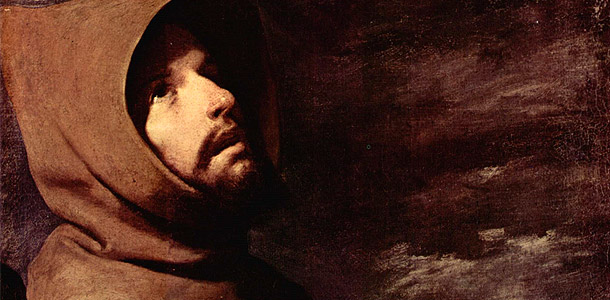
Saint Francis of AssisiBefore I got to know the Christian faith I always thought the three religious vows were an abomination. Why would anyone deliberately choose the masochistic way of a life in “poverty, chastity and obedience”? Only after I saw a documentary on the Franciscan Friars of the Renewal in New York and only after I delved into the Gospels more carefully I discovered that these vows were not ends in themselves, but should actually be understood as means to seeming antitheses of those very vows. It turns out that the three religious vows are anything but masochistic. They should be based on the paradox of the Gospel:

For whoever wants to save their life will lose it… What good is it for someone to gain the whole world, and yet lose or forfeit their very self?” (Luke 9:24a-25).

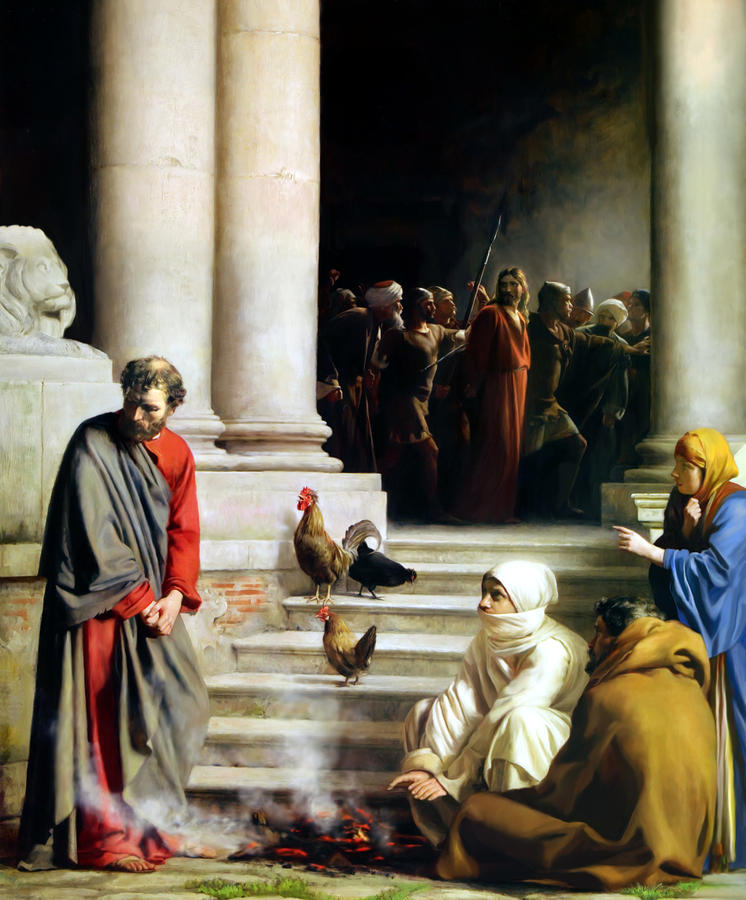
agape loveIn other words: there is a certain way of life we should get rid of to gain or regain ourselves. Again, to lose your old life is not an end in itself, but a means to gain a truer or more authentic new life. To gain social recognition often means that you’re accepted not for who you are, but for the image you’re presenting of yourself. Indeed, you’re losing your life while trying to “gain the whole world”. This process might also imply that you’re sacrificing others to protect that socially acceptable image. The apostle Peter denies knowing Jesus when the latter is arrested. Fearing that his association with Jesus will make him socially unacceptable as well, Peter presents an untruthful image of himself. From this angle Jesus rightfully says: “But whoever loses their life for me will save it…” (Luke 9:24b). If you lose your socially acceptable image to defend the one who is socially deprived, you will gain a truer identity as an unexpected and surprising consequence. To (re)establish relationships with the excluded is to take part in the dynamic of agape (love for one’s neighbor). It is making the “Body of Christ” – which is a body of Love – transparent.

Faces of Christ (Body of Christ)

The three religious vows can be helpful in actually settling the paradox of the Gospel:

  • THE VOW OF POVERTY LEADS TO RICHES
  • THE VOW OF CHASTITY LEADS TO INTIMACY
  • THE VOW OF OBEDIENCE LEADS TO FREEDOM

I’ll try to explain this by means of examples.

1. THE VOW OF POVERTY.

For whoever wants to save their life will lose it… translates to For whoever wants to become rich will become poor… Indeed. Ever met those people who “wanted it all” – perhaps in the mirror? Those who want to enjoy as much parties as possible? If you want all the clothes in the world and go out shopping all the time you won’t ever fully enjoy any of your clothes. If you want to attend ten parties in just one night you will not have enjoyed any of them, because you will constantly worry about the next party you might be missing. If you want to love all the women in the world, you won’t have loved any of them in the end.

The challenge is to choose life where it’s present. As a present. To quote John Lennon: “Life is what happens to you while you’re busy making other plans.” The challenge is to live in the here and the now. To choose quality instead of worrying about quantity. Intensity. NON MULTA SED MULTUM. Epicurus (BC 341-270) already warns against discomposing desires: “Do not spoil what you have by desiring what you have not; remember that what you now have was once among the things you only hoped for.” If you stop trying to possess what others have (which is the same as no longer surrendering to mimetic desire), you will become aware of the things you do have and discover that there’s a world of plenty in one single moment, at one place. Jesus expresses this quite beautifully (Matthew 6:25-34):

Saint Francis of Assisi (Regina Ammerman)“Therefore I tell you, do not worry about your life, what you will eat or drink; or about your body, what you will wear. Is not life more than food, and the body more than clothes? Look at the birds of the air; they do not sow or reap or store away in barns, and yet your heavenly Father feeds them. Are you not much more valuable than they? Can any one of you by worrying add a single hour to your life? “And why do you worry about clothes? See how the flowers of the field grow. They do not labor or spin. Yet I tell you that not even Solomon in all his splendor was dressed like one of these. If that is how God clothes the grass of the field, which is here today and tomorrow is thrown into the fire, will he not much more clothe you—you of little faith? So do not worry, saying, ‘What shall we eat?’ or ‘What shall we drink?’ or ‘What shall we wear?’ For the pagans run after all these things, and your heavenly Father knows that you need them. But seek first his kingdom and his righteousness, and all these things will be given to you as well. Therefore do not worry about tomorrow, for tomorrow will worry about itself. Each day has enough trouble of its own.”

Imagine what this attitude of “having enough” could mean for the natural environment! It’s no surprise Saint Francis of Assisi (1181-1226) deeply respected and enjoyed the riches of nature… If only we could follow his example a little better.

But whoever loses their life for me will save it… True, as explained earlier. It’s like imitating the good Samaritan. He is prepared to stop worrying about his plans and to free himself for the uninvited neighbor – right here, right now.

2. THE VOW OF CHASTITY.

Saint Francis and the SultanFor whoever wants to save their life will lose it… translates to For whoever wants to love everyone will not be able to love anyone… If you are a heterosexual bachelor who tries to develop a friendly relationship with a woman, you might soon find out that the woman herself or others fear you’re friendly because you want “something more”. This fear might prevent the possibility of more intimate relationships. On the other hand, when people know you’re married or that you took another vow of chastity, they will not have to fear you’re “after something more than friendship”. This opens up the possibility of more authentic and intimate relationships. It opens up the possibility of meeting the other as “other”, of true personal care – CURA PERSONALIS. Of course, we all know that in human relationships there is no black and white. There’s lots of colors in between the limits of a “grey zone”.

3. THE VOW OF OBEDIENCE.

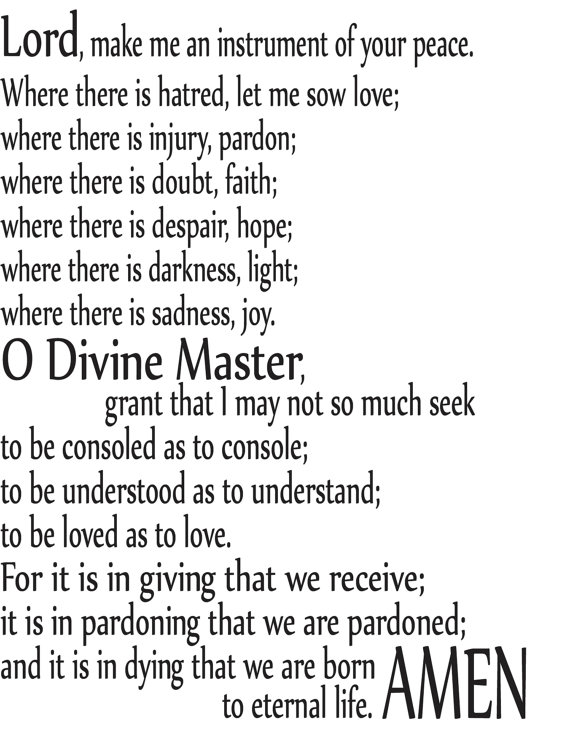
Prayer attributed to Saint Francis of AssisiFor whoever wants to save their life will lose it… translates to For whoever wants to be free will be imprisoned… Oh yes, we tend to listen to the ones who are promising us a great future, a beautiful career, happiness etc. – in one word: “paradise”. But if a workaholic keeps on listening to his boss, he will remain a puppet of a degrading work ethic. If a drug addict keeps on believing the drug dealer who tells him that he doesn’t really have any problem, he will remain an enslaved human being for the rest of his life… In contrast, the vow of obedience means that you will try to obey to the Voice of a Love that wants what’s best for you. It means listening to a Voice that liberates you and enables you to be who you are… Only if you’re capable of accepting and loving yourself, you will be capable of loving others as well. The drug addict is so in need of drugs that he will approach others out of this need. He will use others to satisfy his needs and he won’t be able to approach them as ends in themselves. But if he frees himself from these needs and takes responsibility for himself he will be able to take responsibility for others as well. FREEDOM AND RESPONSIBILITY are twin brothers, or sisters…

Poverty leads to riches, chastity to intimacy, obedience to freedom. All three outcomes are surprising consequences of the transformative power of the Gospel paradox. The imitation of Christ changes yourself, here and now, and by that you change the world.

I could only write this post after seeing an inspiring documentary on the life of the Franciscan Friars of the Renewal. It’s really worthwhile to catch a glimpse of their life and vocation. Here’s how they explain the three religious vows.

CLICK TO WATCH:

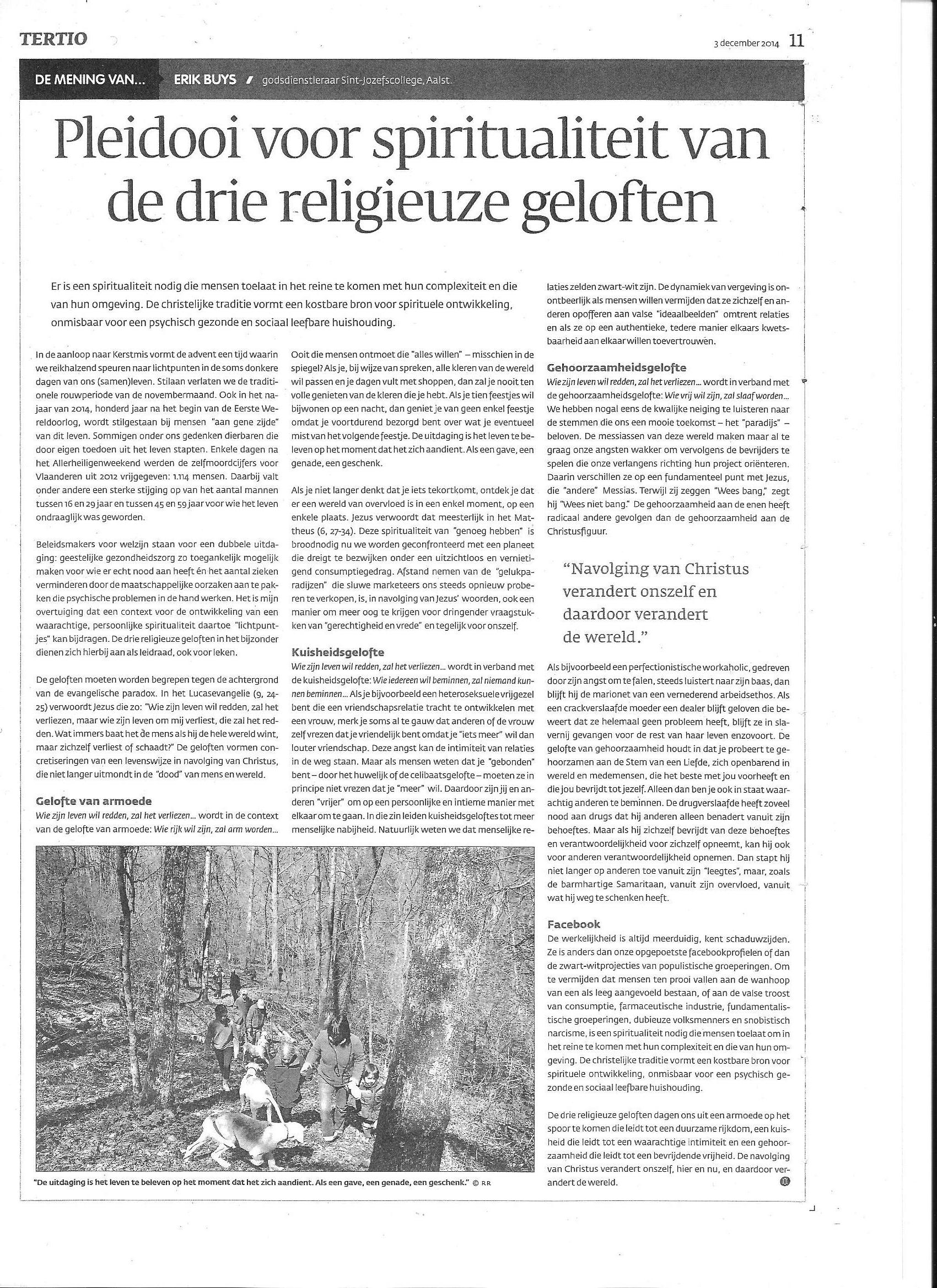
Een Nederlandstalige versie hiervan verscheen in de vorm van een artikel in het weekblad Tertio  – klik op de afbeelding om ze te vergroten:

Tertio 3 december 2014

An interesting and funny experiment is the now well-known fairness study by Dutch ethologist Frans de Waal and his colleagues.

WATCH IT HERE:

The Age of Empathy (by Frans de Waal)It once again confirms some basic intuitions of mimetic theory. Frans de Waal seems to treat the tendency to be competitive and aggressive on the one hand, and the tendency to be empathic on the other, as two different faculties. Seen from René Girard’s mimetic theory both competition and empathy can be attributed to one and the same source: mimesis (imitation).

  1. The ability to imitate another (see: mirror neurons or mirror neuron system!) opens up the possibility to imagine what the other is experiencing – as an “alter ego”. This is the foundation for the development of empathy and compassion.
  2. René Girard also points to mimesis as a potentially divisive force in the context of desire: when two individuals imitate each other’s desire for acquiring one and the same object, they can become each other’s rival. Mimetic desire thus threatens the stability of relationships.

In the words of Vittorio Gallese, one of the discoverers of mirror neurons, in conclusion to his paper The Two Sides of Mimesis (click title to read the whole paper): “We have examined empirical results showing how interpersonal relations are made possible — in the first place — by resonance mechanisms that provide the common ground upon which the I–Thou relation can be established. It could be tempting to use such evidence to assert the neurobiological basis of the supposed natural proclivity of mankind to sympathy, fellow feelings, good will and altruism. I think we must resist such temptation, and look at human nature as it really is and not as we would like it to be. In this respect, Girard’s Mimetic Theory is illuminating, because it shows that mimesis when declined as mimetic desire has the intrinsic potentiality of driving humans to aggression and violence. Mimesis, as I have been trying to show throughout this paper, is neither intrinsically good nor bad. It is a basic functional mechanism at the core of our diversified social competencies and activities. Nevertheless, mimesis has two sides. Any serious neuroscientific attempt to shed light on the truest and deepest nature of human condition cannot neglect either side. I posit that the empirical evidence here briefly summarized and future research stimulated and driven by the currently available evidence have the potentiality to shed further light on both sides of mimesis.”

Both above mentioned points can be observed in many of de Waal’s experiments and observations. The second point becomes very clear in this fairness study. Consider the following remark by de Waal:

“Note that the first piece of cucumber is perfectly fine. The first piece she eats. Then she sees the other one getting grape, and you will see what happens…”

The Gift (by Marcel Mauss)In other words, the frustration and anger for not receiving grapes is aroused by comparison with the other monkey. Potential conflict does not arise from inequality as such, but from the tendency to imitate someone else and therefore desire what he receives, desires or possesses. The monkey is perfectly willing to eat cucumber instead of the better tasting grapes as long as her neighbor is in the same position. But would you still be happy with a little Toyota if everyone else in the neighborhood is driving a big Mercedes? We have to keep up with the Joneses, don’t we? Indeed, beyond basic needs, our and the monkey’s desires are structured by imitating others and comparing ourselves to them.

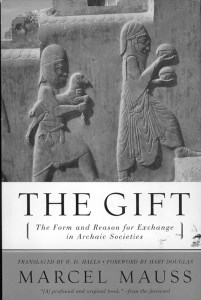
Primitive societies are well aware of the potential destructive outcomes of sharing gifts. That’s why gift exchange is highly regulated in archaic contexts. Besides establishing an acceptable hierarchy (which implies differences and inequalities), the rules of gift exchange also aim to undermine feelings of frustration and envy. To keep the peace! Essai sur le don  (The Gift), the groundbreaking study by Marcel Mauss (1872-1950) [PDF], to this day is very revealing in this regard (e.g. p.11: “To refuse to give, or to fail to invite, is – like refusing to accept – the equivalent of a declaration of war; it is a refusal of friendship and intercourse.”).

The ethical question remains whether the ties and bonds between humans that arise from mimetic interplays (manifested in empathy, fear of violence, but also lust for power and prestige) are a good basis for morality. I guess, as mimetic creatures, we have no choice but to rely on imitation. But this can be tricky. It’s very common to empathize with a friend or a clique and to imitate their hostility towards an enemy. But this kind of loyalty is not necessarily just or righteous. It’s the blind loyalty of the mafia or the mob. What if your friends or your clan is wrong? The big challenge, as put forward among others by Christ, is to include the ones that are considered “enemies” as “members of the community” – as “neighbors”, fellow human beings.

Chimpanzee Politics (Frans de Waal)René Girard claims that an imitation of Christ could guide our mimetic faculties in such a way that they would enable us to “love our enemies”. This is not to be understood in a masochistic way. To protect the victim of bullies doesn’t mean that you want to get bullied yourself. To put it differently: to speak in favor of the socially deprived or “crucified” doesn’t mean that you want to get crucified yourself, although of course you always run the risk that “bullies” don’t “show mercy” but keep on “crucifying”. Nevertheless Christ “turns the other cheek”, not because he wants another blow, but because he hopes that merciful, non-vengeful conduct will eventually be imitated.

So, empathy as the basis for morality? It depends on the examples one imitates and empathizes with. Will you follow the idol of yourself – the important person you imagine yourself to be in a certain group (that structures itself partly by excluding its “enemies”)? Or will you follow the Voice of the one who questions the image of yourself that exists at the expense of excluded others – in order to find yourself in relationship to those others?

de donkere kamer van damokles

Graag verwijs ik naar een boeiend initiatief van de Nederlandse Girard Studiekring (Dutch Girard Society): een lesbrief over De donkere kamer van Damokles van W.F. Hermans, naar aanleiding van het evenement Nederland Leest.

KLIK HIER OM DE BRIEF TE LEZEN (PDF).

Dorbeck is alles!De brief is gebaseerd op een proefschrift van Sonja Pos. Over haar benadering van De donkere kamer van Damokles schreef W.F. Hermans aan een vriend: Sommige beschouwingen over mijn werk kan ik niet lezen zonder angstgevoelens. Ken jij: Mimese en geweld, beschouwingen over het werk van René Girard, Kampen 1988? Hierin staat een opstel van Sonja Pos over De donkere kamer van Damokles, dat me bang van mijzelf liet worden toen ik het las. Nou ja, ik overdrijf een beetje. Het is een van de beste beschouwingen die er ooit over dat veelbesproken verhaal zijn verschenen.”

Klik hier om een verrijkend interview met Sonja Pos te lezen over de dialoog tussen het werk van Hermans en Girard (interview door Els Launspach).

Milan KunderaHermans’ enthousiasme doet denken aan een bewering van een andere grote romancier, Milan Kundera. Deze Tsjechisch-Franse auteur schreef over het eerste boek van Girard: “Mensonge romantique et vérité romanesque is het beste dat ik ooit over de romankunst heb gelezen.” (uit Verraden Testamenten, Baarn, Ambo, 1994, p.160).

Uit de lesbrief:

Girards mimetische theorie is goed te herkennen in toneelstukken en literaire werken. Een mooi voorbeeld is De donkere kamer van Damokles(1958) door Willem Frederik Hermans. In haar proefschrift Dorbeck is alles! Navolging als sleutel tot enkele romans en verhalen van W.F. Hermans heeft literatuurwetenschapper Sonja Pos overtuigend aangetoond dat Girards belangrijkste ideeën, waaronder navolging, in De donkere kamer van Damokles opduiken zonder dat de schrijver Hermans zich dat bewust is geweest. Toen zij hem daarop attent maakte, was hij uitermate verrast. “Het [werk van Sonja Pos] is een van de beste beschouwingen die er ooit over dat veelbesproken verhaal zijn verschenen”, schreef hij aan een vriend. De roman, die in de Tweede Wereldoorlog speelt, laat zien hoe de mens door navolging ten onder kan gaan.

Mensonge romantique et vérité romanesque (René Girard)René Girard beschreef in De romantische leugen en de romaneske waarheid Europese literatuur waarin de hoofdpersonen een model navolgen. Soms zijn dat geen daadwerkelijke personages, maar verre geïdealiseerde voorbeelden zoals in Don Quichot van Cervantes. Deze relatie is eenzijdig: de hoofdpersoon oefent geen invloed uit op het model. Maar wat als het model dat door de hoofdpersoon van een roman wordt nagevolgd, niet veraf maar dichtbij is? Dan kan er rivaliteit ontstaan waarbij het model een obstakel voor de navolger gaat vormen, een voorwerp van haat. De mimetische rivaliteit is volgens Girard niet alleen besmettelijk maar ook destructief.

De donkere kamer van Damokles draait om Henri Osewoudt die een andere persoon, Dorbeck, wil navolgen. Juist door deze navolging gaat Osewoudt uiteindelijk ten onder. Girards mimetische theorie kan worden gebruikt om tot een beter begrip van Hermans’ roman te komen, en verschaft nieuwe inzichten over geweld in het algemeen.

Wie vertrouwd is met het werk van René Girard en in het Vlaamse onderwijs actief is, zal zeker opgekeken hebben van een artikel in het tijdschrift Klasse van december 2012. De titel van het artikel luidt (klik op de titel om het te lezen): Queen bee zaait terreur – Meisjesvenijn: een subtiel machtsspel.

Queen Bees and Wannabes (Rosalind Wiseman)Uit het artikel:

  • Koningin (queen bee): een populair, mooi, sociaal vaardig meisje. Graag gezien bij leraren. Zij domineert de pikorde, laat haar meelopers de vuile klusjes opknappen. Na een tijdje vindt ze het normaal dat ze altijd haar zin krijgt.
  • Meelopers (wanna-bees): een grote groep meisjes die heel graag bij de koningin willen horen. Ze kijken naar haar op, imiteren haar en doen haar vuile werk.
  • Slachtoffer (target): valt buiten de groep, staat helemaal alleen. Ze wordt vernederd, aangetrokken en afgestoten. Ze denkt dat ze niets waard is.
  • Zwijgende omstanders (torn bystanders): meisjes die zien wat er gebeurt, maar zwijgen uit angst zelf slachtoffer te worden.

Zodra je een klas vormt, bepalen de leerlingen een ‘pikorde’. Dat is een natuurlijk groepsproces. Maar als de klassfeer verziekt of er is veel stress, loeren machtsspelletjes om de hoek.

mean girlsHet is duidelijk dat het zogenaamde target als een zondebok functioneert waartegen een groep meisjes zich mimetisch verenigt (de wanna-bees imiteren de queen bee) in tijden van crisis (als de klassfeer verziekt is). De dubbelzinnige benadering van het target (zowel aangetrokken als afgestoten) doet denken aan de even dubbelzinnige benadering van de zogenaamde pharmakoi in het Oude Griekenland. Niet toevallig, natuurlijk, heeft ook Girard hierover geschreven. Pharmakoi waren gemarginaliseerde individuen die zowel negatief als positief bejegend werden – ze leken op een of andere manier vaak gevaarlijk voor de gemeenschap, maar schenen tegelijk de oplossing voor allerlei problemen. Het ritueel van de Pharmakos (φαρμακός) bestond uit het offeren of verbannen van een menselijke zondebok door priester-tovenaars. Een tovenaar werd pharmakon genoemd. Het was aan hem om een slaaf, een kreupele of een misdadiger uit te kiezen in tijden van crisis en rampspoed (bijvoorbeeld tijdens een hongersnood, een pestepidemie of een invasie). Het slachtoffer kreeg drugs (pharmakeus) toegediend van een priester-tovenaar die pharmakeia beoefende. Het Nederlandse woord farmacie is hiervan afgeleid, en verwijst nog altijd naar middelen die genezing moeten bewerkstelligen.

Meer informatie over mogelijke pesterijen van meisjeskliekjes vind je bij Rosalind Wiseman, meer bepaald in haar boek Queen Bees & Wannabes.

Een onderhoudende film over het onderwerp, die gebaseerd is op het boek van Wiseman en een en ander in een klas bespreekbaar kan maken, is Mean Girls (Mark Waters, 2004). Daarin moet een zekere Cady (gespeeld door Lindsay Lohan) de strijd aanbinden met Regina – Latijn voor ‘Koningin’ – George (gespeeld door Rachel McAdams). Als nieuwkomer valt Cady aanvankelijk in goede aarde bij The Plastics, een meisjeskliekje dat geleid wordt door Regina, tot ze verliefd wordt op het ex-vriendje van ‘the Queen’… Een interessante verwijzing naar de film in een bespreking van Nella Larsens Passing, aan de hand van het werk van René Girard en Rosalind Wiseman, lees je hier.

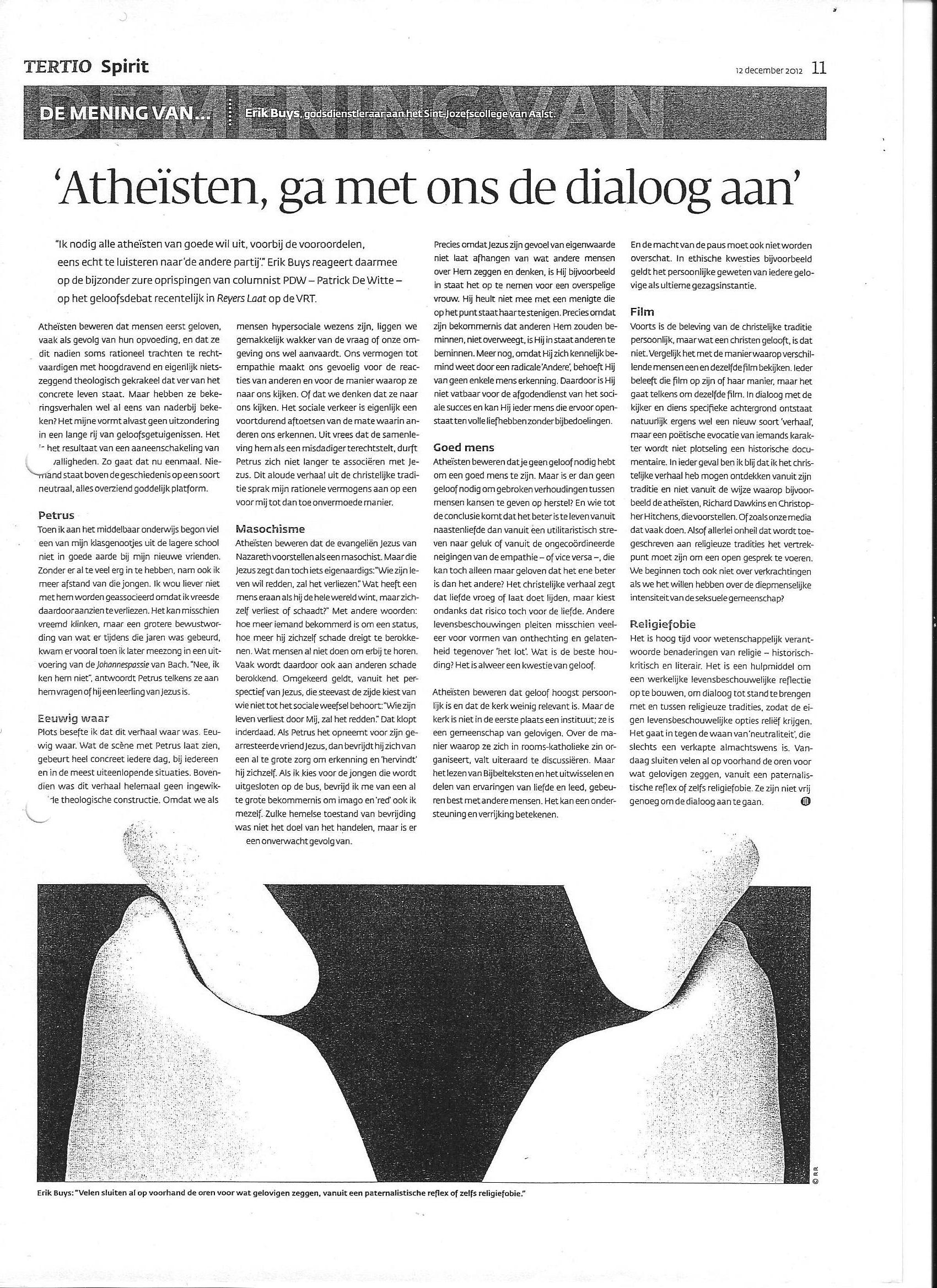
Naar aanleiding van een gesprek over ‘de kerk’ in het tv-programma Reyers Laat (van 13 november 2012), en een column daarover van Patrick De Witte in De Morgen (16 november 2012), richt ik deze brief aan alle atheïsten van goede wil.

In het bijzonder richt ik dit ‘sermoen’ aan Patrick De Witte, Patrick Loobuyck, Johan Braeckman, Anne Provoost, Nic Balthazar en Etienne Vermeersch. Jullie geëxpliciteerde ideeën over religie, en meer bepaald over de christelijke tradities en de verhouding tussen kerk en samenleving, vertolken immers vaak nogal gangbare veronderstellingen uit de onderbuik van onze geseculariseerde samenleving. Het ware boeiend geweest jullie aan tafel te zien met Mieke Van Hecke, Pieter De Crem, Annemie Struyf en Monseigneur Léonard. Dat is misschien voor een volgende Reyers Laat… Lees hier (ook op de Thomassite te lezen):

KLIK HIER VOOR EEN PDF-VERSIE VAN DE BRIEF AAN ALLE ATHEÏSTEN VAN GOEDE WIL

Een kortere versie van deze brief verscheen in het weekblad Tertio (nummer 670).

Klik op de afbeelding om ze te vergroten:

Tertio 12 december 2012

Het aloude verhaal. Van individuen die elkanders pestgedrag imiteren, en die zich op die manier verenigen rond een willekeurig slachtoffer. Een slachtoffer van wie zij echter beweren dat het dat pestgedrag “zelf uitlokt”. Een slachtoffer dat, met andere woorden, ten onrechte verantwoordelijkheid wordt toegedicht voor wat het overkomt. Een zondebok dus.

We zijn er als de kippen bij om onze eigen verantwoordelijkheid in dergelijke verhalen te ontlopen. We zijn geschokt door wat Tim Ribberink is overkomen, of Amanda Todd, of Tyler Long… We zijn verontwaardigd over het gedrag van de pesters. Maar intussen blijven we blind voor ons eigen aandeel in het creëren van een maatschappelijk klimaat dat telkens weer ruimte geeft aan vernederende woorden en daden. Aan het geweld van een bepaald soort taalgebruik. Van satire, bijvoorbeeld.

HUMOR (SATIRE) DIE ZICHZELF TE ERNSTIG NEEMT?

Ja, natuurlijk kan humor “ont-wapenend” zijn. Ruimte scheppen voor wie anders is dan jezelf begint bij een gezonde dosis zelfrelativering. En geen betere manier om jezelf te relativeren dan eens met jezelf lachen in het bijzijn van anderen. Maar tegenwoordig wordt “humor” – of wat daarvoor moet doorgaan – meer en meer een wapen ter onderdrukking van anderen. Je mag blijkbaar zelf niet meer bepalen waar je gevoeligheden en grenzen liggen, je moet “tegen een stootje” kunnen, een grapje kunnen verdragen, enzovoort. Vooraleer je jezelf kan relativeren, hebben anderen jou al – vaak ongevraagd – gerelativeerd in jouw plaats. Ze hebben jouw beslissingsruimte gekoloniseerd voor je er erg in hebt. Als je je dan gekwetst zou voelen, ligt het probleem natuurlijk niet bij die anderen, maar bij jou – jij, die geen gevoel voor humor kent of jezelf te ernstig neemt… Zo is de redenering van pesters die zichzelf niet als dusdanig herkennen, en die de verantwoordelijkheid voor het feit dat iemand zich gekwetst voelt bij de gekwetste zelf leggen – onder het mom: “Onze woorden zijn humoristisch op te vatten; wij kunnen het niet helpen dat iemand ze kwetsend opvat of niet in staat is om met mogelijks kwetsende taal om te gaan…”

En ondertussen tonen we toch ons respect voor het slachtoffer van een groep vermaledijde pesters – die zogezegd enorm van ons verschillen, maar die we in andere omstandigheden eigenlijk gewoon navolgen of imiteren. Of hoe het diaboliserende “pesten van pesters” zelf ook pesten is. Wie zich wreekt op boosdoeners, imiteert hun gedrag, en zet het kwaad dat hij dacht te bestrijden eigenlijk verder.

Wij (‘ons groepje’) zijn niet zoals zij (‘dat groepje’); ik niet zoals hij. Want wij betuigen eer aan hun slachtoffer…” De Jezusfiguur van de canonieke evangeliën ontmaskert de hypocrisie van zulke mechanismen (Mt.23,29-31): Wee u, schriftgeleerden en farizeeën, schijnheiligen; u bouwt graftekens voor de profeten en versiert de grafstenen van de rechtvaardigen, en u zegt: “Als wij geleefd hadden in de tijd van onze vaderen, zouden wij niet medeplichtig geweest zijn aan de moord op de profeten.” Zo getuigt u zelf dat u zonen bent van profetenmoordenaars.

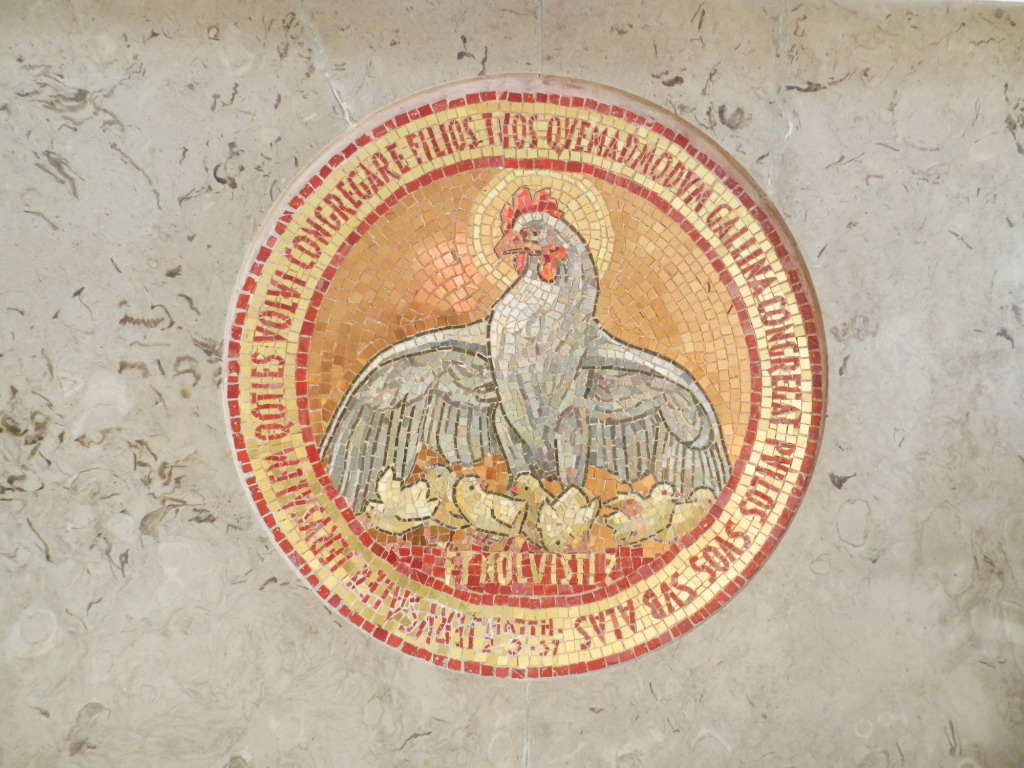
We zien het slachtoffer van een andere groep of van een ander individu nogal gemakkelijk, maar blijven inderdaad vaak blind voor de slachtoffers die we zelf maken. Aan de oproep tot zelfonderzoek en inkeer wordt zelden beantwoord. Aan “de stad” – de samenleving – waar het goed toeven is als mens, wordt niet verder gebouwd. Of zoals die Jezusfiguur het zegt, als “de Stem van een roepende in de woestijn” (Mt.23,37-38): Jeruzalem, Jeruzalem, dat de profeten doodt en diegenen stenigt die tot haar gezonden zijn! Hoe vaak heb Ik uw kinderen niet onder mijn hoede willen nemen, zoals een kip haar kuikens bijeenbrengt onder haar vleugels. Maar u hebt het niet gewild. Kijk, uw huis blijft onbewoond achter.

Tim, ik ken je niet. Ik ben niet direct verantwoordelijk voor je dood. Maar ik ben wel, op mijn manier, mede verantwoordelijk voor een sociaal klimaat waarin pestgedrag kan floreren. Mea culpa. Ik hoop dat ik niet te trots ben om vergiffenis te vragen aan of te ontvangen van wie ik heb gekwetst. Ik hoop dat ik van mezelf geen slachtoffer maak of mezelf als “zondebok” presenteer (zogezegd “onterecht beschuldigd van medeplichtigheid”) om mijn verantwoordelijkheid te ontlopen als “medeplichtige” in een samenleving die vaak blind blijft voor haar eigen zondebokken. Ik bid dat ik meer oog krijg voor de onbedoelde kwalijke gevolgen van bepaalde van mijn woorden en handelingen. Want ik ben hardleers en koppig. Ik hoop dat ik jou tijdig in mijn leven mag herkennen en erkennen. Zodat jij en alle andere slachtoffers misschien ooit in ons midden kunnen vertoeven, en wij niet langer “daders” hoeven te zijn. In een Bijbelse woordenschat die tot mijn achtergrond behoort, die mij helpt om een en ander uit te drukken, en die ook mijn rationele vermogens aanspreekt: Als “Abel” niet langer dood is, is “Kaïn” niet langer schuldig aan moord, en dan krijgt Kaïn nogmaals een kans om de relatie met Abel nieuw leven in te blazen… In die geschonken vrijheid wil ook ik in mijn leven verantwoordelijkheid opnemen voor de “Abel” in mijn midden, wetende dat dit met vallen en opstaan gebeurt door vergeving te krijgen en te geven, maar dat daarmee dat grote “Lichaam van Liefde” verder vorm krijgt…

Jammer genoeg is het verhaal van Tim, zoals geweten is, lang geen alleenstaand geval. In mei 2011 schreef ik reeds een reflectie over pesten (Laatste Oordeel), geholpen door de mimetische theorie van René Girard. Daarin wordt met name aan het zondebokmechanisme een centrale plaats toegekend. Dit kwam toen uit de bus – het verhaal van Tyler Long vertoont pijnlijke overeenkomsten met het verhaal van Tim Ribberink, spijtig genoeg… :

OVER OORDELEN EN LAATSTE OORDELEN BIJ DE DOOD VAN EEN MOEGETERGDE JONGEN (PDF)

“As you get older you will learn that loyalty is a virtue too important to be lavished on individual personalities.”

(From That Hideous Strength, by C.S. Lewis).

When I was a child, back in the eighties, my friends and I used to play this hero or superman game. We would identify with some action figure we considered super-dooper and, well, “fight” each other. Or at least we would mimic a fight from an action movie we secretly watched behind our parents back. Most of us were allowed to watch some violence in cartoons, but weren’t allowed to see the real deal – or so we thought… So Rambo and Rocky were out of the question. This prohibition only added to the mystique of these films and ignited our desire to watch them at all costs. It also made the movie characters larger than life, still, if that was even possible.

I remember that we weren’t quite fully aware of the fictitious nature of most heroes. So Sylvester Stallone was different from Rambo and Rocky, as Arnold Schwarzenegger differed from, say, Conan the BarbarianMr. T and B.A. Baracus likewise might have had the same look, but were not to be mistaken for each other. Besides, for some strange reason still unknown to us, we could watch the A-Team. Other cardboard characters in our “realm of the gods” were real cartoon (hmm, “real cartoon”) characters like He-Man or G.I. Joe. And Bruce Lee was the ultimate legend, of course.

It was a simpler world then, for me and my friends. There were good guys and bad guys. Heroes and villains. The Cold War hadn’t quite finished, and as children from Europe’s West we would team up with the valiant knights of the USA against the evil empire of the USSR. For instance, together with Rocky we would fight the Russian monstrous man-machine Drago in Rocky IV. Or we would cheer Rambo to outsmart the Soviets with aid of the Taliban in Rambo III (imagine that – how policies change according to newly found “common enemies”!). We had yet to learn that “the Russians love their children too”, although Sting already sang this as far back as 1985.

Growing up, I learned that the battle between good and evil is not really a battle of “us” (the good guys) versus “them” (the bad guys), but should actually be located in the individual.The battle of the handsome He-Man versus the atrocious Skeletor became understandable as a metaphor for an inner struggle in every man’s heart or soul. After all, “we all have our demons to fight”, don’t we? Freudian psycho-analysis would call this battle the source of an ever fragile equilibrium the Ich has to maintain between Es and Über-Ich.

All of a sudden, the world wasn’t that simple anymore. We couldn’t just locate evil outside of ourselves anymore and banish it, like some scapegoat in the desert. Moreover, the heroes we identified with as children turned out to posses some bad character traits as well. It all boils down to your point of view. I once read a testimony from a Jewish woman who survived the Holocaust wherein she states that the most scandalous experience she had back then, was the realization that her tormentor was a human being, just like herself – after seeing him in a gentle mood with his family. Or, to put things slightly different, Superman only appears beneficial among his own kin. From the perspective of his opponents and victims, he is the devil. So to follow some kind of Superman in all circumstances – even if it’s the Superman you imagine yourself to be – is a shady affair. You could become a monster in trying to turn yourself into a hero…

“Yesterday he was a god; today he is a devil; tomorrow he’ll be a man again; that’s all.”

(From The Three Clerks, by Anthony Trollope).

The challenge that arises from this identity crisis is to accept that you yourself and the people you look up to are not the noble heroes you imagined, nor is your opponent or enemy the monster you always thought. Mercy and forgiveness can only come from this kind of acceptance, from the realization that it is okay to be “mere men”. For the longest time humanity has convinced itself that people should strife for perfection no matter what, that people should resemble some godly ideal.

The ancient Greek philosophers basically defended the idea that it’s nature’s law that “man becomes god.” Christianity tells the shocking story that “God becomes man.” Meaning that it’s not even necessary to participate in a battle between “angels and demons” to sustain some sense of identity. Beyond psycho-analytical identity constructions, you are loved just the same. The paradoxical miracle of accepting yourself as “not being a hero”, is that you can truly become a saving grace for others. For it is when we keep on believing the illusion that we can somehow heroically protect ourselves and our own from all harm and that “evil does not happen but far from our quarters”, that we remain blind for the evil that happens on our very doorstep.

When pedophilia scandals came to light in the Catholic Church of Belgium as well, following reports from child abuse by churchmen from around the world and with the infamous case of Bishop Roger Vangheluwe serving as a trigger, one of my colleagues was scandalized because I claimed that we all bear some sort of responsibility in these cases. Let’s face it, when push comes to shove, we often do have the tendency to look the other way and to let others – you know, “professionals” – deal with “sensitive cases”. But even psychiatrists and health care workers, it seems, aren’t to be trusted. The Netherlands were recently shocked by Rieke Samson’s report on child abuse in youth care. And in Belgium there was psychiatrist Walter Vandereycken’s case. He allegedly abused some of his adult female patients.

It’s very easy to express disgust for criminals and wrongdoers, and to feel some relief for “not being part of the corrupt group” that let them have their way. But I think, considering the spread of child abuse cases, that the Gospel is right for revealing the painful truth that we are all, more often than not, like the apostle Peter whose loyalty is refuted by Jesus (Matthew 26:34): “Truly, I tell you, this very night, before the rooster crows, you will deny me three times.” Indeed, when Jesus becomes a victim of the authorities, Peter looks the other way in order to keep himself from getting contaminated with the troubles of his friend.

So it comes as no surprise then that it was easier for the BBC to run a documentary about child abuse in the Catholic Church (The Shame of the Catholic Church), than to give green light for a documentary about the systematic child abuse of one of its celebrity TV-personalities, the late Jimmy Savile. It’s all too human, sadly. But evil is and can be everywhere, also in our own quarters. We might be tempted again to exorcize that evil and restore our sense of identity by “sending a scapegoat into the desert” or by executing large scale witch hunts, but that won’t heal the damage done. It will only increase people’s solicitude to be “on the right side of the line” between good and evil. It will create further mistrust between people and complicate relationships, especially between educators and children. Educators might start to promote a culture of distance between themselves and children, which will again allow malicious minds to gain an aura of inaccessibility and power – and the problem of child abuse might continue by the very measures that tried to avoid it.

As long as we are more preoccupied to safeguard our own “goodness” by blaming each other for all the “badness”, we won’t be able to help any one victim.

To give up on an easy manicheistic duality between good and evil is very difficult. Make no mistake, many of the people who were on Lance Armstrong’s side when he provided the Tour de France with himself as a new legend in cycling publicly loathe him now. He’s gained money for lots of people, and we just love heroic athletes. But ever since he was revealed as a cheat, we’re on the search for new, “real” heroes. And the vicious circle goes on, for no mere man is capable of being that legendary. Maybe he’ll be remembered more positively when he passes away as a tragic old man and long forgotten sports hero. It’s what happened to Michael Jackson and so many other celebrities. Before he died, the general public didn’t care about Jackson’s music anymore, focusing instead on allegations of child abuse and other scandals Jackson was involved in. Dead, he again became the attractive idol he once was. René Girard’s mimetic theory explains parts of our awe for (and idolization of) the dead from deeply embedded and culturally transmitted experiences surrounding victims of mob violence, whose death formerly brought peace and unity to communities.

Mimetic mechanisms time and again trick us into participating in the creation of “heroes” and “monsters” (who are often our former heroes). We constitute the crowd that applauds the emperor’s new clothes, until a child tells us that he really has no clothes. And then Lance walks on, proud as we have taught him to be, and we, doing everything not to lose face, convince ourselves that we somehow knew or didn’t know (depending on our position) of his deception all along…

One can only pray that people like football coach Jerry Sandusky, who abused several boys, are also taken care of by relatives. Else fallen heroes mainly serve as markers to identify and to judge what and who is “good” and what and who is “bad”. To forget that our “heroes” or “zeros” are mostly “mere men”, is to forget our own humanity. It means that we will imitate the crowd that claims to be “righteous”. It means that we will identify with the hero we imagine ourselves to be to destroy “the bad guys” outside ourselves. It means that we will unwittingly become monsters ourselves, equal to the monster we were trying to destroy – its double. Shouldn’t we be preoccupied with Sandusky’s victims instead of Sandusky himself? To listen to the voice of the Victim in our midst, instead of the thousands of godly heroes in our head that put “us” against “them”, well… that’ll be the day…

For insofar as there is jealousy, strife, and factions among you, aren’t you fleshly, and don’t you walk in the ways of men? For when one says, “I follow Paul,” and another, “I follow Apollos,” aren’t you fleshly? […] Therefore let no one boast in men. For all things are yours, whether Paul, or Apollos, or Cephas, or the world, or life, or death, or things present, or things to come. All are yours, and you are Christ’s, and Christ is God’s.

(1 Corinthians 3:3-4 & 3:21-23).

THE QUESTION IS NOT JUST: TO BE OR NOT TO BE?

THE QUESTION IS: WHO/HOW DO YOU WANT TO BE?

French rap star Diam’s (born Mélanie Georgiades) shed some light on her conversion to Islam, after a few years of silence. Only 32 years old, she recently published a revealing autobiography, explaining the matter. While some people regard her decision as proof for an ongoing “Islamization of Europe” (from the right wing), or as proof for the fact that “she lost her mind”, or that “she gave in to the false consolations of irrational religious beliefs” (from the left field), other observations are possible.

This line struck me in an interview she gave for French radio (click here for more information):

Commenting on her decision to wear a veil or hijab, she said: Pour certains, une femme qui porte le voile le fait forcément sous la contrainte. Mais non! Ca peut être par amour aussi, pour Dieu… (translation: To some, a woman who wears a veil does this because she is forced. On the contrary! It can equally be done out of love, for God…).

What some people fail to realize in Europe’s secularized society is the nature of traditional spiritual experiences, which also explains why they don’t understand decisions like Diam’s to wear a hijab. “Spirituality” today is often reduced to relaxation techniques or management tricks, helping people with busy schedules to cope with the demands of a performance oriented social life. But that’s not what spirituality in the traditional sense is about. A spiritual experience befalls us, and inspires us to question ourselves and our way of life. It literally inspires us to critique systems of oppression we help to sustain. This kind of self-critique is truly liberating, and cannot be reduced to the world we were functioning in until then, precisely because it looks at that world from another perspective. This is exactly the kind of experience which drew Diam’s to Islam.

Talking about her life before her conversion to Islam, Diam’s said in an interview: “I was very famous and I had what every famous person looks for, but I was always crying bitterly alone at home, and this is what none of my fans had felt.”

She added: “I was heavily addicted to drugs and went to a mental asylum to recover, but this was in vain until I heard one of my Muslim friends say ‘I am going to pray for a while and will come back.’ I told her that I wanted to pray as well.”

Recalling that moment, Diam’s continued: “It was the first time that I touched the floor with my head, and I had a strong feeling that I had never experienced before, and I believe now that kneeling in prayer shouldn’t be done to anyone but Allah.”

So, the first question any convert seems to ask (whether it is a Christian like Ignatius of Loyola or a Muslim like Diam’s), is:

WHAT HAS BEEN THE SOURCE OF MY EXPERIENCES OF JOY AND OF SORROW,

UP UNTIL NOW?

Diam’s, like Ignatius of Loyola, had been leading a life of ambition, pride, competition, and she was led by a desire for recognition, fame and power. And like Ignatius, she discovered how this kind of life gave her joy when ambitions seemed to be fulfilled, but it also made her sad when some things didn’t work out the way she planned. Moreover, new ambitions kept coming up. In short, she was suffering from a hunger that was never satisfied. She discovered how she tried to live up to the expectations of her fans, and how this enslaved her. She was kneeling to an image of herself as the admirable idol her fans wanted her to be.

Kneeling to Allah, on the other hand, apparently meant that Diam’s no longer bowed to the demands of the music and entertainment industry. It was a turning point in her life. It enabled her to free herself, and to criticize the priorities in her life. From now on, she would seek and explore another source of motivations for her life. It was a source that had always been there, but that she had forgotten about: LOVE. Not love for one’s admirable self-image or some other idol, but self-transcending love for others.

A spoiled brat cries because he is frustrated in his ambitions. A caring child cries because he suffers from the suffering of others. Diam’s turned from spoiled brat to compassionate child in a truly spiritual moment.

It’s good to know that spirituality does not liberate us from pain and suffering,

LOVE DOESN’T MAKE YOU HAPPY JUST LIKE THAT,

but spiritual reflection enables us to distinguish between two possible sources of happiness or grief:

IS IT MERE AMBITION

OR IS IT LOVE FOR MYSELF AND OTHERS WHICH MAKES ME HAPPY OR SAD?

Diam’s discovered how obeying to the demands of love – “divine” because of its unexpected awakening from outside the perspective of her life until then – liberated her to experience a different kind of sadness, and a different kind of joy. She consciously made a choice to place a higher value to the source of these latter types of feelings. Or, put differently, she discovered this truth:

“Every finite spirit believes either in a God or in an idol” (Max Scheler, 1874-1928).

Make no mistake, secularized readers. Converts like Diam’s don’t ask themselves first whether or not God exists to become “believers”. THAT IS NOT THE QUESTION! Converts like Diam’s get a clear vision on the reality of their lives and inner motives, and question these after experiencing the reality of love in a profound and often unexpected way. They are also aware of the historical and situated character of this experience. Regarding this, another line struck me in the interview I mentioned at the beginning of this post. Commenting on her discovery of the Holy Qur’an, Diam’s said: J’ai ouvert ce livre, comme j’aurais pu ouvrir autre chose… (translation: I have opened this book, like I could have opened something else…).

So, God is always higher. The Holy Qur’an is not itself God. The Bible is not itself God. These books are ways and means to another end, and should not be idolized as ends in themselves. Some people are Muslim. Others are Christian. Others atheists. And so on. But each and every one of us has the potential to experience the liberating reality of love and compassion. Knowing that you could have defined yourself as a Muslim if you would have been born in another part of the world doesn’t mean that you should stop being a Christian, or an atheist for that matter. It’s like you shouldn’t stop loving your wife knowing that you would have met someone else if you would have been born in another part of the world. We are historical creatures, and the way we discover the liberating reality of love depends on some arbitrary circumstances. Some experience Islam as a source of oppression, which forces people (especially women) to act and behave in a certain way. Others, like Diam’s, experience the opposite: Islam as a liberating force in a world ruled and consumed by neverending ambitions. The same goes for other religious as well as atheist convictions.

Once again, according to traditional spiritual reflection, the question should not be whether one believes in God or not, but it should be whether one is guided by ambition, love for power, fortune and fame on the one hand, or by the transcending dynamic of love for oneself and others on the other… Or, to put it differently once more: whether one is guided by idols or by a reality that can never be fully “captured”, “controlled” or “imagined”?

Anyway, Diam’s testimony on dealing with a religious tradition deserves to be imitated, doesn’t it? Being in Istanbul, earlier this year, and visiting some beautiful mosques, I can imagine some aspects of Diam’s experience with kneeling to Allah. It is indeed astonishing to realize that you aren’t perfect as a human being, and that you will never be able to completely perfect yourself. It is liberating to realize the vanity of ambitions that can never be fully satisfied, the vanity of a hunger that just keeps coming… and to give up on this hunger. It is liberating to drink from that other source… imitating, like so many others at different times and places, the one who said:

Those who drink the water I give will never be thirsty again. It becomes a fresh, bubbling spring within them, giving them eternal life. 

(John 4:14).