Dear guest, It all started with… dinosaurs. From an early age I was fascinated by those strange creatures that walked the earth millions of years ago. Not surprisingly, as a young boy I wanted to become a paleontologist. This initial plan concerning my future took a slight turn from the moment I met Michaël Ghijs (1933-2008), a Catholic priest and teacher at the high school I was attending. He was also the founding conductor of the boys’ and men’s choir Schola Cantorum Cantate Domino. He enabled his singers, me being one of them, to broaden their horizon on many levels: on the geographical and cultural level by literally travelling the world with us, but also spiritually by living out the message of the Gospel. Inspired by his example and my experiences within his choir, I decided to commit myself to a further exploration of The Christian Story. I hold a master’s degree in Religious Studies at the Catholic University of Leuven (Belgium). It was in Leuven I first encountered the work of René Girard (1923-2015), one of the great intellectuals of our time and immortel of the Académie française. A little book by a great theologian, Knowing Jesus by James Alison, set me on track to discover Girard’s further developed Mimetic Theory. For me, this became an anthropological and interdisciplinary starting point to challenge the richness of the Christian tradition. It affected me in a very profound way, and I’m convinced that the thought provoking power of Mimetic Theory can support our multi-layered human society on the road to ‘post-sacrificial’ peace. Eventually, I published several books and articles on René Girard, Mimetic Theory, culture and religion. I also became a member of the Dutch Girard Society and of COV&R (the Colloquium on Violence & Religion). In 2019, I became an elected member of the board of COV&R for several years. In 2011, I started Mimetic Margins, a blog to explore the work of René Girard (and many others) further. Scapegoat Shadows, this website, is a reboot of my first online activity in that regard. It contains the Mimetic Margins Archives (with lots of instructive debates under certain posts), as well as new material. I’m currently teaching at a Jesuit High School, Sint-Jozefscollege, in Aalst (Belgium). I am also a journalist and editor-at-large for Tertio, a weekly magazine. In my spare time I keep on singing, as an alto or countertenor, trained at Schola Cantorum Cantate Domino as I mentioned (I was a member from 1991-2010). I took part in several recordings, both as a choir member and as a soloist.

It’s that time of year again. Advent? Christmas shopping? Charity fundraising? Sure. All of that and more. But also, exams!

It made me think of a particular situation between two friends, Jack and Bob. Jack used to come up to Bob in the morning, while Bob was repeating his courses for the exam that was about to take place. Jack would ask Bob these questions: “Did you pay special attention to that chapter? How long did you study, yesterday, for that part? At least five hours, no? Did you make sure to repeat the extracurricular material?” It drove Bob nuts! Jack made Bob feel bad about himself. Bob always thought that he was prepared well enough for his exams. After five minutes in the presence of Jack, however, Jack somehow managed to give Bob the eerie feeling that Bob might not be up to the task at hand, time and again!

Years later, I realized that this might have been Jack’s purpose all along, albeit maybe rather unconsciously. Sure, his annoying questions and remarks were always wrapped in a package of so-called “good intentions”. He seemed concerned about Bob. But as it turned out, this concern really was a way of troubling Bob. Jack’s “love” came from a little jealousy and resentment. After all, at the end of the day, Bob’s grades were always much better than Jack’s!

Things got worse when Bob started a relationship with the girl Jack secretly had fallen in love with. Her name was Marilyn. At first, Jack comforted himself with the thought that Marilyn “really was a dumb blonde”, and that “Bob was stupid for wanting a relationship with her”. Other friends of Jack confirmed Jack’s ideas. Jack hated Bob for being “so blind”. In the end, however, Jack’s hatred of Bob transformed to pity, even compassion. He felt sorry for Bob, who was “wasting time” with a girl like Marilyn. Once again, Jack managed to make Bob feel bad about himself!

According to Friedrich Nietzsche (1844-1900), Christian love is comparable to Jack’s so-called love for his friend Bob.

Nietzsche claims that, in Antiquity, the Jews represented a group of weak people who were secretly jealous of the people in power. However, because they couldn’t possess the same position as the powerful, the Jews started comforting themselves with the delusion that “there is one true God who takes sides with the weak, the oppressed and marginalized victims”. The Jews became convinced that the gods at the side of the powerful were false, and that they wouldn’t want to trade places with “those blind, powerful people”. It is clear, in Nietzsche’s scenario, that this hatred of the powerful people’s position comes from hidden jealousy (hidden, even, from the jealous persons themselves). To get back to the aforementioned situation between Jack and Bob: Jack, who is secretly jealous of Bob, makes himself believe that he wouldn’t want to be in the situation of Bob with Marilyn to comfort himself for not obtaining that situation, like the Jews make themselves believe that they wouldn’t want to be in the situation of the powerful to comfort themselves for not obtaining that situation.

Calvin and Hobbes Resentment

Hatred is the first phase of resentment or, better still, ressentiment. Ressentiment literally is an aversion one develops towards something one secretly desires but cannot obtain. In Dutch a synonym for aversion (Dutch: “afkeer”) is “weerzin”, which goes back to a translation of the Latin prefix “re-” (“weer”) and the Latin noun “sensus” (“zin”). Sometimes ressentiment evolves into a second phase, whereby hatred transforms into a kind of compassion and love. Again according to Nietzsche, Christianity represents the second phase of the ressentiment of the Jews: instead of hating the powerful, Jesus of Nazareth starts pitying them. It’s like the story of Jack: in the end he no longer hates Bob, but he develops a feeling of compassion for Bob.

Still following Nietzsche, the dynamic of ressentiment is complete when the people one is secretly jealous of start feeling bad about themselves. That’s the ultimate revenge. Nietzsche claims that a Judeo-Christian morality based on ressentiment eventually contaminated western culture as a whole: powerful people started feeling bad about themselves. The powerful started developing a bad conscience, just like Bob under the influence of his so-called “worried friend” Jack.

Max Scheler & Friedrich Nietzsche

With all due respect to Nietzsche’s impressive account of ressentiment in the development of the West’s morality, it could be argued that Judeo-Christian love itself is not the result of ressentiment. Max Scheler (1874-1928) has done this. He concedes that ressentiment plays a powerful role in our world, but he firmly disagrees with Nietzsche concerning the true nature of Judeo-Christian morality. According to Scheler, Jesus of Nazareth embodies a love that is born, not from ressentiment or hidden jealousy, but from freedom. The love coming from Jesus of Nazareth is like the love of Johnny, yet another friend of Bob’s. Johnny truly was a happy camper, grateful for a life filled with more than he needed. He had a good relationship with his girlfriend Jacoba, for one thing, and at school he always got good grades. He was happy for Bob when Bob started his relationship with Marilyn. He was also concerned about the way Bob prepared for his exams, but contrary to Jack, Johnny sincerely looked after Bob because of Bob, and not because he needed to satisfy his hidden frustrations. In short, with his love, Johnny empowered Bob. Moreover, Johnny was able to reveal to Bob how Jack really was driven by resentment (or, better again, ressentiment), much in the same way as Jesus of Nazareth unveils the fears, the ressentiment and the ulterior motives of the people he meets. These types of revelations make possible new types of relationships between people: from love of one’s self-image (and its confirmation by others) to love of oneself and others. (For more on all this, especially on the way Jesus unmasks ressentiment, click here.)

It’s that time of year again, when we are challenged to imagine ourselves that a Being of Abundant Life comes to us as a fragile child in a manger, not because that Being of Abundant Life is secretly jealous of us, mere mortals, but to offer us a participation in its Abundant Life. That child in a manger does not want us to feel bad about ourselves, but it wants to empower us to love. And what other love responds more to the reality of that little, vulnerable babe than a love that comes from our fullness, from what we have to give rather than from our needs or what we are lacking? What other love responds more to the reality of that little, vulnerable babe than a love that is not driven by fear, wounded pride or resentment, but by hope and joy?

adoración de los pastores (Murillo)

A shepherd wants us to become shepherds, like a resurrected Abel, so like shepherds we shall adore him.

It is no secret that atheist philosopher, Slavoj Zizek, relies quite heavily on René Girard’s assessment of Christianity.

Slavoj Zizek refers to René Girard‘s work in the book God in Pain: Inversions of Apocalypse and concludes that Christianity, revealing the innocence of erstwhile sacrificial victims, “[undermines] the efficiency of the entire sacrificial mechanism of scapegoating: sacrifices (even of the magnitude of a holocaust) become hypocritical, inoperative, fake…” As this sacrificial mechanism is the cornerstone of religious behavior, Christianity thus indeed is “the religion of the end of religion” (atheist historian Marcel Gauchet). Zizek, still in the aforementioned essay, also briefly explains how Christianity potentially brings to an end the ever-present sacrificial temptation: “Following René Girard, Dupuy demonstrates how Christianity stages the same sacrificial process [of archaic religion], but with a crucially different cognitive spin: the story is not told by the collective which stages the sacrifice, but by the victim, from the standpoint of the victim whose full innocence is thereby asserted. (The first step towards this reversal can be discerned already in the book of Job, where the story is told from the standpoint of the innocent victim of divine wrath.)” This assessment of Christianity could also help to understand Dietrich Bonhoeffer’s call for a “religionless Christianity” (or maybe we should speak of a Christianity transforming religion rather than destroying it – click here for more).

In other words, Christianity is – in a profound sense – one of the main sources of secularization. Secular societies are challenged to build a world without “sacred sacrifices”. As Zizek notes, “the sacred sacrifice to the gods is the same as an act of murder – what makes it sacred is that it limits/contains violence, including murder, in everyday life.” Precisely because a secular society, heir to the dismantlement of “the archaic sacred” by Christianity, no longer possesses the traditional religious means to contain violence, it has to find other ways to deal with violence, or else destroy itself. Zizek quotes Jean-Pierre Dupuy in this regard: “Concerning Christianity, it is not a morality but an epistemology: it says the truth about the sacred, and thereby deprives it of its creative power, for better or for worse.” And Zizek continues: “Therein resides the world-historical rupture introduced by Christianity: now we know [the truth about the sacred], and can no longer pretend that we don’t. And, as we have already seen, the impact of this knowledge is not only liberating, but deeply ambiguous: it also deprives society of the stabilizing role of scapegoating and thus opens up the space for violence not contained by any mythic limit.”

(Quotes from Zizek in Slavoj Zizek & Boris Gunjevic, God in Pain: Inversions of Apocalypse [Essay] Christianity Against the Sacred, Seven Stories Press, New York, 2012, pp. 63-64).

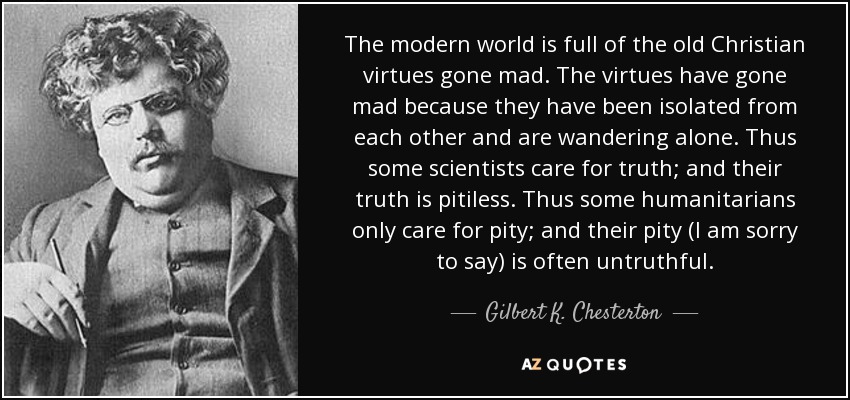
Zizek’s understanding of Christianity, in line with Christians like Girard, Chesterton and Bonhoeffer (see below), allows him to criticize the “religious atheism” of people like Richard Dawkins, Christopher Hitchens, Sam Harris and the like. For instance in the clip below:

Chesterton‘s reading of those famous ‘Eli, Eli, lama sabachtani?’ (‘Father, why have you forsaken me?’) is that only in Christianity, and for him this is crucial, God himself becomes for a moment an atheist. And this is so tremendously important for me.

I think far from this fashionable idea that the Christian era is over, you know, all of this Aquarius bullshit, and we are entering a new era… Yes, we are, but I don’t like this new era, neo-paganism and so on… I think that today precisely we should stick to this tremendous explosive impact, we are still not ready to confront it, of what Christianity is truly telling us.

This is why I like to say paradoxically that to be an atheist, but don’t be afraid, not in the Richard Dawkins – Christopher Hitchens sense, but this authentic atheism in the sense of experiencing the radical absence of any transcendent guarantee (and in this sense, for me, Stalinists, communists, Darwinists are not atheists… no, they always have some higher figure of necessity and so on…), you have to go through Christianity.

My formula is not just that I try to give some atheist reading of Christianity, how God is really meant, that’s bullshit, but that only through the Christian experience can you reach the abyss of what I call atheism, which, again, is something much more radical than all the bullshit of Richard Dawkins and so on.”

Error
This video doesn’t exist


Zizek also explains how Christianity destroys every possible “scapegoat” people can use to escape their own freedom and responsibility. There is no “karma”, no “natural necessity”, etc. that justifies and explains why people are and behave as they do:

“The only way really to be an atheist is through Christianity. Christianity is much more atheist than the usual atheism, which can claim there is no God and so on, but nonetheless it retains a certain trust into the Big Other. This Big Other can be called natural necessity, evolution, or whatever. We humans are nonetheless reduced to a position within the harmonious whole of evolution, whatever, but the difficult thing to accept is again that there is no Big Other, no point of reference which guarantees meaning.”

Error
This video doesn’t exist


Compare all this with the following quote from Dietrich Bonhoeffer (from Widerstand und Ergebung):

“Und wir können nicht redlich sein, ohne zu erkennen, daß wir in der Welt leben müssen — ,’etsi deus non daretur’. Und eben dies erkennen wir – vor Gott! Gott selbst zwingt uns zu dieser Erkenntnis. So führt uns unser Mündigwerden zu einer wahrhaftigeren Erkenntnis unsrer Lage vor Gott. Gott gibt uns zu wissen, daß wir leben müssen als solche, die mit dem Leben ohne Gott fertig werden. Der Gott, der mit uns ist, ist der Gott, der uns verläßt (Markus 15, 34)! Der Gott, der uns in der Welt leben läßt ohne die Arbeitshypothese Gott, ist der Gott, vor dem wir dauernd stehen. Vor und mit Gott leben wir ohne Gott. Gott läßt sich aus der Welt herausdrängen ans Kreuz, Gott ist ohnmächtig und schwach in der Welt und gerade und nur so ist er bei uns und hilft uns. Es ist Matthäus 8,17 ganz deutlich, daß Christus nicht hilft kraft seiner Allmacht, sondern kraft seiner Schwachheit, seines Leidens!

Hier liegt der entscheidende Unterschied zu allen Religionen. Die Religiosität des Menschen weist ihn in seiner Not an die Macht Gottes in der Welt, Gott ist der deus ex machina. Die Bibel weist den Menschen an die Ohnmacht und das Leiden Gottes; nur der leidende Gott kann helfen. Insofern kann man sagen, daß die beschriebene Entwicklung zur Mündigkeit der Welt, durch die mit einer falschen Gottesvorstellung aufgeräumt wird, den Blick frei macht für den Gott der Bibel, der durch seine Ohnmacht in der Welt Macht und Raum gewinnt. Hier wird wohl die ‘weltliche Interpretation’ einzusetzen haben.”


Na meldingen over grensoverschrijdend gedrag van Bart De Pauw zet de Vlaamse openbare omroep VRT de samenwerking met hem stop. Dat nieuws geraakt bekend op 9 november 2017.

Bart De PauwBart De Pauw is geen monster. Daarvan ben ik overtuigd. Tegelijk geloof ik ook niet dat de VRT, of de leiding van de zender, zich louter laat leiden door vage insinuaties van “gefrustreerde vrouwen” om de samenwerking met “goudhaantje” De Pauw te beëindigen. Waarom zou de VRT zichzelf op die manier in de voet schieten? Bart De Pauw is geen monster, maar ook de vrouwen die zich slachtoffer voelen van grensoverschrijdend gedrag door hem zijn dat niet. Van dat laatste ben ik eveneens overtuigd.

Ergens is het begrijpelijk dat Bart De Pauw zelf de zaak via de media aan zijn fans voorlegde. Een mens kan wel wat steun gebruiken als hij na dertig jaar gepassioneerde arbeid op die manier een samenwerking beëindigd ziet. Dat is bijzonder pijnlijk. Daarnaast moet het echter ook bijzonder pijnlijk zijn voor de slachtoffers van grensoverschrijdend gedrag dat steunbetuigingen aan Bart De Pauw ontaarden in het fenomeen van blaming the victim. Advocate Christine Mussche wees daarop in Terzake (10 november 2017).

Femme de la Rue posterEnkele jaren geleden maakte Sofie Peeters Femme de la Rue, een documentaire waarin hetzelfde fenomeen van blaming the victim wordt aangekaart (voor meer: klik hier). Sofie Peeters laat zien hoe ze door verscheidene mannen in de straten van Brussel wordt geïntimideerd. Steevast wordt de verantwoordelijkheid voor de seksueel getinte boodschappen die ze te horen krijgt bij haar gelegd. De mannen uit de documentaire redeneren dat ze zich maar niet zo uitdagend moet kleden als ze met rust wil worden gelaten. Terecht is er toen veel kritiek gekomen op dat soort seksistische redenering. De schuld voor seksuele agressie, in dit geval verbale, in de schoenen van het slachtoffer van die agressie schuiven, maakt van het slachtoffer een zondebok: het slachtoffer krijgt de schuld voor iets waaraan het niet, of op zijn minst niet exclusief, schuldig is. De Frans-Amerikaanse denker René Girard (1923-2015) laat in zijn werk zien hoe gemeenschappen keer op keer zulke zondebokmechanismen gebruiken om een bepaald soort sociale orde te creëren en te rechtvaardigen. In patriarchale samenlevingen zijn niet toevallig vrijgevochten vrouwen vaak kop van Jut, en niet alleen van de mannen in die samenlevingen.

De overgrote meerderheid van de publieke opinie in Vlaanderen sprak schande over de manier waarop de mannen uit de documentaire Femme de la Rue zich bezondigen aan het fenomeen van blaming the victim. Die mannen zouden behoren tot “achterlijke culturen”. Vandaag, naar aanleiding van de toestand rond Bart De Pauw, bezondigt de overgrote meerderheid van de publieke opinie in Vlaanderen zich blijkbaar zélf aan gelijkaardige, “achterlijke” redeneringen. De vrouwelijke redacteurs van nieuwssite newsmonkey verwoorden het als volgt in een genuanceerd stuk (klik hier voor het volledige artikel):

“Terwijl Bart De Pauw niet ontkent dat hij berichtjes stuurde, maar de sms’jes afdoet als ‘een manier om een goede band te creëren met mijn medewerkers’, wordt er door diverse media al gemeld dat er dagelijks berichten werden gestuurd met ‘ik wil je neuken’ erin. Vreemde manier om een band met je werknemers te creëren, als je ‘t ons vraagt. En pas op, flirten is au fond geen probleem, maar de sms’en waren ook wel degelijk ongewenst.

We hebben ons waarschijnlijk allemaal al eens schuldig gemaakt aan een aangebrand sms’je dat achteraf gezien misschien niet helemaal gepast was. Maar opnieuw: er is een groot verschil tussen één verkeerd sms’je of een stroom aan berichten waardoor vrouwen zich geïntimideerd voelen.

[…]

Het is waar dat het soms niet even duidelijk is wanneer bepaald gedrag te ver gaat, net omdat die grens voor iedereen ergens anders ligt, maar als slachtoffers worden afgeschilderd als daders en als sensatiezoekers en Bart De Pauw wordt voorgesteld als het slachtoffer, dan wordt het echt wel hallucinant.

[…]

Met tweets als ‘je blokkeert het nummer gewoon’, ‘ze hebben het zeker gewoon uitgelokt’, ‘ze probeerden hogerop te geraken en nu dat niet gelukt is, liegen ze De Pauw in de val’, is het schandalig hoe er wordt gedacht over slachtoffers als de dader een BV is.

[…]

Het is net door dit soort gedrag dat slachtoffers niet, of pas vele jaren later, met hun verhaal naar buiten komen. Dus alstublieft, bespaar ons het verwijt dat de slachtoffers nu pas melding hebben gemaakt van De Pauws gedrag. Het is de schuld van iedereen die de schuld in de schoenen van de slachtoffers schuift, dat dergelijke situaties niet op een betere manier worden opgelost.

En Bart, wij hopen enerzijds dat de VRT fout zit, maar we geloven vanuit het diepste van ons journalistieke hart dat zij hun beslissing niet zomaar zullen gemaakt hebben. Dus in plaats van Vlaanderen te misleiden met je mistroostige blik, wees een man. Geef gewoon toe dat je er niet stil bij stond dat je erover ging. En zeg dan nog eens oprécht sorry.”

Gedreven door massahysterie kiezen gemeenschappen hun zondebokken. Als Bart De Pauw niet zo populair was, dan was hij misschien, op basis van exact dezelfde karige informatie, aan de schandpaal genageld. Dat speelt mensen in de kaart die zelf boter op het hoofd hebben, maar hun eigen goede naam beschermen door te doen alsof ze “helemaal niet zoals dat monster Bart De Pauw” zijn. Niet alleen gemeenschappen drijven het kwaad in zichzelf uit door het te projecteren op één of meerdere zogezegd “door en door slechte” anderen die dan sociaal worden “afgemaakt”. Ook individuen doen dat.

SchandpaalHet is belangrijk om zowel collectief als individueel zelfkritisch te blijven om al te gemakkelijke, vernietigende oordelen en nietsontziende, meedogenloze heksenjachten te vermijden.

Bart De Pauw moet niet aan de schandpaal worden genageld. De vrouwen die door hem op een grensoverschrijdende manier werden benaderd evenmin. Hopelijk komt er een bemiddeling waar alle betrokken partijen beter van worden.

[KLIK HIER VOOR SAMENVATTING IN HET NEDERLANDS – PDF]

Skeptic Brian Dunning sharply observes the following:

“Who has been the worst throughout history: atheist regimes or religious regimes? Obviously the big numbers come from the 20th century superpowers (China, Russia, Germany) so the answer depends on how you classify those. And this is where the meat of these debates is usually found, splitting hairs on which regime is atheist, which is merely secular, which is non-Christian and thus fair game to be called atheist. […] In summary, the winner of these debates is the one who can convince the other that the big 20th century genocidal maniacs were motivated either by religion or by a desire to destroy religion. The entire debate is the logical fallacy of the excluded middle.

[…]

I’m convinced that arguing either side is merely an opportunistic way to tingle sensitive nerves and sell a lot of books. And, I’m convinced that any discussion of the religious causes of genocide is a divisive distraction from the more worthwhile investigation into the true cultural and psychological causes. We are human beings, and we need to understand our human motivations.

So I am no longer going to participate in the childish debate of what religion has killed more people in history, because it doesn’t matter. The way I see it, you might as well debate what color underpants are worn by the largest number of killers, and try to draw a causal relationship there as well. Religion does not cause you to kill people, and it certainly doesn’t prevent you from killing people. Let’s stop pretending that it does either.”

Dunning, B. “Who Kills More, Religion or Atheism?” Skeptoid Podcast. Skeptoid Media, 27 Nov 2007. Web. 7 Nov 2017. http://skeptoid.com/episodes/4076

See also: http://worldwithoutgenocide.org/

It is strange, indeed, how some people express their outrage about “violent Islam” or “violent religion” on Facebook after an ISIS terror attack in New York that killed eight people (November 3, 2017), while those very same people remain silent about the mass killer in Las Vegas who slaughtered 58 people (October 1, 2017). Makes you wonder if the victims are a primary concern. Maybe victims are primarily used to make political statements?

The problem of violence lies within man himself and in his tendency to deify human preoccupations. Man’s addictive attachment to wealth, pleasure, power and/or honor often creates a deadly cocktail of (self-)destructive behavior. The deification of wealth, pleasure, power and/or honor means that they are considered as ends in themselves. It means that they are considered as goals of mimetically driven desires; as parts of a love for a mimetically constructed psychosocial (self-)image, and not as means to or consequences of a love for one”self” (a self that is, paradoxically maybe, always “relational”) and one’s neighbor.

The deification of wealth, pleasure, power and/or honor prevents the (truly divine) reality of neighborly love. For instance, a capitalist who accepts cheap child labor in his factories is not concerned with his neighbors (in casu the children), but only in the fulfilment of his (mimetically driven) desire for, and love of wealth and social status (“honor”) because of that wealth. Equally, a child molester, like a pedophile priest, is not interested in loving children, but in the fulfilment of his love for pleasure and power. Or another example: a student who is only interested in courses when they are “not boring” is primarily interested in the fulfilment of the desire for pleasure. True love is a learning process, though, which is not always and automatically accompanied by “good feelings”. If, for instance, you want to develop the freedom to play whatever piano piece, you will at first have to develop the discipline to obey certain rules about music theory and piano playing techniques. Which might be boring at times, but you will never learn to enjoy the reality of certain music as a player if you are simply driven by a desire for pleasure. The fact that love is more than “feeling good” also appears when you are sad because of the death of a dearly beloved – and yet you are willing to bear sadness because of love (and not, in a masochistic way, because of sadness itself).

Throughout history, there have been numerous attempts to create a utopian peace that could fully satisfy any one of those aforementioned addictions, or a combination of them. The attempts have always led to large numbers of despair, oppression and bloodshed. Utopias turn to dystopias. It’s a law of human history. Those utopias have been religious as well as secular. Indeed, the addiction to wealth, pleasure, power and/or honor is a universal human temptation, which has nothing to do with defining yourself as a theist or an atheist. Theists as well as atheists sometimes deify wealth, pleasure, power and/or honor.

So, it is no coincidence that:

  • Human history has witnessed the temptation to deify the pursuit of wealth and pleasure. Remember, for instance, the war between Mexican drug cartels?
  • Human history has witnessed the temptation to deify a cultural religious and ethnic identity in order to defend or expand one’s honor and power over against others. Remember, for instance, the Yugoslav wars (1991-2001)? It’s religion and nationalism gone mad.
  • Human history has witnessed the temptation to deify the pursuit of wealth and capital through power. Remember, for instance, colonialism (15th – 20th century)? Or remember, for instance, the so-called “Great Leap Forward” in China (1958-1962)? It’s socioeconomic relations gone mad.
  • Human history has witnessed the temptation to deify an ethnic identity and a so-called “natural order of racial competition” in order to defend or expand one’s honor and power over against others. Remember, for instance, the Holocaust (1933-1945)? It’s nationalism and pseudo-Darwinian ideology gone mad.

It’s in light of these facts that we can reconsider the beginning of the Ten Commandments (Exodus 20, 3-5a):
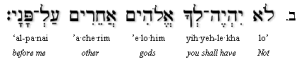
2commandment“You shall have no other gods before me. You shall not make for yourself an image in the form of anything in heaven above or on the earth beneath or in the waters below. You shall not bow down to them or worship them…”

In other words, nothing should be deified. Deification (whether of a material object, an ideological system or a combination of both) leads to slavery and all kinds of mental and physical violence. Expressed paradoxically: in a Jewish sense, to love God means refusing to consider anything as divine (in order to become “children of God”, which is “deification” in a totally different sense!). It is the paradoxically absolute refusal of absolutism, totalitarianism and idolatry, in order to make way for the reality of love. There is no middle ground here. Christians believe that Jesus of Nazareth embodied the absolute refusal of absolutism. That’s why, for instance, Matthew the Evangelist let’s Jesus proclaim (Matthew 12:30a): “Whoever is not with me, is against me…”

[Note: I could have made the following considerations perhaps from a different spiritual tradition, or at least I could have made similar ones. To me, Judeo-Christian tradition is not an end in itself. It is a starting point. So I don’t want to absolutize this religion. On the other hand, I accept that I am a historical creature and I also don’t want to absolutize a so-called self-sufficient a-historical identity. The Judeo-Christian tradition is the woman I coincidentally met and have a relationship with. I don’t need to see all other women first to have an inspiring relationship with this one, enabling me to creatively meet other people as well, men and women.]

Love ultimately is a concern for the reality of the (human and non-human) other because of the other, which is only possible if people are concerned with… their own freedom! In the words of Robert Barron: “Love is not a sentiment or feeling. It is actively willing the good of the other.” Only if you are not fully defined by and attached to your biological need for survival, or your mimetically driven psychosocial desire for safety from potential rivals (power), for entertainment (pleasure), or for approval (honor), can you become free to experience reality more fully (no longer approaching it from any particular need). A scientist is truly a scientist when he is interested in reality because of reality itself, and not, for instance, because of his biological need for survival or because of a psychosocially mediated desire to become famous for his discoveries. What is true is true apart from whatever “need” or “desire”. Truth transcends those circumstances. Moreover, the refusal to deify yourself (which is, in other words, to love God) means that you might lessen the temptation to sacrifice others to or use them for your mimetically driven desire for approval, as you learn to love the reality of who you are. This is “the logic of Jesus” in his conversation with a lawyer (Matthew 22:35-40):

A lawyer asked Jesus a question to test him. “Teacher, which is the great commandment in the Law?” And Jesus said to him, “You shall love the Lord your God with all your heart and with all your soul and with all your mind. This is the great and first commandment. And a second is like it: You shall love your neighbor as yourself. On these two commandments depend all the Law and the Prophets.”

A Depiction of Jesus and the Woman taken in Adultery (Vasily Polenov)Jesus often confronts people with their narcissistic tendencies, or, in other words, with their tendency to deify themselves. For instance, when he is surrounded by people who are about to stone a woman caught in the act of adultery (John 8:1-11), Jesus awakens a sense of reality in each individual. He asks people to consider whether they themselves are “without sin”. After which he decides that “whoever is without sin may cast the first stone”. At first sight this is merely a clever trick that allows Jesus to take control of the situation. Indeed, no Jew would claim to be perfect. That would mean that he claims to be like God, and then he would trespass the first of the ten commandments. So no one can cast the first stone, because that would be one of the greatest sins in the light of Jesus’ saying. At a deeper level, it is precisely Jesus’ constant “iconoclasm” of false self-concepts that, apart from the social position Jesus himself receives for doing so, opens up possibilities for new relationships between people. If you don’t deify yourself, if you don’t surrender to idolatry (of illusionary ideas of yourself), then you become able of accepting yourself more realistically (with your limits and mistakes), and then you might also be more able to accept others (with their limits and mistakes). In other words, if you “love God” (i.e. refuse to deify anything, including yourself), then you open up the possibility of “loving yourself”, which is the condition to “love others”.

Jesus is convinced that the source from which he lives “desires mercy, and not sacrifice” (Matthew 9:13). The consequences of this conviction are paradoxical. It implies that Jesus refuses to merely sacrifice the existing worldly structures to establish his own rule. Jesus acts non-dualistically. Hence he says (Matthew 5:17):

“Do not think that I have come to abolish the Law or the Prophets; I have not come to abolish them but to fulfill them.”

The priority of love implies that existing laws, structures and rituals should be tested against the extent to which they help to avoid making victims and to which they allow for authentic human lives. Man should not live according to rules, as if preserving a social system and its rules would be an end in itself, but rules should be means at the service of individual human beings and society as a whole. When Jesus and his disciples are criticized for doing things that are, strictly speaking, forbidden on the rest day – the Sabbath – Jesus answers (Mark 2:27):

“The Sabbath was made for man, not man for the Sabbath.”

Again, this is a refusal to deify any worldly or human reality. It is a refusal to deify religion, in this case the Jewish one.

BeatitudesOne of the most impressive summaries of the teachings of Jesus is, without a doubt, the Sermon on the Mount. Father Robert Barron makes some very inspiring observations about the eight beatitudes, especially about the four seemingly more “negative” prescriptions (all the following fragments from Robert Barron are taken from Barron, Robert. Catholicism: A Journey to the Heart of the Faith. New York: Image Books, 2011, pp.43-47):

“Thomas Aquinas said that the four typical substitutes for God are wealth, pleasure, power, and honor. Sensing the void within, we attempt to fill it up with some combination of these four things, but only by emptying out the self in love can we make the space for God to fill us. The classical tradition referred to this errant desire as ‘concupiscence,’ but I believe that we could neatly express the same idea with the more contemporary term ‘addiction.’ When we try to satisfy the hunger for God with something less than God, we will naturally be frustrated, and then in our frustration, we will convince ourselves that we need more of that finite good, so we will struggle to achieve it, only to find ourselves again, necessarily, dissatisfied. At this point, a sort of spiritual panic sets in, and we can find ourselves turning obsessively around this creaturely good that can never in principle make us happy.

And so Jesus says: ‘Blessed are the poor in spirit, for theirs is the kingdom of heaven’ (Mt 5:3). This is neither a romanticizing of economic poverty nor a demonization of wealth, but rather a formula for detachment. Might I suggest a somewhat variant rendition: how blessed are you if you are not attached to material things, if you have not placed the goods that wealth can buy at the center of your concern? When the Kingdom of God [love, mercy, grace] is your ultimate concern, not only will you not become addicted to material things; you will, in fact, be able to use them with great effectiveness for God’s purposes [love]. Under this same rubric of detachment consider the beatitude ‘Blessed are they who mourn, for they will be comforted’ (Mt 5:4). Again, this can sound like the worst sort of masochism, but we have to dig deeper. We could render this adage as how blessed, how ‘lucky’… you are if you are not addicted to good feelings. Pleasant sensations – physical, emotional, psychological – are wonderful, but since they are only a finite good, they can easily drive an addiction, as can clearly be seen in the prevalence of psychotropic drugs, gluttonous habits of consumption, and pornography in our culture. Again, Jesus’s saying hasn’t a thing to do with puritanism; it has to do with detachment and hence with spiritual freedom. Unaddicted to sensual pleasure, one can unreservedly follow the will of God, even when such a path involves psychological or physical suffering.”

I wrote an earlier post on this blog about the religious vows (click here for more). It joins the previous considerations by Father Barron:

Saint Francis of AssisiBefore I got to know the Christian faith I always thought the three religious vows were an abomination. Why would anyone deliberately choose a seemingly masochistic way of a life in “poverty, chastity and obedience”? Only after I saw a documentary on the Franciscan Friars of the Renewal in New York and only after I delved into the Gospels more carefully I discovered that these vows were not ends in themselves, but should actually be understood as means to seeming antitheses of those very vows. It turns out that the three religious vows are anything but masochistic. They should be based on the paradox of the Gospel:

For whoever wants to save their life will lose it… What good is it for someone to gain the whole world, and yet lose or forfeit their very self?” (Luke 9:24a-25).

Concerning the vow of poverty: For whoever wants to save their life will lose it… translates to For whoever wants to become rich will become poor… Indeed. Ever met those people who “wanted it all” – perhaps in the mirror? Those who want to enjoy as much parties as possible? If you want all the clothes in the world and go out shopping all the time you won’t ever fully enjoy any of your clothes. If you want to attend ten parties in just one night you will not have enjoyed any of them, because you will constantly worry about the next party you might be missing. If you want to love all the women in the world, you won’t have loved any of them in the end.

The challenge is to choose life where it’s present. As a present. To quote John Lennon: “Life is what happens to you while you’re busy making other plans.” The challenge is to live in the here and the now. To choose quality instead of worrying about quantity. Intensity. NON MULTA SED MULTUM. Epicurus (BC 341-270) already warns against discomposing desires: “Do not spoil what you have by desiring what you have not; remember that what you now have was once among the things you only hoped for.” If you stop trying to possess what others have (which is the same as no longer surrendering to mimetic desire), you will become aware of the things you do have and discover that there’s a world of plenty in one single moment, at one place.

Saint Francis of Assisi (Regina Ammerman)Imagine what this attitude of “having enough” could mean for the natural environment! It’s no surprise Saint Francis of Assisi (1181-1226) deeply respected and enjoyed the riches of nature… If only we could follow his example a little better.

Concerning the vow of chastity: For whoever wants to save their life will lose it… translates to For whoever wants to love everyone will not be able to love anyone… If you are a heterosexual bachelor who tries to develop a friendly relationship with a woman, you might soon find out that the woman herself or others fear you’re friendly because you want “something more”. This fear might prevent the possibility of more intimate relationships. On the other hand, when people know you’re married or that you took another voSaint Francis and the Sultanw of chastity, they will not have to fear you’re “after something more than friendship”. This opens up the possibility of more authentic and intimate relationships. It opens up the possibility of meeting the other as “other”, of true personal care – CURA PERSONALIS. Of course, we all know that in human relationships there is no black and white. There’s lots of colors in between the limits of a “grey zone”.

In yet other words, using another formula from the Gospels (the aforementioned “The Sabbath was made for man, not man for the Sabbath”):

Wealth is there for man (in service of neighborly love – considering wealth as a means to help our neighbor), not man for wealth (we shouldn’t exploit our neighbor to become wealthy – considering wealth as our goal, and not our neighbor). That’s why Jesus says: “Blessed are the poor in spirit, for theirs is the kingdom of heaven [the reality of love]” (Mt 5:3).

The development of a sexual relationship might be a consequence of our love for the other, as it is not the end of our relationship. The other should not be a means to satisfy our sexual desires, but our sexual desires are, in ideal circumstances, consequences of a very intimate friendship. True love accepts to bear sadness when beloved others are unhappy, it does not seek pleasure at the expense of others (a child molester, for instance, doesn’t care about the brokenness of his victim as he is addicted to pleasure).

If you don’t flee sadness because of the loss of a dearly beloved by “drinking away ‘bad feelings’ with alcohol”, you might allow the source of your sadness, which is the reality of the love for the person you lost. And by allowing that love, you also allow the comforting gratitude for what that person gave you and meant to you. That’s why Jesus says: “Blessed are they who mourn, for they will be comforted” (Mt 5:4).

Father Barron again:

“Jesus says, ‘Blessed are the meek, for they will inherit the land’ (Mt 5:5). I don’t know of any culture at any time that would be tempted to embrace this beatitude as a practical program of world conquest! Meek people don’t come to positions of political or institutional influence. But once more, Jesus is not so much passing judgment on institutions of power as he is showing a path of detachment. How lucky you are if you are not attached to the finite good of worldly power. Many people up and down the centuries have felt that the acquisition of power is the key to beatitude. In the temptation scene in the Gospel of Matthew, the devil, after luring Christ with the relatively low-level temptations toward sensual pleasure and pride, brings Jesus to the top of a tall mountain and reveals to him all of the kingdoms of the world in their glory and offers them to Jesus. Matthew’s implication is that the drive to power is perhaps the strongest, most irresistible temptation of all. In the twentieth century, J.R.R. Tolkien, who had tasted at first hand the horrors of the First World War and had witnessed those of the Second, conceived a ring of power as the most tempting talisman in his Lord of the Rings trilogy. But if you are detached from worldly power, you can follow the will of God, even when that path involves extreme powerlessness. Meek – free from the addiction to ordinary power – you can become a conduit of true divine power to the world.

The last of the ‘negative’ beatitudes is ‘Blessed are they who are persecuted for the sake of righteousness, for theirs is the kingdom of heaven’ (Mt 5:10). We must read this, once again, in light of Thomas Aquinas’s analysis. If the call to poverty holds off the addiction to material things, and the summons to mourn counters the addiction to good feelings, and the valorization of meekness blocks the addiction to power, this last beatitude gets in the way of the addictive attachment to honor. Honor is a good thing in the measure that it is a “flag of virtue,” signaling to others the presence of some excellence, but when love of honor becomes the center of one’s concern, it, like any other finite good, becomes a source of suffering. Many people who are not terribly attracted to wealth, pleasure, or power are held captive by their desire for the approval of others, and they will accordingly, order their lives, arrange their work, and plot their careers with the single value in mind of being noticed, honored and endowed with titles. But this again involves the attempt to fill up the infinite longing with a finite good, and it produces, by the laws of spiritual physics, addiction. Therefore, how lucky are you if you are not attached to honor and hence are able to follow the will of God even when that path involves being ignored, dishonored, and, at the limit, persecuted.”

agape loveTo gain social recognition often means that you’re accepted not for who you are, but for the image you’re presenting of yourself. Indeed, you’re losing your life while trying to “gain the whole world”. This process might also imply that you’re sacrificing others to protect that socially acceptable image. The apostle Peter denies knowing Jesus when the latter is arrested, instead of defending Jesus. Fearing that his association with Jesus will make him socially unacceptable as well, Peter presents an untruthful image of himself. From this angle Jesus rightfully says: “But whoever loses their life for me will save it…” (Luke 9:24b). If you lose your socially acceptable image to defend the one who is socially deprived, you will gain a truer identity as an unexpected and surprising consequence. To (re)establish relationships with the excluded is to take part in the dynamic of agape (love for one’s neighbor). It is making the “Body of Christ” – which is a body of Love – transparent. In short, if you lose the love for your image, then you gain love for yourself and others.

Faces of Christ (Body of Christ)

Concerning the vow of obedience: For whoever wants to save their life will lose it… translates to For whoever wants to be free will be imprisoned… Oh yes, we tend to listen to the ones who are promising us a great future, a beautiful career, happiness etc. – in one word: “paradise”. But if a workaholic keeps on listening to his boss, he will remain a puppet of a degrading work ethic. If a drug addict keeps on believing the drug dealer who tells him that he doesn’t really have any problem, he will remain an enslaved human being for the rest of his life… In contrast, the vow of obedience means that you will try to obey to the Voice of a Love that wants what’s best for you. It means listening to a Voice that liberates you and enables you to be who you are… Only if you’re capable of accepting and loving yourself, you will be capable of loving others as well. The drug addict is so in need of drugs that he will approach others because of this need. He will use others to satisfy his needs and he won’t be able to approach them as ends in themselves. But if he frees himself from these needs and takes responsibility for himself he will be able to take responsibility for others as well. FREEDOM AND RESPONSIBILITY are twin brothers, or sisters…

Father Barron has the last word:

Thomas Aquinas (Gentile da Fabriano)“Thomas Aquinas said that if you want to see the perfect exemplification of the beatitudes, you should look to Christ crucified. The saint specified this observation as follows: if you want beatitude (happiness), despise what Jesus despised on the cross and love what he loved on the cross. What did he despise on the cross but the four classical addictions? The crucified Jesus was utterly detached from wealth and worldly goods. He was stripped naked, and his hands, fixed to the wood of the cross, could grasp at nothing. More to it, he was detached from pleasure. On the cross, Jesus underwent the most agonizing kind of physical torment, a pain that was literally excruciating (ex cruce, from the cross), but he also experienced the extreme of psychological and even spiritual suffering (‘My God, my God, why have you forsaken me?’). And he was bereft of power, even to the point of being unable to move or defend himself in any way. Finally on that terrible cross he was completely detached from the esteem of others. In a public place not far from the gate of Jerusalem, he hung from an instrument of torture, exposed to the mockery of the crowd, displayed as a common criminal. In this, he endured the ultimate of dishonor. In the most dramatic way possible, therefore, the crucified Jesus demonstrates a liberation from the four principal temptations that lead us away from God. […]

But what did Jesus love on the cross? He loved the will of his Father [Love]. […] What he loved and what he despised were in a strange balance on the cross. Poor in spirit, meek, mourning, and persecuted, he was able to be pure of heart, to seek righteousness utterly, to become the ultimate peacemaker, and to be the perfect conduit of the divine mercy to the world. Though it is supremely paradoxical to say so, the crucified Jesus is the man of beatitude, a truly happy man. And if we recall our discussion of freedom, we can say that Jesus nailed to the cross is the very icon of liberty, for he is free from those attachments that would prevent him from attaining the true good, which is doing the will of his Father [Love].

One of the most brutally realistic and spiritually powerful depictions of the crucifixion is the central panel of the Isenheim Altarpiece painted in the late fifteenth century by the German artist Matthias Grünewald. Jesus’s body is covered with sores and wounds, his head is surrounded by a particularly brutal crown of thorns, his hands and feet are pierced, not with tiny nails, but with enormous spikes, and, perhaps most terribly, his mouth is agape in worldless agony. The viewer is spared none of the horror of this most horrible of deaths. To the right of the figure of Jesus, Grünewald has painted, in an eloquent anachronism, John the Baptist, the herald and forerunner of the Messiah. John is indicating Jesus as the Lamb of God, but he does so in the most peculiar way. Instead of pointing directly at the Lord, John’s arm and hand are oddly twisted, as though he had to contort himself in order to perform his task. One wonders whether Grünewald was suggesting that our distorted expectations of what constitutes a joyful and free life have to be twisted out of shape (and hence back into proper shape) in order for us to grasp the strange truth revealed in the crucified Christ.”

Isenheim Altarpiece (Matthias Grünewald)

Original Latin text Robert Barron refers to:

Sancti Thomae de Aquino Expositio in Symbolum Apostolorum (reportatio Reginaldi de Piperno)

(Textum Taurini 1954 editum ac automato translatum a Roberto Busa SJ in taenias magneticas denuo recognovit Enrique Alarcón atque instruxit)

Articulus 4

Passus sub Pontio Pilato, crucifixus, mortuus et sepultus

[…]

Nam, sicut dicit beatus Augustinus, passio Christi sufficit ad informandum totaliter vitam nostram. Quicumque enim vult perfecte vivere, nihil aliud faciat nisi quod contemnat quae Christus in cruce contempsit, et appetat quae Christus appetiit. Nullum enim exemplum virtutis abest a cruce.

[…]

Si quaeris exemplum contemnendi terrena, sequere eum qui est rex regum et dominus dominantium, in quo sunt thesauri sapientiae; in cruce tamen nudatum, illusum, consputum, caesum, spinis coronatum, et felle et aceto potatum, et mortuum. Igitur non afficiaris ad vestes, et ad divitias: quia diviserunt sibi vestimenta mea, Psal. XXI, 19; non ad honores, quia ego ludibria et verbera expertus sum; non ad dignitates, quia plectentes coronam de spinis imposuerunt capiti meo; non ad delicias, quia in siti mea potaverunt me aceto, Psal. LXVIII, 22.

Dutch Translation – Vertaling:

Artikel 4

Geleden onder Pontius Pilatus, gekruisigd, gestorven en begraven

[…]

Want zoals de zalige Augustinus zegt, de passie van Christus volstaat om de totaliteit van ons leven vorm te geven. Wie volmaakt wil leven, zou niets anders moeten doen dan verachten wat Christus verachtte op het kruis, en verlangen wat Christus verlangde [op het kruis].

[…]

Als je een voorbeeld zoekt van de verachting van aardse dingen, volg dan hem die de koning der koningen is en de heer der heerscharen, in wie zich de schatten bevinden van de wijsheid; op het kruis werd hij ontkleed, bespot, bespuwd, geslagen, gekroond met doornen, en gelaafd met azijn en gal, en is er gestorven. Daarom, wees niet gehecht aan kledij, en aan rijkdommen: want ze verdeelden mijn kleren onder hen, Psalm 21, 19; [wees] ook niet [gehecht] aan eer(bewijzen), want ik heb harde woorden en verwijten ondergaan; [wees] ook niet [gehecht] aan sociale rang (waardigheid, macht), want een doornen kroon wevend plaatsten ze die op mijn hoofd; [wees] ook niet [gehecht] aan genotvolle dingen, want in mijn dorst gaven ze mij azijn te drinken, Psalm 68, 22.

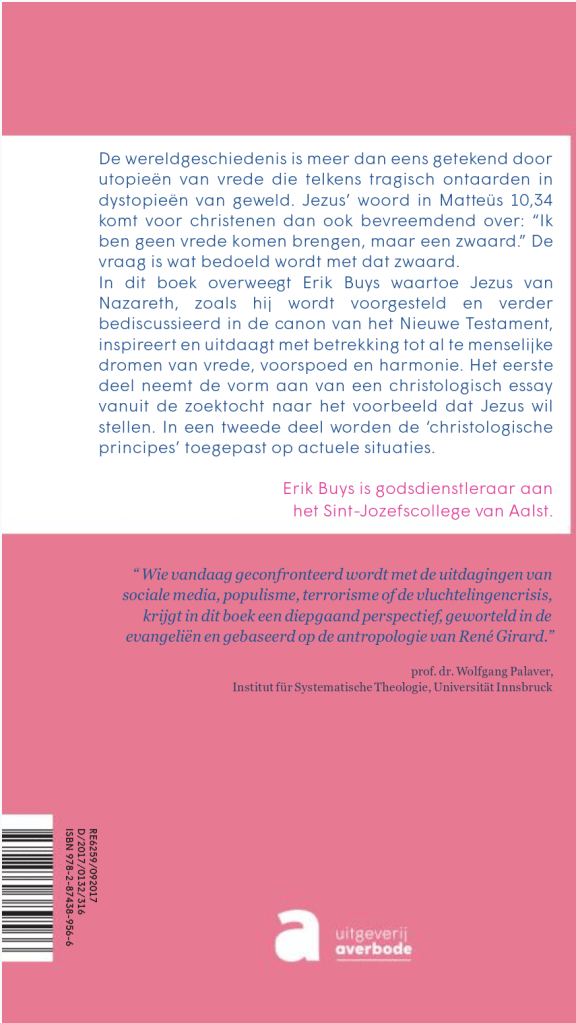
GEEN VREDE, MAAR EEN ZWAARD – Een christelijke provocatie in tijden van Facebook, IS en vluchtelingenstromen is onder andere te bestellen bij uitgeverij Averbode – klik hier. Geïnteresseerden kunnen hieronder meer informatie vinden.

De wereldgeschiedenis is meer dan eens getekend door utopieën van vrede die telkens tragisch ontaarden in dystopieën van geweld. Jezus’ woord in Matteüs 10,34 komt voor christenen dan ook bevreemdend over: “Ik ben geen vrede komen brengen, maar een zwaard.” De vraag is wat bedoeld wordt met dat zwaard.

geen vrede, maar een zwaard (front cover) - Erik Buys

geen vrede, maar een zwaard (back cover) - Erik Buys

In dit boek overweegt Erik Buys waartoe Jezus van Nazareth, zoals hij wordt voorgesteld en verder bediscussieerd in de canon van het Nieuwe Testament, inspireert en uitdaagt met betrekking tot al te menselijke dromen van vrede, voorspoed en harmonie. Het eerste deel neemt de vorm aan van een christologisch essay vanuit de zoektocht naar het voorbeeld dat Jezus wil stellen. In een tweede deel worden de ‘christologische principes’ toegepast op actuele situaties.

Op zaterdag 4 november, van 11 tot 12 uur, wordt het boek voorgesteld op de Antwerpse boekenbeurs in de vorm van een panelgesprek met Mark Janssens (presentator bij Klara), Nikolaas Sintobin s.j. (internetpastor), Filip Noël o.praem. (redacteur bij uitgeverij Averbode), Alexander Van de Sijpe en Karel Brackeniers (oud-leerlingen van het Sint-Jozefscollege, Aalst).


Prof. dr. Wolfgang Palaver, Institut für Systematische Theologie, Universität Innsbruck:

Wie vandaag geconfronteerd wordt met de uitdagingen van sociale media, populisme, terrorisme of de vluchtelingencrisis, krijgt in dit boek een diepgaand perspectief, geworteld in de evangeliën en gebaseerd op de antropologie van René Girard.

Prof. George Dunn, University of Indianapolis, USA & Zhejiang University, China:

De manier waarop Erik Buys het evangelie begrijpt, is grondig geïnformeerd door zijn verkenning van René Girards mimetische theorie, die hij kent als zijn broekzak. Hij slaagt erin om met een veelheid aan goed gekozen voorbeelden de betekenis van het evangelie te belichten met behulp van Girards inzichten. Daarnaast heeft hij een uitzonderlijk scherp oog voor de complexe dynamieken van verlangen en ressentiment, die vormgeven aan actuele gebeurtenissen. Hij geeft een intrigerend christelijk antwoord op de crisissen van onze tijd.

Interview door Adam Ericksen van The Raven Foundation:

Here are a few topics we discussed:

The logic and the scandal of Jesus are both provocative.

If you call yourself a “Christian nation” but you exclude refugees, then you aren’t a Christian nation.

You have more in common with your enemy than you think.

Narcissism. Like, was Jesus a narcissist?

The Gerasene Demoniac and our need for common enemies.

How, in the 19th century, Nietzsche explained the motivation of ISIS warriors. Whoa … Nietzsche was brilliant.

The real miracle of Jesus is not that he can manipulate nature and natural forces. The real miracle is that he is concerned about people who do not belong to the group. All any of us want is to belong. Well, with Jesus, you have a place at the table. You belong. But so does your enemy … That could be awkward … So, where are you going to sit?

Hope you enjoy this provocative conversation!

Inhoudsopgave (pdf)

geen vrede, maar een zwaard (inhoudsopgave eerste deel)geen vrede, maar een zwaard (inhoudsopgave tweede deel)

Peace I leave with you

Muslim WomenOnce upon a time, there was this Muslim woman who wore a headscarf and always went on a rant when she saw other Muslim women without headscarves. She thought Muslim women without the scarf were “bad Muslims”. After her husband died, however, she herself decided not to wear the scarf any longer and let her hair hang down. As it turned out, she had been afraid of her husband, her family and the village she used to live in, and that was the real reason why she had worn the scarf. She thought that she would have lost face when she didn’t dress like the other women in her village. All along, she had desired to walk around like Muslim women without a headscarf, but because she hadn’t been able to fulfill this desire, she had convinced herself that she didn’t want to walk around without a headscarf, and she had begun to despise women who didn’t wear a scarf. That’s how she had comforted herself, how she had reconciled herself with her situation. In other words, this woman had been driven by ressentiment: she had developed an aversion towards something she had secretly desired.

Muslim WomanA couple of years ago, I had the privilege of welcoming some Muslim girls in my religion class. Among them were two sisters from Chechnya. Years later I came across them again in the streets of my hometown. One was wearing a headscarf, the other was not. I asked the one without the scarf if she considered herself less religious than her sister. She assured me that this was not the case, and her sister, the one with the scarf, added that it was not really an issue. The latter also wasn’t at all disturbed that her sister didn’t wear a scarf. She was happy with wearing a headscarf, it was her freely chosen way of symbolizing her faith, but she could understand that her sister made other choices.

Makes you think… Apparently, to point the finger at someone sometimes has to do with a desire to uphold a certain reputation or image. If you do things because of love for what you are doing, you are less inclined to judge people who make other choices (within certain ethical limits, of course).

Collegecross SJC Aalst 2016Yesterday our high school (Sint-Jozefscollege, Aalst – Belgium) organized its yearly run. Since a couple of years, our senior year students try to make their run more playful and humorous, instead of competitive. They just want to have some fun together. What I notice, however, is that a few of them do feel tempted to act like a nuisance to other students (or, in the past, to teachers and principals as well). They can’t seem to accept that not every student has the same idea of fun and humor. To those (few) students who point fingers at supposedly “uncool” and “lacking sense of humor” classmates, I would ask: if you are enjoying yourselves and if you are having fun (because of love for… the fun!), why would you care about others and their idea of fun? The thing is, if “having fun” and “being humorous” become serious business, not allowed to being put into perspective and to being criticized, then they gradually lose the fun and the humor. Especially when they become moral instruments for judging others.
This all happens when “having fun” is not primarily a sign that people are enjoying themselves, but is a way of establishing a “cool” reputation or image. Some students seem to imagine that they are performing some “heroic act against an all too disciplined school system” (which is not the case; our school is very tolerating – but maybe some of our students are a bit spoiled?). Their all too necessary “humor” becomes an outlet for frustrations. Although they reproach others with being humorless, they themselves seem filled with bitterness, unable to minimize the importance of their “fun”. Fun at the expense of others is no fun at all. It is often a sign of ressentiment.

In short, like a Muslim woman who wears a headscarf because she wants to uphold a certain reputation, some students “have fun” because they want to be noticed as “cool dudes”. It’s basic narcissism. And like the Muslim woman who wears a headscarf because of her image has the tendency to point fingers at others (she blames Muslim women without a headscarf for “not being true Muslims”), some students who “have fun” because of their image also have the tendency to point fingers at others (they blame the student who doesn’t take part in their particular activity for “not being humorous”).

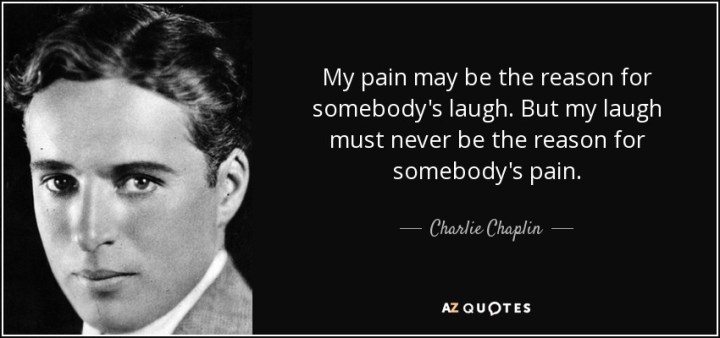
Charlie Chaplin Quote on Laugh

On the other hand, a Muslim woman who freely wears a headscarf, because of love, will not have the tendency to point fingers at others. She will not bother or harm others. After all, she loves how she dresses. Equally, students who freely enjoy themselves, because of love, will not have the tendency to point fingers at others. They will not bother or harm others. After all, they love what they are doing…

  • THE SPIRITUALITY OF A SCIENTIFIC ATTITUDE

Spirituality or a spiritual attitude basically consists of an interest in reality because of reality itself. It means that you do not reduce reality to a particular need or something that is useful (and, of course, what human beings need is not only defined by nature; we also mimetically learned to desire things beyond merely biological needs – nurture has its way as well in human life). It also means that the question of something’s or someone’s worth is not dependent on the question of usefulness. For instance, in a spiritual sense it makes no sense to ask about a newborn baby what he or she can be used for.

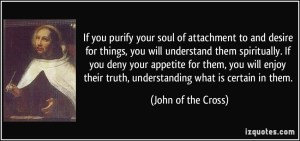
Nowadays we often seem brainwashed to approach reality from a utilitarian or even purely economic point of view. But this means that other aspects of reality and a more complete understanding of it remain in the dark. Therefore, St. John of the Cross writes:

St John of the Cross quote on spiritual understandingIf you purify your soul of attachment to and desire for things, you will understand them spiritually. If you deny your appetite for them, you will enjoy their truth, understanding what is certain in them.

Indeed, if a student no longer approaches a poem merely because of a possible test about it and because of a desire to get good grades, the student can become interested in the poem because of the poem itself – and enjoy its beauty. Indeed, if a physicist does not approach nature from the question how it can be made of use for the survival of the human species (what physicists rarely do, anyway), the physicist may approach the truth of nature more fully – and enjoy its poetry.

carrot and stick methodTruth, in whatever sense, does not primarily have to be useful. Truth has to be true. Nowadays, all too often in science too, research is legitimized by utilitarian concerns. But this is not what drives scientists who are involved in a quest for truth. The following clip may illustrate this. It is about assistant Professor Chao-Lin Kuo who surprises Professor Andrei Linde with evidence that supports cosmic inflation theory. The discovery, made by Kuo and his colleagues at the BICEP2 experiment, represents the first images of gravitational waves, or ripples in space-time. These waves have been described as the “first tremors of the Big Bang.” Note that possible recognition by organizations like the Nobel Prize Committee is a consequence of what these scientists do, it is not a goal that serves as the source of their passion and vocation as “truth seekers” (they are not enslaved donkeys who need that kind of carrot to move). Click to watch:
Error
This video doesn’t exist


  • SPIRITUALITY IN AMERICAN BEAUTY (SAM MENDES, 1999)

The core of the spiritual attitude is portrayed magnificently in American Beauty (the 1999 Sam Mendes picture that would eventually win 5 Academy Awards out of 8 nominations). Lester Burnham, the main character (played by Academy Award winning actor Kevin Spacey), “passes from death to life” as he awakens to a fuller awareness of reality. In the beginning of the film Lester is entangled in the preoccupations of a society that focuses on appearances. Clearly he has gradually learned to approach other people and things from the question whether or not they are useful in his pursuit of happiness. Instead of giving him a fulfilled life, this utilitarian approach has left him empty and alienated from himself and others. “In a way, I am dead already,” he says.

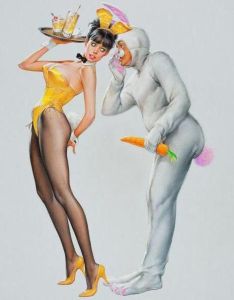
Playboy Bunny Carrot CartoonThroughout the film, Lester becomes obsessed with the young “American Beauty” Angela, a friend of his daughter Jane. He mainly fantasizes about her as the ultimate fulfillment of his sexual desires. Angela knows about this male gaze all too well, and she presents herself accordingly in order to gain some sort of (questionable) recognition. Maybe she could have become a playboy bunny in the mansion of the late Hugh Hefner (1926-2017), who knows?

Angela appears to be a sexually very experienced girl. The reality, however, is that she is still a virgin. Lester awakens to this reality when he is on the verge of having sex with her. “This is my first time,” she tells him. This statement literally brings Lester to his senses. After that, he no longer approaches Angela from his particular needs, but he opens up to the more complete reality of the vulnerable angel that she is. In short, Lester becomes interested in Angela because of Angela herself, and not because of the satisfaction of his desires. For the first time he really looks at her more closely. He learns to love the truth and beauty of who she is, and is no longer blinded by who she appears to be. He converts to Love.

Lester has rediscovered a truly spiritual perspective on life, a perspective that is exemplified throughout the film by the character of Ricky, the son of the family next door. Ricky is able to contemplate reality because of reality itself and discovers beauty in all things. He is even moved by a bag, dancing in the wind. As he watches the film he made of it together with Jane, he says:

Do you want to see the most beautiful thing I’ve ever filmed? It was one of those days when it’s a minute away from snowing. And there’s this electricity in the air. You can almost hear it, right? And this bag was just… dancing with me… like a little kid begging me to play with it. For fifteen minutes. That’s the day I realized that there was this entire life behind things, and this incredibly benevolent force that wanted me to know that there was no reason to be afraid… ever. Video is a poor excuse, I know. But it helps me remember… I need to remember… Sometimes there’s so much beauty in the world I feel like I can’t take it, and my heart is just going to cave in.

Click to watch this scene:

Error
This video doesn’t exist

These words of Ricky are repeated at the end of the film by Lester, whose voice over is actually the voice over of a dead man, a murdered man. By quoting the words of Ricky, Lester shows that he has truly become alive to reality as a whole. The paradox, of course, is that in the beginning of the film Lester is physically alive but dead spiritually (remember him saying, “In a way, I am dead already.”). At the end of the film he is dead physically but resurrected to a spiritually fulfilled life.

Biblically speaking, Lester went from being like Cain to being like Abel (see Genesis 4). Apparently, Cain’s goal in life is the recognition of others. He desires the affirmation of a certain idea of himself, and thus does not love himself nor others (he is not interested in others because of themselves, but because of his desire for recognition). Abel, on the other hand, approaches others because of a love for those others themselves. He presents a gift to make someone happy, not to gain some sort of status or prestige. Of course, the possible consequence of love is recognition. Cain, in contrast, presents a gift to get attention. That’s why he becomes jealous of his brother Abel when he sees that Abel’s gift is noticed and his is not. If Cain’s goal would have been to love the other, he would have been happy to see the other happy, even if it wasn’t with his gift. Cain’s deeds, however, clearly are not inspired by love. That’s why he becomes mad and that’s why he is unable to feel gratitude for the attention he does receive when the other he presented his gift to asks him, “Why are you so mad?” Dead to himself, Cain is dead to others as well. Eventually, Abel is also physically murdered by him. Indeed, if you’re associated with others who become obstacles to a desirable social image, you run the risk of being banned, eliminated or killed. Concerned with socially acceptable images, people tend to be in a constant state of transiency (“eternal life does not reside” in their identity, as they constantly have to change it to what’s popular), which, like Cain, leads them to hate themselves and others. In the New Testament, the first letter of John summarizes all of these insights (1 John 3: 11-15):

This is the message you heard from the beginning: We should love one another. Do not be like Cain, who belonged to the evil one and murdered his brother. And why did he murder him? Because his own actions were evil and his brother’s were righteous. Do not be surprised, my brothers and sisters, if the world hates you. We know that we have passed from death to life, because we love each other. Anyone who does not love remains in death. Anyone who hates a brother or sister is a murderer, and you know that no murderer has eternal life residing in him.

In American Beauty, Lester becomes one of those victims of people who want to protect their self-image. However, instead of mimetically responding to the lack of love and the evil that he had to endure by seeking revenge, he focuses on the love he did receive. That’s why he does not stay mad. That’s why he is eventually fulfilled with gratitude. Filled with grace, he becomes merciful – a forgiving victim (see James Alison’s theology). These are his final words:

I guess I could be pretty pissed off about what happened to me… but it’s hard to stay mad, when there’s so much beauty in the world. Sometimes I feel like I’m seeing it all at once, and it’s too much, my heart fills up like a balloon that’s about to burst… And then I remember to relax, and stop trying to hold on to it, and then it flows through me like rain and I can’t feel anything but gratitude for every single moment of my stupid little life… You have no idea what I’m talking about, I’m sure. But don’t worry… You will someday.

Click to watch more scenes and their analysis:


CLICK HERE TO SEE SCAPEGOATING IN AMERICAN BEAUTY

  • HET VERHAAL VAN SOFIE

Sofie was nog net geen vijftien jaar toen ze op een vrijdagavond het huis uit sloop om naar een fuif van haar jeugdbeweging te fietsen in de parochiezaal van haar dorp. Ze had geen toelating gekregen van haar ouders, maar ze was vastbesloten om eens iets “rebels” te doen. In wat volgt, beschrijft Sofie hoe haar avond eindigde.

Vrij naar een fragment uit Brief aan Cooper en de wereld van Dalilla Hermans, Manteau, 2017:

“Ik probeerde me te amuseren, maar was de hele avond toch ook zenuwachtig. Ik had nog nooit zoiets rebels gedaan. En ik voelde me al snel schuldig. Lang voor de anderen besliste ik dan ook gewoon naar huis terug te gaan. Ik had uiteindelijk mijn punt wel bewezen. Ik was op een fuif geweest, en ik had iets stiekem gedaan. Ik was de ultieme puber.

Het was intussen nacht. In het donker zocht ik naar mijn fiets in de bosjes naast de kerk. Ik zocht mijn fietssleutel in het kleine tasje waarin ik de paarse lippenstift en mijn geld had gestopt. Hoe klein een tasje ook is, je verliest er altijd je sleutel in, vraag maar aan elke vrouw. Opeens hoorde ik gelach, vlakbij. Het klonk anders dan het geroezemoes dat door de lucht waaide van de parking van de parochiezaal. Het klonk gemaakt, vals.

‘Da’s Sofie’, hoorde ik een jongensstem zeggen. Mijn adem stokte. Ik draaide me om. In het donker zag ik een paar figuren op me afkomen. Ik voelde meteen dat het niet goed was, dat ik in gevaar was. Ik durfde me niet meer te bewegen, stond aan de grond genageld, mijn hand nog in het tasje. De jongens kwamen in een halve cirkel om me heen staan. Ik herkende een van hen vaag, waarschijnlijk degene die mijn naam had genoemd. De andere jongens had ik nog nooit gezien.

Het was te donker om een goed zicht te krijgen op wie er voor me stonden. Toen er een auto voorbijreed, zag ik even snel hun gezichten. De grootste, de oudste ook waarschijnlijk, stond in het midden voor me, bedreigend dichtbij. Hij had donkere ogen, ijzige ogen, die oplichtten door de koplampen van de auto. Zijn haar was donkerbruin, kortgeknipt, licht krullend. De andere jongens zagen er net zo uit. Ze droegen nauw aansluitende jeans, sportschoenen en leren jekkers. Ze spraken met hetzelfde, lichte accent. Plots herkende ik ze. Het was het groepje Marokkaanse moslimjongens dat ik altijd passeerde op weg naar het station. Ze hadden mij al eerder verbaal lastiggevallen. Ik hoorde het hen weer zeggen: ‘Met Mohammed heb je de beste seks, Vlaamse slet.’ Dat alles besefte ik in de paar seconden dat ik daar zo stond.

Het leken een paar uren. De grootste zei iets tegen me, spottend, en spuwde op de grond. Ik had het niet verstaan. Ik durfde nog steeds niet me te bewegen, hield mijn adem in. Ik keek hem aan met grote, bange ogen. Met mijn blik pleitte ik om met rust te worden gelaten. Zonder woorden gilde ik dat ik gewoon naar huis wilde. Met mijn opengesperde ogen smekend dat ze weg wilden gaan. Zwijgend. Dat leken ze grappig te vinden, dat ik niets durfde te zeggen.

Ze porden elkaar, lachten. Ik rook hun adem, zo dichtbij stonden ze. Nog altijd verstond ik niet wat ze zeiden. Ik zat gevangen in een verstard lichaam, stijf van angst en in paniek. Wat waren ze van plan? Niemand kon me hier horen, niemand kon me zien. Niemand wist waar ik was. Opeens was er een woord waardoor ik weer bij mijn positieven kwam. Iemand zei ‘zeiken’. Het duurde een tel voordat mijn brein dat verwerkt had. ‘Ik moet eigenlijk ook zeiken’, klonk uit de mond van een ander.

Ze zouden toch niet… Dat kon niet. Zoiets gebeurt niet, niet in het echt, niet met mij. Nog voordat ik die gedachte kon afmaken, voelde ik iets warms en nats tegen mijn been klateren. Ik voelde mijn broek, die ik nog maar pas had gekregen, voor in de winter wanneer we geen uniformrok moesten dragen, nat en zwaar worden. Ik zag rook omhoog kringelen, van de warme urine die dampte in de koude nachtlucht.

Ik dacht dat ik flauw zou vallen. Of zou overgeven. Ik wilde schreeuwen. Ik wilde… Maar ik deed niks. Ik stond daar, gevangen in een verstard lichaam, terwijl de jongens op me plasten. Ik sloot mijn ogen. Ik weet niet hoelang ik daar zo heb gestaan. Ik weet niet hoelang de hele episode heeft geduurd.

Toen ik mijn ogen opende, waren ze aan het weglopen. Ze lachten. Luid, vals, triomfantelijk. Op de automatische piloot vond ik mijn fietssleutel en fietste naar huis. Ik huilde niet. Thuisgekomen stroopte ik de natte broek van mijn lijf. Ik rolde het ding tot een bal en wierp het in een hoek van de garage. Ik ging gewoon slapen.

Ik vertelde aan niemand wat er gebeurd was. Als ik deed alsof het niet gebeurd was, zou het ook zo zijn. Misschien was het ook niet echt. Er waren geen getuigen. De volgende dag stopte ik de natte broek in een plastic zak, fietste ermee naar het speelpleintje in onze wijk en propte de zak daar in een vuilnisbak. Zo, het was niet gebeurd. Er waren geen getuigen, en er was geen bewijs. Telkens als mama die winter vroeg waarom ik mijn nieuwe broek niet aandeed, reageerde ik geïrriteerd, zoals een echt pubermeisje, dat olifantenpijpen alweer uit de mode waren.”

Deze ervaring heeft Sofie getekend. Begrijpelijk. Ze wil vermijden dat nog andere meisjes het slachtoffer worden van zoveel seksistisch geweld en racisme. Jaren later, ze is intussen zelf moeder geworden, krijgt ze op een dag een flyer in de bus voor een debat over het al dan niet toelaten van hoofddoeken op de school van haar dochter. Moslimmeisjes hadden daar om gevraagd.

Sofie schrijft een boze brief aan het schoolbestuur. “Dit kan niet!” schrijft ze. “Die meisjes hebben zelf niet door in wat voor een seksistische cultuur ze opgevoed worden; die hoofddoek is per definitie een symbool van de onderdrukking van de vrouw! Wie met jeugd werkt, kan zoiets niet promoten! De islam is in het algemeen trouwens een gevaarlijke, onderdrukkende godsdienst die onze vrijheden bedreigt. Vrouwen mogen niet gekleed gaan zoals ze willen, en redacties van satirische tijdschriften worden bedreigd als ze Mohammed-cartoons afbeelden. Terroristen als de mannen die de aanslagen pleegden op de redactie van het satirische tijdschrift Charlie Hebdo moeten niet nog meer ruimte krijgen in onze samenleving.” De brief van Sofie wordt opgepikt door enkele kranten, en binnen de kortste keren verschijnt ze in verschillende programma’s op televisie.

Gelukkig kan ze bij veel mensen op begrip rekenen. Een groot deel van de moslimgemeenschap keert zich echter tegen haar. “Wij zijn helemaal geen onderdrukte vrouwen”, beweert een van de moslimmeisjes die om het debat had gevraagd. “Ik draag graag een hoofddoek, mijn zus niet. Wij maken zelf die keuze, en waarom zouden we die keuzevrijheid niet krijgen? Godsdienstvrijheid is een mensenrecht. Sofie suggereert daarbovenop nog eens dat we de weg zouden plaveien voor terroristen, terwijl de manier waarop wij onze godsdienst beleven volstrekt niets te maken heeft met de gruwelijke daden van die mensen.” Ze besluit: “Wij zijn helemaal geen terroristen.”

Een andere moslima kruipt in haar pen en schrijft aan Sofie een open brief, die alweer verschijnt in verscheidene kranten. “Je wentelt je in een slachtofferrol en vraagt op die manier om aandacht. Je zou zelfs kunnen denken dat je een aandachtshoer bent. Gelukkig reageert niet iedereen zo hysterisch als jij op een hoofddoek. Jij associeert hoofddoeken met onderdrukking van vrouwen en (groeiend gevaar voor) terroristische aanslagen, terwijl de overgrote meerderheid van de moslimgemeenschap daar absoluut niets mee te maken wil hebben. Misschien moet je ook eens overwegen dat moslimvrouwen soms een ander idee hebben dan jij over wat vrouwenemancipatie eigenlijk is. Dat mag volgens de vrijheid van meningsuiting. Je moet geen lange tenen hebben. We hebben allemaal onze jeugdtrauma’s. Get over it. Ik werd vroeger bespot om mijn kleine gestalte. Moest ik dan een boze brief schrijven in naam van de VKM (Vereniging van Kleine Moslims)? Ach, buit je slachtofferschap zo niet uit om in de schijnwerpers te staan en reddertje te spelen. Kortom, je moet niet zo klagen.”

En zo wordt er plotseling aan alle kanten geklaagd over iemand die zich zorgen maakt en haar beklag doet over mogelijke uitingen van religieus extremisme. Sofie wordt afgeschilderd als een paranoïde aandachtshoer, een narcistisch iemand die spoken ziet. Ze is bovendien laf. Ze lijkt niet in staat om volledig los te komen van haar jeugdtrauma, terwijl de kleine moslima haar het zogezegd heldhaftige goede voorbeeld geeft: zij kan wel afstand nemen van de mensen die haar uitlachten om haar gestalte.

Vanuit haar trauma overdrijft Sofie misschien, dat is waar. Maar het is op zijn minst te betwijfelen of ze echt handelt uit narcisme. Ze heeft alvast aan den lijve ervaren hoezeer religieus of ander seksisme kan kwetsen, en het lijkt erop dat ze anderen zulke kwetsuren wil besparen. Meisjes van veertien moeten niet beplast worden door een groepje jongens “om karakter te kweken”. Vooraleer we zelf op onze tenen getrapt zijn en ons beklag doen over de zogezegd “lange tenen” van Sofie, loont het de moeite om in gesprek te gaan met iemand die handelt uit zelfrespect en liefde. Onze eigen zogenaamde heldhaftigheid omtrent slachtofferschap onder de aandacht brengen om dat gesprek te beginnen, is een narcistische reflex die ieder mogelijk begrip voor de positie van de ander afsluit. We zijn tot meer in staat.

  • HET VERHAAL VAN DALILLA

Dalilla was nog net geen vijftien jaar toen ze op een vrijdagavond het huis uit sloop om naar een fuif van haar jeugdbeweging te fietsen in de parochiezaal van haar dorp. Ze had geen toelating gekregen van haar ouders, maar ze was vastbesloten om eens iets “rebels” te doen. In wat volgt, beschrijft Dalilla hoe haar avond eindigde.

Fragment uit Brief aan Cooper en de wereld van Dalilla Hermans, Manteau, 2017:

“Ik probeerde me te amuseren, maar was de hele avond toch ook zenuwachtig. Ik had nog nooit zoiets rebels gedaan. En ik voelde me al snel schuldig. Lang voor de anderen besliste ik dan ook gewoon naar huis terug te gaan. Ik had uiteindelijk mijn punt wel bewezen. Ik was op een fuif geweest, en ik had iets stiekem gedaan. Ik was de ultieme puber.

Het was intussen nacht. In het donker zocht ik naar mijn fiets in de bosjes naast de kerk. Ik zocht mijn fietssleutel in het kleine tasje waarin ik de paarse lippenstift en mijn geld had gestopt. Hoe klein een tasje ook is, je verliest er altijd je sleutel in, vraag maar aan elke vrouw. Opeens hoorde ik gelach, vlakbij. Het klonk anders dan het geroezemoes dat door de lucht waaide van de parking van de parochiezaal. Het klonk gemaakt, vals.

‘Da’s Dalilla’, hoorde ik een jongensstem zeggen. Mijn adem stokte. Ik draaide me om. In het donker zag ik een paar figuren op me afkomen. Ik voelde meteen dat het niet goed was, dat ik in gevaar was. Ik durfde me niet meer te bewegen, stond aan de grond genageld, mijn hand nog in het tasje. De jongens kwamen in een halve cirkel om me heen staan. Ik herkende een van hen vaag, waarschijnlijk degene die mijn naam had genoemd. De andere jongens had ik nog nooit gezien.

Het was te donker om een goed zicht te krijgen op wie er voor me stonden. Toen er een auto voorbijreed, zag ik even snel hun gezichten. De grootste, de oudste ook waarschijnlijk, stond in het midden voor me, bedreigend dichtbij. Hij had helblauwe ogen, ijzige ogen, die oplichtten door de koplampen van de auto. Hij droeg een pet, zo’n platte opapet. De andere jongens waren kaal. Ze droegen zwarte bottines en dikke bomberjacks. Het waren skinheads. Dat alles besefte ik in de paar seconden dat ik daar zo stond.

Het leken een paar uren. Hij zei iets tegen me, spottend, en spuwde op de grond. Ik had het niet verstaan. Ik durfde nog steeds niet me te bewegen, hield mijn adem in. Ik keek hem aan met grote, bange ogen. Met mijn blik pleitte ik om met rust te worden gelaten. Zonder woorden gilde ik dat ik gewoon naar huis wilde. Met mijn opengesperde ogen smekend dat ze weg wilden gaan. Zwijgend. Dat leken ze grappig te vinden, dat ik niets durfde te zeggen.

Ze porden elkaar, lachten. Ik rook hun bieradem, zo dichtbij stonden ze. Nog altijd verstond ik niet wat ze zeiden. Ik zat gevangen in een verstard lichaam, stijf van angst en in paniek. Wat waren ze van plan? Niemand kon me hier horen, niemand kon me zien. Niemand wist waar ik was. Opeens was er een woord waardoor ik weer bij mijn positieven kwam. Iemand zei ‘zeiken’. Het duurde een tel voordat mijn brein dat verwerkt had. ‘Ik moet eigenlijk ook zeiken’, klonk uit de mond van een ander.

Ze zouden toch niet… Dat kon niet. Zoiets gebeurt niet, niet in het echt, niet met mij. Nog voordat ik die gedachte kon afmaken, voelde ik iets warms en nats tegen mijn been klateren. Ik voelde mijn broek, die ik nog maar pas had gekregen, voor in de winter wanneer we geen uniformrok moesten dragen, nat en zwaar worden. Ik zag rook omhoog kringelen, van de warme urine die dampte in de koude nachtlucht.

Ik dacht dat ik flauw zou vallen. Of zou overgeven. Ik wilde schreeuwen zoals ik tegen mijn ouders had geschreeuwd. Ik wilde… Maar ik deed niks. Ik stond daar, gevangen in een verstard lichaam, terwijl de jongens op me plasten. Ik sloot mijn ogen. Ik weet niet hoelang ik daar zo heb gestaan. Ik weet niet hoelang de hele episode heeft geduurd.

Toen ik mijn ogen opende, waren ze aan het weglopen. Ze lachten. Luid, vals, triomfantelijk. Op de automatische piloot vond ik mijn fietssleutel en fietste naar huis. Ik huilde niet. Thuisgekomen stroopte ik de natte broek van mijn lijf. Ik rolde het ding tot een bal en wierp het in een hoek van de garage. Ik ging gewoon slapen.

Ik vertelde aan niemand wat er gebeurd was. Als ik deed alsof het niet gebeurd was, zou het ook zo zijn. Misschien was het ook niet echt. Er waren geen getuigen. De volgende dag stopte ik de natte broek in een plastic zak, fietste ermee naar het speelpleintje in onze wijk en propte de zak daar in een vuilnisbak. Zo, het was niet gebeurd. Er waren geen getuigen, en er was geen bewijs. Telkens als mama die winter vroeg waarom ik mijn nieuwe broek niet aandeed, reageerde ik geïrriteerd, zoals een echt pubermeisje, dat olifantenpijpen alweer uit de mode waren.”

Deze ervaring heeft Dalilla getekend. Begrijpelijk. Ze wil vermijden dat nog andere meisjes het slachtoffer worden van zoveel seksistisch geweld en racisme. Jaren later, ze is intussen zelf moeder geworden, ziet ze op een dag een poster voor de zogenaamde “oerwoudfuif” van een scoutsgroep. Op de poster staat een karikatuur van een zwart Afrikaans jongetje afgebeeld.

Dalilla reageert boos, en haar reactie verschijnt in de media. “Dit is een schoolvoorbeeld van hoe je zwarte kinderen en jongeren nogmaals in de hoek van ‘jolig n-woordje uit het oerwoud’ duwt”, beweert ze. Ze geeft meer uitleg:

“Beeldtaal is een heel krachtig wapen. Door constant bepaalde beelden te zien van zwarte mensen en zelden een tegengeluid installeer je bepaalde visies in mensen. Je geeft de onderliggende boodschap dat zwarte mensen zoals die stereotypen zijn (= grotesk uiterlijk, aapachtig, altijd vrolijk, dom, niet serieus etc.) en je praat historisch onrecht goed (=de koloniale periode, slavernij, institutioneel racisme). Daarom vecht ik tegen dat soort beeldtaal.”

Bij veel mensen kan Dalilla op begrip rekenen. Een groot deel van de blanke Vlaamse bevolking keert zich echter tegen haar. “Wij zijn helemaal geen racisten, beweert een zekere Jozef. “Het moet maar eens gedaan zijn met ons te linken aan (neo-)nazisme, slavenhandel en kolonisatie. Mijn voorouders zijn nooit met die zaken in contact gekomen en ze hebben er ook niet aan meegewerkt. Die vrouw is een aandachtshoer die overal spoken ziet.”

Journalist Luckas Vander Taelen kruipt in zijn pen en schrijft een open brief aan Dalilla. Hij schrijft onder andere:

“Als roodharige jongen werd ik vaak geconfronteerd met onaangename opmerkingen. Omdat ik sproeten in mijn gezicht had, vroeg een man me lachend of ik ‘in hondenpoep geblazen had’. Mijn moeder legde me uit hoe stom die man wel was en dat hij jaloers was omdat mijn haarkleur zoveel mooier was dan de zijne. […] Dit is misschien wel het misverstand, Dalilla: het gaat hier bij de oerwoudaffiche niet over een afbeelding van een zwarte Belg. Als de tekening was gebruikt als uitnodiging voor een debat over diversiteit, dan zou dat bepaald aanstootgevend geweest zijn, omdat een zwarte landgenoot gelijkgesteld wordt met een karikatuur van een inwoner van het oerwoud. Maar het ging dus over een brousse-themafuif. Ik zocht gisteren enige foto’s van mensen die daar wonen en kon er geen andere vinden dan een hele reeks die jij waarschijnlijk al even stigmatiserend en karikaturaal zou vinden. Want die mensen zien er heel erg verschillend van ons uit. En als die tot stripfiguurtjes worden getransformeerd, dan excelleert een karikaturist in de kunst van de overdrijving. Dat heb je nu eenmaal met karikaturisten. Ik heb daar nooit van gehouden. Ooit prijkte er een van mezelf op de cover van een Vlaams weekblad. Al mijn kenmerken waren op de spits gedreven; ik werd er niet vrolijk van. Maar ik heb me niet verontwaardigd uitgesproken in naam van alle roodharigen met flaporen. Moslims hebben het moeilijk met cartoons van Allah. Zij vinden dat die niet mogen. De redactie van Charlie Hebdo werd uitgemoord door mensen die dachten dat ze handelden in naam van het grote morele gelijk. Nu houdt zelfs Charlie zich in om nog zogenaamd aanstootgevende cartoons over de islam te publiceren. […] Soms is het belangrijk zijn verontwaardiging op te sparen en niet epidermisch te reageren op iets als een scoutsaffiche uit Hansbeke. Daarmee krijg je misschien veel applaus uit eigen rangen, maar oogst je vooral veel onbegrip…”

En zo wordt er plotseling aan alle kanten geklaagd over iemand die zich zorgen maakt en haar beklag doet over mogelijke uitingen van racisme. Dalilla wordt afgeschilderd als een paranoïde aandachtshoer, een narcistisch iemand die spoken ziet. Ze is bovendien laf. Ze lijkt niet in staat om volledig los te komen van haar jeugdtrauma, terwijl Luckas Vander Taelen haar het zogezegd heldhaftige goede voorbeeld geeft: hij kan wel afstand nemen van de mensen die hem uitlachten om zijn flaporen.

Vanuit haar trauma overdrijft Dalilla misschien, dat is waar. Maar het is op zijn minst te betwijfelen of ze echt handelt uit narcisme. Ze heeft alvast aan den lijve ervaren hoezeer racisme kan kwetsen, en het lijkt erop dat ze anderen zulke kwetsuren wil besparen. Meisjes van veertien moeten niet beplast worden door een groepje jongens “om karakter te kweken”. Vooraleer we zelf op onze tenen getrapt zijn en ons beklag doen over Dalilla’s zogezegd “lange tenen”, loont het de moeite om in gesprek te gaan met iemand die handelt uit zelfrespect en liefde. Onze eigen zogenaamde heldhaftigheid omtrent slachtofferschap onder de aandacht brengen om dat gesprek te beginnen, is een narcistische reflex die ieder mogelijk begrip voor de positie van de ander afsluit. Luckas Vander Taelen bombarderen tot “Vlaamse held” en Dalilla Hermans tot “zwarte zeurpiet” is al te gemakkelijk. We zijn tot meer in staat.

In termen van de Frans-Amerikaanse denker René Girard is er een vorm van mimetische rivaliteit tussen groepen die elk aandacht opeisen voor hun gevoeligheden; daarbij wil de ene niet “racistisch” genoemd worden (of verweten worden van “(neo)nazistische terreur”), en de andere niet “terroristisch” (of verweten worden van “(islamistisch) racisme”), terwijl we de andere partij vlotjes aanwrijven waarvan we zelf niet willen verdacht worden. Met andere woorden: de pot verwijt de ketel… Of nog, in Bijbelse termen: we zien gemakkelijk de splinter in het oog van iemand anders, terwijl we blind blijven voor de balk in ons eigen oog.

  • VIETATO LAMENTARSI, VERBODEN TE KLAGEN!

In naam van slachtoffers van terreur hele groepen stigmatiseren, discrimineren en tot slachtoffer maken, is pervers. Het is de terreur verder zetten door nieuwe slachtoffers te maken.

De N-VA-fractie protesteert terecht tegen een gefotoshopte afbeelding van Theo Francken in nazi-uniform, gepubliceerd door de jeugdafdeling van Ecolo. De slachtoffers van de holocaust moeten niet misbruikt worden om met een zogezegd “ludieke” of “studentikoze” actie aan politiek te doen. De N-VA-fractie verwijten dat ze “lange tenen” zou hebben, is dan ook totaal misplaatst. Of niet?

Sympathisanten van Dalilla Hermans geven terecht kritiek op uitlatingen waarin Dalilla al te snel vergeleken wordt met de terroristen die de aanslagen pleegden op de redactie van Charlie Hebdo. De slachtoffers van terreuraanslagen moeten niet misbruikt worden om een open en vrij gesprek over de rol van beeldvorming in de kiem te smoren. Dalilla verwijten dat ze “lange tenen” zou hebben, is dan ook totaal misplaatst, niet?

Dalilla Hermans heeft het recht om haar mening te geven en kritiek te leveren op een bepaald soort afbeelding van een Afrikaans jongetje. De NV-A-fractie heeft het recht om haar mening te geven en kritiek te leveren op een bepaald soort afbeelding van Theo Francken.

Alles kan natuurlijk ook humor zijn, maar humor die zichzelf bloedernstig neemt en geen kritiek verdraagt, is geen humor meer.

Humor kan bevrijdend zijn, als het machtsstructuren relativeert, als het mensen in een context van wederzijds vertrouwen in staat stelt om hun eigen identiteit te relativeren, als het mensen uiteindelijk samen laat lachen en dichter bij elkaar brengt. Maar humor kan ook louter bijtend en destructief zijn, als het vanuit frustraties gericht is op het kwetsen van anderen. Humor wordt dan een nietsontziende cynische pletwals en al te noodzakelijke uitlaatklep van een verwende en verzuurde samenleving, een vermomde uiting van verbittering, waarin gevoeligheden van anderen niet van tel zijn. In dat soort samenleving moet je niet verwonderd zijn dat sommige jonge leerlingen wel klagen over schoolse begrenzingen van promotiecampagnes voor 100dagen-fuiven, maar veel minder klagen over het feit dat enkele medeleerlingen gepest worden…

Vandaar:

Verboden te klagen (uit een narcistische reflex) om te kunnen (aan)klagen (uit liefde en zelfrespect)!

  • CHRISTIAN VIRTUES GONE MAD…

Wat vaak opvalt in hedendaagse debatten is de mimetische competitie om slachtofferschap: individuen en groepen imiteren elkaar in de presentatie van zichzelf als slachtoffer. Wie zichzelf als het grootste slachtoffer kan voorstellen, heeft zogezegd het meeste spreekrecht. Dat heeft te maken met de immense impact van Jezus van Nazareth op de geschiedenis – althans volgens Friedrich Nietzsche, die bekende atheïstische filosoof.

Misschien heeft Nietzsche wel gelijk. Stel je eens voor dat je een attest bovenhaalt van arbeidsongeschiktheid wegens ziekte of een ongeval, of dat je kan bewijzen last te hebben van ADHD, ADD, ASS, dyslexie of dyscalculie, van sociale, psychologische of financiële problemen, en dat je zou leven in een klassiek antieke cultuur die nog niet “besmet” is door de joodse of christelijke godsdienst. Als slachtoffer van om het even welke aandoening of rampspoed zou je dan te horen krijgen dat je het lot maar moet aanvaarden, of erger nog, dat je op een of andere manier verdiend hebt wat je te beurt valt (vanuit “karma” en zo van die dingen).

De joodse en christelijke geschriften introduceren gaandeweg een radicaal nieuwe visie op slachtoffers. Dat blijkt vooral uit het optreden van Jezus van Nazareth die, bijvoorbeeld in de Bergrede, slachtoffers niet langer beschouwt als “vervloekten” zonder recht van spreken, maar integendeel, als mensen die precies de (oproep tot) gerechtigheid aan hun kant hebben. Via denkers als Erasmus (“de vader van het humanisme”) is deze nieuwtestamentische visie op slachtoffers ook in de moderniteit levend gehouden, ook als de christelijke kerken hun eigen evangelie verloochenden. Daardoor geraakte uiteindelijk de hele westerse cultuur doordrongen van het idee dat slachtoffers “recht van spreken” hebben.

Volgens Nietzsche is dit een volstrekt negatieve evolutie geweest, ingegeven vanuit het ressentiment van zwakkelingen tegenover machtigen (voor een kritiek op deze opvatting van Nietzsche over de joods-christelijke traditie: klik hier). In zijn werk minacht hij voortdurend wat hij “de joods-christelijke slavenmoraal” noemt. Het is geen toeval dat het nazisme enkele essentiële concepten van Nietzsche gebruikte en in meerdere opzichten een “neo-paganistische” ideologie bleek. Niettemin, ondanks de nazistische poging in het midden van de twintigste eeuw om “alles wat joods was” uit te roeien, heeft de joods-christelijke godsdienst, om het in de woorden van Nietzsche te zeggen, “er tweeduizend jaar over gedaan om de overwinning te behalen.” En over Jezus schrijft Nietzsche (let wel, zoals de hoger vermelde link al aangeeft: Nietzsche vergist zich als hij beweert dat de positieve aandacht voor slachtoffers bij Jezus zou ingegeven zijn vanuit ressentiment):

“Die Jezus van Nazareth, het vleesgeworden evangelie der liefde, de ‘Verlosser’ die de armen, zieken en zondaren de zaligheid en overwinning brengt – was hij niet juist de verleiding in haar meest beklemmende en onweerstaanbare gedaante, de verleiding en omweg tot juist die Joodse waarden en vernieuwingen van het ideaal? Heeft Israël niet juist langs de omweg van deze ‘Verlosser’, deze schijnbare vijand en ontbindende kracht Israëls, het laatste doel van zijn sublieme wraakzucht bereikt?”

(Zie Friedrich Nietzsche, Zur Genealogie der Moral, eerste essay, par. 8.).

Vandaag zie je niet toevallig het volgende gebeuren (om bij de hoger vermelde voorbeelden te blijven):

  • Dalilla Hermans claimt spreekrecht in naam van slachtoffers van racisme.
  • Luckas Vander Taelen claimt spreekrecht in naam van slachtoffers van censuur en terroristische aanslagen.
  • Ecolo J claimt spreekrecht in naam van slachtoffers die op de vlucht zijn.
  • NV-A claimt spreekrecht in naam van slachtoffers van diabolisering (in casu Theo Francken).

De vraag is echter of in zulke debatten slachtoffers wel altijd werkelijk slachtoffers zijn. Soms zullen daders zichzelf voorstellen als slachtoffers, of zich associëren met slachtoffers, om een discriminerende politiek te rechtvaardigen – waarbij dan net slachtoffers worden gemaakt! IS-strijders, bijvoorbeeld, stellen zichzelf wat graag voor als slachtoffers van onderdrukking om hun terreurdaden in bepaalde landen te legitimeren (terwijl moslims in de betreffende landen misschien helemaal niet worden gediscrimineerd). In dat geval perverteert de joods-christelijke invloed tot haar tegendeel (en Nietzsche valt eigenlijk, zonder het zelf te beseffen, de pervertering van het christelijk verhaal aan): in plaats van slachtoffers te beschermen, worden in naam van de rechten van slachtoffers nieuwe slachtoffers gemaakt (vanuit ressentiment). G.K. Chesterton beweert niet toevallig “dat de moderne wereld vol is van oude christelijke deugden die doorgedraaid zijn” (zie zijn werk Orthodoxy – pdf).

Zie ook volgende citaten in dit verband.

René Girard in Evolution and Conversion – Dialogues on the Origins of Culture, Continuum, London, New York, 2007, p. 236:

“We have experienced various forms of totalitarianism that openly denied Christian principles. There has been the totalitarianism of the Left, which tried to outflank Christianity; and there has been totalitarianism of the Right, like Nazism, which found Christianity too soft on victims. This kind of totalitarianism is not only alive but it also has a great future. There will probably be some thinkers in the future who will reformulate this principle in a politically correct fashion, in more virulent forms, which will be more anti-Christian, albeit in an ultra-Christian caricature. When I say more Christian and more anti-Christian, I imply the figure of the Anti-Christ. The Anti-Christ is nothing but that: it is the ideology that attempts to outchristianize Christianity, that imitates Christianity in a spirit of rivalry.

[…]

You can foresee the shape of what the Anti-Christ is going to be in the future: a super-victimary machine that will keep on sacrificing in the name of the victim.”

Gil Bailie in Violence Unveiled – Humanity at the Crossroads, The Crossroad Publishing Company, New York, 1995, p. 20:

“There’s plenty of truth in the revised picture of Western history that the young are now routinely taught, the picture of the West’s swashbuckling appetite for power, wealth, and dominion. What’s to be noted is that it is we, and not our cultural adversaries, who are teaching it to them. It is we, the spiritual beneficiaries of that less than always edifying history, who automatically empathize more with our ancestors’ victims than with our ancestors themselves. If we are tempted to think that this amazing shift is the product of our own moral achievement, all we have to do is look around at how shamelessly we exploit it for a little power, wealth, and dominion of our own.

The fact is that the concern for victims has gradually become the principal gyroscope in the Western world. Even the most vicious campaigns of victimization – including, astonishingly, even Hitler’s – have found it necessary to base their assertion of moral legitimacy on the claim that their goal was the protection or vindication of victims. However savagely we behave, and however wickedly and selectively we wield this moral gavel, protecting or rescuing innocent victims has become the cultural imperative everywhere the biblical influence has been felt.”

Sherin Khankan (°1974), Denmark’s first female imam and one of the leaders of the Mariam Mosque in Copenhagen, was interviewed for Belgian television (May 29th, 2017).

The full interview can be watched here – definitely a MUST SEE:

Here are some transcripted excerpts from the interview:

Interviewer Bart Schols: Did you get some bad reactions on what you’re doing? Because every religion has a very traditional side sometimes, probably also in Denmark?

Sherin Khankan: Actually, I never focus on the bad reactions. I always focus on the support, and we have a lot of support from all over the world. Actually, recently we had a visitor, from one of the world’s largest mosques, the world’s third largest mosque – it’s the Grand Mosque in Indonesia –, and the grand imam he came and he blessed our mosque, and he prayed in our mosque, and he made a written document, saying that female imams are of course a possibility, and it’s a part of our Islamic tradition and theology… So, but of course, when you create change… When you change the structure, when you change the fundamentals, when you challenge the patriarchal structure, you challenge the power balance. And when you do that, people will get upset, it’s natural.

So we are prepared for opposition, but actually the worst opposition that we met so far was not from Muslims. The reactions from Muslims were quite moderate, but from the right wing parties, Islamophobes, Nazi-parties… we had very bad reactions.

Interviewer: More than from the inside?

Sherin Khankan: Yeah, I think it’s because… to Islamophobes progressive Muslims are a greater threat than Islamists are, because we are actually able to change the narrative on Islam in Europe.

Interviewer: Okay. You are traveling around the world with a message, if I may call it like that. What is the fight that you are fighting?

Sherin Khankan: First of all we want to give women the chance to disseminate the Islamic message. We want to create a place where women are equal to men. We want to challenge the patriarchal structure. We want to challenge the growing Islamophobia, and we wish to unite or unify all the great forces throughout the world who are fighting for women’s rights.

Interviewer: That’s in general, but if you, like in different countries, because you travel around the world, around Europe… you have different issues. There’s the headscarf, that’s a discussion about everywhere, also here in Belgium. What is your position on that?

Sherin Khankan: I do believe that, it’s stated very clearly in the Declaration of Human Rights, that any person has the right to practice his or her religion in the public sphere and in the private sphere. So if a person chooses to wear the headscarf of her own free will, it’s her choice and nobody should be able to touch that woman.

Interviewer: Also a police officer, for example?

Sherin Khankan: Of course, why not? A police officer, a doctor, a lawyer, a judge, anyone, because what’s important is not what you wear on your head. It’s what you have inside your head. So even if you ban the scarf, people will still have the same opinions inside. So it’s not a matter of the scarf, it’s a matter of realizing that we are living in a world and we have to accept pluralism as a factor, as a fundament for our societies. If not we are becoming oppressive. So I’m fighting for any woman’s right to wear the hijab and not to wear the hijab…

From a rational point of view, you would expect that Western extreme right-wing parties are delighted with the kind of Islam Sherin Khankan is advocating. After all, their message to people from other cultures has always been: “Adapt or go back to your country!” Exactly what culture people should adapt to or how that culture is defined is never quite clear, but anyways: here you have a kind of Islam that is perfectly compatible with the principles of a Western political, secularized culture, respecting the separation of Church and State. This separation goes both ways, of course. Article 18 of the Universal Declaration of Human Rights makes it very clear:

Everyone has the right to freedom of thought, conscience and religion; this right includes freedom to change his religion or belief, and freedom, either alone or in community with others and in public or private, to manifest his religion or belief in teaching, practice, worship and observance.

Sherin Khankan defends an Islam that does not interfere with the fundamental rights in a modern, Western democracy, so what are some extreme right-wing parties making such a fuss about? Aren’t they defending their “own” Western culture and values? Apparently, we shouldn’t expect too much rationality from them. What happens is quite simple: extreme right-wing parties partly need an “enemy monster” to justify and manage their own existence. If the so-called monster that is Islam turns out not to be such a monster after all, their reason for existence is threatened. That’s why extreme right-wing parties always make reasonable Muslim voices “the exception”. Sometimes they also argue that those reasonable Muslim voices are to blame for the infiltration of Islamist extremists in Western society, as if they function as “hosts” for extremist “parasites”.

What extreme right-wing parties rarely notice, of course, is the result of research done by security services all over the world: when people feel very oppressed or frustrated, they can radicalize very quickly one way or the other (extreme right-wing parties, as advocates of the reasoning that “our own culture is under threat”, are also an example). So to suppress a religion like Islam and Muslims is a very bad idea. The British Security Service MI5 (Military Intelligence, Section 5) claims there is evidence that a well-established religious identity actually protects against violent radicalization. Indeed, as the research by MI5 reveals, the vast majority of extremists participating in terrorist attacks in the UK, are British nationals. They are not illegal immigrants and, far from having received a religious upbringing, most are religious novices.

Ah, well… Are we strong enough to create identities beyond the need for an enemy monster? What if “the Wicked Witch of the West” isn’t wicked after all? I can’t help but mention in this context a great book that deals with the recurring dynamic of the need for a monstrous enemy: The Wicked Truth: When Good People Do Bad Things by Suzanne Ross. It is about the musical Wicked, the subversive and challenging prequel to the well-known story of The Wizard of Oz. Indeed, today we could ask the question: “What if the Wicked Witch of Islam isn’t wicked after all?” Maybe we remain anti-rational weaklings who need witches… Or maybe there’s hope, if we just listen to women like Sherin Khankan.


Some atheists nowadays are a bit confused as to what contemporary theology is all about, also in Belgium. Hence it is no surprise that Maarten Boudry, a quite public philosopher of science and a devoted opponent of all things religious, could tweet the following statement:

Well, what do you know, according to Maarten Boudry, Harvard is no self-respecting university and neither is Yale, because they both have faculties of theology! How could they?

In a piece for Belgian newspaper De Standaard Boudry tried to explain why he thinks that contemporary theology is not a scientific activity. One of his final sentences reveals a great deal about his ideas on theology and literary criticism:

The equivalent of a theologian in literary criticism is someone who asks himself where exactly 221B Baker Street is located, or someone who examines a map in search of Middle-Earth.

Okay, let’s see if this statement is true for theologians who received their education at universities like Harvard and Yale by briefly interpreting a story from the Bible. Why not take the well-known story of Cain and Abel in the book of Genesis (Chapter 4)? If you read the work of Harvard theologians, then you will notice that none of them ever claims this story is anything else but a myth. However, being a myth, it nevertheless expresses the universal experience that “human beings can be so jealous that they are capable of killing the human being they are jealous of”.

Anyway, both those theologians and (supposedly also) Maarten Boudry know that great literature can reveal universal truths through stories that never really happened. Even fiction about fiction can be true in that sense. Read for instance how the character of the Chinese butler Lee interprets the story of Cain and Abel in John Steinbeck’s magnificent novel East of Eden (click here).

It should be noted that metaphors and allegories may also refer to real historical events and experiences. The story of Jesus who is tempted by the devil in the desert, for instance, says that Jesus was historically experienced as someone who didn’t give in to the lust for power, among other things.

It’s common for writers to use images. There’s nothing “sophisticated” about this type of interpretation. Of course, we might have to study a bit to understand the idiom and images of an ancient culture. But hey, that’s what science and rationality are for. Who knows, in two thousand years’ time, people might have to explain that the Dutch expression “Hij heeft vele watertjes doorzwommen” (“He swam through many waters”, meaning “He’s been through a lot in his life”) can be true even if the person in question doesn’t know how to swim.

By the way, the claim that Jesus of Nazareth never existed is, from a scientific point of view (in the eyes of both atheist and non-atheist experts), as ridiculous as the claim that creationism is more plausible than the theory of evolution. For more on this, click here.

Now that the error about Harvard theologians and the like is corrected, we can perhaps deal with some other issues as well in order to get a clearer picture of what contemporary theology is all about. Let’s take another tweet from Maarten Boudry as a new starting point to again correct some errors:

We shouldn’t unnecessarily complicate matters. If you take a look at what scholars do research on in pneumatology, their research questions take the same shape as other research questions in the humanities. An example:

What are the views of Augustine of Hippo concerning the Holy Spirit?

This type of question can be dealt with by any researcher, regardless of the fact that the researcher is an atheist, a Hindu, a Muslim, a Christian or anyone else. The main things needed are access to the work of Augustine, critical and scientifically sustained research on the Bible, ancient philosophy and the Church Fathers, and a thorough knowledge of Latin and other classical languages.

Of course, as is the case with all subjects of the humanities, in order to conduct an objectifiable research, also the interpretive starting points must be taken into account. No interpretation of Augustine’s work is neutral, but once researchers have agreed on their interpretive framework, they will be able to conduct a research that comes to similar conclusions as the research done by other scholars who use the same framework.

Pneumatology is but one part of a Christian theology. More generally speaking, contemporary theology is concerned with the scientific study of concepts of God and their implications. Again, an example:

Where was God at Auschwitz?

The answer to this question of course depends on the concept of God one uses. If God is thought of as an almighty being in the sense that God has the power to control everything, and at the same time as a being that is all good, it becomes clear that such a God, in the face of the Holocaust, cannot exist. If, on the other hand, God is, among other things, thought of as a love that manifests itself regardless and independent of the possible risks (and thus ‘almighty’ in a totally different sense than ‘in total control’), then God is present during the Holocaust in the loving attempts of people to save their suppressed neighbor’s life.

Anyway, to conclude, here are some more examples of questions in contemporary Christian theology which prevent other errors concerning this field of study. Again, these questions can be dealt with in an objectifiable way by believers and non-believers alike:

What does the Catholic Church mean when she says that God is revealed through Christ?

Is Catholic priest and famous physicist Georges Lemaître (founder of the “Big Bang” hypothesis) in agreement with the age-old teachings of his Church on the Bible as one way of ‘divine revelation’ when he claims the following: “Once you realize that the Bible does not purport to be a textbook of science, the old controversy between religion and science vanishes. […] The writers of the Bible were illuminated more or less – some more than others – on the question of salvation. On other questions [scientific, historical, moral] they were as wise or ignorant as their generation.”

Why doesn’t the Catholic Church accept the fundamentalist reading of the Bible (click here for more)? What God concept and concept of revelation lie behind the rejection of fundamentalism?

What are the core differences between a fundamentalist reading of the Bible and medieval interpretations of the Bible? What concepts of God lie behind these differences?

What arguments are there to claim that Jesus of Nazareth, as he is depicted in the Gospels, was a masochist who believed in God as a sadist? What arguments are there to claim that Jesus of Nazareth, as he is depicted in the Gospels, was anything but a masochist, and what does this mean for the idea that “God is revealed through Christ”?

Do Catholics have to agree with everything the pope says regarding moral issues? Is it acceptable for the Church that, for instance, 63 % of white American Catholics is in favor of the availability of same-sex marriage (this percentage from the same poll on the legalization of same-sex marriage shows that American Roman Catholics are more supportive of marriage equality than are the average American by a full ten percentage points – click here for more).

What kind of different texts are there in the Bible and how can we read them to do them justice?

What concept of God and of revelation is used by the Evangelical minister Pat Robertson and what are the implications regarding ethics, world-view and the view on what it means to be human?

What concept of God and of revelation is used by the Catholic Jesuit priest Karl Rahner and what are the implications regarding ethics, world-view and the view on what it means to be human?

[By the way, knowledge through revelation is a day-to-day experience which is not necessarily crazy or irrational: somehow you would expect that you know a person who reveals himself to you, every day, honestly and faithfully, better than a person you only know from scientific descriptions but have never met. Or would it be true that the “real” and “complete” identity of a person (his “soul”, to use an age-old word) can be reduced to what science may say about him?]

What are the main differences between Lutheranism and Catholicism?

Anyway, to put it succinctly: Stars exist, Concepts of God exist. 🙂

There is no need to change the definition of theology. The discipline and faculty of theology and its researchers have the right to define themselves within the required criteria of the academic world, even at Harvard University. 😉

A REPLY TO MAARTEN BOUDRY’S REPLY

P.S. Maarten Boudry tweeted two times in reply to this post. In his second reply he called me a “sweaty theologian”. I’m not sure where that came from 🙂 , but anyway, I expected some ad hominem comment sooner or later from him.

Boudry’s first reply reminded me of a story about a certain Theo Longshot. Theo was quite a character, a philosopher with strange, challenging ideas. Many people knew his name, they knew he existed, but very few had actually met or seen him. Photographs of the mysterious man were non-existent.

Martin Swissair was a young, ambitious reporter who decided to write an article on Theo. Since he lacked the time to talk to Theo directly, Martin decided to interview people who claimed to know Theo. In other words, his research was based on hearsay. Martin started off his article with a description of Theo’s appearance. Theo was white, supposedly had half long, light brown straight hair, wore glasses over blue eyes, was about 6-foot-tall and was dressed in costumes. He often wore a hat. The informants told Martin that Theo was 50 years old.

However, a couple of days after Martin had published his article on Theo Longshot, a young looking man appeared on his doorstep. He was black, had long and curly black hair, brown eyes, wore no glasses, was 5 ft 3″ tall and wore jeans and a T-shirt. He was 40 years old. He introduced himself as Theo Longshot, the man Martin had wanted to write an article about. Martin’s reply was very weird, to say the least: “If you’re not white, and if you don’t have blue eyes and don’t wear glasses, if you’re not 50 years old and if you don’t walk around dressed up in costumes, you shouldn’t call yourself Theo Longshot.”

Well, that’s basically Maarten Boudry’s reply as he is confronted with the fact that contemporary theology is not what he thought it was. Instead of admitting that he was fighting a straw man, he argues that the existing faculties of theology should accept his definition and idea of theology and shouldn’t call themselves theology at all. In this case, he behaves as if he is some totalitarian ruler of the academic world. However, just like Theo Longshot from the above mentioned story has the right to be who he is, contemporary theology has the right to be what it is, regardless of whatever straw man fallacy. One would expect that philosophers are able to question and criticize their own assumptions. Apparently, that’s a wrong assumption in this case.

READ MORE ABOUT BOUDRY’S FAULTY ANALOGY BETWEEN THEOLOGY AND ASTROLOGY HERE (IN DUTCH, ARTICLE BY WIM VANRIE FOR MIRARIPROJECT.COM).