I can’t help but quote the following article by Philip Ball in its entirety. It summarizes an interesting paper that appeared in Nature by Joseph Watts, Ritual human sacrifice promoted and sustained the evolution of stratified societies – Nature 532, 228–231 (14 April 2016). For those of us who are familiar with the work of René Girard and mimetic theory, it offers some great factual perspectives. I’ve highlighted sentences that are especially remarkable from a Girardian point of view in purple.
James Frazer’s classic anthropological study The Golden Bough1 contains a harrowing chapter on human sacrifice in rituals of crop fertility and harvest among historical cultures around the world. Frazer describes sacrificial victims being crushed under huge toppling stones, slow-roasted over fires and dismembered alive.
Frazer’s methods of analysis wouldn’t all pass muster among anthropologists today (his work was first published in 1890), but it is hard not to conclude from his descriptions that what industrialized societies today would regard as the most extreme psychopathy has in the past been seen as normal — and indeed sacred — behaviour.
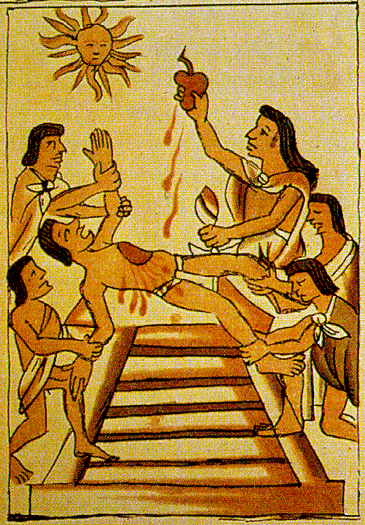
In almost all societies, killing within a tribe or clan has been strongly taboo; exemption is granted only to those with great authority. Anthropologists have suspected that ritual human sacrifice serves to cement power structures — that is, it signifies who sits at the top of the social hierarchy.
Florilegius/SSPL/Getty Images
An Aztec priest removes a man’s heart in a sacrificial ritual and offers it to the god Huitzilopochtli (from handcoloured engraving by Giulio Ferrario’s Ancient and Modern Costumes of all the Peoples of the World, Florence, Italy, 1843).
Sacrifice for social order
The idea makes intuitive sense, but until now there has been no clear evidence to support it. In a study published in Nature2, Joseph Watts, a specialist in cultural evolution at the University of Auckland in New Zealand, and his colleagues have analysed 93 traditional cultures in Austronesia (the region that loosely embraces the many small and island states in the Pacific and Indonesia) as they were before they were influenced by colonization and major world religions (generally in the late 19th and early 20th centuries).
By delving into ethnographic records, the researchers tried to tease out the relationship between human sacrifice and social hierarchy. They find that the prevalence of sacrifice increased with the degree of social stratification: it occurred in 25% of cultures with little or no stratification, 37% of those with moderately stratified societies, and 67% of those that had a pronounced hierarchy.
And by mapping the evolutionary relationships between cultures, the team suggests that human sacrifice and social hierarchy co-evolved. Although societies can become more or less stratified over time, societies that practised sacrifice were less apt to revert to milder degrees of stratification.
In other words, human sacrifice seems to bolster stratification: it helped to stabilize hierarchy, and conceivably, therefore, had a common role in the development of highly stratified societies that generally persist even today.
Religious undertones
Human sacrifice seems to have been largely the privilege of priests or others who claimed religious authority. Watts and colleagues say that their results therefore disclose a “dark side” to the social role of religion. (They have previously shown that belief in supernatural punishing agencies in Austronesian cultures encouraged moral observance, and thereby promoted the emergence of stratified and complex social structures3).
There’s a danger of overgeneralization from any study of this kind. Human sacrifice is no more likely than, for instance, music to have had a single role in early societies. In the third century bc, for example, Chinese administrator Li Bing eliminated the sacrifice of young maidens to a river god during the conquest of Sichuan by the First Emperor. Some have suggested that he called the bluff of a local racket in which families rid themselves of unwanted daughters while getting rich on the compensation they received. Whether or not that is true, it’s easy to imagine how rituals could be abused for prosaic gain.
And even in Austronesia, add Watts’s team, sacrifice wasn’t always conducted for purely religious reasons. It could have other motivations, including to punish taboo violations, demoralize underclasses, mark class boundaries and instil fear of social elites, all of which aim at building and maintaining social control. For this reason, says Michael Winkelman, an anthropologist now retired from Arizona State University in Tempe, “I suspect that Watts et al. are assessing some general notion of social legitimated killing.”
Such considerations complicate any interpretation of Watts’s results, but it also gives them considerably more contemporary resonance.
Death-penalty parallels
By today’s standards, human sacrifice scarcely seems to fall within the norms of good morality. But one doesn’t need to be a moral relativist to accept that the connections between human sacrifice, obedience to authority and stable governance persist. To perceive a link between ancient, “savage” human sacrifices and the death penalty in some modern societies isn’t to exaggerate or indulge in melodrama, as Winkelman’s remarks testify.
Certainly the suggestion could seem glib, and the parallels cannot be taken too far. Unlike today’s death penalties, traditional ritual sacrifice was generally for religious purposes and it tended to exhibit no bloodlust or contempt for the victims. Often they were seen as godlike, and before their sacrifice, they might be treated with reverence and affection, and perhaps fed well like the biblical fatted calf. The remains of the dead body — it’s not even clear whether the word “victim” is appropriate — were imbued with power. If the flesh was chopped up, it was to share out this potent relic among the tribe.
Yet a contemporary state’s arrogation of the right to slaughter through the death penalty — breaking an otherwise rigid prohibition — still serves as, among other things, a demonstration of authority and a ritual of appeasement, whether towards supposed religious strictures or public opinion.
To future anthropologists, whatever explanations or justifications states offer today for imposing capital punishment may seem less revealing than the broader view of how such sanctified killing reinforces the social order. We can expect time’s retrospective gaze to lay bare the real reasons why we, no less than the ancient Aztecs or Samoans, valorize murder.
Watts, J.et al. Proc. R. Soc. B282, 20142556 (2015).
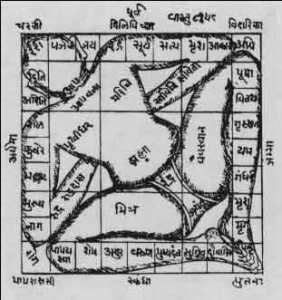
One of the oldest written religious texts, the Rig-Veda (the oldest of the four Vedas of Hindu religion), contains a creation myth that tells about the sacrifice of the giant Purusha. This sacrifice serves as the basis for the Indian caste system. Once again, in light of mimetic theory and the above mentioned scientific research, the existence of such stories comes as no surprise.
From the Rig-Veda
Thousand-headed Purusha, thousand-eyed, thousand-footed he, having pervaded the earth on all sides, still extends ten fingers beyond it.
Purusha alone is all this—whatever has been and whatever is going to be. Further, he is the lord of immortality and also of what grows on account of food.
Such is his greatness; greater, indeed, than this is Purusha. All creatures constitute but one quarter of him, his three-quarters are the immortal in the heaven.
With his three-quarters did Purusha rise up; one quarter of him again remains here. With it did he variously spread out on all sides over what eats and what eats not.
From him was Viraj born, from Viraj evolved Purusha. He, being born, projected himself behind the earth as also before it.
When the gods performed the sacrifice with Purusha as the oblation, then the spring was its clarified butter, the summer the sacrificial fuel, and the autumn the oblation.
The sacrificial victim, namely, Purusha, born at the very beginning, they sprinkled with sacred water upon the sacrificial grass. With him as oblation the gods performed the sacrifice, and also the Sadhyas [a class of semidivine beings] and the rishis [ancient seers].
From that wholly offered sacrificial oblation were born the verses and the sacred chants; from it were born the meters; the sacrificial formula was born from it.
From it horses were born and also those animals who have double rows [i.e., upper and lower] of teeth; cows were born from it, from it were born goats and sheep.
When they divided Purusha, in how many different portions did they arrange him? What became of his mouth, what of his two arms? What were his two thighs and his two feet called?
His mouth became the brahman; his two arms were made into the rajanya; his two thighs the vaishyas; from his two feet the shudra was born.
The moon was born from the mind, from the eye the sun was born; from the mouth Indra and Agni, from the breath the wind was born.
From the navel was the atmosphere created, from the head the heaven issued forth; from the two feet was born the earth and the quarters [the cardinal directions] from the ear. Thus did they fashion the worlds.
Seven were the enclosing sticks in this sacrifice, thrice seven were the fire-sticks made, when the gods, performing the sacrifice, bound down Purusha, the sacrificial victim.
With this sacrificial oblation did the gods offer the sacrifice. These were the first norms [dharma] of sacrifice. These greatnesses reached to the sky wherein live the ancient Sadhyas and gods.
Source: The Rig-Veda, 10.90, in Sources of Indian Tradition by Theodore de Bary (New York: Columbia University Press, 1958), pp. 16-17.
Sometimes, just sometimes, quite revealing scientific insights slip into popular culture. I was watching a rerun of an episode of The Big Bang Theory sitcom on Belgian television. More specifically, I found out, I was watching The White Asparagus Triangulation (episode 9, season 2 – click to watch).
The title itself can already be connected to a basic concept of René Girard’s mimetic theory, namely mimetic desire. As it turns out, “triangulation” indeed refers to the triangular nature of human desire (beyond instinctive needs) as described by Girard: the desire of a subject towards a certain object is positively or negatively influenced by mediators or models (click here to watch an example of negatively mediated desire from another popular sitcom,Seinfeld). Humans imitate others in orienting their desires – their desire thus is mimetic.
In the case of this episode from The Big Bang Theory: Sheldon tries to positively influence the desire of Leonard’s new girlfriend, Stephanie. After all, she is the first of Leonard’s dates to meet Sheldon’s high intellectual standards, so Sheldon does everything to increase Stephanie’s desire for Leonard. At some point he tries to persuade the girl next door, Penny, to present herself as a rival/model for Stephanie. Here’s the script for this scene.
Sheldon: I see. Apparently my earlier inquiry regarding you and Leonard crossed some sort of line. I apologize.
Penny: Well, thank you.
Sheldon: So, have you and I returned to a social equilibrium?
Penny: Yes.
Sheldon: Great. New topic. Where are you in your menstrual cycle?
Penny: What?
Error
This video doesn’t exist
Sheldon: I’ve been doing some research online, and apparently female primates, you know, uh, apes, chimpanzees, you, they find their mate more desirable when he’s being courted by another female. Now, this effect is intensified when the rival female is secreting the pheromones associated with ovulation. Which brings me back to my question, where are you in (Penny slams door). Clearly, I’m 14 days too early.
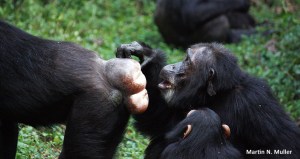
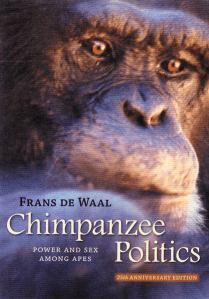
Anne E.Pusey andKaraSchroepfer-Walker wrote an interesting article on the subject mentioned by Sheldon, Female Competition in Chimpanzees (find a PDF by clicking here). Apparently, the closer to humans, the more mimetic desire and competition can be found in mammals. Chimpanzee females indeed sometimes develop a “desire” for sexual intercourse with male chimpanzees when potential competitors arrive at the scene, even disrupting their normal biological cycle! From the article:
Several lines of evidence indicate some female competition over mating. First, at Mahale, females sometimes directly interfered in the mating attempts of their rivals by forcing themselves between a copulating pair. In some cases, the aggressive female went on to mate with the male. At Gombe, during a day-long series of attacks by Mitumba females on a fully swollen new immigrant female, the most active attackers were also swollen and their behaviour was interpreted as ‘sexual jealousy’ by the observers. Townsend et al. found that females at Budongo suppressed copulation calls when in the presence of the dominant female, possibly to prevent direct interference in their copulations. Second, females occasionally seem to respond to the sexual swellings of others by swelling themselves. Goodall described an unusual incident in which a dominant, lactating female suddenly appeared with a full swelling a day after a young oestrous female had been followed by many males. Nishida described cases at Mahale in which a female would produce isolated swellings that were not part of her regular cycles when a second oestrous female was present in the group.
The White Asparagus Triangulation eventually gets its title from another scene in the episode. Sheldon tries to establish Leonard as “the alpha male”. Sheldon will pretend that he is unable to open a jar of asparagus. If Leonard then opens the jar he will have won the mimetic competition over the question “who is the strongest?”, resulting in an increase of his sex appeal. Of course, for the sake of comedy, things go terribly wrong :). Here’s the script for this scene.
Scene: The apartment.
Leonard: All I’m saying is if they can cure yellow fever and malaria, why can’t they do something about lactose intolerance?
Steph: Leonard, you’re going to have to let this go. You had a little cheese dip, you farted, I thought it was cute.
Sheldon: Oh, hi Stephanie.
Steph: Hi.
Leonard: Want some more wine?
Steph: Yeah, I assume I’m not driving anywhere tonight. (Sheldon lets out a loud noise).
Leonard: What are you doing?
Sheldon: I have a craving for white asparagus that apparently is destined to go unsatisfied.
Leonard: Excuse me. What the hell is wrong with you?
Sheldon: I’m helping you with Stephanie.
Leonard: By making constipated moose sounds?
Sheldon: When I fail to open this jar and you succeed it will establish you as the alpha male. You see, when a female witnesses an exhibition of physical domination she produces the hormone oxytocin. If the two of you then engage in intercourse this will create the biochemical reaction in the brain which lay people naively interpret as falling in love.
Leonard: Huh? Would it work if I just punched you in the face?
Sheldon: Yes, actually it would, but let’s see how the lid goes. I’m not strong enough, Leonard, you’ll have to do it.
Leonard: Oh, for god’s sakes.
Sheldon: Go ahead, it’s pre-loosened.
Steph: Do you want some help with that?
Leonard: No, no, no, I got it.
Sheldon: No, yeah, yeah, he’s got it, and that’s not surprising. This is something I long ago came to peace with in my role as the beta male. Open it. (Leonard tries again. Then taps jar on counter. Jar breaks.)
Error
This video doesn’t exist
Steph: Oh my god, are you okay?
Leonard: No, I’m not. I’m bleeding.
Sheldon: Like a gladiator!
Steph: Oh, honey, you’re going to need stitches.
Leonard: Stitches? With a needle?
Steph: Well, yeah, I mean, just a few.
Leonard: Oh, okay, yeah, hang on a sec. (Throws up in sink)
Already in 1961, publishing Mensonge romantique et vérité romanesque, René Girard made the world familiar with his concept of mimetic desire. Mimetic desire is literally desire based on imitation. Like so many others before and after him, Girard observes that human beings are highly mimetic creatures. Humans imitate each other in all sorts of ways and thereby learn from each other – they learn good as well as bad behavior… To name but one example, people imitate the sounds of their environment and learn to speak, for instance, with a Texan accent. I don’t know if that’s a good or a bad thing :).
By introducing the concept of mimetic desire, Girard stresses that our desire is structured by imitating others who function as models for our desire. It is important to distinguish this type of desire from our basic biological or physical needs. When you’re walking in the desert alone and your body is yearning for water, your desire for water is, of course, not based on the imitation of someone else’s desire. True, nature has its impact on human life. However, when our basic physical needs are met, our desire goes beyond them. Our basic need for water is transformed in what eventually became a supermarket world that asks us to choose between different types of water, juices and soft drinks. Growing up, we develop a certain taste, transmitted to us by our social and cultural surroundings. We might even develop desires that not only go further than our physical needs, but also against them (anorexia being one example).
So, it’s not just nature that defines human life, nurture has its way too… We all have the biological need for food, but if we were born in another part of the world we would probably have developed different eating habits. It’s as simple as that. We imitate others. We mimetically learn to quench our natural thirst and to satisfy our natural hunger in a certain, culturally dependent way. No one is born with the desire for the newest soft drink produced by The Coca-Cola Company (indeed, Thou Shalt Covet What Thy Neighbor Covets – click to read this article by famous marketeer Martin Lindstrom), as no one is born with the desire to become a police officer. Our identities are not ahistorically determined from birth, they’re co-created with others.
We always write our personal history together with others, and we mutually influence each other. Since we’re social creatures we cannot escape this influence. Relationships precede and shape our (sense of) identity. Even if we go against our tendency to imitate an immediate social environment that seems indifferent towards the victim of some crime or accident (see “Bystander Effect” – click for more), we probably still imitate heroic examples from stories we grew up with (“The Good Samaritan” may be one of them).
Two questions often appear after these considerations, which show just how hard it is to let go of any type of Ego Illusion:
We often imitate others to adjust to our social environment. We imitate others because we desire social recognition. So, our desire for social recognition must be more fundamental than our mimetic tendencies, no?
If we imitate each other’s desire for something, someone still has to be the first to desire that something. Surely, the latter’s desire cannot be based on imitation, can it?
I’ve answered the first question before, but I’ll repeat it here. Of course we often imitate others to ‘fit in’. However, we could not develop a desire to fit in if it weren’t for our mimetic abilities. Our mimetic abilities allow us to put ourselves in each other’s shoes. They allow us to pretend that we are someone else. For instance, a little girl playing with her dolls pretends being a mother by imitating real mothers. Our mimetic abilities allow us, thereby, to imagine – however preliminary – what others are experiencing, expecting and desiring. So our ability to empathize and to adjust to the expectations of others (maybe to gain their recognition) rests on mimetic ability.
The second question seems very logical. Confronted with real life cases, the quest for ‘the first model’ is not that easy to answer though. Even simple situations show it might be the wrong question. Think, for instance, about two babies in a room full of toys. Let’s name the two Bobby and Johnny. Bobby starts playing with a little ball. Note that he didn’t necessarily wake up with the desire to play with a ball. Already in this sense his desire isn’t his own. It is awakened by people who left him the ball to play with. After just ten seconds, Bobby gets tired of the ball. He doesn’t really enjoy playing with it. So he starts playing with some other toy. He has no desire to play with the ball whatsoever. In comes Johnny. He saw Bobby playing with the ball and this raised Johnny’s attention. Now that the ball is left, Johnny takes the opportunity to start playing with it himself. In this situation Johnny is the imitator. However, when Bobby notices Johnny playing with the ball, he immediately leaves the toy that was more fun to him and tries to lay his hands on the ball Johnny is playing with now. In this situation Bobby is the imitator. In short, Johnny’s desire rests on the imitation of Bobby as model for his desire, while Bobby’s desire rests on the imitation of Johnny as model for his desire. It’s no use asking “Who’s first?” Johnny and Bobby mutually reinforce each other’s desire by becoming each other’s model and imitator. Thereby they become each other’s rival. René Girard speaks of the rivalry between mimetic doubles. More generally, we become each other’s rival if we cannot or do not want to share the object of our mimetic desire. Here’s an example – it could have been Bobby and Johnny 🙂 – CLICK TO WATCH:
2. REGARDING RITUAL SACRIFICE
Some consider René Girard’s explanations on the origin and maintenance of human cultures far-fetched. Well, are they?
René Girard considers the very first sacrificial rituals as imitations of a scapegoat mechanism in groups of primitive humans whose internal (mimetic) rivalry threatened to destroy the group itself. Primitive human societies experienced the killing of one member of their group by a significant part of the community as something which restored calm and order. This must have happened so much in primitive human societies that they started making certain associations.
On the one hand primitive societies experience turmoil as long as ‘the common enemy’ is alive, while on the other hand they experience peace after he is beaten to death. Gradually they will associate new situations of disorder with the resurgence of a former victim of group violence. In other words, they experience a person who is not visibly present anymore, but whose presence is ‘felt’ in situations of turmoil. In other words still, one of the former victims of group violence has become a ‘ghost’ or a ‘god’. At the same time, primitive human societies also ‘learn’ that killing someone apparently restores order. So together with the belief in ghosts and gods considered responsible for all kinds of possible violent disasters, the belief originates concerning the effectiveness of sacrifices to restore, renew and/or keep order, life and stability in human society. If primitive societies would have seen that the victims of group violence are no more responsible for violence than other members of the group, they would not have developed these beliefs. Violence became something sacred because the victims of group violence were considered exclusively responsible for the violence they were associated with. Those victims were scapegoats.
Girard argues that all other associations regarding ‘the sacred’ rest on this first association between violence and divinized victims of group violence. Everything that can be associated with violence had the potential to become sacred or divinized as well. Sexuality became sacred. Indeed, sometimes males fight over females. Food became sacred. Indeed, people fight over food sometimes. Territory became sacred. Indeed, people go to war sometimes because of territory. Nature as a whole became sacred. Indeed, natural disasters are ‘violent’ and provoke violence if they cause lack of food and water… And so the world and the experience of man became sacred.
Religions came and went, but the age-old associations regarding the sacred were transmitted down the generations. The Greeks still had Ares, god of war, as they had their goddess of love, Aphrodite. The Romans copied (indeed, ‘imitated’) the Greeks and spoke of Mars and Venus.
Asked why they perform their rituals and sacrifices and why they respect their taboos, primitive societies always answer: “Because our ancestors did it, and because we have to respect the ghosts and the gods in order to sustain our community…”
Could it really be true that the structure of ancient human sacrifice goes back to a mechanism that can still be observed in our ape cousins? And that this mechanism provides the foundation of the archaic sacred? Is it far-fetched to suspect that the former fact (the structure of ancient human sacrifice, which begins with a fight!) has something to do with the latter fact (the scapegoat mechanism)?
Girard has argued that the dividing line between human and ape lies in the way mimetic quarrels became a threat to the survival of primitive human communities. Precisely because the mimetic ability of humans grew, their tendency towards near uncontrollable mimetic rivalry increased likewise. Hence it became possible that humans began to make associations that their ape cousins could not make regarding the communal killing of a group member. Compare to Pavlov’s dog: a dog who has only arbitrarily or sporadically heard a signal while getting food will not drool if he hears the signal, while Pavlov’s dog who has systematically heard the signal while getting food will at some point start to drool from the moment he merely hears the signal… Apes won’t associate turmoil with a victim, while primitive humans will start to do exactly that at some point. The consequences can be suspected: primitive humans will start to consciously ritualize the scapegoat mechanism, while apes only experience this mechanism sporadically. Here’s a powerful example of the mechanism, nonetheless, observed in a group of monkeys. We can almost observe how it must have been like that ‘a loathed enemy’ became ‘a revered god’. This also explains why gods have a ‘dual’, ‘ambiguous’ quality.They’re good and bad…
Dan wil je eens even niet bezig zijn met de onderwerpen van de mimetische theorie, stuurt Arno Couwenbergh – een kersverse oudleerling – dit artikel op uit Knack. Waarvoor dank :)!
An interesting and funny experiment is the now well-known fairness study by Dutch ethologist Frans de Waal and his colleagues.
WATCH IT HERE:
It once again confirms some basic intuitions of mimetic theory. Frans de Waal seems to treat the tendency to be competitive and aggressive on the one hand, and the tendency to be empathic on the other, as two different faculties. Seen from René Girard’s mimetic theory both competition and empathy can be attributed to one and the same source: mimesis (imitation).
The ability to imitate another (see: mirror neurons or mirror neuron system!) opens up the possibility to imagine what the other is experiencing – as an “alter ego”. This is the foundation for the development of empathy and compassion.
René Girard also points to mimesis as a potentially divisive force in the context of desire: when two individuals imitate each other’s desire for acquiring one and the same object, they can become each other’s rival. Mimetic desire thus threatens the stability of relationships.
In the words of Vittorio Gallese, one of the discoverers of mirror neurons, in conclusion to his paper The Two Sides of Mimesis (click title to read the whole paper): “We have examined empirical results showing how interpersonal relations are made possible — in the first place — by resonance mechanisms that provide the common ground upon which the I–Thou relation can be established. It could be tempting to use such evidence to assert the neurobiological basis of the supposed natural proclivity of mankind to sympathy, fellow feelings, good will and altruism. I think we must resist such temptation, and look at human nature as it really is and not as we would like it to be. In this respect, Girard’s Mimetic Theory is illuminating, because it shows that mimesis when declined as mimetic desire has the intrinsic potentiality of driving humans to aggression and violence. Mimesis, as I have been trying to show throughout this paper, is neither intrinsically good nor bad. It is a basic functional mechanism at the core of our diversified social competencies and activities. Nevertheless, mimesis has two sides. Any serious neuroscientific attempt to shed light on the truest and deepest nature of human condition cannot neglect either side. I posit that the empirical evidence here briefly summarized and future research stimulated and driven by the currently available evidence have the potentiality to shed further light on both sides of mimesis.”
Both above mentioned points can be observed in many of de Waal’s experiments and observations. The second point becomes very clear in this fairness study. Consider the following remark by de Waal:
“Note that the first piece of cucumber is perfectly fine. The first piece she eats. Then she sees the other one getting grape, and you will see what happens…”
In other words, the frustration and anger for not receiving grapes is aroused by comparison with the other monkey. Potential conflict does not arise from inequality as such, but from the tendency to imitate someone else and therefore desire what he receives, desires or possesses. The monkey is perfectly willing to eat cucumber instead of the better tasting grapes as long as her neighbor is in the same position. But would you still be happy with a little Toyota if everyone else in the neighborhood is driving a big Mercedes? We have to keep up with the Joneses, don’t we? Indeed, beyond basic needs, our and the monkey’s desires are structured by imitating others and comparing ourselves to them.
Primitive societies are well aware of the potential destructive outcomes of sharing gifts. That’s why gift exchange is highly regulated in archaic contexts. Besides establishing an acceptable hierarchy (which implies differences and inequalities), the rules of gift exchange also aim to undermine feelings of frustration and envy. To keep the peace! Essai sur le don (The Gift), the groundbreaking study by Marcel Mauss (1872-1950) [PDF], to this day is very revealing in this regard (e.g. p.11: “To refuse to give, or to fail to invite, is – like refusing to accept – the equivalent of a declaration of war; it is a refusal of friendship and intercourse.”).
The ethical question remains whether the ties and bonds between humans that arise from mimetic interplays (manifested in empathy, fear of violence, but also lust for power and prestige) are a good basis for morality. I guess, as mimetic creatures, we have no choice but to rely on imitation. But this can be tricky. It’s very common to empathize with a friend or a clique and to imitate their hostility towards an enemy. But this kind of loyalty is not necessarily just or righteous. It’s the blind loyalty of the mafia or the mob. What if your friends or your clan is wrong? The big challenge, as put forward among others by Christ, is to include the ones that are considered “enemies” as “members of the community” – as “neighbors”, fellow human beings.
René Girard claims that an imitation of Christ could guide our mimetic faculties in such a way that they would enable us to “love our enemies”. This is not to be understood in a masochistic way. To protect the victim of bullies doesn’t mean that you want to get bullied yourself. To put it differently: to speak in favor of the socially deprived or “crucified” doesn’t mean that you want to get crucified yourself, although of course you always run the risk that “bullies” don’t “show mercy” but keep on “crucifying”. Nevertheless Christ “turns the other cheek”, not because he wants another blow, but because he hopes that merciful, non-vengeful conduct will eventually be imitated.
So, empathy as the basis for morality? It depends on the examples one imitates and empathizes with. Will you follow the idol of yourself – the important person you imagine yourself to be in a certain group (that structures itself partly by excluding its “enemies”)? Or will you follow the Voice of the one who questions the image of yourself that exists at the expense of excluded others – in order to find yourself in relationship to those others?
In the 1950s, psychologist Solomon Asch (1907-1996) published a series of studies that demonstrated the power of conformity in groups. His findings come as no surprise, since we, as human beings, have the natural tendency to imitate others… don’t we ;)? Because of this tendency we desire social recognition, and easily adapt ourselves to what others are doing – even if it doesn’t seem to make any sense.
The capacity to imitate others allows us to “walk in someone else’s shoes”, to imagine what others might expect and to be sensitive about those expectations. Hence, as said, the desire for social recognition springs from our imitative or mimetic tendencies.
Asch’s experiments were highly influential and directly inspired Stanley Milgram (1933-1984) and his studies of obedience to authority. In any case, these experiments are classical studies in the world of psychology, and naturally attract mimetic scholars – even if their theoretical framework is somewhat different from that of Asch and Milgram, and sustained by new empirical research from the neurosciences.
CLICK TO WATCH the Asch Conformity Experiment:
As proven by Milgram’s studies of obedience to authority and the later executed Stanford Prison Experiment, the way we adapt to our environment often leads to tragic situations. A variation of the Asch Conformity Experiment reveals how it can be comic as well.
CLICK TO WATCH:
Another interesting phenomenon from the point of view of mimetic theory is the so-called bystander effect. It shows how imitating others can foster mechanisms of exclusion and scapegoating impulses. “Why should I do what could equally be done by others?” seems to be the underlying question we use for avoiding our responsibility to help a person in need amidst a crowd.
CLICK TO WATCH:
These short films once again demonstrate how deeply embedded is the tendency to imitate what others are doing… or not doing…
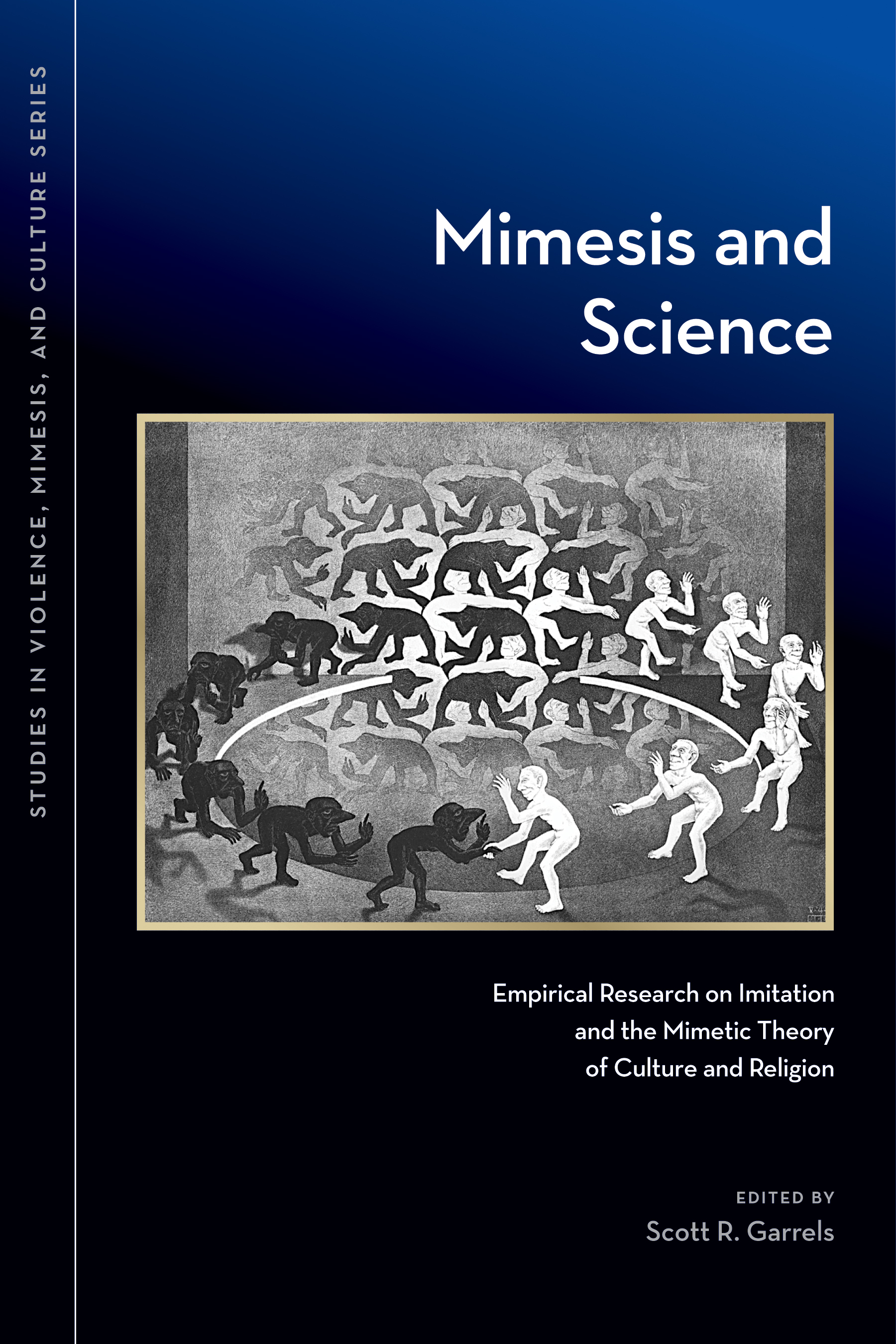
A book that brings together some of the world’s leading scientists and philosophers who are investigating the enormous role of imitation in human life? It seems like a dream come true for me. Scott R. Garrels edited Mimesis and Science – Empirical Research on Imitation and the Mimetic Theory of Culture and Religion(Studies in Violence, Mimesis and Culture Series, Michigan State University Press, 2011), which definitely initiates a process of cross-fertilization between scholars concerned with René Girard’s mimetic theory and empirical researchers whose work is devoted to the question of imitation in human development.
I assembled some excerpts from the first part of the book – click to read:
Here are some acknowledgements from the back cover:
“The most exciting and generative new ideas arrive over bridges built between previously isolated fields. Mimesis and Science brings together Girard’s paradigm-changing mimetic theory with a very large literature on human imitation from fields of psychology, cognitive neuroscience, and cultural anthropology. The result is a stimulating set of essays that will advance current perspectives on human nature and human culture.”
– Warren S. Brown, Director of the Lee Edward Travis Research Institute and Professor of Psychology in the Department of Clinical Psychology at Fuller Theological Seminary.
“René Girard has provided us with an incredibly rich theory of human culture: Mimetic Theory. We must look at human nature as it really is, and not as we would like it to be. Girard’s Mimetic Theory is illuminating because it shows that mimesis has the intrinsic potentiality of driving humans to violence. Any serious neuroscientific attempt to shed light on the truest and deepest nature of the human condition cannot neglect this.”
– Vittorio Gallese, Professor of Physiology in the Department of Neuroscience of the School of Medicine at the University of Parma.
“In the past decade, we witnessed an overturning of the myth of the asocial infant. René Girard is among the thinkers who refused to portray the human from an isolationist perspective. To adapt Girard: Babies hold a secret about the human mind that has been hidden for millenia. They are our double. They have a primordial drive to understand us that advances their development; we have a desire to understand them that propels social science and philosophy.”
– Andrew Meltzoff, Co-Director of the University of Washington Institute for Learning and Brain Sciences.
“In brilliantly original works such as Things Hidden Since the Foundation of the World, René Girard confronts a possibility that most modern social scientists have shied away from: that bloodshed may be at or close to the heart of all human social life. Only a few thinkers have addressed the problem of violence fully and deeply; yet the threat of it pervades our lives as a species, and we cannot learn to deal with it by drawing back.”
– Melvin Konner, Samuel Candler Dobbs Professor in the Department of Anthropology and the Program in Neuroscience and Behavioral Biology at Emory University.
I came across a recording of an interview with Julian Paul Keenan, one of biopsychologist Gordon Gallup’s better known students. Keenan explains his mentor’s famous mirror test. I combined his explanation with scenes from The Human Ape, a documentary by National Geographic.
CLICK TO WATCH:
What this test demonstrates concerning the questions of self-awareness, consciousness and what it means to be human, is highly debated. It is clear, however, that increased mimetic abilities allow for higher levels of self-recognition, self-consciousness and empathy with others. The ability to duplicate myself (duplication is a kind of mimesis) allows me to imagine myself (being somewhere else, e.g. in the mirror) – this is the creation of a distance towards myself which allows me to reflect upon myself (increased self-awareness) and to put myself in someone else’s shoes (important for developing empathy – of course empathy has positive and negative consequences; read more on this by clicking here).
I’ve put the word ‘religulous’ in this post’s title after a documentary, or should I say ‘mockumentary’ of the same name by director Larry Charles. In it, Bill Maher goes around the US primarily to investigate certain people’s religious beliefs and comes to the conclusion these beliefs are ‘ridiculous’ – hence the title: Religulous.
Bill Maher is right to point out some absurdities in certain people’s convictions, although stylistically spoken he could have done it a little less ad hominem. It’s a pity, however, that he limits his investigation to people who say they believe in ‘God’. I think it would have been much more interesting if he had shown how the psychological and sociological mechanisms that produce certain convictions are also hugely conditioning people who claim they don’t believe in ‘God’. Maybe he would have called his documentary Anthropologulous then. Whether we do or do not believe in God, we’re susceptible, as human beings, to some very strange convictions and behavior.
In fact, what I’ve learned from René Girard (among others) is that ‘belief in God’ is not ‘the real problem’. Atheists are no less capable of the kind of ‘religious’ behavior Bill Maher calls ‘ridiculous’. Similar to the rituals surrounding the deities of traditional religion are, for example, pop festivals or the ceremonies honoring dictatorial leaders of atheistic regimes (such as some of the annual festivities held in North Korea). So the question should not be ‘do you believe in God’? Maybe we should rather reflect on the social and psychological mechanisms, the desires and deeper motivations which shape our life.
To me, German philosopher Max Scheler (1874-1928) seems to summarize the ‘real’ dilemma when he claims “Man has either a God or an idol”. Or, to put it differently, the question isn’t so much ‘do you believe in God’ as it is ‘what (kind of) God do you believe in?’ So it’s not only a pity that Bill Maher doesn’t reveal the parallels between potentially ridiculous behavior of both ‘theists’ and ‘atheists’, it’s also a shame he doesn’t interview more people who try to develop their faith in a constant and frank dialogue with the natural and social sciences. Too bad he doesn’t get into the rich philosophical and theological traditions of Christianity. Actually, the way he reads the Bible is none other than the way his adversaries read it – he just comes to a different conclusion. In this sense he imitates his adversaries and becomes somewhat of a ‘mimetic rival’. Bill Maher is oblivious to the basic hermeneutical principles that were used by educated theologians throughout the ages (and from the get-go, meaning these principles were also used by the biblical writers themselves!).
Nevertheless, all these remarks on content and style aside, it must be said I did enjoy quite a few hilarious moments in this documentary. I thought about it when I recently visited Barcelona together with my wife to celebrate her birthday [Was she happy? Yes, she was!]. We were there when Barca, the unmatched and world-famous soccer team that is, had to play the Champions League final at Wembley against Manchester United. So we were confronted with exuberant Barcelona soccer fans the night their team won this important match. At the same time we witnessed a leftist manifestation that went on for a few days at the Plaça de Catalunya. Mostly young people were gathered there to demand governmental and economic reform that should result, among other things, in job creation, since unemployment is on the rise in Spain. In both instances we witnessed what Bill Maher would call ‘religulous’ behavior.
I don’t want to imply that supporting a soccer team is ridiculous as such. It is, however, a social phenomenon that is susceptible to extreme and bizarre behavior, as it tends to produce processes of idolatry. The picture on the left indeed shows that Lionel Messi is treated like a god by some of his fans. I neither want to imply that the unemployment claims made by the Spanish youth at the large square in central Barcelona should not be taken seriously. I just wanted to record how people sometimes ‘strangely’ behave when they’re united against a ‘common enemy’ (in this case ‘the system’).
Amidst all of this social upheaval and turmoil both my wife and I were driven by yet another herd of people towards the work of famous architect Antoni Gaudí (1852-1926), especially his Basilica Church La Sagrada Família. Never to be completed during the architect’s lifetime, this amazing monument is now finished on the inside and, perhaps needless to say, visiting it opened my senses and heart to another kind of religious, even ‘spiritual’ experience. It was like walking into the spatial mind of a genius who devoted his life to the creation of a sphere where people could ‘reconnect’ with themselves, each other, nature and, ultimately ‘God’. As is known, Gaudí was a devoted Catholic who put all of his talents as a scientist, mathematician and artist at the service of ‘The Holy Family’. His work displays a deep awareness of the interconnectedness, indeed ‘familiarity’ of all that is. Moreover, Gaudí was convinced people could only ‘find’ them‘selves’ if they discovered there was no ‘self’ apart from a ‘being’ that ‘is’ always already ‘in relationships’. What and who we are is first and foremost ‘given’ – it is not something we autonomously create. To deny this, is to surrender to what René Girard would call a ‘romantic deception’.
The following quotes of Gaudí show how he considered any artist’s creativity as something that doesn’t spring from a purely ‘original’ mind. Rather, his view on ‘originality’ is closely connected to the discovery of a creation that always precedes the work of the artist:
“Originality consists in returning to the origin.”
“Man does not create… he discovers.”
Artists like Gaudí consider themselves ‘co-creators’ or ‘collaborators’, only relatively ‘free’ as ‘imitators’ of Nature:
“The creation continues incessantly through the media of man.”
“Those who look for the laws of Nature as a support for their new works collaborate with the creator.”
Gaudí seems to distinguish between two kinds of imitation, ‘blindly copying’ and ‘creatively mimicking’:
“Copiers do not collaborate.”
From the point of view of Girard’s theory on imitation (his ‘mimetic’ theory) blindly copying exactly occurs when people feel they are not imitating at all. On the other hand, people who realize they are dependent on others will develop a creative kind of imitation, allowing ‘originality’. By consciously imitating something or someone other you’re indeed saying two things: that there is a likeness between yourself and that other and that there’s also a ‘distance’ (otherwise imitation would not be possible). One could even say that imitation somehow creates this distance, a kind of ‘space’ where men each become ‘others’ towards… others.
As said, the Sagrada Família, as a building that so closely resembles the ‘mathematical’ mystique of natural forms, precisely produces a realm wherein people are not swallowed by the unifying yet destructive powers of ‘wild’ crowd mechanisms, but a ‘breathing’ sphere where people really become aware of each other in the ‘space’ surrounding them. To Christians like Gaudí and Girard this kind of awareness allows for the experience of a divine Love which creates us. From the contrasting situations in Barcelona I start to see what they’re getting at…
Lorenzi Marcella Giulia and Francaviglia Mauro wrote a very interesting article on Gaudí’s La Sagrada Família in the Journal of Applied Mathematics (click on the title to read it): Art & Mathematics in Antoni Gaudí’s architecture: “La Sagrada Família”. I especially recommend it to those mathematicians who want to taste something of Gaudí’s peculiar spiritual take on science.
Of course there are other ways to enjoy the swarming life in God’s grace – “His ways are manifold”.
Try for example the Hard Rock Cafe in Barcelona, and discover “God is my Co-Pilot”, celebrating that good old rock ‘n’ roll music!
MIMETIC THEORY (RENÉ GIRARD) – FIVE-PART VIDEO SERIES (11 VIDEOS)
The following five-part video series provides a preliminary understanding of human culture from the perspective of mimetic theory, which was first developed by René Girard (1923-2015).
I made the first parts to give an overview of some basic cultural facts. The later parts of the video series deal with mimetic theory’s explanation of those facts, ending with the role of the Judeo-Christian heritage in making that type of explanation possible. The last part of the series (PART V) clarifies how the Judeo-Christian traditions result in either a radical atheism or a radically new understanding of God.
POST SCRIPTUM BIJ DE VIDEOSERIE OVER DE MIMETISCHE THEORIE (RENÉ GIRARD)
OVER HET VISIONAIRE KARAKTER EN DE ATHEÏSTISCHE KANT VAN HET WERK VAN GIRARD
Onder andere het werk van David Watts (primatoloog en antropoloog) en dat van professoren Vilayanur Ramachandran en Giacomo Rizzolatti (neurofysiologen) tonen aan hoe visionair de bevindingen zijn van de Frans-Amerikaanse professor en interdisciplinaire denker René Girard… Al die mensen genieten intussen terecht wereldfaam.
Professor David Watts, primatoloog en antropoloog aan Yale University, bestudeert met zijn team sinds 1993 de grootste in het wild levende groep chimpansees. Die bevindt zich in Ngogo, Oeganda. De groep bestaat op een bepaald moment uit meer dan 150 leden. Watts en zijn team wijzen erop dat hun vaststellingen kunnen bijdragen aan een beter inzicht in de evolutie van de mens:
“Chimpansees zijn fascinerende dieren om onszelf mee te vergelijken. Ze zijn meer zoals mensen dan om het even welk levend wezen op aarde. Wat vertelt dit ons over de menselijke evolutie? En wat betekent dit voor mensen?”
In Rise of the Warrior Apes, een documentaire uit 2017 over het onderzoek naar de chimpansees van Ngogo, deelt Watts een aantal observaties die verrassende overeenkomsten vertonen met de veronderstellingen van René Girard over prehistorische menselijke gemeenschappen. Het loont de moeite om ze naast elkaar te plaatsen. Het is een van de zovele aanwijzingen voor het visionaire karakter van het denkwerk van René Girard – die niet toevallig immortel is van de Académie française. De uitspraken van Girard komen uit een interview voor de Nederlandse televisie in 1985, naar aanleiding van zijn eredoctoraat aan de Vrije Universiteit Amsterdam. De uitspraken van Watts en zijn team komen uit de reeds vermelde documentaire.
René Girard: “Als mensen kwaad zijn en opgaan in hun rivaliteit, doden zij elkaar. … De dominantie die onder dieren iedere generatie wordt hernieuwd werkt niet onder mensen, omdat die tot het einde doorvechten en elkaar doden. Een gemeenschap van mensen is dus ondenkbaar als er geen ander mechanisme werkzaam zou zijn…”
David Watts en zijn team: “Mannelijke chimpansees lijken te leven, te ademen en te eten om dominantie te verwerven. Ze streven naar status. Het hoort bij het spel. … Er is nu een situatie waarbij er veel meer mannetjes concurreren om de toppositie. Welke gevolgen heeft dat?… We begonnen ons zorgen te maken: deze gemeenschap is zo groot dat ze niet bij elkaar zal kunnen blijven. Ze zal uiteenvallen nog voor we begrijpen wat er aan de hand is.”
David Watts en zijn team hebben geobserveerd hoe de hoog oplopende interne spanningen (een situatie van ‘allen tegen allen’) verdwijnt als de vijandigheid zich richt naar een tegenstander die geïsoleerd geraakt en die het slachtoffer wordt van een grotere groep (een situatie van ‘allen tegen één’). René Girard veronderstelt terecht dat zulke taferelen zich ook hebben afgespeeld in prehistorische mensengroepen, waarbij mimetische begeerte eerst soms zorgt voor verdeeldheid en geweld; vervolgens zorgt de mimetische vereniging tegen één tegenstander weer voor een tijdelijke eenheid en vrede.
René Girard: “Als er een mimetisch gevecht zonder einde is, dan zal de mimetische kracht zich uiteindelijk op een enkel slachtoffer richten. Anders gezegd: mensen kunnen een object niet delen als zij om dat object gevochten hebben. Om een object vechten verdeelt mensen. Op een gegeven punt zal iedereen met iedereen vechten en verschuift de mimetische kracht van vijand naar vijand. Als twee vijanden dan dezelfde tegenstander kiezen, dan zullen steeds meer mensen dat doen, en uiteindelijk iedereen. De paradox is: vechten om een object verdeelt mensen, maar als iedereen tegen dezelfde vecht, ontstaat er juist eenheid.”
David Watts en zijn team: “We arriveerden op de plaats waar iets gaande was. De chimpansees waren iemand van hun eigen groep aan het aanvallen. Brownface en Pincer…, de meest Ngogo chimpansees waren iemand aan het aanvallen. Al snel realiseerden we ons dat ze Grapelli aan het aanvallen waren. En dat hij in groot gevaar verkeerde. … Ze sloegen hem, schopten hem, beten hem! … Het is onmogelijk dat een dier dit overleeft. … Waarom is het gebeurd, waarom hebben ze hem gedood? Het gaat over een jong mannetje dat sociaal niet zo geïntegreerd is, maar hij lijkt vrij ambitieus. Sommigen zien hem wellicht als een rivaal. Hij is plots in de minderheid, ze kunnen hem echt schaden, en dus doen ze dat…”
David Watts en zijn team observeerden dat chimpansees regelmatig jacht maken op andere apen, of op chimpansees die niet tot de eigen groep behoren. Het is zeer opmerkelijk dat chimpansees blijkbaar niet jagen om voedsel te verkrijgen. Alles wijst erop dat ze jagen om hun sociale banden te versterken. Dat ligt alweer in de lijn met wat René Girard beweert over de oorsprong van jachtrituelen bij onze prehistorische voorouders.
David Watts en zijn team: “Waarom jagen chimpansees? Een oud idee is dat ze jagen wanneer ze honger hebben, als er weinig voedsel is. Maar eigenlijk blijkt het tegenovergestelde. … Vlees lijkt een belangrijke rol te spelen bij het onderhouden en vormen van sociale banden.”
De ‘jacht’ van de chimpansees op Grapelli is uitzonderlijk omdat het een lid van de eigen groep betreft. Tegelijk hoeft het geen verbazing te wekken dat zoiets gebeurt bij een groep van meer dan 150 leden. Onder andere Yuval Noah Harari verwijst in zijn bestseller Sapiens naar het feit dat mensengroepen van die omvang meer met roddelen bezig moeten zijn geweest –The Gossip Theory. Dat is een manier om sociale cohesie te bevorderen ten koste van een gemeenschappelijke tegenstander; zie Sapiens – A Brief History of Humankind (London, Vintage, 2015), p. 28-29:
“Our chimpanzee cousins usually live in small troops of several dozen individuals. They form close friendships, hunt together and fight shoulder to shoulder against baboons, cheetahs and enemy chimpanzees. Their social structure tends to be hierarchical. The dominant member, who is almost always male, is termed ‘alpha male’. Other males and females exhibit their submission to the alpha male by bowing before him while making grunting sounds, not unlike human subjects kowtowing before a king. The alpha male strives to maintain social harmony within his troop. When two individuals fight, he will intervene and stop the violence. Less benevolently, he might monopolise particularly coveted foods and prevent lower-ranking males from mating with the females.
When two males are contesting the alpha position, they usually do so by forming extensive coalitions of supporters, both male and female, from within the group. Ties between coalition members are based on intimate daily contact – hugging, touching, kissing, grooming and mutual favours. … The alpha male usually wins his position not because he is physically stronger, but because he leads a large and stable coalition. These coalitions play a central part not only during overt struggles for the alpha position, but in almost all day-to-day activities. Members of a coalition spend more time together, share food, and help one another in times of trouble.
There are clear limits to the size of groups that can be formed and maintained in such a way. In order to function, all members of a group must know each other intimately. Two chimpanzees who have never met, never fought, and never engaged in mutual grooming will not know whether they can trust one another, whether it would be worthwhile to help one another, and which of them ranks higher. Under natural conditions, a typical chimpanzee troop consists of about twenty to fifty individuals. As the number of chimpanzees in a troop increases, the social order destabilises, eventually leading to a rupture and the formation of a new troop by some of the animals. Only in a handful of cases have zoologists observed groups larger than a hundred. Separate groups seldom cooperate, and tend to compete for territory and food. Researchers have documented prolonged warfare between groups, and even one case of ‘genocidal’ activity in which one troop systematically slaughtered most members of a neighbouring band.
Similar patterns probably dominated the social lives of early humans, including archaic Homosapiens. Humans, like chimps, have social instincts that enabled our ancestors to form friendships and hierarchies, and to hunt or fight together. However, like the social instincts of chimps, those of humans were adapted only for small intimate groups. When the group grew too large, its social order destabilised and the band split. Even if a particularly fertile valley could feed 500 archaic Sapiens, there was no way that so many strangers could live together. How could they agree who should be leader, who should hunt where, or who should mate with whom?
In the wake of the Cognitive Revolution, gossip helped Homo sapiens to form larger and more stable bands. But even gossip has its limits. Sociological research has shown that the maximum ‘natural’ size of a group bonded by gossip is about 150 individuals. Most people can neither intimately know, nor gossip effectively about, more than 150 human beings.
Harari legt uit hoe taal en cognitieve vermogens bij de eerste mensen ontsprongen aan de nood om almaar complexere sociale banden te vormen die de kans op overleving bevorderden (in fysieke en/of ‘culturele’ termen); Sapiens – A Brief History of Humankind (London, Vintage, 2015), p. 25-26:
“Our language evolved as a way of gossiping. According this theory Homo sapiens is primarily a social animal. Social cooperation is our key for survival and reproduction. It is not enough for individual men and women to know the whereabouts of lions and bison. It’s much more important for them to know who in their band hates whom, who is sleeping with whom, who is honest, and who is a cheat.
[…]
The gossip theory might sound like a joke, but numerous studies support it. Even today the vast majority of human communication – whether in the form of emails, phone calls or newspaper columns – is gossip. It comes so naturally to us that it seems as if our language evolved for this very purpose. Do you think that history professors chat about the reasons for the First World War when they meet for lunch, or that nuclear physicists spend their coffee breaks at scientific conferences talking about quarks? Sometimes. But more often, they gossip about the professor who caught her husband cheating, or the quarrel between the head of the department and the dean, or the rumours that a colleague used his research funds to buy a Lexus.”
Kortom, zowel ons overlevingsinstinct als ons verlangen om sociale banden te onderhouden en een sociaal respectabele positie te verwerven (zelfs soms ten koste van ons overlevingsinstinct!) gaan vaak vooraf aan ons verlangen om dingen te verklaren. De vroegste culturele overtuigingen ontstonden niet vanuit een louter ‘contemplatieve’ of ‘intellectuele’ onderneming. Ze dienden fysieke noden en het verlangen om een culturele identiteit te bewaren.
Hoe groter chimpanseegroepen worden, hoe meer rivaliteit en interne spanningen er blijkbaar zijn. Bij prehistorische mensengroepen moet dat nog meer het geval zijn geweest. De mimetische neigingen bij mensen zijn immers sterker, waardoor de neiging om elkaars verlangen te imiteren (= mimetische begeerte) ook sterker zal zijn. Dat laatste kan voor conflicten zorgen als mensen het object van hun verlangen niet kunnen of willen delen.
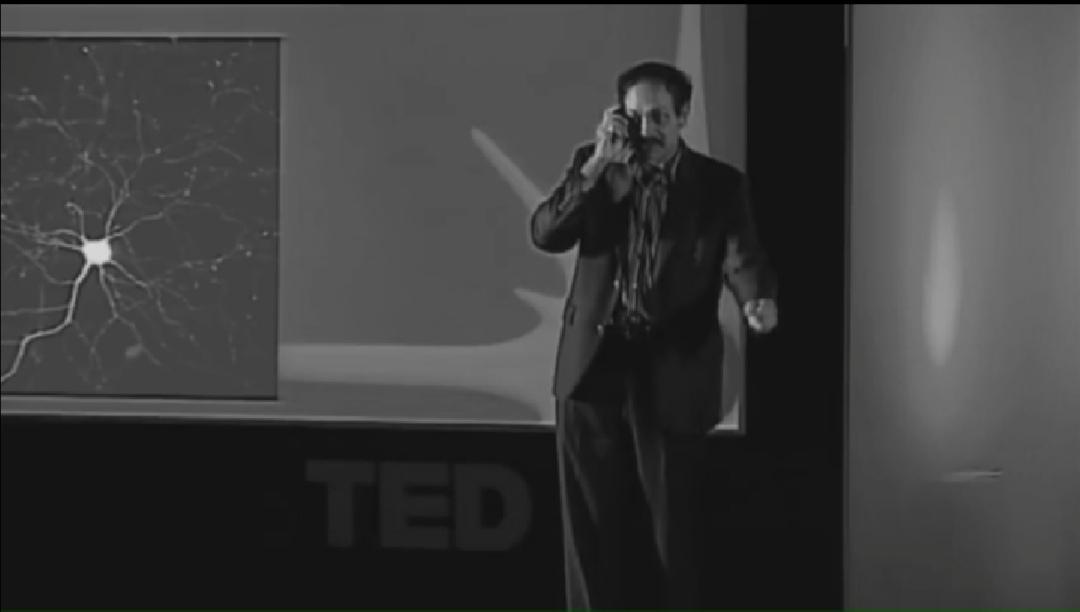
In 2009 geeft neurowetenschapper Vilayanur Ramachandran een TED-talk over spiegelneuronen (in 1996 ontdekt door Giacomo Rizzolatti en zijn team) waarin alweer opvallende overeenkomsten aan het licht komen met wat René Girard beweert over de mimetische begeerte. Als Girard daarover spreekt in het vermelde interview uit 1985 maakt hij zelfs dezelfde gebaren als Ramachandran! Het gaat over volgende uitspraken:
René Girard: “Als ik naar een bepaald voorwerp grijp, zult u geneigd zijn hetzelfde voorwerp te willen grijpen.”
Vilayanur Ramachandran: “Er zijn dus neuronen die actief zijn als ik naar iets grijp, maar die ook actief zijn als ik een ander naar iets zie grijpen.”
Op cellulair niveau is dus een ‘neiging’ meetbaar die we als dusdanig niet altijd ervaren. We leren geleidelijk aan om te gaan met onze ‘directe’ mimetische begeerte. Kleine kinderen kunnen dat vaak veel minder, waardoor ze sneller elkaars verlangen imiteren naar objecten en elkaars ‘obstakel’ worden bij de verwerving ervan. Geef twee kinderen bijvoorbeeld elk een blikje cola, en dan nog kan er een conflict ontstaan als ze die niet willen delen (zie de tweede foto hieronder; de eerste is afkomstig van een experiment in het Max Planck instituut voor Psycholinguïstiek, waarbij onderzoekers vaststelden dat chimpansees de grijpbeweging van hun trainer imiteerden om bij een bekertje uit te komen waaronder een balletje lag):
De keren dat rivaliteit bij prehistorische mensengroepen tijdelijk wordt opgeheven door een collectieve aanval op een lid van de eigen groep (en niet door jacht te maken op dieren of mensen die niet tot de eigen groep behoren), nemen toe. Daardoor zullen primitieve mensen gaandeweg associaties maken bij de slachtoffers van collectief geweld die niet door apen worden gemaakt.
Zoals de hond van Pavlov gaandeweg een geluidssignaal in verband brengt met een bepaald soort voedsel, ook al is dat voedsel niet in de buurt, brengen prehistorische mensen geweld in verband met bepaalde personen (de slachtoffers van collectief geweld!), ook al zijn die personen niet in de buurt. Zoals voor de kwijlende hond gaandeweg ‘onzichtbaar voedsel’ aanwezig lijkt te zijn bij het horen van een geconditioneerde geluidsstimulus, lijken voor de prehistorische gemeenschap gaandeweg ‘onzichtbare personen’ aanwezig te zijn bij het ervaren van geweld.
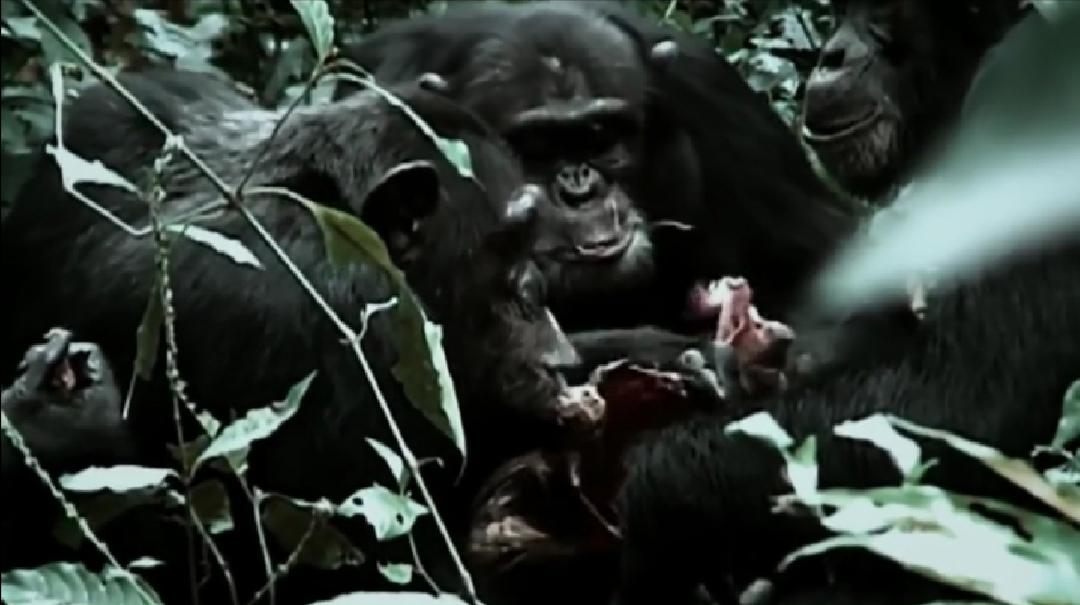
Geweld escaleert soms zodanig bij apen dat er slachtoffers vallen. Uit concrete observaties blijkt dat een groep apen dan plotseling ongewoon kalm wordt en zich verzamelt rond het slachtoffer. Ook de apen die verantwoordelijk zijn voor de neergang van het slachtoffer doen dat. Als zoiets inderdaad vaak is voorgevallen bij onze prehistorische voorouders, kan dat tot bepaalde associaties hebben geleid: zolang die persoon leeft, ervaart de groep geweld en tumult; als die persoon dood is, ervaart ze vrede en stabiliteit.
Met andere woorden, het slachtoffer krijgt gaandeweg onterecht de schuld voor het tumult waarvoor het niet – of slechts gedeeltelijk – verantwoordelijk is (in werkelijkheid gaat het over een escalatie van mimetisch aangevuurde spanningen). Het slachtoffer is met andere woorden een zondebok. Tegelijk leert de groep dat het tumult te bestrijden valt door iemand te doden. Naarmate de groep dat met opzet begint te doen, ontstaat het offerritueel. Vanuit het zondebokmechanisme ontspringt dus het valse geloof dat er onzichtbare personen bestaan (later ‘geesten’ en ‘goden’ genoemd) die verantwoordelijk zijn voor mogelijk geweld en rampspoed, en die met offers te manipuleren zijn. Zulke ideeën hebben zich als een lopend vuurtje verspreid over verschillende gemeenschappen en generaties, in telkens nieuwe gedaanten van duizenden religies.
De mimetische theorie van René Girard toont alvast aan dat zulke religies gebaseerd zijn op een leugenachtige vergissing in de prehistorie. De geesten en goden van die religies bestaan uiteraard niet.
I compiled the following, older documentary film On the Origin of Cultures, in three parts, introducing some major topics of mimetic theory and René Girard’s thinking. Transcription of the videos (in English & Dutch) is available below, beneath PART III.
PART I of the film explores the fundamental role of mimesis (imitation) in human development on several levels (biological, psychological, sociological, cultural). René Girard’s originality lies in his introduction of a connection between this old philosophical concept and human desire. He speaks of a certain mimetic desire and ascribes to it a vital role in our social interaction. It explains our often competitive and envious tendencies. More specifically, Girard considers mimetic desire as the source for a type of conflict that is foundational to the way human culture originates and develops. In his view the primal cultural institutions are religious. Following a sociologist like Émile Durkheim, Girard first considers religion as a means to organize our social fabric, and to manage violence within communities.
The more specific question the first part of this documentary tries to answer is the following: where do sacrifices, as rituals belonging to the first signs of human culture, originally come from? How can they be explained? Click to watch:
PART II starts off with a summary and then further insists on the fundamental role of the so-called scapegoat mechanism at the origin of religious and cultural phenomena.
PART III explores the world of mythology and human storytelling in the light of Girard’s theory on certain types of culture founding conflicts and scapegoat mechanisms. Girard comes to surprising conclusions regarding storytelling in Judeo-ChristianScripture.
 Florilegius/SSPL/Getty Images
 When they divided Purusha, in how many different portions did they arrange him? What became of his mouth, what of his two arms? What were his two thighs and his two feet called?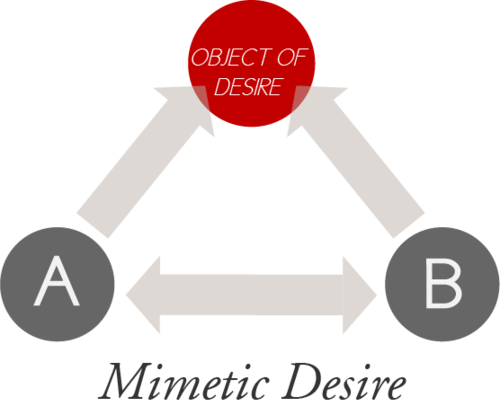

 Several lines of evidence indicate some female competition over mating. First, at Mahale,












 Similar patterns probably dominated the social lives of early humans, including archaic Homo sapiens. Humans, like chimps, have social instincts that enabled our ancestors to form friendships and hierarchies, and to hunt or fight together. However, like the social instincts of chimps, those of humans were adapted only for small intimate groups. When the group grew too large, its social order destabilised and the band split. Even if a particularly fertile valley could feed 500 archaic Sapiens, there was no way that so many strangers could live together. How could they agree who should be leader, who should hunt where, or who should mate with whom?



 SCAPEGOAT SHADOWS