Christ comes to the world as the example, constantly enjoining: Imitate me. We humans prefer to adore him instead. – Quote by Soren Kierkegaard (1813-1855).
To adore Christ means, in the sense that Kierkegaard uses the verb, to idolize him. When you idolize someone else, it often means that you secretly want to become this other person, that you want to take his ‘royal’ place, sometimes even by ‘murdering’ him. In other words, to idolize someone means that you’re not satisfied with yourself, that you’re not accepting yourself, that you don’t experience love for who you are. This explains why we tend to look for what others designate as desirable, and why we want to obtain a desirable position ourselves – i.e. why we want to become ‘perfect’ and ‘divine’ idols ourselves. For obtaining a desirable position seems to fulfill our need to feel loved. However, in the process of surrendering to an imitation of the desires of others we simply lose ourselves. Guided by what René Girard calls ‘mimetic’ (i.e. ‘imitative’) desire, we often want things for ourselves which alienate us from our ‘true’ nature and from our own, unique vocation. So, near the end of this process we’re not loved for who we are but because of the ‘status’ we seem to have gained. Jesus magnificently points out this tragic paradox: “For whoever wants to save their life will lose it… What good is it for someone to gain the whole world, and yet lose or forfeit their very self?” (Luke 9:24a-25).
Sometimes the devil wants you to think that until you’re perfect don’t go talking to God. – Quote by C.C. DeVille.
As you can see in the film below, C.C. DeVille – what’s in an artist’s name? –, guitarist of ‘hair metal, glam rock’ band Poison, clearly understands how his early life relied heavily on the principles I just described. He admits giving in to an unhealthy sense of pride, to a desire for ‘status’. He quite literally says he wanted others to be envious of him. Indeed, envy is the negative side of mimetic desire, the flipside of admiration, and for a person who desires to be desirable it is a big achievement to feel envied. Yet C.C. DeVille felt his life was not fulfilled. He was not happy until he experienced, in his own words, ‘God’s grace’. He discovered the ‘unconditional love’ by which he was finally able to accept himself. The paradox is that, by obeying God’s call through Christ, he became free. “For whoever wants to save their life will lose it but whoever loses their life for me will save it,” Christ claims (in the completed Luke 9:24). That’s exactly what C.C. DeVille discovered, for truly imitating Christ means to accept yourself and others, not to be ashamed of oneself, and to be enabled to grow towards one’s ‘real’ and ‘honest’ vocation. It’s only when we’re accepting ourselves that we are able to approach others, not as means to fulfill our need to feel loved, but as the true ‘goals’ of our lives in the realm of Love, in the realm of a giving Grace that wants to be ‘imitated’ – and to imitate giving means to become ‘givers’ ourselves. That’s why St. Francis (1181-1226) prays: “O Lord, grant that I may not so much seek to be loved, as to love…”
Being free means ‘being free for the other,’ because the other has bound me to him. Only in relationship with the other am I free. – Quote by Dietrich Bonhoeffer.
We are relational beings. We don’t develop relationships ‘out of the blue’, from a primal ‘individual freedom’. On the contrary, it’s the quality of our relationships which decides whether we become free or not – are we led by fear, envy and pride or by trust, grace and truthful honesty?
This post might seem a little weird. I realize that. Few of my friends in the world of music understand why I like ‘hair metal’ so much. This particular brand of rock music has never been a favorite among established pop criticism. I discovered it as a kid, and I was attracted first by the colorful extravaganza of the bands, the big choruses of the songs and the sheer joy displayed in live shows. ‘Hair metal’ felt like summer to me. Later on I discovered that behind this joyful image there often lurked an empty world of drug abuse, superficial relationships without real intimacy and just plain decadence. Yet, at the same time, some of the songs had a melancholic feel which betrayed a longing for more sustainable experiences in life.
Guitarist C.C. DeVille articulates this longing of ‘the soul’ in the following interview. I combined it with quotes by famous thinkers, mostly Christian. One of my pupils, who commences studies in philosophy next year, convinced me to try working with quotes. So, here you have it. I hope I’m able to show in this way that C.C. DeVille really understands what Christianity is all about. Because, let’s face it, especially in the academic world we all too often look down on the so-called ‘superficial’ world of popular culture. Well, at the margins of that world, at what seems to be the pinnacle of superficiality, we have a band like Poison. I dare you, dear reader, to look beyond everything you think to know about bands like these, and to move beyond certain ‘mimetic’ processes which convinced you to dismiss the members of ‘glam metal’ bands. True, Poison might not have written the best songs ever, but I do believe their music is honest – ‘what you hear is what you get’. And if you’re still looking for unexpected complexity and sophistication in this music genre, try a band like Winger – great musicianship combined with the compositional talents of lead singer Kip Winger (as is evidenced by his solo efforts).
Now, watch the interview with C.C. – what you see is what you get –, and click here
My summer holiday started with a blast. Some of my friends are real opera connoisseurs and they invited me and my wife to experience Otello, a true operatic masterpiece of the Romantic era, composed by the great Italian composer Giuseppe Verdi (1813-1901). The libretto was provided by poet and musician Arrigo Boito (1842-1918), the play itself of course being one of William Shakespeare’s tragedies (in English written as Othello, Italian Otello).
René Girard wrote a very interesting book on Shakespeare’s oeuvre, A Theater of Envy. Chapter 31 of this book deals with Othello, entitled Shall we desire to raze the sanctuary? Desire and Death in Othello and other plays. The main characters of Othello are indeed driven by jealousy, by envy – a ‘force’ biblically and traditionally identified with ‘Satan’ or ‘the Devil’. Girard describes envy as the negative side of ‘mimetic’ or ‘imitative’ desire. When a desire is mimetic, it means this desire is based on the imitation of someone else’s desire. We often desire what others desire or possess, not because we intrinsically want to obtain a certain object or goal, but because we more or less unwittingly imitate each other’s desires. An imitated ‘other’ becomes a ‘model’ – someone who is admired – and an ‘obstacle’ at the same time – someone who is envied because of what he owns or is supposed to own; someone who ‘stands in the way’ between the mimetically created subject and object of desire.
Othello is an uncertain and tragic hero. As a dark-skinned Moorish general in the Venetian army, he’s not at ease in the aristocratic circles of Venice. Yet he finds himself married to Desdemona, daughter of a Venetian senator. Throughout the play Othello more and more becomes the puppet of his own uncertainties, as well as of others who ‘pull the strings’ of his worst fears. He first seeks refuge with Cassio, whom he highly admires and therefore will also start to distrust as a potential rival in his love for Desdemona. Othello’s relationship with Cassio (his ‘model-obstacle’), originating from his uncertainties, is at the heart of Othello’s eventual tragic downfall. René Girard in A Theater of Envy (in the edition of St. Augustine’s Press, South Bend, Indiana, 2004 – originally this title was edited by Oxford University Press, 1991) writes the following on the subject (p.290):
“At the thought of entering for the first time the exalted world of Venetian nobility, Othello is struck with panic and he… resorts to a go-between, his own lieutenant, Cassio. […] Cassio is everything that Othello is not: white, young, handsome, elegant, and above all a true Venetian aristocrat, a real man of the world, always at ease among the likes of Desdemona. Othello appreciates Cassio so much that he selects him rather than Iago as his lieutenant.”
Iago becomes the demonic machinator of the play, driven by envy himself. Jealous of Othello’s choice for Cassio, Iago sets up a trap by which he convinces Othello to lower Cassio’s rank. He then gains both Othello’s and Cassio’s trust: he advises Cassio to ask Desdemona to plead for him with her husband, while at the same time he suggests to Othello that Cassio is after his wife. So, every time Desdemona puts in a good word for Cassio, Othello’s suspicion as well as his desire to possess Desdemona ‘completely’ is reinforced (as he ‘imitates’ the supposed desire of Cassio). In order to fulfill his desire Othello eventually murders his wife – so she can no longer belong to Cassio or someone else. Girard is right to emphasize the close relationship between Eros (desire) and Thanatos (death) – p.294-295:
“Death… often has a sexual meaning in Shakespeare… Like everything else in Shakespeare, the kinship of death and desire can be read in either a comic or a tragic vein. Whether or not it ‘really occurs,’ and whether or not it is turned into a pun, the violent conclusion alludes to the overwhelming presence of death at the climax of the mimetic process. As desire becomes increasingly obsessed with the obstacles that it keeps generating, it moves inexorably toward self-and-other annihilation, just as erotic courtship moves toward its sexual fulfillment.”
In Verdi’s rendition of the play, the dramatic pinnacle lies in the second to last act of the opera, Act III. I chose fragments of this act from a 1995 performance, with Placido Domingo as Otello and Renée Fleming as Desdemona, at the famous Metropolitan Opera House (the Met) in New York. My friends and I were lucky enough to hear Renée Fleming as Desdemona once more at the Opéra de la Bastille in Paris, last Friday, July 1. The setting was different, but she was just as great…
CLICK TO WATCH the first part of Act III:
What strikes me the most in Act III, from a dramatic point of view, is Otello’s refusal to listen to his wife. He considers listening to her as taking advice from the devil. At this point in the libretto, Arrigo Boito refers to the Medieval Catholic formula for exorcisms, “Vade Retro, Satana” (recorded in a 1415 manuscript found in the Benedictine Metten Abbey of Bavaria). Otello sings “Indietro!” (“Aback!”), an important word that is not translated in the fragments shown. The aforementioned formula as well as this word are similar to Jesus saying to Peter “Get behind me, Satan” in Mark 8:33 or Matthew 16:23. There, Jesus refuses to listen to Peter because Peter tries to seduce him to compete with ‘the rulers of this world’. In other words, Peter takes the role of ‘Satan’, meaning that he tries to trick Jesus into ‘mimetic rivalry’. Peter tries to trick Jesus into enviously comparing himself to others ‘to protect himself’. With this in mind the tragic irony in Act III of Verdi’s Otello becomes obvious. Otello’s paranoia has become so powerful that he is no longer capable of hearing the truth. The truth is Desdemona is innocent, but she becomes the victim, the ‘scapegoat’ of Otello’s anxieties and frustrations. Otello believes he’s denouncing ‘Satan’, but in fact he actually takes advice from Iago’s hints and is consumed by envy.
Click to continue the important duet between Otello and Desdemona and keep enjoying two of the greatest singers of all time
In the book Evolution and Conversion – Dialogues on the Origins of Culture (Continuum, London, New York, 2007), René Girard talks about popular culture and discusses the power of mass media. His approach is very nuanced, as he distinguishes between positive and negative aspects of these phenomena. He even dares to compare television seriesSeinfeldto the works of William Shakespeare (1564-1616). Girard develops his thoughts in a conversation with Pierpaolo Antonello and João Cezar de Castro Rocha. The seventh chapter, Modernity, Postmodernity and Beyond, reads the following (p.249-250):
“Guy Debord wrote that ‘the spectacle is the material reconstruction of the religious illusion’ brought down to earth. Could we consider the expansion of the mass-media system, and the ideological use of it, as a ‘kathechetic’ instrument as well?
Of course, because it is based on a false form of transcendence, and therefore it has a containing power, but it is an unstable one. The conformism and the ethical agnosticism induced by media such as television could also produce forms of mimetic polarization at the mass level, making people more prone to be swayed by mimetic dynamics, inducing the much-feared populism in Western democracies.
Do you agree, however, that movies, TV and advertising draw heavily on mimetic principle, therefore increasing our awareness on this score?
Yes and no, because the majority of Hollywood or TV productions are very much based on the false romantic notion of the autonomy of the individual and the authenticity of his/her own desire. Of course there are exceptions, like the popular sit-com Seinfeld, which uses mimetic mechanisms constantly and depicts its characters as puppets of mimetic desire. I do not like the fact that Seinfeld constantly makes fun of high culture, which is nothing but mimetic snobbery, but it is a very clever and powerful show. It is also the only show which can afford to make fun of political correctness and can talk about important current phenomena such as the anorexia and bulimia epidemic, which clearly have strong mimetic components. From a moral point of view, it is a hellish description of our contemporary world, but at the same time, it shows a tremendous amount of talent and there are powerful insights regarding our mimetic situations.
Seinfeld is a show that gets closer to the mimetic mechanism than most, and indeed is also hugely successful. How do you explain that?
In order to be successful an artist must come as close as he can to some important social truth without inciting painful self-criticism in the spectators. This is what this show did. People do not have to understand fully in order to appreciate. They must not understand. They identify themselves with what these characters do because they do it too. They recognize something that is very common and very true, but they cannot define it. Probably the contemporaries of Shakespeare appreciated his portrayal of human relations in the same way we enjoy Seinfeld, without really understanding his perspicaciousness regarding mimetic interaction. I must say that there is more social reality in Seinfeld than in most academic sociology.”
Maybe a small example can lift a tip of the veil. I chose a short excerpt from Seinfeld’s episode 88 (season 6, episode 2, The Big Salad). Jerry Seinfeld is dating a nice lady. However, when he finds out his annoying neighbor Newman is her former lover, his face darkens… One doesn’t have to watch the whole episode to know what will happen next. Indeed, Jerry eventually breaks up with his date, imitating what Newman did and ‘ending it’. The reason Jerry’s desire for his girlfriend diminishes precisely lies in the often imitative or, as Girard would call it, ‘mimetic’ nature of desire. Jerry just doesn’t desire his date directly all the way, but he is – like all of us – sometimes heavily influenced by certain models who point out what he should or should not desire. In this case, Newman turns out to be a model who negatively influences Jerry’s desire…
This scene is fun, because it’s all too recognizable and it mirrors some aspects of our tragic comic behavior – good, refined humor as it should be!
MIMETIC THEORY (RENÉ GIRARD) – FIVE-PART VIDEO SERIES (11 VIDEOS)
The following five-part video series provides a preliminary understanding of human culture from the perspective of mimetic theory, which was first developed by René Girard (1923-2015).
I made the first parts to give an overview of some basic cultural facts. The later parts of the video series deal with mimetic theory’s explanation of those facts, ending with the role of the Judeo-Christian heritage in making that type of explanation possible. The last part of the series (PART V) clarifies how the Judeo-Christian traditions result in either a radical atheism or a radically new understanding of God.
POST SCRIPTUM BIJ DE VIDEOSERIE OVER DE MIMETISCHE THEORIE (RENÉ GIRARD)
OVER HET VISIONAIRE KARAKTER EN DE ATHEÏSTISCHE KANT VAN HET WERK VAN GIRARD
Onder andere het werk van David Watts (primatoloog en antropoloog) en dat van professoren Vilayanur Ramachandran en Giacomo Rizzolatti (neurofysiologen) tonen aan hoe visionair de bevindingen zijn van de Frans-Amerikaanse professor en interdisciplinaire denker René Girard… Al die mensen genieten intussen terecht wereldfaam.
Professor David Watts, primatoloog en antropoloog aan Yale University, bestudeert met zijn team sinds 1993 de grootste in het wild levende groep chimpansees. Die bevindt zich in Ngogo, Oeganda. De groep bestaat op een bepaald moment uit meer dan 150 leden. Watts en zijn team wijzen erop dat hun vaststellingen kunnen bijdragen aan een beter inzicht in de evolutie van de mens:
“Chimpansees zijn fascinerende dieren om onszelf mee te vergelijken. Ze zijn meer zoals mensen dan om het even welk levend wezen op aarde. Wat vertelt dit ons over de menselijke evolutie? En wat betekent dit voor mensen?”
In Rise of the Warrior Apes, een documentaire uit 2017 over het onderzoek naar de chimpansees van Ngogo, deelt Watts een aantal observaties die verrassende overeenkomsten vertonen met de veronderstellingen van René Girard over prehistorische menselijke gemeenschappen. Het loont de moeite om ze naast elkaar te plaatsen. Het is een van de zovele aanwijzingen voor het visionaire karakter van het denkwerk van René Girard – die niet toevallig immortel is van de Académie française. De uitspraken van Girard komen uit een interview voor de Nederlandse televisie in 1985, naar aanleiding van zijn eredoctoraat aan de Vrije Universiteit Amsterdam. De uitspraken van Watts en zijn team komen uit de reeds vermelde documentaire.
René Girard: “Als mensen kwaad zijn en opgaan in hun rivaliteit, doden zij elkaar. … De dominantie die onder dieren iedere generatie wordt hernieuwd werkt niet onder mensen, omdat die tot het einde doorvechten en elkaar doden. Een gemeenschap van mensen is dus ondenkbaar als er geen ander mechanisme werkzaam zou zijn…”
David Watts en zijn team: “Mannelijke chimpansees lijken te leven, te ademen en te eten om dominantie te verwerven. Ze streven naar status. Het hoort bij het spel. … Er is nu een situatie waarbij er veel meer mannetjes concurreren om de toppositie. Welke gevolgen heeft dat?… We begonnen ons zorgen te maken: deze gemeenschap is zo groot dat ze niet bij elkaar zal kunnen blijven. Ze zal uiteenvallen nog voor we begrijpen wat er aan de hand is.”
David Watts en zijn team hebben geobserveerd hoe de hoog oplopende interne spanningen (een situatie van ‘allen tegen allen’) verdwijnt als de vijandigheid zich richt naar een tegenstander die geïsoleerd geraakt en die het slachtoffer wordt van een grotere groep (een situatie van ‘allen tegen één’). René Girard veronderstelt terecht dat zulke taferelen zich ook hebben afgespeeld in prehistorische mensengroepen, waarbij mimetische begeerte eerst soms zorgt voor verdeeldheid en geweld; vervolgens zorgt de mimetische vereniging tegen één tegenstander weer voor een tijdelijke eenheid en vrede.
René Girard: “Als er een mimetisch gevecht zonder einde is, dan zal de mimetische kracht zich uiteindelijk op een enkel slachtoffer richten. Anders gezegd: mensen kunnen een object niet delen als zij om dat object gevochten hebben. Om een object vechten verdeelt mensen. Op een gegeven punt zal iedereen met iedereen vechten en verschuift de mimetische kracht van vijand naar vijand. Als twee vijanden dan dezelfde tegenstander kiezen, dan zullen steeds meer mensen dat doen, en uiteindelijk iedereen. De paradox is: vechten om een object verdeelt mensen, maar als iedereen tegen dezelfde vecht, ontstaat er juist eenheid.”
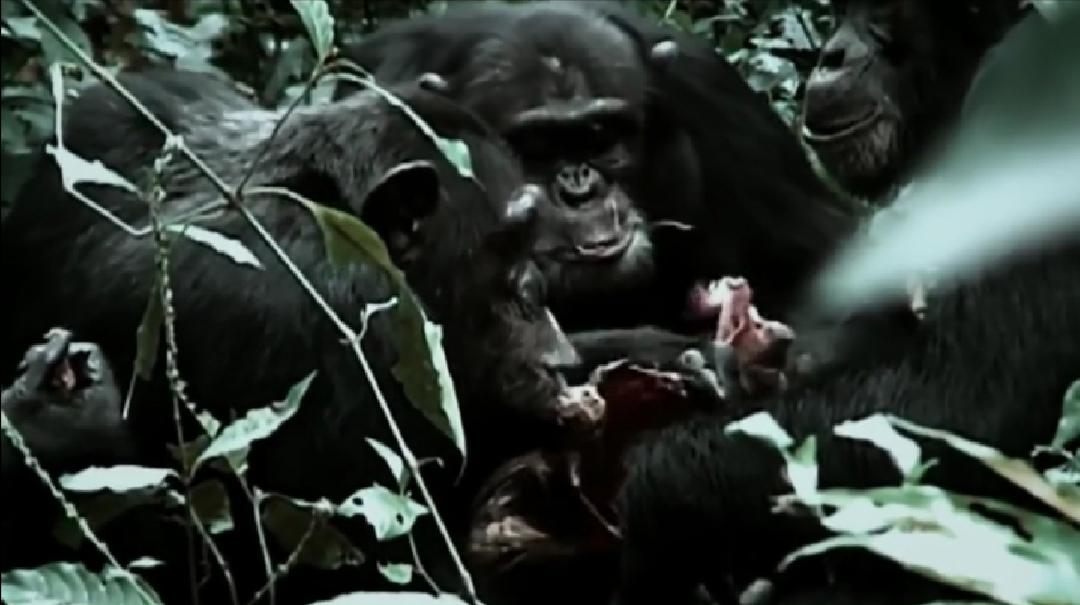
David Watts en zijn team: “We arriveerden op de plaats waar iets gaande was. De chimpansees waren iemand van hun eigen groep aan het aanvallen. Brownface en Pincer…, de meest Ngogo chimpansees waren iemand aan het aanvallen. Al snel realiseerden we ons dat ze Grapelli aan het aanvallen waren. En dat hij in groot gevaar verkeerde. … Ze sloegen hem, schopten hem, beten hem! … Het is onmogelijk dat een dier dit overleeft. … Waarom is het gebeurd, waarom hebben ze hem gedood? Het gaat over een jong mannetje dat sociaal niet zo geïntegreerd is, maar hij lijkt vrij ambitieus. Sommigen zien hem wellicht als een rivaal. Hij is plots in de minderheid, ze kunnen hem echt schaden, en dus doen ze dat…”
David Watts en zijn team observeerden dat chimpansees regelmatig jacht maken op andere apen, of op chimpansees die niet tot de eigen groep behoren. Het is zeer opmerkelijk dat chimpansees blijkbaar niet jagen om voedsel te verkrijgen. Alles wijst erop dat ze jagen om hun sociale banden te versterken. Dat ligt alweer in de lijn met wat René Girard beweert over de oorsprong van jachtrituelen bij onze prehistorische voorouders.
David Watts en zijn team: “Waarom jagen chimpansees? Een oud idee is dat ze jagen wanneer ze honger hebben, als er weinig voedsel is. Maar eigenlijk blijkt het tegenovergestelde. … Vlees lijkt een belangrijke rol te spelen bij het onderhouden en vormen van sociale banden.”
De ‘jacht’ van de chimpansees op Grapelli is uitzonderlijk omdat het een lid van de eigen groep betreft. Tegelijk hoeft het geen verbazing te wekken dat zoiets gebeurt bij een groep van meer dan 150 leden. Onder andere Yuval Noah Harari verwijst in zijn bestseller Sapiens naar het feit dat mensengroepen van die omvang meer met roddelen bezig moeten zijn geweest –The Gossip Theory. Dat is een manier om sociale cohesie te bevorderen ten koste van een gemeenschappelijke tegenstander; zie Sapiens – A Brief History of Humankind (London, Vintage, 2015), p. 28-29:
“Our chimpanzee cousins usually live in small troops of several dozen individuals. They form close friendships, hunt together and fight shoulder to shoulder against baboons, cheetahs and enemy chimpanzees. Their social structure tends to be hierarchical. The dominant member, who is almost always male, is termed ‘alpha male’. Other males and females exhibit their submission to the alpha male by bowing before him while making grunting sounds, not unlike human subjects kowtowing before a king. The alpha male strives to maintain social harmony within his troop. When two individuals fight, he will intervene and stop the violence. Less benevolently, he might monopolise particularly coveted foods and prevent lower-ranking males from mating with the females.
When two males are contesting the alpha position, they usually do so by forming extensive coalitions of supporters, both male and female, from within the group. Ties between coalition members are based on intimate daily contact – hugging, touching, kissing, grooming and mutual favours. … The alpha male usually wins his position not because he is physically stronger, but because he leads a large and stable coalition. These coalitions play a central part not only during overt struggles for the alpha position, but in almost all day-to-day activities. Members of a coalition spend more time together, share food, and help one another in times of trouble.
There are clear limits to the size of groups that can be formed and maintained in such a way. In order to function, all members of a group must know each other intimately. Two chimpanzees who have never met, never fought, and never engaged in mutual grooming will not know whether they can trust one another, whether it would be worthwhile to help one another, and which of them ranks higher. Under natural conditions, a typical chimpanzee troop consists of about twenty to fifty individuals. As the number of chimpanzees in a troop increases, the social order destabilises, eventually leading to a rupture and the formation of a new troop by some of the animals. Only in a handful of cases have zoologists observed groups larger than a hundred. Separate groups seldom cooperate, and tend to compete for territory and food. Researchers have documented prolonged warfare between groups, and even one case of ‘genocidal’ activity in which one troop systematically slaughtered most members of a neighbouring band.
Similar patterns probably dominated the social lives of early humans, including archaic Homosapiens. Humans, like chimps, have social instincts that enabled our ancestors to form friendships and hierarchies, and to hunt or fight together. However, like the social instincts of chimps, those of humans were adapted only for small intimate groups. When the group grew too large, its social order destabilised and the band split. Even if a particularly fertile valley could feed 500 archaic Sapiens, there was no way that so many strangers could live together. How could they agree who should be leader, who should hunt where, or who should mate with whom?
In the wake of the Cognitive Revolution, gossip helped Homo sapiens to form larger and more stable bands. But even gossip has its limits. Sociological research has shown that the maximum ‘natural’ size of a group bonded by gossip is about 150 individuals. Most people can neither intimately know, nor gossip effectively about, more than 150 human beings.
Harari legt uit hoe taal en cognitieve vermogens bij de eerste mensen ontsprongen aan de nood om almaar complexere sociale banden te vormen die de kans op overleving bevorderden (in fysieke en/of ‘culturele’ termen); Sapiens – A Brief History of Humankind (London, Vintage, 2015), p. 25-26:
“Our language evolved as a way of gossiping. According this theory Homo sapiens is primarily a social animal. Social cooperation is our key for survival and reproduction. It is not enough for individual men and women to know the whereabouts of lions and bison. It’s much more important for them to know who in their band hates whom, who is sleeping with whom, who is honest, and who is a cheat.
[…]
The gossip theory might sound like a joke, but numerous studies support it. Even today the vast majority of human communication – whether in the form of emails, phone calls or newspaper columns – is gossip. It comes so naturally to us that it seems as if our language evolved for this very purpose. Do you think that history professors chat about the reasons for the First World War when they meet for lunch, or that nuclear physicists spend their coffee breaks at scientific conferences talking about quarks? Sometimes. But more often, they gossip about the professor who caught her husband cheating, or the quarrel between the head of the department and the dean, or the rumours that a colleague used his research funds to buy a Lexus.”
Kortom, zowel ons overlevingsinstinct als ons verlangen om sociale banden te onderhouden en een sociaal respectabele positie te verwerven (zelfs soms ten koste van ons overlevingsinstinct!) gaan vaak vooraf aan ons verlangen om dingen te verklaren. De vroegste culturele overtuigingen ontstonden niet vanuit een louter ‘contemplatieve’ of ‘intellectuele’ onderneming. Ze dienden fysieke noden en het verlangen om een culturele identiteit te bewaren.
Hoe groter chimpanseegroepen worden, hoe meer rivaliteit en interne spanningen er blijkbaar zijn. Bij prehistorische mensengroepen moet dat nog meer het geval zijn geweest. De mimetische neigingen bij mensen zijn immers sterker, waardoor de neiging om elkaars verlangen te imiteren (= mimetische begeerte) ook sterker zal zijn. Dat laatste kan voor conflicten zorgen als mensen het object van hun verlangen niet kunnen of willen delen.
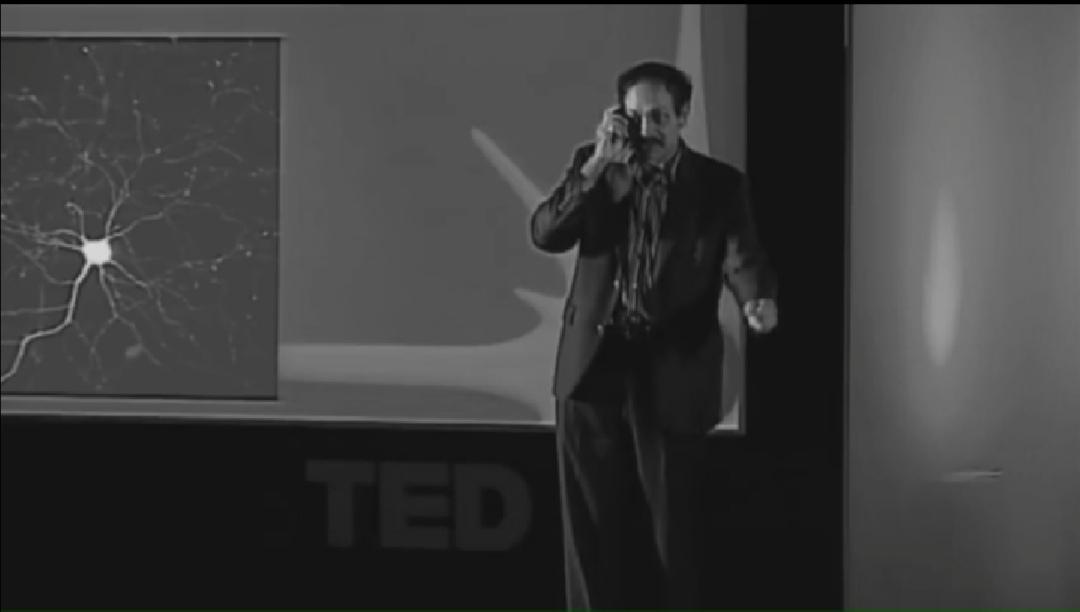
In 2009 geeft neurowetenschapper Vilayanur Ramachandran een TED-talk over spiegelneuronen (in 1996 ontdekt door Giacomo Rizzolatti en zijn team) waarin alweer opvallende overeenkomsten aan het licht komen met wat René Girard beweert over de mimetische begeerte. Als Girard daarover spreekt in het vermelde interview uit 1985 maakt hij zelfs dezelfde gebaren als Ramachandran! Het gaat over volgende uitspraken:
René Girard: “Als ik naar een bepaald voorwerp grijp, zult u geneigd zijn hetzelfde voorwerp te willen grijpen.”
Vilayanur Ramachandran: “Er zijn dus neuronen die actief zijn als ik naar iets grijp, maar die ook actief zijn als ik een ander naar iets zie grijpen.”
Op cellulair niveau is dus een ‘neiging’ meetbaar die we als dusdanig niet altijd ervaren. We leren geleidelijk aan om te gaan met onze ‘directe’ mimetische begeerte. Kleine kinderen kunnen dat vaak veel minder, waardoor ze sneller elkaars verlangen imiteren naar objecten en elkaars ‘obstakel’ worden bij de verwerving ervan. Geef twee kinderen bijvoorbeeld elk een blikje cola, en dan nog kan er een conflict ontstaan als ze die niet willen delen (zie de tweede foto hieronder; de eerste is afkomstig van een experiment in het Max Planck instituut voor Psycholinguïstiek, waarbij onderzoekers vaststelden dat chimpansees de grijpbeweging van hun trainer imiteerden om bij een bekertje uit te komen waaronder een balletje lag):
De keren dat rivaliteit bij prehistorische mensengroepen tijdelijk wordt opgeheven door een collectieve aanval op een lid van de eigen groep (en niet door jacht te maken op dieren of mensen die niet tot de eigen groep behoren), nemen toe. Daardoor zullen primitieve mensen gaandeweg associaties maken bij de slachtoffers van collectief geweld die niet door apen worden gemaakt.
Zoals de hond van Pavlov gaandeweg een geluidssignaal in verband brengt met een bepaald soort voedsel, ook al is dat voedsel niet in de buurt, brengen prehistorische mensen geweld in verband met bepaalde personen (de slachtoffers van collectief geweld!), ook al zijn die personen niet in de buurt. Zoals voor de kwijlende hond gaandeweg ‘onzichtbaar voedsel’ aanwezig lijkt te zijn bij het horen van een geconditioneerde geluidsstimulus, lijken voor de prehistorische gemeenschap gaandeweg ‘onzichtbare personen’ aanwezig te zijn bij het ervaren van geweld.
Geweld escaleert soms zodanig bij apen dat er slachtoffers vallen. Uit concrete observaties blijkt dat een groep apen dan plotseling ongewoon kalm wordt en zich verzamelt rond het slachtoffer. Ook de apen die verantwoordelijk zijn voor de neergang van het slachtoffer doen dat. Als zoiets inderdaad vaak is voorgevallen bij onze prehistorische voorouders, kan dat tot bepaalde associaties hebben geleid: zolang die persoon leeft, ervaart de groep geweld en tumult; als die persoon dood is, ervaart ze vrede en stabiliteit.
Met andere woorden, het slachtoffer krijgt gaandeweg onterecht de schuld voor het tumult waarvoor het niet – of slechts gedeeltelijk – verantwoordelijk is (in werkelijkheid gaat het over een escalatie van mimetisch aangevuurde spanningen). Het slachtoffer is met andere woorden een zondebok. Tegelijk leert de groep dat het tumult te bestrijden valt door iemand te doden. Naarmate de groep dat met opzet begint te doen, ontstaat het offerritueel. Vanuit het zondebokmechanisme ontspringt dus het valse geloof dat er onzichtbare personen bestaan (later ‘geesten’ en ‘goden’ genoemd) die verantwoordelijk zijn voor mogelijk geweld en rampspoed, en die met offers te manipuleren zijn. Zulke ideeën hebben zich als een lopend vuurtje verspreid over verschillende gemeenschappen en generaties, in telkens nieuwe gedaanten van duizenden religies.
De mimetische theorie van René Girard toont alvast aan dat zulke religies gebaseerd zijn op een leugenachtige vergissing in de prehistorie. De geesten en goden van die religies bestaan uiteraard niet.
I compiled the following, older documentary film On the Origin of Cultures, in three parts, introducing some major topics of mimetic theory and René Girard’s thinking. Transcription of the videos (in English & Dutch) is available below, beneath PART III.
PART I of the film explores the fundamental role of mimesis (imitation) in human development on several levels (biological, psychological, sociological, cultural). René Girard’s originality lies in his introduction of a connection between this old philosophical concept and human desire. He speaks of a certain mimetic desire and ascribes to it a vital role in our social interaction. It explains our often competitive and envious tendencies. More specifically, Girard considers mimetic desire as the source for a type of conflict that is foundational to the way human culture originates and develops. In his view the primal cultural institutions are religious. Following a sociologist like Émile Durkheim, Girard first considers religion as a means to organize our social fabric, and to manage violence within communities.
The more specific question the first part of this documentary tries to answer is the following: where do sacrifices, as rituals belonging to the first signs of human culture, originally come from? How can they be explained? Click to watch:
PART II starts off with a summary and then further insists on the fundamental role of the so-called scapegoat mechanism at the origin of religious and cultural phenomena.
PART III explores the world of mythology and human storytelling in the light of Girard’s theory on certain types of culture founding conflicts and scapegoat mechanisms. Girard comes to surprising conclusions regarding storytelling in Judeo-ChristianScripture.










 Similar patterns probably dominated the social lives of early humans, including archaic Homo sapiens. Humans, like chimps, have social instincts that enabled our ancestors to form friendships and hierarchies, and to hunt or fight together. However, like the social instincts of chimps, those of humans were adapted only for small intimate groups. When the group grew too large, its social order destabilised and the band split. Even if a particularly fertile valley could feed 500 archaic Sapiens, there was no way that so many strangers could live together. How could they agree who should be leader, who should hunt where, or who should mate with whom?



 SCAPEGOAT SHADOWS