Students of psychology would not be surprised by some of the key statements made by René Girard and his mimetic theory.

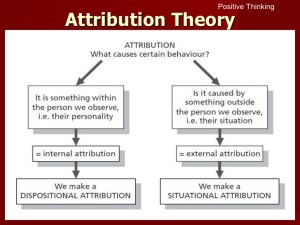
Indeed social psychology time and again shows how people’s social behavior and self-concepts are shaped by imitation processes and scapegoat mechanisms, as stressed by mimetic theory. For instance, Stanley Milgram’s obedience study and the Stanford Prison Experiment show how powerful individuals as well as socially established abstract norms of “role” models are easily obeyed (imitated). The attribution theory teaches how someone tends to “blame” circumstances to justify his or her own “bad” behavior, while, on the other hand, he or she tends to hold others personally responsible for their “loathsome” conduct. Apparently, others are not so easily excused and appear as convenient scapegoats. People who play the blame game consider their own behavior to be “very different” from similar behavior in others. Insights into social identities reveal how gaining an identity through conformity (again by imitating others, of course) leads to stereotyping of and competing with others (as common enemies and scapegoats of one’s group). Here also, there is a tendency to exaggerate differences between one’s own group and other groups. The conduct of one’s own group is easily justified, while similar conduct of a competing group is considered “unjust”. Achever Clausewitz (2007)The problem, of course, is that competing groups imitate this reasoning for their own particular group and thus reinforce the rivalry between each other (read René Girard’s Battling to the End in this regard, on mimetic rivalry on a planetary scale – highly recommended!).

These are all but some preliminary considerations regarding the relationship between mimetic theory and social psychology. There is much more to explore in this relationship. So without further ado, in order to know where to start, here is a short overview of some basic studies and concepts of social psychology which relate directly to mimetic theory.

1. Stanley Milgram’s Obedience Study (click for more information)

Stanley Milgram Obedience to AuthorityNot surprisingly, in light of mimetic theory, disobedience is more likely to occur:

  • when the experimenter leaves the room
  • when the orders are given by an “ordinary” man
  • when the subject works with peers who refuse to go on
  • [considering the philosophy of Emmanuel Levinas]
    when the “learner” is in the same room

2. The Stanford Prison Experiment (Philip Zimbardo – click for more)

People adapt to the social norms of the role assigned to them. Prisoners become distressed, helpless and panicky. Guards become nice, or “tough but fair”, or tyrannical.

3. Social Cognition

Social cognition is an area of social psychology concerned with social influences on thought, memory, perception and all kinds of other cognitive processes. More specifically, researchers are interested in how people’s self-perception affects relationships, thoughts, beliefs and values. Here are some findings regarding attribution, factors in attitude change and conformity.

Attribution theory:

Attribution TheoryPeople are motivated to explain their own and others’ behavior by attributing its causes to situation or disposition. Again, not surprisingly in light of mimetic theory, people show the tendency to overestimate personality factors in explaining the behavior of others, while they underestimate situational influence. On the other hand, the concept of self-serving bias points to the fact that people often do the opposite when explaining their own behavior: people try to justify themselves.

Major factors in attitude change:

  • endorsement by an admired or attractive person
  • a leader who offers unconditional love, acceptance and attention
  • the creation of a new identity based on a group
  • repetition (imitation, indeed) of ideas and assertions; entrapment (justification of an escalating commitment); isolation from other sources of information

Conformity (click for more) (see also Solomon Asch, click here),

related to:

  • groupthink: in close-knit groups all members tend to think alike and suppress disagreement for the sake of harmony
  • diffusion of responsibility
  • bystander apathy
  • deindividuation (the loss of awareness of one’s own individuality in groups or crowds)
  • ethnocentrism
    (aids survival by making people feel attached to and willing to work for their own group)
  • group identity and social identity
    (a person’s self-concept based on an identification with a group, a nation or a culture, or with gender or other social roles)
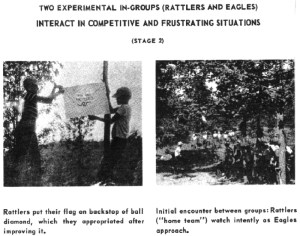
  • Robbers Cave Experiment 1“us vs. them” social identities that are strengthened when groups compete (in-group vs. out-group; see Muzafer Sherif and his Robbers Cave experiment)
  • stereotypes that distort reality for they:
    exaggerate differences between groups and underestimate differences within groups; allow for disliking others so people feel closer to their own group and inflate self-worthRobbers Cave Experiment 2


Ruben Van GuchtRuben Van Gucht, a Belgian sports journalist, did a little research on the question whether soccer teams really benefit from firing a coach and attracting a new one when a team is not delivering expected results. He presented his results on De Afspraak (December 8, 2015), a Belgian TV-show.

The short answer to Van Gucht’s research question is NO.

Similar research done in other countries already suggested this outcome.

Often there is a short-term effect, but this has more to do with statistical regularity, especially when considered from the perspective of long-term effects. Indeed, in the long run there seem to be no significant differences between the results under the guidance of the former coach and those of the new one.

Victories as well as defeats of soccer teams are just that: TEAM EFFORTS & EXPERIENCES. Of course it is tempting to look for a scapegoat in times of crisis. And coaches are easy targets. But as Van Gucht’s research reveals: a coach is not a decisive factor; he’s just one of many.

Coincidentally, I wrote about the tendency to use coaches as scapegoats in an introduction to my course on René Girard’s mimetic theory in high school. Here’s an excerpt:

Scapegoat Team BuildingThe mimetic building blocks of our psycho-social fabric are at once responsible for the preservation and disintegration of that very same fabric. One of the well-tried means to restore a social order that is in crisis because of escalating mimetic rivalry, is the so-called scapegoat mechanism. This restoration again rests on mimetic processes. Let’s turn to the example of the soccer team once more. When a team loses time and again, that’s normally no favorable factor for the group atmosphere. Teammates start blaming each other for bad results, maybe even sabotaging each other. There also might be ill-will towards the coach by players who feel they’re not given enough opportunities to play matches. And when the coach becomes part of the rivalry and frustrations within the team, that’s usually the end of his career there. As more players imitate the ill-will of some teammates towards their coach, the latter becomes the one held responsible for all the major problems within the team, and he’ll be fired by the board in the end. Instead of recognizing the mimetic origins of social disorder, people tend to blame one outsider or a group of outsiders. This scenario is well-known. Coaches indeed often function as convenient scapegoats, as they are outsiders because of their position of leadership, and they are easily blamed unjustly for a crisis they’re not or only partly responsible for. Like other scapegoats they’re interpreted in a twofold manner by the group they’re expelled from: perceived as the main cause for the tensions, divisions and disorder within the group, and experienced as the main cure while being sacrificed (expelled, or worse) to restore unity and order within that same group. Scapegoats are at once villain and hero, monster and savior, hated and loved, unwanted and wanted, scorned yet needed. Think, for example, of dictatorial regimes who blame all their domestic problems on foreign enemies. As long as a dictator can unite his citizens against some outside enemy, he can at least prevent them from uniting against himself and remain in the saddle. This means that he cannot completely destroy the enemy he publicly loathes. Dictators need the periodic sacrifice of their scapegoat in order to preserve the social fabric on a very large scale, but human beings in general tend to use the scapegoat mechanism on a day-to-day basis, albeit often in smaller ways.

READ ABOUT an example in the world of baseball:

Mike Redmond and the easy Marlins scapegoat

READ ABOUT an example in the world of soccer:Rafa Benitez

Rafa Benitez is an easy scapegoat for problems at Real Madrid

From the Dominican Republic to Australia, from the United States of America to countries all over Europe, from Brazil to India and South Korea, from the left to the right in political quarters, from the world of science and the humanities, from believers and atheists alike, from media big (e.g. The New York Times) and small (e.g. Provinciale Zeeuwse Courant): René Girard received numerous accolades at his passing. To cite just a few examples, in honor of this “Darwin of the human sciences”:

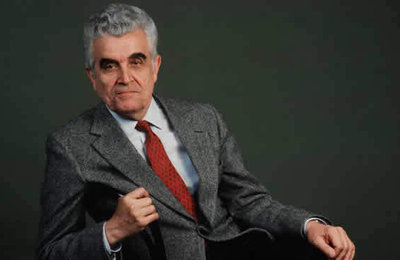
René Girard portraitRené Girard was one of the leading thinkers of our era – a provocative sage who bypassed prevailing orthodoxies and “isms” to offer a bold, sweeping vision of human nature, human history and human destiny.

The renowned Stanford French professor, one of the 40 immortels of the prestigious Académie Française, died at his Stanford home on Nov. 4 at the age of 91, after long illness.

Fellow immortel and Stanford Professor Michel Serres once dubbed him “the new Darwin of the human sciences.” The author who began as a literary theorist was fascinated by everything. History, anthropology, sociology, philosophy, religion, psychology and theology all figured in his oeuvre.

International leaders read him, the French media quoted him. Girard influenced such writers as Nobel laureate J.M. Coetzee and Czech writer Milan Kundera – yet he never had the fashionable (and often fleeting) cachet enjoyed by his peers among the structuralists, poststructuralists, deconstructionists and other camps. His concerns were not trendy, but they were always timeless.

READ MORE:

Many scholars have claimed that René Girard’s mimetic theory is one of the most important insights of the 20th century. This morning brought the news that René has passed away at age 91. “Girardians,” as we are called, have been on social media sharing our sorrow at his passing, but also our profound sense of gratitude for this giant among human beings. We stand on his shoulders. And our vision is all the clearer for it.

READ MORE: Patheos, November 4, 2015

Dans un communiqué, le président de la République, François Hollande, a salué la mémoire du philosophe et académicien français René Girard: «C’est un intellectuel exigeant et passionné, exégète à la curiosité sans limite, théoricien brillant et à l’esprit fondateur, enseignant et chercheur atypique aimant aller à contre-courant, René Girard était un homme libre et un humaniste dont l’œuvre marquera l’histoire de pensée», affirme le chef de l’Etat.

READ MORE: Le Figaro, November 5, 2015

Mensonge romantique et vérité romanesque (René Girard)Fondateur de la « théorie mimétique », ce franc-tireur de la scène intellectuelle avait bâti une œuvre originale, qui conjugue réflexion savante et prédication chrétienne. Ses livres, commentés aux quatre coins du monde, forment les étapes d’une vaste enquête sur le désir humain et sur la violence sacrificielle où toute société, selon Girard, trouve son origine inavouable.

READ MORE: Le Monde, November 5, 2015

Dès demain, vendredi 6 novembre, France Culture bouleverse ses programmes et rend hommage dans Les Matins au philosophe et académicien français, René Girard, « éminent théoricien surnommé « le nouveau Darwin des sciences humaines ».

Entretiens inédits, rediffusions d’interviews à partir du vendredi 6 novembre et tout au long de la semaine prochaine.

Réécoutez La Grande Table du 5 novembre : hommage à René Girard

Dossier spécial sur franceculture.fr :«Mort de l’anthropologue et philosophe René Girard»

READ MORE & LISTEN TO: France Culture, November 5, 2015

Quand, à 18 ans, Jean-Marc Bastière entre dans une librairie et tombe sur un livre de René Girard “des choses cachées  depuis la fondation du monde”, après quelques pages,  c’est comme si la foudre lui était tombé dessus. “Une révélation sur la nature humaine” nous dit-il, “une révélation sur l’humanité parce que je trouvais que ce qu’il disait, était limpide”. Chez Jean-Claude Guillebaud, ami de longue date de l’académicien, c’est un retour dans la religion qui l’a marqué: “je lui dois d’être revenu à la foi chrétienne. Je faisais partie de la génération des soixante-huitards , plus ou moins sécularisé comme beaucoup de jeunes de mon âge”. Progressivement en lisant ces livres, Jean-Claude Guillebaud prend conscience de la pertinence du message évangélique et “redevient chrétien”. D’ailleurs Jean-Marc Bastière retient la même chose, un accomplissement de la pensée, qu’il a pu approfondir et qui, aujourd’hui, est arrivé à maturité.

A écouter : René Girard dans notre émission Face aux chrétiens.

READ MORE & LISTEN TO: RADIO NOTRE DAME, November 5, 2015

In de Verenigde Staten is de Franse antropoloog en literatuurwetenschapper René Girard overleden. De Frans-Amerikaanse intellectueel wordt gezien als een van de grootste denkers van de voorbije 100 jaar. Hij schreef over de menselijke begeerte en was de ontdekker van het zondebokmechanisme als het verborgen fundament van religie en maatschappij. Cultuur, godsdienst en geweld staan centraal in zijn werk.

READ MORE: VRT Nieuws, deredactie.be, November 5, 2015

René Girard geldt als een van de belangrijkste denkers over de menselijke cultuur en godsdienstgeschiedenis van zijn generatie. Zijn reputatie vestigde hij met zijn even bejubelde als omstreden studie God en geweld. Elke cultuur gaat uiteindelijk terug op een gewelddaad, zo betoogde hij, en wordt juist cultuur doordat ze dat geweld weet te beteugelen. Het was een klap in het gezicht van ieder die meende dat de (moderne) beschaving juist tegenover het geweld en de religie staat, in plaats van eruit te zijn ontstaan.

READ MORE: NRC Handelsblad, November 5, 2015

La obra de Girard parte del campo de la historia, pero se mueve siempre de forma transversal entre la antropología, la filosofía y la literatura. Parte de una noción central: la de “mímesis” o imitación, que él toma directamente de Platón y Aristóteles para reconducirla en la elaboración de una concepción del hombre que encuentra refrendada tanto en la literatura como en la historia (la pasada y la presente). 

READ MORE: El País, November, 5, 2015

Nascido no dia de Natal de 1923, em Avignon, René Girard escreveu bastante sobre a diversidade e unidade das religiões.

René Girard viva nos Estados Unidos desde 1947. Ensinou em várias universidades, como Duke, Johns Hopkins e, sobretudo, Stanford, onde dirigiu durante muito tempo o departamento de língua, literatura e civilização francesa.

Terminou a sua carreira académica em Stanford em 1995.

READ MORE: RTP, November 5, 2015

O acadêmico francês René Girard, eminente teórico conhecido como “o novo Darwin das ciências humanas”, morreu nesta quarta-feira (4), aos 91 anos, nos Estados Unidos, anunciou a universidade de Stanford, onde lecionou durante muitos anos.

READ MORE: Globo, November 5, 2015

Zum Tod des Kulturanthropologen René Girard – Wolfgang Palaver im Gespräch

LISTEN TO: ARD Mediathek, Deutschlandfunk, November 5, 2015

Vielfach ausgezeichnet, war Girard nach seiner Aufnahme in die Académie Française „unsterblich“. Seine Bücher werden bleiben – als Deutungsschema und Zündstoff im Zwillingskonflikt der Religionen, zwischen denen er keine Gleichheit ausmachen konnte.

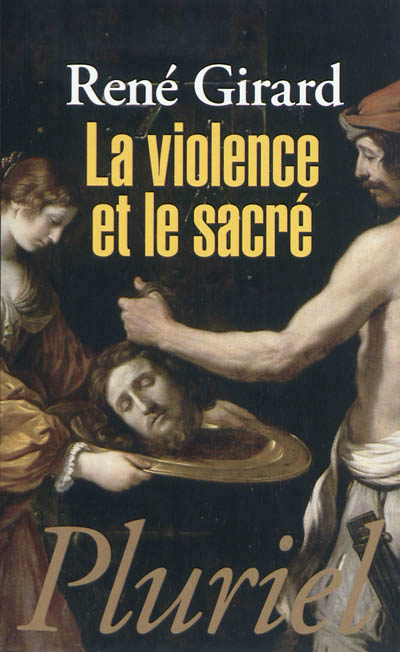
La violence et le sacré (1972)READ MORE: Frankfurter Allgemeine Zeitung, November 5, 2015

Dank Figuren wie ihm hatten die Gegenstimmen zur “French Theory” das letzte Wort. Es waren Stimmen, die sich als die des “Realen” verstanden, gegen jene der Generationsgenossen Lévi-Strauss, Foucault, Derrida, welche die Mythen, Religionen, literarischen Texte, philosophischen Systeme vor allem für struktural zerlegbare Produkte der Fantasie hielten. Der Philosoph, Anthropologe und Religionsforscher René Girard weigerte sich jedoch, den Trieb, den Mythos oder das Kunstwerk einfach als Strukturelement eines immanenten Bedeutungssystems aufzufassen. Er suchte die gesellschaftliche und psychologische Wirklichkeit dahinter.

READ MORE: Süddeutsche Zeitung, November 5, 2015

Der 1923 in Avignon geborene Girard war zu seinen Lebzeiten ein singulärer kulturgeschichtlicher Denker. Aus seinem umfangreichen Werk sticht vor allem seine “Mimetische Theorie” und der “Sündenbockmechanismus” hervor.

Girard erklärt damit den Zusammenhang zwischen menschlichem Zusammenleben, der Entstehung von Gewalt und ihrer Eindämmung durch Religion, Tabus und Verbote. René Girard analysiert die menschliche Kultur und Geschichte aus der Perspektive der Gewaltentstehung und ihrer Opfer.

READ MORE & LISTEN TO: Österreichischer Rundfunk, November 5, 2015

Denn so subtil seine Beschreibung sozialer Phänomene ausfiel, so obsessiv versuchte er, sie für seine Zwecke, die Apologie der Religion, zu instrumentalisieren. Deshalb wirken seine Befunde manchmal überraschend und überzeugend, manchmal aber auch erzwungen.

Girards ganzes Werk ist eine Polemik gegen den Wunschtraum von der «rationalistischen Unschuld» der Moderne. Dass dieser Wunschtraum heutzutage tatsächlich ausgeträumt ist, ist nicht wirklich Girards Verdienst, aber Grund genug, sein Werk als Wegzehrung auf die Reise der Menschheit nach dem Ende der Unschuld mitzunehmen.

READ MORE: Neue Zürcher Zeitung, November 5, 2015

Academicianul francez Rene Girard, un eminent teoretician supranumit “noul Darwin al stiintelor umaniste”, a incetat din viata miercuri, la varsta de 91 de ani, in Statele Unite, a anuntat universitatea Stanford unde acesta a predat pentru o lunga perioada de timp, transmite AFP.

“Renumitul profesor francez de la Stanford, unul dintre cei 40 de nemuritori ai prestigioase Academii Franceze, a decedat in casa sa de la Stanford miercuri, dupa o indelungata boala”, a declarat universitatea californiana intr-un comunicat de presa.

Rene Girard si-a inceput cariera ca teoretician literar, fascinat de toate stiintele sociale: istorie, antropologie, sociologie, filosofie, religie, psihologie si teologie.

READ MORE: HotNews.ro, November 5, 2015

Rođen 1923. u Avignonu , kršćanin Girard mnogo je pisao o raznolikosti, ali i univerzalnosti religija, a svoju je misao crpio iz vjerskih tekstova i velikih književnih klasika.

READ MORE: SEEbiz, November 5, 2015

Girard’s extensive oeuvre has generated a wide range of responses across many disciplines, not least within Christian theology.

In 2005, on his election to L’Académie française, Girard was acclaimed by Michel Serres as the “Charles Darwin of the human sciences.” The post-modern intelligentsia – deeply wedded to the dogma of culture’s irreducible plurality – remains sceptical, also despising any attempted rehabilitation for the Queen of the Sciences.

Girard, with a dash of Gallic insouciance, referred to his critics’ small intellectual ambitions as “the comprehensive unionization of failure” – and of course his theory gives a good account of such academic rivalry, as well as the individualist’s refusal of personal conversion that acceptance of his theory demands.

Unsatisfied with uncovering the origin of culture and explicating the emergence of secular modernity, however, Girard came eventually to predict the apocalyptic acceleration of history towards a tragic denouement.

As for Rene Girard himself, he was an observant Catholic layman for 55 years and he knew that God’s Kingdom was not of this world. He looked forward to union with God, and there in faith and hope we leave him, where all the victims of history are vindicated and every tear is wiped away.

READ MORE: ABC, Australia, November 5, 2015

René Girard visited the UK on three occasions and was grateful to the Jesuits in Britain for the welcome he received here. His first visit was to Oxford, where stayed at Campion Hall and where he delivered the D’Arcy Lecture to 200 people in the university. This was followed by two visits to Heythrop, the second of which was to receive an honorary doctorate, as he was on his way to Paris to be received into the Académie française as one of their 40 immortels.

At times he was like an evangelical about his insights, but he was also capable of being playful, even offhand: ‘People are against my theory, because it is at the same time an avant-garde and a Christian theory … Theories are expendable. They should be criticized. When people tell me my work is too systematic, I say, I make it as systematic as possible for you to be able to prove it wrong.’

READ MORE: Jesuits in Britain, November 5, 2015

The following tribute is adapted in part from the forthcoming book Raising the Ante: God’s Gamble by Gil Bailie, a long-time friend and student of René Girard.

READ MORE: Catholic World Report, November 5, 2015

A társadalomtudományok új Darwinjaként méltatták, amikor a múlt század ’70-es éveiben kifejtette civilizációelméletét.

Életének 92. évében elhunyt René Girard francia tudós, aki a mimetikus vágyelmélet, a bűnbakképzés és a bibliamagyarázat terén megfogalmazott elméleteivel újfajta antropológiát alapozott meg. Kora egyik legjelentősebb gondolkodójaként, a társadalomtudományok új Darwinjaként emlegették. A Francia Akadémia tagja hosszan tartó betegség után szerdán hunyt el az Egyesült Államokban, halálhírét a Stanford Egyetem közölte. A francia gondolkodó hosszú ideig tanított a neves intézményben.

„Látám a sátánt, mint a villámlást lehullani az égből.” E könyvében a kereszténység kritikai apológiáját nem teológiai alapokon, hanem racionális bizonyítások útján írja meg. Valójában a zsidó-keresztény vallási tradíció rendkívül eredeti antropológiáját tárja az olvasó elé, magáévá téve Simone Weil egyik gondolatát, miszerint az Evangéliumok mindenekelőtt egy „emberelméletet”, egy antropológiát tartalmaznak, és csak ez után tekintendők „Istenelméletnek”, teológiának.

READ MORE: 24.hu, November 5, 2015

Des choses cachées depuis la fondation du mondeUn pensiero potentemente originale, quello dell’antropologo accademico di Francia che ha inventato — nel senso etimologico di “scoprire” — teorie illuminanti come il desiderio mimetico e il rito del capro espiatorio, perché non nato da schemi speculativi astratti, ma dall’osservazione dei meccanismi interiori che muovono quell’animale strutturalmente sociale che è l’uomo. L’essere umano di ogni epoca, non nel migliore dei mondi possibili ma nel mondo reale, dove si soffre e si muore per mano dei propri simili, vittime a loro volta — spesso inconsapevoli — di un automatismo interiore che li trasforma in carnefici certi di essere nel giusto e di obbedire a un dovere morale. Un pensiero letteralmente vicino all’origine, quello del «Darwin dell’antropologia», come lo chiamano in Francia, e quindi capace di illuminare anche i recessi più oscuri di quel mistero che chiamiamo genericamente coscienza, una chiave di lettura semplice e geniale allo stesso tempo scaturita più dalla lettura attenta dei capolavori di Proust, Dostoevskij, Dante e Cervantes che dalle pagine dei manuali di filosofia.

Un pensiero tanto celebrato quanto contestato, quello dell’antropologo francese che ha continuato a lavorare e a scrivere anche dopo aver superato i novant’anni, capace di anticipare successive scoperte scientifiche.

READ MORE: L’Osservatore Romano, November 5, 2015

L’antropologo, 91 anni, è morto ieri a a Stanford, negli Stati Uniti. Fondatore della “teoria mimetica”, da anticonformista della scena intellettuale aveva costruito un lavoro originale, che unisce riflessione accademica e predicazione cristiana. I suoi libri, commentati in tutto il mondo, sono tappe di una importante indagine sul desiderio umano e sulla violenza sacrificale da cui qualsiasi società, secondo Girard, trova la sua origine vergognosa. In Italia i suoi libri sono pubblicati da Adelphi.

READ MORE: Rai News, November 5, 2015

Pour finir, je voudrais dire un mot des implications pour le lecteur d’une telle théorie. Devenir «girardien», ce n’est pas appartenir à une secte ; ce n’est pas tenir pour vrai tout ce que Girard a écrit; c’est d’abord se laisser aller à une «conversion» qui n’est pas d’ordre religieux, mais qui est un bouleversement du regard sur soi, une critique personnelle de son propre désir.

Pour comprendre à quel point la théorie de Girard est vraie, il faut avoir cheminé à rebours de son désir, non pas pour atteindre un illusoire «moi» authentique, mais au contraire pour aboutir à l’inexistence de ce moi, toujours déjà agi par des «désirs selon l’autre». La théorie mimétique est un dévoilement progressif dont le lecteur n’est jamais absent de ce qui se dévoile à lui. Elle menace l’existence du sujet que je croyais être. Elle s’attaque à ce que je croyais le plus original chez moi.

Il n’est pas un lecteur de Girard, même le plus convaincu, qui ne se soit dit à la lecture de Mensonge romantique et vérité romanesque : «Il a raison, tout ça est vrai. Heureusement que pour ma part j’y échappe en partie.» Il serait suicidaire de ne se lire soi-même qu’avec les lunettes girardiennes ; on a besoin de croire un minimum aux raisons que notre désir se donne ; ces raisons constituent toujours une résistance en nous à la théorie mimétique, plus ou moins grande selon les individus. Il ne s’agit pas de s’en défendre, mais de le savoir. La lecture de Girard nous impose donc un double processus de révélation : on se rend compte d’abord que notre propre désir obéit aux lois décelées par Girard ; et dans un second temps, on se rend compte qu’on a feint l’adhésion totale à ses thèses, et qu’il reste en nous un moi «néo-romantique» qui ne se croit pas concerné par ces lois. Ainsi, la découverte de Girard doit nous interdire, in fine, le surplomb de celui qui aurait compris, contre tous ceux qui seraient encore des croyants naïfs en l’autonomie de leur désir.

READ MORE: Causeur.fr, November 5, 2015

René Girard 1979

Largement traduite, souvent admirée hors de son pays, comme aux Etats-Unis ou en Italie, l’oeuvre de René Girard reste assez mal connue du grand public en France. «Pour un intellectuel qui a longtemps été considéré comme un auteur à contre-courant et atypique, l’élection à l’Académie est une forme de reconnaissance», déclarait-il au quotidien La Croix le 15 décembre 2005, jour de sa réception à l’Académie française.

«Je peux dire sans exagération que, pendant un demi-siècle, la seule institution française qui m’ait persuadé que je n’étais pas oublié en France, dans mon propre pays, en tant que chercheur et en tant que penseur, c’est l’Académie française.»

READ MORE & WATCH: Le Parisien, November 5, 2015

Je me souviendrai toute ma vie de ce jour où mon ami François et moi, nous nous sommes annoncés chez lui dans le VIIème. Il avait la gentillesse de nous recevoir alors qu’il était au milieu de sa famille. Il nous parlait. O temps suspends ton vol. Le monde familier qui l’entourait n’existait plus pour lui. Cette longue conversation qui n’était pas la première, m’a beaucoup fait réfléchir sur le mal. François, passionné de Thomas d’Aquin, trouvait Girard pessimiste. Quant à moi, j’ai décidé ce jour-là de remonter, avec Girard, de saint Thomas à saint Augustin.

Girard est-il pessimiste? Il le serait, il serait gnostique si l’on découvrait dans son oeuvre un refus quelconque de la chair et de la condition charnelle de l’homme. C’est tout le contraire. Le désir charnel n’intéresse pas Girard comme il intéresse Freud, parce que Girard le méridional sait très bien ce que Freud ne sait pas : le désir n’est pas une production physique de l’animal humain mais une construction psychique.

“For me he completely undid the secular Enlightenment’s undoing of Christianity.”  (Sean O’Conaill).

READ MORE: acireland, November 5, 2015
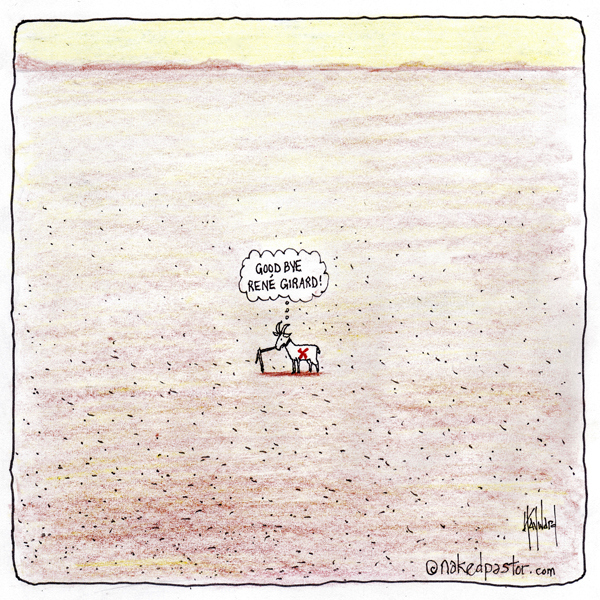
René Girard Scapegoat cartoon by nakedpastor David Hayward

Comprendere «nello stesso momento, perché i credenti dapprima, e sul loro esempio i non credenti poi, sono sempre passati vicino al segreto, peraltro così semplice, di ogni mitologia»: è stata questa l’ambizione e l’esito della ricerca del francese René Girard, che si è spento a Stanford, negli Stati Uniti. Una ricerca che era impossibile (lo dimostra l’intervista autobiografica del 1994 con Michel Treguer) incasellare nei riquadri angusti delle discipline accademiche.

Da questa ricerca iniziata con Dostoevskij arriva l’opera che ne fa un filosofo e un antropologo della religione: La violenza e il sacro del 1972 (Adelphi, 1980) elabora una teoria della genesi della religione. Nella mitologia e nella sua elaborazione filosofica e letteraria Girard ritrova l’atto iniziale di occultamento che «inganna la violenza»: il «sacro» che assorbe la violenza destinata fatalmente a nascere e la riversa su una entità non vendicabile e insieme in apparente continuità con coloro al posto dei quali viene sacrificato. Così il capro espiatorio placa e fonda la società in questa ombra religiosa che è «il sentimento che la collettività ispira ai suoi membri, ma proiettato fuori dalle coscienze che lo provano, e oggettivato».

READ MORE: Corriere della Sera, November 6, 2015

Jean-Pierre Elkabbach et Europe 1 ont souhaité rendre hommage à l’académicien et philosophe René Girard disparu à l’âge de 91 ans.

WATCH & LISTEN TO: Europe 1, Crif, November 6, 2015

Difficilement «classable» dans une pensée ou l’autre, René Girard a toujours affiché sa foi chrétienne malgré les critiques d’une partie de la communauté scientifique. Il s’est ainsi beaucoup penché sur l’origine et le devenir des religions, jusqu’à leurs formes extrémistes d’aujourd’hui.

Ce sont d’ailleurs ses recherches sur la Bible qui l’ont conduit à la foi chrétienne, comme l’explique à Anne-Sophie Saint-Martin le théologien jésuite Dominique Peccoud.

READ MORE & LISTEN TO: Radio Vatican, November 6, 2015

In his 1950s poem “Vespers,” W. H. Auden recalls a meeting of representatives of two different political standpoints. They come together:

to remind the other (do both, at bottom, desire truth?) of that half
of their secret which he would most like to forget,
 
forcing us both, for a fraction of a second, to remember our victim
(but for him I could forget the blood, but for me he could forget
the innocence),
 
on whose immolation (call him Abel, Remus, whom you will, it is
one Sin Offering) arcadias, utopias, our dear old bag of a democracy
are alike founded:
 
For without a cement of blood (it must be human, it must be
innocent) no secular wall can safely stand

Nobody familiar with René Girard’s mimetic theory can read this poem and not think somehow that Auden “got it.” Girard himself never discussed this poem, but argued convincingly that so many of the greatest literary giants—Proust, Dostoevsky, Freud, Shakespeare, Sophocles, the evangelists, the Psalmist—got it, or very nearly got it. Girard’s doggedness led him on a wild intellectual journey from the great novelists to Greek tragedy, from biblical texts to the writings of Freud and Nietzsche. He devoted his final book to the thought of a Prussian military historian, Carl Clausewitz.

Even in taking full measure of Girard’s impact on the human and social sciences, it seems silly to label Girard a “genius.” Besides being a Romantic descriptive that Girard would have certainly abhorred, such a moniker ignores the fact that Girard’s great insight was not his at all. His primary talent was to notice how others captured the mimetic quality of human desire, and the consequences of this peculiarly human way of desiring.

There is an Ignatian quality to mimetic theory. Mimetic forces operated loudly in the life of St. Ignatius, and his “Exercises” and contemplative practices seem geared to helping us gain awareness of the undercurrents that otherwise manhandle us. This explains to some extent why the first theologian to discover Girard was a Jesuit—Raymund Schwager—and why Henri de Lubac, perhaps the greatest Jesuit theologian of the past century, read Girard and assured him that nothing in his thought could not be reconciled with orthodox Christianity.

READ MORE: America Magazine, November 6, 2015

Girard is a thinker who combined an utter lack of self-importance with the boldest intellectual risk-taking. A Stanford colleague, Hans Ulrich Gumbrecht, declares that Girard is:

“a great, towering figure – no ostentatiousness. … Despite the intellectual structures built around him, he’s a solitaire. His work has a steel-like quality– strong, contoured, clear. It’s like a rock. It will be there and it will last.”

READ MORE: Thinking Faith, November 6, 2015

Typiquement, le girardien sans christianisme, cet oxymoron  qui prolifère aujourd’hui, s’efforce de découvrir la violence, les boucs émissaires et le ressentiment partout, sauf là où cela ferait vraiment une différence, la seule différence qui tienne, c’est-à-dire en lui-même. C’est ainsi que les bien-pensants passent leur temps à dénoncer le racisme dégoutant du bas-peuple de France sans paraître voir le racisme de classe dont ils font preuve à cette occasion.  Ce girardisme sans christianisme est le pire des contresens d’un monde qui pourtant n’en est pas avare: le monde post-moderne est plein de concepts girardiens devenus fous.

READ MORE: Causeur.fr, November 6, 2015

Achever Clausewitz (2007)«Existen graves malentendidos en lo que concierne a mi trabajo. A menudo se ve en mí un reaccionario o, al contrario, del lado de los cristianos, una especie de herético utopista.» (René Girard).

Podrá estarse de acuerdo o no con muchas de las propuestas de Girard, podrá surgir cierto empalago entre sus lectores (me incluyo entre ellos), mas lo que no puede negarse es su capacidad de provocar pensamiento, de atravesar diferentes campos del saber y comportarse, tras su pista como, un cazador furtivo que penetra en campos inesperados y que en principio parecen acotados para otros acercamientos. Llegados a este punto no queda más que desear al pensador desaparecido, verdadero agitador del campo del pensamiento … que la terre vous soit légère.

READ MORE: Kaosenlared, November 6, 2015

Quelle est la nature du désir humain? Quelle est l’origine de la violence? Comment naissent les religions? Qu’est-ce qu’une culture? Ce ne sont là que quelque unes des questions fondamentales auxquelles les travaux de l’anthropologue français René Girard, décédé le 04 novembre à l’âge de 91 ans, permettent de répondre.

Considéré à juste titre comme l’un des penseurs majeurs de la seconde partie du XXième siècle, il était parfois surnommé depuis le début du troisième millénaire « le Darwin des sciences humaines ». Une reconnaissance tardive pour celui qui publia son premier ouvrage en 1961 – Mensonge romantique et vérité romanesque, devenu un classique – mais qui donne une idée de l’ampleur de l’apport girardien au savoir universel.

Comme le naturaliste anglais, René Girard est un penseur des origines. Sa découverte de la nature mimétique du désir et des mécanismes de désignation et de meurtres de boucs émissaires qui en découlent, partage avec la notion darwinienne d’évolution une simplicité explicative à l’efficacité redoutable, pour ne pas dire incontestable.

Mais il y a une différence entre les deux penseurs. Alors que les découvertes de Charles Darwin l’amenèrent à perdre la foi, c’est en comparant des mythes du monde entier avec la Bible que René Girard renoua avec une foi qu’il avait passablement oubliée.

READ MORE: Atlantico, November 7, 2015

Tommy WieringaDe mens heeft, zoals we weten, de geheimzinnige neiging om te gaan lijken op zijn tegenstander. De religieus geïnspireerde oorlogsretoriek van George Bush was op den duur niet meer van die van Osama bin Laden te onderscheiden. Vijanden bestuderen elkaar zo diepgaand, dat ze elkaar gaan nabootsen. De filosoof en religiewetenschapper die daar veel over heeft geschreven, René Girard, overleed deze week op 91-jarige leeftijd. Zijn werk heeft het denken over begeerte, geweld en rivaliteit veranderd.

Een variant op deze nabootsing tussen vijanden doet zich voor bij betogers tegen vluchtelingenopvang. Zo beducht zijn de betogers voor verkrachting, geweld en maatschappelijke ontwrichting door vluchtelingen, dat zij andersdenkenden verkrachting toewensen, geweld toepassen en maatschappelijke ontwrichting veroorzaken.

READ MORE: Column Tommy Wieringa, Provinciale Zeeuwse Courant, November 7, 2015

“Die Rivalität spielt eine so gewaltige Rolle, daß man den Versuch, die Nachahmung auszutreiben, vergeblich unternimmt.”

Der Verfasser dieser so rabiat richtigen Sätze ist am vergangen Mittwoch in Stanford knapp 92jährig verstorben. René Girard, der Bibeltreueste aller französischen Denker, erreichte ein biblisches Alter.

READ MORE: artmagazine, November 7, 2015

The publishing world says that the title to be called a “bestselling book” rather than an advertisement gives stronger motivation for Korean readers to purchase the book. When best-selling products sell more, we call it the theory of social evidence in social psychology.

“Following what others do” is particularly evident in Korea. Imitating others’ preference and desire, however, is one of the features of modern society. That’s why TV commercials prod consumers’ desire to buy products by showing a rice cooker that Kim Soo-hyeon uses and beer that Jun Ji-hyun drinks. René Girard (1923-2015), French philosopher who died in the U.S. on Wednesday, formulated the structure of human being’s desire into the theory of “triangular desire.”

In many cases, the coercion by parents who push their kids to become a doctor or a lawyer regardless of their aptitude derives from “mimetic desire.” The triangular desire can be dreadful in that people are not aware of the fact that they live their lives mimicking others. Girard says that the mankind competes each other to mimic other’s desire and creates collective stress such as jealousy and animosity that is relieved in a wrong manner by using socially marginalized people as scapegoats. Peeping into the desire of others through social network service has become a daily routine. Now, we need to practice not to be swayed by the desire that “seems to be mine, but is not mine, still looks like mine” just like a line of a popular song.

출판시장에선 잊을만하면 사재기 베스트셀러 순위 조작 논란이 불거진다. 편법을 써서라도 베스트셀러 순위에 오르면 판매실적이 올라간다는 믿음 때문이다. 출판계에 따르면 국내 독자의 구매 욕구를 자극하는 건 광고보다 베스트셀러 타이틀이다. 가장 많이 팔린 상품이 더 많이 팔리는 현상을 사회심리학에서는 사회적 증거의 법칙이라고 부른다.

한국사회에서 유독 남들 따라하기와 쏠림현상이 심하기는 하지만 타인의 취향과 욕망을 모방하는 것은 현대 사회의 특징이다. TV 광고에서 김수현이 쓰는 밥솥과 전지현이 마시는 맥주를 보여주며 대중의 소비 욕망을 자극하는 것도 그 때문이다. 이 같은 인간 욕망의 구조를 욕망의 삼각형 이론으로 체계화한 프랑스 사상가가 4일 미국서 별세한 르네 지라르(19232015)였다.

문학평론가에서 출발한 지라르는 철학 역사학 인류학 종교학 등을 두루 통섭하는 업적을 남겨 인문학의 새로운 다윈으로 평가받는다. 미국에서 반세기 넘게 살았음에도 2005년 불멸의 40인으로 불리며 국민의 존경을 받는 프랑스 아카데미 프랑세즈의 정회원이 됐다. 그는 소설 분석을 통해 우리가 원하는 것이 실은 남의 욕망을 베낀 것에 지나지 않는다는 결론을 내렸다. 예컨대 보바리 부인에서 상류사회를 동경하는 엠마의 욕망은 자연발생적인 것이 아니다. 단지, 사춘기 때 읽은 삼류 소설 주인공의 욕망을 본뜬 것이다.

부모가 자녀 적성에 관계없이 의시나 변호사가 되라고 강요하는 것도 모방욕망에서 비롯된 경우가 많다. 욕망의 삼각형이 무서운 이유는 자신이 남의 욕망을 모방하며 살고 있다는 사실 자체를 자각하지 못하는 것이다. 지라르에 따르면 인류는 경쟁적으로 남의 욕망을 모방하다 쌓여가는 질투 적개심 같은 집단적 스트레스를 사회의 소외된 사람을 엉뚱한 희생양으로 삼아 해소한다. 소셜네트워크서비스(SNS)를 통해 남의 욕망을 엿보는 게 일상이 돼버렸다. 유행가 가사에 나오듯 내 것인 듯 내 것 아닌 내 것 같은 욕망에 휘둘리지 않는 연습이 필요한 시대다.

READ MORE: The Dong-A Ilbo, November 7, 2015

In 2001, my spiritual mentor Bob Holum gave me a book that completely changed everything for me: Rene Girard’s Things Hidden Since the Foundation of This World. I learned the sad news that Girard died this past week, so I wanted to reflect on how his ideas helped Jesus’ cross and the Christian gospel make a lot more sense to me.

READ MORE: Patheos, November 7, 2015

Many Christians have not yet caught up with his scholarship on these themes, disclosing not so much new ideas but original themes often hidden. The life, teaching and death of Jesus are shown to continue the work of unraveling human violence and scapegoating and to reveal the divine as the source of creative love unfolding through history and culture. His work is not an easy read but many other scholars, authors and teachers are making his work accessible. Thank you René!

READ MORE: Modern Church, November 7, 2015

For Girard, one summary view might have it, at the very beginning it is not religion that leads to violence, but violence which leads to—which indeed creates a need for—religion, as a way of channeling and constraining the use of force. But once the process starts, religion can of course fuel violence, as Girard could see. You don’t have to be one of his devotees to observe that scapegoating as a form of team-building has taken many different forms, from the Salem witch-trials to the anti-communist hysteria of 1950s America to ritual denunciations of erstwhile comrades by the Soviet Politburo. But there is something particularly vicious and destructive about a religiously inspired lynch mob whose blood is up, and has somehow been convinced that its own salvation (and internal cohesion) lies in annihilating the heretic or the infidel. At the very minimum, Girard’s work is a help in understanding how religions (Christianity in particular, but perhaps also Buddhism) can be pacifist in content but often violent and bullying in historical practice. Think of the mobs that rampaged through Jewish quarters in European cities during the Middle Ages, especially in Holy Week. At a time when Christians were supposed to be identifying with a victim of scapegoating, they perpetrated that very thing.


READ MORE: The Economist, November 7, 2015

Mercredi 4 novembre, René Girard a rejoint le ciel de la vérité romanesque en compagnie des grands romanciers qui lui ont donné à penser sa théorie du désir mimétique. L’occasion de revenir sur les essais et les concepts qui ont jalonné sa carrière intellectuelle iconoclaste.

Avec son premier essai paru en 1961, Mensonge romantique et vérité romanesque, Girard approfondit les grands textes de Don Quichotte à L’Éternel mari, au point d’élaborer une clef de lecture qui dépasse le strict cadre de la littérature. Grâce à une analyse comparée des classiques, il remarque que Dostoïevski, Flaubert, Stendhal ou Proust, surmontent tous un passage romantique pour embrasser une vérité romanesque. L’épreuve romanesque d’un Julien Sorel, celle d’une Emma Bovary, rappellent combien nous ne sommes jamais seuls avec nos désirs les plus intimes.

Scandale pour les structuralistes de l’époque qui ne lui pardonneront pas une lecture thématique ouverte à la psychanalyse, l’essai accouche d’une théorie décisive pour les sciences humaines. Un tiers est toujours là, qu’il soit rival ou modèle souverain, à l’origine de toutes nos actions. Avec son mythe individualiste qui nous veut maîtres de nos propres désirs, la littérature romantique participe à cacher cette vérité dérangeante. Pourtant, si Madame Bovary trompe son médiocre mari et noie son ennui dans des romans à l’eau de rose, elle imite, fascinée, ses lectures qui l’invitent à l’évasion sentimentale. Tous les grands romanciers ont conscience de ces modèles qui hantent leurs personnages en situation de crise, souvent dans le sang et les larmes.

READ MORE: Philitt, November 7, 2015

Frankfurter Allgemeine Sonntagszeitung, November 8, 2015:

Cord Riechelmann René Girard

Acaba de fallecer (4.XI.2015) en Estados Unidos, donde vivía y enseñaba desde hace unos decenios, el mayor de los antropólogos y quizá de los pensadores cristianos de la segunda mitad del siglo XX.
R. Girard ha repensado y ha querido superar la visión del hombre que ofrecen Marx y Freud, con una teoría abarcadora (universal) que permite integrar (interpretar y recrear) los temas radicales de la conciencia individual y social, con la mímesis, la lucha mutua y violencia.

Su investigación crítica (hipotética en algunos puntos) resulta necesaria para entender algunos de los temas más significativos de nuestra cultura, como son la violencia y el victimismo o, mejor dicho, la existencia de las víctimas, primero asesinadas y después manipuladas por los mismos asesinos.

Todos los políticos que yo conozco hablan de la importancia de las víctimas, quizá sin saber que ese lenguaje se lo deben a Girard, aunque no hayan entendido lo que él quiere decir…, aunque no aceptarían muchas de sus propuestas.

A los ojos de Girard, la crítica de Nietzche en contra de la religión resulta más aguda que la de Marx, pues él ha puesto de relieve unos mecanismos de proyección reactiva de los oprimidos que tienden a satanizar a los triunfadores, haciendo de la religión un principio de venganza. Pero tampoco Nietzsche ha llegado hasta el fondo del problema, pues su filosofía sigue presa en los esquemas o mecanismos del chivo expiatorio.

READ MORE: Salamanca RTV, November 8, 2015

Larga vida a las obras magistrales de René Girard.

READ MORE: Milenio, November 8, 2015

A veces digo que Girard me salvó la vida. Yo andaba por esa época obsesionadísimo con las aristas fascinantes y suicidas del hombre del subsuelo de Dostoievski: Raskolnikov y su forma demente de ver el mundo, trastornado por una rabia insondable. Si no llego a leer esa primavera su análisis crítico y clarividente de las pulsiones subsuelíticas, difícilmente habría llegado a la treintena. Todavía hay gente que hoy me considera un exaltado, pero lo de ahora no es nada comparado con esa época.

READ MORE: El Mundo, November 9, 2015

Sous les couronnes, on tend à passer sous silence qu’on l’a fortement critiqué, car il dérangeait les philosophes marxistes et qu’il portait un éclairage différent sur l’anthropologie structuraliste. De plus, son analyse du phénomène religieux était considérée comme superflue à une époque où l’on prétendait que “Dieu était mort”. 

Les intellectuels français, plutôt que de débattre, ont préféré exclure. C’est ainsi qu’un des penseurs les plus reconnus mondialement est décédé à Los Angeles.

READ MORE: Les Echos, November 10, 2015

‘जमाव कधीच निरपराध नसतो. सामूहिक हिंसाचार हा खोटारडेपणाच्या आड दडलेला असतो’, हे विधान फ्रेंच विचारवंत आणि मानव्यसंशोधक रेने गिरार्ड यांनी येशूच्या सुळी जाण्यासंदर्भात केले होते खरे, पण ते कोणत्याही देशातील/ काळातील सामूहिक हिंसाचाराला लागू पडावे. गिरार्ड यांचे निधन गेल्या आठवडय़ात, वयाच्या ९२ व्या वर्षी झाले आणि जगाने तत्त्वचिंतक- अभ्यासक गमावला. युद्ध, हिंसाचार आणि ‘संस्कृती’ यांच्या संबंधांचा अभ्यास करताना वाङ्मय, तत्त्वज्ञान, मानसशास्त्र, इतिहास यांचा आंतरशाखीय विचार करून त्यांनी ‘बळीचा सिद्धान्त’ मांडला होता. या अनुषंगाने, ‘आपल्या इच्छा आपल्या नसतात’ (मानवी अनुकरणाचा सिद्धान्त) आणि अनुकरण करता येत नाही म्हणून- किंवा दुसऱ्याकडे आहे ते आपल्याकडे नाही म्हणून संघर्ष/ हिंसाचार, कारणाचे सुलभीकरण करून निरपराधांना नाडण्याची प्रवृत्ती.. अशी सत्ये त्यांनी साधार मांडली. चार्ल्स डार्विनचा नैसर्गिक निवडीचा सिद्धान्त हा मानवी संस्कृतीत टिकून राहिलेल्या बहुविधतेलाही लागू आहे असे सांगणारे गिरार्ड ‘मानव्यविद्यांमधील डार्विन’ म्हणून ओळखले जात.

READ MORE: Loksatta, November 10, 2015

Girard’s first book, Deceit, Desire and the Novel (1961 in French; 1965 in English), used Cervantes, Stendhal, Proust and Dostoevsky as case studies to develop his theory of mimesis. The Guardian recently compared the book to “putting on a pair of glasses and seeing the world come into focus. At its heart is an idea so simple, and yet so fundamental, that it seems incredible that no one had articulated it before.

READ MORE: The Wire, November 10, 2015

Too few people know about René Girard, who passed away on Nov. 4 at 91. He was undoubtedly one of the most important men of the 20th century.

In the end, his country recognized him, giving him perhaps its highest honor for intellectuals of the humanities, a seat at the Académie Française.

Girard’s work, summed up under the heading “mimetic theory,” is like a flash of lightning on a dark summer night, suddenly illuminating everything in a strange new light. Girard’s thought has had an influence in fields as diverse as literary criticism, history, anthropology, philosophy, theology, psychology, economics, and even Silicon Valley entrepreneurship.

READ MORE: The Week, November 10, 2015

En Colombia vivimos un tanto crispados por la polarización entre posiciones extremas, que siempre tienden a descalificar al adversario. Así, el principal reto para la construcción de la paz es el cambio cultural. Algunos proponen aplicar técnicas de diverso orden, para aprender a gestionar los conflictos sin recurrir a la violencia; otros, incrementar el estado liberal de derecho y fortalecer el mercado, restringiendo el poder de la religión, considerada como causa del fanatismo que nos impide vivir en paz.

Con Girard, podríamos aprender cómo salirnos de los enredos que nos conducen a la violencia, tanto la cotidiana como la que enfrenta a diversos grupos y afecta dramáticamente a la sociedad. Y también podríamos aprender a ganar una distancia crítica frente a las posiciones que consideran que la paz significa más mercado y más Estado de derecho. Y lo haríamos al reconocer que estos son también sistemas constituidos sobre exclusiones y centrados en elementos incuestionables, que ocupan el lugar de lo sagrado primitivo; dicho brevemente, son sistemas religiosos.

Así, gracias a Girard podríamos volver a apreciar el valor de ese viejo libro, la Biblia, que nos expone los mecanismos religiosos, o sea, de violencia, que constituyen a las sociedades, al tiempo que nos invita a tomar distancia y a reflexionar en silencio.

READ MORE: El Tiempo, November 10, 2015

Peter Thiel - Forbes Cover StoryMr. Thiel, of PayPal, said that he was a student at Stanford when he first encountered Professor Girard’s work, and that it later inspired him to quit an unfulfilling law career in New York and go to Silicon Valley.

He gave Facebook its first $100,000 investment, he said, because he saw Professor Girard’s theories being validated in the concept of social media.

“Facebook first spread by word of mouth, and it’s about word of mouth, so it’s doubly mimetic,” he said. “Social media proved to be more important than it looked, because it’s about our natures.”

The investment made Mr. Thiel a billionaire.

A nonpracticing Roman Catholic, Professor Girard underwent a religious awakening after a cancer scare in 1959, while working on the conclusion of his first book.

“I was thrown for a loop, because I was proud of being a skeptic,” he later said. “It was very hard for me to imagine myself going to church, praying and so on. I was all puffed up, full of what the old catechisms used to call ‘human respect.’ ”

The Christian influence on his work was most apparent in “Things Hidden Since the Foundation of the World,” written in 1978 and published in English in 1987. In that book he said Christianity was the only religion that had examined scapegoating and sacrifice from the victim’s point of view.

His final work, published in 2007, posited that the mimetic competition among nations would lead to an apocalyptic confrontation unless nations could learn to renounce retaliation.

That forthright religious stance may have cost him status in university circles, said Robert Pogue Harrison, a professor of literature at Stanford. “No doubt it was an obstacle,” he said. “He believed in Christian truth, which isn’t going to find ready acceptance in contemporary academia.”

Much recognition came to Professor Girard late in life. He was elected to the Académie Française in 2005 and received a lifetime achievement award from the Modern Language Association in 2009. In 2013 he received the Order of Isabella the Catholic from the king of Spain for his work in philosophy and anthropology.

READ MORE: The New York Times, November 10, 2015

Exclusif: un entretien inédit avec René Girard (1923-2015) réalisé en 2008 à l’université de Stanford.

READ MORE: Contrepoints, November 11, 2015

Han blev inte en tänkare på modet, men René Girards analyser av litteraturen lämnade ovärderliga bidrag till förståelsen av människan, skriver Anders Olsson.

Men med hjälp av de nycklar han haft till hands har han gett oss ovärderliga bidrag till förståelsen av människans fatala – eller underbara – bundenhet vid sin nästa. Med stort mod och stor envishet har han fått oss att se dolda mekanismer som formar och bryter ner kulturer och samhällen, men som vi har ytterst klena resurser att bemöta. Av sådant skapas uppenbarligen inga trender. Behovet ligger djupare, i den vilja till insikt som mödosamt och föga gloriöst söker upp det vi inte vill veta av.

READ MORE: Sydsvenskan, November 11, 2015

There are some thinkers that offer intriguing ideas and proposals, and there is a tiny handful of thinkers that manage to shake your world. Girard was in this second camp. In a series of books and articles, written across several decades, he proposed a social theory of extraordinary explanatory power.

In the second half of the twentieth century, academics tended to characterize Christianity – if they took it seriously at all – as one more iteration of the mythic story that can be found in practically every culture. From the Epic of Gilgamesh to Star Wars, the “mono-myth,” to use Joseph Campbell’s formula, is told over and again. What Girard saw was that this tired theorizing has it precisely wrong. In point of fact, Christianity is the revelation (the unveiling) of what the myths want to veil; it is the deconstruction of the mono-myth, not a reiteration of it-which is exactly why so many within academe want to domesticate and de-fang it.

The recovery of Christianity as revelation, as an unmasking of what all the other religions are saying, is René Girard’s permanent and unsettling contribution.

READ MORE: The Boston Pilot, November 11, 2015

Looking at patterns across historical cultures, Girard had noticed a the prevalence of “scapegoating” or ceremonially placing communal indiscretions onto one person. This is so prevalent today that our ears are likely deaf and eyes blind to it when it happens. A celebrity who kisses the nanny and divorces their spouse is, in some sense, hated all the more not because of what they did but because their behavior embodies “everything wrong with the world,” even our own longing for adventure. Girard’s unique perspective, focused through years of studying literature, mythology, and religious texts, saw scapegoating behavior as imitative or “mimetic.” That is, once the needs of survival are met, humans begin to develop wants that are shaped communally, in emulation of one another. This always leads to competition – indeed, competitive desire is the primary assumption of Western economics.

READ MORE: Huffington Post, November 11, 2015

MORE INTERESTING ARTICLES AND MORE MEDIA:

Obituary by Maria Clara Lucchetti Bingemer in Journal do Brasil

Radio Feature by Joe Gelonesi on ABC, Australia (with references on the passing of Rene Girard)

Interview with James Alison (Video) in America Media

Hommage for René Girard (Audio) by Raphaël Enthoven in franceculture

Article by Rodrigo Negrete in Nexos (Mexico)

Obituary by Antoine Lagadec in Revue des deux Mondes (France)

Obituary by Thomas Assheuer in Die Zeit (Germany)

Obituary by Józef Niewiadomski in Die Furche (Austria)

Obituary by Nelson Tepedino in Prodavinci (Venezuela)

Article by Roberto Ago in Artribune (Italy)

Obituary by Joseph Bottum in The Weekly Standard (USA)

Obituary by Suzanne Ross in Patheos

Obituary by Social Science Space

Obituary by Antoine Nouis and Jean-Luc Mouton in Réforme (France) – including a long interview with René Girard from 2008

Article by Michael Kirwan in Thinking Faith (UK)

Hommage René Girard (Video), École Normale Supérieure

Obituary SanatAtak (Turkey)

Obituary by Pierre-Yves Gomez in The Conversation (UK)

Obituary by Joanna Tokarska-Bakir in wyborcza.pl (Poland)

Obituary by Pier Giacomo Ghirardini in Tempi (Italy)

Article by Stéphane Ratti in Revue des deux Mondes (France)

Obituary by Alfio Squillaci in gliStatiGenerali (Italy)

Obituary by Roberto Calasso in Re Pubblica (Italy)

Article by Jean-Baptiste NOE in La Synthèse (France)

Article by The Raven Foundation: Many Voices in Celebration – a Tribute to René Girard

Article by Cynthia Haven, remembering today’s funeral (November 14, 2015) of René Girard and paying tribute to the victims of yesterday’s (November 13, 2015) terrorist attacks in Paris

RENÉ GIRARD, “THE EINSTEIN OF THE SOCIAL SCIENCES” IN FORBES, NOV 30, 2015

READ ALSO: Killing Idols – Commemorating René Girard’s Spirituality

To conclude, this video interview by Daniel Lance:


C S LewisC.S. Lewis (1898-1963), a former atheist who converted to Christianity, became well-known for his series of seven fantasy novels The Chronicles of Narnia, but the fame of this series sometimes overshadows other work by this fascinating author. And that’s a shame because, up to this day, Lewis remains a surprisingly fresh Christian thinker.

In Mere Christianity Lewis identifies “the great sin” of humanity as Pride. From his account it is clear that pride rests on what René Girard has called mimetic desire – i.e. a desire based on the imitation of what others desire. Mimetic desire can easily become competitive and lead to mimetic rivalry if people cannot or do not want to share the objects of their mutually enforced desire. The “proud man” derives his pride from the supposition that other people desire what he possesses. In a sense he needs competition (competitive desire) to affirm his prestigious aura, all the while of course not suspecting that his own desire is also based on the imitation of the desires of others… Of course, following the nuances of Lewis himself about pride, there’s nothing wrong with being proud of some achievement. To be proud of some recognition we receive from others might be a consequence of something that we have done. The proud man, on the other hand, is guided by his pride as the ultimate goal of his existence.

But enough introductory talk. Here’s what Lewis has to say on Pride – people acquainted with René Girard’s further developed mimetic theory will surely recognize some familiar themes 😉 [For more on this, click here].

I now come to that part of Christian morals where they differ most sharply from all other morals. There is one vice of which no man in the world is free; which every one in the world loathes when he sees it in someone else; and of which hardly any people, except Christians, ever imagine that they are guilty themselves. I have heard people admit that they are bad-tempered, or that they cannot keep their heads about girls or drink, or even that they are cowards. I do not think I have ever heard anyone who was not a Christian accuse himself of this vice. And at the same time I have very seldom met anyone, who was not a Christian, who showed the slightest mercy to it in others. There is no fault which makes a man more unpopular, and no fault which we are more unconscious of in ourselves. And the more we have it ourselves, the more we dislike it in others.

The vice I am talking of is Pride or Self-Conceit: and the virtue opposite to it, in Christian morals, is called Humility. You may remember, when I was talking about sexual morality, I warned you that the centre of Christian morals did not lie there. Well, now, we have come to the centre. According to Christian teachers, the essential vice, the utmost evil, is Pride. Unchastity, anger, greed, drunkenness, and all that, are mere fleabites in comparison: it was through Pride that the devil became the devil: Pride leads to every other vice: it is the complete anti-God state of mind.

C.S. Lewis quote on Pride gets no pleasure out ofDoes this seem to you exaggerated? If so, think it over. I pointed out a moment ago that the more pride one had, the more one disliked pride in others. In fact, if you want to find out how proud you are the easiest way is to ask yourself, ‘How much do I dislike it when other people snub me, or refuse to take any notice of me, or shove their oar in, or patronise me, or show off?’ The point is that each person’s pride is in competition with every one else’s pride. It is because I wanted to be the big noise at the party that I am so annoyed at someone else being the big noise. Two of a trade never agree. Now what you want to get clear is that Pride is essentially competitive – is competitive by its very nature – while the other vices are competitive only, so to speak, by accident. Pride gets no pleasure out of having something, only out of having more of it than the next man. We say that people are proud of being rich, or clever, or good-looking, but they are not. They are proud of being richer, or cleverer, or better-looking than others. If everyone else became equally rich, or clever, or good-looking there would be nothing to be proud about. It is the comparison that makes you proud: the pleasure of being above the rest. Once the element of competition has gone, pride has gone. That is why I say that Pride is essentially competitive in a way the other vices are not. The sexual impulse may drive two men into competition if they both want the same girl. But that is only by accident; they might just as likely have wanted two different girls. But a proud man will take your girl from you, not because he wants her, but just to prove to himself that he is a better man than you. Greed may drive men into competition if there is not enough to go round; but the proud man, even when he has got more than he can possibly want, will try to get still more just to assert his power. Nearly all those evils in the world which people put down to greed or selfishness are really far more the result of Pride.

Take it with money. Greed will certainly make a man want money, for the sake of a better house, better holidays, better things to eat and drink. But only up to a point. What is it that makes a man with £ 10,000 a year anxious to get £ 20,000 a year? It is not the greed for more pleasure. £ 10,000 will give all the luxuries that any man can really enjoy. It is Pride – the wish to be richer than some other rich man, and (still more) the wish for power. For, of course, power is what Pride really enjoys: there is nothing makes a man feel so superior to others as being able to move them about like toy soldiers. What makes a pretty girl spread misery wherever she goes by collecting admirers? Certainly not her sexual instinct: that kind of girl is quite often sexually frigid. It is Pride. What is it that makes a political leader or a whole nation go on and on, demanding more and more? Pride again. Pride is competitive by its very nature: that is why it goes on and on. If I am a proud man, then, as long as there is one man in the whole world more powerful, or richer, or cleverer than I, he is my rival and my enemy.

C.S. Lewis quote on pride The Christians are rightThe Christians are right: it is Pride which has been the chief cause of misery in every nation and every family since the world began. Other vices may sometimes bring people together: you may find good fellowship and jokes and friendliness among drunken people or unchaste people. But pride always means enmity – it is enmity. And not only enmity between man and man, but enmity to God.

In God you come up against something which is in every respect immeasurably superior to yourself. Unless you know God as that – and, therefore, know yourself as nothing in comparison – you do not know God at all. As long as you are proud you cannot know God. A proud man is always looking down on things and people: and, of course, as long as you are looking down, you cannot see something that is above you.

That raises a terrible question. How is it that people who are quite obviously eaten up with Pride can say they believe in God and appear to themselves very religious? I am afraid it means they are worshipping an imaginary God. They theoretically admit themselves to be nothing in the presence of this phantom God, but are really all the time imagining how He approves of them and thinks them far better than ordinary people: that is, they pay a pennyworth of imaginary humility to Him and get out of it a pound’s worth of Pride towards their fellow-men. I suppose it was of those people Christ was thinking when He said that some would preach about Him and cast out devils in His name, only to be told at the end of the world that He had never known them. And any of us may at any moment be in this death-trap. Luckily, we have a test. Whenever we find that our religious life is making us feel that we are good – above all, that we are better than someone else – I think we may be sure that we are being acted on, not by God, but by the devil. The real test of being in the presence of God is, that you either forget about yourself altogether or see yourself as a small, dirty object. It is better to forget about yourself altogether.

C.S. Lewis quote on Pride is spiritual cancerIt is a terrible thing that the worst of all the vices can smuggle itself into the very centre of our religious life. But you can see why. The other, and less bad, vices come from the devil working on us through our animal nature. But this does not come through our animal nature at all. It comes direct from Hell. It is purely spiritual: consequently it is far more subtle and deadly. For the same reason, Pride can often be used to beat down the simpler vices. Teachers, in fact, often appeal to a boy’s Pride, or, as they call it, his self-respect, to make him behave decently: many a man has overcome cowardice, or lust, or ill-temper, by learning to think that they are beneath his dignity – that is, by Pride. The devil laughs. He is perfectly content to see you becoming chaste and brave and self-controlled provided, all the time, he is setting up in you the Dictatorship of Pride – just as he would be quite content to see your chilblains cured if he was allowed, in return, to give you cancer. For Pride is spiritual cancer: it eats up the very possibility of love, or contentment, or even common sense.

Before leaving this subject I must guard against some possible misunderstandings:

(1) Pleasure in being praised is not Pride. The child who is patted on the back for doing a lesson well, the woman whose beauty is praised by her lover, the saved soul to whom Christ says ‘Well done,’ are pleased and ought to be. For here the pleasure lies not in what you are but in the fact that you have pleased someone you wanted (and rightly wanted) to please. The trouble begins when you pass from thinking, ‘I have pleased him; all is well,’ to thinking, ‘What a fine person I must be to have done it.’ The more you delight in yourself and the less you delight in the praise, the worse you are becoming. When you delight wholly in yourself and do not care about the praise at all, you have reached the bottom. That is why vanity, though it is the sort of Pride which shows most on the surface, is really the least bad and most pardonable sort. The vain person wants praise, applause, admiration, too much and is always angling for it. It is a fault, but a child-like and even (in an odd way) a humble fault. It shows that you are not yet completely contented with your own admiration. You value other people enough to want them to look at you. You are, in fact, still human. The real black, diabolical Pride, comes when you look down on others so much that you do not care what they think of you. Of course, it is very right, and often our duty, not to care what people think of us, if we do so for the right reason; namely, because we care so incomparably more what God thinks. But the Proud man has a different reason for not caring. He says ‘Why should I care for the applause of that rabble as if their opinion were worth anything? And even if their opinions were of value, am I the sort of man to blush with pleasure at a compliment like some chit of a girl at her first dance? No, I am an integrated, adult personality. All I have done has been done to satisfy my own ideals – or my artistic conscience – or the traditions of my family – or, in a word, because I’m That Kind of Chap. If the mob like it, let them. They’re nothing to me.’ In this way real thorough-going pride may act as a check on vanity; for, as I said a moment ago, the devil loves ‘curing’ a small fault by giving you a great one. We must try not to be vain, but we must never call in our Pride to cure our vanity.

(2) We say in English that a man is ‘proud’ of his son, or his father, or his school, or regiment, and it may be asked whether ‘pride’ in this sense is a sin. I think it depends on what, exactly, we mean by ‘proud of’. Very often, in such sentences, the phrase ‘is proud of’ means ‘has a warm-hearted admiration for’. Such an admiration is, of course, very far from being a sin. But it might, perhaps, mean that the person in question gives himself airs on the ground of his distinguished father, or because he belongs to a famous regiment. This would, clearly, be a fault; but even then, it would be better than being proud simply of himself. To love and admire anything outside yourself is to take one step a way from utter spiritual ruin; though we shall not be well so long as we love and admire anything more than we love and admire God.

(3) We must not think Pride is something God forbids because He is offended at it, or that Humility is something He demands as due to His own dignity – as if God Himself was proud. He is not in the least worried about His dignity. The point is, He wants you to know Him: wants to give you Himself. And He and you are two things of such a kind that if you really get into any kind of touch with Him you will, in fact, be humble – delightedly humble, feeling the infinite relief of having for once got rid of all the silly nonsense about your own dignity which has made you restless and unhappy all your life. He is trying to make you humble in order to make this moment possible: trying to take off a lot of silly, ugly, fancy-dress in which we have all got ourselves up and are strutting about like the little idiots we are. I wish I had got a bit further with humility myself: if I had, I could probably tell you more about the relief, the comfort, of taking the fancy-dress off – getting rid of the false self, with all its ‘Look at me’ and ‘Aren’t I a good boy?’ and all its posing and posturing. To get even near it, even for a moment, is like a drink of cold water to a man in a desert.

C.S. Lewis Mere Christianity(4) Do not imagine that if you meet a really humble man he will be what most people call ‘humble’ nowadays: he will not be a sort of greasy, smarmy person, who is always telling you that, of course, he is nobody. Probably all you will think about him is that he seemed a cheerful, intelligent chap who took a real interest in what you said to him. If you do dislike him it will be because you feel a little envious of anyone who seems to enjoy life so easily. He will not be thinking about humility: he will not be thinking about himself at all. If anyone would like to acquire humility, I can, I think, tell him the first step. The first step is to realise that one is proud. And a biggish step, too. At least, nothing whatever can be done before it. If you think you are not conceited, it means you are very conceited indeed.

Taken from Mere Christianity by C.S. Lewis (Collins, C.S. Lewis Signature Classics Edition 2012; p.121-128).

C.S. Lewis Stained Glass Window St George Episcopal Church Dayton Ohio

It is often said that René Girard is like “the Einstein or Darwin of the social sciences or the humanities”. According to Girard, however, the social sciences as such as they came to flourish in the West’s modern age, and his own contributions are only possible because of a “superior” knowledge revealed in Judeo-Christian tradition. Jean-Pierre Dupuy puts Girard’s claim this way in his book The Mark of the Sacred – which is in many ways a further development of Girard’s main ideas:

Only a madman or a crackpot, disregarding all the conventions of scholarship in the humanities and social sciences, could make the following outrageous claims today: That the history of humanity, considered in its entirety, and in spite – or rather because – of its sound and fury, has a meaning. That this meaning is accessible to us, and although a science of mankind now exists, it is not mankind that has made it. [And] that this science was given to mankind by divine revelation. That the truth of mankind is religious in nature…

That madman is René Girard.

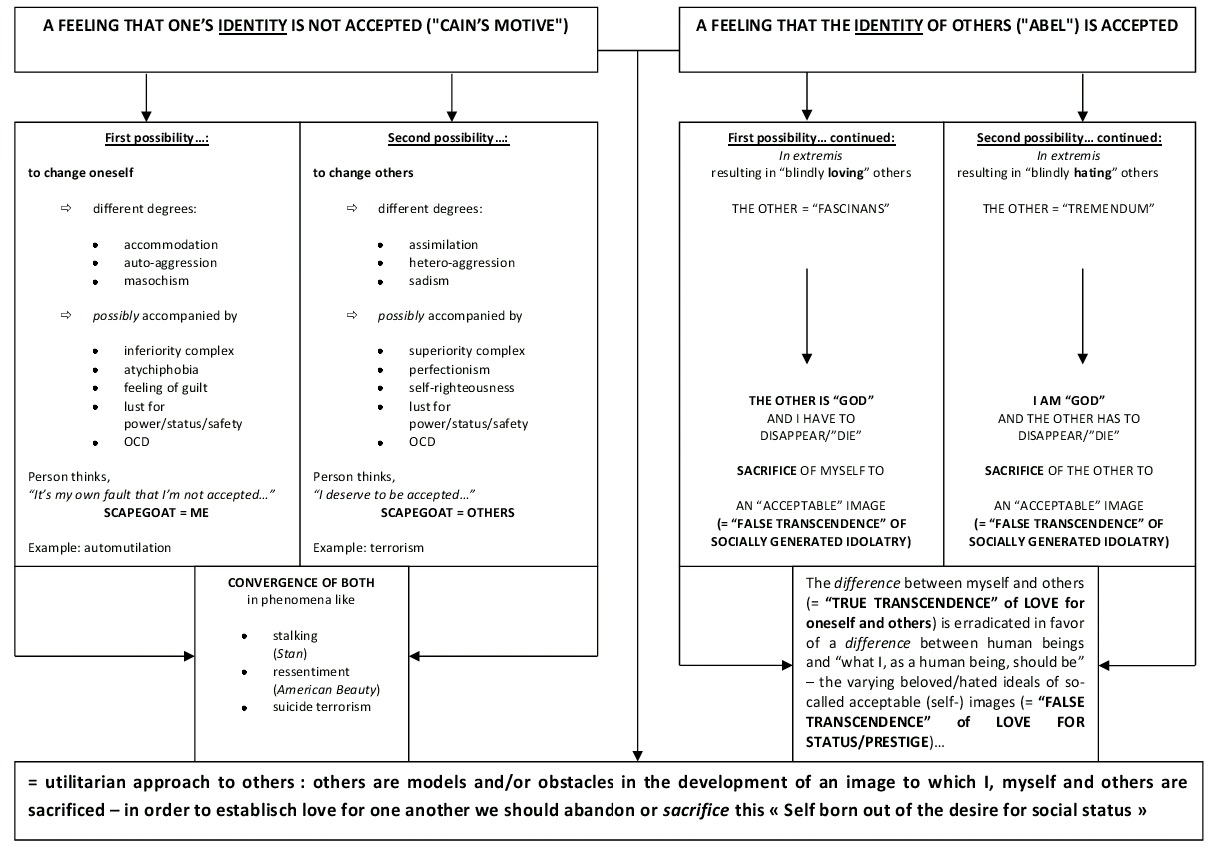
In this post I will try to give a glimpse of the way mimetic theory is able to foster a fruitful dialogue between different strands of thought in the humanities and how this dialogue indeed seems the result of Judeo-Christian influence in the Western world. I try to show that mimetic theory is a good starting point, able to connect and sometimes “correct” (or “ground” more fundamentally) basic insights of people like Thomas Hobbes, Sigmund Freud, Rudolf Otto, Jean Piaget, Jacques Lacan, Emmanuel Levinas and even a sociologist like Niklas Luhmann – among many others. But first I’ll give “the outcome” of my explorations, in a diagram (that was conceived for my book Vrouwen, Jezus en rock-‘n-roll).

From EROS (a mimetically mediated desire for recognition / a love for one’s self-image) to THANATOS (mental and/or physical “death”):

two potential destructive reactions following the confrontation with an (always mimetically) experienced difference between oneself and another (as an individual or collective entity).

TWO FEELINGS AN INDIVIDUAL IN THIS SITUATION IS CONFRONTED WITH AT THE SAME TIME AND TWO POSSIBLE “SOLUTIONS” TO THE FRUSTRATIONS ARISING OUT OF THE UNFULFILLED DESIRE FOR RECOGNITION

[CLICK IMAGE TO ENLARGE!]

Diagram Interdividual Psychology (Erik Buys)

CLICK HERE FOR PDF VERSION OF THE DIAGRAM

SOME BACKGROUND INFORMATION

Here are some text fragments from books I have been reading that led me to an even better understanding of my own diagram :). Three books are involved: Totalité et infini by Emmanuel Levinas, For René Girard edited by Sandor Goodhart et al., and When These Things Begin by René Girard. I have to mention especially that, apart from Emmanuel Levinas and René Girard, I was very inspired by the texts of Eugene Webb, Wolfgang Palaver and Michael Hardin in For René Girard. After the quote from Levinas, I also give some personal comments as a guideline to somewhat connect the different text fragments. [For more on Girard and Levinas, click here].

Emmanuel Levinas:

La philosophie occidentale a été le plus souvent une ontologie: une réduction de l’Autre au Même, par l’entremise d’un terme moyen et neutre qui assure l’intelligence de l’être.

Translation: Western philosophy has most often been an ontology: a reduction of the other to the same by interposition of a middle and neutral term that ensures the comprehension of being.

(Emmanuel Levinas, Totalité et infini. Essai sur l’extériorité, Paris, Le Livre de Poche, Kluwer Academic, p.33-34).

Personal comments (also to the texts mentioned below):

It is important to note that Levinas speaks of a “reduction”. Whenever traditional Western philosophy thinks of what the kosmos is essentially made of, it always posits an “ideal”. The whole of reality then should be understood as a striving towards the manifestation of that ideal (Aristotle‘s entelechy), or at least as an attempt to manifestly distinguish the “eternal, ever-present ideal essence of reality” from “what reality sometimes seems to be but is not” (Plato‘s or Socrates‘s maieutics). The ideal essence of reality brings about an order (out of “chaos”) that actually is sacrificial, a “peace” that rests on the oppression of what seems to contradict the ideal. Hence one could say, together with Levinas, that the ideal – whatever features it gets in a particular philosophical system – reduces everything that is other than itself to itself. However, what enables this reduction precisely is the fact that there indeed really is something “other” to reduce to begin with! So one could say that whenever some ideal is postulated as “the essence” or “the being itself” of reality, the “fuller” or “more true” being of reality is “forgotten.” Being is reduced to a goal oriented movement from an incomplete world (the subject of movement) toward a “perfect” world (the object of movement).

Martin Heidegger identified the subject-object dichotomy as the Seinsvergessenheit (forgetting of being) of traditional Western metaphysics. He tried to “go back”, beyond the order of clearly defined dichotomies (the law of non-contradiction of course being one of them) towards a thinking inspired by the poets – who remain much closer to the unresolvable ambiguities of reality. It shouldn’t surprise anyone that, by leaving the unavoidably sacrificial peace of a so-called ideal world order and philosophy behind, Heidegger’s philosophy at first could not resist the temptation of glorifying and unleashing the powers of violence as part of the “revelation of truth” (see his interpretation of the Greek aletheia). In a profound sense he continued the philosophical project begun by Friedrich Nietzsche, without however “moralizing” his ontology (in a renewed sacrificial hero-cult).

As far as I interpret and try to understand both Heidegger and Levinas, Heidegger considers violence (understood as the “struggle or concern for being”) as the basic answer to the ever-present possibility of death, while Levinas points to another possibility as far as human beings are concerned: the encounter with the Other (my fellow human being, my neighbor). In encountering the Other I discover my own struggle for being (against the fearful possibility of death) as a potential threat to the life of the Other. In other words, I get to know my own being as a potentially violent being. It is the “disinterested connection” to the Other – in other words “love without ulterior motives” – that both limits and opens up my struggle for being to a “being for the Other.”

Speaking with René Girard, it’s our mimetic (i.e. imitative) ability that connects us to the Other and that also allows us to discover the irreducible nature of the Other. True, it’s our mimetic ability that allows us to empathize with the Other, to “feel one” with the Other (to be able to “pretend” that we are the Other and to imagine what he feels, expects or desires we have to be able to imitate him). But on the other hand, the process of mimesis is only possible because of a distance, an insurmountable gap between myself and the Other, that is discovered precisely in the act itself of mimesis!

Because we are mimetically connected to each other, we are able to adapt ourselves to an image that we think would answer to the expectations of the other. When this becomes our main preoccupation, we reduce each other to mere means to fulfill a mimetically generated desire for recognition. Let me try to explain this a little better.

The originally disinterested connection to the Other (upon which all “interested” connections are – “parasitically, satanically” – dependent) might be corrupted when we imitate each other’s desires. It’s because you are (mimetically) able to identify yourself with the desires of others that you, first, might discover yourself as an object of (their) desire and, second, that you might discover someone else as well as object of (their) desire. Because your desire imitates (and is thus engendered by) the desires of others, your desire towards yourself as the object of the desires of others will generate admiration or envy towards that other who seems to be also desired by others. You’re not only mimetically able to identify with the desires of others to discover yourself as an object of desire, but you’re also able to mimetically identify yourself with an other who seems to posses the desire (and thus recognition) of others. What happens, time and again, is that we develop a desire to be like an admired / envied other. This implies that we cannot love ourselves anymore, but it also implies that we can no longer love the other. We often desire recognition, not for ourselves, but for the prestige we have constructed in jealously comparing ourselves – not to others, but to what we imagine about others. We, as human beings, don’t just want what we need, we want what seems desirable by others as well (the BMW instead of…), and this grants us prestige.

GoetheSee this insightful quote by Johann Wolfgang von Goethe, in his The Sorrows of Young Werther: We are so constituted by nature, that we are ever prone to compare ourselves with others; and our happiness or misery depends very much on the objects and persons around us. On this account, nothing is more dangerous than solitude: there our imagination, always disposed to rise, taking a new flight on the wings of fancy, pictures to us a chain of beings of whom we seem the most inferior. All things appear greater than they really are, and all seem superior to us. This operation of the mind is quite natural: we so continually feel our own imperfections, and fancy we perceive in others the qualities we do not possess, attributing to them also all (those talents) that we enjoy ourselves, that by this process we form the idea of a perfect, happy man, — a man, however, who only exists in our own imagination.

The Sorrows of Young Werther Goethe quote

As René Girard shows in discussing the presence of mimetic desire in groups of primitive humans, the mutually (mimetically) enforced competitive desire for prestige – mimetic desire, in short – might spread throughout individuals of the same group in such a way that the group finds itself in a veritable crisis wherein all differences disappear and each rival resembles the others more and more. The solution to this crisis might be the mimetic unification against one rival. Indeed, my (or another’s) rival might become the enemy of all if everyone imitates my enmity against that rival. The war of all against all becomes the war of all against one, and a new difference – a new foundation for further differences and order – is established. When the common enemy is banned from the group or even beaten to death, the scapegoat mechanism sets in. The group experienced turmoil as long as their victim was around, while, on the other hand, it experiences a renewed stability when the victim is no longer around or alive – the victim is present as dead. According to Girard, groups of primitive humans gradually projected their own violence unto the victims of group violence, wrongfully experiencing these victims as responsible both for crisis and the resolution of crisis.

Also gradually, primitive communities will associate new situations of disorder with the resurgence of a former victim of group violence. In other words, they experience a person who is not visibly present anymore, but whose presence is ‘felt’ in situations of turmoil. In other words still, one of the former victims of group violence has become a ‘ghost’ or a ‘god’. At the same time, primitive human societies also ‘learn’ that killing someone apparently restores order. So together with the belief in ghosts and gods considered responsible for all kinds of possible violent disasters, the belief originates concerning the effectiveness of sacrifices to restore, renew or keep order, life and stability in human society. If primitive societies would have seen that the victims of group violence are no more responsible for violence than other members of the group, they would not have developed these beliefs. Violence became something sacred because the victims of group violence were considered exclusively responsible for the violence they were associated with. Those victims were, in other words, scapegoats. [For more on Girard’s account on the origin of religion, click here].

Girard argues that all other associations regarding ‘the sacred’ rest on this first association between violence and divinized victims of group violence. Everything that can be associated with violence had the potential to become sacred or divinized as well. Sexuality became sacred. Indeed, sometimes males fight over females. Food became sacred. Indeed, people fight over food sometimes. Territory  became sacred. Indeed, people go to war sometimes because of territory. Nature as a whole became sacred. Indeed, natural disasters are ‘violent’ and provoke violence if they cause lack of food and water… And so the world and the experience of man became sacred. The ambiguity of the erstwhile victims of group violence also explains why gods have a ‘dual’, ‘ambiguous’ quality.They’re good and bad… Good aspects of the gods can be allowed in rituals, while bad aspects of the gods are forbidden and taboo. For instance, sacrifice is a form of ‘good’ (controlled) sacred violence to be distinguished from ‘bad’ sacred violence, which is to be avoided and is taboo…

Religions came and went, but the age-old associations regarding the sacred were transmitted down the generations, albeit in varying forms (human sacrifice becoming animal sacrifice, for instance). The Greeks still had Ares, god of war, as they had their goddess of love, Aphrodite. The Romans copied (indeed, ‘imitated’) the Greeks and spoke of Mars and Venus. Asked why they perform their rituals and sacrifices and why they respect their taboos, primitive societies always answer: “Because our ancestors did it, and because we have to respect the ghosts and the gods in order to sustain our community…”

The image or model for the cultural order in a particular society – with its particular taboos and rituals that have to be respected – rests on the wrongful perception of the victims of group violence. Human culture can be understood as the continuous attempt to justify the violent death (murder or suicide) of one (monstrous and/or heroic) member for the salvation of (the order in) a whole group. Christianity, however, undermines this justification. Christ is a victim of the same sacrificial system which grounds human culture, but he is said to be innocent! This allows human beings to discover the true origin of violence and crisis. It is not something “alien” that comes from the gods and is demanded or justified by them, it’s something that comes from (mimetic) interactions between human beings themselves. Hence the possibility of a “true” psychology, sociology and anthropology. The Christ event also allows human beings to (re)discover their own responsibility before each “Other” and to part ways with the justification of a sacrificial order – whether expressed in mythology or philosophy. In a paradoxical way, Christ invites us to imitate him and to sacrifice our sacrificial identity. Instead of just imitating and accepting a given order, we should ask ourselves at what (or better, whose) expense we continue this order.

One final remark. The abandonment of sacrifice to ground a given order is, as Girard has shown following Judeo-Christian revelation, deeply ambiguous: it allows for new types of competition, rivalry and even violence between human beings as it also allows for “Love born out of freedom” for each Other (true Love that is, not out of fear of not having an admirable “self-image”).

In short, the image of an ideal world – in whatever context of human life – results from mimetically mediated desires between human beings, and is, as we have said already above, essentially sacrificial. It does not only “forget” the “otherness” of the Other, but also the “otherness” of myself. To escape this mimetically generated tendency to (mentally and/or physically) “kill” myself and the Other in favor of the idol of “an ideal”, we should redirect our mimetic faculties to their origin: the mysterious, disinterested connection to the Other – Love. Historically, the Christ event unleashes the possibility of this redirection in a fundamental way.

Emmanuel Levinas Qote on Faith

Eugene Webb:

Lacan proceeded more directly from the tradition of Freud than did Girard, and he uses the imagery of sacrifice in a more positive way, but both can be interpreted as revisionist figures in the Freudian tradition. For both, desire tends to have a mimetic character, in that it is closely tied up with the perceived or presumed desires of others. Also for both, desire tends to be metaphysical, in that it generates a falsely conceived self. For Lacan, the false self is any object (a person or an image) in which the ego tends to lose itself through identification, but it is especially the objectified image of a self that forms in what Lacan termed “the mirror stage” of development, the child’s “jubilant assumption of his specular image.” Out of this enchantment by one’s own objectified image evolves what Lacan called l’imaginaire: a fundamentally narcissistic fascination that tends to draw all relationships into an unrealistic and futile striving for identification with an objectified “other” – one’s own self-image, or the mother, or some other object – in a sort of “fusional cannibalism.” In this process, the individual confuses his and the other’s desires, seeking to see himself as the object of the other’s desire and, by imaginative identification with that other, to desire himself with that same desire, so as to believe in his own reality as an object. Put concisely, the fundamental human temptation is to avoid the risk of being an actual subject by becoming an imaginary object. […] Despite Girard’s distrust of the language of sacrifice, there is a sense in which the transcendence Girard seeks of the self generated by mimetic desire could also be described as something like the sacrifice of a false self for the sake of discovering a new, true life animated by the spirit that was in Christ.

(Sandor Goodhart et al. (editors), For René Girard. Essays in Friendship and in Truth, Studies in Violence, Mimesis, and Culture Series, Michigan State University Press, 2009, p.151).

Wolfgang Palaver:

It was Eric Voegelin‘s comparison of Hobbes and Augustine that… opened my eyes and made me realize how far Hobbes had departed from Christian tradition. Voegelin’s insight – that Hobbes’s description of human nature is nothing but a description of pride, a “passion aggravated by comparison” – helped me to connect this departure with mimetic theory. Whereas Augustine distinguished the love of self (amor sui) from the love of God (amor Dei), Hobbes “threw out the amor Dei and relied for his psychology on the amor sui, in his language the self-conceit or pride of the individual, alone.” Christianity, in accordance with the biblical Revelation, always emphasized the human orientation primarily toward eternal or heavenly transcendent goods – especially the love of God – to avoid the lethal trap of mimetic rivalry following the soul’s longing for temporal goods. Both Augustine and Hobbes were aware how much human violence is rooted in mimetic rivalry. But it was only the Church Father who realized that there is a way out of this deadlock – namely, by searching first for the kingdom of God. This is the same insight that is expressed in the Ten Commandments. We are only able to follow the tenth commandment – the rule against mimetic rivalry – if we obey the first commandment and overcome idolatry.

(Sandor Goodhart et al. (editors), For René Girard. Essays in Friendship and in Truth, Studies in Violence, Mimesis, and Culture Series, Michigan State University Press, 2009, p.192-193).

Michael Hardin:

At the Cross, our god concepts die. The New Testament writers and early Church Fathers called this death of the god concepts the conquering of the satanic powers, the powers that rule human life. In the Cross of Jesus, the horizon of the kingdom of God’s love and forgiveness is opened and our self-understanding is transformed, as we relate no longer to the gods of this world but to the Creator of heaven and earth. […] We become those who no longer imitate the desires of the world, the kosmos structured on a dysfunctional logos (1 John 2:15ff), but instead, like Jesus, become those who seek God and God’s rule with a singular focus. This transformation does not remove us from the world but enables us to be active agents of the transforming character of the love of God in all our relationships. […] The New Testament writers perceived the great power behind the imitation of the love of God expressed in Jesus. To desire as Jesus desired is to desire the transcendent in the immanent neighbor, to recognize that love of God and love of neighbor form a unity that cannot be broken. Rather than separating theology and ethics, mimetic theory grounds each in the other in the redemptive event of the Cross.

(Sandor Goodhart et al. (editors), For René Girard. Essays in Friendship and in Truth, Studies in Violence, Mimesis, and Culture Series, Michigan State University Press, 2009, p.267-268).

René Girard in conversation with Michel Treguer:

MT: What do you think of the famous “death drive” introduced by Freud?

RG: It’s a good example of pointless complication. In my view, the death drive exists, but it is entirely linked to mimetic rivalry. Mimetic desire makes you into the rival of your model: you fight with him over the object that he himself pointed out to you. This situation reinforces desire and increases the prestige of the obstacle as such. And the supreme obstacle, of course, is death, it’s what can kill you. The death drive is the logical outcome of this mechanism. But Freud is unable to link this paradoxically narcissistic desire for a biological, inanimate state to the other phases of the process; nor even, to use his own concepts, to link it to the Oedipus complex, for example, even though he’s perfectly aware of the latter’s mimetic nature. He contents himself in some sense with adding an extra drive. This motley assemblage inspires awe in the credulous, but if it can be simplified, we have to simplify it.

MT: This is the question that comes to mind as I listen to you: “death drive” or “drive to murder”?

RG: [A pause] It’s the same thing! And eroticism tends toward both. Just think about the symmetry of the processes at play. Take Romeo and Juliet, who are defined perfectly by Friar Lawrence: “These violent delights have violent ends” (Romeo and Juliet, II, vi, 9). It’s always forgotten that Shakespeare starts by showing us the young Romeo madly in love with a woman who wants nothing to do with him. Shakespeare’s plays always contain things that contradict in specular fashion the conventional – and stubbornly romantic – image that, in spite of everything, we have of them. The cult of the obstacle drives human beings from their human condition toward what is most against them, toward what hurts them the most, toward the non-human, toward the inert, toward the mineral, toward death… toward everything that goes against love, against spirit. The skandalon that the Gospels speak of in relation to covetousness is the obstacle that is increasingly attractive the more it pushes you away. You want it because it rejects you. This seesawing back and forth between attraction and repulsion cannot fail to be mutually destructive and destabilizing at first, before leading to utter annihilation. Refusing God is the same thing because God is the opposite of the skandalon. God died for human beings. Remaining blind to God while going for the first super model who comes along – that’s what human beings do.

(René Girard, When These Things Begin, Studies in Violence, Mimesis, and Culture Series, Michigan State University Press, 2014, p.106-107).

This post follows a thread on suggestions for the development of a high school curriculum on Mimetic Theory. Click the following titles to see what else I’ve done on this so far (be sure to check out the pdf-files!):

  1. Mimetic Theory in High School (click to read)
  2. Types of the Scapegoat Mechanism (click to read)
  3. Scapegoating in American Beauty (click to read)
  4. Philosophy in American Beauty (click to read)
  5. Real Life Cases of Ressentiment (click to read)

Eminem (Horns)The story of Cain and Abel (in the book of Genesis) is compared to the story of Stan (by Eminem) to illustrate what I’ve called types 1 and 2 of the scapegoat mechanism. Cain and Abel is an example of the second type of scapegoat mechanism, namely hetero-aggression. Stan is an example of the first type of scapegoat mechanism, namely auto-aggression. By the way, the comparison between Cain and Stan is a translation of a text that first appeared in Dutch in my book Vrouwen, Jezus en rock-‘n-roll (Averbode, 2009).

CLICK TO READ PDF-VERSION OF A COMPARISON BETWEEN CAIN AND STAN

CLICK TO READ PDF-VERSION SCAPEGOAT MECHANISM 1 & 2 (EXAMPLES)

Stan

Cain

[As an aside, it is possible to criticize Nietzsche’s concept of Judeo-Christian tradition as a product of ressentiment by comparing the third type of the scapegoat mechanism (ressentiment, indeed) with the story of Cain and Abel as an example of the second type. It is clear that, in the biblical story, the Lord condemns the actions of Cain. This implies that the Lord would condemn the actions of persons that are consumed by ressentiment as they take the parallel position of person A (Cain’s position). Thus the god born out of the ressentiment of the so-called slaves (a god who recognizes the slaves while condemning the so-called masters) is not the God of Judeo-Christian tradition.]

[As a second aside, click here for more on hip-hop and theology.]

In short, what the following comparison is all about: mimetically ignited love – eros – for the imagined situation of the other leads to hate towards one’s own life and the life of the other (or, which is the same, love for a so-called acceptable self-image) – a crisis of identity and social order. Person A (CAIN or STAN) tries to resolve the crisis that arises out of a comparison with person B (ABEL or SLIM) by sacrificing the other or by sacrificing him/herself – thanatos!

PDF-text of Cain and Abel (Genesis 4:1-18)

PDF-text of Stan (by Eminem)

CAIN AND ABEL COMPARED TO STAN AND SLIM

  • IDENTIFICATION (THROUGH MIMESIS)

Cain and Abel develop similar activities:
In the course of time Cain brought to the LORD an offering of the fruit of the ground, and Abel also brought of the firstborn of his flock and of their fat portions.

Stan and Slim have similar experiences:
“See I’m just like you in a way… I never knew my father neither – he used to always cheat on my mom and beat her. I can relate to what you’re saying in your songs…”

  • ANGER BECAUSE OF A – FELT, THOUGH NOT NECESSARILY REAL – LACK OF RECOGNITION

Cain becomes angry because Abel gets attention from the Lord while he himself doesn’t seem to get any attention at all:
And the LORD had regard for Abel and his offering, but for Cain and his offering he had no regard. So Cain was very angry, and his face fell.

Stan becomes angry because Slim does get recognition from his fans – Stan being one of them – while Stan seems to find no recognition at all:
“Dear Mister-I’m-Too-Good-To-Call-Or-Write-My-Fans, this’ll be the last package I ever send your ass! It’s been six months and still no word – I don’t deserve it?”

  • RECOGNITION NONETHELESS FOR THE PERSON WHO FEELS UNRECOGNIZED

The Lord worries about Cain:
The LORD said to Cain, “Why are you angry, and why has your face fallen?”

Slim worries about Stan:
“… why are you so mad?”

  • A WARNING FOR THE POSSIBLE EVIL CONSEQUENCES OF FRUSTRATION, ANGER AND STUBBORN PRIDE

The Lord advises Cain to do well:
“If you do well, will you not be accepted? And if you do not do well, sin is crouching at the door. Its desire is for you…”

Slim advises Stan to calm down and to do well:
“I really think you and your girlfriend need each other or maybe you just need to treat her better. […] I think that you’ll be doin’ just fine if you relax a little…”

  • A FINAL WARNING 

The First Mourning (Adam and Eve mourn the death of Abel) by Bouguereau 1888“… but you must rule over it…”

“I just don’t want you to do some crazy shit.”

  • WARNING GOES IN VAIN – MURDER ON A DESOLATE PLACE

Cain kills Abel:
Cain spoke to Abel his brother. And when they were in the field, Cain rose up against his brother Abel and killed him.

Stan kills himself and his pregnant girlfriend:
“Some dude was drunk and drove his car over a bridge and had his girlfriend in the trunk, and she was pregnant with his kid…”

In 1985, René Girard received his first honorary doctorate at Vrije Universiteit Amsterdam. More followed at various universities throughout the world. In December 2006, he was installed as a member immortel of the Académie Française, the highest honor a French intellectual can achieve in his home country.

A month after René Girard received his first honorary doctorate an interview with him appeared for Dutch television (IKON). The interview is in English with Dutch subtitles.

CLICK TO WATCH IT HERE:

There is also footage from the ceremony for the honorary doctorate at VU Amsterdam.

CLICK TO WATCH IT HERE:

Okay, this post eventually is about this documentary clip (from a previous post – click here for Monkey Business):

Rest assured, I’m getting there, but I have to tell a little story first…

watching a soap opera (Pacheco Mexican family)Mary was watching a soap opera on a big screen TV in the living room. Her brother, Martin, came in and joined her on the sofa. “You know, there’s a lecture by Stephen Hawking on the Discovery Channel right now”, Martin said. And he continued: “It’s his explanation about the origin of the universe. Maybe we can watch it together?” “Oh, come on Martin”, his sister replied, “that’s so boring; I’d rather watch this soap, it’s really exciting and I’m curious how that new girl character will overcome the break up with her boyfriend…”

We can all imagine this type of situation. More often than not, people choose to enjoy stories that allow them to identify with certain characters and events over a desire to explain things. Most of us are no Nobel Prize winning scientists. Flash back to prehistoric times: would our so-called primitive ancestors be any different? I’ve always wondered why we would accept the notion that religion and belief in spirits and gods arose out of prehistoric man’s innate desire to explain things. I can imagine prehistoric man trying to survive in an often hostile, barren environment. I can also imagine prehistoric man, further on in evolution, listening to (sometimes contradictory) mythical stories that express and justify a certain world-view and way of doing things, allowing him to develop a sense of identity within his tribe (see the quote by the Indigenous Peoples of California below). But I cannot imagine prehistoric man as a would-be scientist. It goes against a day-to-day experience and observation of myself and fellow human beings.Indigenous Peoples of California (Quote on Storytelling) Showbizz websites with spectacular stories about celebrities get more views than academic websites…

I know that an argument based on intuition and personal experience might not be very convincing, but there are other problems connected to the idea that animism or primitive religion arose out of prehistoric man’s desire to explain things. Consider for a moment a reasoning that often goes something like this: “Because primitive man had not yet developed science, he tried to explain the world in which he lived by spiritual, invisible or supernatural forces…” The problem is that this reasoning already somewhat presupposes the belief in a spiritual or supernatural realm to explain the origins of such a belief. That’s a circular argument that, in this case, actually doesn’t explain anything about the origin of religion. Of course it is true that religion has been used to explain things, but before it can function like that it has to already exist. It is not because electricity has been used to bring trains into motion that electricity originated from the desire “to move trains”. It is not because religion has been used to explain things that religion arose from the desire “to explain”. And, once again, early mythology and storytelling is not concerned with the question “What really happened?” They are considered true in another sense, namely in that they (“archetypically”) express and mold life experiences and views on life.

Indian Storytelling (stories are true)

So let’s consider René Girard’s idea again that primitive religion arose out of certain associations made concerning the victims of group violence. From this point of view, it is no coincidence that sacrificial rituals belong to the oldest expressions of religious behavior. Moreover, seen from Girard’s perspective, it is no coincidence that creation myths or myths of heroes from all over the world contain the theme of sacrifice as a way to establish, renew or preserve a world order.

René Girard considers the very first sacrificial rituals as imitations of a scapegoat mechanism in groups of primitive humans whose internal (mimetic) rivalry threatened to destroy the group itself. Primitive human societies experienced the killing of one member of their group by a significant part of the community as something which restored calm and order. This must have happened so much in primitive human societies that they started making certain associations.

On the one hand primitive societies experience turmoil as long as ‘the common enemy’ is alive, while on the other hand they experience peace after he is beaten to death. Gradually they will associate new situations of disorder with the resurgence of a former victim of group violence. In other words, they experience a person who is not visibly present anymore, but whose presence is ‘felt’ in situations of turmoil. In other words still, one of the former victims of group violence has become a ‘ghost’ or a ‘god’. At the same time, primitive human societies also ‘learn’ that killing someone apparently restores order. So together with the belief in ghosts and gods considered responsible for all kinds of possible violent disasters, the belief originates concerning the effectiveness of sacrifices to restore, renew or keep order, life and stability in human society. If primitive societies would have seen that the victims of group violence are no more responsible for violence than other members of the group, they would not have developed these beliefs. Violence became something sacred because the victims of group violence were considered exclusively responsible for the violence they were associated with. Those victims were, in other words, scapegoats.

ancient human sacrificeGirard argues that all other associations regarding ‘the sacred’ rest on this first association between violence and divinized victims of group violence. Everything that can be associated with violence had the potential to become sacred or divinized as well. Sexuality became sacred. Indeed, sometimes males fight over females. Food became sacred. Indeed, people fight over food sometimes. Territory  became sacred. Indeed, people go to war sometimes because of territory. Nature as a whole became sacred. Indeed, natural disasters are ‘violent’ and provoke violence if they cause lack of food and water… And so the world and the experience of man became sacred.

Religions came and went, but the age-old associations regarding the sacred were transmitted down the generations, albeit in varying forms (human sacrifice becoming animal sacrifice, for instance). The Greeks still had Ares, god of war, as they had their goddess of love, Aphrodite. The Romans copied (indeed, ‘imitated’) the Greeks and spoke of Mars and Venus.

Asked why they perform their rituals and sacrifices and why they respect their taboos, primitive societies always answer: “Because our ancestors did it, and because we have to respect the ghosts and the gods in order to sustain our community…”

Could it really be true that the structure of ancient human sacrifice goes back to a mechanism that can still be observed in our ape cousins? And that this mechanism provides the foundation of the archaic sacred? Is it far-fetched to suspect that the former fact (the structure of ancient human sacrifice, which begins with a fight!) has something to do with the latter fact (the scapegoat mechanism)?

Pavlov DogGirard has argued that the dividing line between human and ape lies in the way mimetic quarrels became a fearful threat to the survival of primitive human communities (it is no surprise that prehistoric massacre mass graves exist – click here for an example). Precisely because the mimetic ability of humans grew, their tendency towards near uncontrollable mimetic rivalry increased likewise. Hence it became possible that humans began to make associations that their ape cousins could not make regarding the communal killing of a group member. Compare to Pavlov’s dog: a dog who has only arbitrarily or sporadically heard a signal while getting food will not drool if he hears the signal, while Pavlov’s dog who has systematically heard the signal while getting food will at some point start to drool from the moment he merely hears the signal… Apes won’t associate turmoil with a victim, while primitive humans will start to do exactly that at some point. The consequences can be suspected: primitive humans will start to consciously ritualize the scapegoat mechanism, while apes only experience this mechanism sporadically. The above posted fragment of a documentary on monkeys shows a powerful example of the mechanism. The monkeys gather around the corpse of their former leader who has been killed after a fight for control over the group. “They are unusually silent as they gather around…” We can almost observe how it must have been like that ‘a loathed enemy’ became ‘a revered god’. This also explains why gods have a ‘dual’, ‘ambiguous’ quality.They’re good and bad… Good aspects of the gods can be allowed in rituals, while bad aspects of the gods are forbidden and taboo. For instance, sacrifice is a form of ‘good’ (controlled) sacred violence to be distinguished from ‘bad’ sacred violence, which is to be avoided and is taboo…

FIND OUT MORE ON THIS BY CLICKING HERE

(with some examples of similar behavior observed in groups of chimpanzees)

Pimu Alpha Male Chimpanzee killed by fellow chimps Mahala Park Tanzania 2011

From time to time I’m confronted with objections to mimetic theory that, looked at more closely, are based on some misconceptions. Here are some clarifications, hopefully. (For more on scientific research concerning imitation, click here: Mimesis and Science).

1. REGARDING MIMETIC DESIRE

Already in 1961, publishing Mensonge romantique et vérité romanesque, René Girard made the world familiar with his concept of mimetic desire. Mimetic desire is literally desire based on imitation. Like so many others before and after him, Girard observes that human beings are highly mimetic creatures. Humans imitate each other in all sorts of ways and thereby learn from each other – they learn good as well as bad behavior… To name but one example, people imitate the sounds of their environment and learn to speak, for instance, with a Texan accent. I don’t know if that’s a good or a bad thing :).

By introducing the concept of mimetic desire, Girard stresses that our desire is structured by imitating others who function as models for our desire. It is important to distinguish this type of desire from our basic biological or physical needs. When you’re walking in the desert alone and your body is yearning for water, your desire for water is, of course, not based on the imitation of someone else’s desire. True, nature has its impact on human life. However, when our basic physical needs are met, our desire goes beyond them. Our basic need for water is transformed in what eventually became a supermarket world that asks us to choose between different types of water, juices and soft drinks. Growing up, we develop a certain taste, transmitted to us by our social and cultural surroundings. We might even develop desires that not only go further than our physical needs, but also against them (anorexia being one example).

coca cola thirst asks nothing moreSo, it’s not just nature that defines human life, nurture has its way too… We all have the biological need for food, but if we were born in another part of the world we would probably have developed different eating habits. It’s as simple as that. We imitate others. We mimetically learn to quench our natural thirst and to satisfy our natural hunger in a certain, culturally dependent way. No one is born with the desire for the newest soft drink produced by The Coca-Cola Company (indeed, Thou Shalt Covet What Thy Neighbor Covets – click to read this article by famous marketeer Martin Lindstrom), as no one is born with the desire to become a police officer. Our identities are not ahistorically determined from birth, they’re co-created with others.

We always write our personal history together with others, and we mutually influence each other. Since we’re social creatures we cannot escape this influence. Relationships precede and shape our (sense of) identity. Even if we go against our tendency to imitate an immediate social environment that seems indifferent towards the victim of some crime or accident (see “Bystander Effect” – click for more), we probably still imitate heroic examples from stories we grew up with (“The Good Samaritan” may be one of them).

Two questions often appear after these considerations, which show just how hard it is to let go of any type of Ego Illusion:

  1. We often imitate others to adjust to our social environment. We imitate others because we desire social recognition. So, our desire for social recognition must be more fundamental than our mimetic tendencies, no?
  2. If we imitate each other’s desire for something, someone still has to be the first to desire that something. Surely, the latter’s desire cannot be based on imitation, can it?

I’ve answered the first question before, but I’ll repeat it here. Of course we often imitate others to ‘fit in’. However, we could not develop a desire to fit in if it weren’t for our mimetic abilities. Our mimetic abilities allow us to put ourselves in each other’s shoes. They allow us to pretend that we are someone else. For instance, a little girl playing with her dolls pretends being a mother by imitating real mothers. Our mimetic abilities allow us, thereby, to imagine – however preliminary – what others are experiencing, expecting and desiring. So our ability to empathize and to adjust to the expectations of others (maybe to gain their recognition) rests on mimetic ability.

The second question seems very logical. Confronted with real life cases, the quest for ‘the first model’ is not that easy to answer though. Even simple situations show it might be the wrong question. Think, for instance, about two babies in a room full of toys. Let’s name the two Bobby and Johnny. Bobby starts playing with a little ball. Note that he didn’t necessarily wake up with the desire to play with a ball. Already in this sense his desire isn’t his own. It is awakened by people who left him the ball to play with. After just ten seconds, Bobby gets tired of the ball. He doesn’t really enjoy playing with it. So he starts playing with some other toy. He has no desire to play with the ball whatsoever. In comes Johnny. He saw Bobby playing with the ball and this raised Johnny’s attention. Now that the ball is left, Johnny takes the opportunity to start playing with it himself. In this situation Johnny is the imitator. However, when Bobby notices Johnny playing with the ball, he immediately leaves the toy that was more fun to him and tries to lay his hands on the ball Johnny is playing with now. In this situation Bobby is the imitator. In short, Johnny’s desire rests on the imitation of Bobby as model for his desire, while Bobby’s desire rests on the imitation of Johnny as model for his desire. It’s no use asking “Who’s first?” Johnny and Bobby mutually reinforce each other’s desire by becoming each other’s model and imitator. Thereby they become each other’s rival. René Girard speaks of the rivalry between mimetic doubles. More generally, we become each other’s rival if we cannot or do not want to share the object of our mimetic desire. Here’s an example – it could have been Bobby and Johnny 🙂 – CLICK TO WATCH:

2. REGARDING RITUAL SACRIFICE

Some consider René Girard’s explanations on the origin and maintenance of human cultures far-fetched. Well, are they?

René Girard considers the very first sacrificial rituals as imitations of a scapegoat mechanism in groups of primitive humans whose internal (mimetic) rivalry threatened to destroy the group itself. Primitive human societies experienced the killing of one member of their group by a significant part of the community as something which restored calm and order. This must have happened so much in primitive human societies that they started making certain associations.

On the one hand primitive societies experience turmoil as long as ‘the common enemy’ is alive, while on the other hand they experience peace after he is beaten to death. Gradually they will associate new situations of disorder with the resurgence of a former victim of group violence. In other words, they experience a person who is not visibly present anymore, but whose presence is ‘felt’ in situations of turmoil. In other words still, one of the former victims of group violence has become a ‘ghost’ or a ‘god’. At the same time, primitive human societies also ‘learn’ that killing someone apparently restores order. So together with the belief in ghosts and gods considered responsible for all kinds of possible violent disasters, the belief originates concerning the effectiveness of sacrifices to restore, renew and/or keep order, life and stability in human society. If primitive societies would have seen that the victims of group violence are no more responsible for violence than other members of the group, they would not have developed these beliefs. Violence became something sacred because the victims of group violence were considered exclusively responsible for the violence they were associated with. Those victims were scapegoats.

ancient human sacrificeGirard argues that all other associations regarding ‘the sacred’ rest on this first association between violence and divinized victims of group violence. Everything that can be associated with violence had the potential to become sacred or divinized as well. Sexuality became sacred. Indeed, sometimes males fight over females. Food became sacred. Indeed, people fight over food sometimes. Territory  became sacred. Indeed, people go to war sometimes because of territory. Nature as a whole became sacred. Indeed, natural disasters are ‘violent’ and provoke violence if they cause lack of food and water… And so the world and the experience of man became sacred.

Religions came and went, but the age-old associations regarding the sacred were transmitted down the generations. The Greeks still had Ares, god of war, as they had their goddess of love, Aphrodite. The Romans copied (indeed, ‘imitated’) the Greeks and spoke of Mars and Venus.

Asked why they perform their rituals and sacrifices and why they respect their taboos, primitive societies always answer: “Because our ancestors did it, and because we have to respect the ghosts and the gods in order to sustain our community…”

Could it really be true that the structure of ancient human sacrifice goes back to a mechanism that can still be observed in our ape cousins? And that this mechanism provides the foundation of the archaic sacred? Is it far-fetched to suspect that the former fact (the structure of ancient human sacrifice, which begins with a fight!) has something to do with the latter fact (the scapegoat mechanism)?

Pavlov DogGirard has argued that the dividing line between human and ape lies in the way mimetic quarrels became a threat to the survival of primitive human communities. Precisely because the mimetic ability of humans grew, their tendency towards near uncontrollable mimetic rivalry increased likewise. Hence it became possible that humans began to make associations that their ape cousins could not make regarding the communal killing of a group member. Compare to Pavlov’s dog: a dog who has only arbitrarily or sporadically heard a signal while getting food will not drool if he hears the signal, while Pavlov’s dog who has systematically heard the signal while getting food will at some point start to drool from the moment he merely hears the signal… Apes won’t associate turmoil with a victim, while primitive humans will start to do exactly that at some point. The consequences can be suspected: primitive humans will start to consciously ritualize the scapegoat mechanism, while apes only experience this mechanism sporadically. Here’s a powerful example of the mechanism, nonetheless, observed in a group of monkeys. We can almost observe how it must have been like that ‘a loathed enemy’ became ‘a revered god’. This also explains why gods have a ‘dual’, ‘ambiguous’ quality.They’re good and bad…

CLICK TO WATCH:

Shane Koyczan is a spiritual man. A man of poetry and gentle madness. A man of stories, a man of truth. A man of beauty. His poem To This Day would be a great way to end a first part of a journey with mimetic theory in high school, especially regarding what I’ve written so far on the film American Beauty. It could follow these posts:

  1. Mimetic Theory in High School (click to read)
  2. Types of the Scapegoat Mechanism (click to read)
  3. Scapegoating in American Beauty (click to read)
  4. Philosophy in American Beauty (click to read)
  5. Real Life Cases of Ressentiment (click to read)

quote A weed is but an unloved flower Ella Wheeler WilcoxTo This Day and Shane’s TED-talk contain many themes I’ve written about before, for instance in a post entitled Atheism: a lack of unbelief?:

A person’s worth cannot be determined solely by human perception and judgment. Man is not simply the child of a “social other”, i.e. the product of a man-made social environment in which he gains or loses a sense of (self-) worth. He’s also, following the thoughts of people like James Alison and Emmanuel Levinas, a child of “the other Other”, and we should postpone any final judgment on other people and ourselves.

It also reminded me of this famous quote: “Every finite spirit believes either in a God or in an idol” (Max Scheler, 1874-1928). I wrote about this in several posts before, for instance in a post entitled That is (not) the question, about rap star Diam’s conversion to Islam – it talks about how we have the tendency to sacrifice ourselves and others to the demands of a so-called admirable (self-)image that seeks confirmation and recognition:

quote Shane Koyczan Be the weedDiam’s discovered how she tried to live up to the expectations of her fans, and how this enslaved her. She was kneeling to an image of herself as the admirable idol her fans wanted her to be. Kneeling to Allah, on the other hand, apparently meant that Diam’s no longer bowed to the demands of the music and entertainment industry. It was a turning point in her life. It enabled her to free herself, and to criticize the priorities in her life. From now on, she would seek and explore another source of motivations for her life.

Finally, Shane Koyczan’s story is reminiscent of Peter Howson’s story in a post entitled Desert Moments with Peter Howson:

“I used to be very badly bullied at school and when I was a bouncer in a nightclub for quite a few years I changed in a false sense then, and became a bully myself.” In other words: Howson became the imitator of his persecutors… He followed the mimetic principle of vengeance.

CLICK TO WATCH the video To This Day (click here to read the lyrics in pdf):

I’d like to give some quotes from his TED-talk as well, because they illustrate some key insights from René Girard’s mimetic theory and they reminded me of those previous posts:

quote do not be conformed by this world RomansWe were expected to define ourselves at such an early age, and if we didn’t do it, others did it for us. Geek. Fatty. Slut. Fag. And at the same time we were being told what we were, we were being asked, “What do you want to be when you grow up?” I always thought that was an unfair question. It presupposes that we can’t be what we already are.

See, they asked me what I wanted to be, then told me what not to be. And I wasn’t the only one. We were being told that we somehow must become what we are not, sacrificing what we are to inherit the masquerade of what we will be. I was being told to accept the identity that others will give me.

quote be this guyOne of the first lines of poetry I can remember writing was in response to a world that demanded I hate myself. From age 15 to 18, I hated myself for becoming the thing that I loathed: a bully. When I was 19, I wrote, “I will love myself despite the ease with which I lean toward the opposite.

CLICK TO WATCH Shane’s TED-talk: