There’s a remarkable analogy between political, dictatorial regimes that uphold themselves by using violence against dissident voices, and economic behavior that is based on the idea of scarcity. Both social phenomena are tragic in the sense that they accomplish exactly what they are trying to avoid.
Paul Dumouchel and Jean-Pierre Dupuy offered an analysis of modern economics from the point of view of René Girard’s mimetic theory, among others in a book entitled L’enfer des choses. Similar analyses are made by people like Hans Achterhuis (Het Rijk van de Schaarste) and André Lascaris. I’ve tried to summarize what I’ve learned from these efforts so far, as it sheds some interesting light on contemporary international social and political issues – the elimination of Osama Bin Laden being one of them.
“The rich man glories in his riches, because he feels that they naturally draw upon him the attention of the world, and that mankind are disposed to go along with him in all those agreeable emotions which the advantages of his situation so readily inspire him … In a great assembly he is the person upon whom all direct their eyes; it is upon him that their passions seem all to wait with expectation, in order to receive that movement and direction which he shall impress upon them.”
Adam Smith, in The Theory of Moral Sentiments (London, 1959 (Ed. Oxford, 1976) 1, iii, 2).
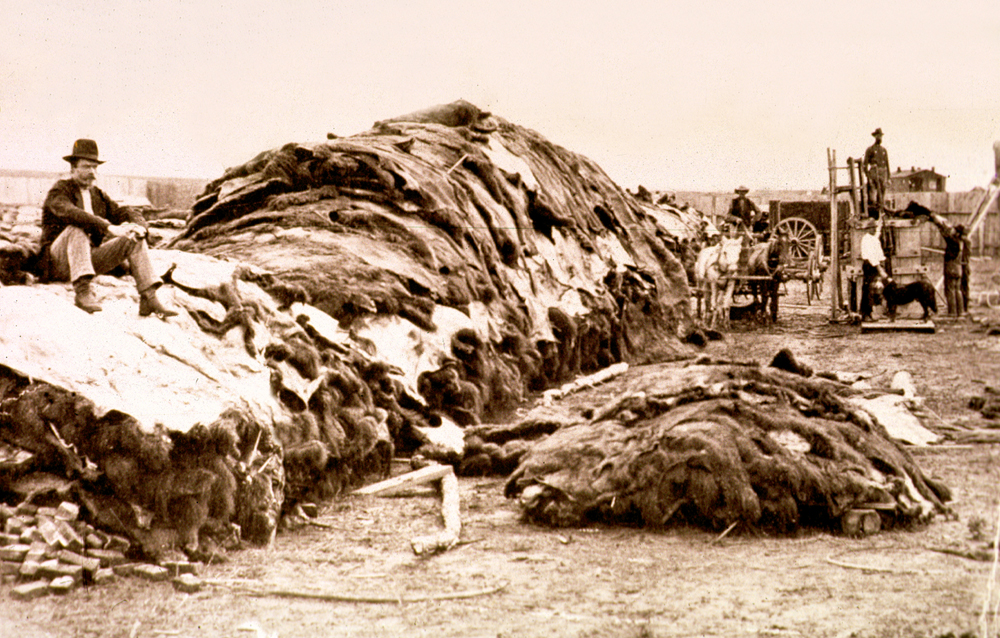
The direction which, according to Adam Smith (1723-1790), the rich man impresses upon other individuals often has had some shattering consequences for tribal societies and the natural environment. The difference in the way tribal communities deal with the gifts of nature and the way individual capitalists handle with them perhaps never became any clearer during the years of massive buffalo hunting on the great American plains. For centuries the native American indians hunted no more buffalo than they needed and shared what they had caught among the members of their respective tribes. Individual community members didn’t enrich themselves too much, because that would have led to envious quarrels. As is sufficiently known, the business men who originally came from Europe displayed a reverse attitude (imitating ‘the rich man’), which nearly eradicated the mighty animals of the great plains – literally creating ‘scarcity’ of the buffalo. My essay tries to point to the origin of this turn to individualism in Europe. Some of the negative consequences of this shift are shown in these pictures – more than words can say…
Above: Buffalo Hides at Dodge City (Kansas, 1874).
Below: Pile of Buffalo Skulls (1870’s).
This we know: the earth does not belong to man, man belongs to the earth. All things are connected like the blood that unites us all. Man did not weave the web of life, he is merely a strand in it. Whatever he does to the web, he does to himself.
(Words ascribed to Chief Seattle – to read more, click here).
What no man can own, no man can take…
(Bono, singer in rock band U2, from their song Yahweh).
Just recently I stumbled upon quite a fun BBC documentary about monkeys. Fragments can be watched below.
Of particular interest to anyone who’s concerned with mimetic theory are the following observations, eminently shown in the documentary:
Besides getting smarter, monkeys living in larger groups also become more competitive, even aggressive and violent. From the point of view of mimetic theory this comes as no surprise, since an increased learning capacity is based on the same principle as an increased tendency for a certain type of rivalry: imitation or ‘mimesis’. Monkeys learn through imitation, but they can also become rivals through imitation. The latter happens when they imitate each other’s desire for a certain object – be it a female, a piece of food or some favorable territory. It is from this mimetic interplay that a craving for ‘status’ and ‘power’ emerges, as well as a certain ‘greed’.
Individual rivaling monkeys tend to gather allies to compete with each other. Again, the engine behind these forms of empathetic bonding seems to be mimesis by which monkeys are able to ‘project’ themselves in other members of the group. They might even ‘imagine’ what others are up to and make plans for themselves. The so-called mirror neurons in the brain play a tremendous role in this regard.
Normally, rivaling groups balance each other and keep their violent tendencies in check. However, sometimes an individual monkey becomes the victim of a whole group. The documentary shows what happens when this victim dies. His former attackers – actually the ones who murdered him! – gather around the dead body, unusually calm. [WATCH THE DOCUMENTARY FROM 4:23!]
René Girard considers this type of event foundational to the way human culture eventually originated and to the way it developed sacrificial rites. Already the BBC documentary states that more monkeys are victim to other monkeys than to predators. Girard claims that the intra-violence of mob lynching must have occurred even more in primitive ape-man societies, since rivalries must have been more intense there due to an ever stronger mimetic ability. Gradually, our primitive ancestors might have made associations during their experience of killing a common ‘enemy’ that account for the emergence of sacrifice. Aggression, rivalry and turmoil within the group seem to persist for as long as the common enemy lives. From the moment he is dead, contention ceases. ‘Chaos’ no longer reigns. ‘Order’ is restored.
The sacrificial rites of our ancestors suggest that they indeed gave meaning to victims of ‘mob lynching’. According to René Girard, the significance these victims and the mob lynching eventually received, creates the dividing line between animals and humans, and has two aspects:
1. Chaotic situations or crises within a community can be controlled by killing someone – hence the rise of what is eventually called ‘sacrifice’.
2. Chaotic situations are associated with the resurgence of a victim that is held responsible for previous chaotic situations. Indeed chaos reigned for as long as some victim was alive. That victim, therefore, is perceived as ‘being’ chaos – what seems to be beyond the control of the community, as a ‘transcendent’ or ‘sacred’ force. This violent force – i.e. the now divinized and ‘invisible’ victim – can be stopped, as experience seems to show our ancestors, by killing a new victim. So together with sacrifice the potentially violent gods originate who demand that sacrifice.
Very important to understand Girard’s mimetic theory is the observation that the victims of this type of collective violence are scapegoats, meaning: held responsible for something they’re not really responsible for (even when they are, in fact, considered ‘bad’ individuals). The real source for certain types of rivalry, tensions, conflicts and chaotic situations within communities are all sorts of ‘mimetic’ interactions. This is something the first human communities don’t realize, and that’s why, according to Girard, religion and human culture as a whole developed in all kinds of directions from sacrificial origins. Some of these origins can still be observed in groups of our actual ‘family members’, the monkeys and the apes, who, more than ever, seem to mirror fundamental aspects of ourselves.
‘Know thyself’ the Temple of Apollo at Delphi read. Start this quest by watching the fragments from the documentary Clever Monkeys
Let me start off with a short introduction to the spiritual life of David LaChapelle – click to watch the following interview (online version October 15, 2008)
– CLICK TO WATCH:
A lot of Christians might feel shocked when they first encounter the work of David LaChapelle. A renowned photographer and film-maker, LaChapelle is equally ranked among The Top Ten Most Important People in Photography in the World by American Photo as he is sometimes scornfully called the king of ‘kitsch’ or, bluntly, of ‘bad taste’ by his adversaries. The artist isn’t too proud to answer his critics:
“I use pop imagery – that’s my vocabulary; glamour and beauty is my vocabulary. They get angry when you use pop imagery (the things that are accessible) to talk about anything other than the completely superficial. And you know what? Let ’em be angry … I’m into narrative and clarity. I’m not into obscurity. I’m not into people having to read and research – I’m just into the title, and the image, and the image being the language. If people don’t want to take ten seconds to look at a picture and put it together, I can’t help that, but I stand by it and I love it. And I will keep doing it. And I ain’t going away.” (Taken from an interview for Dazed and Confused, March 2010, by Anna Carnick).
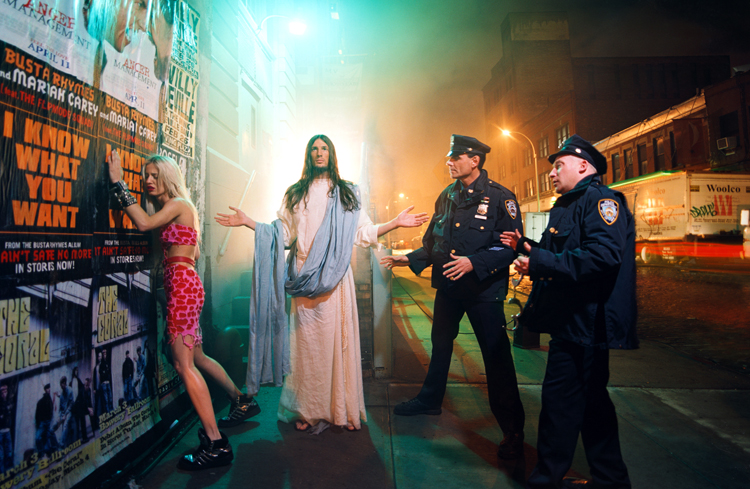
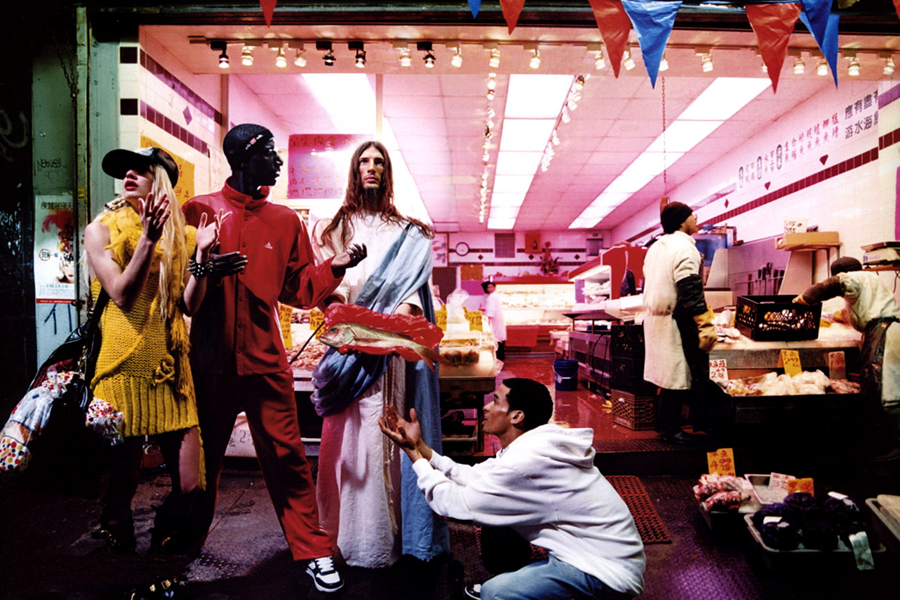
LaChapelle’s work displays a tremendous knowledge and admiration of western art’s history, and is peppered with Christian symbolism and imagery, as is shown especially by the ‘Jesus is My Homeboy’ and ‘American Jesus’ series.
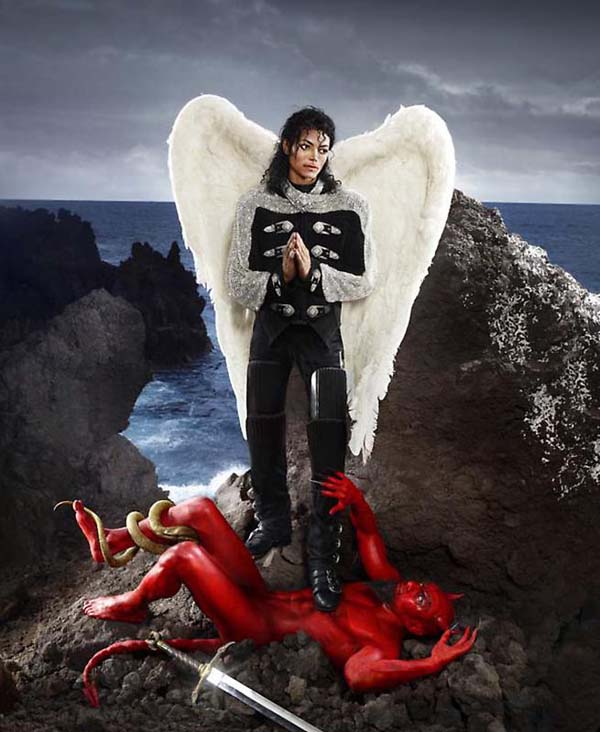
The American Jesus series revolves around images of Michael Jackson (a lookalike that is), depicted in various Biblical and even typically Catholic scenes. If some Christians already find these questionable or offensive, they will really get irritated by the image entitled ‘Thy Kingdom Come’, which features a papal figure sitting on a throne before a pile of dead, naked men. The photographer seems to easily condemn the Catholic Church. However, when asked about his intentions behind his particular treatment of forms of corruption within the Church, LaChapelle answers with wit and nuance:
“I’m not condemning the Catholic Church — it’s too big, it’s like condemning a nation and that would be prejudiced. But what I’m doing here is pointing out an irony: Here you have an institution that has systematically protected pedophile priests and then you have an innocent Michael Jackson, who California spent millions of dollars trying to prosecute and could not do it because it was complete bulls–t.” (Taken from an interview for WWD, issue 07/13/2010, by Amanda Fitzsimons).
Moreover, LaChapelle has no problems whatsoever referring to his Catholic upbringing (the quote is taken from the same interview for WWD):
“I still go to church occasionally. I went the other day and found peace. I had this duality growing up with my dad being a strict Catholic and his brother being a priest and my mother finding God in nature, so I’ve taken a little from both [traditions].”
From the point of view of his Christian background, it’s no coincidence that LaChapelle has developed a special interest for two groups of people in particular: rich and famous celebrities on the one hand, and economically deprived young people on the other. His preoccupation with the Christ figure has led him to some enthralling insights. Those familiar with mimetic theory will find them fascinating as well.
I’m glad to share David LaChapelle’s views in the following two sections.
1. The sacrificial celebrity cults as producers of modern day ‘scapegoat-gods’
The biblical writings unanimously reject phenomena like gossip and the spread of false rumors about other people. Already one of the ten commandments forbids ‘to give false testimony against a neighbor’ (Exodus 20:16).
Those who gossip – and we are all tempted to do so from time to time – create alliances based on the exclusion of the one who is gossiped about. The Book of Proverbs warns for the seductive nature of voyeurism, and its destructive, dehumanizing consequences. People shouldn’t deliver themselves too easily to the delights of gossip:
Remove perverse speech from your mouth; keep devious talk far from your lips. (Proverbs 4:24).
The north wind brings forth rain, and a gossiping tongue brings forth an angry look. (Proverbs 25:23).
Where there is no wood, a fire goes out, and where there is no gossip, contention ceases. Like charcoal is to burning coals, and wood to fire, so is a contentious person to kindle strife. The words of a gossip are like delicious morsels; they go down into a person’s innermost being. Like a coating of glaze over earthenware are fervent lips with an evil heart. The one who hates others disguises it with his lips, but he stores up deceit within him. When he speaks graciously, do not believe him, for there are seven abominations within him. Though his hatred may be concealed by deceit, his evil will be uncovered in the assembly. The one who digs a pit will fall into it; the one who rolls a stone – it will come back on him. A lying tongue hates those crushed by it, and a flattering mouth works ruin. (Proverbs 26:20-28).
A gossiped-about person is either spoken of in unrealistically praiseful terms, or, on the contrary, in a non-proportional degrading way. In other words, gossiped-about persons become the ‘sacred’ glue that hold certain communities together. The gossiped-about persons become divinized idols or equally deceitfully presented demonized ‘monsters’. David LaChapelle, inspired by his Christian background, clearly understands these mechanisms, as is demonstrated in an interview with digital magazine Nowness:
It is definitely true that celebrities are our modern day gods and goddesses, and we build them up and tear them down.
Madonna has been torn down. Michael Jordan has been torn down. Michael Jackson was destroyed. Like no other person in our times. You have to remember that Michael Jackson was innocent. He was proved innocent in our courts. If you read the transcripts of the trial it is insanity, it should never have gone to court. We spent tens of millions of dollars to prosecute him when we don’t have money for schools in California.
Why is that?
Not because he was a celebrity but because he looked different. He was obsessive about privacy and it made him “other,” it made him different, and he went from being the most famous, most beloved singer to the most reviled, joked about—he couldn’t open a newspaper without reading horror stories about himself.
Judeo Christian Scripture unveils and denounces the mechanisms by which a human being’s true, imperfect ‘black-and-white’ nature is sacrificed for the sake of an unreal ‘image’. David LaChapelle saw this happening to Michael Jackson (in the aforementioned interview with WWD):
WWD: Why did you choose to photograph Michael in a variety of religious scenes?
David LaChapelle: Michael had paintings of himself at Neverland depicting himself as a knight and surrounded by cherubs and angels. People might think he’s an egomaniac, but he’s not. It’s because the world turned against him. I mean, Michael couldn’t even get B-listers to show up for the second trial. [With these pictures he’s saying] “I’m not the joke and the horror the media is making me out to be.”
WWD: Michael stars in the show’s title piece “American Jesus.” Do you believe him to be a modern-day Jesus?
D.L.: I believe Michael in a sense is an American martyr. Martyrs are persecuted and Michael was persecuted. Michael was innocent and martyrs are innocent. If you go on YouTube and watch interviews with Michael, you don’t see a crack in the facade. There’s this purity and this innocence that continued [throughout his life]. If it had been an act, he couldn’t have kept it up. If you watch his [1992] concerts from Budapest and compare it to a Madonna concert of today, you’ll see such uplifting beauty and a message that you won’t see in any other artist of our time.
In the interview with the aforementioned Nowness LaChapelle goes even further and states:
We persecuted Michael Jackson. Every person who ever bought a tabloid or watched the news, we all contributed to his death by taking in that form of gossip.
The Bible is concerned with ‘truth’ and takes sides with the wrongfully presented and the wrongfully accused persons – the scapegoats! The prophet Isaiah calls out to the people of Israel:
“You mustremovethe burdensome yokefrom amongyou and stop pointing fingers and speaking sinfully.” (Isaiah 58:9b).
Jesus, the one who is called the Christ, even goes so far as to bless the victims of gossip and false rumors:
“Blessed are you when people insult you and persecute you and say all kinds of evil things about you falsely on account of me.” (Matthew 5:11).
It is no coincidence then that the easily gossiped-about persons in the Jewish community at the time of the New Testament, like prostitutes or the infamous tax collectors, are among Christ’s favorites. He shares meals with these ‘sinners’, like with the tax collector Zacchaeus (Luke 19:1-10). Even one of his apostles – Levi or ‘Matthew’ – is known to be a former tax collector (Luke 5:27-39).
The apostle Paul asks us to transform our imitative, mimetic abilities in order to become ‘children of God’. Instead of reinforcing processes of victimization by imitating the ones who gossip and ‘point fingers’, he asks us to become ‘imitators of Christ’. Christ is the One who was eventually sacrificed, because he completely delivered himself to Compassion:
Be imitators of God as dearly loved children and live in love, just as Christ also loved us and gave himself for us, a sacrificial and fragrant offering to God. […] There should be no vulgar speech, foolish talk, or coarse jesting – all of which are out of character – but rather thanksgiving. For you can be confident of this one thing: that no person who is immoral, impure, or greedy (such a person is an idolater) has any inheritance in the kingdom of Christ and God. (Ephesians 5:1-5).
Christ completely imitated and ‘incarnated’ his ‘Father’ – a Love which ‘refuses sacrifice and desires mercy’ – see for instance Matthew 9:13. Therefore Christ could not defend himself by starting some sort of ‘civil war’, because that would imply sacrifices of others. In any case, Christ doesn’t want us to be suicidal, but he is very much aware of the risks in taking sides with the excluded and the outcasts. It might mean that these become members of the community again, but it might also have as a consequence that the outcast’s defender is excluded oneself and that he ‘has to take up his cross’ to be ‘crucified’. Christ’s preference for the victims of gossip and rumors indeed often meant he himself became gossiped-about. Nevertheless, he kept approaching people like tax collectors in liberating ways. Many a victim of gossip, like these tax collectors at the time of Jesus, imitates the reasoning of his attackers and thinks it’s ‘part of the deal’ of being a ‘celebrity’. Jesus points out that people shouldn’t accept being gossiped about by the self-declared ‘righteous’ and ‘elected’:
Jesus told this parable to some who were confident that they were righteous and looked down on everyone else. “Two men went up to the temple to pray, one a Pharisee and the other a tax collector. The Pharisee stood and prayed about himself like this: ‘God, I thank you that I am not like other people: extortionists, unrighteous people, adulterers – or even like this tax collector. I fast twice a week; I give a tenth of everything I get.’ The tax collector, however, stood far off and would not even look up to heaven, but beat his breast and said, ‘God, be merciful to me, sinner that I am!’ I tell you that this man went down to his home justified rather than the Pharisee. For everyone who exalts himself will be humbled, but he who humbles himself will be exalted.” (Luke 18:9-14).
2. The ‘richness’ of ‘poor’ people and the ‘poverty’ of the ‘rich’
Jesus distinguishes two kinds of motivations to give (of) oneself: there are those who give and sacrifice in order to receive some kind of ‘reward’, and there are those who give in order to let others come to life. The first are the real ‘poor people’ in the eyes of Jesus because they worryingly adhere and enslave themselves to ‘material’, ‘worldly’ things like ‘wealth’ or ‘social status’. They also have the ‘mimetic’ (i.e. imitative) tendency to enviously compare themselves to others and to compete with their thus conceived ‘enemies’ in order to ‘rise above’ them. In the above mentioned parable, Jesus denounces this mechanism wherein people not only sacrifice themselves to a deceitful self-image, but also sacrifice others in presenting them in an equally deceitful and degrading way. Real richness, according to Jesus, comes with those who develop a realistic, ‘truthful’ view about themselves and who are able to give whatever they received:
Jesus looked up and saw the rich putting their gifts into the offering box. He also saw a poor widow put in two small copper coins. He said, “I tell you the truth, this poor widow has put in more than all of them. For they all offered their gifts out of their wealth. But she, out of her poverty, put in everything she had to live on.” (Luke 21:1-4).
David LaChapelle pays particular attention to this kind of unconditional life bringing and therefore community enhancing way of ‘giving’ in his film Rize. Therein socially and economically deprived youngsters aren’t reduced to their situation, but are shown as talented people who are able to rebuild their communities in new, joyful and colorful ways. They really are ‘Church builders’, able to ‘give back’ inspired by the love they experience from each other. From the point of view of mimetic theory, their dancing not only ritualizes mimetic rivalry and restrains violence, but it also celebrates the grateful experience of life itself. Here’s what the synopsis of the film has to say:
“Rize” reveals a groundbreaking dance phenomenon that’s exploding on the streets of South Central, Los Angeles. Taking advantage of unprecedented access, this documentary film brings to first light a revolutionary form of artistic expression borne from oppression. The aggressive and visually stunning dance modernizes moves indigenous to African tribal rituals and features mind-blowing, athletic movement sped up to impossible speeds. “Rize” tracks the fascinating evolution of the dance: we meet Tommy Johnson (Tommy the Clown), who first created the style as a response to the 1992 Rodney King riots and named it “Clowning”, as well as the kids who developed the movement into what they now call Krumping. The kids use dance as an alternative to gangs and hustling: they form their own troupes and paint their faces like warriors, meeting to outperform rival gangs of dancers or just to hone their skills. For the dancers, Krumping becomes a way of life – and, because it’s authentic expression (in complete opposition to the bling-bling hip-hop culture), the dance becomes a vital part of who they are.
Like “Paris is Burning” or “Style Wars” before it, “Rize” illuminates an entire community by focusing on an artform as a movement that the disenfranchised have created. But the true stars of the film are the dancers themselves: surrounded by drug addiction, gang activity, and impoverishment, they have managed to somehow rise above. The film offers an intimate, completely fresh portrayal of kids in South Central as they reveal their spirit and creativity. These kids have created art – and often family – where before there was none.
It is evident that the young dancers are able to found communities in non-exclusive ways. In this way, they really are building the Church – the Community – Jesus dreamt of:
Realizing THOMAS “TOMMY THE CLOWN” JOHNSON had become a positive role model for the kids in South Central, he created the Battle Zone to provide an alternative outlet for the kids in the community to battle it out on the dance floor instead of on the streets. In 2003, Tommy the Clown’s Battle Zone hosted a sold-out performance at the Los Angeles Forum. Tommy continues the battles every third Saturday of every month at Debbie Allen Dance Academy – a non-profit dance studio where kids from the community can learn all forms of dance training. Tommy the Clown emerged as a community icon and was asked to be a spokesperson for Governor Gray Davis’ Census Campaign which involved outreach to schools, neighborhood questionnaire assistance centers and statewide agencies which succeeded with the highest mail-in response rates in four decades. He formed strategic partnerships with counties and cities, all while delivering smiles and laughter. […] Truly an entertainer for all ages, Tommy the Clown’s mission is to reach out to communities across the world that are in need of a positive alternative lifestyle.
DRAGON was born Jason Green in Frankfurt on November 2, 1981. A military baby, he spent his initial years living throughout Germany, his very first in a hospital, the result of being born prematurely. His family eventually moved to California and settled in Compton. Dragon first crossed paths with Tommy the Clown while dancing for Platinum Clowns, a rival clown group, in competition. Dancing since the age of 19, Dragon has appeared in such music videos as Blink 182’s “I’m Feelin’ It,” and in various awards shows including the Choreographer Awards and the 2005 NAACP Awards. Outside of the Clowning world, Dragon is also an accomplished artist whose experience spans across fashion design, the graphic arts, multi-media, airbrushing, and comic book art. Now residing in Carson, CA, Dragon is currently studying to be a minister. He rediscovered the church after years of distancing himself from it, only to realize how truly unhappy he was with his life. Dragon now believes that the principles our nation was established upon – religion, principle, respect – have been compromised by our drive for material things which have no true value. Through the church, he hopes to someday help others find their own spiritual foundation for a happy life.
TIGHT EYEZ, real name Ceasare Willis, is one of the founders of Krumping. He created the Krump movement in 2000 with his brothers and Lil C and Mijo. While living in New York, Tight Eyez dreamed of launching a dance that would get everyone “hyped up.” He soon moved to Los Angeles and founded Clown dancing, which thereafter evolved into Krumping. He went on to perform with many clown groups before finally meeting and joining creative forces with Tommy the Clown. Tight Eyez has turned his life over to God and changed his life through Jesus. He uses the Krump movement to help young people in faith to change their lives. His goal is to establish his own Krump Organization, of which he would be the CEO, and hopes to open schools for youth to dance, exercise their talent and utilize their inner gifts. Hopefully, by the age of 23…
Christian Jones, a/k/a BABY TIGHT EYEZ, was born and raised in the Church. His grandfather was the founder of the Christian Tabernacle of Love, Faith and Deliverance, and his Aunt is now Pastor of Christian Tabernacle Ministries. After his grandfather passed on in 1998, he took up the organ, which he plays at services. Baby Tight Eyez learned how to Krump dance at the heels of Tight Eyez, Lil C, Mijo, and Dragon, and considers them among his closest friends in the Krump movement. When he is not dancing, he loves to hang with his homies. His goal is to launch a big dance studio where everyone could Krump for free. He would also like to buy his pastors a new church. He hopes to give back to those who do not have, to give back to his neighborhood, to give those who are as he once was.
I compiled a film with some of the documentary’s testimonies, and combined them with fragments of pop diva Madonna‘s 2006 Confessions Tour. I know that her allusion to the crucifixion of Christ – as shown at the ending of this compilation – stirred a lot of controversy, but I hope people are able to see it as an artistic commentary on what happens when deprived people are given voice and rediscover their dignity: it means that the love of Christ, Christ himself, is in our midst. Although some of the youngsters explain their life story in a sacrificial way (in the sense of ‘I had to endure what happened to me to receive a rewarding insight or gift’ – the Nietzschean ‘What doesn’t kill me, makes me stronger’ type of explanation), above all they try to ‘enlighten’ the world with their dance talents. These are really ‘tales of resurrection’ wherein the gift of life is passed on to others. Watch my video compilation right here
William Blake (1757 – 1827) is one of the most intriguing artists ever to have walked the face of this earth. An English poet and painter, he conceived his own mythology, rich in symbolism and meaning, based on a thorough knowledge of Classical Antiquity and the Biblical traditions.
I first became attracted to his work by reading Gil Bailie’s book Violence Unveiled – Humanity at the Crossroads. The cover showed The Body of Abel Found by Adam and Eve, one of William Blake’s later paintings.
Struck by this powerful image and the equally powerful writings of Bailie, I delved into some of Blake’s poems. I knew he took a critical stance toward organised religion, as well as toward an idealization or ‘idolization’ of Reason.
Reading his poems, I soon discovered a human soul who was concerned with and moved by ‘the core business of Christ’: the refusal of sacrifice in the name of some ‘Higher Entity’ (be it a God, an Institution, a State or an Idea). Of course, this refusal might paradoxically imply that one is sacrificed by those who don’t respond to the call of a Love which desires ‘mercy, not sacrifice’ (Matthew 9:13). The Everlasting Gospel seems especially challenging, with sentences like these: God wants not man to humble himself: That is the trick of the Ancient Elf. This is the race that Jesus ran: Humble to God, haughty to man…
Perhaps most remarkable, William Blake shows a profound understanding with regard to the origin of ‘resentment’ in this poem. We all have the tendency to look out for what is socially acceptable, be it consciously or unconsciously. Depending on the particular group we want to be part of, we imitate certain behaviors and clothing styles. Likewise, we even hang on to certain ideas, rules and norms, defining what is morally ‘good’ or ‘bad’ for our particular group. It’s, in a sense, ironic and even funny that one of the best propagated ideas in our western society today is the idea we should be independent and not easily manipulated individuals. So, it has become the social norm to say of oneself “I’m an autonomous, critical individual, not easily imitating others”. But, by presenting such images of our own ‘independency’, we precisely imitate everyone else desiring a similar autonomy and boasting of themselves in a similar way. René Girard has called the denial of the imitative or ‘mimetic’ nature of a certain, but basic, type of human desire a ‘romantic illusion’ (see Deceit, Desire and the Novel).
Anyway, if we frustrate ourselves by adhering an acceptable ‘image’ (and, for example, refuse to recognize our ‘relational, non-independent nature’ as human beings), we might get frustrated by others who don’t seem to follow that image. For frustrating certain desires in order to satisfy our need to obtain a social status only makes these desires grow stronger. So others, who do follow the desires we suppress for ourselves, become a ‘stumbling block’ we want to get rid of. Very often, we can’t stand the confrontation with the fulfillment of our deepest, frustrated desires by these others. We become jealous of them. We would like to imitate their way of behaving, but precisely because we fear to lose our socially acceptable image, we deny being jealous of them. In the end, we’ll even state we find their behavior morally repulsive. Of course, this is a self-deception to comfort oneself. This process is exactly what Friedrich Nietzsche (1844-1900) called ‘resentment’. In Girard’s terms this resentment is part of the ‘romantic lie’, as this feeling once again denounces the mimetic nature of desire – the resentful individual doesn’t recognize being jealous of the one whose behavior he resents. Unlike Nietzsche, Girard doesn’t consider Judeo-Christian tradition as the source of a morality based on resentment, but, on the contrary, as a tradition which precisely uncovers the mimetic tendencies underlying our hate towards others.
By expulsing or ‘sacrificing’ the others we consider ‘morally wrong’, we actually try to conjure our own, ‘secret’ desire to be ‘morally wrong’. We try to convince ourselves and the ones of our own ‘group’ that we in no way resemble the ‘others’ we’re expulsing. As a tragic consequence of our enslavement to a dishonest self-image, we will not only victimize others, but we will also develop ways to secretly fulfill our frustrated desires – as they do have become ‘unmanageable’ and ‘too big’ to handle. So our desire to be ‘morally just and socially acceptable’ (‘chaste’) ignites a hypocritical lifestyle. This can be prevented if we are honest about ourselves and acknowledge certain desires in healthy, non-destructive ways – in other words if we, like Mary Magdalen or the adulteress from John’s gospel (John 8:1-11), look at ourselves through the eyes of Grace, and no longer through the eyes of those who might ‘press charges’ against us and who want us to ‘humble’ ourselves ‘in dark pretence to chastity’. That Grace, embodied so eminently by Jesus who ‘loved the sinner but condemned the sin’, indeed ‘reshapes’ sinners and empowers them to ‘sin no more’.
Like René Girard, Max Scheler (1874-1928) and other Christian thinkers, William Blake once again points to the origin of ‘bad’ i.e. ‘envious’ desire (covet), resentment and sacrificial impulses – all part of the ‘original sin’ – in his magnificent poem:
Blake, as a Christian visionary, became very sensitive toward processes of victimization, as this is shown by yet another illustration of his to J. G. Stedman’s Narrative of a Five Years’ Expedition against the Revolted Negroes of Surinam (1796).
The Little Black Boy, a poem addressing a similar theme as this shocking, indeed ‘unveiling’ image, can be found by clicking here. In this poem, Blake first and foremost explores the dynamics of Divine Love and Grace, which call for ‘imitation’, once more…
Divine Love is different from Envy which Blake, time and again, considers the source of all evil (the original sin). A fragment from his poem Visions of the Daughters of Albion puts it this way:
Can that be Love, that drinks another as a sponge drinks water, That clouds with jealousy his nights, with weepings all the day, To spin a web of age around him, grey and hoary, dark; Till his eyes sicken at the fruit that hangs before his sight? Such is self-love that envies all, a creeping skeleton, With lamplike eyes watching around the frozen marriage bed!
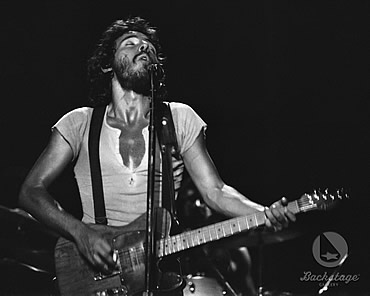
Bruce Springsteen‘s take on the story of Christ’s Passion certainly reflects a profound spiritual awareness of what this event is actually about. In an episode for VH1 Storytellers, Springsteen meditates on his song Jesus was an only son, and brings out the universal and existential truths the story of the Passion reveals.
CLICK TO WATCH it right here:
Click here to read a full transcription of this video.
Springsteen’s interpretation of the song’s ending is especially moving. A transformation takes place. Whilst in the beginning of the song Jesus is comforted by his mother Mary, at the end it’s the son who comforts his mother. Mary is asked to respect the particular destiny of her child. Jesus chose the path of compassion and love. He was touched, so deeply, by the suffering of the outcasts that he couldn’t do anything else but reach out to them. By associating him with these scapegoats, he eventually became a victim himself. In refusing to take part in a social system that constructs itself by means of sacrifices, Jesus was eventually sacrificed himself.
Following Springsteen’s reasoning, Jesus cannot start some sort of ‘civil war’ to defend himself, because that would make him the imitator of his persecutors – Jesus would thus become a sacrificer himself, a ‘prince of this world’, a ‘Muammar Gaddafi’… Christ’s kingdom, on the other hand, is ‘not of this world’. Jesus follows, in the song’s words, ‘the soul of the universe’ which ‘willed a world and it appeared’. Indeed, by withdrawing from vengeance (i.e. the imitation of the persecutors), Jesus creates the possibility of a new world. Imitating the one who ‘offers the other cheek’, the one who forgives and approaches his persecutors and betrayers with compassion, allows us to accept our own and each other’s weaknesses and iniquities, without us being victimized or ‘crucified’ for doing so…
At the end of Springsteen’s song, Jesus seems confident that his ‘Heavenly Father’ would ultimately refuse the sacrifice of his son – and this confidence is reflected in the stories of Christ’s resurrection. Jesus fully imitates ‘the One who doesn’t want sacrifices or victims’ and therefore he is said to be the ultimate incarnation or ‘materialization’ of Love: “A bruised reed shall he not break, and smoking flax shall he not quench, till he send forth judgment unto victory.” (KJV, Matthew 12:20). Bruce Springsteen speaks of this mystery of the incarnation at the end of his ‘sermon’:
“Whatever divinity we can lay claim to is hidden in the core of our humanity… When we let our compassion go, we let go of what little claim we have to the divine.”
Love seeks to be concrete and ’embodied’. The very nature of Love is to throw off its spiritual garment, to ’empty’ itself from the ‘sacred’ realm in order to become ‘flesh’ – which is called ‘kenosis’. The story of Christ’s Passover can be considered a pinnacle in our clumsy attempts to express this reality. However, if these attempts produce songs like Bruce Springsteen’s Jesus was an only son, we should be grateful, as we are comforted by the fragile light of hope amidst our own ‘darkness on the edge of town’.
Faith, hope and love have always played a part in Bruce Springsteen’s songs, but this has become more explicit in recent years. Springsteen’s willingness to talk about these themes also is relatively new.
“The loss and search for faith and meaning have been at the core of my own work for most of my adult life. I’d like to think that perhaps that is what Dr. Percy heard and was what moved him to write me. Those issues are still what motivate me to sit down, pick up my guitar and write.”
René Girard’s mimetic theory is heir to a long and widespread Christian tradition of meditating on imitation, more specifically on the imitation of Christ. This tradition is such an essential part of the Christian ‘DNA’, that Christians throughout the ages have dwelled upon it. Not surprisingly then, the wisdom of a famous Medieval Catholic monk – Thomas à Kempis – coincides with the insights of a contemporary Christian rock star – Bono. I found it interesting to organize a meeting between the two. So, here you have it: some excerpts from De Imitatione Christi next to a video fragment of an interview with Bono.
Thomas à Kempis(c.1380-1471) is famous for his spiritual guide De Imitatione Christi – ‘(On) The Imitation of Christ’. These are its first words:
Qui sequitur me non ambulat in tenebris dicit Dominus. Hæc sunt verba Christi, quibus admonemur quatenus vitam eius et mores imitemur, si volumus veraciter illuminari, et ab omni cæcitate cordis liberari. Summum igitur studium nostrum, sit in vita Jesu meditari.
(De Imitatione Christi, Liber Primus Caput I, 1).
Translation:
“He who follows Me, walks not in darkness,” says the Lord. By these words of Christ we are advised to imitate His life and habits, if we wish to be truly enlightened and free from all blindness of heart. Let our chief effort, therefore, be to study the life of Jesus Christ.
Christ indeed asks us to imitate him, thereby reorienting our mimetic abilities. Bono, lead singer of rock band U2, tried to follow this call from an early age and always looked for authentic ways to develop his life as a Christian. He tried to follow in the early church’s footsteps:
In school I met some people who knew the Scriptures. It was quite a moment there when people got very interested in the early church and the possibilities of imitating the early church.
Because of certain mimetic tendencies, our ears often remain deaf to these possibilities. All too soon we imitate those who judge us, and we become judgmental ourselves. Answering Christ’s call to ‘follow’ him has to do with finding out the truth about our’selves’ and with the ability to love our neighbour. The evangelical paradox is this: in obeying Christ we don’t lose ourselves but instead we actually find who we are – we become free! Christ represents the realm of grace and forgiveness, where we don’t have to hide our weaknesses and iniquities. This realm is an antidote for the temptation to present ourselves in such a way that we don’t run the risk of being judged. We are often tempted to enslave ourselves to an admirable image (Latin: imago) or to imitate an illusory idol. Bono puts it this way:
The key that great art has in common with Christianity is: “Know the truth and the truth will set you free.” I’ve held on to that very tightly. That’s how I start my day as a writer. I (can) start on a lie… and a lie can be being the person that you’d like to be, rather than the person you are…
If we don’t experience ‘the space of grace’, we will indeed easily lie about our own shortcomings and place the blame on something or someone else – and thus create scapegoats. We are so used to being judged that we judge others in our defense, and so multiply the evil we are trying to avoid. To imitate Christ means to imitate the One who is merciful and by doing so, in turn, free others in becoming and accepting themselves. The dynamic thus created is a dynamic of love which eventually hopes to save the world from the ‘bad’ imitation of ‘an eye for an eye’ violence. Bono also talks about this interruption of ‘the laws of karma’ (i.e. the laws of harmony, balance as well as revenge) by the creative, unexpected and ‘unbalancing’ dynamic of grace and forgiveness:
I’m pretty sure that the Universe operates by the laws of Karma essentially. All physical laws do. What you put out comes back against you. Then enters the story of Grace, which really is the story of Christ, which turned this view of the Universe upside down. And it’s completely counter-intuitive. It’s very, very hard for human beings to grasp Grace. We can actually grasp atonement, revenge, fairness… all of this we can grasp. But we don’t grasp Grace very well. I’m much more interested in Grace because I’m really depending on it.
In order to become loving persons – which is the ultimate goal of the biblical enterprise – we first need to accept ourselves as we are. That’s why Thomas à Kempis advises us to temporarily withdraw from a world where we are tempted to keep up appearances by gossip and rumors. From time to time, we need to retreat from ‘the company of men’ in order to distinguish ‘the call of the One who creates us’
… so we might truly become ‘imitators of Christ’:
Quære aptum tempus vacandi tibi, de beneficiis Dei frequenter cogita. Relinque curiosa, tales potius perlege materias, quæ compunctionem magis præstent quam occupationem. Si te subtraxeris a superfluis locutionibus et curiosis circuitionibus nec non a novitatibus et remoribus audiendis, invenies tempus sufficiens et aptum bonis meditationibus insistendis. Maximi Sanctorum humana consortia ubi poterant vitabant et Deo in secreto vivere eligebant.
Dixit quidam: Quoties inter homines fui, minor homo redii. Hoc sæpius experimur, quando diu confabulamur. Facilius est enim tacere quam in verbo non excedere. Facilius est domi latere quam foris se posse sufficienter custodire. Qui igitur intendit ad interiora et spiritualia pervenire, oportet eum cum Jesu a turba declinare.
(De Imitatione Christi, Liber Primus Caput XX, 1-2a).
Translation:
Seek a suitable time for leisure and meditate often on the favors of God. Leave curiosities alone. Read such matters as bring sorrow to the heart rather than occupation to the mind. If you withdraw yourself from unnecessary talking and idle running about, from listening to gossip and rumors, you will find enough time that is suitable for holy meditation. Very many great saints avoided the company of men wherever possible and chose to serve God in retirement.
“As often as I have been among men,” said one writer, “I have returned less a man.” We often find this to be true when we take part in long conversations. It is easier to be silent altogether than not to speak too much. To stay at home is easier than to be sufficiently on guard while away. Anyone, then, who aims to live the inner and spiritual life must go apart, with Jesus, from the crowd.
The video fragment of an interview with Bono on ‘faith, hope and love’
– CLICK TO WATCH:
For more cross-references between U2 and mimetic theory I highly recommend a book, in German, by Austrian Brigitte Dorner: U2 ist ihre Religion, Bono ihr Gott. Zur theologischen Relevanz der Rock- und Popmusik am Beispiel von U2.For more information, click here.
In 1952, Scottish-born Canadian film director and animator Norman McLaren (1914-1987) released his hugely acclaimed short film Neighbours. It won both a Canadian Film Award and an Academy Award, and has been designated as a ‘masterwork’ by the Audio-Visual Preservation Trust of Canada. Moreover, in 2009, the film was added to UNESCO’s Memory of the World Programme. Neighbours is a revolutionary piece of art, both in content and in style. McLaren is a master in using the so-called pixilation, an animation technique which treats live actors as stop-motion objects. As for the content, Neighbours can be considered an anti-war statement.
Asked about the inspiration for his film, McLaren answered: “I was inspired to make Neighbours by a stay of almost a year in the People’s Republic of China. Although I only saw the beginnings of Mao’s revolution, my faith in human nature was reinvigorated by it. Then I came back to Quebec and the Korean War began. My sympathies were divided at that time. I felt myself to be as close to the Chinese people as I felt proud of my status as a Canadian. I decided to make a really strong film about anti-militarism and against war.”
The film clearly demonstrates the mimetic origin of rivalry and its escalation into violence. Two neighbours, living together peacefully and enjoying shared interests, become each other’s rivals once they both lay claim on a flower. The film plainly depicts they not only pay attention to this object, but also that they increasingly keep an eye on each other until, finally, the attention for the object completely disappears. As they imitate each other’s claims and try to manifest themselves over against one another, the object is even destroyed during the process.
CLICK TO WATCH:
Neighbours not only ironically reveals that one’s desire for prestige, pride and power is actually based on nothing (but an imitation of another’s desire), but it also shows the tragic and horrifying, shocking outcome of escalated mimetic rivalry. The former friends are tricked into becoming each other’s monstrous doubles. The Latin word praestigia means deception or illusion and it indeed points to the misleading nature of mimetic desire.
“PEACE CERTAIN IF NO WAR. WAR CERTAIN IF NO PEACE.” – so the mirror said…
The rock band Extreme made a video for their song Rest in Peace which all too overtly draws on Neighbours. A tribute, nonetheless. Watch it here:
“Art enables us to find ourselves and lose ourselves at the same time.” (Thomas Merton, 1915-1968; from No Man Is an Island).
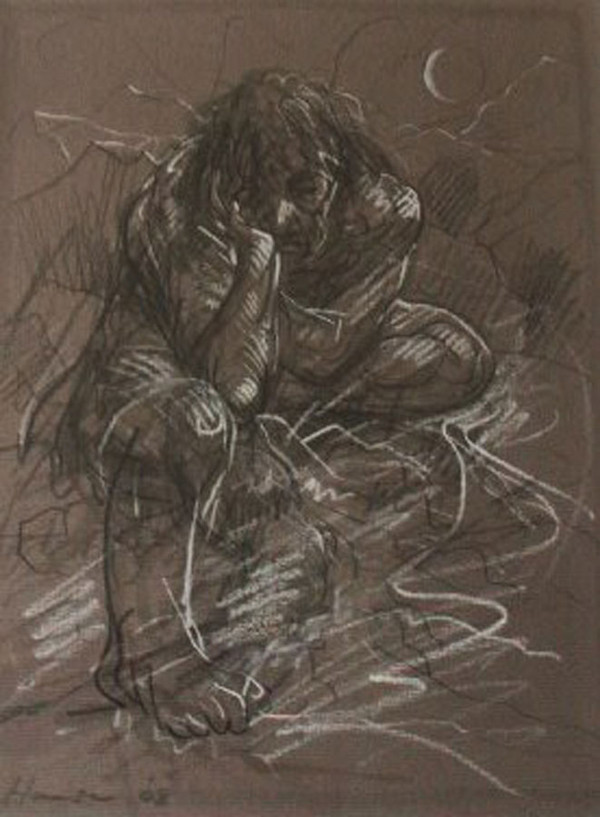
This quote reminded me of a painting by Peter Howson, who converted to Christianity around the year 2000 after battling his alcohol and drug addictions. Christ in the Desert depicts Jesus as he struggles with anxieties and temptations during his ’40 days in the wilderness’. The painting reflects every man’s ‘darkest hours’, and certainly also some dark moments of the painter himself. Peter Howson talked about his ‘rage’ in an interview with TheSunday Times (July 27, 2008). Here are some excerpts:
“Because of my Asperger syndrome I could have ended up murdering someone. I’m capable of it, I know that. When I was drinking I went into very dark places. If you think life is meaningless you think, well, why not go down with a bang.”
“I used to be very badly bullied at school and when I was a bouncer in a nightclub for quite a few years I changed in a false sense then, and became a bully myself.”
In other words: Howson became the imitator of his persecutors… He followed the mimetic principle of vengeance. He became ‘the old man’, the biblical Cain. Luckily, through painting he gradually managed to move away from his ‘murderous rage’ and to ‘find himself’ in a new way. Yet he will always be watchful of the darkness lurking beneath his newly gained life:
“I can hold myself back now, but the anger will always be there.”
I guess we all have our ‘desert(ed)’ moments…
To watch an interesting interview with Peter Howson, click the following:
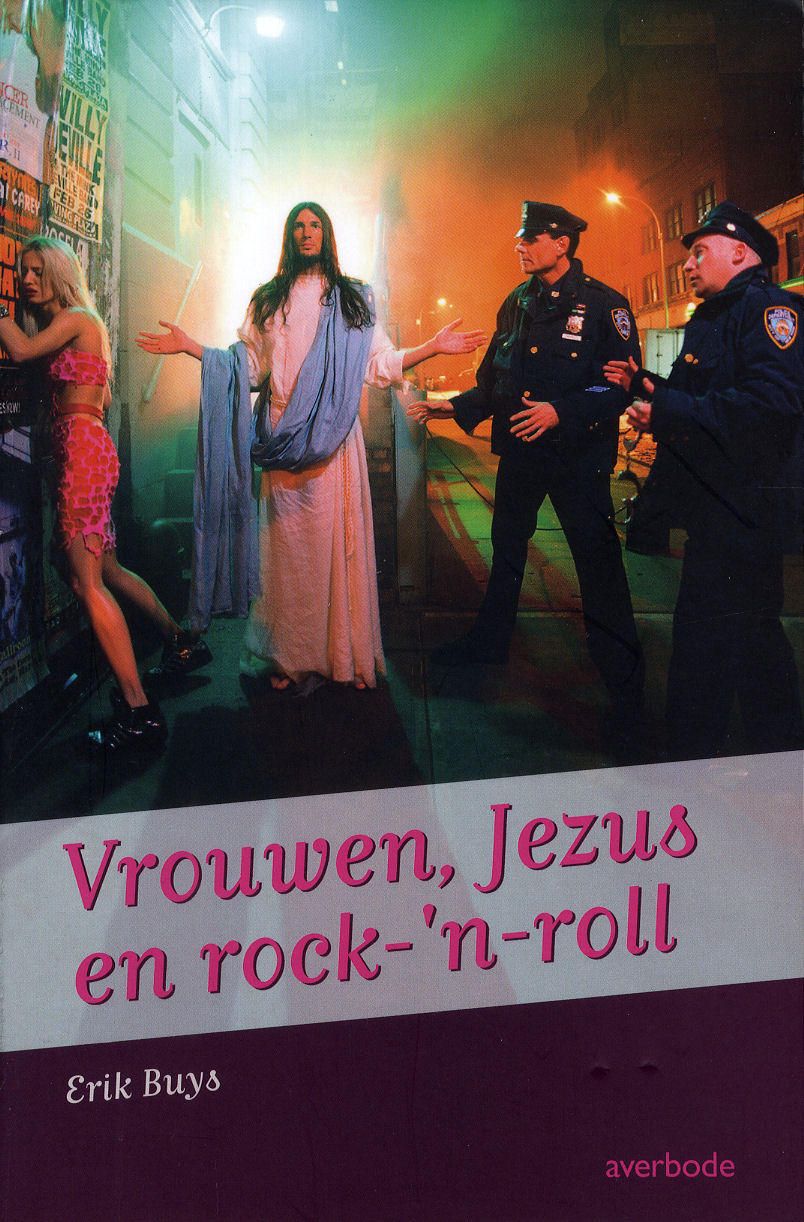
In het boekVrouwen, Jezus en rock-‘n-roll – Met René Girard naar een dialoog tussen het christelijk verhaal en de populaire cultuur(cover – pdf) is de mimetische theorie van René Girard een dankbaar referentiekader om de relevantie van het christelijk verhaal voor de populaire cultuur te schetsen aan de hand van een aantal concrete voorbeelden (gaande van Stan, een wereldhit van rapper Eminem, over andere meer en minder bekende songs – bijvoorbeeld American Life van Madonna, The Unforgiven van Metallica en When you were young van The Killers -, tot films als American Beauty en Pleasantville).















 SCAPEGOAT SHADOWS