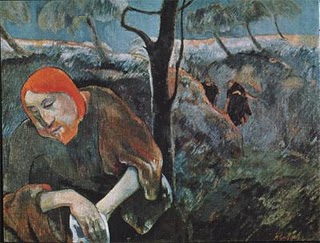
Last year I made a video for our school, allowing pupils as well as colleagues to contemplate the Stations of the Cross. Originally this video used Dutch translations of the biblical texts, but for this blog I replaced them by English ones, so the video can be understood by a wider audience.

My interpretation of the Via Crucis is based on the so-called biblical Way of the Cross, which is a variation on the more traditional forms from the Middle Ages.

The music and paintings I used are mainly from 20th century and contemporary artists. Even the excerpt from Allegri’s Miserere is presented in a modern arrangement. I explicitly and consciously chose certain music to accompany the images and texts of the Via Crucis. If you’re interested, and want to contemplate even more intensely, click here to read the lyrics from the music. The prayer at the ending is ascribed to Saint Francis of Assisi (1181-1226).

CLICK TO WATCH the video right here:

Archbishop Piero Marini writes the following on the biblical Way of the Cross (text from the ‘Office for the Liturgical Celebrations of the Supreme Pontiff’):

  Compared with the traditional text, the biblical Way of the Cross celebrated by the Holy Father at the Colosseum for the first time in 1991 presented certain variants in the «subjects» of the stations. In the light of history, these variants, rather than new, are – if anything – simply rediscovered.The biblical Way of the Cross omits stations which lack precise biblical reference such as the Lord’s three falls (III, V, VII), Jesus’ encounter with his Mother (IV) and with Veronica (VI). Instead we have stations such as Jesus’ agony in the Garden of Olives (I), the unjust sentence passed by Pilate (V), the promise of paradise to the Good Thief (XI), the presence of the Mother and the Disciple at the foot of the Cross (XIII). Clearly these episodes are of great salvific import and theological significance for the drama of Christ’s passion: an ever-present drama in which every man and woman, knowingly or unknowingly, plays a part.

[…] The Congregation for Divine Worship on various occasions in recent years authorised the use of formulas alternative to the traditional text of the Way of the Cross.

With the biblical Way of the Cross the intention was not to change the traditional text, which remains fully valid, but quite simply to highlight a few «important stations» which in the textus receptus are either absent or in the background. And indeed this only emphasises the extraordinary richness of the Way of the Cross which no schema can ever fully express.

The biblical Way of the Cross sheds light on the tragic role of the various characters involved, and the struggle between light and darkness, between truth and falsehood, which they embody. They all participate in the mystery of the Passion, taking a stance for or against Jesus, the «sign of contradiction» (Lk 2,34), and thus revealing their hidden thoughts with regard to Christ.

Making the Way of the Cross, we, the followers of Jesus, must declare once more our discipleship: weeping like Peter for sins committed; opening our hearts to faith in Jesus the suffering Messiah, like the Good Thief; remaining there at the foot of the Cross of Christ like the Mother and the Disciple, and there with them receiving the Word which redeems, the Blood which purifies, the Spirit which gives life.

(Piero Marini is Titular Archbishop of Martirano and Master of the Liturgical Celebrations of the Supreme Pontiff).

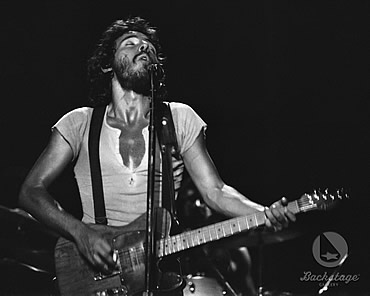
Bruce Springsteen‘s take on the story of Christ’s Passion certainly reflects a profound spiritual awareness of what this event is actually about. In an episode for VH1 Storytellers, Springsteen meditates on his song Jesus was an only son, and brings out the universal and existential truths the story of the Passion reveals.

CLICK TO WATCH it right here:

Click here to read a full transcription of this video.

Springsteen’s interpretation of the song’s ending is especially moving. A transformation takes place. Whilst in the beginning of the song Jesus is comforted by his mother Mary, at the end it’s the son who comforts his mother. Mary is asked to respect the particular destiny of her child. Jesus chose the path of compassion and love. He was touched, so deeply, by the suffering of the outcasts that he couldn’t do anything else but reach out to them. By associating him with these scapegoats, he eventually became a victim himself. In refusing to take part in a social system that constructs itself by means of sacrifices, Jesus was eventually sacrificed himself.

Following Springsteen’s reasoning, Jesus cannot start some sort of ‘civil war’ to defend himself, because that would make him the imitator of his persecutors – Jesus would thus become a sacrificer himself, a ‘prince of this world’, a ‘Muammar Gaddafi’… Christ’s kingdom, on the other hand, is ‘not of this world’. Jesus follows, in the song’s words, ‘the soul of the universe’ which ‘willed a world and it appeared’. Indeed, by withdrawing from vengeance (i.e. the imitation of the persecutors), Jesus creates the possibility of a new world. Imitating the one who ‘offers the other cheek’, the one who forgives and approaches his persecutors and betrayers with compassion, allows us to accept our own and each other’s weaknesses and iniquities, without us being victimized or ‘crucified’ for doing so…

At the end of Springsteen’s song, Jesus seems confident that his ‘Heavenly Father’ would ultimately refuse the sacrifice of his son – and this confidence is reflected in the stories of Christ’s resurrection. Jesus fully imitates ‘the One who doesn’t want sacrifices or victims’ and therefore he is said to be the ultimate incarnation or ‘materialization’ of Love: A bruised reed shall he not break, and smoking flax shall he not quench, till he send forth judgment unto victory.” (KJV, Matthew 12:20). Bruce Springsteen speaks of this mystery of the incarnation at the end of his ‘sermon’:

“Whatever divinity we can lay claim to is hidden in the core of our humanity… When we let our compassion go, we let go of what little claim we have to the divine.”

Love seeks to be concrete and ’embodied’. The very nature of Love is to throw off its spiritual garment, to ’empty’ itself from the ‘sacred’ realm in order to become ‘flesh’ – which is called ‘kenosis’. The story of Christ’s Passover can be considered a pinnacle in our clumsy attempts to express this reality. However, if these attempts produce songs like Bruce Springsteen’s Jesus was an only son, we should be grateful, as we are comforted by the fragile light of hope amidst our own ‘darkness on the edge of town’.

The sports-minded Jesuit Patrick Kelly wrote the following on Bruce Springsteen’s faith and his Roman Catholic background in a column for America Magazine (The National Catholic Weekly) – February 10, 2003 (click here to read):

Faith, hope and love have always played a part in Bruce Springsteen’s songs, but this has become more explicit in recent years. Springsteen’s willingness to talk about these themes also is relatively new.

The Rev. Andrew Greeley’s article, “The Catholic Imagination of Bruce Springsteen” (click to read Am., 2/6/88), seems to have been a catalyst in this regard. The Catholic novelist Walker Percy read the article and wrote to Springsteen in early 1989, particularly interested in the fact that Greeley described him as a Catholic. “If this is true, and I am too,” his letter read, “it would appear the two of us are rarities in our professions: you as a post-modern musician, I as a writer, a novelist and a philosopher. That and your admiration of Flannery O’Connor. She was a dear friend of mine, though she was a much more heroic Catholic than I.” Walker Percy died before Springsteen responded to his letter, but the musician wrote in a four-page letter to Percy’s widow:

“The loss and search for faith and meaning have been at the core of my own work for most of my adult life. I’d like to think that perhaps that is what Dr. Percy heard and was what moved him to write me. Those issues are still what motivate me to sit down, pick up my guitar and write.”

Percy’s nephew, Will Percy, subsequently interviewed Springsteen about the formative influences on his song-writing for the Harvard psychiatrist Robert Coles’s magazine Doubletake in 1998 (click here to read).

I assembled some excerpts from this interview. Click here if you’re interested.