We all know the story:

  • The Christian faith is, by its very nature, an enemy of science.
  • The Catholic Church has, during its history, vehemently and violently suppressed scientists who came up with new scientific ideas.
  • Scientists from the past who believed in God did so because of their upbringing, or they faked it because they feared prosecution by religious authorities.
  • For proof of all of the above, one just has to look at what happened to Galileo Galilei or Giordano Bruno.
  • Historians who criticize these views are biased Catholic apologists.

galileo-goes-to-jailToday we should know that this story is itself biased and apologetic of the view that the Catholic Church (or even religion in general) is one of the main sources of superstitious darkness and evil in the world. One of the books that dismantles the myth of the Catholic Church as sworn enemy to science, is Galileo Goes to Jail and Other Myths about Science and Religion (pdf). It was edited by Prof. Ronald L. Numbers and published by Harvard University Press in 2009. The word myth in the title means what it means in everyday conversation and thus refers to a claim that is false.

In his introduction, Numbers briefly mentions the ideological background of the 25 authors who each debunk a myth on the relation between science and religion. Perhaps because he is aware that some people don’t necessarily have a scientific mindset (although they might claim the opposite). A scientist normally reads what is written, critically weighing the rational and scientific arguments that are brought up. If someone asks who wrote something to judge whether a text is truthful, he or she is not really judging from scientific criteria. Anti-theists (from the so-called “new atheist” corner) often think that the religious views of an author automatically get in the way of scientific research, and then close themselves off from further reading. This close-mindedness is, of course, not a sole preserve of new atheists. Theists also might not be free enough to hear what atheists have to say, thinking that atheists are automatically anti-theists, who push an often emotionally driven campaign against religion. Seemingly to reassure the lesser scientific minds on both sides, Numbers gives his overview: nearly half of the book’s contributors (twelve out of twenty-five) are unbelievers (agnostic or atheist), five are mainstream Protestants, two are evangelical Protestants, one is a Roman Catholic, one a Jew, another a Muslim, one a Buddhist, and the beliefs of yet two others fit no conventional category. This already makes clear that not everyone who criticizes the above mentioned myth is a biased Catholic, since there is only one Roman Catholic among the 25 authors of Galileo Goes to Jail.

Among many other interesting facts, the book provides and proves some important points regarding the Galileo Galilei and Giordano Bruno case. Both Galileo and Bruno defended heliocentrism, a view that was at the time developed most prominently by Nicolaus Copernicus. Both men received their education within the Catholic Church. However, while Galileo remained a genuinely pious Roman Catholic (a fact that is overlooked sometimes), Bruno converted to the so-called Hermetic Tradition (Hermeticism). The reason why Bruno was an adherent of heliocentrism, was because of his religious views (and not because of a scientific insight independent of religion!). As is also the case for his contemporary scientific colleagues, Bruno did not separate matters of science (“natural philosophy” at the time) from religious matters. (Natural) philosophy and theology were, eventually, one and the same. From Galileo Goes to Jail, pp 66-67:

In Bruno’s day, indeed in his own writings, theology and philosophy were of one piece, inseparable. He stated this succinctly in the prefatory letter dedicating The Cabala of Pegasus (1585) to the fictional Bishop of Casamarciano: “I don’t know if you are a theologian, philosopher, or cabalist – but I know for sure that you are all of these… And therefore, here you have it – cabala, theology and philosophy; I mean, a cabala of theological philosophy, a philosophy of kabbalistic theology, a theology of philosophical cabala.” Clearly Bruno thought of his work as all three and incomplete if construed as any one of them alone; he wrote as a philosopher but reckoned himself a Professor of Sacred Theology.

Also, Ibid., p 98:

Seventeenth-century natural philosophers were not modern scientists. Their exploration of the natural world was not cut off from their religious views and theological assumptions. That separation came later. Reading the past from the standpoint of later developments has led to serious misunderstandings of the Scientific Revolution. For many of the natural philosophers of the seventeenth century, science and religion – or, better, natural philosophy and theology – were inseparable, part and parcel of the endeavor to understand our world.
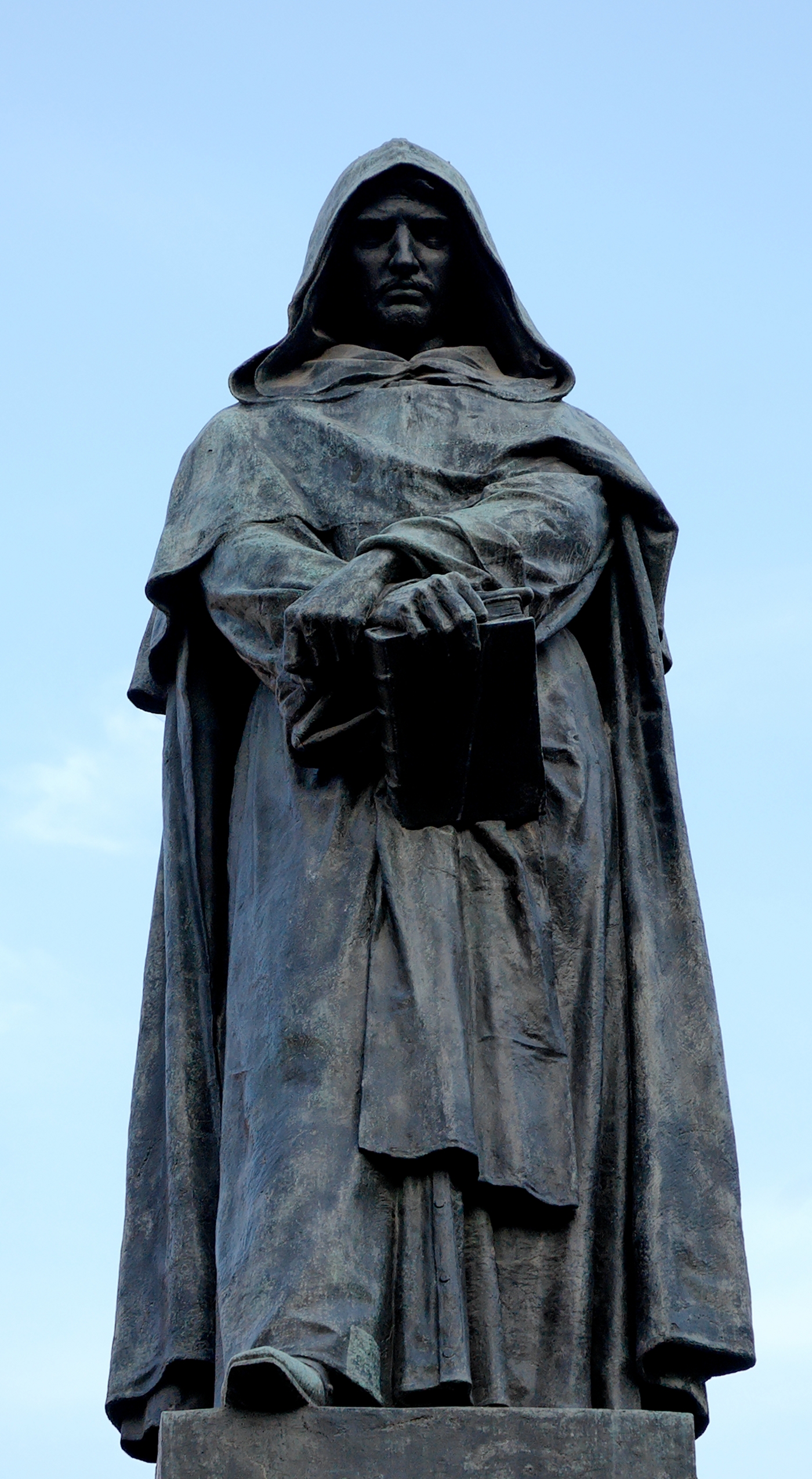
giordano_bruno_campo_dei_fioriGiordano Bruno was eventually burned at the stake in 1600. Although this is of course an appalling punishment, Bruno was not burned because of an anachronistic modern scientific worldview, but because of a number of so-called religious heresies (which he didn’t fake, by the way; apparently he was even prepared to die for them). His “Pythagorean” convictions (the way the heliocentric hypothesis was sometimes referred to at the time) included, for instance, the belief in the transmigration of souls. As is known, the Catholic Church had just gone through a period of a stricter attention to orthodoxy, because of the turmoil created by the Reformation and Counter-reformation. Therefore the Church, as all human endeavors tend to do in circumstances questioning the cornerstones of their sense of identity, could barely stand what it experienced as new attacks on its identity. It may remind some people of the difficulty certain anti-theists experience to accept criticism on their views about religion. Of course anti-theists don’t burn people at the stake, unless, of course, their hatred of religion comes from some “neo-Stalinist” worldview. In that case, theists should run for their lives.

All these matters aside, in fact, essentially the debate between Catholics (and others) who were defending the heliocentric hypothesis and Catholics (and others) who weren’t, was a debate between ancient Greek philosophers with slightly different religious convictions. For centuries, the worldview of Aristotle and Ptolemy had dominated intellectual life, as it was adopted by Christian theology. People like Copernicus, Galileo and Kepler challenged this view, at the same time challenging mainstream medieval theology. From Galileo Goes to Jail, p 83:

In the sixteenth century, Nicolaus Copernicus’s (1473–1543) view that the sun is at the center of the universe was often called the “Pythagorean hypothesis,” and Galileo Galilei (1564–1642) and Johannes Kepler (1571–1630) both traced the roots of their innovations back to Plato. These men and their contemporaries all knew what some today have forgotten, that Christian astronomers (and other students of nature) owe a great debt to their Greek forebears.

Observations like these already debunk another myth, namely that Christianity gave birth to modern science. Although the Catholic Church played a significant role (see below) in the birth and development of modern science, it was self-evidently not the sole factor. Again, from Galileo Goes to Jail, p 83:

Christian astronomers (and other students of nature) owe a great debt to their Greek forebears. This was not the only debt outstanding for Christian philosophers of nature. They had also benefited directly and indirectly from Muslim and, to a lesser degree, Jewish philosophers of nature who used Arabic to describe their investigations. It was in Muslim lands that natural philosophy received the most careful and creative attention from the seventh to the twelfth century.

Nevertheless, the discussion about heliocentrism at the dawn of the modern era was also (and perhaps mainly) a discussion within the Church, among Catholics (intellectuals engaged in matters of natural philosophy)! A more extended quote from Galileo Goes to Jail, pp 101-106:

It would of course be absurd to claim that there have been no instances of Catholic laymen or clerics opposing scientific work in some form or other. Without question, such examples can be found, and quite easily. Yet it would be equally absurd to extend these examples of opposition – no matter how ignorant or illconceived – to the Catholic church or to Catholics as a whole. This act would be to commit the historical sin of overgeneralization, that is, the unwarrantable extension of the actions or thought of one member of a collective body to the entire body as a whole. (For example, there are apparently American flatearthers alive today, yet it is not correct then to say that twentyfirst-century Americans in general believe that the earth is flat.)

The Catholic church is not, and has never been (perhaps to the chagrin of some pontiffs), a monolithic or unanimous entity; it is composed of individuals and groups who often hold widely divergent viewpoints. This diversity of opinion was in full evidence even in the celebrated case of Galileo, where clerics and laymen are to be found distributed across the whole spectrum of responses from support to condemnation. The question, then, is what the preponderant attitude was, and in this case it is clear from the historical record that the Catholic church has been probably the largest single and longest-term patron of science in history, that many contributors to the Scientific Revolution were themselves Catholic, and that several Catholic institutions and perspectives were key influences upon the rise of modern science.

In contrast to our starting myth, it is an easy matter to point to important figures of the Scientific Revolution who were themselves Catholics. The man often credited with the first major step of the Scientific Revolution, Nicolaus Copernicus (1473–1543), was not only Catholic but in Holy Orders as a cathedral canon (a cleric charged with administrative duties). And lest it be said that he was simultaneously persecuted for his astronomical work, it must be pointed out that much of his audience and support came from within the Catholic hierarchy, and especially the Papal Court. His book begins with a dedication to Pope Paul III that contains an account of the various church officials who supported his work and urged its completion and publication. Galileo, too, despite his celebrated and much mythologized face-off with church officials, was and remained Catholic, and there is no reason to question the sincerity of his faith.

A catalog of Catholic contributors to the Scientific Revolution would run to many pages and exhaust the reader’s patience. Thus it will suffice to mention just a very few other representatives from various scientific disciplines. In the medical sciences, there is Andreas Vesalius (1514–1564), the famous anatomist of Brussels; while another Fleming, Joan Baptista Van Helmont (1579–1644), one of the most innovative and influential voices in seventeenth-century medicine and chemistry, was a devout Catholic with strong mystical leanings. In Italy, the microscopist Marcello Malpighi (1628–1694) first observed capillaries, thus proving the circulation of the blood. Niels Stensen (or Nicolaus Steno, 1638–1686), who remains known today for his foundational work on fossils and the geological formation of rock strata, converted to Catholicism during his scientific work and became first a priest, then a bishop, and is currently a beatus (a title preliminary to official sainthood). [Another famous convert to Christianity from the same period is the brilliant French mathematician and physicist Blaise Pascal]. The revival and adaptation of ancient atomic ideas was due in no small part to the work of the Catholic priest Pierre Gassendi (1592–1655). The Minim friar Marin Mersenne (1588–1648), besides his own competence in mathematics, orchestrated a network of correspondence to disseminate scientific and mathematical discoveries, perhaps most notably the ideas of René Descartes (1596–1650), another Catholic.

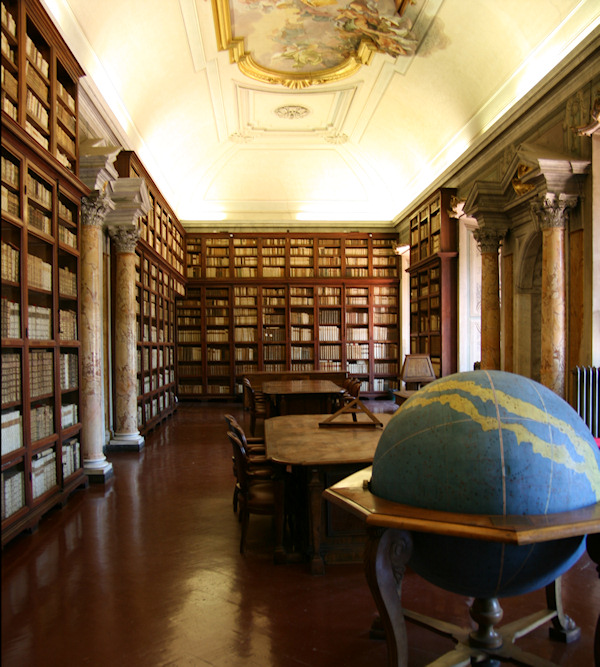
accademia-dei-lincei-sala-letturaBesides individuals there are also institutions to be mentioned. The first scientific societies were organized in Italy and were financed and populated by Catholics. The earliest of these, the Accademia dei Lincei, was founded in Rome in 1603. Many other societies followed across Italy, including the Accademia del Cimento, founded in Florence in 1657, that brought together many experimentalists and former students of Galileo. Later, the Royal Academy of Sciences in Paris, founded in 1666 and probably the most stable and productive of all early scientific societies, had a majority of Catholic members, such as Gian Domenico Cassini (1625–1712), famed for his observations of Jupiter and Saturn, and Wilhelm Homberg (1653–1715), a convert to Catholicism and one of the most renowned and productive chemists of his day. Four of the early members were in orders, including the abbe Jean Picard (1620–1682), a noted astronomer, and the abbe Edme Mariotte (ca. 1620–1684), an important physicist. Even the Royal Society of London, founded in very Protestant England in 1660, had a few Catholic members, such as Sir Kenelm Digby (1603–1665), and kept up a vigorous correspondence with Catholic natural philosophers in Italy, France, and elsewhere.

Catholic religious orders provided a variety of opportunities for natural-philosophical work. One of Galileo’s closest early students and supporters, and his successor to the chair of mathematics at the University of Pisa, was the Benedictine monk Benedetto Castelli (1578–1643). But on a broader scale, during the Scientific Revolution, Catholic monks, friars, and priests in missions constituted a virtual worldwide web of correspondents and data collectors. Information on local geography, flora, fauna, mineralogy, and other subjects as well as a wealth of astronomical, meteorological, and seismological observations flooded back into Europe from far-flung Catholic missions in the Americas, Africa, and Asia. The data and specimens they sent back were channeled into natural-philosophical treatises and studies by Catholics and Protestants alike. This massive collection of new scientific information was carried out by Franciscans, Dominicans, Benedictines, and, perhaps most of all, Jesuits.

No account of Catholic involvement with science could be complete without mention of the Jesuits (officially called the Society of Jesus). Formally established in 1540, the society placed such special emphasis on education that by 1625 they had founded nearly 450 colleges in Europe and elsewhere. Many Jesuit priests were deeply involved in scientific issues, and many made important contributions. The reformed calendar, enacted under Pope Gregory XIII in 1582 and still in use today, was worked out by the Jesuit mathematician and astronomer Christoph Clavius (1538–1612). Optics and astronomy were topics of special interest for Jesuits. Christoph Scheiner (1573–1650) studied sunspots, Orazio Grassi (1583–1654) comets, and Giambattista Riccioli (1598–1671) provided a star catalog, a detailed lunar map that provided the names still used today for many of its features, and experimentally confirmed Galileo’s laws of falling bodies by measuring their exact rates of acceleration during descent. Jesuit investigators of optics and light include Francesco Maria Grimaldi (1618–1663), who, among other things (such as collaborating with Riccioli on the lunar map), discovered the phenomenon of the diffraction of light and named it. Magnetism as well was studied by several Jesuits, and it was Niccolo Cabeo (1586–1650) who devised the technique of visualizing the magnetic field lines by sprinkling iron filings on a sheet of paper laid on top of a magnet. By 1700, Jesuits held a majority of the chairs of mathematics in European universities.

Undergirding such scientific activities in the early-modern period was the firm conviction that the study of nature is itself an inherently religious activity. The secrets of nature are the secrets of God. By coming to know the natural world we should, if we observe and understand rightly, come to a better understanding of their Creator. This attitude was by no means unique to Catholics, but many of the priests and other religious involved in teaching and studying natural philosophy underscored this connection. For example, the Jesuit polymath Athanasius Kircher (1602–1680) envisioned the study of magnetism not only as teaching about an invisible physical force of nature but also as providing a powerful emblem of the divine love of God that holds all creation together and draws the faithful inexorably to Him. Indeed, if Jesuit work remains today inadequately represented in accounts of scientific discovery, it is in part because science proceeded down a path of literalism and dissection rather than following the Jesuits’ path of comprehensive and emblematic holism.

Finally, historians of science now recognize that the impressive developments of the period called the Scientific Revolution depended in large part on positive contributions and foundations dating from the High Middle Ages, that is to say, before the origins of Protestantism. This fact too must be brought to bear on the role of Catholics and their church in the Scientific Revolution. Medieval observations and theories of optics, kinematics, astronomy, matter, and other fields provided essential information and starting points for developments of the sixteenth and seventeenth centuries. The medieval establishment of universities, the development of a culture of disputation, and the logical rigor of Scholastic theology all helped to provide a climate and culture necessary for the Scientific Revolution.

Neither interest and activity in science nor criticism and suppression of its tenets align with the confessional boundary between Catholics and Protestants. Modern science is not a product of Protestantism and certainly not of atheism or agnosticism. Catholics and Protestants alike made essential and fundamental contributions to the developments of the period we have called the Scientific Revolution.
Indeed, as the above quoted text mentions, within the Catholic Church the order of the Jesuits holds a special place regarding the origins and further development of modern science. As the astronomer George Coyne points out, himself a Jesuit priest, Galileo’s observations caused tensions within the Jesuit order at the time, and eventually Jesuits at the Roman College confirmed the earth-shaking ideas of their fellow Catholic. It is truly worth reading Coyne’s paper on the relationship between Galileo and his Jesuit colleagues, The Jesuits and Galileo: Fidelity to Tradition and the Adventure of Discovery (pdf).

Some people, especially so-called anti-theistic new atheists, claim that all those great Catholic or other Christian scientists and mathematicians from the past believed in God simply because they were raised that way, or because they feared prosecution. Maybe some anti-theists have special powers, able to read the minds of people who died a long time back. In any case, what those scientists wrote about their own faith suggests otherwise. Some got in conflict with religious authorities, claiming that those authorities betrayed the Christian faith. Alright, maybe they all participated in a conspiracy to raise the impression that they had a strong spiritual mind, thinking profoundly, honestly and individually about the Christian tradition. However, so long as we don’t have any proof of such a conspiracy, and as long as we don’t have any proof of anti-theistic paranormal powers, we should perhaps abandon the paternalistic claim that those great, innovative minds were not able to think about their faith in a mature way. Once again, from Galileo Goes to Jail, p 81:

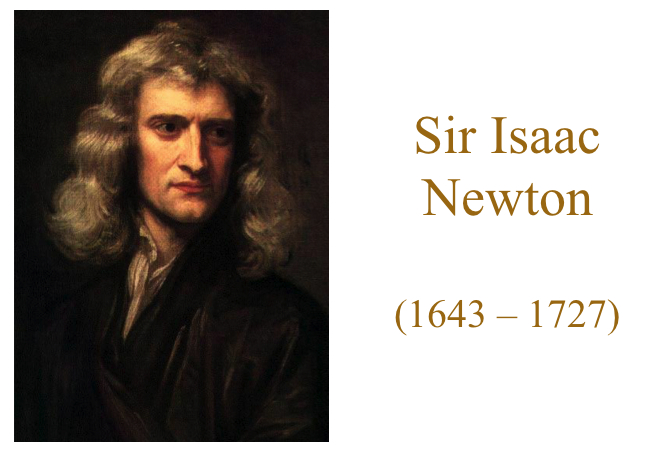
sir-isaac-newtonRené Descartes (1596–1650) boasted of his physics that “my new philosophy is in much better agreement with all the truths of faith than that of Aristotle.” Isaac Newton (1642–1727) believed that his system restored the original divine wisdom God had provided to Moses and had no doubt that his Christianity bolstered his physics – and that his physics bolstered his Christianity.
Or take Galileo, Ibid., p 96:

Another theme common to early-modern discussions about the possibility of human knowledge of the creation was that expressed by the metaphor of God’s two books: the book of God’s word (the Bible) and the book of God’s work (the created world). Natural philosophers regarded both books as legitimate sources of knowledge. Early in the seventeenth century, Galileo Galilei (1564–1642) appealed to this metaphor in the context of a discussion of the relative importance of studying the Bible and observing natural phenomena: “the holy Bible and the phenomena of nature proceed alike from the divine Word, the former as the dictate of the Holy Ghost and the latter as the observant executrix of God’s commands.”

As for the further relationship between what became modern science and the Christian Bible, it should be clear how it eventually developed. Georges Lemaître‘s ideas may serve as an example. This Belgian Catholic priest and famous physicist (founder of the “Big Bang” hypothesis among others) clearly distinguishes the questions of modern science from the questions the New Testament authors deal with. In fact, according to Lemaître, questions of modern science have nothing to do with theology, and vice versa. The Christian scientist thus cannot let his faith be of any importance for his scientific work. Some quotes from Lemaître, taken from an article by Joseph R. Laracy (click to read) clarify his position regarding the relationship between theology and modern science:

Georges Lemaître and Albert EinsteinShould a priest reject relativity because it contains no authoritative exposition on the doctrine of the Trinity? Once you realize that the Bible does not purport to be a textbook of science, the old controversy between religion and science vanishes… The doctrine of the Trinity is much more abstruse than anything in relativity or quantum mechanics; but, being necessary for salvation, the doctrine is stated in the Bible. If the theory of relativity had also been necessary for salvation, it would have been revealed to Saint Paul or to Moses… As a matter of fact neither Saint Paul nor Moses had the slightest idea of relativity.

The Christian researcher has to master and apply with sagacity the technique appropriate to his problem. His investigative means are the same as those of his non-believer colleague… In a sense, the researcher makes an abstraction of his faith in his researches. He does this not because his faith could involve him in difficulties, but because it has directly nothing in common with his scientific activity. After all, a Christian does not act differently from any non-believer as far as walking, or running, or swimming is concerned.

The writers of the Bible were illuminated more or less – some more than others – on the question of salvation. On other questions they were as wise or ignorant as their generation. Hence it is utterly unimportant that errors in historic and scientific fact should be found in the Bible, especially if the errors related to events that were not directly observed by those who wrote about them… The idea that because they were right in their doctrine of immortality and salvation they must also be right on all other subjects, is simply the fallacy of people who have an incomplete understanding of why the Bible was given to us at all.

The question about the meaning of “salvation” in the light of the New Testament indeed is different from, for instance, the question how and why objects fall down. That’s how plain and simple an insight can be in order to stop battling windmills like some heroic but mad and narcissistic Don Quixote.

For more on Lemaître, click the following (pdf): The Faith and Reason of Father Georges Lemaître & Priestly Contributions to Modern Science.

The already mentioned astronomer and Jesuit George Coyne also points to the false conflict between modern science and the Bible, for instance in the “mockumentary” Religulous (click here for more):

The Christian Scriptures were written between about 2,000 years before Christ to about 200 years after Christ. That’s it. Modern science came to be with Galileo up through Newton, up through Einstein. What we know as modern science, okay, is in that period. How in the world could there be any science in Scripture? There cannot be. Just the two historical periods are separated by so much. The Scriptures are not teaching science. It’s very hard for me to accept, not just a literal interpretation of scripture, but a fundamentalist approach to religious belief. It’s kind of a plague. It presents itself as science and it’s not.

Not insignificant note: the Roman Catholic Church accepts all kinds of interpretive approaches to the Bible, but it decisively rejects one approach, namely a fundamentalist reading of the Bible (click here for more).

Maybe Coyne says it more beautifully in this TED-talk (click to watch):

Hopefully, together with both Lemaître and Coyne, and with countless other researchers from different ideological backgrounds, it’s a bit more clear now that the story this post started with is indeed a biased myth, even plain propaganda. In the words of Prof. Ronald L. Numbers, from the introduction to Galileo Goes to Jail, pp 1-6:

The greatest myth in the history of science and religion holds that they have been in a state of constant conflict. No one bears more responsibility for promoting this notion than two nineteenth-century American polemicists: Andrew Dickson White (1832–1918) and John William Draper (1811–1882).

[…]

history-of-the-conflict-between-religion-and-scienceHistorians of science have known for years that White’s and Draper’s accounts are more propaganda than history. Yet the message has rarely escaped the ivory tower. The secular public, if it thinks about such issues at all, knows that organized religion has always opposed scientific progress (witness the attacks on Galileo, Darwin, and Scopes). The religious public knows that science has taken the leading role in corroding faith (through naturalism and antibiblicism). As a first step toward correcting these misperceptions we must dispel the hoary myths that continue to pass as historical truths. No scientist, to our knowledge, ever lost his life because of his scientific views, though, the Italian Inquisition did incinerate the sixteenth-century Copernican Giordano Bruno for his heretical theological notions.

Unlike the master mythmakers White and Draper, the contributors to this volume have no obvious scientific or theological axes to grind.

Perhaps the reason why some atheists stubbornly still swallow and believe the propaganda that began with people like White and Draper, is that they need an outside “enemy” to build their identity. If religion in general, and the Catholic Church in particular, can be depicted as a bulwark of stupidity and evil, some atheists can more easily see themselves as belonging to the intelligent and moral part of humanity. Of course, as we know from the Gospels and other spiritual resources: to see the stupidity and immorality of someone else does not automatically make oneself intelligent and moral. Apparently, creating an “us vs them” to get a sense of superiority is a universally human temptation. The French-American anthropologist and literary critic, René Girard (1923-2015), had a profound insight in this matter and its implications.

The way certain atheists build part of their identity by their emotionally driven aversion to religion, also explains why they consider religion as one of the main sources of violence in the world. A claim that can be highly debated, especially from an atheist point of view! Before being religious or secular (communist or nationalistic or whatever), violence is always human violence. Religious ideas originated in humans, they did not come from divine revelation (at least from an atheist perspective). Thus – this can be reasonably expected, as is also clear from a human history of violence – human characteristics that gave birth to certain religious ideas legitimating violence will continue to generate ideas to legitimate violence, whether of a religious or secular nature. The disappearance of one religious or secular ideology legitimating violence does not take away the universally human characteristics that gave birth to the violence in the first place.

These considerations on the origin of violence might lead to a better assessment of the basic sources of any type of violence. For instance while interpreting recent 10 year average data of annually killed Americans. According to these data, 9 Americans are killed annually by Islamic jihadist terrorists (including jihadists who are US citizens), while 11,737 (almost twelve thousand!) Americans are killed annually by other Americans. Is it really far-fetched to think that those 9 jihadist terrorists would have found other outlets for their psychologically developed frustrations, anger and aggressive tendencies anyway? In the case a violent Islamist ideology was not available? The focus on so-called religious violence (9 killed) gets in the way of attacking the real problem, namely human violence (11,737 + 9).

number-of-americans-killed-annually

For instance, the man who killed 84 people in Nice, France, by driving a lorry through a crowd (click here for more), 31 year old Tunisian delivery man Mohamed Lahouaiej-Bouhlel, clearly had identity and social issues. It should be stressed that this “Nice killer” not only searched the web for “jihadist” terror attacks, but that he also looked at shootings like the one in Dallas, where a black army veteran shot five police officers. He was apparently interested in violent acts that would put him in the spotlight and give him a sense of significance, no matter under what flag. The Nice killer thus showed signs of the “copycat effect” (a mimetic phenomenon, indeed): sensational media exposure about violent suicides and murders results in more of the same through imitation. Moreover, this terrorist showed no interest in religion until only a few weeks before his violent act. In short, violent Islamist ideology seemed to be one of the coincidental guises he could use to perform his act. If it were not available, it is very likely that he would have used something else.

Of course it is easy to prove that something is bad or evil. If I would list all the rapes and other acts of sexual violence that happen daily around the world, I could maybe make the claim that “sex is evil”. But that would, luckily, not be the whole story.

In short, if you still believe the story of the Catholic Church as the age-old sworn enemy of science, your historical views belong, metaphorically speaking, to the Middle Ages.

Some content on this page was disabled on August 9, 2019 as a result of a DMCA takedown notice from Harvard University Press. You can learn more about the DMCA here:

https://wordpress.com/support/copyright-and-the-dmca/

COV&R 2016The annual and 26th conference of the Colloquium on Violence & Religion (COV&R) coincided with the 6th annual conference of the Australian Girard Seminar. It was the first meeting of its kind after the passing of René Girard (December 25, 1923 – November 4, 2015), whose groundbreaking interdisciplinary work and eventually developed mimetic theory is further explored by an ever growing number of scholars on these occasions. Certainly and sadly in this day and age, the theme of the conference couldn’t have been more appropriate: Violence in the Name of Religion. The academic yet also cordial gathering was held at the campus of ACU (Australian Catholic University) from Wednesday 13 July until Sunday 17 July 2016 in Melbourne, Australia.

As is always the case, also at this COV&R the participants gave each other lots of inspiration. In the coming months I will probably share some explorations I felt invited to on this blog. For now I’d like to highlight some of the ideas I thought were quite inspiring (at least to me).

WEDNESDAY, 13 JULY

The Myth of Religious ViolenceProf. William T. Cavanaugh started off the event by giving the Raymund Schwager Memorial Lecture. AS PEOPLE USED TO BELIEVE IN THE GODS – Girard and the Myth of Religious Violence was the provocative title of his contribution, which essentially stated that violence is not a religious problem but a universally human reality (as Dr. Petra Steinmair-Pösel succinctly pointed out in her response to the lecture).

Cavanaugh summarized the myth many people believe in nowadays as follows:

  1. There is a trans-historical and transcultural essence of religion that distinguishes it from essentially secular phenomena like reason, or politics and economics: religions like Christianity, Islam, and Buddhism [Cavanaugh was aware that some people might not call Buddhism a religion] are essentially different from secular phenomena like nationalism, consumerism, and Marxism.
  2. Religion has more of a tendency to promote violence than secular phenomena.
  3. Therefore, religion should be marginalized from public power and secularism should be encouraged.

He then went on to debunk this myth by pointing out how the religious/secular dichotomy originated as a typically western phenomenon. In the words of Cavanaugh:

The religious/secular distinction is not trans-historical and transcultural: it is a contingent product of the modern West. What counts as religious and what counts as secular in any given circumstance depends on the political purposes of the one making the distinction. The distinction is commonly used to endorse as rational and peacemaking certain beliefs and practices, labeled secular, and to condemn others, labeled religious, as essentially irrational and prone to violence. The distinction does not simply describe the way the world is, but rather tells us about how the West distributes power.

The creation of the sovereign state meant that the ambit of ecclesiastical authorities would gradually be confined to religion – the realm of belief – while the civil authorities would take charge of the political. The religious/secular and religion/politics distinctions helped eventually to create the expectation that the natural place of the church was the private sphere.

Some more explanation might be in place here for some readers. Following René Girard, the possibility itself of a dichotomy between the religious and the secular can be considered as a consequence of the Judeo-Christian unveiling of the lie at the heart of archaic religious systems, namely the scapegoat mechanism. As such the Judeo-Christian tradition is, in principle, responsible for the gradual loss of belief in the effectiveness of ancient ritual sacrifices (even if these were sometimes revived in so-called Christian societies; criticism of these practices comes from the Gospel itself, for instance by Erasmus, “Prince of the Humanists”). Ritual sacrifices contained violence in a twofold sense (see also Prof. Jean-Pierre Dupuy): they were themselves of course a form of bloody violence, but they were also believed to control the possibility of greater violent (natural and/or social) disasters understood as “the wrath of the gods” (= violence transferred to a sacred or transcendent realm).

While secularism no longer endorses the belief that potentially violent gods should be appeased by bloody sacrifices to establish an eventually peaceful world order, it does try to locate potential sources of violence or disorder that should be eliminated (“sacrificed” in a sense). It is no accident that Dr. Steinmair-Pösel, in her response to the lecture, spoke of secularism “as a mutilated version of Judeo-Christian tradition” in that it “scapegoats the scapegoaters”. In this sense it goes against the heart of Christianity as a call for forgiveness (from the part of the victim) and conversion (to neighborly love that is, from the part of the perpetrator). The imitation of the “kenotic movement of Christ” should result in attitudes refraining from revenge. Nevertheless, in today’s globalized human community, people often rival each other’s claim to be “victims” and as such feel entitled to sometimes violently prosecute others who are considered “perpetrators”. While we’re Wolfgang Palaver COV&R 2016at it, Prof. Wolfgang Palaver would later on, in his own lecture, rightly point to the fact that many of today’s terrorists legitimize themselves as victims or defenders of victims (from groups like ISIS to Aum Shinrikyo and people like Anders Breivik). Secularism thus is, in certain circumstances, but one of several contemporary ideological systems that can legitimize marginalization and even (violent) discrimination of certain groups in the name of victims. Mosques have been set to fire after ISIS attacks, for instance. As a means of victimizing others in turn, however, secularism tragically adds to the problem of violent extremism: it makes it more easy for organizations like ISIS to claim that “their people” are indeed “victims” or that they are being “marginalized”. And so the vicious circle goes on and on. In short, by labeling religion in general and its believers as “often dangerously irrational”, “potentially violent” and therefore “better if gone, eliminated or destroyed”, secularism ironically becomes a religious system itself. A religious system is understood then as a social order arising out of so-called necessary sacrifices to prevent potentially violent mayhem. All of this, again, in the words of Prof. Cavanaugh:

The point is not only that people are just as likely to kill for secular things like Marxism and capitalism [remember the Gulag or the Cold War] as they are for religious things like Islam and Hinduism. The point is that the religious/secular distinction is itself an act of power that labels certain things “religious” and therefore essentially irrational and potentially dangerous, while authorizing as “secular” other belief systems and practices whose violence is accepted as rational and peacemaking.

[Cavanaugh eventually quotes Girard on religion and religion in the secular, and provides further explanation (I took the picture on the right from the core of the ANZAC War Memorial in Sydney):]

IMAG2676_1_1Girard: “Any phenomenon associated with the acts of remembering, commemorating, and perpetuating a unanimity that springs from the murder of a surrogate victim can be termed ‘religious’.”

Religion, in this sense, is not a sui generis phenomenon that can be separated out from culture, reason, politics, economics, or society.

Girard uses religion in a narrow sense to refer to the archaic (mis)representation of sacrificial violence, and in a broader sense to refer to the ways that all societies – even modern secular ones – employ the same mechanisms to legitimate and control violence. In good Durkheimian fashion, Girard uses the term “religion” to name the way that any society – including any “secular” society – represents itself to itself. As Girard writes “There is no society without religion because without religion society cannot exist.”

[From Girard’s anthropological perspective on secularism and anti-religion, the religious/secular dichotomy indeed becomes part of one of today’s most important myths (the discourse that establishes a distinction between illegitimate and legitimate violence). Cavanaugh continues and concludes:]

The religious/secular dichotomy is itself part of the apparatus whereby violence is concealed. Girard’s goal is to reveal it, and thereby undermine the religious/secular dichotomy.

As Girard says, the Christian “Revelation deprives people of religion, and it is this deprivation that can increasingly be seen around us, in the naïve illusion that we are finished with it… Today’s anti-religion combines so much error and nonsense about religion that it can barely be satirized. It serves the cause that it would undermine, and secretly defends the mistakes that it believes it is correcting.”

During the remainder of my time in Australia, about a week after the conference, I discovered that the myth of secularism is alive and well on Speakers’ Corner in Hyde Park, Sydney:

IMAG2574 IMAG2575 IMAG2577

Secularism “as a mutilated version of Judeo-Christian tradition” (see higher, Dr. Steinmair-Pösel) thus contains a warning for Christians themselves (and for all who try to develop a spiritual attitude that goes beyond the convenient and comfortable dualism of “good versus evil”, be it for instance “good secularism versus evil religion”): Jesus never attempted to completely abolish the existing cultural (religious) traditions and social systems, he merely tried to transform his own Jewish religion, whenever and wherever needed, in light of neighborly love. In their covert and overt attempts to completely remove religion from the public sphere, certain secularists attain the exact opposite of what they’re trying to accomplish: they continue an essentially sacrificial (“religious”) system. As Dr. Steinmair-Pösel concluded in her response to the first plenary session, the difference between so-called archaic religion and Judeo-Christian tradition (or religion and “secularism” for that matter) therefore can never result in a complete “separation” with one destroying the other, but should be thought of as a distinction. In other words and as I understand it, the ultimate human possibility of a humanitarian ethos, materializing in whatever cultural form, ceases to exist whenever one culture establishes itself at the expense of another (for sure, the colonial history of certain so-called Christians implied the disappearance of humanitarianism).

Evening Drink with COV&R friends Melbourne 2016Well, one thing became clear on the first evening of the conference. The organizers not only provided the participants with a great reception and dinner, they indeed also promised copious food for thought.
THURSDAY, 14 JULY

The high expectations for the rest of the conference were already met on the second day. Religion and Violence in Girard’s Mimetic Theory, the second plenary session, saw Prof. Jean-Pierre Dupuy, Dr. Sarah Bachelard and Dr. Chris Fleming engage in a discussion with Girard’s thought to approach modern politics and contemporary social phenomena.

Jean-Pierre Dupuy COV&R 2016From the lectures of Prof. Dupuy and Dr. Bachelard I became more aware of the difference between the terror of today’s violent extremism on the one hand, and the terror of “the fear of MAD (Mutually Assured Destruction)” by a nuclear war during the Cold War on the other. During the Cold War, the threat of total annihilation served as a third party, a non-human entity (an exteriorization of violence) to which both the US and the USSR bowed. A “cold war” thus resulted in a “hot peace” (a nuclear peace). Today’s suicidal terrorists, however, don’t fear annihilation in any way. So the threat of annihilation as a means to establish an ever precarious peace doesn’t work. This means that we are challenged to look for other attempts to create peace which don’t alienate us from “the best of ourselves”.
Prof. Dupuy also made an intriguing remark on the relationship between “victim” and “crowd”. While the old sacred is based on the gathering of an undifferentiated crowd around a sacrificial victim (or a series of victims), today’s violent extremism basically consists of one or more murderous suicidal subjects who attack and disperse an undifferentiated crowd. Dupuy therefore considers modern terrorism as a sham or simulacrum of the foundational event (of the old sacred). The UNANIMITY of the crowd is swapped for the ANONIMITY of the crowd. Instead of containing violence, the self-sacrifice of the suicide terrorist implies not contained violence. In one of the concurrent sessions I attended, The Sham Incarnation of the Antichrist: Some Girardian Dimensions, Prof. Thomas Ryba pointed to the difference between the dynamic of Christ and its “satanic” reversal, which joins the thought of Dupuy from a Christian perspective. Jesus is one who is willing to die for all (because he refuses the sacrifice of others to save himself), while a suicide terrorist wants all to die for one (for the purpose of his self-aggrandizement).

Dr. Fleming concluded the second plenary session by pointing to an interesting (mimetically opposing) parallel between the political left and right when it comes to interpreting violent extremism. Depending on the external features of the violent extremists in question, both the political left and right easily replace structural theories with theories of agency in explaining human behavior. For instance, the right tends to explain the violence of a Muslim shooter from the ideological structure that is Islam, while the left in this case generally claims that the problem lies in the individual and not in Islam. The reverse will happen in the case of a white (Christian) shooter, for instance. In other words, from a certain political left, Islam structurally remains something pure and worthy of protection by scapegoating an individual agent, i.e. the Muslim shooter. On the other hand, from a certain political right, Christianity structurally remains something pure and worthy of protection by, once again, scapegoating an individual agent, this time a Christian shooter. Contenders on both sides would try to generalize the disposition of one agent to a collective disposition of THE Muslim or THE Christian, or even THE believer (if certain atheists were to be believed). If you belong to a certain group and you want to protect the image of purity of that group, you might attribute the terrorist behavior of one of your own to specific circumstances explaining the erratic behavior of that individual. So there are different levels of attribution (see attribution theory in social psychology, click here) in all these cases.

In any case, it seems that violent extremists try to escape the limits of human existence by committing “non-negotiable” acts which make them feel like gods. In the words of Fleming, “gods don’t need politics.” Which made me suddenly think about the saying, “All’s fair in love and war…” A reflection that is to be continued, for sure.

The third plenary session, on the evening of the second day, was a lecture by Prof. Asma Afsaruddin, Islam and Violence: Debunking Myths. She gave a challenging assessment of the relationship between Islam and violence, stressing the point that poor religious education and a very limited understanding of Islam facilitate the connection between Islam and violence. Once again, removing a religion like Islam from serious public and academic debate and leaving it to the hands of self-declared imams on the worldwide web seems like a very bad idea. I can only highly recommend the work of Prof. Afsaruddin to clear some important misconceptions.

FRIDAY, 15 JULY

The first plenary session on Friday morning started with some turmoil. Prof. Wolfgang Palaver, Prof. Greg Barton and Dr. Julian Droogan eventually talked about Religious Extremism, Terrorism and Islam. Their session, sadly enough, was all the more topical since news of a terrorist attack in Nice, France, on Bastille Day had just arrived. Prof. Greg Barton came in a bit late because he was asked, being a counter-terrorist expert, about his first thoughts on the attack for Australian TV.

Dr. Droogan began his lecture by describing the main conceptual problems with “radicalization” as an explanatory tool for violent extremism. Again, also in this lecture, some common assumptions were challenged:

  • The assumption that violent extremism is caused by radical beliefs is not born out by research that suggests that violent extremism is more often supported by social dynamics and perceptions of identity.
  • By assuming that it is radical ideas that primarily lead people to violent extremism, an easy assumption is made linking religious or political concepts as the primary drivers of violence.
  • De-radicalization? It is a difficult and sensitive task to convince an individual to make changes to cognitive beliefs especially when these are tied to a person’s identity / reinforced through social networks.

So de-radicalization programs which merely focus on “ideas” won’t work, since violent extremism has more to do with building an identity than with ideology as such.

No wonder then that violent extremists like ISIS find their most ardent supporters in youth groups, traditionally groups in the midst of developing their identity. As Droogan pointed out, a 2014 ICM poll revealed that more than 25 % of French youth (of all religions and backgrounds between the ages of 18 and 24) had a favorable attitude towards ISIS.

The man who killed 84 people in Nice by driving a lorry through a crowd, 31 year old Tunisian delivery man Mohamed Lahouaiej-Bouhlel, clearly had identity and social issues as well. Dr. Droogan presented the profile of an ISIS fighter in the western diaspora, containing characteristics that would prove to be true for this terrorist too (inserted information about the Nice killer comes from BBC News, in italics):

Young – grew up in the post 9/11 world of counter terrorism and “clash of civilizations” rhetoric.

75 % joined Al Qaeda or ISIS through friends – social networks.

Almost 25 % joined through family or acquaintances.

Speak of the importance of finding meaning in their lives – a search for meaning and identity.

Very rare that parents were at all aware of their children’s desire; international affairs, foreign policy or terrorism not discussed at home.

Lahouaiej-Bouhlel last visited Tunisia four years ago, people in his hometown Msaken told the BBC’s Rana Jawad. They said many people knew his family and were shocked by his actions. “We remember him as a normal person from a wealthy family,” a town resident told her.

Mostly youth in transitional stages of their lives:

Students

Immigrants

Between jobs

Between relationships

Police say Lahouaiej-Bouhlel was married with three children, although he no longer lived with his wife. She was detained for questioning by police on 15 July but has since been released. A woman who knows the family told the BBC Lahouaiej-Bouhlel had been thrown out of their home in the Le Ray area of Nice more than a year ago after allegedly beating his wife.

Left or about to leave their family

Looking for new family or friends or community of like-minded passionate idealists

Mostly youth who are deeply concerned with finding meaning, value and significance in their lives, and have a commitment to action

Examinations of Lahouaiej-Bouhlel’s browsing history showed he had carried out research for his attack. On 1 July he searched for details of the Bastille Day celebrations in Nice as well as videos showing “terrible” fatal traffic accidents. He had also read about recent attacks in Orlando, where a man proclaiming allegiance to IS shot 49 people in a gay nightclub, Dallas, where a black army veteran shot five police officers, and Magnanville near Paris, where a French jihadist stabbed two police officials to death. In the days before the attack, he twice drove to the Promenade des Anglais in his rented lorry, sold his van and attempted to withdraw money, Mr Molins said. This showed that his act was “premeditated and deliberate”, he said. He reserved the 19-tonne refrigeration lorry on 4 July and collected it on 11 July in Saint-Laurent-du-Var, just west of Nice. During his reconnaissance trips, he sent a selfie photo from the driver’s cabin. Just minutes before launching his attack, he sent text messages asking accomplices to give him more weapons and boasting about having obtained a pistol. He fired that pistol at police during his rampage, before police shot him dead. “Bring more weapons, bring five to C,” one of the messages said. Police are trying to identify who the message was sent to.

No traditional religious education

The Nice killer lived a life “far from religion”, eating pork, taking drugs and indulging in a “wild” sex life, French prosecutor François Molins said.

Some “born again” or “conversion” experience

French Interior Minister Bernard Cazeneuve said the Nice killer had apparently been radicalized very quickly. From 1 July, Lahouaiej-Bouhlel made more or less daily internet searches for verses of the Koran and “nasheeds” – jihadist propaganda chants. He also researched the Islamic holiday of Eid al-Fitr. Investigators found photos of dead bodies and images linked to radical Islamism on his computer, including the flag of so-called Islamic State, the cover of an issue of French satirical magazine Charlie Hebdo – attacked by gunmen in January 2015 – and photos of Osama bin Laden and Algerian jihadist Mokhtar Belmokhtar. In the eight days leading up to the attack, he grew a beard and told friends this was for “religious reasons”. He also told them he did not understand why IS could not hold territory and showed them a video of a beheading on his mobile phone. In response to their shock, he said he was “used to it”. However, there was no evidence that he had pledged allegiance to any radical groups or had contact with known Islamists.

Those who do practice religious ritual may have been expelled from the mosque for expressing radical political beliefs

Religious Extremism, Terrorism and Islam COV&R 2016As is also clear from the research conducted by Prof. Barton, many of the recent terrorists have a history of violence and petty crime.

Lahouaiej-Bouhlel had been in trouble with police between 2010 and 2016 for threatening behaviour, violence and petty theft. In March, a court in Nice convicted him of assaulting a motorist with an improvised weapon – a wooden pallet – during an altercation. He was given a six-month suspended prison sentence and ordered to contact police once a week, which he did. Lahouaiej-Bouhlel was “never flagged for signs of radicalization”, officials say, and he was not on France’s “Fiche S” high-security watch list. The majority of attacks carried out in the country since January 2015 have been staged by men designated “Fiche S”, and also linked to IS. In 2014, IS spokesman Mohammed al-Adnani told supporters in an audio message: “If you can’t detonate a bomb or fire a shot, manage by yourself… run them over with your car.” Many of France’s jihadist killers, starting with Mohammed Merah in Toulouse in 2012, also began their journey towards militant Islam as petty criminals.

Dr. Droogan concluded that groups like ISIS capitalize on youth rebelliousness and the search for significance and glory. It should be stressed that the Nice killer, for instance, not only searched the web for “jihadist” terror attacks, but also looked at shootings like the one in Dallas, where a black army veteran shot five police officers. He was apparently interested in violent acts that would put him in the spotlight and give him a sense of significance, no matter under what flag. The Nice killer thus showed signs of the “copycat effect” (a mimetic phenomenon, indeed): sensational media exposure about violent suicides and murders results in more of the same through imitation. Moreover, the Nice killer apparently had mental issues as well. Add this to the equation and you might get a very explosive, dangerous mindset.

A psychiatrist, Chamseddine Hamouda, carried out a mental assessment of the killer a few years ago after his father became concerned about his “troubling behaviour of a psychotic nature”. “He was a stranger to himself,” Mr Hamouda said. “I advised his parents that he needed treatment. At the time he exhibited violent behaviour towards his family… I’m sure that in the past 12 years something else happened that perhaps influenced how he thought.”

In short, ISIS is one of possible organizations, and a popular one at that, which provide an outlet for people who became extremely violent. These violent tendencies mainly have other causes than some twisted ideology. The allegiance with a twisted ideology should be understood more as a consequence of the obsession to achieve significance, attention or recognition through a highly publicized act of violence.

ProfSolidarity with France & Nice (because of terror attack) in Melbourne. Wolfgang Palaver’s contribution for this plenary session was all the more challenging as it highlighted the inspiration Islamic tradition itself could provide to create a more peaceful world. Prof. Palaver situated Islam within the Abrahamic tradition’s potential to criticize “sacred” phenomena born from bloody sacrifices. In the words of René Girard, “The peoples of the world do not invent their gods, they deify their victims.” This could be said of the way ISIS glorifies its suicide terrorists as well. In this context Palaver distinguished between the sacred and the holy, the first basically being the false transcendence of idolatry (as in ISIS claimed suicide attacks), while the latter points to the mysterious transcendence of a “God” who is other than the human projections of power. Seems like a grace needed in this ever broken world…

SATURDAY, 16 JULY

The final plenary session again was packed with impulses for further explorations. Prof. Frank Brennan SJ, Assoc. Prof. Kathleen Butler, Archbishop Philip Freier & Ms Naomi Wolfe formed the panel for Religion and Violence in Australian-Indigenous History.

One realization in particular struck me. When white people first came to Australia, they asked themselves whether aboriginals were actually “real human beings”, and tried to think of aboriginals as somewhat being in an animal stage instead. Similarly, however, aboriginals too asked themselves whether white people were actually “real human beings”, thinking of white people as ghosts instead.

I guess there is no greater challenge in human relationships than to think of the other as “other” without, however, situating that “otherness” in “something less” or “something more” than oneself. Idolatry of one’s self-image as “better than others” or of others as “better than myself” only leads to alienation, narcissistic illusions, hypodermic frustrations, self-loathing, hatred of others and eventually violence.

We are limited human beings, and as such we’re always called to the never-ending exploration and acceptance of the mystery we are to ourselves and to each other. Us is a life sizzling with creativity.

This COV&R has only been the third I went to (the first two I attended were in the US – Cedar Falls, 2013 & Saint Louis, 2015), but I must say that I always feel charged with energy when coming back. For this I’m very grateful. I’d like to end this report by explicitly thanking the organizers of all COV&R conferences, on this occasion the organizers of the 2016 COV&R.

So thank you:

COV&R 2016 Gala DinnerACU (Australian Catholic University)

Centre for Public and Contextual Theology (Charles Sturt University)

IMITATIO

THE RAVEN FOUNDATION (Suzanne & Keith Ross)

THE AUSTRALIAN GIRARD SEMINAR (especially Prof. Scott Cowdell, Dr. Chris Fleming, Dr. Joel Hodge, Dr. Carly Osborn, Wojtek Kaftanski)

The Theory of René Girard by Carly Osborn

I’d also like to congratulate Yevgen Galona, Lukasz Mudrak and Elizabeth Culhane for winning the Raymund Schwager Memorial Essay Prize (place one to three, respectively).

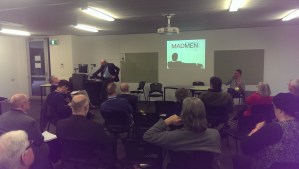
Concurrent Session on Madmen COV&R 2016I’d like to thank the lecturers of the concurrent sessions I went to (they were all delightful): Jonathan Cole (The Jihadist Current and the West: The Clash of Conceptuality), Susan Wright (Rekindling a Sacrificial Crisis in the Eucharist: John’s Midrashic Reversal of the ‘Manna’ Metaphors), Chloé Collier (American Presidents and Apocalyptic Discourse: Justifying Violent Foreign Policies in Times of Crisis), Suzanne Ross (Acquisitive Desire in Early Childhood: Rethinking Rivalry in the Playroom), Mathias Moosbrugger (Ignatius of Loyola and Mimetic Theory: Is it a Thing?), Wojtek Kaftanski (Mimesis as the Problem and the Cure: Kierkegaard and Girard on Human Autonomy and Authenticity), Scott Cowdell (A Five-Act Girardian Theo-Drama), David Gore (The Call to Follow Jesus), Thomas Ryba (The Sham Incarnation of the Antichrist: Some Girardian Dimensions), Jeremiah Alberg (Forbidding What We Desire; Desiring What We Are Forbidden – Krzysztof Kieslowski’s The Decalogue *), Diego Bubbio (The Self in Crisis: A Mimetic Theory of Mad Men), Paul Dumouchel (About Joshua Oppenheimer’s The Act of Killing).Dekalog Kieslowski

* In his presentation on Kieslowski’s The Decalogue, Prof. Jeremiah Alberg mentioned that the co-scenarist for these groundbreaking movies, Krzysztof Piesiewicz, declared that his ideas are based on the books of René Girard. Something to look at more thoroughly in the future. For more on this, click here: Krzysztof Kieslowski – Jeux interdits – Essai sur le Décalogue de Kieslowski (extrait), Yves Vaillancourt (pdf).

Finally, I’d like to thank every single participant for making this a warm, loving gathering as well, with an ever present spirit of kindness and friendship. I’m already looking forward to the COV&R of 2017, in Madrid.

Lunch Field Trip COV&R 2016COV&R 2016 participantsLunch & Wine Tasting Field Trip COV&R 2016

Who or what is to blame for the massacre at Pulse, a gay night club in Orlando, Florida (June 12, 2016)? Muslims? Religious people in general? Islam? Religion in general? Or just the twisted mindset of a troubled individual?

Omar Mateen, a 29 year old American Muslim of Afghan descent leaves 49 people dead and 53 injured after opening fire at Pulse, the gay night club he allegedly visited himself on a regular basis. He was eventually shot by the police. Being a regular visitor of the club, as well as his use of gay dating sites, suggest Mateen was gay himself. His ex-wife also made the claim that he was gay. So maybe it was ressentiment that drove him (for similar examples, click here)?

Whatever the case, there is no doubt that religion often advocates intolerance and hatred against LGBT people. Religious leaders past and present have discriminated against LGBT people. For instance, two days after the 9/11 terrorist attacks, Christian evangelicals Jerry Falwell and Pat Robertson blamed gays and lesbians, among other people, for the attacks (which they interpreted as “the wrath of God”). Jerry Falwell stated (for more on this, click here):

Muslim Lesbian Gay HappyI really believe that the pagans, and the abortionists, and the feminists, and the gays and the lesbians who are actively trying to make that an alternative lifestyle, the ACLU, People For the American Way – all of them who have tried to secularize America – I point the finger in their face and say “you helped this happen.”

In other words, some religious people hold LGBT people themselves responsible for the oppression and violence they have to endure, allegedly “because they don’t respect God and His laws”. Seen from the perspective of René Girard’s mimetic theory, this is a form of scapegoating: instead of taking responsibility for their own intolerant and sometimes violent attitude, the perpetrators of hate crimes blame the victims and even God for their own terrorist behavior.

The aversion to LGBT people and their sexuality by certain religious people is sometimes mirrored by an aversion to religion by certain “anti-theists”. In the words of Girard, this makes the latter doubles of their theist counterparts. Because religion is seen as one of the main causes of evil, hatred and violence in the world, certain people would rather eradicate religion, blaming religious people for fostering one of the main breeding grounds for evil, and thus start scapegoating themselves. Bill Maher, for example, in the mockumentary Religulous:

LGBT MuslimsThis is why rational people, anti-religionists, must end their timidity and come out of the closet and assert themselves. And those who consider themselves only moderately religious really need to look in the mirror and realize that the solace and comfort that religion brings you actually comes at a terrible price. […] If you belonged to a political party or a social club that was tied to as much bigotry, misogyny, homophobia, violence and sheer ignorance as religion is, you’d resign in protest. To do otherwise is to be an enabler, a Mafia wife, with the true devils of extremism that draw their legitimacy from the billions of their fellow travelers. If the world does come to an end here or wherever, or if it limps into the future, decimated by the effects of a religion-inspired nuclear terrorism, let’s remember what the real problem was: That we learned how to precipitate mass death before we got past the neurological disorder of wishing for it. That’s it. Grow up or die.

Well, seen from Bill Maher’s perspective, you’re in big trouble if you are gay and Muslim. You shouldn’t be surprised that you experience violence because being a Muslim, being religious is, in the words of Bill Maher, being “an enabler of homophobia and violence”. Once again the (potential) victim, in this case the gay Muslim, is held responsible, this time by so-called anti-religionists, for the violence the victim might have to endure.

In short, some people scapegoat people for being gay, others scapegoat people for being religious. Being gay and muslim means running the risk of being twice the scapegoat.

I am Gay and Muslim

From a spiritual perspective we are challenged to criticize ourselves by listening to the Voice of our (potential) Victim, by listening to the voice of the scapegoat, in order to become “the change we want to see”. Maybe “true Islam” is not a religion of bigotry, misogyny, homophobia and violence. Maybe “true Islam” is the religion of a “radical minority” that testifies to the Love of “the Merciful One”.

In the words of a gay Muslim man from the documentary I am Gay and Muslim:

No one has the right to tell me whether I’m a good Muslim or not.


To put things in perspective, an overview of mass shootings in the US of the last decades shows that most of the murderers didn’t need religion to get them to kill people. Some even hated religion. All they needed was easy access to guns and all too human characteristics played out in the wrong circumstances:

July 18, 1984: unemployed security guard James Oliver Huberty kills 21 people at a McDonald’s in San Ysidro, California. He is killed himself by a police sniper.

October 16, 1991: George Jo Hennard crashes his pickup into a Luby’s cafetaria and begins firing, killing 22 people before taking his own life.

April 20, 1999: Columbine High School students Eric Harris and Dylan Klebold kill 13 people before taking their own lives.

April 16, 2007: student Seung-hui Cho kills 32 people on Virginia Tech campus and eventually commits suicide.

April 3, 2009: Jiverly Voong kills 13 people when attacking Binghampton immigration center in New York state.

November 5, 2009: Major Nidal Malik Hasan, an Army psychiatrist, attacks Fort Hood in Texas and kills 13 people.

July 20, 2012: James Holmes kills 12 people in what became known as the Colorado cinema shooting, during the screening of the new Batman movie.

December 14, 2012: Adam Lanza kills 27 people, including himself, during an attack on Newtown school in Connecticut.

September 16, 2013: Aaron Alexis, a Navy contractor, kills 12 people at Washington Navy Yard.

June 18, 2015: Dylann Roof kills 9 people at Charleston prayer meeting.

December 2, 2015: Syed Farook and his wife Tashfeen Malik kill 14 people at a community centre in San Bernardino. They die in police shootout.

June 12, 2016: Omar Mateen kills 49 people and injures another 53 at a gay nightclub in Orlando, Florida.

no to homophobia islamophobia

I can’t help but quote the following article by Philip Ball in its entirety. It summarizes an interesting paper that appeared in Nature by Joseph Watts, Ritual human sacrifice promoted and sustained the evolution of stratified societies Nature 532, 228–231 (14 April 2016). For those of us who are familiar with the work of René Girard and mimetic theory, it offers some great factual perspectives. I’ve highlighted sentences that are especially remarkable from a Girardian point of view in purple.

Find more information on how to interpret the following article and similar research from a Girardian perspective by clicking here.

How human sacrifice propped up the social order


James Frazer’s classic anthropological study The Golden Bough1 contains a harrowing chapter on human sacrifice in rituals of crop fertility and harvest among historical cultures around the world. Frazer describes sacrificial victims being crushed under huge toppling stones, slow-roasted over fires and dismembered alive.

Frazer’s methods of analysis wouldn’t all pass muster among anthropologists today (his work was first published in 1890), but it is hard not to conclude from his descriptions that what industrialized societies today would regard as the most extreme psychopathy has in the past been seen as normal — and indeed sacred — behaviour.

In almost all societies, killing within a tribe or clan has been strongly taboo; exemption is granted only to those with great authority. Anthropologists have suspected that ritual human sacrifice serves to cement power structures — that is, it signifies who sits at the top of the social hierarchy.

Florilegius/SSPL/Getty Images

An Aztec priest removes a man’s heart in a sacrificial ritual and offers it to the god Huitzilopochtli (from handcoloured engraving by Giulio Ferrario’s Ancient and Modern Costumes of all the Peoples of the World, Florence, Italy, 1843).

Sacrifice for social order

The idea makes intuitive sense, but until now there has been no clear evidence to support it. In a study published in Nature2, Joseph Watts, a specialist in cultural evolution at the University of Auckland in New Zealand, and his colleagues have analysed 93 traditional cultures in Austronesia (the region that loosely embraces the many small and island states in the Pacific and Indonesia) as they were before they were influenced by colonization and major world religions (generally in the late 19th and early 20th centuries).

By delving into ethnographic records, the researchers tried to tease out the relationship between human sacrifice and social hierarchy. They find that the prevalence of sacrifice increased with the degree of social stratification: it occurred in 25% of cultures with little or no stratification, 37% of those with moderately stratified societies, and 67% of those that had a pronounced hierarchy.

And by mapping the evolutionary relationships between cultures, the team suggests that human sacrifice and social hierarchy co-evolved. Although societies can become more or less stratified over time, societies that practised sacrifice were less apt to revert to milder degrees of stratification.

In other words, human sacrifice seems to bolster stratification: it helped to stabilize hierarchy, and conceivably, therefore, had a common role in the development of highly stratified societies that generally persist even today.

Religious undertones

Human sacrifice seems to have been largely the privilege of priests or others who claimed religious authority. Watts and colleagues say that their results therefore disclose a “dark side” to the social role of religion. (They have previously shown that belief in supernatural punishing agencies in Austronesian cultures encouraged moral observance, and thereby promoted the emergence of stratified and complex social structures3).

There’s a danger of overgeneralization from any study of this kind. Human sacrifice is no more likely than, for instance, music to have had a single role in early societies. In the third century bc, for example, Chinese administrator Li Bing eliminated the sacrifice of young maidens to a river god during the conquest of Sichuan by the First Emperor. Some have suggested that he called the bluff of a local racket in which families rid themselves of unwanted daughters while getting rich on the compensation they received. Whether or not that is true, it’s easy to imagine how rituals could be abused for prosaic gain.

And even in Austronesia, add Watts’s team, sacrifice wasn’t always conducted for purely religious reasons. It could have other motivations, including to punish taboo violations, demoralize underclasses, mark class boundaries and instil fear of social elites, all of which aim at building and maintaining social control. For this reason, says Michael Winkelman, an anthropologist now retired from Arizona State University in Tempe, “I suspect that Watts et al. are assessing some general notion of social legitimated killing.”

Such considerations complicate any interpretation of Watts’s results, but it also gives them considerably more contemporary resonance.

Death-penalty parallels

By today’s standards, human sacrifice scarcely seems to fall within the norms of good morality. But one doesn’t need to be a moral relativist to accept that the connections between human sacrifice, obedience to authority and stable governance persist. To perceive a link between ancient, “savage” human sacrifices and the death penalty in some modern societies isn’t to exaggerate or indulge in melodrama, as Winkelman’s remarks testify.

Certainly the suggestion could seem glib, and the parallels cannot be taken too far. Unlike today’s death penalties, traditional ritual sacrifice was generally for religious purposes and it tended to exhibit no bloodlust or contempt for the victims. Often they were seen as godlike, and before their sacrifice, they might be treated with reverence and affection, and perhaps fed well like the biblical fatted calf. The remains of the dead body — it’s not even clear whether the word “victim” is appropriate — were imbued with power. If the flesh was chopped up, it was to share out this potent relic among the tribe.

Yet a contemporary state’s arrogation of the right to slaughter through the death penalty — breaking an otherwise rigid prohibition — still serves as, among other things, a demonstration of authority and a ritual of appeasement, whether towards supposed religious strictures or public opinion.

To future anthropologists, whatever explanations or justifications states offer today for imposing capital punishment may seem less revealing than the broader view of how such sanctified killing reinforces the social order. We can expect time’s retrospective gaze to lay bare the real reasons why we, no less than the ancient Aztecs or Samoans, valorize murder.

References

  1. Frazer, J. G. The Golden Bough (Macmillan, 1890).
  2. Watts, J., Sheehan, O., Atkinson, Q. D., Bulbulia, J. & Gray, R. D. Nature http://dx.doi.org/10.1038/nature17159 (2016).
  3. Watts, J. et al. Proc. R. Soc. B 282, 20142556 (2015).

One of the oldest written religious texts, the Rig-Veda (the oldest of the four Vedas of Hindu religion), contains a creation myth that tells about the sacrifice of the giant Purusha. This sacrifice serves as the basis for the Indian caste system. Once again, in light of mimetic theory and the above mentioned scientific research, the existence of such stories comes as no surprise.

From the Rig-Veda

Thousand-headed Purusha, thousand-eyed, thousand-footed he, having pervaded the earth on all sides, still extends ten fingers beyond it.

Purusha alone is all this—whatever has been and whatever is going to be. Further, he is the lord of immortality and also of what grows on account of food.

Such is his greatness; greater, indeed, than this is Purusha. All creatures constitute but one quarter of him, his three-quarters are the immortal in the heaven.

With his three-quarters did Purusha rise up; one quarter of him again remains here. With it did he variously spread out on all sides over what eats and what eats not.

From him was Viraj born, from Viraj evolved Purusha. He, being born, projected himself behind the earth as also before it.

When the gods performed the sacrifice with Purusha as the oblation, then the spring was its clarified butter, the summer the sacrificial fuel, and the autumn the oblation.

The sacrificial victim, namely, Purusha, born at the very beginning, they sprinkled with sacred water upon the sacrificial grass. With him as oblation the gods performed the sacrifice, and also the Sadhyas [a class of semidivine beings] and the rishis [ancient seers].

From that wholly offered sacrificial oblation were born the verses and the sacred chants; from it were born the meters; the sacrificial formula was born from it.

From it horses were born and also those animals who have double rows [i.e., upper and lower] of teeth; cows were born from it, from it were born goats and sheep.

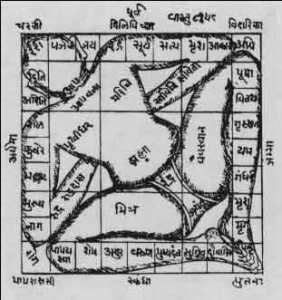
Purusha MandalaWhen they divided Purusha, in how many different portions did they arrange him? What became of his mouth, what of his two arms? What were his two thighs and his two feet called?

His mouth became the brahman; his two arms were made into the rajanya; his two thighs the vaishyas; from his two feet the shudra was born.

The moon was born from the mind, from the eye the sun was born; from the mouth Indra and Agni, from the breath the wind was born.

From the navel was the atmosphere created, from the head the heaven issued forth; from the two feet was born the earth and the quarters [the cardinal directions] from the ear. Thus did they fashion the worlds.

Seven were the enclosing sticks in this sacrifice, thrice seven were the fire-sticks made, when the gods, performing the sacrifice, bound down Purusha, the sacrificial victim.

With this sacrificial oblation did the gods offer the sacrifice. These were the first norms [dharma] of sacrifice. These greatnesses reached to the sky wherein live the ancient Sadhyas and gods.

Source: The Rig-Veda, 10.90, in Sources of Indian Tradition by Theodore de Bary (New York: Columbia University Press, 1958), pp. 16-17.

Find more information and an alternative, younger version of this myth by clicking here.


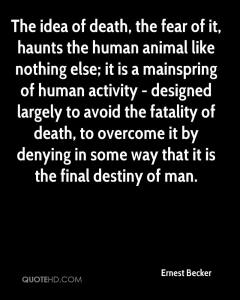
Ernest BeckerIn 1973, cultural anthropologist Ernest Becker (1924-1974) published his seminal book The Denial of Death. Because of this publication, a year later and two months after his death, Becker was granted the Pulitzer Prize for general non-fiction.

The Denial of Death elaborates the following thesis:

The basic motivation for human behavior is our biological need to control our basic anxiety, to deny the terror of death.

One of the most important functions of culture therefore is to provide symbolic defense mechanisms against the knowledge of mortality. Culture, and religion in particular, can be understood as an attempt to deny death. In this context Becker writes about immortality projects. These projects allow us to create a symbolic, so-called meaningful and heroic self-concept that we feel outlasts our physical self and time on earth.

Combined with the insights of yet another “out of the box” thinking literary critic and anthropologist, René Girard (1923-2015), we might conclude that the creation of our heroic self-concepts is possible because of our mimetic (i.e. imitative) nature.

The way we think about ourselves and the way we develop a sense of identity is always mediated by our social environment. And that which makes something like a social environment possible precisely is our – indeed mimetic – ability to put ourselves in each other’s shoes. Neuroscientists have discovered that so-called mirror neurons in our brains play a very important role in this regard. These brain cells allow us to imitate others. They allow us to pretend that we’re someone else and to take another person’s point of view. And this allows us to imagine what others are experiencing, thinking, expecting or even desiring. In short, our mimetic ability is the conditio sine qua non to empathize and bond with others, and to develop a sense of self.

Of course our imaginative projections about others can be wrong. That’s why we, rather unwittingly, constantly look for the confirmation of mutually established social expectations. The question “Am I doing this right?” seems to be the ever present subtext to our behavior. It really structures the interaction between ourselves and others. To quote sociologist Niklas Luhmann (1927-1998), we expect that others have certain expectations and act accordingly. That’s how a social order is established in a particular culture.

Each (sub-)cultural environment establishes its own identity concepts, based on particular mimetic interactions. Those identity concepts are models that we use to create a meaningful image for ourselves. As stated earlier, according to Becker, a meaningful culturally defined self-image can be understood as an attempt to escape the realization that we are mortal beings. In other words,

our attempt to create an image that is loved by others whose respect we (mimetically) learned to desire = an attempt to deny death.

Although they might provide us with a good and secure feeling, there’s a downside to our immortality projects. We might become so obsessed with our symbolic, so-called meaningful self-image that we might be prepared to literally sacrifice ourselves to it. As anxious persons, we show the tendency to act according to the supposed expectations of “meaningful” others in order to gain their approval. As we become more obsessed with our social status, we might accomplish exactly what we were trying to move away from, death! Think of workaholics who destroy their own health, or think of ISIL suicide bombers, who sacrifice themselves in order to gain a supposedly “sacred” identity. Jesus of Nazareth formulates this tragic, failed and paradoxical attempt at “the denial of death” in our cultural and/or religious projects very succinctly in the Gospels (Matthew 16:25a-26a):

For whoever would save his life will lose it. For what will it profit a man if he gains the whole world and forfeits his soul?

And not only that, we might also be prepared to sacrifice those others we deem a threat to our self-image. Jesus himself becomes a victim of people (among them are his own disciples!) who try to protect their “socially acceptable” self-image.

In short, if we make it our goal “to be loved” by so-called meaningful others, we tend to become auto- and hetero-aggressive.

ernest-becker-quote-the-idea-of-deathThe question is whether we can be saved from our sacrificial tendencies. Since we are relational beings [or since our being is essentially relational], we can only be saved from these tendencies if we receive an identity from a being that is not at all interested in “being loved” (a being that comes from outside the human game of mutually established social expectations). This can only be a being that is not mortal, since it is mortality that leads human beings to the desire “to be loved”. If we experience the love of such a being, we can distance ourselves more and more from the desire to adjust ourselves to a self-image that seeks the approval of others. Moreover, since we diminish our auto-aggressive tendencies we will also diminish our hetero-aggressive tendencies. We will no longer defend a so-called socially acceptable self-image at the expense of others. Paradoxically, the acknowledgment of ourselves and our mortality might allow us to surrender to that Love that is “not defined by death”. Our newly found ability “to love” will enable others to love themselves as well, and save them as well from their auto-aggressive tendencies, thus enabling them to love others, etcetera. Until the whole world is “saved” by this Love.

Christians are convinced that the “Spirit of Love” springs from the relationship between Jesus of Nazareth and his so-called “Father”. They believe that God can be experienced as a Love – at least at the human level – that is not defined by death. One of the images they use to speak of this Love indeed is the image of the Trinity (love means “relation”, thus the image of a relation between a Father and a Son, and the Spirit that springs from that relation, is appropriate). To be loved by Jesus of Nazareth thus means to be loved by a being that allows us to more fully accept ourselves and others.

In other words,

the Love incarnated by Jesus potentially saves us from our cultural (be it secular or religious) illusional immortality projects.

Dirk DraulansDirk Draulans, biologist and science journalist for Belgian Knack magazine, wrote an interesting article on the question of violence in human life (Violence is deeply rooted in us – The biology of terror; PDF: Het geweld zit diep in ons – De biologie van terreur). He drew from several recent findings concerning the ongoing struggle with violence between and within human communities since prehistoric times. Perhaps not surprisingly, he came across questions as well as insights that are at the core of René Girard’s mimetic theory and its explanation of human culture. So I can only advice Draulans to read the work of René Girard and other scholars of mimetic theory. As I’ll try to show, it may resolve some of the ambiguities and dilemmas he touches upon in his article. I’ve translated parts of the article from Dutch, emphasizing certain sentences, before commenting from a Girardian point of view.

First of all, Draulans points to the importance of imitation or mimesis in the origin and maintenance of human culture:

Our culture is not in our genes, but is transmitted by copying and learning behavior.

Island of Wild ChildrenIn this context Draulans refers to a thought experiment conducted by scientists who specialize in the emergence of culture. More specifically, he refers to an article in New Scientist, Island of wild children: Would they learn to be human? (Christopher Kemp, June 3, 2015) that contains the experiment:

100 babies. No adults. One island. Without language, culture or tools, what would they become and how would their own children evolve?

Or, as Draulans puts it:

This led to the key question whether we humans are born violent.

Here’s how Draulans continues:

Protective ButtressingQuite a few scientists who participated in the thought experiment assumed that there soon would be tensions within the group, especially when food is scarce. Indeed, biologically speaking, violence is deeply rooted in us. Chimpanzees, who are models for the ape-men who were our ancestors, are ‘naturally’ violent. The world of chimpanzees is organized around the members of their own group, and neighboring groups are by definition enemies to be fought. Last year, Biological Reviews published an analysis of the skulls of australopithecines, chimpanzee-like ancestors of man who lived several million years ago. The results show that their hands were so evolved that they could easily make fists, not only for handling equipment but also to commit violence. Some skulls, especially of men, were hardened to better absorb punches. Yet in the course of our evolution we gradually became more gentle. We had to, if we wanted to survive in a world with ever more people, many of them we didn’t know. […] An average person would find groups of 150 people or more difficult to handle, for he wouldn’t know everyone personally.

[…]

7000 Year Old Mass Grave GermanyAlthough culture and morality became very powerful in the course of our history, they could never prevent the resurgence of extreme violence. The Proceedings of the National Academy of Sciences published a study of a 7,000 year old mass grave in Germany. It showed that dozens of people, including children, were brutally maimed and killed. It is not the only mass grave from that period. The question is whether the violence was provoked by famine, by the need for survival. It could just as well have been an expression of the expansion of one group at the expense of another, without any further information about the groups in question.

A Talent for FriendshipScientists are struggling with the difficult balance between our propensity to violence on the one hand and our ability to cooperate on the other. This is shown by two books published last year. In A Talent for Friendship an American ethnographer develops the idea that so-called primitive tribes are not as violent as we were led to believe for a long time. On the contrary, they would have had systems to learn to accept strangers as friends […]. They would even have had ‘ritual battlefields’ to turn hostility into friendship. In another book, Virtuous Violence (CLICK HERE FOR A PRESENTATION IN SLIDES), both an American anthropologist and psychologist defend the surprising statement that violence often is not the result of a diminished moral sense, but rather the reverse: people sometimes use violence because they believe that it’s the best thing to do. They often feel ‘morally obliged’ to be violent.Virtuous Violence

[…]

‘Normal’ people can be victims of thinking in terms of one’s own group just as much as terrorists. It is a modern variant of the biological tribal feeling. If we can position ourselves as a group against another group, feelings of empathy easily erode as we cannot possibly sympathize with large numbers of strangers. People more easily commit violence in groups than on their own, partly because they then can evade personal responsibility. Research into activity of certain areas in the brain clearly revealed this. Thus our brains not always contribute to the accomplishment of a more livable world. That is not their concern. It should be possible with our culture, though. But unfortunately it is not always as powerful as it should be.

Pimu Alpha Male Chimpanzee killed by fellow chimps Mahala Park Tanzania 2011In a video compilation I made (on the origin of cultures) as an introduction to mimetic theory (click here), anthropologist David Watts filmed an event that normally doesn’t happen within groups of chimpanzees. True, chimpanzees often collectively inflict extreme violence on individual members of an outside community, but they would not do this to a member of their own community. And yet, that’s what Watts witnessed. It happened in the largest group that was ever observed in the wild, with over a 150 chimpanzees. Indeed, as Draulans writes, groups of 150 people or more become difficult to handle, and people no longer know each member of the group well. It is no surprise that chimpanzees experience similar problems in such a large group: tensions rise, and feelings of empathy are not as strong for every member. Interestingly, Yuval Noah Harari also stresses the critical threshold of 150 members in his bestseller Sapiens – A Brief History of Humankind (Part One, Chapter 2 The Tree of Knowledge – The Legend of Peugeot):
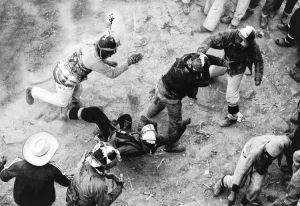
“In the wake of the Cognitive Revolution, gossip helped Homo sapiens to form larger and more stable bands. But even gossip has its limits. Sociological research has shown that the maximum ‘natural’ size of a group bonded by gossip is about 150 individuals. Most people can neither intimately know, nor gossip effectively about, more than 150 human beings.

Even today, a critical threshold in human organisations falls somewhere around this magic number.”

What Draulans only partly emphasizes in his article is the fact that violent tensions within and between groups of primates may also occur when ‘survival’ (of the individual or of the group as a ‘species’) is not exactly the issue. In groups of chimpanzees, males constantly vie for dominance and form frequently changing alliances in order to move up the hierarchy. This has to do with an increased mimetic ability. In many circumstances a group benefits from mimetic (i.e. imitative) ability as survival and other skills are more easily passed on from one member of the group to others, but in the context of mutually imitated desires the mimetic ability often leads to violent conflict. Even if there’s enough food and water for everybody, mimetic desire might cause violence as individuals do not want to share the objects of their desire (for an example of two babies fighting over two identical cans of coke that could easily be shared, click here). Collective violence of chimpanzees against individual members of an outside community thus also has a social function: it reunites normally competing males of the same group against a common enemy. This behavior forms the basis for the scapegoat mechanism in (primitive) human communities as it is described by René Girard.

It should come as no surprise that the rare event of collective violence against a member of one’s own group precisely occurred in an exceptional group of chimpanzees with over 150 members. Indeed: the bigger the group, the bigger the tensions, and the more individual members may fall outside ‘circles of empathy’, thus running the chance of becoming the victim of a ‘reuniting collective violence’. According to Girard, events of collective violence, releasing tensions within one’s own group, would have happened more in primitive human communities (as those became larger and as humans have even more mimetic ability and thus potentially destructive mimetic desires than other primates). This, again according to Girard, eventually resulted in rituals belonging to the first signs of human culture: ritual sacrifices (for more on Girard’s account on the origin of religion and ‘the sacred’, click here). These rituals try to distinguish so-called ‘good’, ‘justified’ or ‘regenerating’ violence from ‘bad’ or ‘destructive’ violence. For instance, in the AndesTinku of Bolivia descendants of the Inca stage a festival called Tinku to receive a good harvest from ‘the mountain spirits’ (this is also shown in the video compilation, on the origin of cultures – click here for more). Almost every year someone dies during this ritual battle, that nevertheless still often ends in an embrace of the fighters. Indeed, this ritual sacrifice of human blood wants to turn potential destructive enmity over scarcity of food into the maintenance of peace because of a good harvest. Honoring the spirits in maintaining certain taboos and sacrifices prevents their wrath (perceived as some sort of supernatural punishment by the contagious disease of destructive violence). A recent study in Science (click here pdf) claims that beliefs like these were necessary to make societies socially and politically more complex: indeed, the establishment of periodic ritual sacrifices would release tensions in a more controlled, structured way.

As said, all these observations from mimetic theory may resolve some of the dilemmas in the article of Dirk Draulans as well as nuance some of his statements. Summarized:

1) Humans are not ‘naturally violent’. We don’t automatically feel nor need to suppress the urge to attack others. What is the case is that we are ‘naturally mimetic’ and that mimetic tendencies in the context of desire might lead to violent conflict (read also pdf The Two Sides of Mimesis by Vittorio Gallese). As Draulans observes, commenting on the study of a prehistoric mass grave:

The question is whether the violence was provoked by famine, by the need for survival. It could just as well have been an expression of the expansion of one group at the expense of another…

Even if there’s enough food and water for everybody, mimetic desire might cause violence as individuals do not want to share the objects of their desire (again for the aforementioned example of two babies fighting over two identical cans of coke that could easily be shared, click here). Humans sometimes even suppress instinctual needs and desires because of mimetically enhanced ambitions. Germany, for instance, entered the first world war as one of the most powerful nations in the world. It had no shortage of consumer products, let alone of basic food supplies and water. It mainly wanted to express its supremacy. Of course, tragically, Germany came out of the war as a broken nation (for more, click here). On an individual level, things like anorexia would not be possible if humans were mainly guided by their ‘natural needs’. Moreover, a recent study once again reveals what happens when mimetic desire is not kept in check by certain beliefs (“I have to accept my social position because of karma”) or taboos (“I cannot question the authority of my king because god will punish me if I do so”). The article of this study, in Nature (October 15, 2015), Conspicuous wealth undermines cooperation, concludes:

Visibility of WealthWealth inequality and wealth visibility can both potentially affect levels of cooperation in a society and overall levels of economic success. Akihiro Nishi et al. use an online game to test how the two factors interact. Surprisingly, wealth inequality by itself did not damage cooperation or overall wealth as long as players do not know about the wealth of others. But when players’ wealth was visible to others, inequality had a detrimental effect.

2) Human culture (and morality – Draulans seems to use this term as a synonym) arises both as an attempt to suppress violence and as an attempt to justify so-called ‘necessary’ violence. Draulans refers to the ambiguity of ‘ritual battlefields’, which is in itself a way out of the dilemma of ‘cooperation vs violence’. Following René Girard and mimetic theory, basic cultural religious institutions such as ritual (sacrifices) allow for a fundamental distinction between so-called ‘good’ and ‘bad’ violence and provide individual members of human communities with the collective means to justify the violence they inflict on others. This justification is part of what Girard calls the scapegoat mechanism. As it provides ‘distinctions’, ‘definitions’ and ‘(psychological and social) identity’ against the threat of undifferentiated, ‘contagious’ violence, the scapegoat mechanism also forms the basis of human culture according to Girard. It might shed more light on this quote by Draulans:

‘Normal’ people can be victims of thinking in terms of one’s own group just as much as terrorists. It is a modern variant of the biological tribal feeling. If we can position ourselves as a group against another group, feelings of empathy easily erode as we cannot possibly sympathize with large numbers of strangers. People more easily commit violence in groups than on their own, partly because they then can evade personal responsibility. Research into activity of certain areas in the brain clearly revealed this. Thus our brains not always contribute to the accomplishment of a more livable world. That is not their concern.

René Girard portraitI guess ‘reason’ alone doesn’t make us human. There are ‘matters of the heart’ too, guiding us to use our brains not to build weapons of mass destruction but to build ‘bridges of solidarity’…
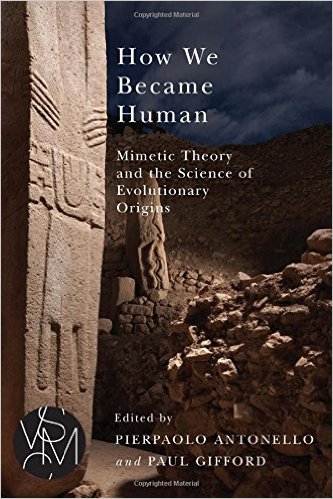
Anyway, Dirk, read René Girard!

Highly recommended:

How We Became Human – Mimetic Theory and the Science of Evolutionary Origins

How We Became Human

Paul RozinIt would be very interesting to create an intensified dialogue between Paul Rozin‘s research on the acquisition of likes and dislikes of foods and René Girard’s mimetic theory. Although some scholars already made some connections between the two (for instance in Culinary Cultures of Europe: Identity, Diversity and Dialogue, ed. by Darra Goldstein & Kathrin Merkle, Council of Europe Publication, 2005), much promising work remains to be done.

bugpartywormeatingAmong other things, biology and psychology professor Paul Rozin conducted a research with children from 16 months to five years of age. This resulted in a paper first published in Appetite (7: 141-151; June 1986), The Child’s Conception of Food: Differentiation of Categories of Rejected Substances in the 16 Months to 5 Year Age Range (click for pdf). The abstract from the article:

Children (N = 54) ranging in age from one year four months to five years were offered over 30 items to eat. The items included normal adult foods and exemplars of different adult rejection categories: disgust (e.g. grasshopper, hair), danger (liquid dish soap), inappropriate (e.g. paper, leaf) and unacceptable combinations (e.g. ketchup and cookie). We report a high to moderate level of acceptance (item put into mouth) of substances from all of these categories in the youngest children. Acceptance of disgusting and dangerous substances decreases with increasing age, while acceptance of inappropriate substances remains at moderate levels across the age range studied. Although the youngest children accepted more disgust items, the majority rejected most of the disgust choices. Almost all children at all ages tested accept combinations of foods which, although individually accepted by adults, are rejected in combination. No significant differences were observed between ‘normal’ children and those with a history of toxin ingestion, although there was a tendency of ingesters to accept more inedible items. In general, the results suggest that a major feature of the development of food selection is learning what not to eat.

disgust“A major feature of the development of food selection is learning what not to eat.” In other words, disgust is not just a biological thing, a matter of nature. It is a cultural thing too, a matter of nurture. In yet other words, a huge part of our development concerning likes and dislikes of food lies in the imitation of others. If disgust is a matter of nurture it is also a matter of mimesis. Powerful social models have the potential to increase or decrease the disgust for certain foods. For instance, the disgust for organ meat is decreasing since it is increasingly perceived as food served to the beau monde in fancy restaurants. Organ meat thus becomes an object of mimetic desire, while at the beginning of the nineteenth century, it used to be something undesirable for the rich as it was “meat for the poor”.

Further considerations by Paul Rozin on the origin of disgust as a specifically human trait include the possibility that disgust arose around things that were (considered to be) contagious. Which brings us back to René Girard, whose mimetic theory could explain why things that are not actually contaminating on a purely biological, “natural” level are indeed considered disgusting to the extent that they were once associated with “contaminating” violence (on the “cultural” level).

Well, let’s explore!

culinary-cultures-of-europe-identity-diversity-and-dialogue

Students of psychology would not be surprised by some of the key statements made by René Girard and his mimetic theory.

Indeed social psychology time and again shows how people’s social behavior and self-concepts are shaped by imitation processes and scapegoat mechanisms, as stressed by mimetic theory. For instance, Stanley Milgram’s obedience study and the Stanford Prison Experiment show how powerful individuals as well as socially established abstract norms of “role” models are easily obeyed (imitated). The attribution theory teaches how someone tends to “blame” circumstances to justify his or her own “bad” behavior, while, on the other hand, he or she tends to hold others personally responsible for their “loathsome” conduct. Apparently, others are not so easily excused and appear as convenient scapegoats. People who play the blame game consider their own behavior to be “very different” from similar behavior in others. Insights into social identities reveal how gaining an identity through conformity (again by imitating others, of course) leads to stereotyping of and competing with others (as common enemies and scapegoats of one’s group). Here also, there is a tendency to exaggerate differences between one’s own group and other groups. The conduct of one’s own group is easily justified, while similar conduct of a competing group is considered “unjust”. Achever Clausewitz (2007)The problem, of course, is that competing groups imitate this reasoning for their own particular group and thus reinforce the rivalry between each other (read René Girard’s Battling to the End in this regard, on mimetic rivalry on a planetary scale – highly recommended!).

These are all but some preliminary considerations regarding the relationship between mimetic theory and social psychology. There is much more to explore in this relationship. So without further ado, in order to know where to start, here is a short overview of some basic studies and concepts of social psychology which relate directly to mimetic theory.

1. Stanley Milgram’s Obedience Study (click for more information)

Stanley Milgram Obedience to AuthorityNot surprisingly, in light of mimetic theory, disobedience is more likely to occur:
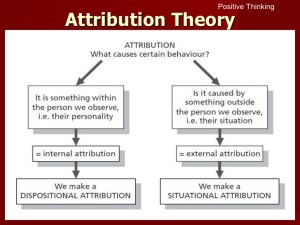
  • when the experimenter leaves the room
  • when the orders are given by an “ordinary” man
  • when the subject works with peers who refuse to go on
  • [considering the philosophy of Emmanuel Levinas]
    when the “learner” is in the same room

2. The Stanford Prison Experiment (Philip Zimbardo – click for more)

People adapt to the social norms of the role assigned to them. Prisoners become distressed, helpless and panicky. Guards become nice, or “tough but fair”, or tyrannical.

3. Social Cognition

Social cognition is an area of social psychology concerned with social influences on thought, memory, perception and all kinds of other cognitive processes. More specifically, researchers are interested in how people’s self-perception affects relationships, thoughts, beliefs and values. Here are some findings regarding attribution, factors in attitude change and conformity.

Attribution theory:

Attribution TheoryPeople are motivated to explain their own and others’ behavior by attributing its causes to situation or disposition. Again, not surprisingly in light of mimetic theory, people show the tendency to overestimate personality factors in explaining the behavior of others, while they underestimate situational influence. On the other hand, the concept of self-serving bias points to the fact that people often do the opposite when explaining their own behavior: people try to justify themselves.
Major factors in attitude change:

  • endorsement by an admired or attractive person
  • a leader who offers unconditional love, acceptance and attention
  • the creation of a new identity based on a group
  • repetition (imitation, indeed) of ideas and assertions; entrapment (justification of an escalating commitment); isolation from other sources of information

Conformity (click for more) (see also Solomon Asch, click here),

related to:

  • groupthink: in close-knit groups all members tend to think alike and suppress disagreement for the sake of harmony
  • diffusion of responsibility
  • bystander apathy
  • deindividuation (the loss of awareness of one’s own individuality in groups or crowds)
  • ethnocentrism
    (aids survival by making people feel attached to and willing to work for their own group)
  • group identity and social identity
    (a person’s self-concept based on an identification with a group, a nation or a culture, or with gender or other social roles)
  • Robbers Cave Experiment 1“us vs. them” social identities that are strengthened when groups compete (in-group vs. out-group; see Muzafer Sherif and his Robbers Cave experiment)
  • stereotypes that distort reality for they:
    exaggerate differences between groups and underestimate differences within groups; allow for disliking others so people feel closer to their own group and inflate self-worthRobbers Cave Experiment 2


Sometimes, just sometimes, quite revealing scientific insights slip into popular culture. I was watching a rerun of an episode of The Big Bang Theory sitcom on Belgian television. More specifically, I found out, I was watching The White Asparagus Triangulation (episode 9, season 2 – click to watch).

Mimetic DesireThe title itself can already be connected to a basic concept of René Girard’s mimetic theory, namely mimetic desire. As it turns out, “triangulation” indeed refers to the triangular nature of human desire (beyond instinctive needs) as described by Girard: the desire of a subject towards a certain object is positively or negatively influenced by mediators or models (click here to watch an example of negatively mediated desire from another popular sitcom, Seinfeld). Humans imitate others in orienting their desires – their desire thus is mimetic.

In the case of this episode from The Big Bang Theory: Sheldon tries to positively influence the desire of Leonard’s new girlfriend, Stephanie. After all, she is the first of Leonard’s dates to meet Sheldon’s high intellectual standards, so Sheldon does everything to increase Stephanie’s desire for Leonard. At some point he tries to persuade the girl next door, Penny, to present herself as a rival/model for Stephanie. Here’s the script for this scene.

Scene: Outside Penny’s door.

Sheldon (Knock, knock, knock) : Penny (knock, knock, knock) Penny.

Penny: What?

Sheldon (Knock, knock, knock) : Penny. Zucchini bread.

Penny: Oh, thank you.

Sheldon: May I come in?

Penny: No.

The White Asparagus Triangulation Penny and Sheldon Zucchini

Sheldon: I see. Apparently my earlier inquiry regarding you and Leonard crossed some sort of line. I apologize.

Penny: Well, thank you.

Sheldon: So, have you and I returned to a social equilibrium?

Penny: Yes.

Sheldon: Great. New topic. Where are you in your menstrual cycle?

Penny: What?

Error
This video doesn’t exist

Sheldon: I’ve been doing some research online, and apparently female primates, you know, uh, apes, chimpanzees, you, they find their mate more desirable when he’s being courted by another female. Now, this effect is intensified when the rival female is secreting the pheromones associated with ovulation. Which brings me back to my question, where are you in (Penny slams door). Clearly, I’m 14 days too early.

Female Chimpanzee Sexual Swelling KanyawaraSeveral lines of evidence indicate some female competition over mating. First, at Mahale, females sometimes directly interfered in the mating attempts of their rivals by forcing themselves between a copulating pair. In some cases, the aggressive female went on to mate with the male. At Gombe, during a day-long series of attacks by Mitumba females on a fully swollen new immigrant female, the most active attackers were also swollen and their behaviour was interpreted as ‘sexual jealousy’ by the observers. Townsend et al. found that females at Budongo suppressed copulation calls when in the presence of the dominant female, possibly to prevent direct interference in their copulations. Second, females occasionally seem to respond to the sexual swellings of others by swelling themselves. Goodall described an unusual incident in which a dominant, lactating female suddenly appeared with a full swelling a day after a young oestrous female had been followed by many males. Nishida described cases at Mahale in which a female would produce isolated swellings that were not part of her regular cycles when a second oestrous female was present in the group.
The White Asparagus Triangulation eventually gets its title from another scene in the episode. Sheldon tries to establish Leonard as “the alpha male”. Sheldon will pretend that he is unable to open a jar of asparagus. If Leonard then opens the jar he will have won the mimetic competition over the question “who is the strongest?”, resulting in an increase of his sex appeal. Of course, for the sake of comedy, things go terribly wrong :). Here’s the script for this scene.

Scene: The apartment.

Leonard: All I’m saying is if they can cure yellow fever and malaria, why can’t they do something about lactose intolerance?

Steph: Leonard, you’re going to have to let this go. You had a little cheese dip, you farted, I thought it was cute.

Sheldon: Oh, hi Stephanie.

Steph: Hi.

Leonard: Want some more wine?

Steph: Yeah, I assume I’m not driving anywhere tonight. (Sheldon lets out a loud noise).

Leonard: What are you doing?

Sheldon: I have a craving for white asparagus that apparently is destined to go unsatisfied.

Leonard: Excuse me. What the hell is wrong with you?

Sheldon: I’m helping you with Stephanie.

Leonard: By making constipated moose sounds?

The White Asparagus Triangulation Big Bang Theory

Sheldon: When I fail to open this jar and you succeed it will establish you as the alpha male. You see, when a female witnesses an exhibition of physical domination she produces the hormone oxytocin. If the two of you then engage in intercourse this will create the biochemical reaction in the brain which lay people naively interpret as falling in love.

Leonard: Huh? Would it work if I just punched you in the face?

Sheldon: Yes, actually it would, but let’s see how the lid goes. I’m not strong enough, Leonard, you’ll have to do it.

Leonard: Oh, for god’s sakes.

Sheldon: Go ahead, it’s pre-loosened.

Steph: Do you want some help with that?

Leonard: No, no, no, I got it.

Sheldon: No, yeah, yeah, he’s got it, and that’s not surprising. This is something I long ago came to peace with in my role as the beta male. Open it. (Leonard tries again. Then taps jar on counter. Jar breaks.)

Error
This video doesn’t exist

Steph: Oh my god, are you okay?

Leonard: No, I’m not. I’m bleeding.

Sheldon: Like a gladiator!

Steph: Oh, honey, you’re going to need stitches.

Leonard: Stitches? With a needle?

Steph: Well, yeah, I mean, just a few.

Leonard: Oh, okay, yeah, hang on a sec. (Throws up in sink)

Sheldon: FYI, I was defrosting a steak in there.

WATCH THE WHOLE EPISODE, CLICK HERE

[READ A PDF-VERSION OF THIS ARTICLE HERE]

Even before the terrorist shootings at Charlie Hebdo and later this year at other sites in Paris, quality labeled Belgian magazines and newspapers reported on the socially precarious situation in certain areas of Brussels, especially in Molenbeek. I’ve translated parts of an article that appeared in Knack magazine concerning the issue. Next to this article I’ve translated parts of other articles as well (from Knack magazine and De Standaard newspaper). These appeared in the aftermath of the Charlie Hebdo shootings. I will use some findings of these articles to answer a few questions on the nature of the conflict we’re dealing with when we’re talking about “homegrown terrorism”.

  • FIRST QUESTION: IS IT A “CLASH OF CIVILIZATIONS”?

FROM AN ARTICLE BY HAN RENARD:

Rachid Zegzaoui is a blogger of Moroccan descent living in Sint-Joost-ten-Node [another municipality of Brussels]. Rachid notices how many youngsters turn their back on the society they grew up in. “Second and third generation migrants no longer believe that a life of study, career and retirement is fit for them and consider their parents losers. They accuse their parents of being slaves to the West and the infidels. So it is a generational conflict as well, a revolt against their family. Parents are dead worried but no longer understand their offspring. They don’t know what their children are doing on the internet. In many Muslim families there is a complete sense of disunity. Young people reject the society in which they grew up. Religion guides their life, it is the meaning of their existence. But Islam as they understand it is not practiced here in Belgium.” […]

Call of Duty ISISZeguendi Khalil, editor in chief of Le Maroxellois, a magazine aimed at the Moroccan community, joins in. During one month and a half, Khalil listened to sermons with regard to the war in Syria in about twenty Mosques in Brussels. He concludes that imams warn their young audience against Jihad ideology and that imams sharply condemn ISIS terrorism. “However”, he says, “from our inquiry we know that members for Jihad are recruited through the internet nowadays, while this used to happen on the streets or in the near of Mosques.” Imported imams from Morocco or Turkey in Brussels don’t understand the young, Khalil explains. They don’t speak their language, nor know their culture and don’t have any clue whatsoever about Facebook or WhatsApp. “Imams fail. And so young Muslims, looking for meaning, construct their own version of Islam aided by Jihadist websites.”

We need positive role models, according to Khalil. Young Muslims who made it one way or the other should be put forward.

Young Islamologist Jessika Soors works as an official against radicalization in Vilvoorde. […] Although Jihadists justify their departure with the ideal of a holy war, many of them hardly knew anything about Islam and the Quran just before their sudden radicalization. “They’re religiously illiterate in many cases”, Soors says. […] ISIS appeals to vulnerable young people who are looking for a sense of self-worth and an all-encompassing identity.” […]

Young people who are bored here or who feel rejected, become members of ISIS in a quest for adventure. […] ISIS propaganda promises superstardom to those who feel lost in the West – all in the name of Allah.

MORE IN Knack, September 24, 2015, Voor Allah én het avontuur (p. 28-32), by Han Renard.

ISIS Hipster BeardPERSONAL COMMENTS

ANSWER TO THE FIRST QUESTION: NO. It is a clash within civilizations and cultures, not between them. Radicalized young Muslims seem to reject western society (although things like ISIS propaganda films borrow their look from western action movies and video games), but they also turn their back on the culture of their family and the imported imams from Morocco and Turkey. They create a new counter-culture which thrives on the internet. Their religion is mainly a consequence, not a cause of their violent tendencies. And the terror boys grow beards like hipsters (or was it the other way around?).

  • SECOND QUESTION: IS IT A “CLASH BETWEEN THE SEXES”?

FROM AN ARTICLE BY HAN RENARD:

Ahmed El Khanouss (CDH) is a jurat in Molenbeek, an impoverished municipality of Brussels and home to many migrants. Most of them are of Moroccan descent. […]

Khanouss notices how radicalization of youngsters expresses itself in two ways. “Some of them totally change their attitude. All of a sudden they become very demanding towards the women in their family, particularly with regard to their clothing, and they rebel against their parents. Others show no sign of radicalization until the day they leave. They wear brands and behave themselves like any western kid.” […]

MORE IN Knack, September 24, 2015, Voor Allah én het avontuur (p. 28-32), by Han Renard.

FROM AN ARTICLE BY TINNEKE BEECKMAN:

“Porn-watching losers”. That’s how London mayor Boris Johnson described the Jihadists psychological profile. He claims paraphrasing a confidential report from intelligence service MI5. Jihadists don’t know how to approach women and feel rejected. To compensate for their lack of self-esteem they go to war. They could have equally become members of a youth gang. Johnson’s subtle analysis doesn’t get you very far in understanding a phenomenon like extremism, but he does point to another current topic: the fact that a sense of identity goes hand in hand with sexuality. And also the fact that many people feel lost when temptations and romantic feelings are the ultimate measure.

Radicalized young people are not capable of dealing with that kind of freedom. They look for a social framework with clearly established roles for men and women. They long for stable patterns. They loathe LGBT’s and women’s rights because they consider these to be disrupting. They want to go back to a clear definition of the masculine and the feminine. But the West has dismantled such definitions. It’s because of this context that any kind of extremism becomes attractive: it offers a simple solution, a clarity which leaves no room for doubt.

Loneliness and sexuality are also major themes in Michel Houellebecq’s “Soumission” (Submission), a novel displaying the advantages of a patriarchal society. The author considers the hypothesis that leftist parties in France form a coalition with an Islamic party led by Mohammed Ben Abbes. Ben Abbes thus becomes president of France in 2022. The paradox is that in the final round only rightwing conservative parties remain: Marine Le Pen (FN) is the opponent of Ben Abbes.Soumission Michel Houellebecq

Houellebecq’s talent consists in capturing the spirit of the age like some contemporary Balzac or de Maupassant. His novel is about the difficult heritage of a free, libertarian consumerist society brought by May 1968. Islam plays an important part in resisting this new society. It fills an ideological void. France so eagerly destroyed part of its own tradition that neither Catholicism nor the proud Republican morality offer an alternative. Ben Abbes and his moderate Islam thus embody the possibility of a political conservatism, with more stable family relationships, law and order in the outskirts of the city and less unemployment: women stay at home. No more disruptions, no more failing romantic love affairs. Religion even answers the riddles of the universe.

Houellebecq suggests that many men would be prepared to get rid of feminism. Many of them don’t care about a postmodernist ideology that leaves every individual the possibility to define its own (sexual) identity. […]

MORE IN De Standaard, February 2, 2015, Over radicale jongeren en seks (Column Tinneke Beeckman).

male dominated cultures cartoon

PERSONAL COMMENTS

ANSWER TO THE SECOND QUESTION: MAYBE. At least it seems part of it. Western society seems liberating for women but it has its own forms of sexism. The question whether or not a certain image of women is oppressive depends on the motivations that guide women to uphold that image. If women conduct themselves in a certain way to gain social recognition or because of a fear of social rejection, they actually don’t accept themselves and they will tend to look down on women who make other choices (forms of auto-aggression lead to forms of hetero-aggression).

More generally, from a patriarchal viewpoint, socially and sexually emancipated women (who make their own choices, in whatever direction – “chaste” or “not so chaste”) are often experienced as a threat. René Girard helps us understand why women are depicted as troublemakers and how they, more specifically (sexually) emancipated women, become scapegoats, unjustly held responsible for all kinds of evil in the world. The sexist reasoning often goes something like this. Emancipated women are no longer dependent on their husbands. This means that they can more easily divorce them. Divorces potentially trouble the mind of children and youngsters, who might lose the security of a “home”. Hence juvenile delinquency could increase as young people get together in gangs to create a sense of self-worth and identity. Thus the stability of society as a whole is threatened by women who refuse to remain faithful to the man they’re married off to. Moreover, sexually independent women can stir rivalry and violence between men, which once again destabilizes the internal cohesion of a community. Indeed, sex (eros) might lead to death (thanatos).

Stoning a Woman for Adultery (Qajar Era)To avoid these potential troubles patriarchal societies have the tendency to suppress the freedom of women. This means women have to pay for the potential rivalry between men and the potential lack of responsibility of other members of the society. Instead of taking responsibility for their rivalrous and even violent desires and instead of taking control of them, patriarchal men blame women for their own behavior. And instead of taking more responsibility as a parent, patriarchal men also blame women if their offspring ends up on the wrong track… Peace and order in society, according to the patriarchal system, can only be obtained by keeping women in check. In other words, women and their freedom are violently sacrificed in order to establish “peace and quiet”.

It is no surprise that emancipated women are targeted as “symbols” of a “decadent western society”. Radicalized young Muslims who grew up with the “great expectations” sold by the West’s consumerist society but who started resenting that very same society once they felt rejected, come to the same conclusions as some old white conservative fundamentalist Christians. Jerry Falwell and Pat Robertson blamed “the gays and the lesbians and the feminists” for 9/11 (click here for more on this).

Apart from pointing to the West’s hypocritical stance towards the suffering of Muslims in the world, young radicalized Muslims justify their terrorist actions by pointing to the so-called decadence of western society’s tolerance for “the gays and the lesbians and the feminists”. Some fundamentalist Christians claim the West has to blame itself for the terrorist attacks it experiences, as some radicalized Muslims claim the West has to blame itself for the terrorist attacks it experiences. Once again, it is not “the Christian West” against “the Islamic East”, it is NOT A CLASH BETWEEN CIVILIZATIONS, but a clash within a globalizing consumerist world. Indeed, economic interests are often the key factors in international policymaking decisions, more than a concern for human rights – although the West always claims it defends “modern democracy”. This doesn’t mean that terrorists are justified in using this hypocrisy to violate human rights themselves, but the fact remains they do justify their actions in this way. Terrorists often don’t belong to “the poorest of the poor”, but also to relatively “wealthy” people who feel western society creates “injustices”. Of course a so-called “individualist” society is good for the economy (instead of selling one car to a family you sell three as a car dealer since Mum, Dad and Son or Daughter are all busy developing their very own “project” in life), but it also destabilizes “traditional” family relationships (Mum, Dad and Son or Daughter are doing “their own thing”). And more consumption might lead to more environmental issues. Hell, from the viewpoint of some twisted patriarchal minds, the emancipation of women and other individuals might even cause a catastrophic apocalyptic climate change!

A Depiction of Jesus and the Woman taken in Adultery (Vasily Polenov)As for the Jesus Christ of the Gospels: he is a “destabilizer”. How about that, Pat Robertson? Throughout the Gospels it becomes clear that Jesus criticizes the universal tendency of human communities to structure themselves according to the identification of a common enemy or a common victim (be it an individual or a group). So on the one hand, concerning the group people are part of and that often manifests itself at the expense of a common enemy (for instance an adulteress who is about to be stoned – see John 8:1-11), it is no surprise that Jesus sows discord. It is no coincidence that he claims (Matthew 10:34-36): “Do not think that I have come to bring peace to the earth. I have not come to bring peace, but a sword. For I have come to set a man against his father, and a daughter against her mother, and a daughter-in-law against her mother-in-law. And a person’s enemies will be those of his own household.” This intention of Jesus, to create conflict where there is a certain order, is actually and paradoxically a plea against violence. Family members who slavishly obey a pater familias, tribe members who harmoniously feel superior to other groups, criminal gangs who blindly pledge allegiance to the mob boss, cult members and fundamentalist believers who are prepared to fight for their leader and their God till death, anxious employees who sell their soul to keep their job in a sick working environment, (youthful) cliques who strengthen their internal cohesion by bullying someone, whole nations who bow to the demands of a populist dictator and execute so-called “traitors” – Jesus doesn’t like it one bit.

Peace I leave with youOpposed to the small and big forms of “peace” based on oppression and violence, of which the Pax Romana in the time of Jesus is an obvious case of course, Jesus challenges people to build peace differently. Family members who belong to a “home” where they can have debates with each other, members of enemy tribes who end age old feuds by questioning their own perception of “the other tribe”, former criminals who start to behave like “moles” to clear their violent Mafia gang, fundamentalists who – realizing what they do to those who supposedly don’t belong to “the chosen ones” – liberate themselves from religious indoctrination, employees who address a reign of terror at their workplace, individuals who criticize the bullying of their own clique, pacifists who dare to dissent with the violent rule of a dictatorship and unveil its enemy images as grotesque caricatures – Jesus likes it. “Love your enemies”, Jesus says. Everyone who no longer condemns the external enemy of his own particular group because of a stirred up feeling of superiority, generates internal discord: “A person’s enemies will be those of his own household.” It’s only logical.

In short, Jesus argues in favor of non-violent conflict in order to end violent peace. That’s why he can say on the other hand, eventually (John 14:27): “Peace I leave with you; my peace I give to you. Not as the world gives do I give to you.”

  • THIRD QUESTION: IS IT A “SPIRITUAL CLASH” WITHIN HUMAN NATURE?

FROM AN ARTICLE BY CHRIS DESTOOP:

Ernst Kat, a convert, is active as an “Islamic psychologist” who treats lots of radicalized youngsters. […] “Part of the Jihadists have serious mental issues”, he says. “Many of them suffer from paranoia. They distrust others and they heavily engage in conspiracy theories. They feel rejected by society and have developed hypersensitivity. […] Their problems can also cause an enormous depression. They remain motionless, feel banned and are at a dead end. When recruiters approach these psychologically vulnerable young people and offer them an orderly model like Jihad this can be very attractive. It can cause a rapid radicalization. But most of them are not violent towards others. They become auto-aggressive.”

MORE IN Knack, January 14, 2015, Het monster zit vanbinnen (p. 36-37), by Chris Destoop.

FROM AN ARTICLE IN DE STANDAARD:

Since a couple of years Marion Van San has been conducting a research into families of young people who went to war in Syria, implying that she is closely connected to about ninety such families. […]

Van San defends the idea that “the more young people are integrated, the more they are susceptible to radicalization”. Children and grandchildren of immigrants are born and raised here, and they want to be accepted. “The consequence is that their social expectations are higher than those of others and that they are often more sensitive about (supposed and real) discrimination”, Van San writes.

MORE IN De Standaard, February 2, 2015, Radicalisering dreigt vooral bij geïntegreerde jongeren (Politiek, p. 5).

PERSONAL COMMENTS

ANSWER TO THE THIRD QUESTION: YES. It is a clash within and between human beings who feel rejected by and reject each other. Instead of discovering a Love that allows them to accept themselves even if they are rejected (or feel rejected) by their social environment, they develop forms of auto- and hetero-aggression to create a sense of “pride” and “social status”. To put things Biblically (and in the words of Bruce Springsteen), “Adam raised a Cain” (click to watch). John Steinbeck magnificently summarizes the universal meaning of the Cain and Abel story in his novel East of Eden.

Adam raised a Cain (Bruce Springsteen)

All of us are like Cain, one way or the other, but young radicalized ISIS terrorists commit the sin of murder and show the lack of neighborly love in the most gruesome way. As the Chinese butler Lee explains in Steinbeck’s novel in his comments on the meaning of the Cain and Abel story, the individual biography of many a young ISIS terrorist and the history of the world would have looked quite different without the feeling of rejection and with the acceptance of Love:

East of Eden John Steinbeck Cover“I think this is the best-known story in the world because it is everybody’s story. I think it is the symbol story of the human soul. I’m feeling my way now – don’t jump on me if I’m not clear. The greatest terror a child can have is that he is not loved, and rejection is the hell he fears. I think everyone in the world to a large or small extent has felt rejection. And with rejection comes anger, and with anger some kind of crime in revenge for the rejection, and with the crime guilt – and there is the story of mankind. I think that if rejection could be amputated, the human would not be what he is. Maybe there would be fewer crazy people. I am sure in myself there would not be many jails. It is all there – the start, the beginning. One child, refused the love he craves, kicks the cat and hides the secret guilt; and another steals so that money will make him loved; and a third conquers the world – and always the guilt and revenge and more guilt. The human is the only guilty animal. Now wait! Therefore I think this old and terrible story is important because it is a chart of the soul – the secret, rejected, guilty soul.”