[KLIK HIER VOOR NEDERLANDSTALIGE VERSIE]

1.Right and Left united against “evil religion”, the common scapegoat enemy

“The Qur’an is a licence to kill.”

Filip Dewinter KoranThese words come from Filip Dewinter, one of the leading members of far-right political party Vlaams Belang, who spoke during a session of Belgium’s federal parliament (January 22, 2015).

Dewinter sounds a lot like the members of Islamic State (IS) whose conclusion on the issue of beheadings drawn from their reading of the Qur’an goes as follows:

“The Qur’an justifies these killings.”

It seems a bit ironic, but Dewinter and the members of Islamic State actually agree on the so-called “true nature of Islam”. Dewinter literally echoes the words of Hussein bin Mahmoud, a Jihadi cleric, who said (from an article posted August 21, 2014 on the Shumoukh Al-Islam forum):

Islam-Behead-Infidels“Islam is a religion of power, fighting, jihad, beheading and bloodshed.” 

For some it’s a small step to go from this so-called “true, violent nature of Islam” to the so-called “true, violent nature of religion in general”. That’s in fact an even more extreme version of Dewinter’s discourse and, once again ironically, if Dewinter would deliver that statement he would find some allies on the far-left side of the political spectrum (heir to Marx’s idea that “religion is the opium of the people”). As the French would say, eventually Les extrêmes se touchent”, the extremes meet one another.

In fact, many atheists today believe (hmm, “atheists believe…”), whether from the political “right” or “left”, that “religion must die for mankind to live” (Bill Maher in the mockumentary Religulous). Yet many of them claim to nevertheless have respect for people who believe in God, although some of them make a distinction between “respecting the people” (for instance Muslims) and “disrespecting their belief” (for instance Islam – And then you get things like: “I’m not saying you, as a Muslim, are violent, I’m saying Islam is violent!”). That’s a bit like some Catholics who say that they don’t have any problems with homosexuals, only with homosexuality (“I’m not saying you are perverted, I’m saying your sexuality is!”). For more on this analogy, see below (chapter 4 of this post).

religion is to blameAnyway, as René Girard points out in his mimetic theory, to sacrifice what is considered to bring about violent mayhem – a “scapegoat” – is a mechanism as old as humanity itself. In the words of Karen Armstrong:

As one who speaks on religion, I constantly hear how cruel and aggressive it has been, a view that, eerily, is expressed in the same way almost every time: “Religion has been the cause of all the major wars in history.” I have heard this sentence recited like a mantra by American commentators and psychiatrists, London taxi drivers and Oxford academics. It is an odd remark. Obviously the two world wars were not fought on account of religion . . . Experts in political violence or terrorism insist that people commit atrocities for a complex range of reasons. Yet so indelible is the aggressive image of religious faith in our secular consciousness that we routinely load the violent sins of the 20th century on to the back of “religion” and drive it out into the political wilderness.

2. Mimetic doubling of religious fascism by some (“liberal”) humanists

Our ancestors attributed all sorts of violence to the gods or, more generally speaking, “a sacred realm”. In order to prevent “the wrath of the gods” – experienced in violent rivalry tearing a community apart, but also in the violence of a pandemic or a natural disaster – and receive “peace and order from the gods”, ancient cultures held on to different systems of taboos and rituals. The taboos on violence and the things that were considered to bring about violence could only be transgressed in rituals and sacrificial rituals (which included wars and ceremonial battles). The ritualistic violence of sacrifices, ceremonial battles and wars was considered permissible and necessary violence, sanctioned by the gods, and ultimately aimed at the establishment of a new peace and order. In short, sacrifice – “the good of a stabilized violence” – was considered necessary to expel “the evil of destabilizing violent mayhem”.

Some atheists, dreaming of a “non-religious” world, might pat themselves on the back now and point to the backward nature of the religiously motivated sacrifices by Islamic State:

• Clearly the sacrificial violence of Islamic State (whether suicidal or aimed at others) is primitive and barbaric, rooted in a pre-modern world-view when people could still believe that violence comes from a non-human realm, from a divine or sacred realm.

In short, according to Islamic State, God is violent (although he can grant us peace as well, if we are willing to live according to his rules).

• By using God as a justification for sacrifices the members of Islamic State cowardly try to avoid their own responsibility and accountability for the violent acts they commit. Moreover, the members of Islamic State make themselves dependent on a set of so-called divine rules (sharia), unable to even take responsibility for their own lives as a whole.

In short, the members of Islamic State use God as a scapegoat, blaming God for the violence they commit themselves.

In this regard one would expect that atheists see religion for what it is – at least in this context: religious beliefs and practices are (imaginary) answers to the problem of human violence. Religion is a consequence of the need to deal with our own (tendencies towards) violence. Sure many “islamists” in Europe grew up without religion, or without the religion of their parents (hence the generation gap between some Muslim parents and their radicalized children). The sudden “conversion” of young people in Europe and their violent opinions on Islam can therefore indeed be understood as a consequence of certain frustrations and aggressive tendencies, more than as a cause of those frustrations and aggressive tendencies. The atheist analysis of religiously motivated violence should therefore read as follows:

• In case human beings use violence, this violence comes from a human realm. Violence is not divine or sacred, it is human.

In short, according to atheism, humans are violent (although we can be peaceful as well, of course).

• Atheists claim that God does not exist. A creature that does not exist, cannot be responsible for anything, let alone for the violent acts performed by humans themselves. Humans cannot blame anything other than themselves for violence.

In short, according to atheists, humans carry responsibility for violence.

However, a strange thing occurs in some atheist quarters. The analysis of religiously motivated violence often goes like this:

Gods don't kill people• In case religious people use violence, it is caused by their religion. Since no man is born with a religion, it is clear that the roots of religiously motivated violence lie outside man [as if religion comes from Mars or something, as if religion is alien to (“the true nature of”) man?!]. Of course, it’s true as well that no man is born with any particular language, but the big difference is that we need languages to communicate and work together in order to survive, while we don’t need religion – on the contrary, religion might prevent the survival of the human race! [Note: to determine the value of something by measuring its supposed “usefulness” is not “neutral”, it’s already dependent on a certain outlook on life or world-view].

In short, following this type of reasoning, religion is violent.

According to some atheists, religion is not a consequence of man’s violent tendencies. On the contrary, religion is one of the main causes of man’s violence. Human violence does not cause religion or the need for religious justifications. It’s the other way around: religion causes human violence.

In short, according to some atheists, religion is to blame for violence.

evil-twinThere is a striking resemblance between the way in which some religious fanatics view the reality of religiously motivated violence and the views of some atheists. In the words of René Girard, some atheists are imitative twins or mimetic doubles to their intolerant religious counterparts.

Both groups believe that the roots of violence lie in a realm which somewhat transcends humans (a supernatural or perverted realm respectively). “God orders violence.” Or, “religion causes violence”.

Both groups also share a common view on how to achieve a peaceful world: humans should live according to their “true” nature.

The members of Islamic State believe that humans who live without belief in God (or, more extreme even, without belief in the “true” God) invoke the “violent wrath of God”. Thus peace is only possible if the “infidels” are willing to sacrifice their pagan or secular opinions and lifestyle, and convert to God. If they are unwilling to sacrifice their sinful way of life, they should be sacrificed in order to prevent more “violent wrath of God”.

Some atheists believe that humans who live with belief in God are sustaining some of the major conditions that invoke violence. In the words of Bill Maher (again from his mockumentary Religulous):

Religion is dangerous… This is why rational people, anti-religionists, must end their timidity and come out of the closet and assert themselves. And those who consider themselves only moderately religious really need to look in the mirror and realize that the solace and comfort that religion brings you actually comes at a terrible price.
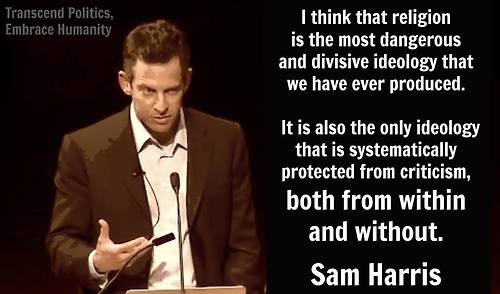
sam harris religion is dangerous

Thus peace is only possible if “theists” are willing to sacrifice their barbaric and primitive opinions and lifestyle, and convert to atheism. After all, according to these atheists, no human being is born with a religion, hence the truly “natural” state of man is non-religious. Note: the zealous advocates of an “Enlightened Reason” that is supposedly very different from “all those fear-rooted religions” constantly refer to “the dangers of religion”. Quite ironic. Ah, well…
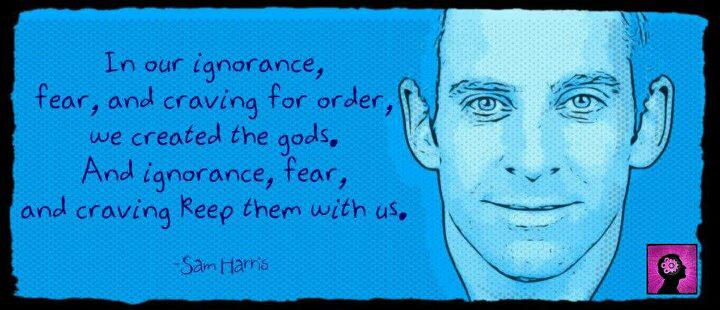
Sam Harris fear

3. The Fascism of Anti-religious Utopians – Joël De Ceulaer joins Filip Dewinter

The atheist camp might point to a difference that still seems to exist between “theists” and “atheists”. Although some atheists ask theists to consider abandoning their beliefs, they don’t use any violence against people. At best they use “verbal violence” against “weird ideas” or “weird behaviors” – you know, again, this is analogous to some Catholics who tolerate gay people while condemning homosexuality. They don’t sacrifice people, unlike some theists. Some regard this as a confirmation of their claim that it is really religion that drives people to violence. Moreover, most atheists are able to tolerate religious people, even if their religion is the cause of so much violence! Surely, atheism leads to a better, more tolerant world, no?

The so-called “humanist” atheist tolerance towards “theists” often comes across a bit strange. The atheist who stresses that the belief of his fellow man “is not a problem” to him actually implies that “this could be an issue in normal circumstances”. As if it’s not self-evident. As if the atheist is in the superior position from which he grants the theist the right to be who he is or wants to be. What if people who claim tolerance towards gay people would stress that they don’t have any problems with gay people every time they meet someone who is gay? A bit odd…

But, oh, I forgot to mention other signs of tolerance among atheists. Many of them have no problem whatsoever to attend Turkish restaurants run by Muslims. Also, many atheists already paid a visit to a mosque. Of course none of them would consider conversion to Islam a reasonable option, but look, even if they know that they are in the superior, more progressed and enlightened position, they still take the time to get to know a little bit more about a “less advanced” culture.
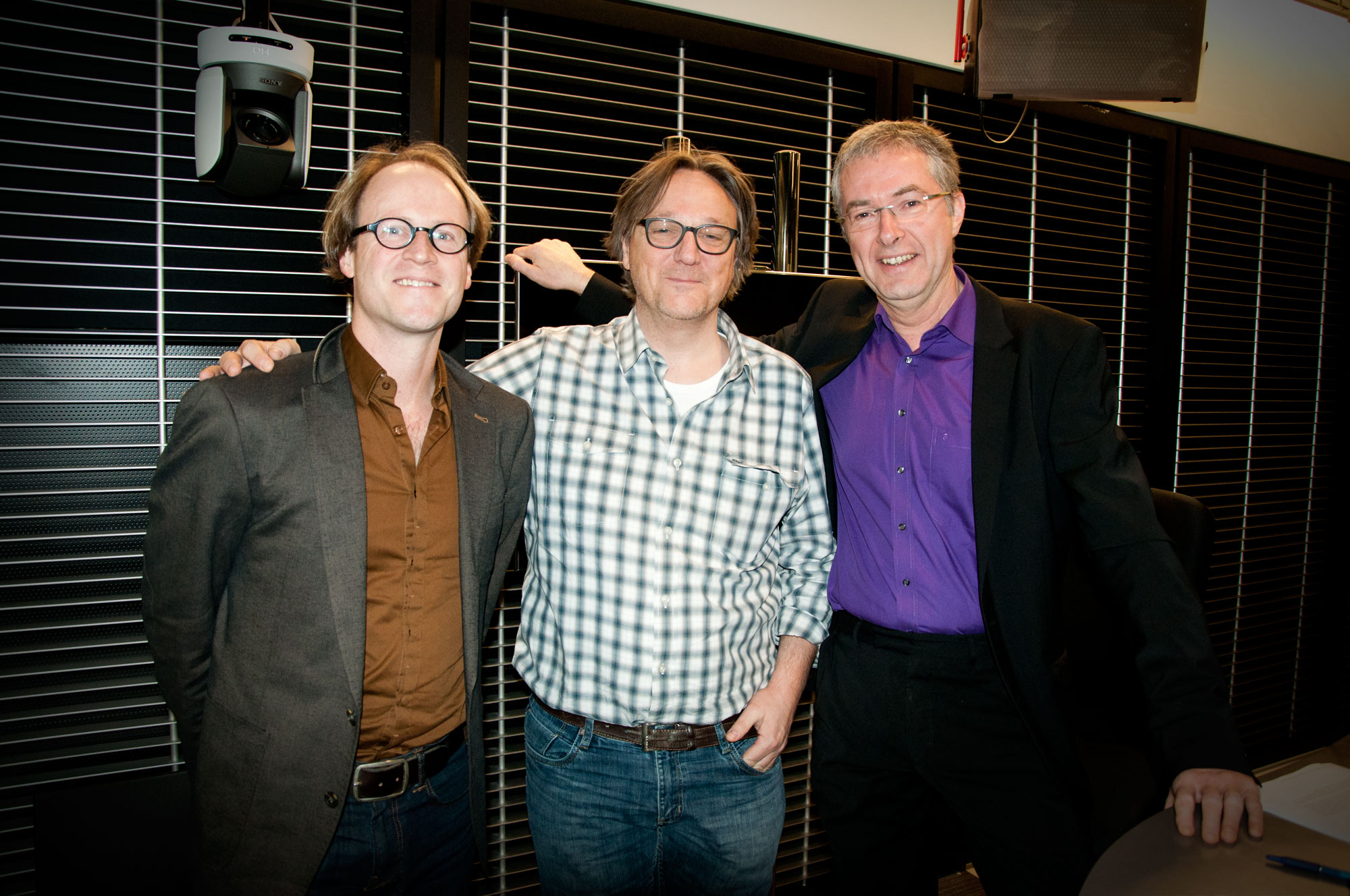
Joel De Ceulaer Patrick Loobuyck Jan HautekietDespite the seeming tolerance, intolerance towards religious people is never far in some atheist quarters. In the wake of the terrorist attacks on Charlie Hebdo, Belgian journalist Joël De Ceulaer expands the Islamophobia of Filip Dewinter to religiophobia. Unlike Dewinter, who still somewhat tried to make a distinction between the Qur’an and Muslims, De Ceulaer immediately becomes personal. The journalist and his ideological friends want to “get rid of all merchants of religion and other world-views” in Belgian schools and replace their respective curricula by one, supposedly “neutral” curriculum on “world-views, ethics and philosophy” (Dutch: “LEF – Levensbeschouwingen, Ethiek, Filosofie”), taught by “neutral” teachers. It’s still not clear what a “neutral” use of rationality and science to study different world-views actually looks like, but De Ceulaer (interviewed on Belgian television program Reyers Laat, January 19, 2015) is convinced that:

“It is a train that cannot be stopped.”

Wow. A neutral curriculum as an antidote to the violence of religious fanatics. It seems De Ceulaer is one of those utopistic atheists John Gray writes about in an article for The New Statesman (October 1, 2014):

The idea that religion is fading away has been replaced in conventional wisdom by the notion that religion lies behind most of the world’s conflicts. Many among the present crop of atheists hold both ideas at the same time. They will fulminate against religion, declaring that it is responsible for much of the violence of the present time, then a moment later tell you with equally dogmatic fervour that religion is in rapid decline. Of course it’s a mistake to expect logic from rationalists. More than anything else, the evangelical atheism of recent years is a symptom of moral panic. Worldwide secularisation, which was believed to be an integral part of the process of becoming modern, shows no signs of happening. Quite the contrary: in much of the world, religion is in the ascendant. For many people the result is a condition of acute cognitive dissonance.

As I already mentioned, both religious and anti-religious fanatics claim that religiously motivated violence is ultimately rooted in a realm that transcends human nature (a supernatural or alienating/perverted realm respectively). Both camps also claim to have access to “The Truth”. The members of Islamic State claim to possess the source of full knowledge (that is, within the limits of human possibilities) of “what’s true” and “what’s right”, revealed to them in the Qur’an. De Ceulaer and his lobbyists also claim to possess the source of full knowledge (again, within the limits of human possibilities) of “what’s true” and “what’s right”, namely reason and science.

In short, both religious and anti-religious fanatics are convinced that they can occupy a viewpoint which transcends “all particular viewpoints”. Call it Divine, call it Neutral – I call it Totalitarian and Idolatrous, implying the self-divinization of Man and the disappearance of any true belief in a transcendent realm. One can expect OBJECTIVITY from teachers of religion and world-views, NOT NEUTRALITY. Atheist, Buddhist, Christian or Islamic teachers who present Christianity from the viewpoints of, say, Karl Rahner, George Coyne or James Alison (all Catholic theologians) will tell similar things to their students if they’re objective. They will be able to confront those views with the views of fundamentalists like Jerry Falwell and Pat Robertson. With the views of past Catholics like Benedict of Nursia, Francis of Assisi or Ignatius of Loyola. They will be able to point to similarities and differences. They will also create the possibility of a dialogue with the perspectives and cultural background of their students. A so-called “DIVINE” or “NEUTRAL” viewpoint does not call for dialogue. It demands to be accepted without any discussion, and is a form of mind control or brainwashing.

merchants of religionI’m one of those so-called “merchants” De Ceulaer refers to. What am I selling, according to him? Lies – maybe even deliberately? Violence? When will I be replaced by a colleague who teaches from the “neutral”, state-imposed viewpoint? Clearly, this has to be done – and I will give De Ceulaer one more reason to demonize the “merchants” – because I will never ever claim or agree to speak from a so-called “neutral” perspective. That would be the biggest lie! I’m trying to teach what Christianity is all about from a Catholic perspective (“a”, not “the”). This should enable my students to form their own opinions on Catholicism, but also on other types of Christianity, and other religions and world-views, because I’m able to point to differences and similarities from my particular perspective. Rest assured, it is not my task to try to convert people to Catholicism, it is my task to enable them to form their own opinions on things they very often know nothing about.

While I wait for De Ceulaer’s unstoppable train of “a state-imposed neutral viewpoint” (I thought we were passed the violence – indeed! – of totalitarian atheist regimes in Europe), there’s another train coming as well. De Ceulaer’s words inadvertently made me think of a statement by Islamist preacher Anjem Choudary, who was interviewed by CNN-host Brian Stelter (on the August 31, 2014 edition of the program Reliable Sources):

“I believe that the Sharia is the best way of life. I believe that one day it will come to America and the rest of the world.”

Apparently we are living in “end times”.

The apocalyptic battle is on. Which train will win?

 freedom of speech megaphone

4. Some more words on the religion/homosexuality analogy

Some atheists say:

“No man is born religiously, religion is a perversion of human nature.”

Note: some argue that the inclination to believe in God can be situated in the brain – since when are brains “unnatural”? Of course, it is not because something is “natural” that it is “good” – maybe pedophilia is also a natural inclination, that doesn’t mean it’s good. It is quite funny, though, how some atheists argue that homosexuality should be allowed because of a “gay gene”, while at the same time they argue that theists should no longer allow their faith because of a “God gene”.

Some religious people (but there are atheists as well who think like this) say:

“No man is born gay, homosexuality is a perversion of human nature.”

Well, of course no one is born with a particular gay partner and a particular way to experience his homosexuality, but the homosexual inclination is there. And no, lovingly or passionately talking about a partner is not synonymous with an attempt to convince other people that they should also start an intense relationship with that partner. They’re still free to choose their own partners, but at least they get a testimony on what it means to be in a relationship with someone.

Are there homosexuals with a distorted, disrespectful sexual life (disrespectful towards other gays)? Sure, like there are heterosexuals with a distorted sexuality; this doesn’t mean that homosexuality as such is a perversion.

Well, of course no one is born with a particular religion and a particular way to experience his sense of awe for what transcends human life (atheists have this spiritual experience as well as theists), but we could argue that a “religious inclination” is there. And no, lovingly or passionately talking about a religion is not synonymous with an attempt to convince other people that they should also start an intense relationship with that religion. They’re still free to choose their own religions, but at least they get a testimony on what it means to be religious.

Most sexual relationships don’t involve rape. The same reasoning goes for religion: most religious beliefs and conducts don’t involve violence. Of course, certain media and polarizing populists often don’t like “the ordinary” – they go for “the sensational”.

Are there religious people with a distorted, disrespectful religious life (disrespectful towards other people)? Sure, like there are atheists with a world-view that encourages disrespectful attitudes towards other people; this doesn’t mean that every religion or world-view is a perversion.

Anyway, some fundamentalist Christians blame homosexuals for some of the main evils in the world (click here for my previous post on this), like some atheists blame religious people (“people with gods kill people”) for some of the main evils in the world. That’s why De Ceulaer says: “Get rid of the merchants of religion in our schools!” As if we’re perverting the youth. This mirrors the reasoning of some religious fundamentalists who ask to “Get rid of the merchants of sexual perversion – homosexuality – in our schools!” As if gays are perverting the youth.

The paradox is that so-called “anti-religionists” create a new religious structure according to a scapegoat mechanism. However, there are enough spiritual minds (whether theist or atheist) who can free us from our scapegoating impulses (whether theist or atheist).

Conclusion:

Every ideological, non-spiritual religion its scapegoat, whether atheist or theist?
René Girard is among those scholars who like to point to the similarities between myths from around the globe. In this regard his work follows in the footsteps of people like James Frazer, Carl Jung, Joseph Campbell and Mircea Eliade. Girard’s explanation of the source of mythological structures and motives, however, is quite different from the approaches of his colleagues. Girard maintains that the archetypal mythological pattern is eventually rooted in a so-called scapegoat mechanism, following a typical ritualistic pattern that is rooted in the same mechanism (for more on this, click here).

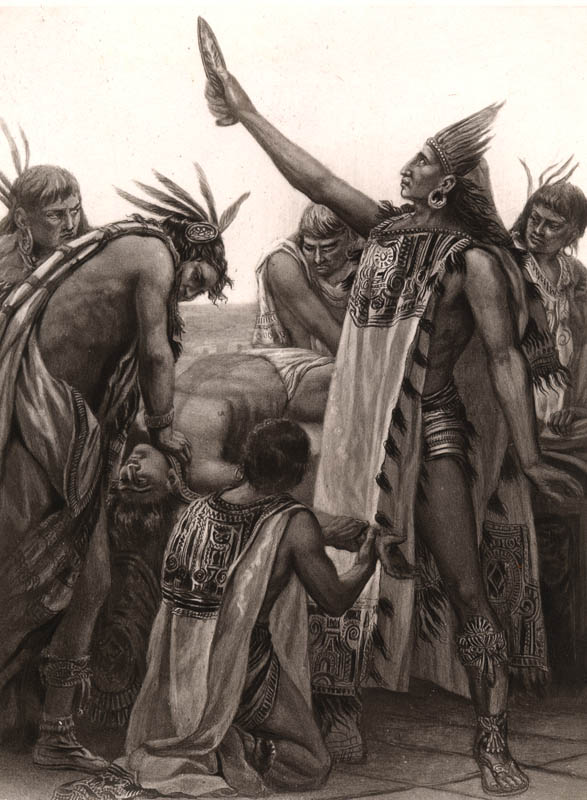
Aztec human sacrificeMyths can be considered as tales which contain the worldview of a culture, transmitting from generation to generation the belief that certain phenomena (from certain things to certain persons and acts) are sacred or belong to the gods. Traditionally, the realm of the gods or the sacred is also the realm of violence. If the sacred order of things is not respected or approached in a proper (i.e. ritualistic) way it brings about violent chaos, diseases, death and destruction in the (human) world. Next to connecting chaotic situations to the realm of the sacred (portraying chaos as “the wrath of god(s)” or “bad karma”), myths also contain messages on how to transform sacred disorder into sacred order. Following René Girard, myths can thus be understood, more specifically, as justifications of certain taboos and of certain types of sacrifice which should help to conserve or renew order in the world.

In short, according to René Girard, mythical thinking consists in connecting violent mayhem, natural disasters and contagious diseases to “god(s)” or “a sacred realm”. As such, violent mayhem etc. are explained as necessary moments of disorder from which a new order is generated. This never ending mythical cycle of “disorder – order – disorder – order – …” at the same time often functions as justification of the sacrifice of certain people whose death should bring about order.

A comparison between some ancient myths and contemporary interpretations of today’s international terrorism makes clear that mythical thinking as Girard understands it is on the rise again, especially in an eschatological sense and also in secular circles that hold on to a naïve version of the myth of human progress. Just take a look at the schematic presentation below presenting the mythical structure, time and again… (for more on the sexist implications of many myths, click here).

A) The Greek myth of Prometheus stealing fire from the gods

Prometheus Gustave Moreau1) A WORLD ORDER
(“ORDO” or “COSMOS”)
with a clear distinction between different realms
=> Fire belongs to the gods and is considered TABOO

2) (TRANSGRESSION OF TABOOS brings about) A MOMENT OF DISORDER
(“MANQUE” or “CHAOS”/“CRISIS”)
with a challenge (the “call”) to restore the balance in the world
=> Prometheus steals the fire from the gods

3) Some kind of SACRIFICE (as the pinnacle of a “HERO’S JOURNEY” or “QUEST”)
with a transformation of the identity of the hero figure(s) – into “monster(s)” or “savior(s)”
=> Prometheus is banned to the Caucasus mountains, where he is chained and tortured

4) GOAL = A (RE)NEW(ED) WORLD ORDER
(“ORDO”)
again with clear distinctions between different realms

B) The Hebrew myth of Adam and Eve in the Garden of Eden

• A WORLD ORDER
(“ORDO” or “COSMOS”)
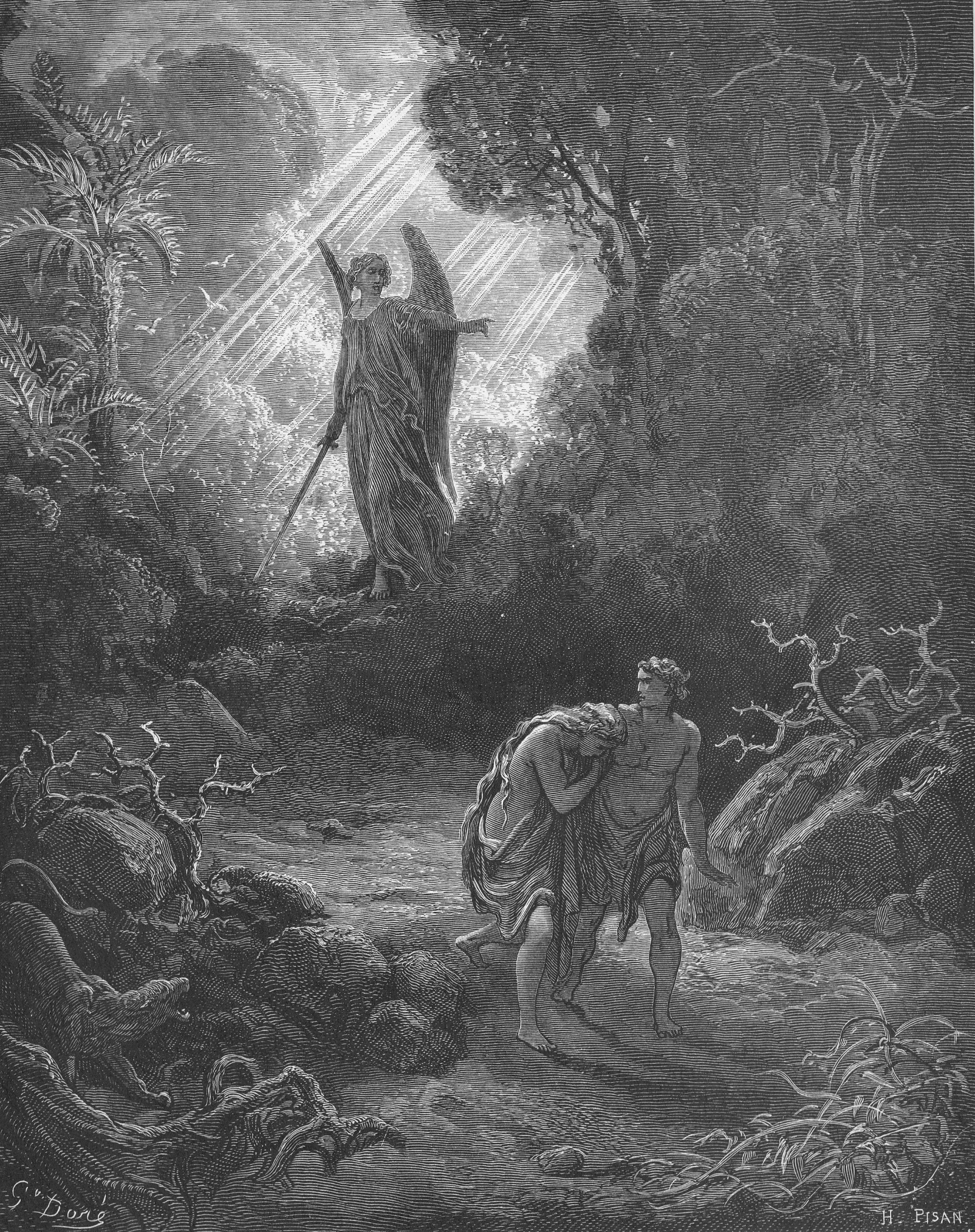
with a clear distinction between different realmsAdam and Eve driven out of Eden by Gustave Dore (1866)
=> Fruits of the Tree of Knowledge belong to God and are considered TABOO

• (TRANSGRESSION OF TABOOS brings about) A MOMENT OF DISORDER
(“MANQUE” or “CHAOS”/“CRISIS”)
with a challenge (the “call”) to restore the balance in the world
=> Adam and Eve “eat from the forbidden fruit”
[from a comparison with the Song of Songs: this is a transgression of the taboo on sex]

• Some kind of SACRIFICE (as the pinnacle of a “HERO’S JOURNEY” or “QUEST”)
with a transformation of the identity of the hero figure(s) – into “monster(s)” or “savior(s)”
=> Adam and Eve are banned from Eden and have to accept a life with suffering and death

• GOAL = A (RE)NEW(ED) WORLD ORDER
(“ORDO”)
again with clear distinctions between different realms

C) The Greek myth of Oedipus

• A WORLD ORDER
(“ORDO” or “COSMOS”)
with a clear distinction between different realms
=> Killing the “father-king” and taking the “mother-queen” is considered TABOO
[Note: “thanatos” and “eros” motif]

• (TRANSGRESSION OF TABOOS brings about) A MOMENT OF DISORDER
(“MANQUE” or “CHAOS”/“CRISIS”)
with a challenge (the “call”) to restore the balance in the world
=> Oedipus kills his father, the king, and marries his mother, the queen and allegedly causes a plague in the city of Thebes

Oedipus stabs out his eyes• Some kind of SACRIFICE (as the pinnacle of a “HERO’S JOURNEY” or “QUEST”)
with a transformation of the identity of the hero figure(s) – into “monster(s)” or “savior(s)”
=> Oedipus stabs out his eyes and goes into exile

• GOAL = A (RE)NEW(ED) WORLD ORDER
(“ORDO”)
again with clear distinctions between different realms

D) A religious fundamentalist mythical interpretation of 9/11 (“end times”)

(Jerry Falwell & Pat Robertson)

• A WORLD ORDER
(“ORDO” or “COSMOS”)
with a clear distinction between different realms
=> Types of relationships which differ from the “traditional”, patriarchal family are TABOO

• (TRANSGRESSION OF TABOOS brings about) A MOMENT OF DISORDER
(“MANQUE” or “CHAOS”/“CRISIS”)
with a challenge (the “call”) to restore the balance in the world
=> Feminists, gays, lesbians and other “liberals” challenge the patriarchal family structure

• Some kind of SACRIFICE (as the pinnacle of a “HERO’S JOURNEY” or “QUEST”)
with a transformation of the identity of the hero figure(s) – into “monster(s)” or “savior(s)”
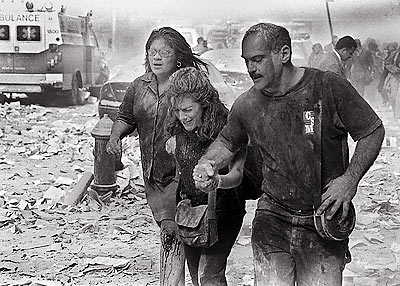
=> Two days after the terrorist attacks of 9/11, Jerry Falwell and Pat Robertson, two evangelicals, shared their “theological” views on the terrorist violence (transcript from the 700 club, a well-known evangelical television program in the States – September 13, 2001). Especially these comments are telling (for more, watch the video below the transcripts):
survivors of 9-11 attacksJERRY FALWELL: The ACLU’s got to take a lot of blame for this.
PAT ROBERTSON: Well yes.
JERRY FALWELL: And, I know that I’ll hear from them for this. But, throwing God out successfully with the help of the federal court system, throwing God out of the public square, out of the schools. The abortionists have got to bear some burden for this because God will not be mocked. And when we destroy 40 million little innocent babies, we make God mad. I really believe that the pagans, and the abortionists, and the feminists, and the gays and the lesbians who are actively trying to make that an alternative lifestyle, the ACLU, People For the American Way – all of them who have tried to secularize America – I point the finger in their face and say “you helped this happen.”
PAT ROBERTSON: Well, I totally concur…

In other words, 9/11 is interpreted as an unavoidable SACRIFICE, sanctioned by God; it is “the wrath of God” caused by people who keep on transgressing “sacred” laws and taboos. This sacrifice manifests itself in a twofold manner: the autoaggression of the terrorists’ suicide implies the heteroaggression against the victims in the planes and the twin towers.

Conclusion: “Secularists” or “the secularist lifestyle” (as Falwell and Robertson understand this – which corresponds to the Islamic fundamentalists’ notion of “the satanic West”) should be abandoned or banned.

• GOAL = A (RE)NEW(ED) WORLD ORDER
(“ORDO”)
again with clear distinctions between different realms

To conclude this post, I’d like to mention an article by John Gray on the book The Pursuit of the Millenium by Norman Cohn. Gray points to the eschatological myths of religious and secular political ideologies, from Christian Millenarianism (especially in today’s context we might think of Islamic Millenarianism as well) to Nazism and Communism. All these ideologies have justified sacrifices and massacres to bring about a new world order, a “paradise” – hence every utopia turns into dystopia… At the end of his article, Gray also warns for new versions of the eschatological myth in “liberal humanism”:

There is a line of reasoning which accepts that totalitarian ideologies were shaped by apocalyptic and utopian thinking, while insisting that liberal humanism is entirely different. They – the Nazis and communists – may have been deluded and irrational; we – enlightened meliorists – have purged our minds of myth. In fact, the belief in progress in ethics and politics, which animates liberal rationalism, is itself a myth: a view of history as a process of redemption without the Christian belief in a single transforming event, but nonetheless a faith-based narrative of human salvation. It is obvious that human life can sometimes be improved. Equally, however, such gains are normally lost in the course of time. The idea that history is a process of amelioration is an article of faith, not the result of observation or reasoning.

Reading Cohn will not lead secular thinkers to relinquish their cherished myths. The need to believe in them is far more powerful than intellectual curiosity. But, for those who want to understand the origins of the conflicts of the past century and the present time, The Pursuit of the Millennium may be, as it was for me, a life-changing book.

Considering all this, we might want to rethink the concept of “eschatological battle” as a struggle we have to face within ourselves, in the depths of our soul… The true fight is a spiritual one, as we are converted from our human violence (and all our man-made gods, idols and ideologies justifying that violence) to the absolute non-violence of the God of Love, The Merciful One… 

The challenge is to build an order and a “peace” that is not built on the violence of sacrifices, but to build a peace that allows for “non-violent conflicts…” (a “non-totalitarian peace”).

… is God dood? … is de Mens dood?

De religieuze fanaticus die terroristische daden pleegt, verschuilt zich achter “god”.

De atheïst zal hem vertellen dat die “god” niet bestaat.

De atheïstische analyse van religieus gemotiveerd geweld leidt tot de onvermijdelijke conclusie dat niet “god” het probleem is – dat wezen bestaat dan immers niet – maar wel “de mens”.

De vraag is dus, vanuit de atheïstische analyse, welke menselijke eigenschappen aan de oorsprong liggen van het geweld dat in naam van al dan niet religieuze ideologieën (alweer creaties van de mens) wordt gepleegd.

Een mens zou er moedeloos van worden…

fundamentalism same coinKunnen we nog geloven in de mens, in onszelf, als we de geschiedenis overzien en beseffen tot welke vormen van geweld we in staat zijn?

Kunnen we nog geloven in de mens als we denken aan de kruistochten, de shoah, de goelag, de genocide in Rwanda, etc.?

Kunnen we nog geloven in de mens als we denken aan haatpredikers en haatpropaganda – van nazistische karikaturen van Joden en fundamentalistische christenen die korans verbranden tot extremistische moslims die oproepen tot daden van terreur?

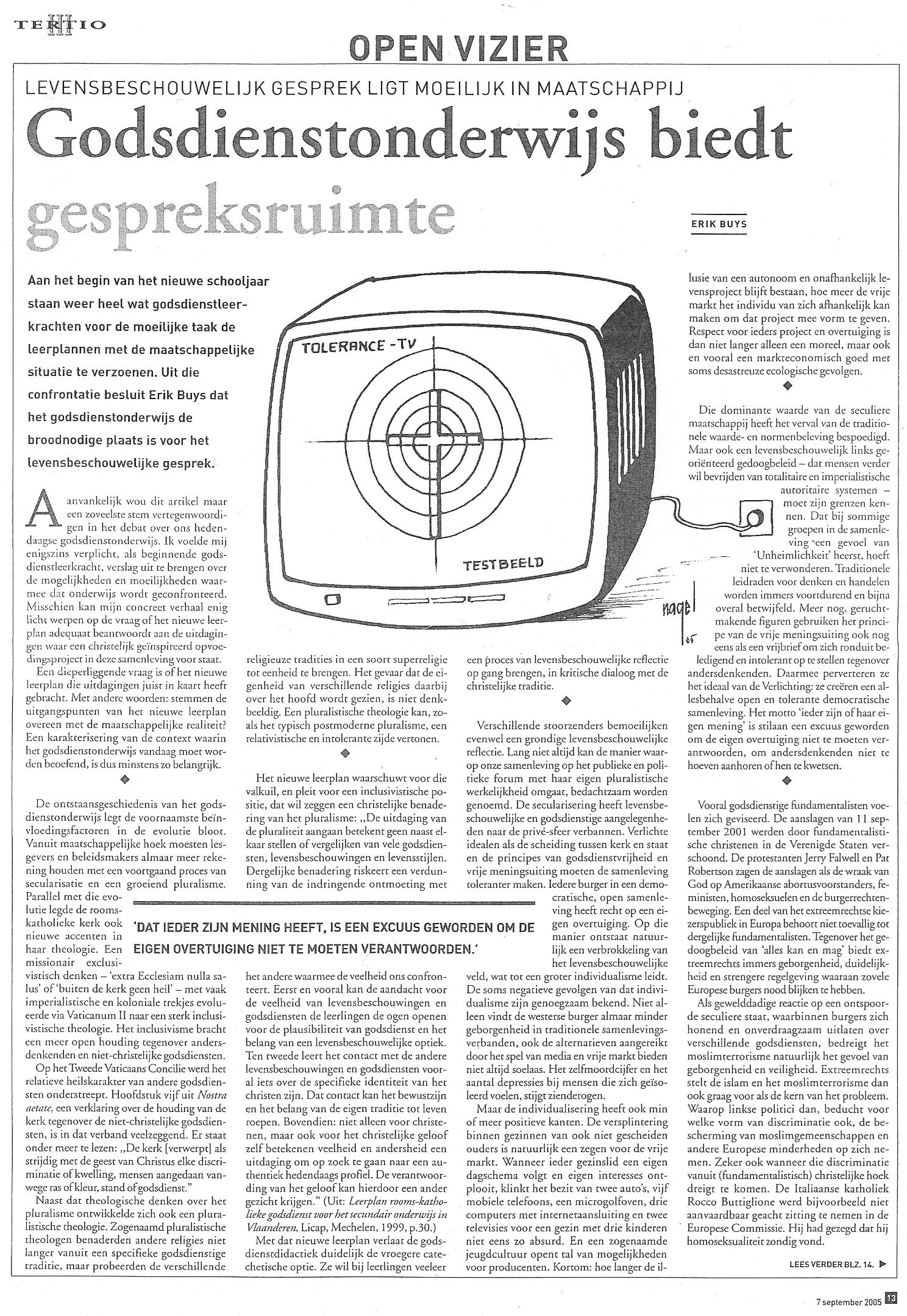
Naar aanleiding van de terroristische aanslagen op de redactie van het Franse satirische weekblad Charlie Hebdo (gisteren, 7 januari 2015), heb ik nog eens een van de artikelen van onder het stof gehaald die ik schreef voor het weekblad Tertio (7 september 2005). Ik probeerde hierin de maatschappelijke context te schetsen waarin het hedendaagse godsdienstonderwijs functioneert. Het sociologische aspect van dit artikel was grotendeels gebaseerd op het werk van politicologen/sociologen als Benjamin Barber en Manuel Castells, maar ook de mimetische theorie van René Girard speelde een niet te onderschatten rol in de analyse (wie vertrouwd is met deze theorie zal dat onmiddellijk merken bij het lezen van het artikel).

dialogueJammer genoeg is er sinds 2005 weinig veranderd. Een levensbeschouwelijke dialoog zou moeten bijdragen tot de ontwikkeling van het broodnodige vertrouwen tussen mensen met uiteenlopende overtuigingen. Alleen wordt die dialoog onvoldoende ontwikkeld. Daardoor kan humor door haatpredikers gemakkelijk voorgesteld worden als “een aanval op de identiteit”. Een context waarin mensen elkaar vertrouwen maakt zelfrelativerende humor mogelijk. Als die ontbreekt wordt “plagen” al te gemakkelijk geïnterpreteerd als “pesten”, en dan springen mensen op de kar die niets liever doen dan polariseren…

In de Verenigde Staten krijgen de zogezegd “linkse rakkers” (liberals) van The New York Times en The Washington Post het verwijt, vanuit rechts conservatieve hoek (conservatives), dat ze toegeven aan de moslimterroristen omdat ze de cartoons van Charlie Hebdo niet publiceren… “Links” zou “te vriendelijk” zijn voor de islam en voor de moslims. Ook wat dat betreft, is er aan de oppervlakte van de polarisering weinig veranderd sinds 2005…

Hieronder het artikel – klik op de afbeeldingen om ze te vergroten:

Tertio 7 september 2005Tertio 7 september 2005_2

P.S.: Intussen laait ook de discussie over het godsdienstonderwijs opnieuw op. Vanmorgen (dinsdag 13 januari 2013) op Radio 1 ging het programma Hautekiet over de vraag of alle levensbeschouwelijke schoolvakken afgeschaft moeten worden (met opnieuw een pleidooi voor LEF – levensbeschouwing, ethiek en filosofie).

Enkele bedenkingen (voor meer: klik hier om “(Theïstisch?) Sermoentje” te lezen):

Levensbeschouwelijke apartheid afschaffen: natuurlijk!

Maar vanwaar toch de pretentie dat er zoiets zou bestaan als een “neutraal” perspectief aangaande levensbeschouwingen?

Twee zaken onderscheiden:

1) Een wetenschappelijk verantwoorde studie van levensbeschouwingen (om vragen te beantwoorden als: “Hoe worden de verschillende literaire genres in de Bijbel geïnterpreteerd – zowel vroeger als nu?”, of “Welke visie op God komt aan de oppervlakte in het soefisme?”, of nog “Wat zijn de voornaamste verschillen in levensvisie tussen eerder westerse ‘lineaire’ levensbeschouwingen die groeiden uit de joods-christelijke tradities, en eerder (ver) oosterse ‘cyclische’ levensbeschouwingen die groeiden uit de hindoeïstische tradities?”).

2) Levensbeschouwelijke reflectie en het maken van levensbeschouwelijke keuzes. Dit proces gebeurt grotendeels buiten de schoolmuren, zelfs als kinderen op school een of ander confessioneel vak krijgen. De wetenschappelijk verantwoorde dialoog met een confessioneel vak, dat zich niet profileert als “neutraal” of “de objectieve waarheid in pacht hebbend”, kan een model zijn om levensbeschouwelijke dialoog en reflectie een plaats te geven in het eigen leven (je moet niet alle talen van de wereld krijgen op school om aan de hand van enkele talen te leren hoe “een taal” eigenlijk werkt en zelf andere talen te gaan studeren).

Kortom, het streven naar “objectiviteit” (wetenschappelijk verantwoorde studie van levensbeschouwingen) mag niet verward worden met “neutraliteit” (een pedagogische positie die niet zou berusten op levensbeschouwelijke keuzes).

De verwarring van “objectiviteit” en “neutraliteit” is kenmerkend voor iedere vorm van (religieus of seculier) totalitarisme dat meent “dé waarheid” in pacht te hebben.

Bij wijze van uitdrukking (voor de secularisten onder ons 😉 ): “God behoede ons voor een maatschappelijk scenario zoals dat beschreven wordt in George Orwells 1984!”

Bij wijze van analogie: porno op het internet, vrouwenhandel en verkrachtingen verdwijnen niet als je van seks een taboe maakt op scholen… Misschien zelfs integendeel? Seksuele opvoeding is meer dan het verschaffen van encyclopedische kennis over de seksuele daad…

Benoît Chantre, co-author of René Girard’s Achever Clausewitz (Battling to the End), made a reference to the fable of Les Deux Coqs (The Two Cocks) by Jean de La Fontaine (1621-1695) at a conference in Paris. René Girard gave a lecture at the Centre Pompidou (March 30, 2005) a good week after he became one of the “immortals” of the Académie française (March 17, 2005). Benoît Chantre humorously and aptly ended the gathering by quoting some lines of the famous French poet, one of Girard’s predecessors in the Academy.

The fable is about mimetic rivalry between two men (“cocks”) over a woman (a “hen”) – indeed a rivalry that sparked more than one (“Trojan”) war in human history. Note that, at the end, La Fontaine suggests a new potential cycle of mimetic rivalry, this time of women over a man…

Deux Coqs vivaient en paix: une Poule survint,
Et voilà la guerre allumée.
Amour, tu perdis Troie; et c’est de toi que vint
Cette querelle envenimée,
Où du sang des Dieux même on vit le Xanthe teint.
Longtemps entre nos Coqs le combat se maintint:
Le bruit s’en répandit par tout le voisinage.
La gent qui porte crête au spectacle accourut.
Plus d’une Hélène au beau plumage
Fut le prix du vainqueur ; le vaincu disparut.
Il alla se cacher au fond de sa retraite,
Pleura sa gloire et ses amours,
Ses amours qu’un rival tout fier de sa défaite
Possédait à ses yeux. Il voyait tous les jours
Cet objet rallumer sa haine et son courage.
Il aiguisait son bec, battait l’air et ses flancs,
Et s’exerçant contre les vents
S’armait d’une jalouse rage.
Il n’en eut pas besoin. Son vainqueur sur les toits
S’alla percher, et chanter sa victoire.
Un Vautour entendit sa voix:
Adieu les amours et la gloire.
Tout cet orgueil périt sous l’ongle du Vautour.
Enfin par un fatal retour
Son rival autour de la Poule
S’en revint faire le coquet:
Je laisse à penser quel caquet,
Car il eut des femmes en foule.
La Fortune se plaît à faire de ces coups;
Tout vainqueur insolent à sa perte travaille.
Défions-nous du sort, et prenons garde à nous
Après le gain d’une bataille.

English translation:

Two cocks had lived in peace, till from afar
A hen came in, and kindled up a war.
          0 love! thou wert the curse of Troy;
By thee were troubled the abodes of joy,
Where strife arose, and god opposed to god,
Till Xanthus flowed with their celestial blood.
          Long time the cocks maintained the fight,
Les Deux Coqs (Gustave Doré)The noise of which spread everywhere around;
The crested tribes came flocking to the sight.
Many a Helen plumed the victor crowned;
          The vanquished hero blushing fled
          To his retreat to hide his head—
There wept his honour and his mistress lost;
          Hearing his happy rival boast
His mistress lost and in his rival’s power,
Which he must see and suffer every hour!
The sight his courage kindled into rage;
His beak and claws he whetted to engage,
          And flapped his sides, and fought the air,
          In his excess of wild despair,
          Burning with jealous wrath to bleed,
          For which at last there was no need.
          The victor cock sat perched on high,
          Proudly chanting victory.
          A vulture heard him as he crew—
          To all his gallantry adieu.
His pride was crushed beneath the vulture’s claws,
And thus by fortune’s unexpected laws,
          Behold, the rival cock again
          Come back to gallant with the hen.
          I leave to guess what tattling lives;
          For there he found a mob of wives.
          Thus Fortune lays the fatal snare:
          The haughty victor seeks to be undone.
Then Fate distrust—be humble, and take care
          After the victory is won.

Nederlandse vertaling:

Twee hanen leefden kalm; een hoentje kwam erbij
En plots was d’oorlog uitgebroken.
Gij, Liefde, hebt den fakkel ook ontstoken
Voor Troje’s brand; van u kwam deze razernij,
Die zelfs met godenbloed den Xanthus kleurde.
Lang duurde der twee hanen felle strijd.
Door gansch de buurt werd het rumoer verspreid,
En al wat kammen droeg, kwam kijken hoe ‘t gebeurde.
Ook menig Helena met fraai gevedert
Werd ‘s overwinnaars loon; de andre haan verdween,Les Deux Coqs (Jean-Jacques Grandville)
Hij hield zich schuil, verslagen en vernederd,
Treurde om zijn glorie en zijn lief, met droef geween,
‘t Lief, dat de medeminnaar voor zijn oogen
Trotsch op zijn overwinning, nu bezat.
Het daaglijksch schouwspel kwam zijn haat en kracht
Die hij voorheen te weinig had. [verhoogen,
Hij scherpte nu zijn bek, sloeg met de vleuglen,
Zich oefnend tegen ‘t windgeblaas,
In woede en jaloezie, niet te beteuglen.
Het was niet noodig. D’andre vechtersbaas
Vloog op het dak en kraaide er zijn victorie.
Een gier, die loerde, hoorde ‘t nauw,
Of uit was ‘t met zijn liefde en zijn glorie,

‘t Bleef alles in de scherpe gierenklauw.
Toen kwam, natuurlijk wisselspel,
Weer d’ander om het hoentje draaien;
Men kan begrijpen wat een kakelen en kraaien,
Want nu beviel hij haar en d’andre wijfjes wel.
Vaak heeft Fortuin dus wraak genomen,
Elk onbeschaamd verwinnaar komt ten val;
Voorzichtig dus; want na gewonnen spel vooral,
Is ‘t zaak, de fierheid in te toomen.

Klik hier voor pdf fabels van La Fontaine

Watch the fable, remade for children, here:


It seems that, in order to understand international politics today (or maybe “as always”?), we need to understand what is happening in the Middle East. Well, at least we’ll get a major part of “the bigger picture” from our attempts to come to terms with the contagion of violence in that region. French American philosopher René Girard and his mimetic theory prove to be very helpful in analyzing the current situation. Let’s start, in this post, with what seemed to be a hopeful sign for the Arab World a few years ago, the Arab Spring.

Arab Spring Deposed Elite Puppet

In 2011 several Arab countries experienced political turmoil that, because of its revolutionary character, would later be described as “the Arab Spring”. The world could observe two patterns in this tumultuous period. On the one hand, in countries like Tunisia and Egypt, long term presidents were willing to give up their position, sometimes under pressure from the military. The free elections that followed were mostly won by Islamic political parties. The revolutions in Libya and Syria, on the other hand, turned violent because Muammar Gadaffi and Bashar al-Assad both refused to give up their presidency. NATO was willing and able to intervene in Libya and end Gadaffi’s leadership but could not undertake a similar action in Syria.

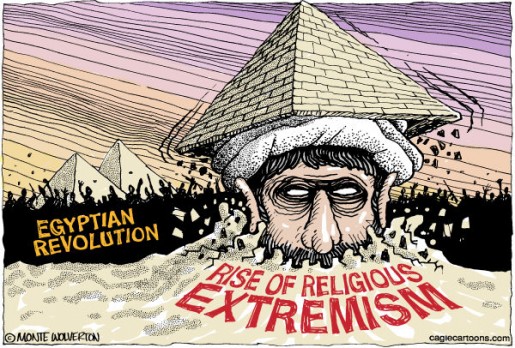
Arab Spring Egypt Rise of ExtremismDespite NATO intervention, Libya doesn’t seem to be much better off than earlier, under Gadaffi’s dictatorship. The West allowed the same mistake to be made in Libya as the US made in 2003, in Iraq. Military, police and intelligence services were disbanded because of their association with the former regime. It would destabilize Libya as it did Iraq, leaving the nation to rivaling tribal militias. Moreover, it made Libya one of the most important exporters of weapons in the region. The political chaos in Libya had a direct influence on the Egyptian situation, and this in turn contaminated the Arab world as a whole. Many thousands of islamists and jihadists escaped the Egyptian prison during the revolution of 2011, regrouping themselves in the Egyptian Sinai Desert, and buying weapons from the Libyans (among others).

Arab Spring Egypt Morsi Manipulated by MilitaryMeanwhile, the newly found political power of the Muslim Brotherhood (a movement with parties in different Arab countries) in Egypt came to an end. Egyptian army officials and generals seized power after the Muslim Brotherhood was held responsible for several terrorist attacks (although many of those attacks were claimed by Ansar Bait al-Maqdis, an organization linked to al-Qaeda). President Morsi, himself a Muslim Brother who briefly took the place of former dictator Hosni Mubarak, was replaced by former general Abdel Fattah el-Sisi, and membership of the Muslim Brotherhood was declared illegal – as it is in Syria. Anthropologist Mark Anspach predicted how the Arab Spring is, ultimately, indeed directed by the military in Egypt (read his very interesting article The Arab Rulers’ New Clothes by clicking here).

Arab Spring SicknessThe question in all this is “How can Satan cast out Satan?” Consecutive Egyptian leaders more or less allowed the Muslim Brotherhood to organize itself, using it as a buffer against more extreme islamists and as a means to blackmail the West. If the West would not support the undemocratic, dictatorial regimes the only lurking alternative would be an extremist political Islam. That’s why the Arab Spring was also in general, in many respects, a movement carried out by religious forces against dictatorial regimes that were perceived as corrupted puppets from a decadent secularized West. It’s not what we, westerners, normally understand as democratization.

Arab Spring US PolicyThe dilemma between economically manipulable and manipulating dictatorships on the one hand, and political Islam on the other, is faced by the West again and again, to this day, in the Arab world. Bashar al-Assad knows this politically tricky situation for the West too. He wanted to use the threat of the so-called Islamic State (IS) to seek new alliances with the West and its Arab allies. Apparently he secretly allowed the jihadists to somewhat organize themselves so he could position himself as potential “savior”. False messiahs are the ones who create the disease they allegedly want to save the world from, but in order to be able to keep on playing “the doctor” they keep the world sick. However, it doesn’t really seem to work for Bashar al-Assad. His enemies didn’t become his friends, but surely it was worth the try from his perspective…

Arab Spring Egypt Revolution CycleAnyway, the age-old enmity between dictators and so-called representatives of suppressed religious (and/or ethnic) groups provides each party with a reason of existence. As if life is not worth living if one doesn’t have an enemy… Moreover, both parties seem to remain blind to the fact that they resemble each other more and more as they tend to imitate each other’s violence and cruelty. René Girard speaks of mimetic doubles as rivals mimic each other in their (mutually imitated and thus reinforced) desire to obtain the same position. It’s no wonder that al-Qaeda and IS rival each other, indeed because (and not “although”) they are so much alike.

Of course, as René Girard righfully points out, enmity between rivaling parties can easily end if they find a common enemy that reunites them. It seems “the West” and what it stands for – its consumerist, so-called “decadent” culture – is well on its way to provide the competing extremists with that “Big Enemy”. Moreover, our consumerist culture alienates many of our own children too. Some of them become depressed, commit suicide because the consumerist way of life leads to feelings of “emptiness” and “unfulfillment” – the market demands that its consumers are never satisfied, that their desires are continuously (mimetically) awakened (read Thou Shalt Covet What Thy Neighbor Covets by Martin Lindstrom). Others find a new sense of identity and fulfillment in extreme political and/or religious groups. After the smoke clears, however, the satanic monster of violence coming from some of those groups is all that’s left, as humanity itself disappears in the process.

Tunisia remains a small beacon of hope amidst all these storms. The Muslim Brothers there were prepared to accept political concessions, the army did not intervene in the political process, and Tunisian president Moncef Marzouki was able to position himself as a “father of the people” instead of as a leader of one political or tribal party. The Tunisian example demands imitation more than ever, as we are confronted with the new face of horrific violence, the terror of ISIS. In many ways the war against ISIS shows how the West is fighting itself, the Arab world is fighting itself, and humanity as a whole, in this globalized world, is fighting itself.

Walead Farwana wrote a compelling article, The History of the Islamic State, on the ISIS movement. It is possible to shed some Girardian light on his writings by using the types of the scapegoat mechanism identified in previous posts.

C S LewisC.S. Lewis (1898-1963), a former atheist who converted to Christianity, became well-known for his series of seven fantasy novels The Chronicles of Narnia, but the fame of this series sometimes overshadows other work by this fascinating author. And that’s a shame because, up to this day, Lewis remains a surprisingly fresh Christian thinker.

In Mere Christianity Lewis identifies “the great sin” of humanity as Pride. From his account it is clear that pride rests on what René Girard has called mimetic desire – i.e. a desire based on the imitation of what others desire. Mimetic desire can easily become competitive and lead to mimetic rivalry if people cannot or do not want to share the objects of their mutually enforced desire. The “proud man” derives his pride from the supposition that other people desire what he possesses. In a sense he needs competition (competitive desire) to affirm his prestigious aura, all the while of course not suspecting that his own desire is also based on the imitation of the desires of others… Of course, following the nuances of Lewis himself about pride, there’s nothing wrong with being proud of some achievement. To be proud of some recognition we receive from others might be a consequence of something that we have done. The proud man, on the other hand, is guided by his pride as the ultimate goal of his existence.

But enough introductory talk. Here’s what Lewis has to say on Pride – people acquainted with René Girard’s further developed mimetic theory will surely recognize some familiar themes 😉 [For more on this, click here].

I now come to that part of Christian morals where they differ most sharply from all other morals. There is one vice of which no man in the world is free; which every one in the world loathes when he sees it in someone else; and of which hardly any people, except Christians, ever imagine that they are guilty themselves. I have heard people admit that they are bad-tempered, or that they cannot keep their heads about girls or drink, or even that they are cowards. I do not think I have ever heard anyone who was not a Christian accuse himself of this vice. And at the same time I have very seldom met anyone, who was not a Christian, who showed the slightest mercy to it in others. There is no fault which makes a man more unpopular, and no fault which we are more unconscious of in ourselves. And the more we have it ourselves, the more we dislike it in others.

The vice I am talking of is Pride or Self-Conceit: and the virtue opposite to it, in Christian morals, is called Humility. You may remember, when I was talking about sexual morality, I warned you that the centre of Christian morals did not lie there. Well, now, we have come to the centre. According to Christian teachers, the essential vice, the utmost evil, is Pride. Unchastity, anger, greed, drunkenness, and all that, are mere fleabites in comparison: it was through Pride that the devil became the devil: Pride leads to every other vice: it is the complete anti-God state of mind.

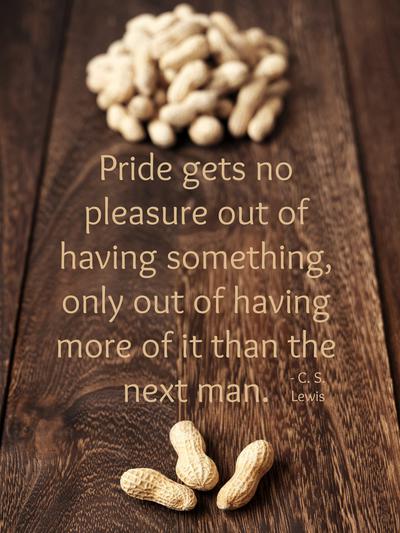
C.S. Lewis quote on Pride gets no pleasure out ofDoes this seem to you exaggerated? If so, think it over. I pointed out a moment ago that the more pride one had, the more one disliked pride in others. In fact, if you want to find out how proud you are the easiest way is to ask yourself, ‘How much do I dislike it when other people snub me, or refuse to take any notice of me, or shove their oar in, or patronise me, or show off?’ The point is that each person’s pride is in competition with every one else’s pride. It is because I wanted to be the big noise at the party that I am so annoyed at someone else being the big noise. Two of a trade never agree. Now what you want to get clear is that Pride is essentially competitive – is competitive by its very nature – while the other vices are competitive only, so to speak, by accident. Pride gets no pleasure out of having something, only out of having more of it than the next man. We say that people are proud of being rich, or clever, or good-looking, but they are not. They are proud of being richer, or cleverer, or better-looking than others. If everyone else became equally rich, or clever, or good-looking there would be nothing to be proud about. It is the comparison that makes you proud: the pleasure of being above the rest. Once the element of competition has gone, pride has gone. That is why I say that Pride is essentially competitive in a way the other vices are not. The sexual impulse may drive two men into competition if they both want the same girl. But that is only by accident; they might just as likely have wanted two different girls. But a proud man will take your girl from you, not because he wants her, but just to prove to himself that he is a better man than you. Greed may drive men into competition if there is not enough to go round; but the proud man, even when he has got more than he can possibly want, will try to get still more just to assert his power. Nearly all those evils in the world which people put down to greed or selfishness are really far more the result of Pride.

Take it with money. Greed will certainly make a man want money, for the sake of a better house, better holidays, better things to eat and drink. But only up to a point. What is it that makes a man with £ 10,000 a year anxious to get £ 20,000 a year? It is not the greed for more pleasure. £ 10,000 will give all the luxuries that any man can really enjoy. It is Pride – the wish to be richer than some other rich man, and (still more) the wish for power. For, of course, power is what Pride really enjoys: there is nothing makes a man feel so superior to others as being able to move them about like toy soldiers. What makes a pretty girl spread misery wherever she goes by collecting admirers? Certainly not her sexual instinct: that kind of girl is quite often sexually frigid. It is Pride. What is it that makes a political leader or a whole nation go on and on, demanding more and more? Pride again. Pride is competitive by its very nature: that is why it goes on and on. If I am a proud man, then, as long as there is one man in the whole world more powerful, or richer, or cleverer than I, he is my rival and my enemy.

C.S. Lewis quote on pride The Christians are rightThe Christians are right: it is Pride which has been the chief cause of misery in every nation and every family since the world began. Other vices may sometimes bring people together: you may find good fellowship and jokes and friendliness among drunken people or unchaste people. But pride always means enmity – it is enmity. And not only enmity between man and man, but enmity to God.

In God you come up against something which is in every respect immeasurably superior to yourself. Unless you know God as that – and, therefore, know yourself as nothing in comparison – you do not know God at all. As long as you are proud you cannot know God. A proud man is always looking down on things and people: and, of course, as long as you are looking down, you cannot see something that is above you.

That raises a terrible question. How is it that people who are quite obviously eaten up with Pride can say they believe in God and appear to themselves very religious? I am afraid it means they are worshipping an imaginary God. They theoretically admit themselves to be nothing in the presence of this phantom God, but are really all the time imagining how He approves of them and thinks them far better than ordinary people: that is, they pay a pennyworth of imaginary humility to Him and get out of it a pound’s worth of Pride towards their fellow-men. I suppose it was of those people Christ was thinking when He said that some would preach about Him and cast out devils in His name, only to be told at the end of the world that He had never known them. And any of us may at any moment be in this death-trap. Luckily, we have a test. Whenever we find that our religious life is making us feel that we are good – above all, that we are better than someone else – I think we may be sure that we are being acted on, not by God, but by the devil. The real test of being in the presence of God is, that you either forget about yourself altogether or see yourself as a small, dirty object. It is better to forget about yourself altogether.

C.S. Lewis quote on Pride is spiritual cancerIt is a terrible thing that the worst of all the vices can smuggle itself into the very centre of our religious life. But you can see why. The other, and less bad, vices come from the devil working on us through our animal nature. But this does not come through our animal nature at all. It comes direct from Hell. It is purely spiritual: consequently it is far more subtle and deadly. For the same reason, Pride can often be used to beat down the simpler vices. Teachers, in fact, often appeal to a boy’s Pride, or, as they call it, his self-respect, to make him behave decently: many a man has overcome cowardice, or lust, or ill-temper, by learning to think that they are beneath his dignity – that is, by Pride. The devil laughs. He is perfectly content to see you becoming chaste and brave and self-controlled provided, all the time, he is setting up in you the Dictatorship of Pride – just as he would be quite content to see your chilblains cured if he was allowed, in return, to give you cancer. For Pride is spiritual cancer: it eats up the very possibility of love, or contentment, or even common sense.

Before leaving this subject I must guard against some possible misunderstandings:

(1) Pleasure in being praised is not Pride. The child who is patted on the back for doing a lesson well, the woman whose beauty is praised by her lover, the saved soul to whom Christ says ‘Well done,’ are pleased and ought to be. For here the pleasure lies not in what you are but in the fact that you have pleased someone you wanted (and rightly wanted) to please. The trouble begins when you pass from thinking, ‘I have pleased him; all is well,’ to thinking, ‘What a fine person I must be to have done it.’ The more you delight in yourself and the less you delight in the praise, the worse you are becoming. When you delight wholly in yourself and do not care about the praise at all, you have reached the bottom. That is why vanity, though it is the sort of Pride which shows most on the surface, is really the least bad and most pardonable sort. The vain person wants praise, applause, admiration, too much and is always angling for it. It is a fault, but a child-like and even (in an odd way) a humble fault. It shows that you are not yet completely contented with your own admiration. You value other people enough to want them to look at you. You are, in fact, still human. The real black, diabolical Pride, comes when you look down on others so much that you do not care what they think of you. Of course, it is very right, and often our duty, not to care what people think of us, if we do so for the right reason; namely, because we care so incomparably more what God thinks. But the Proud man has a different reason for not caring. He says ‘Why should I care for the applause of that rabble as if their opinion were worth anything? And even if their opinions were of value, am I the sort of man to blush with pleasure at a compliment like some chit of a girl at her first dance? No, I am an integrated, adult personality. All I have done has been done to satisfy my own ideals – or my artistic conscience – or the traditions of my family – or, in a word, because I’m That Kind of Chap. If the mob like it, let them. They’re nothing to me.’ In this way real thorough-going pride may act as a check on vanity; for, as I said a moment ago, the devil loves ‘curing’ a small fault by giving you a great one. We must try not to be vain, but we must never call in our Pride to cure our vanity.

(2) We say in English that a man is ‘proud’ of his son, or his father, or his school, or regiment, and it may be asked whether ‘pride’ in this sense is a sin. I think it depends on what, exactly, we mean by ‘proud of’. Very often, in such sentences, the phrase ‘is proud of’ means ‘has a warm-hearted admiration for’. Such an admiration is, of course, very far from being a sin. But it might, perhaps, mean that the person in question gives himself airs on the ground of his distinguished father, or because he belongs to a famous regiment. This would, clearly, be a fault; but even then, it would be better than being proud simply of himself. To love and admire anything outside yourself is to take one step a way from utter spiritual ruin; though we shall not be well so long as we love and admire anything more than we love and admire God.

(3) We must not think Pride is something God forbids because He is offended at it, or that Humility is something He demands as due to His own dignity – as if God Himself was proud. He is not in the least worried about His dignity. The point is, He wants you to know Him: wants to give you Himself. And He and you are two things of such a kind that if you really get into any kind of touch with Him you will, in fact, be humble – delightedly humble, feeling the infinite relief of having for once got rid of all the silly nonsense about your own dignity which has made you restless and unhappy all your life. He is trying to make you humble in order to make this moment possible: trying to take off a lot of silly, ugly, fancy-dress in which we have all got ourselves up and are strutting about like the little idiots we are. I wish I had got a bit further with humility myself: if I had, I could probably tell you more about the relief, the comfort, of taking the fancy-dress off – getting rid of the false self, with all its ‘Look at me’ and ‘Aren’t I a good boy?’ and all its posing and posturing. To get even near it, even for a moment, is like a drink of cold water to a man in a desert.

C.S. Lewis Mere Christianity(4) Do not imagine that if you meet a really humble man he will be what most people call ‘humble’ nowadays: he will not be a sort of greasy, smarmy person, who is always telling you that, of course, he is nobody. Probably all you will think about him is that he seemed a cheerful, intelligent chap who took a real interest in what you said to him. If you do dislike him it will be because you feel a little envious of anyone who seems to enjoy life so easily. He will not be thinking about humility: he will not be thinking about himself at all. If anyone would like to acquire humility, I can, I think, tell him the first step. The first step is to realise that one is proud. And a biggish step, too. At least, nothing whatever can be done before it. If you think you are not conceited, it means you are very conceited indeed.

Taken from Mere Christianity by C.S. Lewis (Collins, C.S. Lewis Signature Classics Edition 2012; p.121-128).

C.S. Lewis Stained Glass Window St George Episcopal Church Dayton Ohio

It is often said that René Girard is like “the Einstein or Darwin of the social sciences or the humanities”. According to Girard, however, the social sciences as such as they came to flourish in the West’s modern age, and his own contributions are only possible because of a “superior” knowledge revealed in Judeo-Christian tradition. Jean-Pierre Dupuy puts Girard’s claim this way in his book The Mark of the Sacred – which is in many ways a further development of Girard’s main ideas:

Only a madman or a crackpot, disregarding all the conventions of scholarship in the humanities and social sciences, could make the following outrageous claims today: That the history of humanity, considered in its entirety, and in spite – or rather because – of its sound and fury, has a meaning. That this meaning is accessible to us, and although a science of mankind now exists, it is not mankind that has made it. [And] that this science was given to mankind by divine revelation. That the truth of mankind is religious in nature…

That madman is René Girard.

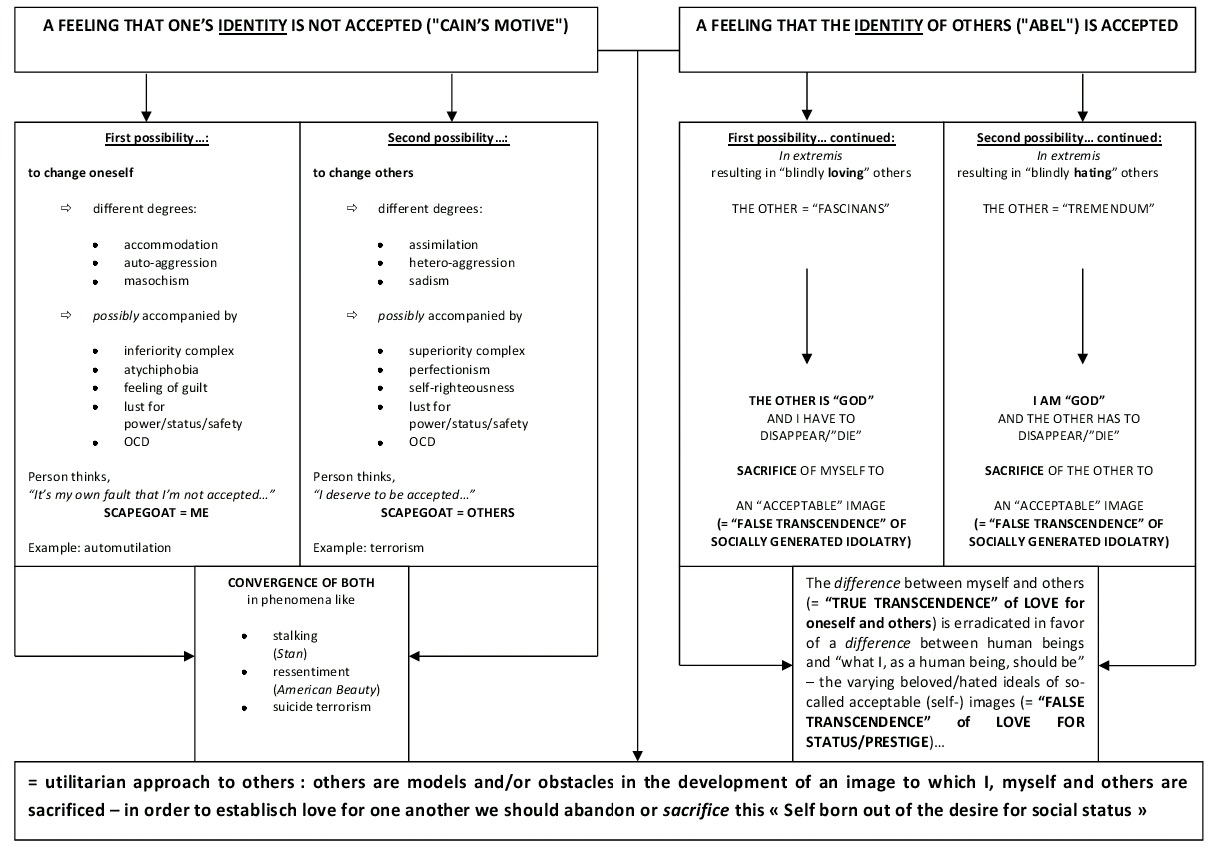
In this post I will try to give a glimpse of the way mimetic theory is able to foster a fruitful dialogue between different strands of thought in the humanities and how this dialogue indeed seems the result of Judeo-Christian influence in the Western world. I try to show that mimetic theory is a good starting point, able to connect and sometimes “correct” (or “ground” more fundamentally) basic insights of people like Thomas Hobbes, Sigmund Freud, Rudolf Otto, Jean Piaget, Jacques Lacan, Emmanuel Levinas and even a sociologist like Niklas Luhmann – among many others. But first I’ll give “the outcome” of my explorations, in a diagram (that was conceived for my book Vrouwen, Jezus en rock-‘n-roll).

From EROS (a mimetically mediated desire for recognition / a love for one’s self-image) to THANATOS (mental and/or physical “death”):

two potential destructive reactions following the confrontation with an (always mimetically) experienced difference between oneself and another (as an individual or collective entity).

TWO FEELINGS AN INDIVIDUAL IN THIS SITUATION IS CONFRONTED WITH AT THE SAME TIME AND TWO POSSIBLE “SOLUTIONS” TO THE FRUSTRATIONS ARISING OUT OF THE UNFULFILLED DESIRE FOR RECOGNITION

[CLICK IMAGE TO ENLARGE!]

Diagram Interdividual Psychology (Erik Buys)

CLICK HERE FOR PDF VERSION OF THE DIAGRAM

SOME BACKGROUND INFORMATION

Here are some text fragments from books I have been reading that led me to an even better understanding of my own diagram :). Three books are involved: Totalité et infini by Emmanuel Levinas, For René Girard edited by Sandor Goodhart et al., and When These Things Begin by René Girard. I have to mention especially that, apart from Emmanuel Levinas and René Girard, I was very inspired by the texts of Eugene Webb, Wolfgang Palaver and Michael Hardin in For René Girard. After the quote from Levinas, I also give some personal comments as a guideline to somewhat connect the different text fragments. [For more on Girard and Levinas, click here].

Emmanuel Levinas:

La philosophie occidentale a été le plus souvent une ontologie: une réduction de l’Autre au Même, par l’entremise d’un terme moyen et neutre qui assure l’intelligence de l’être.

Translation: Western philosophy has most often been an ontology: a reduction of the other to the same by interposition of a middle and neutral term that ensures the comprehension of being.

(Emmanuel Levinas, Totalité et infini. Essai sur l’extériorité, Paris, Le Livre de Poche, Kluwer Academic, p.33-34).

Personal comments (also to the texts mentioned below):

It is important to note that Levinas speaks of a “reduction”. Whenever traditional Western philosophy thinks of what the kosmos is essentially made of, it always posits an “ideal”. The whole of reality then should be understood as a striving towards the manifestation of that ideal (Aristotle‘s entelechy), or at least as an attempt to manifestly distinguish the “eternal, ever-present ideal essence of reality” from “what reality sometimes seems to be but is not” (Plato‘s or Socrates‘s maieutics). The ideal essence of reality brings about an order (out of “chaos”) that actually is sacrificial, a “peace” that rests on the oppression of what seems to contradict the ideal. Hence one could say, together with Levinas, that the ideal – whatever features it gets in a particular philosophical system – reduces everything that is other than itself to itself. However, what enables this reduction precisely is the fact that there indeed really is something “other” to reduce to begin with! So one could say that whenever some ideal is postulated as “the essence” or “the being itself” of reality, the “fuller” or “more true” being of reality is “forgotten.” Being is reduced to a goal oriented movement from an incomplete world (the subject of movement) toward a “perfect” world (the object of movement).

Martin Heidegger identified the subject-object dichotomy as the Seinsvergessenheit (forgetting of being) of traditional Western metaphysics. He tried to “go back”, beyond the order of clearly defined dichotomies (the law of non-contradiction of course being one of them) towards a thinking inspired by the poets – who remain much closer to the unresolvable ambiguities of reality. It shouldn’t surprise anyone that, by leaving the unavoidably sacrificial peace of a so-called ideal world order and philosophy behind, Heidegger’s philosophy at first could not resist the temptation of glorifying and unleashing the powers of violence as part of the “revelation of truth” (see his interpretation of the Greek aletheia). In a profound sense he continued the philosophical project begun by Friedrich Nietzsche, without however “moralizing” his ontology (in a renewed sacrificial hero-cult).

As far as I interpret and try to understand both Heidegger and Levinas, Heidegger considers violence (understood as the “struggle or concern for being”) as the basic answer to the ever-present possibility of death, while Levinas points to another possibility as far as human beings are concerned: the encounter with the Other (my fellow human being, my neighbor). In encountering the Other I discover my own struggle for being (against the fearful possibility of death) as a potential threat to the life of the Other. In other words, I get to know my own being as a potentially violent being. It is the “disinterested connection” to the Other – in other words “love without ulterior motives” – that both limits and opens up my struggle for being to a “being for the Other.”

Speaking with René Girard, it’s our mimetic (i.e. imitative) ability that connects us to the Other and that also allows us to discover the irreducible nature of the Other. True, it’s our mimetic ability that allows us to empathize with the Other, to “feel one” with the Other (to be able to “pretend” that we are the Other and to imagine what he feels, expects or desires we have to be able to imitate him). But on the other hand, the process of mimesis is only possible because of a distance, an insurmountable gap between myself and the Other, that is discovered precisely in the act itself of mimesis!

Because we are mimetically connected to each other, we are able to adapt ourselves to an image that we think would answer to the expectations of the other. When this becomes our main preoccupation, we reduce each other to mere means to fulfill a mimetically generated desire for recognition. Let me try to explain this a little better.

The originally disinterested connection to the Other (upon which all “interested” connections are – “parasitically, satanically” – dependent) might be corrupted when we imitate each other’s desires. It’s because you are (mimetically) able to identify yourself with the desires of others that you, first, might discover yourself as an object of (their) desire and, second, that you might discover someone else as well as object of (their) desire. Because your desire imitates (and is thus engendered by) the desires of others, your desire towards yourself as the object of the desires of others will generate admiration or envy towards that other who seems to be also desired by others. You’re not only mimetically able to identify with the desires of others to discover yourself as an object of desire, but you’re also able to mimetically identify yourself with an other who seems to posses the desire (and thus recognition) of others. What happens, time and again, is that we develop a desire to be like an admired / envied other. This implies that we cannot love ourselves anymore, but it also implies that we can no longer love the other. We often desire recognition, not for ourselves, but for the prestige we have constructed in jealously comparing ourselves – not to others, but to what we imagine about others. We, as human beings, don’t just want what we need, we want what seems desirable by others as well (the BMW instead of…), and this grants us prestige.

GoetheSee this insightful quote by Johann Wolfgang von Goethe, in his The Sorrows of Young Werther: We are so constituted by nature, that we are ever prone to compare ourselves with others; and our happiness or misery depends very much on the objects and persons around us. On this account, nothing is more dangerous than solitude: there our imagination, always disposed to rise, taking a new flight on the wings of fancy, pictures to us a chain of beings of whom we seem the most inferior. All things appear greater than they really are, and all seem superior to us. This operation of the mind is quite natural: we so continually feel our own imperfections, and fancy we perceive in others the qualities we do not possess, attributing to them also all (those talents) that we enjoy ourselves, that by this process we form the idea of a perfect, happy man, — a man, however, who only exists in our own imagination.

The Sorrows of Young Werther Goethe quote

As René Girard shows in discussing the presence of mimetic desire in groups of primitive humans, the mutually (mimetically) enforced competitive desire for prestige – mimetic desire, in short – might spread throughout individuals of the same group in such a way that the group finds itself in a veritable crisis wherein all differences disappear and each rival resembles the others more and more. The solution to this crisis might be the mimetic unification against one rival. Indeed, my (or another’s) rival might become the enemy of all if everyone imitates my enmity against that rival. The war of all against all becomes the war of all against one, and a new difference – a new foundation for further differences and order – is established. When the common enemy is banned from the group or even beaten to death, the scapegoat mechanism sets in. The group experienced turmoil as long as their victim was around, while, on the other hand, it experiences a renewed stability when the victim is no longer around or alive – the victim is present as dead. According to Girard, groups of primitive humans gradually projected their own violence unto the victims of group violence, wrongfully experiencing these victims as responsible both for crisis and the resolution of crisis.

Also gradually, primitive communities will associate new situations of disorder with the resurgence of a former victim of group violence. In other words, they experience a person who is not visibly present anymore, but whose presence is ‘felt’ in situations of turmoil. In other words still, one of the former victims of group violence has become a ‘ghost’ or a ‘god’. At the same time, primitive human societies also ‘learn’ that killing someone apparently restores order. So together with the belief in ghosts and gods considered responsible for all kinds of possible violent disasters, the belief originates concerning the effectiveness of sacrifices to restore, renew or keep order, life and stability in human society. If primitive societies would have seen that the victims of group violence are no more responsible for violence than other members of the group, they would not have developed these beliefs. Violence became something sacred because the victims of group violence were considered exclusively responsible for the violence they were associated with. Those victims were, in other words, scapegoats. [For more on Girard’s account on the origin of religion, click here].

Girard argues that all other associations regarding ‘the sacred’ rest on this first association between violence and divinized victims of group violence. Everything that can be associated with violence had the potential to become sacred or divinized as well. Sexuality became sacred. Indeed, sometimes males fight over females. Food became sacred. Indeed, people fight over food sometimes. Territory  became sacred. Indeed, people go to war sometimes because of territory. Nature as a whole became sacred. Indeed, natural disasters are ‘violent’ and provoke violence if they cause lack of food and water… And so the world and the experience of man became sacred. The ambiguity of the erstwhile victims of group violence also explains why gods have a ‘dual’, ‘ambiguous’ quality.They’re good and bad… Good aspects of the gods can be allowed in rituals, while bad aspects of the gods are forbidden and taboo. For instance, sacrifice is a form of ‘good’ (controlled) sacred violence to be distinguished from ‘bad’ sacred violence, which is to be avoided and is taboo…

Religions came and went, but the age-old associations regarding the sacred were transmitted down the generations, albeit in varying forms (human sacrifice becoming animal sacrifice, for instance). The Greeks still had Ares, god of war, as they had their goddess of love, Aphrodite. The Romans copied (indeed, ‘imitated’) the Greeks and spoke of Mars and Venus. Asked why they perform their rituals and sacrifices and why they respect their taboos, primitive societies always answer: “Because our ancestors did it, and because we have to respect the ghosts and the gods in order to sustain our community…”

The image or model for the cultural order in a particular society – with its particular taboos and rituals that have to be respected – rests on the wrongful perception of the victims of group violence. Human culture can be understood as the continuous attempt to justify the violent death (murder or suicide) of one (monstrous and/or heroic) member for the salvation of (the order in) a whole group. Christianity, however, undermines this justification. Christ is a victim of the same sacrificial system which grounds human culture, but he is said to be innocent! This allows human beings to discover the true origin of violence and crisis. It is not something “alien” that comes from the gods and is demanded or justified by them, it’s something that comes from (mimetic) interactions between human beings themselves. Hence the possibility of a “true” psychology, sociology and anthropology. The Christ event also allows human beings to (re)discover their own responsibility before each “Other” and to part ways with the justification of a sacrificial order – whether expressed in mythology or philosophy. In a paradoxical way, Christ invites us to imitate him and to sacrifice our sacrificial identity. Instead of just imitating and accepting a given order, we should ask ourselves at what (or better, whose) expense we continue this order.

One final remark. The abandonment of sacrifice to ground a given order is, as Girard has shown following Judeo-Christian revelation, deeply ambiguous: it allows for new types of competition, rivalry and even violence between human beings as it also allows for “Love born out of freedom” for each Other (true Love that is, not out of fear of not having an admirable “self-image”).

In short, the image of an ideal world – in whatever context of human life – results from mimetically mediated desires between human beings, and is, as we have said already above, essentially sacrificial. It does not only “forget” the “otherness” of the Other, but also the “otherness” of myself. To escape this mimetically generated tendency to (mentally and/or physically) “kill” myself and the Other in favor of the idol of “an ideal”, we should redirect our mimetic faculties to their origin: the mysterious, disinterested connection to the Other – Love. Historically, the Christ event unleashes the possibility of this redirection in a fundamental way.

Emmanuel Levinas Qote on Faith

Eugene Webb:

Lacan proceeded more directly from the tradition of Freud than did Girard, and he uses the imagery of sacrifice in a more positive way, but both can be interpreted as revisionist figures in the Freudian tradition. For both, desire tends to have a mimetic character, in that it is closely tied up with the perceived or presumed desires of others. Also for both, desire tends to be metaphysical, in that it generates a falsely conceived self. For Lacan, the false self is any object (a person or an image) in which the ego tends to lose itself through identification, but it is especially the objectified image of a self that forms in what Lacan termed “the mirror stage” of development, the child’s “jubilant assumption of his specular image.” Out of this enchantment by one’s own objectified image evolves what Lacan called l’imaginaire: a fundamentally narcissistic fascination that tends to draw all relationships into an unrealistic and futile striving for identification with an objectified “other” – one’s own self-image, or the mother, or some other object – in a sort of “fusional cannibalism.” In this process, the individual confuses his and the other’s desires, seeking to see himself as the object of the other’s desire and, by imaginative identification with that other, to desire himself with that same desire, so as to believe in his own reality as an object. Put concisely, the fundamental human temptation is to avoid the risk of being an actual subject by becoming an imaginary object. […] Despite Girard’s distrust of the language of sacrifice, there is a sense in which the transcendence Girard seeks of the self generated by mimetic desire could also be described as something like the sacrifice of a false self for the sake of discovering a new, true life animated by the spirit that was in Christ.

(Sandor Goodhart et al. (editors), For René Girard. Essays in Friendship and in Truth, Studies in Violence, Mimesis, and Culture Series, Michigan State University Press, 2009, p.151).

Wolfgang Palaver:

It was Eric Voegelin‘s comparison of Hobbes and Augustine that… opened my eyes and made me realize how far Hobbes had departed from Christian tradition. Voegelin’s insight – that Hobbes’s description of human nature is nothing but a description of pride, a “passion aggravated by comparison” – helped me to connect this departure with mimetic theory. Whereas Augustine distinguished the love of self (amor sui) from the love of God (amor Dei), Hobbes “threw out the amor Dei and relied for his psychology on the amor sui, in his language the self-conceit or pride of the individual, alone.” Christianity, in accordance with the biblical Revelation, always emphasized the human orientation primarily toward eternal or heavenly transcendent goods – especially the love of God – to avoid the lethal trap of mimetic rivalry following the soul’s longing for temporal goods. Both Augustine and Hobbes were aware how much human violence is rooted in mimetic rivalry. But it was only the Church Father who realized that there is a way out of this deadlock – namely, by searching first for the kingdom of God. This is the same insight that is expressed in the Ten Commandments. We are only able to follow the tenth commandment – the rule against mimetic rivalry – if we obey the first commandment and overcome idolatry.

(Sandor Goodhart et al. (editors), For René Girard. Essays in Friendship and in Truth, Studies in Violence, Mimesis, and Culture Series, Michigan State University Press, 2009, p.192-193).

Michael Hardin:

At the Cross, our god concepts die. The New Testament writers and early Church Fathers called this death of the god concepts the conquering of the satanic powers, the powers that rule human life. In the Cross of Jesus, the horizon of the kingdom of God’s love and forgiveness is opened and our self-understanding is transformed, as we relate no longer to the gods of this world but to the Creator of heaven and earth. […] We become those who no longer imitate the desires of the world, the kosmos structured on a dysfunctional logos (1 John 2:15ff), but instead, like Jesus, become those who seek God and God’s rule with a singular focus. This transformation does not remove us from the world but enables us to be active agents of the transforming character of the love of God in all our relationships. […] The New Testament writers perceived the great power behind the imitation of the love of God expressed in Jesus. To desire as Jesus desired is to desire the transcendent in the immanent neighbor, to recognize that love of God and love of neighbor form a unity that cannot be broken. Rather than separating theology and ethics, mimetic theory grounds each in the other in the redemptive event of the Cross.

(Sandor Goodhart et al. (editors), For René Girard. Essays in Friendship and in Truth, Studies in Violence, Mimesis, and Culture Series, Michigan State University Press, 2009, p.267-268).

René Girard in conversation with Michel Treguer:

MT: What do you think of the famous “death drive” introduced by Freud?

RG: It’s a good example of pointless complication. In my view, the death drive exists, but it is entirely linked to mimetic rivalry. Mimetic desire makes you into the rival of your model: you fight with him over the object that he himself pointed out to you. This situation reinforces desire and increases the prestige of the obstacle as such. And the supreme obstacle, of course, is death, it’s what can kill you. The death drive is the logical outcome of this mechanism. But Freud is unable to link this paradoxically narcissistic desire for a biological, inanimate state to the other phases of the process; nor even, to use his own concepts, to link it to the Oedipus complex, for example, even though he’s perfectly aware of the latter’s mimetic nature. He contents himself in some sense with adding an extra drive. This motley assemblage inspires awe in the credulous, but if it can be simplified, we have to simplify it.

MT: This is the question that comes to mind as I listen to you: “death drive” or “drive to murder”?

RG: [A pause] It’s the same thing! And eroticism tends toward both. Just think about the symmetry of the processes at play. Take Romeo and Juliet, who are defined perfectly by Friar Lawrence: “These violent delights have violent ends” (Romeo and Juliet, II, vi, 9). It’s always forgotten that Shakespeare starts by showing us the young Romeo madly in love with a woman who wants nothing to do with him. Shakespeare’s plays always contain things that contradict in specular fashion the conventional – and stubbornly romantic – image that, in spite of everything, we have of them. The cult of the obstacle drives human beings from their human condition toward what is most against them, toward what hurts them the most, toward the non-human, toward the inert, toward the mineral, toward death… toward everything that goes against love, against spirit. The skandalon that the Gospels speak of in relation to covetousness is the obstacle that is increasingly attractive the more it pushes you away. You want it because it rejects you. This seesawing back and forth between attraction and repulsion cannot fail to be mutually destructive and destabilizing at first, before leading to utter annihilation. Refusing God is the same thing because God is the opposite of the skandalon. God died for human beings. Remaining blind to God while going for the first super model who comes along – that’s what human beings do.

(René Girard, When These Things Begin, Studies in Violence, Mimesis, and Culture Series, Michigan State University Press, 2014, p.106-107).

There was a time when a literary talk show could attract around 6 million regular viewers on a weekly basis. Apostrophes was one such prime-time show on French television, every Friday night (on the channel France 2 or “Antenne 2”). It was born out of the daring mind of Bernard Pivot, who also hosted the show as long as it ran (for fifteen years that is, from January 10, 1975 to June 22, 1990).

Guests included writers like Georges Simenon, Milan Kundera, Norman Mailer, Tom Wolfe, Umberto Eco, Vladimir Nabokov, Susan Sontag, Marguerite Yourcenar, Aleksandr Solzhenitsyn, John Le Carré and Charles Bukowski. All types of intellectuals (from historians to sociologists) came by as well, like Pierre Bourdieu and Claude Lévi-Strauss. Political figures like François Mitterand and Valéry Giscard d’Estaing didn’t pass the invitation. Even the Dalai Lama was a welcome guest.

René Girard appeared on the show twice, a first time on June 6, 1978 (episode 150 of the show) presenting his seminal book Des choses cachées depuis la fondation du monde (Things Hidden Since the Foundation of the World), and a second time together with Michel Serres in the special episode Deux Philosophes Français aux Etats Unis (July 21, 1989).

WATCH GIRARD’S FIRST APPEARANCE ON APOSTROPHES:

“… the prostitutes are entering the kingdom of God ahead of you.”

[translated from a part in my book Vrouwen, Jezus en rock-‘n-roll]

What a disturbing figure. Jesus openly declares that tax collectors and prostitutes – quintessential sinners – are entering the kingdom of God ahead of the chief priests and the elders of the people of Israel. Go figure.

The chief priests and the elders think highly of themselves. They get recognition from the common people. Or so they think. They have a religious and social status worthy even of some recognition from “the One” Himself. Or so they presume. In comes Jesus. He basically tells them they are high on some grand illusion. He tells them what’s real. And he knows that they know what’s real, deep down inside. Let’s have a closer look at how Jesus proclaims the truth.

Matthew 21:28-32

Jesus said, “What do you think? There was a man who had two sons. He went to the first and said, ‘Son, go and work today in the vineyard.’ ‘I will not,’ he answered, but later he changed his mind and went.

“Then the father went to the other son and said the same thing. He answered, ‘I will, sir,’ but he did not go.

“Which of the two did what his father wanted?”

“The first,” they answered.

Intervention (Jesus is my homeboy)Jesus said to them, “Truly I tell you, the tax collectors and the prostitutes are entering the kingdom of God ahead of you. For John came to you to show you the way of righteousness, and you did not believe him, but the tax collectors and the prostitutes did. And even after you saw this, you did not repent and believe him.”

As he often does, Jesus tells a story to get his point across. This time it’s about a father and two sons. Basically, the second son is a hypocrite and the first son falls victim to the hypocrisy of his brother. Of course the father will think that the second son is the one who worked in the vineyard and appreciate him for it, while it’s his other son who did all the work. In other words, the second son will get the recognition that should actually be given to the first son.

Apart from the story of Cain and Abel, there’s another Old Testament story about two brothers that resonates throughout this parable of Jesus, namely the Genesis story of Jacob who deceitfully takes a blessing from his father Isaac. This particular blessing was normally reserved for his brother Esau, the firstborn. In the Genesis story (Genesis 27:1-46), Jacob (“he grasps the heel”, a Hebrew idiom for “he takes advantage of” or “he deceives”) is the one who gets protection. As is known, Jacob later becomes “Israel”, ancestor of the Jewish people.

By referring to the story of its ancestor Jacob, Jesus implicitly criticizes how Israel tends to build its identity and structure its society. Jesus criticizes social systems that rely on the exclusion of others through rivalry and hypocrisy. This criticism is at once general and personal. Jesus suggests in his parable that the chief priests and the elders are like the second son. In other words, he tells them that they are hypocrites! He also implies that the tax collectors and prostitutes are like the first son; they fall victim to the hypocrisy of the chief priests and the elders.

HookerOf course the elders and chief priests deal with the tax collectors, but to protect their image they will deny any affiliation with “those collaborators of the Roman Empire who take money from their fellow Jews, in the process also fraudulently, deceitfully enriching themselves…” The reality of the situation is not that black and white though. It is no surprise that some of the chief priests and elders turn out to be as corrupt (or even more) as the tax collectors themselves. There is low life in high places. [AUDIO SONG TIP: Low Life in High Places by Thunder].

As for the prostitutes, Jesus suggests that they too suffer from hypocrisy. Indeed, when they meet a client in public, their client will deny any affiliation with them. Their client, be it a chief priest or an elder or someone else, might say “I don’t know the woman!”, and protect his reputation among the common people. And the prostitute, well, she has no choice but to forgive the hypocrisy of her clients beforehand. It’s part of the game she is forced to play. Otherwise she would lose all her clients. She plays forgiveness. [AUDIO SONG TIP: When You Were Young by The Killers].

Now we might understand a little better why Jesus claims that the tax collectors and prostitutes are “closer to the kingdom of God” and to the righteousness proclaimed by John the Baptist. They experience firsthand how mechanisms of social exclusion allow societies to structure themselves. They understand the injustice of many social systems. They know that acting against that injustice has to do with taking sides with the outcasts. To repent thus means to acknowledge that you yourself are part of a social game that’s played at the expense of others and to do something about it. It means “losing a life that is directed at a socially acceptable image/status/reputation/power” for the sake of “the excluded other”, the consequence being that you “gain your life” (as you no longer idolatrously lose yourself to an image).

Jesus himself always takes sides with the excluded others, and deeply understands the hidden truth behind our socially mediated identities. That’s why he says, after yet another parable (of the tenants) in the same chapter of Matthew’s Gospel:

Jesus RockJesus Rejected Cornerstone‘The stone the builders rejected
has become the cornerstone;
the Lord has done this,
and it is marvelous in our eyes’

(Matthew 21:42)

Because he is willing to take the position of the social outcast, Jesus is right when he proclaims the paradox of the Gospel (Matthew 16:25-26):

“For whoever wants to save their life will lose it, but whoever loses their life for me will find it. What good will it be for someone to gain the whole world, yet forfeit their soul?”

Jesus lives out (of) the Love of “the One” who is “Other than human” and therefore his identity and self-concept is not dependent on the socially mediated idolatries of this world. His self-respect is not dependent on the respect he gains from other people and therefore he is able to stand up for the outcasts in society.

Of course, when you imitate Jesus and take sides with the socially excluded, there are two possibilities: or other people will show mercy, or they will sacrifice you as well. Jesus is willing to run this risk because the love for his neighbor is stronger than the fear of becoming a victim himself. He refuses to sacrifice himself to a socially acceptable self-image at the expense of others. He is in no ways a masochist. Jesus believes that his Father – Love – “desires mercy, not sacrifice” (Matthew 9:13). That’s why he indeed can save others but cannot save himself when he is arrested and crucified (Matthew 27:39-41). If he would start a civil war others would be sacrificed because of him, and he thus would no longer obey to the call of Love.

As we know, Peter at first does not imitate Jesus. Peter succumbs to the fear of becoming a social outcast when Jesus is arrested (see below, excerpts from Matthew 26). He denies any affiliation with Jesus because he fears becoming a victim himself. If, on the other hand, he would have taken sides with Jesus, he would have chosen for himself more fully (as he would not have chosen for his image or reputation).

However, like the clients of the prostitutes might say “I don’t know the woman (the prostitute)!” to protect their reputation, Peter says “I don’t know the man (Jesus)” to protect his position in society. Peter wants to secure himself.

At the same time, like the prostitutes forgive the hypocrisy of their clients, Jesus forgives Peter’s hypocrisy beforehand. But unlike the prostitutes, Jesus does have the choice not to forgive Peter, which makes his actual forgiveness more fully an act of grace.

Nevertheless, Matthew makes clear that the grace of Jesus indeed has to do with the grace of “prostitutes”. The Evangelist deliberately constructs a genealogy of Jesus (in the first chapter of his Gospel) wherein he mentions four Old Testament women who had a questionable reputation. Tamar and Rahab are known as prostitutes, Ruth is a seductress and Bathsheba, “Uriah’s wife”, is known as an adulteress…

Maybe one of the first steps towards the righteousness of “the kingdom of Love” has to do with the acknowledgment that our identities exist by receiving grace from those we tend to despise… To realize this might imply the tears that begin to wash our sins away, tears of true metanoia… as we follow in Peter’s footsteps.

Matthew 26:31-35

Then Jesus told them, “This very night you will all fall away on account of me, for it is written: “‘I will strike the shepherd, and the sheep of the flock will be scattered.’ But after I have risen, I will go ahead of you into Galilee.”

Peter replied, “Even if all fall away on account of you, I never will.”

“Truly I tell you,” Jesus answered, “this very night, before the rooster crows, you will disown me three times.”

But Peter declared, “Even if I have to die with you, I will never disown you.” And all the other disciples said the same.

The_Denial_of_Saint_Peter by Caravaggio_(1610)Matthew 26:69-75

Now Peter was sitting out in the courtyard, and a servant girl came to him. “You also were with Jesus of Galilee,” she said. But he denied it before them all. “I don’t know what you’re talking about,” he said.

Then he went out to the gateway, where another servant girl saw him and said to the people there, “This fellow was with Jesus of Nazareth.” He denied it again, with an oath: “I don’t know the man!”

After a little while, those standing there went up to Peter and said, “Surely you are one of them; your accent gives you away.” Then he began to call down curses, and he swore to them, “I don’t know the man!”

Immediately a rooster crowed. Then Peter remembered the word Jesus had spoken: “Before the rooster crows, you will disown me three times.” And he went outside and wept bitterly.

This post follows the suggestions for a high school course on mimetic theory. The aforementioned situations are examples of the third type of the scapegoat mechanism (this time about SHAME and not ressentiment).

FOR MORE, CHECK OUT ANNIE LOBERT’S STORY ON HOOKERS FOR JESUS (CLICK TO READ)

hookers-for-jesus

CLICK HERE FOR PDF-FILE OF THE EXAMPLE IN MATTHEW 21

Screenshot_2014-06-19-19-58-14

CLICK HERE FOR PDF-FILE OF THE EXAMPLE IN MATTHEW 26

Screenshot_2014-06-19-20-05-20

Here are the previous posts:

  1. Mimetic Theory in High School (click to read)
  2. Types of the Scapegoat Mechanism (click to read)
  3. Scapegoating in American Beauty (click to read)
  4. Philosophy in American Beauty (click to read)
  5. Real Life Cases of Ressentiment (click to read)
  6. Eminem Reads the Bible (click to read)

Gustave Caillebotte_Paris Street Rainy Day 1877Last year, after meeting my friends from The Raven Foundation in Chicago, I had the opportunity to visit the exhibition Impressionism, Fashion, and Modernity at The Art Institute of Chicago.

As the exhibition points out, the modern fashion industry was born in Paris in the second half of the nineteenth century. Since then, fashion – la mode – has become one of the main forces in today’s so-called individualistic and free market-driven western society. The fashion industry thus reveals one of the main paradoxes if not contradictions in modern man’s self-concept. Although nowadays we consider ourselves to be emancipated and autonomous individuals we nevertheless remain highly susceptible to herd behavior. René Girard might help us to understand this situation more broadly. [Read also the second part of a previous post by clicking here].

René Girard’s mimetic theory explains that, beyond physical needs, human desire is structured according to mimetic (i.e. imitative) interactions. People model each other’s ambitions and aspirations. As is well-known, the convergence of desires on the same object (e.g. two or more children wanting the same toy) or on the same goal (e.g. two or more people wanting the same job promotion, status or power) often leads to rivalry and sometimes even violence. Not surprisingly, the escalation of this mimetic rivalry (i.e. rivalry based on mimetic/imitative desires) within groups threatens the stability and even survival of communities.

History shows that human communities developed several traditions to prevent the potential destructive outcome of mimetic desire and mimetic rivalry. The French Ancien Régime, still deeply rooted in the feudal system of the Middle Ages, was incredibly hierarchical both socially and politically. There were three different Estates in society, the First being the Church, the Second the Nobility and the Third the so-called Common People. The common people had to accept their unprivileged position in society. They were told that they would evoke the wrath of God if they would question the privileged position of the Church and the Nobility. At the same time, the common people were told that a reward awaited them in “an afterlife” if they “behaved well” and accepted their fate. In other words, the Third Estate could not aspire to the position of the other Estates. In still other words, mimetic desire was suppressed by a religiously established system of taboos and rituals. People had to understand and accept that there were differences in society from birth.

Ancien Regime

Throughout the ages, Christian reformers criticize the Church whenever she lends herself to sustain a society where differences between people are based on oppression. From Saint Benedict to Saint Francis to Saint Ignatius to the “Prince of the Humanists” Desiderius Erasmus – all of them call for a return to the God of Christ, the God of the Gospels, to question the authority of the God who justifies certain types of violence and oppression. It is no coincidence then that several historians (Marcel Gauchet being one of them) understand the Enlightenment and the dismemberment of a principally hierarchical society on the basis of traditional religious means as a consequence of the Judeo-Christian influence on the western world. To quote Marcel Gauchet, Christianity is the “religion of the end of religion”.

Erasmus

Abraham Lincoln emancipation of slavesEventually, because Christianity gradually destroyed the authority of the God(s) of traditional religion, the hierarchical nature of society was no longer accepted. The French revolutionists cried égalité! and the idea of a principally egalitarian society was born – all human beings (should) have equal rights. This meant that mimetic desire became less suppressed, and this led to the emancipation of different groups in western society. First, factory workers started to compare themselves to the wealthy factory owners. Why shouldn’t the workers enjoy the same rights as their employers? In other words, the workers started to desire what their employers possessed and this mimetic desire could no longer be suppressed. Second came the emancipation of women. They started to desire the rights owned by their male counterparts. Third came the full revolt of blacks (heir to black slaves) in the US. Then came the emancipation of gay people who compared themselves to heterosexuals and desired and demanded equal rights… Finally, together with the aforementioned emancipatory movements, the emancipation of children and youngsters (and the phenomenon of a so-called youth culture) poses new challenges to our personal and social self-understanding. There’s a strange interaction going on, with a rivalry between young and old to become each other’s model or example. [Read more on the consequences for young people by clicking here].

What is striking in all these cases is that standing up for one’s own identity is based on a comparison with the identity of others. In standing up for themselves people imitate others.

shoe foot skeleton fashion victimNow, let’s interpret the phenomenon of fashion again from these observations. At the birth of modernity the traditional guidelines which structure the behavior of the individual members of society begin to erode. Individuals more and more find themselves in a vacuum concerning the way they could or should behave and lead their lives. However, instead of developing a life from a so-called very own autonomy and freedom (as people often believe they do – Girard calls this the romantic lie), people look at what others are doing to give their life (their desires and ambitions) direction. Hence a phenomenon like fashion. The fashion industry really rests on the assumption of individuals that they are free to create their own identity and thus is able to enslave those very same individuals to a never-ending cycle of mimetic desire. The price for a so-called free identity is an identity constantly on the brink of being sacrificed again to the latest trend. It’s what drives our economy on the one hand, and might destroy our natural environment on the other… It’s what drives our consumerism yet might destroy our soul (as we attach ourselves to what’s perishable)… I guess G.K. Chesterton is right, in a profound sense, “For when we cease to worship God, we do not worship nothing, we worship anything.”

fashion slavesIn short, the liberation of mimetic desire in western society has some good as well as bad consequences. Anyways, perhaps we should keep our desires “to have more (but never enough)” in check in order to prevent the next financial, ecological, social and personal crisis?

Chesterton quote on worshipidol worship social mediaChesterton quote on believing in anything