This post follows a thread on suggestions for the development of a high school curriculum on Mimetic Theory. Click the following titles to see what else I’ve done on this so far (be sure to check out the pdf-files!):

  1. Mimetic Theory in High School (click to read)
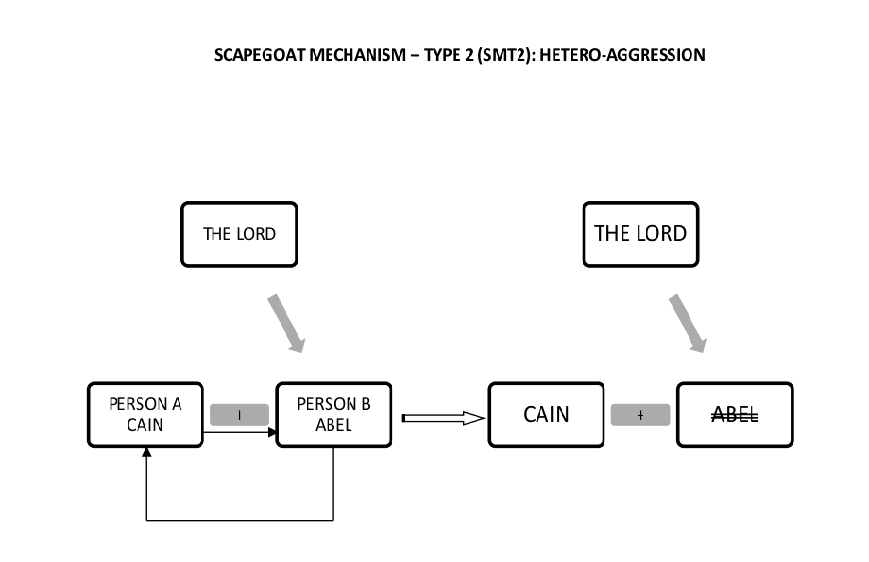
  2. Types of the Scapegoat Mechanism (click to read)
  3. Scapegoating in American Beauty (click to read)
  4. Philosophy in American Beauty (click to read)
  5. Real Life Cases of Ressentiment (click to read)

Eminem (Horns)The story of Cain and Abel (in the book of Genesis) is compared to the story of Stan (by Eminem) to illustrate what I’ve called types 1 and 2 of the scapegoat mechanism. Cain and Abel is an example of the second type of scapegoat mechanism, namely hetero-aggression. Stan is an example of the first type of scapegoat mechanism, namely auto-aggression. By the way, the comparison between Cain and Stan is a translation of a text that first appeared in Dutch in my book Vrouwen, Jezus en rock-‘n-roll (Averbode, 2009).

CLICK TO READ PDF-VERSION OF A COMPARISON BETWEEN CAIN AND STAN

CLICK TO READ PDF-VERSION SCAPEGOAT MECHANISM 1 & 2 (EXAMPLES)

Stan

Cain

[As an aside, it is possible to criticize Nietzsche’s concept of Judeo-Christian tradition as a product of ressentiment by comparing the third type of the scapegoat mechanism (ressentiment, indeed) with the story of Cain and Abel as an example of the second type. It is clear that, in the biblical story, the Lord condemns the actions of Cain. This implies that the Lord would condemn the actions of persons that are consumed by ressentiment as they take the parallel position of person A (Cain’s position). Thus the god born out of the ressentiment of the so-called slaves (a god who recognizes the slaves while condemning the so-called masters) is not the God of Judeo-Christian tradition.]

[As a second aside, click here for more on hip-hop and theology.]

In short, what the following comparison is all about: mimetically ignited love – eros – for the imagined situation of the other leads to hate towards one’s own life and the life of the other (or, which is the same, love for a so-called acceptable self-image) – a crisis of identity and social order. Person A (CAIN or STAN) tries to resolve the crisis that arises out of a comparison with person B (ABEL or SLIM) by sacrificing the other or by sacrificing him/herself – thanatos!

PDF-text of Cain and Abel (Genesis 4:1-18)

PDF-text of Stan (by Eminem)

CAIN AND ABEL COMPARED TO STAN AND SLIM

  • IDENTIFICATION (THROUGH MIMESIS)

Cain and Abel develop similar activities:
In the course of time Cain brought to the LORD an offering of the fruit of the ground, and Abel also brought of the firstborn of his flock and of their fat portions.

Stan and Slim have similar experiences:
“See I’m just like you in a way… I never knew my father neither – he used to always cheat on my mom and beat her. I can relate to what you’re saying in your songs…”

  • ANGER BECAUSE OF A – FELT, THOUGH NOT NECESSARILY REAL – LACK OF RECOGNITION

Cain becomes angry because Abel gets attention from the Lord while he himself doesn’t seem to get any attention at all:
And the LORD had regard for Abel and his offering, but for Cain and his offering he had no regard. So Cain was very angry, and his face fell.

Stan becomes angry because Slim does get recognition from his fans – Stan being one of them – while Stan seems to find no recognition at all:
“Dear Mister-I’m-Too-Good-To-Call-Or-Write-My-Fans, this’ll be the last package I ever send your ass! It’s been six months and still no word – I don’t deserve it?”

  • RECOGNITION NONETHELESS FOR THE PERSON WHO FEELS UNRECOGNIZED

The Lord worries about Cain:
The LORD said to Cain, “Why are you angry, and why has your face fallen?”

Slim worries about Stan:
“… why are you so mad?”

  • A WARNING FOR THE POSSIBLE EVIL CONSEQUENCES OF FRUSTRATION, ANGER AND STUBBORN PRIDE

The Lord advises Cain to do well:
“If you do well, will you not be accepted? And if you do not do well, sin is crouching at the door. Its desire is for you…”

Slim advises Stan to calm down and to do well:
“I really think you and your girlfriend need each other or maybe you just need to treat her better. […] I think that you’ll be doin’ just fine if you relax a little…”

  • A FINAL WARNING 

The First Mourning (Adam and Eve mourn the death of Abel) by Bouguereau 1888“… but you must rule over it…”

“I just don’t want you to do some crazy shit.”

  • WARNING GOES IN VAIN – MURDER ON A DESOLATE PLACE

Cain kills Abel:
Cain spoke to Abel his brother. And when they were in the field, Cain rose up against his brother Abel and killed him.

Stan kills himself and his pregnant girlfriend:
“Some dude was drunk and drove his car over a bridge and had his girlfriend in the trunk, and she was pregnant with his kid…”

MAY 20th, 1910 – The royal and political heads of Europe are (still peacefully) gathered for the funeral of Edward VII, king of Great Britain and Ireland, of the British Dominions beyond the Seas, and Emperor of India. Wilhelm II, Emperor of Germany, is also present at the funeral of his uncle. Once again, Wilhelm is confronted with the grandeur of his British relatives.

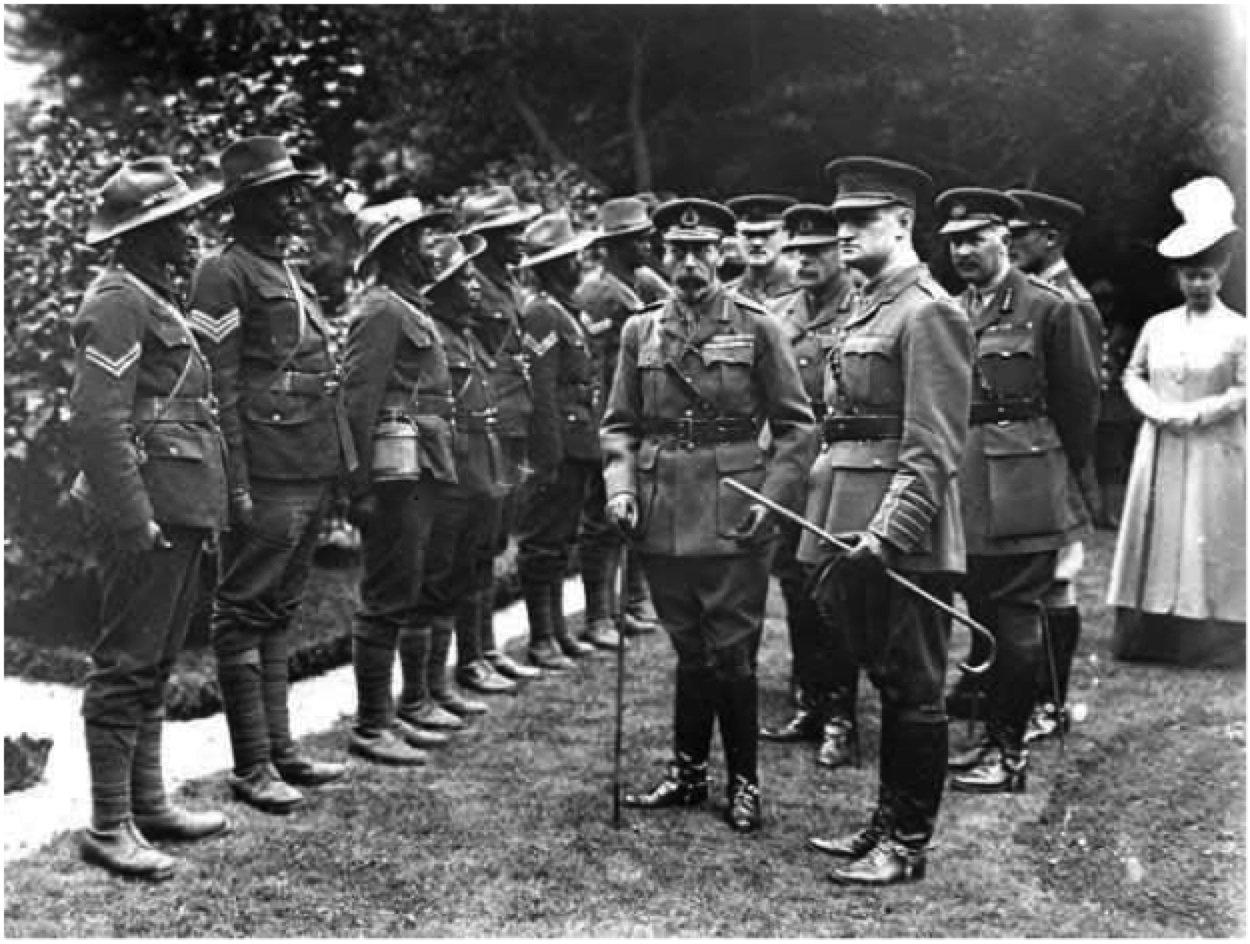
George V and members of WAFFIt is no secret that Wilhelm II was extremely jealous of his British uncle first and then of his cousin, king George V, because of the many colonies they owned (picture on the left, king George and members of the WAFF). This kind of envy can only exist towards people one feels closely related to. It’s easier to keep on admiring those who do not belong to our own social environment than those who are close to us. The great William Shakespeare constantly shows the paradoxical nature of human relationships, where contagious conflicts precisely arise between people who often admire each other first. Already in the prologue of Romeo and Juliet Shakespeare sets the stage for an escalation of a conflict between families “both alike in dignity” – a conflict that only comes to an end when Romeo and Juliet sacrifice themselves:

“Two households, both alike in dignity,

In fair Verona, where we lay our scene,

From ancient grudge break to new mutiny,

Where civil blood makes civil hands unclean.

From forth the fatal loins of these two foes

A pair of star-cross’d lovers take their life;

Whose misadventured piteous overthrows

Do with their death bury their parents’ strife.”

So it’s not the difference or inequality as such that potentially creates enmity but our tendency to imitate those we somehow identify with. It’s – as René Girard would have it – a mimetic (i.e. imitative) law of human conflict, which Plato already refers to in his dialogue Lysis (215d) when Socrates says:

“By a universal and infallible law the nearer any two things resemble each other, the fuller do they become of envy, strife and hatred…”

These universal truths are repeated throughout history, time and again, as in a never ending circle. If we would ever experience a global war because of a lack of natural resources, then the origins of such a war would lie in the mimetic nature of human desire. We are not simply happy with the things we physically need. We want what others have, we imitate the desires of our fellow men, even if we don’t necessarily need what they have. That’s why our ecological footprint is too big. And that’s why we could create scarcities of natural resources. We’re not just happy with the satisfaction of our hunger. We want the grape instead of the cucumber if our neighbor is eating grapes, and this tendency is already present in our ape cousins (for more on this click here to see one of Frans de Waal’s experiments).

Both the origins of World War I and World War II have to do with people wanting grapes although they already had cucumber. The death of millions of Europe’s children eventually ended the first orgy of violence, but – to quote Shakespeare on this – “the parents’ strife” only momentarily came to a halt. World War II indeed meant that “from ancient grudge came new mutiny”, violence spreading itself like a contagious disease…

SPRING 1914 – Germany is one of the wealthiest and most dynamic countries in the world, having the highest material prosperity in the world. In 40 years time the population has increased by 65 % to 68 million inhabitants. Germany is also an industrial giant. Essen has the biggest steel and weapon factory in the world with 81,000 people working there. Daimler-Benz, Siemens, AEG, BASF and Bayer are leading companies.

Hamburg, Kaiser Wilhelm II. im Tierpark HagenbeckDuring that time Kaiser Wilhelm II had the biggest land army in the world and he invested some of his private money to buy and develop cannons.  Growing up he had seen the richness of the British Empire and he tried to emulate this for his own country. Therefore he supported Germany’s naval expansion and eventually did obtain an empire in Africa and the western Pacific, although not as large as he wanted (on the right, Wilhelm II visiting the African Colonies). The so-called Great Naval Race of the early 1900’s was an extension of his need to do better than his relatives by trying to build more battleships than the British Royal Navy had.

JUNE 28th, 1914 – Austrian Archduke Franz Ferdinand is assassinated by nationalists in Sarajevo. Kaiser Wilhelm II encourages the Austrians to adopt an uncompromising line against Serbia, effectively promising them German support in the event of war.

alliance_ententeThis move of Wilhelm II caused a chain reaction he did not foresee. Russia and her allies France and Britain entered the war against Germany and Austria. At first, Wilhelm did try to scale back the mobilization of Germany’s armed forces, but he was overruled by the grandiose war aims of certain generals and politicians. Germany went into war, not because of a lack of resources or poverty, but because of an excess of (mimetically enhanced) pride. The rest of Europe and the world would follow. The war and its aftermath would mean the end of German royalty.

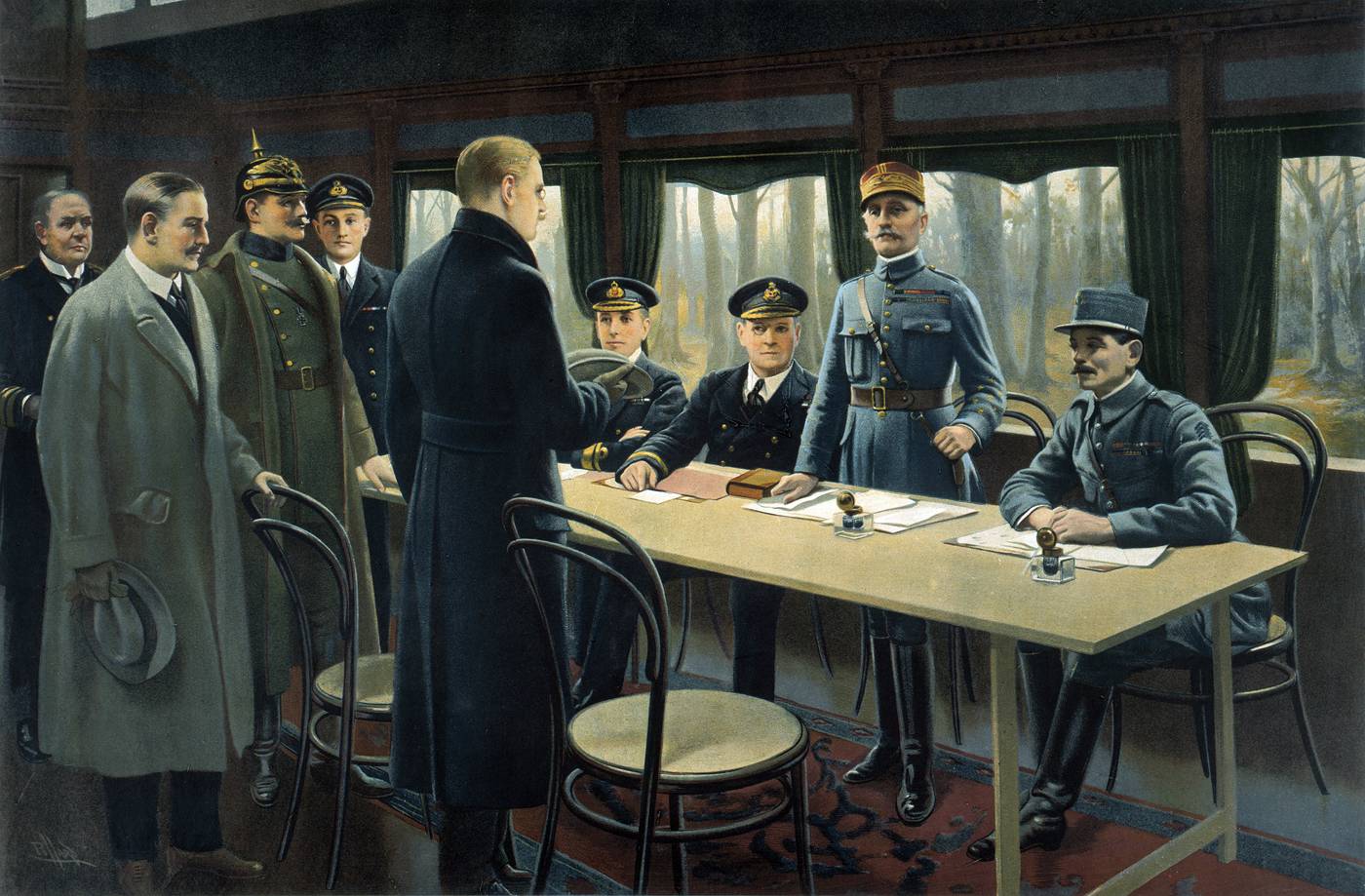
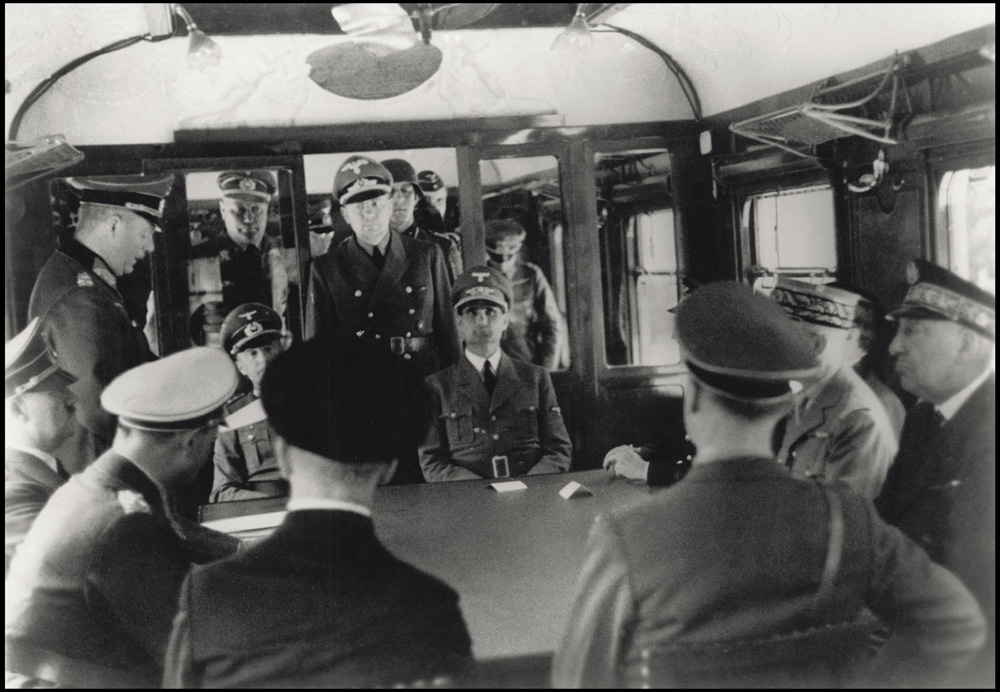
NOVEMBER 11th, 1918 – Armistice is signed between an exhausted Germany and the Allies in the French Forêt de Compiègne. The event takes place in the railway car of French commander-in-chief Marshal Foch. The Germans feel humiliated.

Armistice (the Germans surrender at the end of World War I)

JUNE 22nd, 1940 – Adolf Hitler meticulously imitates what Marshal Ferdinand Foch had done 22 years earlier. Hitler orders to get Foch’s railway car out of Compiègne’s museum and forces the French to surrender in the same way and on the same spot as the Germans in 1918. This vengeance – a mimetic mechanism – announces a second wave of global war, terror and horrific sacrifice, ending in 1945.

mpaa328808

Commemorating the wars and their victims, we can only hope for a European Union that deserves its Nobel Peace Prize.

European Union Nobel Peace Prize

In 1985, René Girard received his first honorary doctorate at Vrije Universiteit Amsterdam. More followed at various universities throughout the world. In December 2006, he was installed as a member immortel of the Académie Française, the highest honor a French intellectual can achieve in his home country.

A month after René Girard received his first honorary doctorate an interview with him appeared for Dutch television (IKON). The interview is in English with Dutch subtitles.

CLICK TO WATCH IT HERE:

There is also footage from the ceremony for the honorary doctorate at VU Amsterdam.

CLICK TO WATCH IT HERE:

OUR WORLD, A WORLD OF CHILD NEGLECT?

Basically, there are three types of child neglect:

  1. Indifference (rarely if ever paying attention to a child)
  2. Denigration (paying attention in an all too negative way)
  3. Adoration (paying attention in an all too positive way)

A child who grew up in an indifferent environment is prone to seek attention from people just for the sake of getting attention. Needless to say, they can easily fall into the hands of malicious manipulators (from gurus to pedophiles) who meet the child’s need “to feel special” and “to be saved and taken care of”.

forgetting children

A child who is denigrated time and again if he does not live up to the expectations of his educators will develop a sense of unworthiness. He will feel ashamed of himself or will even learn to hate himself. Later on in life, he will do anything in his power not to fail in the eyes of others. He might even develop a perverted sense of pride, hiding his sense of unworthiness behind a supposedly socially acceptable self-image. Fear of failure (atychiphobia) then reveals itself as a built-in desire for perfection.

A child who is constantly adored will develop a false sense of superiority. If he fails, he will sometimes feel ashamed of himself or hate himself, but most of the time he will blame others for his failure. In other words, he will create scapegoats because he is not able to take responsibility for his own mistakes. His educators made him believe that he is perfect, and of course he tries to satisfy this built-in desire for perfection.

Indifference, denigration and/or adoration: in all three cases the difference between the wishes of the child’s environment and the child himself are eradicated. The child is forced to adapt to the unrealistic wishes of his environment and therefore is not able to accept himself as he actually is. In other words, because the child has learned to be guided by his desire for recognition, he is not able to love himself (he subjects himself to an unrealistic but supposedly socially acceptable self-image) and he is not able to love others (he only approaches others to satisfy his need for recognition, and not as ends in themselves). The child will fear saying “sorry” because he has learned that the world does not allow for failure…

Ever met those parents who said to their child “You can be a doctor” or “You can be a sports champion” when in fact their child had other talents? Ever met those parents who convinced themselves, their child and part of their environment that “The teacher” or “The coach” was to blame for whatever went wrong when the child did not live up to the parents’ expectations?

OUR ATHEIST WORLD, A WORLD OF GODS AND FAIRY TALES?

Pinocchio seducedYep, it seems the more atheist we become, the more we lose touch with reality, beginning with the reality of ourselves. We bow to the idols we have made from ourselves, the false “monstrous” or “divine” images about ourselves we have learned to love, instead of accepting ourselves and our limits as human beings. If religion is defined as “opium of the masses” (Karl Marx, 1818-1883), then our atheist world is full of it. We have replaced a perverted version of Christianity, one that made us believe we could enter “paradise” if we were willing to make sacrifices, with “secular” dreams of paradise and perfection.

However, the so-called “Christian” attitude to merely confess our sins to God and pay for them by denigrating ourselves (physically and/or mentally) as a “sacrifice to God” in order to become “perfect” and to get God’s recognition, is really a betrayal of the Gospel and of Christianity. Jesus makes it clear: “No one is good – except God alone.” (Mark 10:18). In other words, we should not want to be someone we are not. Indeed, we are not perfect. Jesus also makes clear that prayers and sacrifices should not be used to escape moral responsibilities. If you go to confession and use God’s forgiveness to recreate a so-called acceptable self-image, without actually doing something about the evil you’ve committed, you’re perverting the nature of confession. Confession should serve love for one’s neighbor, and not one’s need for recognition. That’s why Jesus says (Matthew 5:23-24): “If you are offering your gift at the altar and there remember that your brother or sister has something against you, leave your gift there in front of the altar. First go and be reconciled to them; then come and offer your gift.” In other words, sacrifice not as a “do ut des” or “quid pro quo”, but as a free gift of gratitude for what’s already established. Jesus transforms laws and legislations, bringing them back to their true goal against possible perversions (That’s why he says, “Do not think that I have come to abolish the Law or the Prophets; I have not come to abolish them but to fulfill them.” – Matthew 5:17). The law should serve man and enable love for one’s neighbor, it should not be used against man and love (see Matthew 22:34-40 and Matthew 12:1-14).

JESUS CHRIST, BACK TO LIFE, BACK TO REALITY?
????????????????????????The realization that you’re not perfect (and that you don’t have to be) will help you to deal with the imperfections of others as well. That’s why Jesus constantly asks people to realize their own shortcomings. “He that is without sin among you, let him first cast a stone at her”, he says to the crowd that wants to stone a woman accused of adultery (John 8:7). And in the Lord’s prayer he asks us to think of our own trespasses, in order to be able to forgive others (Matthew 6:12): “Forgive us our trespasses, as we forgive those who trespass against us.” The sooner you are able to admit some minor mistakes, the better you will avoid scapegoat mechanisms. On the other hand, if you want to protect an unrealistic yet so-called admirable self-image, you will use one lie after the other and blame others for what’s bad and for what goes wrong, instead of taking responsibility yourself.
forgiveness saves from harmPeople hurt each other. We’re not perfect in our love. We even hurt those we love the most. Every week we say stuff we probably mean less offensive because we’re too easily irritated by each other. Jesus thus is more realist than ever when Peter asks him a question about forgiveness (Matthew 18:21-22): “Lord, how many times shall I forgive my brother or sister who sins against me? Up to seven times?” Jesus answered, “I tell you, not seven times, but seventy times seven.”

Of course, truth hurts. So more often than not, we flee from the truth about ourselves. We rather think about ourselves in a heroic fashion. We identify with “good” characters in Hollywood movies. The apostle Peter also thinks of himself as a hero during the last supper before Jesus is arrested, while Jesus – that hyper-realistic “Christ” man – tries to bring him down to earth (Matthew 26:33-35): Peter said, “Even if all fall away on account of you, I never will.” “Truly I tell you,” Jesus answered, “this very night, before the rooster crows, you will disown me three times.” But Peter declared, “Even if I have to die with you, I will never disown you.” And all the other disciples said the same.

The Denial of St Peter by Gerrit Van Honthorst 1622-1624The Gospel eventually shows man as he is, and not as he romantically dreams himself to be. It is easy to be morally indignant about reports of child abuse in the newspaper. It turns out to be much more difficult to handle such delicate matters when we’re directly confronted with them. Maybe then we’re not as heroic as we thought we’d be. The apostle Peter discovers the not so heroic truth about himself after Jesus is arrested (Matthew 26:69-75): Now Peter was sitting out in the courtyard, and a servant girl came to him. “You also were with Jesus of Galilee,” she said. But he denied it before them all. “I don’t know what you’re talking about,” he said. Then he went out to the gateway, where another servant girl saw him and said to the people there, “This fellow was with Jesus of Nazareth.”He denied it again, with an oath: “I don’t know the man!”After a little while, those standing there went up to Peter and said, “Surely you are one of them; your accent gives you away.” Then he began to call down curses, and he swore to them, “I don’t know the man!” Immediately a rooster crowed. Then Peter remembered the word Jesus had spoken: “Before the rooster crows, you will disown me three times.” And he went outside and wept bitterly.

Ah, the things we do for our reputation, for power, for survival… Jesus warns us not to enslave ourselves to so-called socially acceptable self-images (“idols”) in order to gain recognition. When you force yourself to be someone you are not because certain people made you believe that this is your “ticket to paradise”, your life will become a living hell of frustration, jealousy and hypocrisy. Indeed Jesus is right when he says, “whoever wants to save their life will lose it” (Matthew 16:25). And when he says (Matthew 6:1-2): “Be careful not to practice your righteousness in front of others to be seen by them. If you do, you will have no reward from your Father in heaven. So when you give to the needy, do not announce it with trumpets, as the hypocrites do in the synagogues and on the streets, to be honored by others. Truly I tell you, they have received their reward in full.”

If you want success because of success itself, you will never find love and joy for what you’re doing. If a student wants good grades and academic recognition more than an understanding of his courses, he will never find joy in what he’s actually studying (for more on this, click here or click here). The scientist whose goal it is to win the Nobel Prize won’t get it. It’s the scientist who has learned to be passionate [yep, we have to learn to love – because love is relating to what’s other than ourselves, and therefore goes beyond our needs] about his topic who might eventually get the Nobel Prize as a consequence of his actions – and not as an ultimate goal. So we should not force ourselves to be someone we are not in order to get into heaven. We shouldn’t be like the workaholic who becomes a slave of a “high society lifestyle”. We shouldn’t be like the drug addict who believes that he should flee from himself in a frenzy to be in paradise. We shouldn’t believe that “doing what we please” is the highest form of freedom – the drug dealer wants nothing more than to become the false messiah who satisfies the supposedly very own needs he has inflicted upon his clients.

We should try to find ourselves. We should try to respect ourselves and accept our limitations in this atheist world full of unrealistic idols. We should try to discover our calling. Jesus teaches that we find ourselves if we dare associate ourselves with the social outcasts. Indeed, if Peter would have defended Jesus after the latter’s arrest, Peter wouldn’t have lost himself to a so-called socially acceptable image. Jesus rightly says, “whoever loses their life for me [meaning the Victim of people who look for social recognition and who tend to blame others for their own failures] will find it” (Matthew 16:25). If Peter would have imitated Jesus (who constantly took sides with social outcasts and scapegoats), he wouldn’t have participated in the death of Jesus. Then Peter would have discovered that he’s not merely a child of his social environment and a slave to a socially acceptable self-image (or idol), but also a child of God.

for whoever wants to save their life

As intrinsically relational beings, our identities are given to us in relationships to others. Since no human being is able to love us completely for who we are, only a creature that is “also other than human” is able to truly give us to ourselves. If we believe that this man-made world is the only possible world, we will do everything to gain recognition in this world, force ourselves to be who we are not, and be dead before we have lived – unable to truly love the social outcast. To discover God is to discover Love (see 1 John 4: “God is Love”). It is to discover ourselves as well as our neighbors. 1 John 3,14: “We know that we have passed from death to life, because we love each other. Anyone who does not love remains in death.” The choice is ours: whether we believe we’re merely children of man-made idols, guided by our desire for recognition, or we believe we’re also children of Love… Max Scheler (1874-1928), once again:

Man believes either in a God or in an idol…

If we learn to love ourselves and be genuinely interested in the things we do, we will be rewarded eventually – the joy of doing those things will be a reward in itself. Success or “heaven” will be the consequence of love for ourselves and others and not an end in itself. In the words of Jesus, we should find God’s kingdom and righteousness first, and everything else will come…

“So do not worry, saying, ‘What shall we eat?’ or ‘What shall we drink?’ or ‘What shall we wear?’ For the pagans run after all these things, and your heavenly Father knows that you need them. But seek first his kingdom and his righteousness, and all these things will be given to you as well. Therefore do not worry about tomorrow, for tomorrow will worry about itself. Each day has enough trouble of its own.” (Matthew 6:31-34)

Incensum, a vocal ensemble I am part of, was very honored and grateful to sing at a memorial service for Nelson Rolihlahla Mandela (18 July 1918 – 5 December 2013), organized by the Embassy of South Africa in Belgium, on 12 December 2013. The service was held at the Cathedral of Saint Michael and Saint Gudula in Brussels. For more information and some tributes:

Saint Michaels Cathedral Brussels interior choirCLICK HERE TO READ THE PROGRAM (PDF)

CLICK HERE TO WATCH A REPORT ON THE EVENT (hear us sing at the end)

Click here to read a welcome by Ambassador Mxolisi Nkosi (PDF)

Click here to read a tribute by Mr P. Ustubs of the EEAS (PDF)

Click here to read a tribute by Sec. General Dirk Achten (PDF)

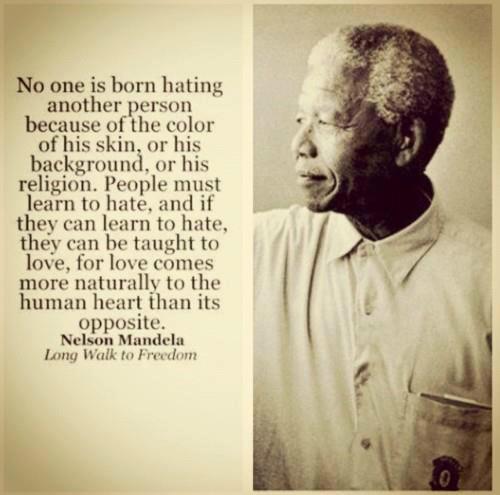
It is clear from testimonies all over the world that Mandela is an inspiring example of forgiveness. The man himself made a spiritual journey from the prison of bitterness to the liberation of pardon. His life took part in a dynamic of Love that is also characteristic of Christ’s life. To imitate these examples is not merely to copy them but to challenge ourselves to continue the creativity of Love in our own circumstances. It is trying to turn the other cheek (Matthew 5:39 – click here to read more) without losing our self-respect. A mimesis (i.e. imitation) of Nelson Mandela can become an example of what René Girard would call “good mimesis”. It seems that African culture itself has its own resources for this type of imitation. African American writer Zora Neale Hurston (1891-1960):

Zora Neale HurstonThe Negro, the world over, is famous as a mimic. But this in no way damages his standing as an original. Mimicry is an art in itself [and] he does it as the mocking-bird does it, for the love of it, and not because he wishes to be like the one imitated.

In other words, to imitate Nelson Mandela or the Christ figure is the exact opposite of an idolization of those figures. Soren Kierkegaard (1813-1855) warned for this (read more by clicking here):

Christ comes to the world as the example, constantly enjoining: Imitate me. We humans prefer to adore him instead.

Joachim Duyndam, Socrates Professor of Philosophy and also a member of the Dutch Girard Society, discusses “good mimesis” and how we learn from inspiring examples in this interview fragment. He also mentions Mandela – CLICK TO WATCH:

Of course, the road that Nelson Mandela traveled is perhaps best described by Madiba himself. These quotes, also from the Gospel, should be self-explanatory:Mandela Quote No one is born hating another personBe Imitators of GodMandela Quote As I walked out the door

Ephesians quote Be kind and compassionate

Okay, this post eventually is about this documentary clip (from a previous post – click here for Monkey Business):

Rest assured, I’m getting there, but I have to tell a little story first…

watching a soap opera (Pacheco Mexican family)Mary was watching a soap opera on a big screen TV in the living room. Her brother, Martin, came in and joined her on the sofa. “You know, there’s a lecture by Stephen Hawking on the Discovery Channel right now”, Martin said. And he continued: “It’s his explanation about the origin of the universe. Maybe we can watch it together?” “Oh, come on Martin”, his sister replied, “that’s so boring; I’d rather watch this soap, it’s really exciting and I’m curious how that new girl character will overcome the break up with her boyfriend…”

We can all imagine this type of situation. More often than not, people choose to enjoy stories that allow them to identify with certain characters and events over a desire to explain things. Most of us are no Nobel Prize winning scientists. Flash back to prehistoric times: would our so-called primitive ancestors be any different? I’ve always wondered why we would accept the notion that religion and belief in spirits and gods arose out of prehistoric man’s innate desire to explain things. I can imagine prehistoric man trying to survive in an often hostile, barren environment. I can also imagine prehistoric man, further on in evolution, listening to (sometimes contradictory) mythical stories that express and justify a certain world-view and way of doing things, allowing him to develop a sense of identity within his tribe (see the quote by the Indigenous Peoples of California below). But I cannot imagine prehistoric man as a would-be scientist. It goes against a day-to-day experience and observation of myself and fellow human beings.Indigenous Peoples of California (Quote on Storytelling) Showbizz websites with spectacular stories about celebrities get more views than academic websites…

I know that an argument based on intuition and personal experience might not be very convincing, but there are other problems connected to the idea that animism or primitive religion arose out of prehistoric man’s desire to explain things. Consider for a moment a reasoning that often goes something like this: “Because primitive man had not yet developed science, he tried to explain the world in which he lived by spiritual, invisible or supernatural forces…” The problem is that this reasoning already somewhat presupposes the belief in a spiritual or supernatural realm to explain the origins of such a belief. That’s a circular argument that, in this case, actually doesn’t explain anything about the origin of religion. Of course it is true that religion has been used to explain things, but before it can function like that it has to already exist. It is not because electricity has been used to bring trains into motion that electricity originated from the desire “to move trains”. It is not because religion has been used to explain things that religion arose from the desire “to explain”. And, once again, early mythology and storytelling is not concerned with the question “What really happened?” They are considered true in another sense, namely in that they (“archetypically”) express and mold life experiences and views on life.

Indian Storytelling (stories are true)

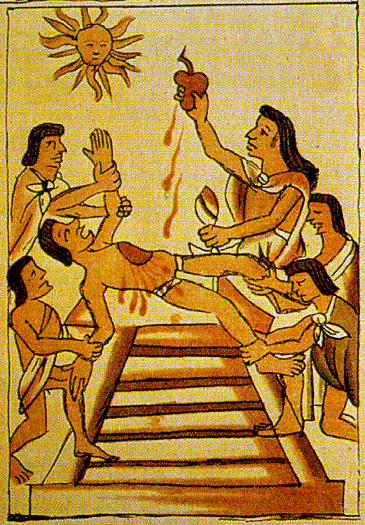
So let’s consider René Girard’s idea again that primitive religion arose out of certain associations made concerning the victims of group violence. From this point of view, it is no coincidence that sacrificial rituals belong to the oldest expressions of religious behavior. Moreover, seen from Girard’s perspective, it is no coincidence that creation myths or myths of heroes from all over the world contain the theme of sacrifice as a way to establish, renew or preserve a world order.

René Girard considers the very first sacrificial rituals as imitations of a scapegoat mechanism in groups of primitive humans whose internal (mimetic) rivalry threatened to destroy the group itself. Primitive human societies experienced the killing of one member of their group by a significant part of the community as something which restored calm and order. This must have happened so much in primitive human societies that they started making certain associations.

On the one hand primitive societies experience turmoil as long as ‘the common enemy’ is alive, while on the other hand they experience peace after he is beaten to death. Gradually they will associate new situations of disorder with the resurgence of a former victim of group violence. In other words, they experience a person who is not visibly present anymore, but whose presence is ‘felt’ in situations of turmoil. In other words still, one of the former victims of group violence has become a ‘ghost’ or a ‘god’. At the same time, primitive human societies also ‘learn’ that killing someone apparently restores order. So together with the belief in ghosts and gods considered responsible for all kinds of possible violent disasters, the belief originates concerning the effectiveness of sacrifices to restore, renew or keep order, life and stability in human society. If primitive societies would have seen that the victims of group violence are no more responsible for violence than other members of the group, they would not have developed these beliefs. Violence became something sacred because the victims of group violence were considered exclusively responsible for the violence they were associated with. Those victims were, in other words, scapegoats.

ancient human sacrificeGirard argues that all other associations regarding ‘the sacred’ rest on this first association between violence and divinized victims of group violence. Everything that can be associated with violence had the potential to become sacred or divinized as well. Sexuality became sacred. Indeed, sometimes males fight over females. Food became sacred. Indeed, people fight over food sometimes. Territory  became sacred. Indeed, people go to war sometimes because of territory. Nature as a whole became sacred. Indeed, natural disasters are ‘violent’ and provoke violence if they cause lack of food and water… And so the world and the experience of man became sacred.

Religions came and went, but the age-old associations regarding the sacred were transmitted down the generations, albeit in varying forms (human sacrifice becoming animal sacrifice, for instance). The Greeks still had Ares, god of war, as they had their goddess of love, Aphrodite. The Romans copied (indeed, ‘imitated’) the Greeks and spoke of Mars and Venus.

Asked why they perform their rituals and sacrifices and why they respect their taboos, primitive societies always answer: “Because our ancestors did it, and because we have to respect the ghosts and the gods in order to sustain our community…”

Could it really be true that the structure of ancient human sacrifice goes back to a mechanism that can still be observed in our ape cousins? And that this mechanism provides the foundation of the archaic sacred? Is it far-fetched to suspect that the former fact (the structure of ancient human sacrifice, which begins with a fight!) has something to do with the latter fact (the scapegoat mechanism)?

Pavlov DogGirard has argued that the dividing line between human and ape lies in the way mimetic quarrels became a fearful threat to the survival of primitive human communities (it is no surprise that prehistoric massacre mass graves exist – click here for an example). Precisely because the mimetic ability of humans grew, their tendency towards near uncontrollable mimetic rivalry increased likewise. Hence it became possible that humans began to make associations that their ape cousins could not make regarding the communal killing of a group member. Compare to Pavlov’s dog: a dog who has only arbitrarily or sporadically heard a signal while getting food will not drool if he hears the signal, while Pavlov’s dog who has systematically heard the signal while getting food will at some point start to drool from the moment he merely hears the signal… Apes won’t associate turmoil with a victim, while primitive humans will start to do exactly that at some point. The consequences can be suspected: primitive humans will start to consciously ritualize the scapegoat mechanism, while apes only experience this mechanism sporadically. The above posted fragment of a documentary on monkeys shows a powerful example of the mechanism. The monkeys gather around the corpse of their former leader who has been killed after a fight for control over the group. “They are unusually silent as they gather around…” We can almost observe how it must have been like that ‘a loathed enemy’ became ‘a revered god’. This also explains why gods have a ‘dual’, ‘ambiguous’ quality.They’re good and bad… Good aspects of the gods can be allowed in rituals, while bad aspects of the gods are forbidden and taboo. For instance, sacrifice is a form of ‘good’ (controlled) sacred violence to be distinguished from ‘bad’ sacred violence, which is to be avoided and is taboo…

FIND OUT MORE ON THIS BY CLICKING HERE

(with some examples of similar behavior observed in groups of chimpanzees)

Pimu Alpha Male Chimpanzee killed by fellow chimps Mahala Park Tanzania 2011

From time to time I’m confronted with objections to mimetic theory that, looked at more closely, are based on some misconceptions. Here are some clarifications, hopefully. (For more on scientific research concerning imitation, click here: Mimesis and Science).

1. REGARDING MIMETIC DESIRE

Already in 1961, publishing Mensonge romantique et vérité romanesque, René Girard made the world familiar with his concept of mimetic desire. Mimetic desire is literally desire based on imitation. Like so many others before and after him, Girard observes that human beings are highly mimetic creatures. Humans imitate each other in all sorts of ways and thereby learn from each other – they learn good as well as bad behavior… To name but one example, people imitate the sounds of their environment and learn to speak, for instance, with a Texan accent. I don’t know if that’s a good or a bad thing :).

By introducing the concept of mimetic desire, Girard stresses that our desire is structured by imitating others who function as models for our desire. It is important to distinguish this type of desire from our basic biological or physical needs. When you’re walking in the desert alone and your body is yearning for water, your desire for water is, of course, not based on the imitation of someone else’s desire. True, nature has its impact on human life. However, when our basic physical needs are met, our desire goes beyond them. Our basic need for water is transformed in what eventually became a supermarket world that asks us to choose between different types of water, juices and soft drinks. Growing up, we develop a certain taste, transmitted to us by our social and cultural surroundings. We might even develop desires that not only go further than our physical needs, but also against them (anorexia being one example).

coca cola thirst asks nothing moreSo, it’s not just nature that defines human life, nurture has its way too… We all have the biological need for food, but if we were born in another part of the world we would probably have developed different eating habits. It’s as simple as that. We imitate others. We mimetically learn to quench our natural thirst and to satisfy our natural hunger in a certain, culturally dependent way. No one is born with the desire for the newest soft drink produced by The Coca-Cola Company (indeed, Thou Shalt Covet What Thy Neighbor Covets – click to read this article by famous marketeer Martin Lindstrom), as no one is born with the desire to become a police officer. Our identities are not ahistorically determined from birth, they’re co-created with others.

We always write our personal history together with others, and we mutually influence each other. Since we’re social creatures we cannot escape this influence. Relationships precede and shape our (sense of) identity. Even if we go against our tendency to imitate an immediate social environment that seems indifferent towards the victim of some crime or accident (see “Bystander Effect” – click for more), we probably still imitate heroic examples from stories we grew up with (“The Good Samaritan” may be one of them).

Two questions often appear after these considerations, which show just how hard it is to let go of any type of Ego Illusion:

  1. We often imitate others to adjust to our social environment. We imitate others because we desire social recognition. So, our desire for social recognition must be more fundamental than our mimetic tendencies, no?
  2. If we imitate each other’s desire for something, someone still has to be the first to desire that something. Surely, the latter’s desire cannot be based on imitation, can it?

I’ve answered the first question before, but I’ll repeat it here. Of course we often imitate others to ‘fit in’. However, we could not develop a desire to fit in if it weren’t for our mimetic abilities. Our mimetic abilities allow us to put ourselves in each other’s shoes. They allow us to pretend that we are someone else. For instance, a little girl playing with her dolls pretends being a mother by imitating real mothers. Our mimetic abilities allow us, thereby, to imagine – however preliminary – what others are experiencing, expecting and desiring. So our ability to empathize and to adjust to the expectations of others (maybe to gain their recognition) rests on mimetic ability.

The second question seems very logical. Confronted with real life cases, the quest for ‘the first model’ is not that easy to answer though. Even simple situations show it might be the wrong question. Think, for instance, about two babies in a room full of toys. Let’s name the two Bobby and Johnny. Bobby starts playing with a little ball. Note that he didn’t necessarily wake up with the desire to play with a ball. Already in this sense his desire isn’t his own. It is awakened by people who left him the ball to play with. After just ten seconds, Bobby gets tired of the ball. He doesn’t really enjoy playing with it. So he starts playing with some other toy. He has no desire to play with the ball whatsoever. In comes Johnny. He saw Bobby playing with the ball and this raised Johnny’s attention. Now that the ball is left, Johnny takes the opportunity to start playing with it himself. In this situation Johnny is the imitator. However, when Bobby notices Johnny playing with the ball, he immediately leaves the toy that was more fun to him and tries to lay his hands on the ball Johnny is playing with now. In this situation Bobby is the imitator. In short, Johnny’s desire rests on the imitation of Bobby as model for his desire, while Bobby’s desire rests on the imitation of Johnny as model for his desire. It’s no use asking “Who’s first?” Johnny and Bobby mutually reinforce each other’s desire by becoming each other’s model and imitator. Thereby they become each other’s rival. René Girard speaks of the rivalry between mimetic doubles. More generally, we become each other’s rival if we cannot or do not want to share the object of our mimetic desire. Here’s an example – it could have been Bobby and Johnny 🙂 – CLICK TO WATCH:

2. REGARDING RITUAL SACRIFICE

Some consider René Girard’s explanations on the origin and maintenance of human cultures far-fetched. Well, are they?

René Girard considers the very first sacrificial rituals as imitations of a scapegoat mechanism in groups of primitive humans whose internal (mimetic) rivalry threatened to destroy the group itself. Primitive human societies experienced the killing of one member of their group by a significant part of the community as something which restored calm and order. This must have happened so much in primitive human societies that they started making certain associations.

On the one hand primitive societies experience turmoil as long as ‘the common enemy’ is alive, while on the other hand they experience peace after he is beaten to death. Gradually they will associate new situations of disorder with the resurgence of a former victim of group violence. In other words, they experience a person who is not visibly present anymore, but whose presence is ‘felt’ in situations of turmoil. In other words still, one of the former victims of group violence has become a ‘ghost’ or a ‘god’. At the same time, primitive human societies also ‘learn’ that killing someone apparently restores order. So together with the belief in ghosts and gods considered responsible for all kinds of possible violent disasters, the belief originates concerning the effectiveness of sacrifices to restore, renew and/or keep order, life and stability in human society. If primitive societies would have seen that the victims of group violence are no more responsible for violence than other members of the group, they would not have developed these beliefs. Violence became something sacred because the victims of group violence were considered exclusively responsible for the violence they were associated with. Those victims were scapegoats.

ancient human sacrificeGirard argues that all other associations regarding ‘the sacred’ rest on this first association between violence and divinized victims of group violence. Everything that can be associated with violence had the potential to become sacred or divinized as well. Sexuality became sacred. Indeed, sometimes males fight over females. Food became sacred. Indeed, people fight over food sometimes. Territory  became sacred. Indeed, people go to war sometimes because of territory. Nature as a whole became sacred. Indeed, natural disasters are ‘violent’ and provoke violence if they cause lack of food and water… And so the world and the experience of man became sacred.

Religions came and went, but the age-old associations regarding the sacred were transmitted down the generations. The Greeks still had Ares, god of war, as they had their goddess of love, Aphrodite. The Romans copied (indeed, ‘imitated’) the Greeks and spoke of Mars and Venus.

Asked why they perform their rituals and sacrifices and why they respect their taboos, primitive societies always answer: “Because our ancestors did it, and because we have to respect the ghosts and the gods in order to sustain our community…”

Could it really be true that the structure of ancient human sacrifice goes back to a mechanism that can still be observed in our ape cousins? And that this mechanism provides the foundation of the archaic sacred? Is it far-fetched to suspect that the former fact (the structure of ancient human sacrifice, which begins with a fight!) has something to do with the latter fact (the scapegoat mechanism)?

Pavlov DogGirard has argued that the dividing line between human and ape lies in the way mimetic quarrels became a threat to the survival of primitive human communities. Precisely because the mimetic ability of humans grew, their tendency towards near uncontrollable mimetic rivalry increased likewise. Hence it became possible that humans began to make associations that their ape cousins could not make regarding the communal killing of a group member. Compare to Pavlov’s dog: a dog who has only arbitrarily or sporadically heard a signal while getting food will not drool if he hears the signal, while Pavlov’s dog who has systematically heard the signal while getting food will at some point start to drool from the moment he merely hears the signal… Apes won’t associate turmoil with a victim, while primitive humans will start to do exactly that at some point. The consequences can be suspected: primitive humans will start to consciously ritualize the scapegoat mechanism, while apes only experience this mechanism sporadically. Here’s a powerful example of the mechanism, nonetheless, observed in a group of monkeys. We can almost observe how it must have been like that ‘a loathed enemy’ became ‘a revered god’. This also explains why gods have a ‘dual’, ‘ambiguous’ quality.They’re good and bad…

CLICK TO WATCH:

A WORLD WITHOUT RELIGION?

 The question is whether an atheist world would be a better world.

Religionless Christianity (Dietrich Bonhoeffer)Slavoj Zizek, atheist philosopher, refers to René Girard’s analysis of Christianity in God in Pain: Inversions of Apocalypse and concludes that Christianity, revealing the innocence of erstwhile sacrificial victims, “[undermines] the efficiency of the entire sacrificial mechanism of scapegoating: sacrifices (even of the magnitude of a holocaust) become hypocritical, inoperative, fake…” As this sacrificial mechanism is the cornerstone of religious behavior, Christianity thus indeed is “the religion of the end of religion” (atheist historian Marcel Gauchet). Zizek, still in the aforementioned essay, also briefly explains how Christianity potentially brings to an end the ever- present sacrificial temptation: “Following René Girard, Dupuy demonstrates how Christianity stages the same sacrificial process [of archaic religion], but with a crucially different cognitive spin: the story is not told by the collective which stages the sacrifice, but by the victim, from the standpoint of the victim whose full innocence is thereby asserted. (The first step towards this reversal can be discerned already in the book of Job, where the story is told from the standpoint of the innocent victim of divine wrath.)” This assessment of Christianity could also help to understand Dietrich Bonhoeffer’s call for a “religionless Christianity” (or maybe we should speak of a Christianity transforming religion rather than destroying it – click here for more).

In other words, Christianity is – in a profound sense – one of the main sources of secularization. Secular societies are challenged to build a world without “sacred sacrifices”. As Zizek notes, “the sacred sacrifice to the gods is the same as an act of murder – what makes it sacred is that it limits/contains violence, including murder, in everyday life.” Precisely because a secular society, heir to the dismantlement of “the archaic sacred” by Christianity, no longer possesses the traditional religious means to contain violence, it has to find other ways to deal with violence, or else destroy itself. Zizek quotes Jean-Pierre Dupuy in this regard: “Concerning Christianity, it is not a morality but an epistemology: it says the truth about the sacred, and thereby deprives it of its creative power, for better or for worse.” And Zizek continues: “Therein resides the world-historical rupture introduced by Christianity: now we know [the truth about the sacred], and can no longer pretend that we don’t. And, as we have already seen, the impact of this knowledge is not only liberating, but deeply ambiguous: it also deprives society of the stabilizing role of scapegoating and thus opens up the space for violence not contained by any mythic limit.”

(Quotes from Zizek in Slavoj Zizek & Boris Gunjevic, God in Pain: Inversions of Apocalypse [Essay] Christianity Against the Sacred, Seven Stories Press, New York, 2012, p. 63-64).

With these thoughts in mind, we can frame the question about the atheist world in another way. Can our world survive its own potential for violence without religion, without the traditional sacrificial mechanisms that try to limit violence?

 NEW ATHEIST RELIGION & AMORAL ATHEISM

four horsemen of new atheismAs it happens, we seem to regenerate the religious impulse. To this day we keep looking for scapegoats to be cast out of society in order to purify ourselves from the evils in our midst. It’s part of the way we build ‘the City of Man’. Richard Dawkins and Christopher Hitchens, two well-known spokesmen of the so-called ‘New Atheism’, clearly consider religion as one of the main sources of evil in the world. Hence, in their views, we would be better off without religion. But, precisely because of their tendency to blame theistic religion for “much of the evil in the world” and their attempts to expel or even sacrifice it, they create a new sacrificial religion, albeit an atheist one. How long before believers – without whom their theistic religion would not exist – no longer have the right to voice their views in the public sphere if the new atheists had their way?

The demonization of theistic religion by the new atheists is their way of suggesting the moral superiority of atheism. Their reasoning, however, is flawed and incomplete. Take, for instance, this challenge by Christopher Hitchens:

“Name one ethical statement made, or one ethical action performed, by a believer that could not have been uttered or done by a nonbeliever. And here is my second challenge. Can anyone think of a wicked statement made, or an evil action performed, precisely because of religious faith?”

Some people, thinking of the atrocities committed by Stalin, Mao and Pol Pot, try to make this a more balanced rhetorical statement by adding a question: Can anyone think of a wicked statement made, or an evil action performed, precisely because of atheism?

The new atheists already have their response to those who think that the crimes of Stalin et al. had anything to do with atheism. Richard Dawkins:

“What I do think is that there is some logical connection between believing in God and doing some, sometimes, evil things, but there’s no logical connection between them [Stalin, Mao, and Pol Pot] being atheists and doing evil things. It’s just incidentally true that, say, Mao Zedong and Joseph Stalin happened to be atheists, but that wasn’t what drove them. What drove them was a political ideology. It had nothing to do with atheism.”

Another atheist puts it this way:

“While Stalin and Mao were atheists, they did not perpetrate their atrocities because of their atheism. Atheism is simply the lack of belief in god. One cannot commit a crime in the name of ‘there is no god’. On the other hand, one can commit a crime in the name of ‘god’.”

This statement also implies that nothing good can be done in the name of atheism. Atheists can do good things like believers can do good things. The difference is that believers can do good things “in the name of god”. Atheists can do bad things like believers can do bad things. The difference is that believers can do bad things “in the name of god”. But, just like crimes cannot be done in the name of “there is no god”, good deeds cannot be done in the name of “there is no god”. Atheism is not immoral, neither is it moral. Atheism is amoral – it literally has no moral implications.

Therefore, it is not guaranteed that an atheist world would be a better world. It all depends on the ethics that will be developed in such a world. Moreover, theists and atheists alike can only believe that one ethical decision or even system is better than another. They can never prove this. Science observes and describes facts, it doesn’t morally judge them – we cannot move from what is to what ought. We’ve already seen the ethics of Stalin’s political ideology, to name but one example, and it’s highly questionable whether that was a good thing…  And if we would put some of the new atheist ideas into practice, we would regenerate a sacrificial system of potentially apocalyptic proportions. Sam Harris, for instance:

“Some propositions are so dangerous that it may even be ethical to kill people for believing them. This may seem an extraordinary claim, but it merely enunciates an ordinary fact about the world in which we live. Certain beliefs place their adherents beyond the reach of every peaceful means of persuasion, while inspiring them to commit acts of extraordinary violence against others. There is, in fact, no talking to some people. If they cannot be captured, and they often cannot, otherwise tolerant people may be justified in killing them in self-defense. This is what the United States attempted in Afghanistan, and it is what we and other Western powers are bound to attempt, at an even greater cost to ourselves and to innocents abroad, elsewhere in the Muslim world. We will continue to spill blood in what is, at bottom, a war of ideas.

sam harris condones murder (cartoon by blamethe1st)

Seen from the perspective of René Girard’s mimetic theory, these ideas of new atheists mirror the ideas of some of their fundamentalist counterparts (for more on this, click here to read and watch Religulous Atheism). The tiny proportion of theistic fundamentalists that take part in acts of violence justify their violence in a similar way. They think it is ethical to kill certain people in order to cleanse the world of evil. New atheists and theistic fundamentalists become mimetic (i.e. imitative) doubles – imitating each other’s ways of scapegoating. However, as a wise man once said, “Satan cannot cast out Satan”. We cannot destroy (the possibility of) violence by using violence. We cannot destroy fear if our politics of security justify themselves by constantly referring to the things we should be afraid of. We cannot destroy evil by using evil.

Dietrich Bonhoeffer on blindness to evil

In the end we’ll have to imagine a new peace, but not the (theist and atheist religious) peace of “this world”, which is based on sacrifice. It might be the peace this man speaks of:

“Peace I leave with you; my peace I give you. I do not give to you as the world gives. Do not let your hearts be troubled and do not be afraid.” (John 14:27)

Peace I leave with you

RoboCopMichael Meuleman, one of my students, briefly talked about his passion for brain imaging and brain imaging technologies. It’s his dream to further work on speech reconstruction for disabled persons, using and developing brain imaging technology himself. Michael referred to famous physicist Stephen Hawking as one of many who could benefit from this research. As a matter of fact, Hawking already participated in attempts to convert his brainwaves into speech. Soon, RoboCop won’t be science-fiction anymore!

On my way home from school, I kept thinking about what Michael had said, and decided to do some reading on the subject matter. In amazing times like these, when valuable information is just a few worldwide web clicks away, I discovered the research my student was referring to quite easily: click to read it here.

Speaking of Stephen Hawking I remembered how Oxford mathematician John Lennox responded to some of Hawking’s philosophical claims in a book called God and Stephen Hawking: Whose Design Is It Anyway? This again reminded me of something that same John Lennox said during a lecture – it actually blew me away at the time:

Applied to the research on brain activity for speech reconstruction, Lennox reasoning implies the following.

When we identify a person’s brain activity while that person is hearing or thinking about, for instance, the word jazz, we might see something like this:

brain activity

In order to enable people like Stephen Hawking to communicate more rapidly by using their brain activity, computers need to do two fundamental things (among many processes):

  1. Register the type of brain activity that is ignited by certain sounds – vowels, syllables, words…
  2. Interpret brain activity so it can be translated to certain sounds – vowels, syllables, words…

The thing is, brain activity as such does not give you any word. In other “words”, the full picture or complete reality of a word like jazz is not given in a scientific representation of brain activity. That activity needs to be connected to the word in question. Computers need to be programmed to decode certain brain activity and to recognize or interpret it as the word jazz. Brain activity itself is nor produces the word jazz. There already has to be meaning (and an entity which produces it) before we can ask ourselves what that meaning looks like in scientific terms. More broadly speaking, the things we can say in scientific terms don’t ever give us the essential reality of a particular phenomenon. Science can only begin to explore reality because of the mysterious fact that there is something to explore to begin with! It comes as no surprise then that science can be considered a highly spiritual activity, as it continuously refers to a reality which transcends its endeavors.

The tendency for scientism by the “secular fundamentalist” (see Chris Hedges) new atheist movement, as if science can answer all important or relevant questions, as if science can provide us full knowledge about the true nature of reality, should be discarded as a perversion of science. If phenomena would not reveal themselves to our eyes – whether we look through telescopes or microscopes -, we would not be able to gain any scientific knowledge at all. No scientific knowledge without the mystical realization of revelation. And no scientific or other knowledge that can ever “solve” the mysterious fact that there is something rather than nothing. In the words of theoretical physicist and mathematician Freeman John Dyson (born December 15, 1923, only ten days before René Girard :)):

“The public has a distorted view of science because children are taught in school that science is a collection of firmly established truths. In fact, science is not a collection of truths. It is a continuing exploration of mysteries.”

Freeman John Dyson

It’s amazing what science can do, but it’s even more amazing that there is anything to do at all. Hopefully we, human beings, learn to use scientific and technological knowledge for some good. At least one of my students seems up to it :), and I’m sure most of them are. And while we’re at it: science can never answer the question what goals it should help to accomplish – those questions are and remain philosophical and draw from many sources…

On a lighter note: there must be a reason why I like this beer so much… True, I liked it before I became a “Girardian” :), but since I got to know René Girard’s work I like it even better! Apparently, Girard’s name functions as a mediator that increases my desire for this beer. It sends out good associations, good vibrations…

gueuze girardin

To my fellow Girardians, I really hope you’ll get to taste this wonderful Belgian beer!

Cheers!