“The public has a distorted view of science because children are taught in school that science is a collection of firmly established truths. In fact, science is not a collection of truths. It is a continuing exploration of mysteries.”

Freeman John Dyson (born 1923).

1. THE INTRO

I don't need youLast week, one of my pupils said something what countless others already said before him, and what countless others will repeat after him – it’s a cultural thing foremost, in our so-called secularized Belgian society:

“I don’t need any theological speculation. I’m an atheist. I don’t need God! I don’t need to go any further than psychology and the social sciences…”

In the same week, on Monday (April 15th, 2013), I read an article in the newspaper about a young professor who had tampered with data and search results (read the article here, in Dutch; for more information in English click here). He allegedly committed large-scale fraud, investigating the causes of epilepsy.

One might ask what one observation has to do with the other. Well, for one, it’s clear that the young scientist was especially interested in the things he needed to promote his career. His desire for recognition and for prestige became more important than science itself. He used scientific research as a means to another end, to satisfy his pride. In the end, he accomplished exactly what he was trying to avoid. Instead of promoting his career and his own future in academia, he ruined it. Jesus points to the tragic nature of attempts like these:

It is a strange desire... (Francis Bacon)For whoever wants to save their life will lose it… What good is it for someone to gain the whole world, and yet lose or forfeit their very self?” (Luke 9:24a-25).

But there’s more. According to Christian tradition, whenever we are guided by pride we not only tend to ruin ourselves. We also tend to ruin our surroundings. Indeed, the young ambitious scientist violated the scientific truth in order to protect his self-image, next to endangering the career of his co-workers. Once again, the Christian tradition is spot-on: the person who cannot love himself, and seeks comfort in the creation of an admirable image, cannot truly love others, for he is primarily interested in others insofar as they are useful for developing and recognizing that image. Our desire for mutual, social recognition – understood as the ultimate goal of our efforts, which is vanity – often gets in the way of our capacity to perceive what is actually happening. This truth is retold in a magnificent way by Hans Christian Andersen’s fairytale The Emperor’s New Clothes.

Precisely because we very often approach reality from the perspective of its eventual usefulness, and from the question whether we need it or not, we remain blind for a fuller understanding of reality. This one’s for my pupils:

THE TRUTH DOES NOT PRIMARILY HAVE TO BE USEFUL

(ALTHOUGH IT CAN BE), THE TRUTH HAS TO BE TRUE!

For instance, if we only focus on the aspects of another person that seem useful to us, we might miss out on other aspects that can actually turn out to be more fundamental than the ones we’re focusing on. More generally, we might get a better picture of reality if we not only focus on purely scientific questions and explanations, but also deal with more philosophical issues and questions.

Rationality should not be restricted to scientific rationality. Actually, we never do this on a day-to-day basis. For instance, scientific rationality might explain why we become jealous sometimes, but we need the more philosophical rationality of ethics to discuss whether or not and to what degree jealousy is a good thing.

Ian Hutchinson on ScientismAnother example: scientific rationality might explain how the universe came into being, but we need philosophical rationality to deal with the question whether or not there is an ultimate purpose of “all that is”, whether or not there will be some “perfection” of the universe. Scientifically speaking, there is none, but it’s logically very debatable that the scientific answer is the only meaningful or true answer to this question. The belief that only scientific claims are true or meaningful is known as scientism, which is problematic. From The Skeptic’s Dictionary: “Scientism, in the strong sense, is the self-annihilating view that only scientific claims are meaningful, which is not a scientific claim and hence, if true, not meaningful. Thus, scientism is either false or meaningless.”

Again, in order to understand reality more fully – in its ethical, aesthetic, and mysterious (non-manipulable) aspects -, we might have to go beyond merely scientific concerns, and also go beyond our immediate “needs”. We might even have to pose theological questions. Moreover, it’s not because we can scientifically explain why we pose certain questions that these questions themselves can be answered by science. To “understand” reality is to contemplate it in all its aspects.

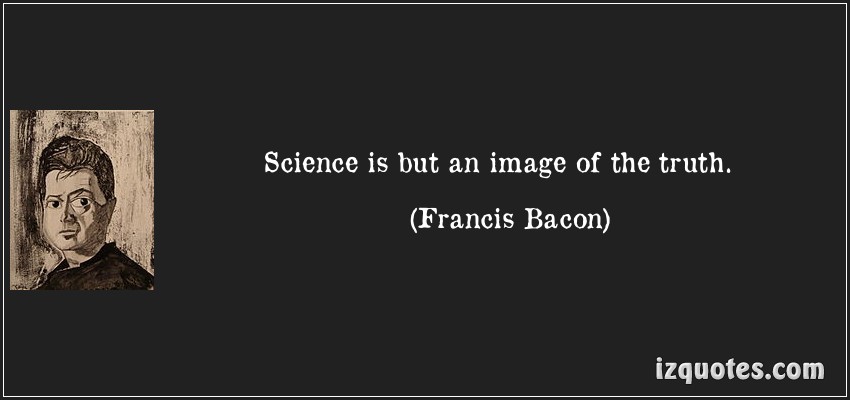
Science is but an image of the truth (Francis Bacon)It is no coincidence that, from a Christian point of view, there are prayers like the one ascribed to Saint Francis of Assisi, containing the words:

“O Divine Master, grant that I may not so much seek to be understood as to understand…”

Although some consider it to be a sign of freedom to be able to approach reality from the perspective of their supposedly very own needs, desires and interests, this is actually a sign of enslavement…

FOR THE THINGS YOU NEED OR LEARNED TO NEED

ARE THINGS YOU ARE DEPENDENT UPON

(OTHERWISE YOU WOULDN’T NEED THEM)

2. THE MIDDLE

“Need” is a complicated affair when it comes to humans.

Maslow's Hierarchy of Needs

Psychologist Abraham Maslow (1908-1970) became famous for mapping our needs in a veritable Hierarchy of Needs – a five-stage model, originally. Once physiological and basic survival needs are met, other needs come to the fore. It is interesting to notice that Maslow characterizes the stages we normally associate with “human freedom” as “needs”. Although we might have the impression that we are free to choose whom we want to belong to, we didn’t choose the need to belong to a group or a person. The same goes for the two highest stages of human needs. We can seemingly choose the things that bring us self-esteem, status or prestige, but we can’t escape the desire for these matters. The biggest paradox, of course, is Maslow’s characterization of self-actualization as a need: we are bound to be free. In other words, reminiscing the thought of Jean-Paul Sartre (1905-1980) and other existentialist philosophers, we face the command to develop ourselves.

Several questions arise here, namely, how do we know who we are, who we want to be, how to gain prestige and self-esteem? René Girard’s answer is quite simple: we imitate others in modeling our desires, ambitions, and sense of self. More specifically those others we’ve (mimetically, i.e. imitatively) learned to appreciate and whose appreciation we’ve (again, mimetically) learned to desire.

As Emmanuel Levinas (1906-1995) pointed out time and again, we tend to approach reality as a whole and fellow human beings in particular from the perspective of our needs. We’re often interested in other people basically because they are experienced as “useful” one way or the other (as friends, as suppliers of security and/or happiness, as financial support, etc.). In fact, we tend to reduce others to their “usefulness”, and to apply this as a criterion to decide whether or not someone or something is valuable. Utilitarian ethics are actually an attempt to found morality on the tendency to focus on our needs. For instance, we should help the poor, not necessarily because we love them, but because not helping them could ultimately cause problems to ourselves. We “need” to help them because we – or the majority of human beings – benefit from it. On a collective level, helping the poor could be one of the roads to a more secure and safer world. On an individual level it could perhaps be a way to gain some status or prestige as “hero”.

Levinas fundamentally criticizes the utilitarian approach to reality. The Other, our fellow human being, our “neighbor”, transcends our needs and desires. If we reduce the Other to the question how he can be useful to us, we will never get to “know” anything about the Other. Moreover, before we can reduce the Other to his usefulness, the Other is simply there, and he might in no way answer to the demands of our actual needs and desires. On the contrary, the Other might reveal himself as a burden or even an enemy to our interests.

The same applies to reality as a whole. It is even said that “reality hits us” whenever we are confronted with aspects of it that we don’t need at all! Reality often reveals itself in shapes we failed to foresee or manipulate according to our needs.

The search for truth therefore begins with the question whether or not we can free ourselves partially from our immediate needs, and from the tendency to control our environment. Are we able to honestly face reality in all its fearful as well as promising possibilities? This is especially challenging in encountering the reality of other persons. For only if we become relatively free from our own needs, anxieties, interests, and prejudices, can we allow the other to freely approach us as “Other” – meaning that we don’t mold him according to the contours of our self-image and our desire for recognition.

3. THE OUTRO

It’s important to notice that, although Christianity reveals the pitfalls of our desire for recognition, it is not about sacrificing this desire. It’s about giving it the right place. I often explain this to my pupils by describing two basic types of students:

  • Student A is basically motivated by the desire to get good grades, because he believes these are his “ticket to paradise” (i.e. recognition by his parents and teachers, and all kinds of “rewards”). In other words, student A is only interested in his courses insofar as he can use them to gain an admirable self-image – which is his ultimate goal. He is guided by his pride. He has lost the capacity to enjoy many of the things he is doing, and that’s why he generally needs to be compensated for what he’s done. Kneeling to the idol of an admirable self-image, student A is no longer capable of loving himself, let alone love others (it’s the kind of student that will pay his teachers some respect because he expects some reward, but who will also tend to get angry if the reward is not granted – which means that his self-image is stained). He finds solace in the recognition for his good grades. However, while focusing on “getting to paradise” (or, in other words, while focusing on the desire to “save his life” and “get into heaven”), he’ll find himself less and less able to study properly, and his grades will go down (he’ll “lose his life” and “get into hell”).

G.K. ChestertonIn the words of the great and late Christian writer, G.K. Chesterton (1874-1936), the situation of student A can be characterized as follows:

“The moment men begin to care more for education than for religion they begin to care more for ambition than for education. It is no longer a world in which the souls of all are equal before heaven, but a world in which the mind of each is bent on achieving unequal advantage over the other. There begins to be a mere vanity in being educated whether it be self-educated or merely state-educated. Education ought to be a searchlight given to a man to explore everything, but very specially the things most distant from himself. Education tends to be a spotlight; which is centered entirely on himself. Some improvement may be made by turning equally vivid and perhaps vulgar spotlights upon a large number of other people as well. But the only final cure is to turn off the limelight and let him realize the stars.”

  • Student B is basically motivated by the desire to know and understand his courses. As a consequence, he’ll often get good grades (“get into heaven”), but this never was his primary goal. Precisely because he considers his courses as ends in themselves, he’ll eventually get and enjoy recognition. Of course, being proud of an achievement is not a crime. It becomes malicious, though, when it is the goal and not the consequence of one’s actions.

Whenever Jesus talks about heaven or hell in the Gospels, he presents them as possible consequences of one’s actions and not as goals. He even says that we shouldn’t do good and help our neighbor in order to gain some kind of heavenly reward and to avoid hell, but that we should help our neighbor because of our neighbor (as end in himself). Then we’ll get “heaven” as a quite unexpected reward, as a logical consequence. The same reasoning applies to his approach of reality as a whole.

gun lobbyFalse prophets or false messiahs (in religion, politics, health care, etc.) are people who try to tell us what we need to get to paradise (a nice house, a good career, a healthy body, a safe but entertaining life etc.), and also scare us with the evil dangers that could send us to hell. They are doctors who constantly produce the disease they supposedly liberate us from. But, of course, they never really liberate us, for they are dependent on the disease to be able to manifest themselves as “liberators” or “messiahs”. They produce one self-fulfilling prophecy after the other. For instance, the more a gun lobby convinces us that we should protect ourselves with weapons to keep safe in an “evil, ugly world”, the more people will get killed because of gun fire, the more we will feel unsafe, the more the gun lobby will be able to convince us of “the unsafe world”, the more we buy guns, etc.

Jesus, on the other hand, points out that “Satan cannot cast out Satan”. We cannot free ourselves and the world if the means we use to make this world a better place actually (and tragically) continue the diseases we try to cure the world from. Contrary to all kinds of false prophets, he advises us – as a fundamental attitude towards life – “not to be afraid” and “not to worry” too much.

I guess he is right, also in the case of the two types of students.

In short,

  • Student A becomes a SLAVE of an ambition he has learned to aspire for himself. The system of “getting good grades” is more important to him than anything else in class. Everything, including himself, is subjected to this GOAL. Student A might become a scientific investigator who uses scientific research to promote his career and thereby satisfy his pride.
  • Student B remains FREE. The system of “getting good grades” is not important in itself. It is a means to check whether or not the studied courses are sufficiently understood. Student B might become a scientific investigator who really gets a better scientific understanding of reality, and therefore gets his academic career going as a logical CONSEQUENCE.

Student B imitates Jesus’ approach to all kinds of laws and regulations (more specifically the Mosaic Law in the case of Jesus). Jesus says that he didn’t come to abolish the Law just like that, but that he came to fulfill it, meaning that rules should always be relative to the end they help to accomplish. A system of rules and laws should never be an end in itself. It should be considered a means to another end. What counts for Jesus is love for one’s neighbor, and if rules become obstacles in accomplishing this goal, they should be adapted or even suspended.

Student B uses the grade system to get more information on his knowledge of the courses he’s presented with, because he tries to respect what the courses are saying (without, however, automatically agreeing with their statements). This indeed is analogous to Jesus’ approach of the Mosaic Law. Jesus tries to create mutual respect between fellow human beings, thereby constantly evaluating if regulations allow others to live fully. Jesus criticizes any use of the Mosaic Law that justifies the sacrifice of others to satisfy one’s (or a group’s) pride or self-image.

Mark 2:23-27 puts it this way – and I’ll leave it at that:

Jesus Lord of Sabbath (grainfield)One Sabbath Jesus was going through the grainfields, and as his disciples walked along, they began to pick some heads of grain. The Pharisees said to him, “Look, why are they doing what is unlawful on the Sabbath?”

He answered, “Have you never read what David did when he and his companions were hungry and in need? In the days of Abiathar the high priest, he entered the house of God and ate the consecrated bread, which is lawful only for priests to eat. And he also gave some to his companions.”

Then he said to them, “The Sabbath was made for man, not man for the Sabbath. So the Son of Man is Lord even of the Sabbath.”

One of today’s more popular philosophers, Alain de Botton, could easily have dubbed his TED-talk “A short history of  human self-understanding in the West according to René Girard”, but settled for “A kinder, gentler philosophy of success” instead.

alain-de-botton-on-rene-girardI accidently saw this talk on Belgian television (Canvas) and immediately suspected Girard’s influence. As it turns out, Alain de Botton rates Girard’s Deceit, Desire and the Novel: Self and Other in Literary Structure five stars out of five on goodreads. No coincidence there…

CLICK TO WATCH:

Error
This video doesn’t exist

Of course, both de Botton and Girard are intellectual omnivores, drawing from similar sources (for instance, de Botton mentions Émile Durkheim in his talk; according to Eric Gans, “In particular, Durkheim should be considered the principal theoretical ancestor of René Girard’s notion of the sacred”). Nevertheless, it’s easy to pinpoint the many parts in de Botton’s talk that correspond with Girard’s preoccupations, even on a structural level. Here’s a comparison…

1. GLOBAL SNOBBERY

blog snobberyOne of René Girard’s main concepts is mimetic desire, i.e. desire based on the imitation (or mimesis) of the desire of others. Beyond instinctive needs and appetites, human desire is highly structured by mimetic interactions. We desire and attach importance to certain aspects of our environment because those others whom we experience as meaningful to our lives attach importance to these aspects, and we tend to imitate them. We gain a sense of identity as subjects by comparing ourselves to others who function as models (or mediators) for our desires and ambitions. So, from this angle, objects (or objectives) of desire are not intrinsically important. They gain value because of certain mediators they’re associated with, and because of the sense of being this association promises.

social-media-snobbery-venn-diagramDue to our mimetic tendencies we are able to imagine others’ viewpoints, to mimic others and to pretend we are like them. It also enables us to discover what those others focus on and what they seem to consider important. Imitating and obtaining what others consider important gives us social recognition, which in turn indeed gives us a sense of identity. We often don’t want material goods per se, we only want them insofar as they evoke social recognition – in the shape of admiration or envy by others. Snobbery grows out of the triangular structure of desire (i.e. the mimetic interplay between subject, model and object). Consumed by envious vanity himself, the snob is someone who desires others to admire or envy (even hate) him. He is an imitator who secretly wants to present himself as a model. The snob is someone who desperately seeks social respectability, in whatever context (be it a sports club, a school, a law firm, a factory, a family, an opera house, a newspaper etc.). In a way, we’re all snobs. We do care about what ‘meaningful others’ think of us! René Girard puts it this way (Deceit, Desire and the Novel: Self and Other in Literary Structure – Translated by Yvonne Freccero, Baltimore: Johns Hopkins University Press, 1966; 24):

“The triangular structure is no less obvious in social snobbism than it is in love-jealousy. The snob is also an imitator. He slavishly copies the person whose birth, fortune, or stylishness he envies. … The snob does not dare trust his own judgment, he desires only objects desired by others. That is why he is the slave of the fashionable. For the first time, moreover, we come across a term in current usage, ‘snobbism,’ which does not conceal the truth of triangular desire. Just to call a desire snobbish is enough to underscore its imitative character. The mediator is no longer hidden; the object is relegated to the background for the very reason that snobbism is not limited to a particular category of desires. One can be a snob in aesthetic pleasure, in intellectual life, in clothes, food etc.”

COMPARE ALL THIS WITH Alain de Botton’s description of job snobbery and the main reason why we want certain material goods (indeed because we think they’ll reward us with social respectability):

beer snob“Snobbery is a global phenomenon. … What is a snob? A snob is anybody who takes a small part of you and uses that to come to a complete vision of who you are. That is snobbery. The dominant kind of snobbery that exists nowadays is job snobbery. You encounter it within minutes at a party, when you get asked that famous iconic question of the early 21st century, ‘What do you do?’ And according to how you answer that question, people are either incredibly delighted to see you, or look at their watch and make their excuses. … Most people make a strict correlation between how much time, and if you like, love – not romantic love, though that may be something – but love in general, respect, they are willing to accord us, that will be strictly defined by our position in the social hierarchy.

And that’s a lot of the reason why we care so much about our careers and indeed start caring so much about material goods. You know, we’re often told that we live in very materialistic times, that we’re all greedy people. I don’t think we are particularly materialistic. I think we live in a society which has simply pegged certain emotional rewards to the acquisition of material goods. It’s not the material goods we want. It’s the rewards we want. And that’s a new way of looking at luxury goods. The next time you see somebody driving a Ferrari don’t think, ‘This is somebody who is greedy.’ Think, ‘This is somebody who is incredibly vulnerable and in need of love.’ Feel sympathy, rather than contempt.”

Alain de Botton also refers to mimetic mechanisms and mimetic desire:

“The thing about a succesful life is, a lot of the time, our ideas of what it would mean to live successfully are not our own. They are sucked in from other people…

And we also suck in messages from everything from the television, to advertising, to marketing, etc. These are hugely powerful forces that define what we want and how we view ourselves. When we’re told that banking is a very respectable profession a lot of us want to go into banking. When banking is no longer so respectable, we lose interest in banking. We are highly open to suggestion.”

2. MODERN EGALITARIANISM AND THE SPIRIT OF ENVY

Envy between the DeadOne of the main problems in the course of human history has been the potential destructive outcome of mimetic desire. If a mediator is at a great distance, the risks of (violent) rivalry between subject and model are not that big. There will often be a sense of admiration (idolatry) from the part of the subject towards its model. René Girard calls this kind of mimetic interplay external mediation. However, if the mediator is a close neighbor, relative or friend, risks of conflict grow increasingly. This so-called internal mediation makes the model of desire also an obstacle. When two (or more) people mutually enforce each other’s desire for certain objects (by way of imitation the model also becomes the imitator of his imitator, his double), envious rivalry emerges.

Premodern societies developed systems of taboos and (sacrificial) rituals to guide mimetic interactions and to prevent mimetic rivalry (and everything it’s associated with) from destabilizing communities. Moreover, there was a hierarchy in society as a matter of principle. One could not just aspire to the positon of a king when one was not of noble birth. This type of hierarchy was eventually justified by reference to ‘higher powers’ – fate, fortune, the gods… Myths were basically tales that defended the way societies structured themselves. People were ultimately not responsible for ‘the way of the world’ and for their own and others’ lives. God (or Fate) was to be thanked or to be blamed for whatever happened. God was the convenient scapegoat. People could not imitate the position of their king because God wouldn’t allow it. Respecting the social hierarchy (enforced by divine, ‘natural’ law) was a way to prevent mimetic rivalry and violent conflict. The French and other revolutions basically destroyed premodern hierarchical principles and their justifications in the western world, making way for modern democracy.

Wolfgang Palaver points to the potential dangers of modern equality in his book on René Girard’s mimetic theory (René Girard’s Mimetic Theory – Translated by Gabriel Borrud, Michigan State University Press, 2013; 61-62):

“Girard’s insight into the potential for conflict that accompanies internal mediation can help us better understand our modern, increasingly egalitarian world. As the metaphysical distance between desiring subject and model diminishes – the key component of internal mediation – the potential for rivalry and violence increases. The more negligible this distance becomes, the more probable it is that mimesis will end in rivalry and violence. The ancient proverbial truth found in mythical texts, primitive practices, and even the Bible, that brothers or sisters are much more prone to rivalry and conflict than others, can be easily understood with the help of Girard’s insight.

The development of mimetic desire from Cervantes to Dostoyevsky reflects the emergence of the modern world, one in which the spread of democracy and equality have meant the vanishing of rigid hierarchical differences. The limits on mimesis have essentially disappeared, as internal mediation increasingly takes the place of external mediation. The modern world has in turn seen a surge in competition, envy, and rivalry. In Girard’s eyes, this development is described most precisely by the French sociologist Alexis de Tocqueville in his work Democracy in America:

‘When all the privileges of birth and fortune are abolished, when all professions are accessible to all, and a man’s own energies may place him at the top of any of them, an easy and unbounded career seems open to his ambition and he will readily persuade himself that he is born to no common destinies. But this is an erroneous notion, which is corrected by daily experience. The same equality that allows every citizen to conceive these lofty hopes, renders all the citizens less able to realize them; it circumscribes their powers on every side, which it gives freer scope to their desires. … They have swept away the privilege of some of their fellow-creatures which stood in their way, but they have opened the door to universal competition.’

James on EnvyTocqueville is cognizant of the dangers posed by the modern phenomenon of equality. The strength of his analysis lies merely at the political level, however, in that he avoids pursuing the deeper anthropological roots of modern egalitarianism and the dangers it poses to society. Girard’s insight into the effects of mimetic desire allows one to understand why the phenomenon of equality – or the disappearance of social differences – poses these dangers. Reactionary or anti-egalitarian movements, in their attempt to maintain social differences, are aware of the conflictual potential of equality. 

One gains a sense of this from the contemporary struggle between the sexes, and the phenomenon of democracy. On the one hand, the equality of the sexes and political equality enhance moral quality in human relations, but, on the other hand, they also increase the possibility of rivalry, competition, and violence. Antje Vollmer, for one, points out in her book Heisser Frieden [Hot Peace] that modern equality is one of the major factors responsible for this increase in social violence.

The workings of mimetic desire, meanwhile, explain the problematic consequences of equality. We will see in the following sections that Girard’s theory of mimetic desire only offers an initial and preliminary answer to modern social dynamics. In his eyes, social differences are not God-given or a product of nature – as Aristotle and his conservative followers contend – but rather a product of mimesis. Just as Heraclitus saw social differences as a product of war – ‘the father and king of all, … some it makes gods, others men; some slaves, and others free’ – Girard also maintains that these distinctions result from the violence of mimetic rivalry.”

Envy the Sin No One ConfessesGirard also refers to Max Scheler in describing the dominant feelings that arise from the idea that anyone can achieve as much as everybody else, and the confrontation with the reality that this is practically impossible: ressentiment and envy. René Girard in his own words (A Theater of Envy: William Shakespeare, New York: Oxford UP, 1991; 4):

“We often brag that no word can scandalize us anymore, but what about ‘envy’? Our supposedly insatiable appetite for the forbidden stops short of envy. Primitive cultures fear and repress envy so much that they have no word for it; we hardly use the one we have, and this fact must be significant. We no longer prohibit many actions that generate envy, but silently ostracize whatever can remind us of its presence in our midst. Psychic phenomena, we are told, are important in proportion to the resistance they generate toward revelation. If we apply this yardstick to envy as well as to what psychoanalysis designates as repressed, which of the two will make the more plausible candidate for the role of best-defended secret?”

Envy indeed often is a big taboo, and Girard also further explains why we might be ashamed to admit that we are jealous:

“Envy subordinates a desired something to the someone who enjoys a privileged relationship with it. Envy covets the superior being that neither the someone nor the something alone, but the conjunction of the two, seems to possess. Envy involuntarily testifies to a lack of being that puts the envious to shame… That is why envy is the hardest sin to acknowledge.”

COMPARE ALL THIS WITH the way Alain de Botton tackles these issues:

“There are other reasons why it’s perhaps harder now to feel calm than ever before. One of these, and it’s paradoxical because it’s linked to something that’s rather nice, is the hope we all have for our careers. Never before have expectations been so high about what human beings can achieve with their lifespan. We’re told, from many sources, that anyone can achieve anything. We’ve done away with the caste system. We are now in a system where anyone can rise to any position they please. And it’s a beautiful idea. Along with that is a kind of spirit of equality. We’re all basically equal. There are no strictly defined kind of hierarchies.

Invidia (Envy) by Hieronymus BoschThere is one really big problem with this, and that problem is envy. Envy, it’s a real taboo to mention envy, but if there is one dominant emotion in modern society, that is envy. And it’s linked to the spirit of equality. Let me explain. I think it would be very unusual for anyone here, or anyone watching, to be envious of the Queen of England. Even though she is much richer than any of you are. And she’s got a very large house. The reason why we don’t envy her is because she’s too weird. She’s simply too strange. We can’t relate to her. She speaks in a funny way. She comes from an odd place. So we can’t relate to her. And when you can’t relate to somebody, you don’t envy them.

The closer two people are, in age, in background, in the process of identification, the more there is a danger of envy – which is incidentally why none of you should ever go to a school reunion – because there is no stronger reference point than people one was at school with. But the problem, generally, of modern society, is that it turns the whole world into a school. Everybody is wearing jeans, everybody is the same. And yet, they’re not. So there is a spirit of equality, combined with deep inequalities. Which makes for a very – can make for a very stressful situation.

It’s probably as unlikely that you would nowadays become as rich and famous as Bill Gates, as it was unlikely in the 17th century that you would accede to the ranks of the French aristocracy. But the point is, it doesn’t feel that way. It’s made to feel, by magazines and other media outlets, that if you’ve got energy, a few bright ideas about technology, a garage, you too could start a major thing.”

3. WHO’S TO BLAME?

FROM BAD FORTUNE TO FAILURE: THE SCAPEGOAT MECHANISM’S NEW CLOTHES

According to René Girard, but also atheists like French historian Marcel Gauchet, the Judeo-Christian traditions are highly responsible for the process of secularization in the West. Girard claims that the biblical writings gradually reveal the scapegoat mechanism as the cornerstone of archaic religion and culture, thereby potentially destroying faith in the gods who are considered responsible for the way the human world ‘works’ – with its different systems of taboos and rituals, and its periodic justification of certain sacrifices and victimary mechanisms. I’ll repeat what I’ve stated before:

Premodern societies developed systems of taboos and (sacrificial) rituals to guide mimetic interactions and to prevent mimetic rivalry (and everything it’s associated with) from destabilizing communities. Moreover, there was a hierarchy in society as a matter of principle. One could not just aspire to the positon of a king when one was not of noble birth. This type of hierarchy was eventually justified by reference to ‘higher powers’ – fate, fortune, the gods… Myths were basically tales that defended the way societies structured themselves. People were ultimately not responsible for ‘the way of the world’ and for their own and others’ lives. God (or Fate) was to be thanked or to be blamed for whatever happened. God was the convenient scapegoat. People could not imitate the position of their king because God wouldn’t allow it. Respecting the social hierarchy (enforced by divine, ‘natural’ law) was a way to prevent mimetic rivalry and violent conflict.

Due to the Judeo-Christian influence secularized societies no longer have an automatic access to the god(s) of archaic religion. Historically, sometimes this god was identified as the Christian God, although theologically one could argue – together with Girard and others – that Christ’s God fundamentally criticizes the mechanisms which produce the archaic sacred. Although the realm of the traditional sacred seems to have vanished in secularized societies, the mimetic and sacrificial mechanisms that lie behind it are still at work – alive as ever in human life. We simply bow to other idols. Often that’ll be the image that we have learned to desire for ourselves, the image which seems to give us social recognition…

One of the main sources of psychological problems nowadays is the idea that we are masters of our own lives, that we are fully responsible for our lives. So, secularized human beings no longer blame the gods for the bad things they encounter, they tend to blame themselves. They become their own scapegoat, their own sacrifice. People in secularized societies more and more sacrifice themselves (in all sorts of auto-aggressive behavior, from automutilation to suicide) if they’re not able to attain the image of ‘winner’ they secretly desire for themselves.

COMPARE ALL THIS WITH the following part of Alain de Botton’s talk:

“There is another reason why we might be feeling more anxious, about our careers, about our status in the world today, than ever before. And it is, again, linked to something nice, and that nice thing is called meritocracy.

meritocracyEverybody, all politicians on Left and Right, agree that meritocracy is a great thing, and we should all be trying to make our societies really, really meritocratic. In other words, what is a meritocratic society? A meritocratic society is one in which if you’ve got talent and energy and skill, you will get to the top. Nothing should hold you back. It’s a beautiful idea. The problem is if you really believe in a society where those who merit to get to the top, get to the top, you’ll also, by implication, and in a far more nasty way, believe in a society where those who deserve to get to the bottom also get to the bottom and stay there. In other words, your position in life comes to seem not accidental, but merited and deserved. And that makes failure seem much more crushing.

You know, in the Middle Ages, in England, when you met a very poor person, that person would be described as an ‘unfortunate’ – literally, somebody who had not been blessed by fortune, an unfortunate. Nowadays, particularly in the United States, if you meet someone at the bottom of society, they may unkindly be described as a ‘loser.’ There is a real difference between an unfortunate and a loser, and that shows 400 years of evolution in society and our belief in who is responsible for our lives. It’s no longer the gods, it’s us. We’re in the driving seat.

That’s exhilarating if you’re doing well, and very crushing if you’re not. It leads, in the worst cases, in the analysis of a sociologist like Émile Durkheim, it leads to increased rates of suicide. There are more suicides in developed individualistic countries than in any other part of the world. And some of the reason for that is that people take what happens to them extremely personally. They own their success. But they also own their failure.”

4. THE COMFORT OF TRAGEDY (AND COMEDY)

hero or villainOur heroes, our idols, our ‘gods’ – the ones we have a love-hate relationship with -, function, in the words of René Girard, as model/obstacle. On the one hand, we tend to imitate them and to model our desires and ambitions on their desires and ambitions. However, when we can’t seem to achieve what we’ve learned to hope for our own lives, the comparison with the ‘winners’ in society – the rich, the bright, the famous etc. – might turn ugly. Admiration can be the forerunner of envy, whereby we experience our models simultaneously as obstacles to our own success. You know, “Why should they have all the glory?” That’s why we like to read, hear and see stories of ‘fallen heroes’ from time to time. The little and big scandals that surround the ‘happy few’ comfort the great lot of us with the thought that “they’re not that fabulous after all.”

stand up comedian jesterIf we see that they’re human beings just like ourselves, they might evoke pity, and empathizing with their fate might help us to cope with the trials and tribulations in our own lives. If we perceive them as villains or even ‘monsters’, following the downfall of a former ‘winner’ might be a form of retribution or even ‘revenge’ for the fact that most of us don’t belong to that special caste of ‘high society’. Indeed, we’re part of the masses instead. In short, tragic stories of fallen heroes often comfort us with the idea that we are spared the fate of having to submit to the judgment of ‘public opinion’. Stand-up comedians are the jesters of the day, ventilating this opinion. Their presence is all the more important in a society like ours, in the West, where we need to ridicule all those seemingly important famous people we secretly envy… The more hidden and suppressed envy, the more need for today’s jesters, laughing at our contemporary ‘kings’ and ‘queens’. The comic is but the other side of the coin of comfort to which also the tragic belongs.

So, basically, there are two types of tragic stories: the scandalous or ‘mythical’ one that tends to present former heroes as ‘monsters’ (or vice versa!), and the actual tragedy which aims more at telling the story of the fallen hero in such a way that it enables the compassion of an audience.

Anyway, the periodic sacrifice of our (monstrous) idols, told and retold in our myths and tragedies, saves and restores our sense of identity and self-worth. It’s no surprise then that former villains can become heroes again after they’ve died, as they are experienced as saviours. They often generate a cult following, which reminds us of the cleansing and structuring effect mythologized heroes/villains like Billy the Kid bestow on ever new generations.

Tragedy and Comedy MasksRobert Hamerton-Kelly very succinctly points to the origin of Greek tragedy in a presentation of René Girard’s mimetic theory. It explains how tragic stories function and help take away conflictual tensions and frustrations in our human society, to this day:

“Greek tragedy originated as a religious ritual that facilitated self-cleansing and emotional renewal…”

COMPARE ALL THIS WITH Alain de Botton’s words on tragedy:

“There is another source of solace and comfort for all this. When we think about failing in life, when we think about failure, one of the reasons why we fear failing is not just a loss of income, a loss of status. What we fear is the judgment and ridicule of others. And it exists.

tabloid heroYou know, the number one organ of ridicule nowadays, is the newspaper. And if you open the newspaper any day of the week, it’s full of people who’ve messed up their lives. They’ve slept with the wrong person. They’ve taken the wrong substance. They’ve passed the wrong piece of legislation. Whatever it is. And then are fit for ridicule. In other words, they have failed. And they are described as ‘losers.’ Now is there any alternative to this? I think the Western tradition shows us one glorious alternative, and that is tragedy.

Tragic art, as it developed in the theaters of ancient Greece, in the fifth century B.C., was essentially an art form devoted to tracing how people fail, and also according them a level of sympathy, which ordinary life would not necessarily accord them. I remember a few years ago, I was thinking about all this, and I went to see ‘The Sunday Sport’, a tabloid newspaper that I don’t recommend you to start reading if you’re not familiar with it already. I went to talk to them about certain of the great tragedies of Western art. I wanted to see how they would seize the bare bones of certain stories if they came in as a news item at the news desk on a Saturday afternoon.

So I told them about Othello. They had not heard of it but were fascinated by it. And I asked them to write the headline for the story of Othello. They came up with ‘Love-Crazed Immigrant Kills Senator’s Daughter’ splashed across the headline. I gave them the plotline of Madame Bovary. Again, a book they were enchanted to discover. And they wrote ‘Shopaholic Adulteress Swallows Arsenic After Credit Fraud.’ And then my favorite. They really do have a kind of genius all of their own, these guys. My favorite is Sophocles’ Oedipus the King: ‘Sex With Mum Was Blinding.’

In a way, if you like, at one end of the spectrum of sympathy, you’ve got the tabloid newspaper. At the other end of the spectrum you’ve got tragedy and tragic art, and I suppose I’m arguing that we should learn a little bit about what’s happening in tragic art. It would be insane to call Hamlet a loser. He is not a loser, though he has lost. And I think that is the message of tragedy to us, and why it’s so very, very important, I think.”

5. A GLIMPSE OF JUDEO-CHRISTIAN REVELATION

The Envious (quote by Baltasar Gracian SJ)I’d like to end this post with a final quote from Alain de Botton, when he refers to Saint Augustine. It comes from the core of Judeo-Christian revelation, and it’s no coincidence – and this becomes even clearer if you’re familiar with René Girard’s rephrasing of the Christian tradition:

“I’m drawn to a lovely quote by St. Augustine in ‘The City of God,’ where he says, ‘It’s a sin to judge any man by his post.’ In modern English that would mean it’s a sin to come to any view of who you should talk to dependent on their business card. It’s not the post that should count. According to St. Augustine, it’s only God who can really put everybody in their place. … In other words, hold your horses when you’re coming to judge people. You don’t necessarily know what someone’s true value is. That is an unknown part of them. And we shouldn’t behave as though it is known.”

In still other words: it’s a sin to waste your life merely as a snob…

Theologically speaking, we’re not just children or ‘products’ of our social surroundings. We’re also ‘children of God’…

There is no saint without a past (Augustine of Hippo)

Regisseur Darren Aronofsky schetst de manier waarop het verhaal voor zijn film Black Swan (2010) vorm kreeg in een interview met Dave Mestdach (Knack Focus, 5 september 2010, op het filmfestival van Venetië):

“Eigenlijk ging het zo. Aangezien mijn zus vroeger danseres was, ben ik altijd in ballet geïnteresseerd geweest zonder daarom een kenner te zijn. Alleen vond ik lange tijd geen geschikt scenario of een juiste invalshoek voor een film. Tien jaar geleden – tijdens het monteren van Requiem for a Dream – las ik echter The Understudy van Andres Heinz. Dat script ging over de intriges achter de schermen van een Broadway-theatergezelschap. Wat later las ik ook De dubbelganger, een kortverhaal van Dostojevski over een man die er van overtuigd is dat zijn collega zijn identiteit heeft overgenomen. Dat vond ik een heel enge en fascinerende gedachte. Nog wat later zag ik een opvoering van Het Zwanenmeer van Tsjaikovski waarin de soliste zowel de rol van de Witte als de Zwarte Zwaan danste. Uit al die dingen samen is uiteindelijk het concept voor Black Swan ontstaan.”

Black SwanMet De dubbelganger van Fjodor Dostojevski (1821-1881) en het ballet Het Zwanenmeer van Pjotr Iljitsj Tsjaikovski (1840-1893) plaatst Aronofsky zijn film in een rijk cultuurhistorisch en literair perspectief, dat gaat van de Metamorfosen van Ovidius (43 v. Chr. – 17 na Chr.), over Duitse, Russische en Deense sprookjes, tot de Engelse gothic novel en Richard Wagners opera Lohengrin. Daardoor bevat het verhaal van Black Swan ook een aantal geliefkoosde kernthema’s uit het werk van René Girard. Het leek mij interessant om die thema’s, en de manier waarop ze in de film aan bod komen, een beetje meer uit te spitten. Het resultaat is een filmfiche met cultuurhistorische en literaire achtergronden:

KLIK HIER OM DE FILMFICHE TE LEZEN (PDF)

VRAGEN BIJ DE FILMFICHE (PDF)

KLIK HIER OM DE VOLLEDIGE LITERAIRE TEKSTEN TE LEZEN VOOR DE VOORNAAMSTE MOTIEVEN IN BLACK SWAN (PDF)

Ik maakte ook een videocompilatie met de eindscènes uit Black Swan, gecombineerd met fragmenten uit enkele literaire werken die in de filmfiche worden besproken.

SPOILER ALERT!

If you haven’t seen the movie Black Swan, you shouldn’t watch this. Otherwise:

CLICK TO WATCH:

de donkere kamer van damokles

Graag verwijs ik naar een boeiend initiatief van de Nederlandse Girard Studiekring (Dutch Girard Society): een lesbrief over De donkere kamer van Damokles van W.F. Hermans, naar aanleiding van het evenement Nederland Leest.

KLIK HIER OM DE BRIEF TE LEZEN (PDF).

Dorbeck is alles!De brief is gebaseerd op een proefschrift van Sonja Pos. Over haar benadering van De donkere kamer van Damokles schreef W.F. Hermans aan een vriend: Sommige beschouwingen over mijn werk kan ik niet lezen zonder angstgevoelens. Ken jij: Mimese en geweld, beschouwingen over het werk van René Girard, Kampen 1988? Hierin staat een opstel van Sonja Pos over De donkere kamer van Damokles, dat me bang van mijzelf liet worden toen ik het las. Nou ja, ik overdrijf een beetje. Het is een van de beste beschouwingen die er ooit over dat veelbesproken verhaal zijn verschenen.”

Klik hier om een verrijkend interview met Sonja Pos te lezen over de dialoog tussen het werk van Hermans en Girard (interview door Els Launspach).

Milan KunderaHermans’ enthousiasme doet denken aan een bewering van een andere grote romancier, Milan Kundera. Deze Tsjechisch-Franse auteur schreef over het eerste boek van Girard: “Mensonge romantique et vérité romanesque is het beste dat ik ooit over de romankunst heb gelezen.” (uit Verraden Testamenten, Baarn, Ambo, 1994, p.160).

Uit de lesbrief:

Girards mimetische theorie is goed te herkennen in toneelstukken en literaire werken. Een mooi voorbeeld is De donkere kamer van Damokles(1958) door Willem Frederik Hermans. In haar proefschrift Dorbeck is alles! Navolging als sleutel tot enkele romans en verhalen van W.F. Hermans heeft literatuurwetenschapper Sonja Pos overtuigend aangetoond dat Girards belangrijkste ideeën, waaronder navolging, in De donkere kamer van Damokles opduiken zonder dat de schrijver Hermans zich dat bewust is geweest. Toen zij hem daarop attent maakte, was hij uitermate verrast. “Het [werk van Sonja Pos] is een van de beste beschouwingen die er ooit over dat veelbesproken verhaal zijn verschenen”, schreef hij aan een vriend. De roman, die in de Tweede Wereldoorlog speelt, laat zien hoe de mens door navolging ten onder kan gaan.

Mensonge romantique et vérité romanesque (René Girard)René Girard beschreef in De romantische leugen en de romaneske waarheid Europese literatuur waarin de hoofdpersonen een model navolgen. Soms zijn dat geen daadwerkelijke personages, maar verre geïdealiseerde voorbeelden zoals in Don Quichot van Cervantes. Deze relatie is eenzijdig: de hoofdpersoon oefent geen invloed uit op het model. Maar wat als het model dat door de hoofdpersoon van een roman wordt nagevolgd, niet veraf maar dichtbij is? Dan kan er rivaliteit ontstaan waarbij het model een obstakel voor de navolger gaat vormen, een voorwerp van haat. De mimetische rivaliteit is volgens Girard niet alleen besmettelijk maar ook destructief.

De donkere kamer van Damokles draait om Henri Osewoudt die een andere persoon, Dorbeck, wil navolgen. Juist door deze navolging gaat Osewoudt uiteindelijk ten onder. Girards mimetische theorie kan worden gebruikt om tot een beter begrip van Hermans’ roman te komen, en verschaft nieuwe inzichten over geweld in het algemeen.

Wie vertrouwd is met het werk van René Girard en in het Vlaamse onderwijs actief is, zal zeker opgekeken hebben van een artikel in het tijdschrift Klasse van december 2012. De titel van het artikel luidt (klik op de titel om het te lezen): Queen bee zaait terreur – Meisjesvenijn: een subtiel machtsspel.

Queen Bees and Wannabes (Rosalind Wiseman)Uit het artikel:

  • Koningin (queen bee): een populair, mooi, sociaal vaardig meisje. Graag gezien bij leraren. Zij domineert de pikorde, laat haar meelopers de vuile klusjes opknappen. Na een tijdje vindt ze het normaal dat ze altijd haar zin krijgt.
  • Meelopers (wanna-bees): een grote groep meisjes die heel graag bij de koningin willen horen. Ze kijken naar haar op, imiteren haar en doen haar vuile werk.
  • Slachtoffer (target): valt buiten de groep, staat helemaal alleen. Ze wordt vernederd, aangetrokken en afgestoten. Ze denkt dat ze niets waard is.
  • Zwijgende omstanders (torn bystanders): meisjes die zien wat er gebeurt, maar zwijgen uit angst zelf slachtoffer te worden.

Zodra je een klas vormt, bepalen de leerlingen een ‘pikorde’. Dat is een natuurlijk groepsproces. Maar als de klassfeer verziekt of er is veel stress, loeren machtsspelletjes om de hoek.

mean girlsHet is duidelijk dat het zogenaamde target als een zondebok functioneert waartegen een groep meisjes zich mimetisch verenigt (de wanna-bees imiteren de queen bee) in tijden van crisis (als de klassfeer verziekt is). De dubbelzinnige benadering van het target (zowel aangetrokken als afgestoten) doet denken aan de even dubbelzinnige benadering van de zogenaamde pharmakoi in het Oude Griekenland. Niet toevallig, natuurlijk, heeft ook Girard hierover geschreven. Pharmakoi waren gemarginaliseerde individuen die zowel negatief als positief bejegend werden – ze leken op een of andere manier vaak gevaarlijk voor de gemeenschap, maar schenen tegelijk de oplossing voor allerlei problemen. Het ritueel van de Pharmakos (φαρμακός) bestond uit het offeren of verbannen van een menselijke zondebok door priester-tovenaars. Een tovenaar werd pharmakon genoemd. Het was aan hem om een slaaf, een kreupele of een misdadiger uit te kiezen in tijden van crisis en rampspoed (bijvoorbeeld tijdens een hongersnood, een pestepidemie of een invasie). Het slachtoffer kreeg drugs (pharmakeus) toegediend van een priester-tovenaar die pharmakeia beoefende. Het Nederlandse woord farmacie is hiervan afgeleid, en verwijst nog altijd naar middelen die genezing moeten bewerkstelligen.

Meer informatie over mogelijke pesterijen van meisjeskliekjes vind je bij Rosalind Wiseman, meer bepaald in haar boek Queen Bees & Wannabes.

Een onderhoudende film over het onderwerp, die gebaseerd is op het boek van Wiseman en een en ander in een klas bespreekbaar kan maken, is Mean Girls (Mark Waters, 2004). Daarin moet een zekere Cady (gespeeld door Lindsay Lohan) de strijd aanbinden met Regina – Latijn voor ‘Koningin’ – George (gespeeld door Rachel McAdams). Als nieuwkomer valt Cady aanvankelijk in goede aarde bij The Plastics, een meisjeskliekje dat geleid wordt door Regina, tot ze verliefd wordt op het ex-vriendje van ‘the Queen’… Een interessante verwijzing naar de film in een bespreking van Nella Larsens Passing, aan de hand van het werk van René Girard en Rosalind Wiseman, lees je hier.

Het aloude verhaal. Van individuen die elkanders pestgedrag imiteren, en die zich op die manier verenigen rond een willekeurig slachtoffer. Een slachtoffer van wie zij echter beweren dat het dat pestgedrag “zelf uitlokt”. Een slachtoffer dat, met andere woorden, ten onrechte verantwoordelijkheid wordt toegedicht voor wat het overkomt. Een zondebok dus.

We zijn er als de kippen bij om onze eigen verantwoordelijkheid in dergelijke verhalen te ontlopen. We zijn geschokt door wat Tim Ribberink is overkomen, of Amanda Todd, of Tyler Long… We zijn verontwaardigd over het gedrag van de pesters. Maar intussen blijven we blind voor ons eigen aandeel in het creëren van een maatschappelijk klimaat dat telkens weer ruimte geeft aan vernederende woorden en daden. Aan het geweld van een bepaald soort taalgebruik. Van satire, bijvoorbeeld.

HUMOR (SATIRE) DIE ZICHZELF TE ERNSTIG NEEMT?

Ja, natuurlijk kan humor “ont-wapenend” zijn. Ruimte scheppen voor wie anders is dan jezelf begint bij een gezonde dosis zelfrelativering. En geen betere manier om jezelf te relativeren dan eens met jezelf lachen in het bijzijn van anderen. Maar tegenwoordig wordt “humor” – of wat daarvoor moet doorgaan – meer en meer een wapen ter onderdrukking van anderen. Je mag blijkbaar zelf niet meer bepalen waar je gevoeligheden en grenzen liggen, je moet “tegen een stootje” kunnen, een grapje kunnen verdragen, enzovoort. Vooraleer je jezelf kan relativeren, hebben anderen jou al – vaak ongevraagd – gerelativeerd in jouw plaats. Ze hebben jouw beslissingsruimte gekoloniseerd voor je er erg in hebt. Als je je dan gekwetst zou voelen, ligt het probleem natuurlijk niet bij die anderen, maar bij jou – jij, die geen gevoel voor humor kent of jezelf te ernstig neemt… Zo is de redenering van pesters die zichzelf niet als dusdanig herkennen, en die de verantwoordelijkheid voor het feit dat iemand zich gekwetst voelt bij de gekwetste zelf leggen – onder het mom: “Onze woorden zijn humoristisch op te vatten; wij kunnen het niet helpen dat iemand ze kwetsend opvat of niet in staat is om met mogelijks kwetsende taal om te gaan…”

En ondertussen tonen we toch ons respect voor het slachtoffer van een groep vermaledijde pesters – die zogezegd enorm van ons verschillen, maar die we in andere omstandigheden eigenlijk gewoon navolgen of imiteren. Of hoe het diaboliserende “pesten van pesters” zelf ook pesten is. Wie zich wreekt op boosdoeners, imiteert hun gedrag, en zet het kwaad dat hij dacht te bestrijden eigenlijk verder.

Wij (‘ons groepje’) zijn niet zoals zij (‘dat groepje’); ik niet zoals hij. Want wij betuigen eer aan hun slachtoffer…” De Jezusfiguur van de canonieke evangeliën ontmaskert de hypocrisie van zulke mechanismen (Mt.23,29-31): Wee u, schriftgeleerden en farizeeën, schijnheiligen; u bouwt graftekens voor de profeten en versiert de grafstenen van de rechtvaardigen, en u zegt: “Als wij geleefd hadden in de tijd van onze vaderen, zouden wij niet medeplichtig geweest zijn aan de moord op de profeten.” Zo getuigt u zelf dat u zonen bent van profetenmoordenaars.

We zien het slachtoffer van een andere groep of van een ander individu nogal gemakkelijk, maar blijven inderdaad vaak blind voor de slachtoffers die we zelf maken. Aan de oproep tot zelfonderzoek en inkeer wordt zelden beantwoord. Aan “de stad” – de samenleving – waar het goed toeven is als mens, wordt niet verder gebouwd. Of zoals die Jezusfiguur het zegt, als “de Stem van een roepende in de woestijn” (Mt.23,37-38): Jeruzalem, Jeruzalem, dat de profeten doodt en diegenen stenigt die tot haar gezonden zijn! Hoe vaak heb Ik uw kinderen niet onder mijn hoede willen nemen, zoals een kip haar kuikens bijeenbrengt onder haar vleugels. Maar u hebt het niet gewild. Kijk, uw huis blijft onbewoond achter.

Tim, ik ken je niet. Ik ben niet direct verantwoordelijk voor je dood. Maar ik ben wel, op mijn manier, mede verantwoordelijk voor een sociaal klimaat waarin pestgedrag kan floreren. Mea culpa. Ik hoop dat ik niet te trots ben om vergiffenis te vragen aan of te ontvangen van wie ik heb gekwetst. Ik hoop dat ik van mezelf geen slachtoffer maak of mezelf als “zondebok” presenteer (zogezegd “onterecht beschuldigd van medeplichtigheid”) om mijn verantwoordelijkheid te ontlopen als “medeplichtige” in een samenleving die vaak blind blijft voor haar eigen zondebokken. Ik bid dat ik meer oog krijg voor de onbedoelde kwalijke gevolgen van bepaalde van mijn woorden en handelingen. Want ik ben hardleers en koppig. Ik hoop dat ik jou tijdig in mijn leven mag herkennen en erkennen. Zodat jij en alle andere slachtoffers misschien ooit in ons midden kunnen vertoeven, en wij niet langer “daders” hoeven te zijn. In een Bijbelse woordenschat die tot mijn achtergrond behoort, die mij helpt om een en ander uit te drukken, en die ook mijn rationele vermogens aanspreekt: Als “Abel” niet langer dood is, is “Kaïn” niet langer schuldig aan moord, en dan krijgt Kaïn nogmaals een kans om de relatie met Abel nieuw leven in te blazen… In die geschonken vrijheid wil ook ik in mijn leven verantwoordelijkheid opnemen voor de “Abel” in mijn midden, wetende dat dit met vallen en opstaan gebeurt door vergeving te krijgen en te geven, maar dat daarmee dat grote “Lichaam van Liefde” verder vorm krijgt…

Jammer genoeg is het verhaal van Tim, zoals geweten is, lang geen alleenstaand geval. In mei 2011 schreef ik reeds een reflectie over pesten (Laatste Oordeel), geholpen door de mimetische theorie van René Girard. Daarin wordt met name aan het zondebokmechanisme een centrale plaats toegekend. Dit kwam toen uit de bus – het verhaal van Tyler Long vertoont pijnlijke overeenkomsten met het verhaal van Tim Ribberink, spijtig genoeg… :

OVER OORDELEN EN LAATSTE OORDELEN BIJ DE DOOD VAN EEN MOEGETERGDE JONGEN (PDF)

“As you get older you will learn that loyalty is a virtue too important to be lavished on individual personalities.”

(From That Hideous Strength, by C.S. Lewis).

When I was a child, back in the eighties, my friends and I used to play this hero or superman game. We would identify with some action figure we considered super-dooper and, well, “fight” each other. Or at least we would mimic a fight from an action movie we secretly watched behind our parents back. Most of us were allowed to watch some violence in cartoons, but weren’t allowed to see the real deal – or so we thought… So Rambo and Rocky were out of the question. This prohibition only added to the mystique of these films and ignited our desire to watch them at all costs. It also made the movie characters larger than life, still, if that was even possible.

I remember that we weren’t quite fully aware of the fictitious nature of most heroes. So Sylvester Stallone was different from Rambo and Rocky, as Arnold Schwarzenegger differed from, say, Conan the BarbarianMr. T and B.A. Baracus likewise might have had the same look, but were not to be mistaken for each other. Besides, for some strange reason still unknown to us, we could watch the A-Team. Other cardboard characters in our “realm of the gods” were real cartoon (hmm, “real cartoon”) characters like He-Man or G.I. Joe. And Bruce Lee was the ultimate legend, of course.

It was a simpler world then, for me and my friends. There were good guys and bad guys. Heroes and villains. The Cold War hadn’t quite finished, and as children from Europe’s West we would team up with the valiant knights of the USA against the evil empire of the USSR. For instance, together with Rocky we would fight the Russian monstrous man-machine Drago in Rocky IV. Or we would cheer Rambo to outsmart the Soviets with aid of the Taliban in Rambo III (imagine that – how policies change according to newly found “common enemies”!). We had yet to learn that “the Russians love their children too”, although Sting already sang this as far back as 1985.

Growing up, I learned that the battle between good and evil is not really a battle of “us” (the good guys) versus “them” (the bad guys), but should actually be located in the individual.The battle of the handsome He-Man versus the atrocious Skeletor became understandable as a metaphor for an inner struggle in every man’s heart or soul. After all, “we all have our demons to fight”, don’t we? Freudian psycho-analysis would call this battle the source of an ever fragile equilibrium the Ich has to maintain between Es and Über-Ich.

All of a sudden, the world wasn’t that simple anymore. We couldn’t just locate evil outside of ourselves anymore and banish it, like some scapegoat in the desert. Moreover, the heroes we identified with as children turned out to posses some bad character traits as well. It all boils down to your point of view. I once read a testimony from a Jewish woman who survived the Holocaust wherein she states that the most scandalous experience she had back then, was the realization that her tormentor was a human being, just like herself – after seeing him in a gentle mood with his family. Or, to put things slightly different, Superman only appears beneficial among his own kin. From the perspective of his opponents and victims, he is the devil. So to follow some kind of Superman in all circumstances – even if it’s the Superman you imagine yourself to be – is a shady affair. You could become a monster in trying to turn yourself into a hero…

“Yesterday he was a god; today he is a devil; tomorrow he’ll be a man again; that’s all.”

(From The Three Clerks, by Anthony Trollope).

The challenge that arises from this identity crisis is to accept that you yourself and the people you look up to are not the noble heroes you imagined, nor is your opponent or enemy the monster you always thought. Mercy and forgiveness can only come from this kind of acceptance, from the realization that it is okay to be “mere men”. For the longest time humanity has convinced itself that people should strife for perfection no matter what, that people should resemble some godly ideal.

The ancient Greek philosophers basically defended the idea that it’s nature’s law that “man becomes god.” Christianity tells the shocking story that “God becomes man.” Meaning that it’s not even necessary to participate in a battle between “angels and demons” to sustain some sense of identity. Beyond psycho-analytical identity constructions, you are loved just the same. The paradoxical miracle of accepting yourself as “not being a hero”, is that you can truly become a saving grace for others. For it is when we keep on believing the illusion that we can somehow heroically protect ourselves and our own from all harm and that “evil does not happen but far from our quarters”, that we remain blind for the evil that happens on our very doorstep.

When pedophilia scandals came to light in the Catholic Church of Belgium as well, following reports from child abuse by churchmen from around the world and with the infamous case of Bishop Roger Vangheluwe serving as a trigger, one of my colleagues was scandalized because I claimed that we all bear some sort of responsibility in these cases. Let’s face it, when push comes to shove, we often do have the tendency to look the other way and to let others – you know, “professionals” – deal with “sensitive cases”. But even psychiatrists and health care workers, it seems, aren’t to be trusted. The Netherlands were recently shocked by Rieke Samson’s report on child abuse in youth care. And in Belgium there was psychiatrist Walter Vandereycken’s case. He allegedly abused some of his adult female patients.

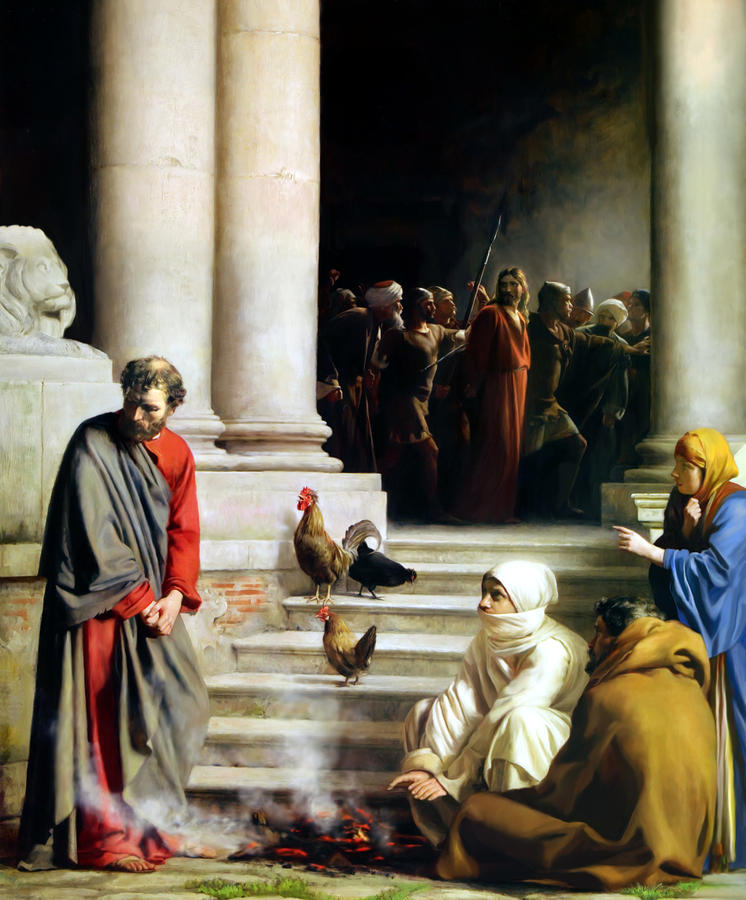
It’s very easy to express disgust for criminals and wrongdoers, and to feel some relief for “not being part of the corrupt group” that let them have their way. But I think, considering the spread of child abuse cases, that the Gospel is right for revealing the painful truth that we are all, more often than not, like the apostle Peter whose loyalty is refuted by Jesus (Matthew 26:34): “Truly, I tell you, this very night, before the rooster crows, you will deny me three times.” Indeed, when Jesus becomes a victim of the authorities, Peter looks the other way in order to keep himself from getting contaminated with the troubles of his friend.

So it comes as no surprise then that it was easier for the BBC to run a documentary about child abuse in the Catholic Church (The Shame of the Catholic Church), than to give green light for a documentary about the systematic child abuse of one of its celebrity TV-personalities, the late Jimmy Savile. It’s all too human, sadly. But evil is and can be everywhere, also in our own quarters. We might be tempted again to exorcize that evil and restore our sense of identity by “sending a scapegoat into the desert” or by executing large scale witch hunts, but that won’t heal the damage done. It will only increase people’s solicitude to be “on the right side of the line” between good and evil. It will create further mistrust between people and complicate relationships, especially between educators and children. Educators might start to promote a culture of distance between themselves and children, which will again allow malicious minds to gain an aura of inaccessibility and power – and the problem of child abuse might continue by the very measures that tried to avoid it.

As long as we are more preoccupied to safeguard our own “goodness” by blaming each other for all the “badness”, we won’t be able to help any one victim.

To give up on an easy manicheistic duality between good and evil is very difficult. Make no mistake, many of the people who were on Lance Armstrong’s side when he provided the Tour de France with himself as a new legend in cycling publicly loathe him now. He’s gained money for lots of people, and we just love heroic athletes. But ever since he was revealed as a cheat, we’re on the search for new, “real” heroes. And the vicious circle goes on, for no mere man is capable of being that legendary. Maybe he’ll be remembered more positively when he passes away as a tragic old man and long forgotten sports hero. It’s what happened to Michael Jackson and so many other celebrities. Before he died, the general public didn’t care about Jackson’s music anymore, focusing instead on allegations of child abuse and other scandals Jackson was involved in. Dead, he again became the attractive idol he once was. René Girard’s mimetic theory explains parts of our awe for (and idolization of) the dead from deeply embedded and culturally transmitted experiences surrounding victims of mob violence, whose death formerly brought peace and unity to communities.

Mimetic mechanisms time and again trick us into participating in the creation of “heroes” and “monsters” (who are often our former heroes). We constitute the crowd that applauds the emperor’s new clothes, until a child tells us that he really has no clothes. And then Lance walks on, proud as we have taught him to be, and we, doing everything not to lose face, convince ourselves that we somehow knew or didn’t know (depending on our position) of his deception all along…

One can only pray that people like football coach Jerry Sandusky, who abused several boys, are also taken care of by relatives. Else fallen heroes mainly serve as markers to identify and to judge what and who is “good” and what and who is “bad”. To forget that our “heroes” or “zeros” are mostly “mere men”, is to forget our own humanity. It means that we will imitate the crowd that claims to be “righteous”. It means that we will identify with the hero we imagine ourselves to be to destroy “the bad guys” outside ourselves. It means that we will unwittingly become monsters ourselves, equal to the monster we were trying to destroy – its double. Shouldn’t we be preoccupied with Sandusky’s victims instead of Sandusky himself? To listen to the voice of the Victim in our midst, instead of the thousands of godly heroes in our head that put “us” against “them”, well… that’ll be the day…

For insofar as there is jealousy, strife, and factions among you, aren’t you fleshly, and don’t you walk in the ways of men? For when one says, “I follow Paul,” and another, “I follow Apollos,” aren’t you fleshly? […] Therefore let no one boast in men. For all things are yours, whether Paul, or Apollos, or Cephas, or the world, or life, or death, or things present, or things to come. All are yours, and you are Christ’s, and Christ is God’s.

(1 Corinthians 3:3-4 & 3:21-23).

  • FEMME DE LA RUE

Sofie Peeters made quite an impression when she launched her student film Femme de la Rue. Not only in her native country Belgium, but also across the borders. Her autobiographical, short documentary film addresses a certain kind of sexism in the streets of Brussels. Peeters is seen walking around the neighborhood that used to be her home while attending film-school. Soon she is yelled at and approached by men of different ages, mainly from North African origin. One moment some guy brutally asks her if she wants to accompany him to his apartment, the next she’s called a “bitch” or a “slut”.

CLICK TO WATCH THE TRAILER:

Allegedly, this isn’t just a problem in Brussels. French feminist groups seized on the film to trigger debates on similar problems in France. And a May 2012 poll found that four in ten young women had been sexually harassed in London over the past year (according to The Guardian, August 3, 2012).

  • “I WANT TO CHASE WOMEN, BUT I WANT MY WOMAN TO BE CHASTE…”

Of course sexism isn’t tied to any one culture. It should be clear that Sofie Peeters is not targeting Islam, for instance, or African men. Her film aims at unraveling the logic of male sexism, which can be found across cultures and in different types. My pupils, for instance, nod affirmatively when I present them with the names a flirty guy often gets on the one hand, and a flirty girl on the other: the former is sometimes rather positively called “playa”, while the latter is more easily referred to in degrading terms as “slut” or “whore”. Most of my pupils are not Muslim or African. Most of them are native, privileged Belgians, and they readily acknowledge that this kind of double-standard sexist speech exists in their social environment as well. It seems that more difficult social and economic circumstances only enhance this ever lurking presence of the male machismo. Michael Eric Dyson very clearly shows this while explaining the roots of men’s ambiguous treatment of women in hip-hop culture. Another book addressing the same issue, and well worth mentioning, is Tracy Denean Sharpley-Whiting’s Pimps Up, Ho’s Down – Hip Hop’s Hold on Young Black Women (New York University Press, 2007). Here are some thought-provoking quotes on the subject from Dyson’s book Holler If You Hear Me – Searching For Tupac Shakur (Plexus Publishing, London, 2001) – which balance a more positive assessment of hip-hop’s liberating potentials in this previous post.

p. 184-185: If social empathy for young black males is largely absent in public opinion and public policies, the lack of understanding and compassion for the difficulties faced by poor young black females is even more deplorable. There exists within quarters of black life a range of justifications for black male behavior. Even if they are not wholly accepted by other blacks or by the larger culture, such justifications have a history and possess social resonance. Young black males hustle because they are poor. They become pimps and playas because the only role models they had are pimps and playas. Black males rob because they are hungry. They have babies because they seek to prove their masculinity in desultory paternity. They rap about violence because they came to maturity in enclaves of civic horror where violence is the norm. Black males do poorly in school because they are deprived of opportunity and ambition. Yet there are few comparable justifications for the black female’s beleaguered status.

p. 186: In its punishing hypocrisy, hip-hop at once deplores and craves the exuded, paraded sexuality of the “ho.” As it is with most masculine cultures, many of the males in hip-hop seek promiscuous sex while resenting the women with whom they share it. This variety of femiphobia turns on the stylish dishonesty that is transmuted into masculine wisdom: Never love or partner with the women you sleep with. Such logic imbues the male psyche with a toleration of split affinities that keep it from being fatally (as opposed to usefully) divided – the male can enjoy the very thing he despises, as long as it assumes its “proper” place. In order for “it” – promiscuous sex – to assume its proper place in male lives, women must assume their proper places. They must occupy their assigned roles with an eye to fulfilling their function as determined by men. If they are “hos,” they are to give unlimited, uncontested sex. If they are girlfriends or wives, they are to provide a stable domestic environment where sex is dutiful and proper. The entire arrangement is meant to maximize male sexual autonomy while limiting female sexuality, even if by dividing it into acceptable and unacceptable categories. The thought that a girlfriend or wife might be an ex-ho is a painful thought in such circles. The hip-hop credo can be summed up in this way: I want to chase women, but I want my woman to be chaste.

p. 188-189: Human sexuality is a complex amalgam of competing interests that claim space in our evolving erotic identities. If human beings are to test the integrity and strength of their sexual identity, they must experiment with a variety of partners and circumstances to define their erotic temperament. At different points in life, different identities emerge, different priorities surface. […] If Tupac’s position – and by extension, hip-hop’s views – can be said to be hypocritical, it is because it reserved that prerogative exclusively for the male gender. When women exercise that prerogative, they are scathingly attacked. When men do so, they are seen as normal and healthy. What may be even more hypocritical – since many rappers claim to stand against white dominance – is hip-hop’s broad endorsement of conservative beliefs about female sexuality. When rappers express femiphobic stances, they often recycle stereotypes of poor black women promoted by right-wing hacks [becoming the “double” of their supposed enemies]: All they want is welfare, more babies, no work, and the freedom to party as they destroy the family and drive the men away.

Another feature of femiphobic culture is the simplistic division of women into angels and demons, both of which are problematic. If women are viewed as angels, the moment they depart from prescribed behavior they’re made into whores or bitches. If they are viewed as demons, it denies the complex sexual personae that all human beings express… Tupac’s femiphobia was certainly of this Manichean variety. “He definitely believed there were two kinds of women,” Jada Pinkett Smith says. “Which was a danger for Pac, because he had a way of putting you on a pedestal, and if there was one thing you did wrong, he would swear you were the devil.”

The male psyche indeed often suspects there’s a demonic old witch lurking beneath the surface of angelic princesses and queens...

  • SEXIST DEPICTIONS OF WOMEN – WOMEN AS “SCAPEGOATS”

Canadian author Jane Billinghurst assembled a “lusciously illustrated exploration of the temptress”, describing how this male and ambiguously valorized image of women has been ever present in human culture – through myth, historical accounts, film and art in general. Her book is aptly entitled Temptress (Greystone Books, Douglas & McIntyre Publishing Group, Vancouver/Toronto/Berkeley/New York, 2003). It gives a delightful overview of the contradictory meanings the image of the temptress is associated with, especially when adopted by women themselves.

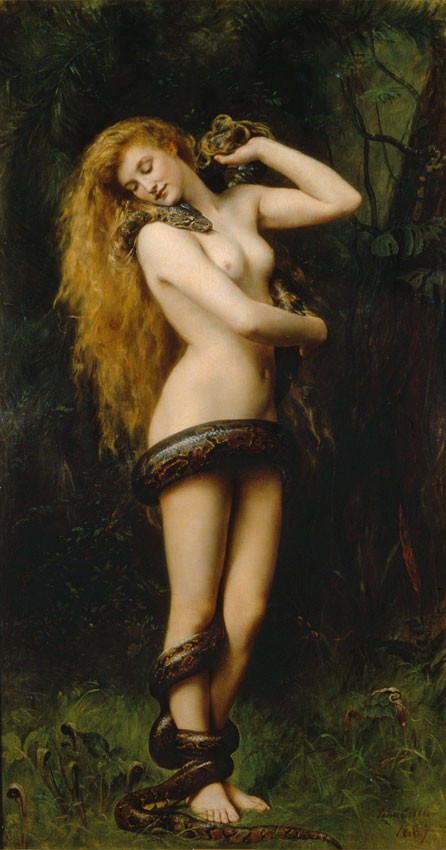
First woman to come to the fore in Billinghurst’s book is Lilith, a female demon, a “monster woman”, mostly known because of the medieval Jewish text The Alphabet of Ben Sira, although her origins can be traced back to far more ancient times.

Here’s Billinghurst’s version of the Lilith story – p. 16-17:

Male painters of Victorian England were fascinated by the independent sexuality of Eve’s predecessor and Adam’s first wife, the mysterious Lilith. Created Adam’s equal, according to medieval Jewish folklore, Lilith was appalled when her husband insisted on the missionary position for sex. She knew she had been made from the same clay that he had, and she wanted an equal say in how their love life unfolded. She wanted to experiment with this new flesh, to explore the range of pleasures it could provide.

Adam, in contrast, was rather prude. The idea of creating a sexual dialogue, of reacting to the signs fed back to his body from Lilith’s, of following an impulse not knowing where it might lead, was foreign to him. He did not yet know enough about his own urges to feel comfortable abandoning himself to Lilith’s. He refused to listen to his wife, and Lilith submitted to night after night of missionary sex – her mind, no doubt, on other things, like the wide expanse of the night sky, the rustling of creatures in the bushes… and the possibilities of life without Adam.

Resentment built in Lilith until she could stand it no longer. Undaunted by the fact that she knew nothing about the world outside paradise, according to the text of The Alphabet of Ben Sira, she “uttered the ineffable name of God,” the gates of Eden swung open, and off she went to make her own way in the world, unencumbered by her sexually unimaginative husband.

Lilith’s life from then on has been portrayed as one long party. She went to the Red Sea, where she cavorted with all manner of hideous demons, indulging in whatever sexual positions she wanted and producing hundreds of demon children. When Adam complained to God that his supposed helpmeet had left him, God sent three angels to bring Lilith back to where she belonged. But she refused to return: she had found a place where she could indulge her sexuality, and she had no regrets.
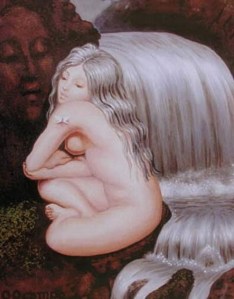
Despite her new lifestyle, Lilith never completely severed her ties with the uptight male to whom she had once been married. After Adam lost his immortality and begat humankind, Lilith started taking the lives of young children, creeping in at night through open windows and snatching their breath away. When unsuspecting parents tried to wake their offspring, they found that their previously healthy babies had died in the night. The three angels were horrified by such heartless, vindictive behavior. They could not force Lilith to return to Eden, but they did strike a bargain with her. Her window of opportunity for such malicious behavior was restricted to eight days after birth for baby boys and twenty days for baby girls. In addition, if amulets were hung inscribed with the angel’s names – Senoy, Sansenoy, and Semangelof – Lilith agreed to stay away.

Strangling babies while they slept was not Lilith’s only revenge against the man who had denied her pleasure. She also wafted into the dreams of men who slept alone. A slight rub of skin on skin or skin on sheet, and the men could not help but react physically to the thoughts she conjured up. The wet dream was her gift to the sons of Adam. A slight morning stickiness, proof of the nocturnal emission, was often the only sign of her visit – and a yearning to remember just what pleasure it was that she had promised as she passed by.

Lilith lingers in the thoughts of men as a reminder of sexual opportunities lost or not yet found. Here was a woman who was not afraid to take charge, who could imagine delights of which Adam could not conceive. To abandon oneself to the charms of such a woman – who knows where that might lead? Men have been wondering ever since.

Although this story could be interpreted as a story about an emancipated woman in some contexts – as Billinghurst suggests at the end of her account –, it should first be considered as a typically male and actually sexist depiction of female sexuality. Moreover, the question remains how women can truly emancipate themselves from male imagination if they simply imitate the images they’re presented with, while arguing – in a spirit of rivalry between the sexes – that they have every right to claim those images as their own. For the time being, I let this question to be answered by the pop diva’s of this world, like Madonna. Let’s take a closer look at how female sexuality and the relationship between the sexes is portrayed in the story of Lilith:

  1. A woman who desires sexual freedom and who wants to have a say in her own destiny transgresses a sacred order of things, disrespecting important taboos that try to avoid chaos in human life. Lilith “uttered the ineffable name of God…”
  2. A woman who desires sexual freedom and who wants to have a say in her own destiny is responsible for all kinds of evil in the world and the loss of what could be “paradise”. How could such a woman be a good mother to her children? She’s a deadly disruption of family life, as she is unable to provide a sustainable environment for children. Undaunted by the fact that she knew nothing about the world outside paradise, Lilith uttered the ineffable name of God, the gates of Eden swung open, and off she went to make her own way in the world… After Adam lost his immortality and begat humankind, Lilith started taking the lives of young children, creeping in at night through open windows and snatching their breath away. When unsuspecting parents tried to wake their offspring, they found that their previously healthy babies had died in the night…
  3. Men are merely helpless victims of a woman who desires sexual freedom and who wants to have a say in her own destiny. Unfortunately, men cannot always be on guard against the seductive powers of the demonic woman. The wet dream was Lilith’s gift to the sons of Adam. A slight morning stickiness, proof of the nocturnal emission, was often the only sign of her visit…
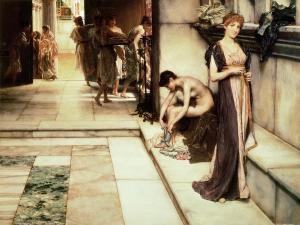
A main challenge for humankind has always been how to restore “paradise” in times of crisis. As the story of Lilith and many other myths make clear, sexuality – especially from the female side – has always been experienced as one of the main sources of turmoil. That’s why sexuality is regulated culturally. It’s often considered taboo because of the possible destructive outcomes it’s associated with. On the other hand, however, fertile sexuality is also needed to secure the survival and stability of communities. Ritualistic “arrangements” – from (temple) prostitution to the institution of marriage – try to give sexuality a proper place in society, so it can be experienced in its beneficial aspects.

No wonder then that certain individuals, who don’t seem to respect a community’s peculiar cultural arrangement of taboos and rituals, are often perceived as provocative and dangerous. They are easily sacrificed, allegedly in order to protect the community from more or imminent chaos. The social mind (male as well as female) actually always suspects sexually independent women who don’t seem to care about our long and diverse traditions of patriarchal taboos and rituals.

Sexually independent women are fascinating and threatening at the same time, revered and loathed, loved and hated. They are mysterious, seemingly beyond any control, evoking the numinous experience of the sacred – Rudolf Otto (1869-1937) speaks of “the holy”. Other women jealously admire them, while men desire them, resenting the destructive power they seem to posses. As Michael Eric Dyson pointed out, hip-hop culture is one clear example where these dynamics come to the fore. Desired and despised “hos” or “whores” are often the first to fall victim to the hidden fears of men and women whose sense of identity feels threatened.

The image of sexually independent, “adulterous” women who are sacrificed – mostly stoned to death – in order to “cleanse” a community, is, however sadly, deeply embedded in our social consciousness. Adulterous men are spared because they are perceived as poor victims of “evil” and “dangerous” temptresses. Men are said not to be responsible for their own words or actions towards sexually independent women. They justify themselves by making these women entirely responsible for what happens to them, saying that these women “provoked” them. The case of Sarah Tobias, who was gang raped, is but one well-known example where this kind of sick reasoning was applied. Her story provided the subject for The Accused, a 1988 Jonathan Kaplan movie with an Oscar winning Jodie Foster portraying Tobias. The men who raped Sarah Tobias tried to defend themselves by insinuating that they fell victim to the seductive and promiscuous attitude of the woman. The reaction of Sharia4Belgium against Sofie Peeters’ Femme de la Rue is analogous. According to this group of Muslims, Peeters was sexually harassed because she “provoked” men by “dressing like a whore”.

Poor, helpless men! Whether men abuse the name of God as an addition in the justification of their own (verbal or physical) violence or not, the bottom line remains: the harassed, raped or stoned victim is a scapegoat – held responsible for the violence she has to endure and accused of the turmoil men experience in their desires, while in fact being innocent. Let’s face it: are men really that weak that they cannot master their own desires, words or actions? And let’s face something else: who’s the real victim, the – seemingly – sexually independent and dangerously powerful seductive woman who’s stoned to death, or the men who stone her? Is she able to defend herself against those so-called “weak”, but nevertheless so-called “heroic” men? Being stoned is passive. To stone is active. For once our language doesn’t lie in presenting the natural order of things.

  • AN EXPLANATION OF SEXISM FROM THE POINT OF VIEW OF MIMETIC THEORY

In order to explain a variety of religious and cultural phenomena and the often contradictory things they’re associated with, René Girard proposes to look for the way these phenomena can be traced back to violent situations and the attempts to cope with this violence. So, to understand the different cultural interpretations of sexuality, and female sexuality in particular – in its demonic as well as in its divine “sacred” aspects –, we should ask ourselves: what could be the basic connection between heterosexuality – since this is what interests us at the moment – and violence? The answer from Girard’s so-called “mimetic theory” is quite obvious: women are often objects of “mimetic desire”, and this desire leads to “mimetic rivalry” or violence.

Mimetic or imitative desire emerges when two or more individuals more or less unwittingly take each other as a model for their own desire. Imitating someone else in desiring a certain object always complicates my relationship with the other. Taking the other as a model for my desire also means that he becomes an obstacle in the pursuit for the object we simultaneously desire. In this way the other appears as someone I admire (whereby I take him as a model), while at the same time he appears as someone I envy (as he becomes an obstacle who tries to posses what I consider rightfully mine). The other, in short, becomes my partner in a mutual love/hate relationship. Since he possesses a similar capacity for imitation, the other will in turn take me as a model, thereby reinforcing his own desire. This process makes me, again, an obstacle for him – his “double” – and this dynamic indeed all too often ends up in an inextricable “mimetic rivalry” (a rivalry based on imitation). And indeed: a classic, archetypal example of this kind of competition is the rivalry between two (or more) men desiring the same woman.

Mimetic rivals remain blind for their interdependency. They are both convinced of the “originality” of their own desire and perceive the other as wrongfully laying claim to something that’s not his or hers. In the end it’s not about obtaining certain objects anymore, but about obtaining a kind of prestige, image or status. More specifically, both rivals desire the other to acknowledge them as autonomously desiring individuals. However, the more they desire to convince themselves and the other of their own glamorous autonomy, the more this desire is mutually imitated and the more this autonomy remains an object(ive) that is not obtained – and so remains desired. Mimesis or imitation stays the hidden source of a tragic competition wherein rivals more and more become each other’s equals as they try to distinguish themselves from each other. Mimesis stays the hidden source of an ever increasing desire for “uniqueness” and “independency”, and an ever increasing failure of reaching these goals.

So what did ancient men do, men who had to fear the competition and violence of fellow men – a violence which could destroy the stability and eventual survival of their community? What did they do to enforce and secure their own status and prestige? Well, apparently they set up different systems of taboos, rituals, plays and games to prevent mimetic competitive tendencies from becoming destructive to community life. But in coping with violence associated with heterosexuality, men failed to take into account their own share and responsibility in that violence, unable to fully acknowledge the mimetic nature of their desires. Instead, women had to take responsibility for the behavior of men: in one culture they had to wear a veil in public “to protect the honor of their husband”, while in another they had to act as mesmerizing and beautiful temptresses – trophies to show off a man’s success and status. Female sexuality was regulated to fulfill men’s expectations and to keep them from fighting each other: prostitutes were considered no one man and every man’s possession – often hailed, in the case of temple prostitution, as allowing the potentially violent nature of “sacred” sexuality in a beneficiary way, while in other cultural contexts also despised as a kind of “necessary evil”.

But enough with this past tense! If one thing becomes clear from the above mentioned examples of certain tendencies in today’s hip-hop culture, Sofie Peeters’ Femme de la Rue, the “gang rape” case of Sarah Tobias, and Sharia4Belgium’s reaction against Peeters, it’s this: we, men, still very often fail to realize how we turn women into scapegoats – victims accused of things they’re not (or certainly not fully – where’s the adulterous husband while adulterous women are stoned to death?) responsible for.

Girard’s mimetic theory explains how sexist tendencies originate in men’s inability to locate the real source of instability and violence in the context of heterosexuality. Instead of acknowledging that anger and rivalry emerge because of the mimetic nature of their desire, men mistakenly locate the source of their anger and rivalry in the object of their desire: the woman. She thus has to pay the price to fulfill men’s lust for status, honor, power and prestige. From the sexist point of view, women are to be respected if they “honor” men’s status, and only then! A sexist man’s love for status is worth more to him than the love for the well-being and happiness of his closest “other” and neighbor – his wife. That’s why a sexist man can be called idolatrous: kneeling to the “divine” image he has created of himself, while failing to love the “other” who does not necessarily answer his needs (which precisely makes the other “other”).

  • WOMEN, JESUS AND ROCK ‘N’ ROLL

In my book Vrouwen, Jezus en rock-‘n-roll (Altiora Averbode, 2009) – “Women, Jesus and rock ‘n’ roll” , I suggested a feminist reading of the story of the Fall in Genesis. Like Pandora in Greek mythology, Eve is portrayed as being mainly responsible for the evils humankind has to suffer. So the sexist element is clearly present in the Hebrew Bible as well. No doubt about that. It’s no wonder that Michelangelo (1475-1564) even depicted the seductive and “dangerous” serpent as a woman in his paintings at the Sistine Chappell. Eve is an “Eve of destruction”.

A more contextual reading, however, delivers different results. In short, Eve is not condemned because she is a woman, but because she is unable to resist a destructive kind of envy (or, more generally, “mimetic desire”). Consider this analogy with a story a few chapters further on in the book of Genesis: Cain is not condemned because he is the oldest of two sons, but because he is unable to resist a destructive kind of jealousy – he kills his brother Abel.

So amidst sexist tendencies there are also texts in the Bible which criticize the mechanisms that turn women into scapegoats. I tried to make this clear in a further contextual reading of the Song of Songs, taking the story of Jesus’ forgiveness of an adulterous woman in John 8:1-11 and his consideration of prostitutes in Matthew 21:28-32 as interpretive keys. But it would go too far to explain this here. Suffice to say that some important biblical texts are surprisingly subversive – “rock ‘n’ roll” indeed – towards the mechanisms that turn women into scapegoats.
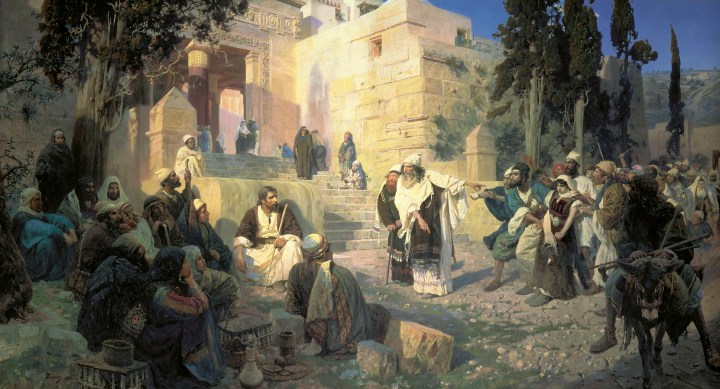
This is in line with Girard’s claim that the Hebrew Bible and the New Testament gradually attack the core of scapegoat mechanisms as the cornerstones of human relationships. Christ, in entering that core by offering to become the forgiving substitute victim of all scapegoats, transforms human relationships from within in a way that no other human being seems to have done. But to grasp this more fully I advise the reader to delve into the work of James Alison.

Anyway, Christ – as others have done – challenges us to build our relationships on “love for our neighbor” instead of on “love for our status or our prestige”. So if a woman wears a veil, the question should not be whether and on what grounds she is obligated to wear a veil. The question should be what motivates her to wear a veil: is it fear of losing her status in the eyes of her husband and other men if she doesn’t, or is it a freely chosen way of expressing the unique type of love she feels for her husband? In the latter case, she won’t be offended or feel threatened if other women don’t follow her example. Because she has freely chosen to wear a veil, she will not be jealous or resentful towards women without a veil. If, on the other hand, she chooses to wear a veil out of fear, she might develop resentment towards women who seem to “get away” with not wearing a veil. The only thing she can do then is to convince herself that her masochistic and “heroic” self-sacrifice is a way to attain a “sacred” (or “holy”) status – which is a way of self-glorification by submitting to a supposedly admirable (self-) image or idol. This kind of perverse, masochistic and often violent martyrdom is all too familiar. Which brings me to the heart of modern fundamentalism and its continuation of sexist tendencies.

  • “CHECK FOR TREACHEROUS WOMEN”  WITHIN AND OUTSIDE FUNDAMENTALISM

In his book, Religion Explained – The Evolutionary Origins of Religious Thought (Basic Books, New York, 2001), French anthropologist Pascal Boyer explains how fundamentalist religious communities have the tendency to “check for cheaters or defectors” as a means to (re)structure themselves and strengthen their coalitions. The public and “spectacular” punishment of defectors – i.e. individuals who are perceived as being not loyal or a threat to a community’s traditionally informed identity –, is a powerful signal to discourage further infidelity, especially in times of crisis.

Guomundur Ingi Markusson pointed out some very interesting connections between Boyer’s evolutionary psychology and René Girard’s mimetic theory in an article for Contagion (number 11; Violent Memes and Suspicious Minds: Girard’s Scapegoat Mechanism in the Light of Evolution and Memetics). Markusson rightly quotes the following passage from Boyer’s Religion Explained, wherein Boyer explains how fundamentalism originated as a modern religious phenomenon (more specifically as an attempt to “restructure traditional coalitions” in the face of secular society’s indifference towards religious demands that are considered necessary) – p. 294:

The message from the modern world is not just that other ways of living are possible, that some people may not believe, or believe differently, or feel unconstrained by religious morality, or (in the case of women) make their own decisions without male supervision. The message is also that people can do that without paying a heavy price. Nonbelievers or believers in another faith are not ostracized; those who break free of religious morality, as long as they abide by the laws, still have a normal social position; and women who dispense with male chaperons do not visibly suffer as a consequence. This “message” may seem so obvious to us that we fail to realize how seriously it threatens social interaction that is based on coalitional thinking. Seen from the point of view of a religious coalition, the fact that many choices can be made in modern conditions without paying a heavy price means that defection is not costly and is therefore very likely.

So, also in the case of modern fundamentalism, independent women not only pose a challenge to male dominance, authority and self-esteem, but also to the very basis of community life and cultural identity. That’s why the fundamentalist reflex consists in treating sexually independent women as “whores”. They are allowed to carry out a relative independency only if they are willing to pay the price of being “public property” – belonging to no one man and to all men. Because of their outspoken indifference towards cultural taboos and ritualistic arrangements (such as marriage), these women are “defectors”. They are perceived as suspicious threats to “the normal state of affairs”, and shouldn’t go totally “unpunished”.  They could receive some form of respect if they played along with male expectations, but, as I mentioned earlier, they are easily victimized in times of crisis. Even if they have nothing to do with the crisis itself. In this sense we could compare these women with ancient Greek pharmakoi – scapegoat victims that were sacrificed in times of social turmoil or ecological disasters.

  • THE CASE OF MATA HARI

A famous example of a (seemingly) sexually independent and seductive woman who was sacrificed in uncertain times is Dutch-born beauty Mata Hari (1876-1917), an exotic dancer. I’d like to end this post by citing the story of her untimely death, as Jane Billinghurst describes it in the aforementioned book Temptress. Mata Hari wanted to work as a spy for the French during the First World War. Unfortunately for her, things got out of hand. It should be clear, from these and other already mentioned cases, that sexism is not a unique characteristic of a certain type of Islam, or of certain passages in the Bible, or of certain tendencies in African (American) culture, or of white male conservatives. It’s a cross-cultural, all too present reality with a long history in many (often contradictory) guises. Here’s the quote from Billinghurst’s book – p. 88-91:

Mata Hari [eager to earn her reward from the French, working as a spy] set her sights on the conquest of the German envoy in Madrid, Major Arnold von Kalle. The investigative work that led her to him was simple: she looked up his name in the phone book, requested an appointment, and set to work. She coyly described her technique: “I did what a woman does in such circumstances where she wants to make a conquest of a gentleman, and I soon realized that von Kalle was mine.”

Unfortunately for Mata Hari, von Kalle suspected her motives and decided to send messages to Germany about her in a code he knew the Allies had broken. If she was working for the French, these messages would make them believe she was working for him as well. The ploy worked. The French, anxious to crack down on spies to boost morale in their ravaged country, hauled Mata Hari in. The dancer-cum-courtesan-cum-amateur spy could not believe it. She protested vehemently that the only spying she had done had been for France. The French authorities needed a scapegoat, however, and Mata Hari fit the bill perfectly.

Sexy and unnervingly independent, she was definitely the kind of woman it was dangerous to have around. The stage had proved to be a place of liberation for many women in the early twentieth century, but when the war came, actresses and dancers, who often supplemented their incomes as mistresses and courtesans, were looked down on as subversive forces likely to upset the order of the world. Women feted for their performances when all was right with the world were now highly suspect. They not only ignored the rules but were privy to the most intimate thoughts and most unguarded moments of powerful men. If they slept with men for money, these self-centered, subversive creatures were also likely to sleep with them for secrets. The more erotic the woman, the more havoc she could wreak. And Mata Hari, a woman to whom borders meant nothing, was eroticism personified. She had to be stopped.

On 13 February 1917, Mata Hari was arrested on charges of espionage and taken to the Saint-Lazare prison for women. When Mata Hari had choreographed her dance performances, she had skillfully woven into her persona hints of temptresses past, such as the forbidden Oriental delights of Cleopatra. When times were good, such associations had served to heighten her appeal, but in the atmosphere of suspicion and intrigue of the war, associations with the exotic “other” now conjured up images of treachery rather than pleasure. Mata Hari’s dark complexion, which previously had intrigued, now disgusted. Given the kind of woman she was, Lieutenant André Mornet, the prosecuting attorney for the Third Council of War in France, explained why she had to be guilty:

“The Zelle lady appeared to us as one of those international women – the word is her own – who have become so dangerous since the hostilities. The ease with which she expresses herself in several languages, especially French, her numerous relations, her subtle ways, her aplomb, her remarkable intelligence, her immortality, congenital or acquired, all contributed to make her a suspect.”

The media quickly made the connection between Mata Hari and the images of evil women that had been hanging in galleries and fleshed out in literature over the past fifty years just waiting for a moment such as this. She was described as “a sinister Salome, who played with the heads of our soldiers in front of the German Herod.” She was compared to Delilah, another expert in getting men to spill deadly secrets. Her frank sexuality was cited as proof of her capacity for betrayal.

Gustave Steinhauer, a German spymaster, wrote that women became spies because of their lust for excitement Whereas the male spy worked for the good of his country, the female spy was focused on self-gratification. And because of their inherently treacherous natures, women who turned to espionage were “far more cunning, far more adroit… than the most accomplished masculine spy.” A novel based on Mata Hari’s story emphasizes the intense personal satisfaction a woman derives from betrayal when the central character exclaims: “How I would fasten my mouth against their hearts! And I would suck them – I would suck them until there wasn’t a drop of blood left, tossing away their empty carcasses.” Appalled, those responsible for keeping order in times of mass destruction closed ranks against the independent international woman and had her shot.

Mata Hari was a sexual adventuress who had the temerity to assert herself in areas of male privilege. She herself had sketched the details that would ensure her destruction. She had portrayed herself as a woman without borders, a woman with an exotic past who reveled in the delights of sex. As long as peace reigned in Europe, such a woman drew crowds anxious to experience a vicarious thrill. When war broke out, however, men knew from all they had read and heard that a woman of Mata Hari’s type was deadly.

The French prosecutors in Mata Hari’s case rushed through the formalities to ensure that justice was done. The jury was swept along on the coattails of their conviction, even though, as the prosecutors later admitted, there was not enough evidence against Mata Hari “to whip a cat.” The temptress mantle she had draped so coquettishly around her shoulders proved to be too effective a costume. The French firing squad believed it was doing its God-given duty when it reduced this vital and proud woman, who had brought so much pleasure to so many men, to nothing more than a “crumpled heap of petticoats,” stripped of all their menacing power.

The storytellers warn that when men are enraptured by women such as Salome and Delilah, they make wild promises and whisper secrets that contain the seeds of their undoing. Subversive temptresses of this ilk are so firmly entrenched in the collective male imagination that the image is easily transferred to real-life women who may – or may not – harbor the destructive, chaotic tendencies men are so quick to ascribe to them. An unfortunate few, like Mata Hari, find that the wave of male desires that sweeps them to success when the future looks bright turns into an undertow of male suspicion that drags them down when the tide turns.

“I hate all this philosophical mumbo-jumbo! It just doesn’t make any sense!”

I’ve experienced reactions like these from my students quite often while trying to teach them some philosophy. They express the normal frustration people get when they just don’t seem to succeed in mastering the issues they’re facing. To be honest, I more than once imitated their feelings of despair by getting frustrated and impatient myself about their inability to understand what I was trying to say. The story of students blaming teachers for not explaining things well enough, and of teachers responding that their students just don’t try hard enough, is all too familiar. But, at the end of the day, having worked through some negative emotions, I somehow always manage to sit down at my desk and try to improve upon my part of communicating. I can only hope it stays that way.

The writings of Jewish philosopher Emmanuel Levinas are not always easy to understand, let alone agree with. Roger Burggraeve, one of my professors at the University of Leuven, has proven to be an excellent guide to introduce me to the philosophy of Levinas (click here for an excellent summary by Burggraeve). But explanations at an academic level are not always easily transferable to a high school level. Regarding Levinas I’m faced with the challenge to explain something about his thoughts on “the Other” and “the Other’s face”. Although Levinas’ musings often appear to be highly abstract for someone who didn’t receive any proper philosophical training, his thinking springs from very “earthly”, even dark realities and experiences – especially the experience of the Holocaust. Levinas’ response to the threat of totalitarianism is actually very down to earth, but because it wants to be “fundamental”, I can imagine it indeed sometimes comes across as mumbo-jumbo to sixteen year olds.

Luckily enough for me, as a teacher, an episode of The Fresh Prince of Bel Air (season 3, episode 12 The Cold War) can help to make clear what “the encounter with the Other” could be like in a particular situation. Moreover, it also serves as a good way to connect René Girard’s mimetic theory with some of Levinas’ main insights. Here’s the story:

Will and his nephew Carlton have a crush on the same girl, Paula. Carlton had been the first to date Paula, but after introducing her to Will, she also becomes Will’s object of interest. Will imitates the desire of Carlton and, upon noticing this, Carlton in turn reinforces his desire for Paula by imitating his new rival Will. This is a prime and archetypal example of what Girard has labeled mimetic (or imitative) desire, which potentially leads to mimetic rivalry. Will and Carlton become each other’s obstacles in the pursuit of an object (in this case a person, Paula) they point to each other as desirable. They become jealous of each other and try to out compete one another. They both fear the other as a threat to their self-esteem and independency. Ironically however, as they try to differ themselves from each other by unwittingly imitating each other’s desire, they resemble each other more and more. In fact, their sense of “being” becomes truly dependent on the other they despise. They end up dueling each other in a pillow fight, trying to settle the score.

At one moment, near the end of Will and Carlton’s fight, something happens which indeed illustrates what Levinas means with “response to the Other’s face” (click here for some excerpts from Levinas’ Ethics as First Philosophy). Will pretends to be severely injured (“My eye!”), whereon Carlton totally withdraws from the fight. Carlton finds himself confronted with Will’s vulnerability, and is genuinely concerned for his nephew’s well-being. The Other he was fighting turns out to be more than his rival, more than the product of his (worst) imaginations. Indeed, before being a rival the Other “is simply there“, not reducible to any of our concerns, desires or anxieties. Carlton is not concerned for his own sake: he doesn’t seem to fear any punishment, nor does he seem to desire any reward while showing his care for Will. He abandons all actions of self-interest “in the wink of an eye”.

This is an ethical moment, as Levinas understands it. It goes beyond utilitarianism which, as it turns out, justifies itself as being “good” by arguing that self-interest (i.e. what proves useful for one’s own well-being) eventually serves the interest (well-being) of others as well. Putting forward the effect on the well-being of others as justification for utilitarianism is telling, and shows that utilitarianism in itself doesn’t seem to be “enough” as a foundation for ethics. Moreover, utilitarianism serves the interests of “the majority”, which threatens to overlook what happens to minorities “other than” that majority. Sometimes sacrificing a minority might seem “logical” from this point of view. By contrast, in what is “the ethical moment” according to Levinas, one fears being a murderer more than one’s own death. In other words, provoked by the Other’s “nakedness” and “vulnerability” (the Other’s face which lies beyond our visible descriptions and labeling of the Other), OUR FEAR OF THE OTHER IS TRANSFORMED IN FEAR FOR THE OTHER. The mimetic rivalry between Will and Carlton is thus interrupted until, of course, Will reveals he was only joking about his injury… and the pillow fight continues.

CLICK TO WATCH:

Eventually, Will and Carlton quit fighting and start confessing their wrongdoings towards one another. They no longer imitate each other’s desire to assert themselves over against one another, but they imitate each other in being vulnerable and forgiving, recognizing “each Other”. They imitate each other’s withdrawal from mimetically converging desire and rivalry. It is by becoming “Other” to one another that they paradoxically gain a new sense of “self”, as an unexpected consequence…

Enjoy that grand twist of humor in Will Smith’s unexpected philosophy class…

CLICK TO WATCH:

The common view in Antiquity on people who fell victim to sickness, suffering and “bad fortune” was that “they had it coming” because of certain transgressions they (or their ancestors) committed against the sacred order of things. In other words, because of sin. It is clear, for instance, that Job’s friends and relatives follow this logic in the Old Testament book of Job. They keep on suggesting that Job somehow deserves the suffering he has to endure. Jesus radically challenges this way of thinking. A prime example of this can be found in John 9:1-12, the story of Jesus healing a young man who had been blind from birth. Given the common understanding of sickness in their pre-modern society, it comes as no surprise that the disciples of Jesus pose the following question:

His disciples asked him, “Rabbi, who sinned, this man or his parents, that he was born blind?” (John 9:2)

The answer of Jesus must have come as a complete and shocking surprise:

“Neither this man nor his parents sinned,” said Jesus, “but this happened so that the works of God might be displayed in him.” (John 9:3)

This story reveals some important aspects of Jesus’ understanding of God and man. Apparently, according to Jesus, God blesses those who are sick, those who suffer – in short: the victims. Not because they are victims per se, but because they are in fact fellow human beings and their suffering is regarded as unjust. This belief in a God who regards victims as human beings who suffer unjustly is exemplified by the healing activity of Jesus, which consists in opening up the possibility for these victims to become part of the (human) community again. Since Jesus reverses the idea that victims are condemned (or “chosen”) by some divine command to suffer, but insists that God actually blesses and “chooses” them as human beings, he takes away the reasons for their marginalization, or persecution and expulsion. Moreover, he takes away, at the same time, the traditional means by which communities structure themselves, and challenges them to include those they experience as a threat, a disgrace or even as an enemy.

As the story turns out, the blind man saw something that the people of his community and Jesus’ disciples remained blind to. Jesus paradoxically accomplishes that the actual sinfulness is no longer located in the blind man, but rather in what had been the (rather unwitting) complicity of the individual members of an entire community to take part in mechanisms of expulsion.

Ever since the traditions of the Gospel spread in western culture, being a victim was gradually no longer experienced as an inevitable and sacred “state of affairs”, nor as a disgrace or something to be ashamed of. Western civilizations developed a growing active and moral concern for victims in the course of their history. Sadly, however, the search for victims all too often became a perversion of Christ’s healing activity. Sometimes we use the claim of being a victim to victimize others and to perpetuate mechanisms of exclusion. Not surprisingly, René Girard and Gil Bailie have some very insightful thoughts on the matter.

René Girard in Evolution and Conversion – Dialogues on the Origins of Culture, Continuum, London, New York, 2007, p. 236:

“We have experienced various forms of totalitarianism that openly denied Christian principles. There has been the totalitarianism of the Left, which tried to outflank Christianity; and there has been totalitarianism of the Right, like Nazism, which found Christianity too soft on victims. This kind of totalitarianism is not only alive but it also has a great future. There will probably be some thinkers in the future who will reformulate this principle in a politically correct fashion, in more virulent forms, which will be more anti-Christian, albeit in an ultra-Christian caricature. When I say more Christian and more anti-Christian, I imply the figure of the Anti-Christ. The Anti-Christ is nothing but that: it is the ideology that attempts to outchristianize Christianity, that imitates Christianity in a spirit of rivalry.

[…]

You can foresee the shape of what the Anti-Christ is going to be in the future: a super-victimary machine that will keep on sacrificing in the name of the victim.”

Gil Bailie in Violence Unveiled – Humanity at the Crossroads, The Crossroad Publishing Company, New York, 1995, p. 20:

“There’s plenty of truth in the revised picture of Western history that the young are now routinely taught, the picture of the West’s swashbuckling appetite for power, wealth, and dominion. What’s to be noted is that it is we, and not our cultural adversaries, who are teaching it to them. It is we, the spiritual beneficiaries of that less than always edifying history, who automatically empathize more with our ancestors’ victims than with our ancestors themselves. If we are tempted to think that this amazing shift is the product of our own moral achievement, all we have to do is look around at how shamelessly we exploit it for a little power, wealth, and dominion of our own.

The fact is that the concern for victims has gradually become the principal gyroscope in the Western world. Even the most vicious campaigns of victimization – including, astonishingly, even Hitler’s – have found it necessary to base their assertion of moral legitimacy on the claim that their goal was the protection or vindication of victims. However savagely we behave, and however wickedly and selectively we wield this moral gavel, protecting or rescuing innocent victims has become the cultural imperative everywhere the biblical influence has been felt.”

Just a few days ago I came across an example of this dynamic, i.e. the dynamic of proclaiming oneself as a victim and of having certain rights to persecute “evil others” because of it. Extreme right wing and nationalist parties, among others, often use the tactic of presenting themselves and their followers as victims to make certain political and social claims. In Belgium and in the Netherlands this is called the “Calimero-complex”. The cartoon character Calimero is a hapless chick, fresh out of the egg, whose famous line is: “This is not  fair; they are big and I am small.” Hence the “Calimero-complex” is used to denote persons who think the world is against them, and who revel in an underdog role.

So, what happened? Well, a few days ago I visited some friends in Antwerp, one of the big cities in Belgium, in Flanders. That’s where I saw this poster of the extreme right wing and Flemish nationalist party “Vlaams Belang” (“Flemish Interest”). It portrayed a caricature of “Lamb of God”, the beautiful 15th century painting by the Van Eyck brothers (conserved at Saint Bavo Cathedral, Ghent). The lamb was depicted in a black color, instead of white, thereby reinforcing the stereotypical connotation that “blacks are bad”. The poster was accompanied with slogans to warn certain people to “stay away from our country”, namely “impostors [abusing the system to seek asylum], illegal immigrants, Islamists, criminal foreigners”. The poster suggests that the people mentioned defile our cultural identity and heritage, and that they are no innocent lambs or wrongfully accused scapegoats.

Filip Dewinter, leading figure of Vlaams Belang, claims that the posters were in no way issued by his party and is filing a complaint. According to him, the unknowns who did issue the poster are trying to blackguard his party, presenting illegal immigrants and others as people who are targeted as “black sheep” by Vlaams Belang. Filip Dewinter suggests that his party falls victim to a campaign that reverses what is actually happening. According to him, Vlaams Belang indeed has every right, even a duty, to defend the country against illegal immigrants and the like, and these people shouldn’t be depicted as “black sheep” or victims.

I guess the real victims of these quarrels stay out of sight. The ones who have to flee their home-country, who have no real options, but are labeled as “illegal immigrants” all the same. Just the beginning of this month, Parwais Sangari, a young promising Afghan and in no way a criminal, had to leave our country to return to Kabul – you know, the place where you wouldn’t send your children on a holiday these days… Twenty year old Sangari had foster parents here. Nevertheless he was sent away to walk around aimlessly, without any real home, in the Afghan capital – after four years in Belgium.

Still there’s hope. As it turns out, we’re not completely blinded by “the atmosphere of fear” we’re creating in our politics. Some people have started campaigns in favor of people like Sangari, demanding to reconsider our general asylum and migration policies.

How blinded are we? Are we capable of noticing the Victim? Can we stand the light that shines in our darkness? Can we allow ourselves to be blinded by its splendor, to see with new eyes and new hearts?