In this post I’d like to present three types of the scapegoat mechanism as it evolves out of mimetic interactions, in a formulaic way. The following weeks I’ll post examples of these types (rap song Stan by Eminem, the biblical story of Cain and Abel and one storyline from the movie American Beauty – I already worked on these examples in my book, published in Dutch: Vrouwen, Jezus en rock-‘n-roll). This will show how these types or ‘formulas’ can be used to analyze inter/intrapersonal and social situations.
[on two types of “rewards” – goals or consequences of one’s actions? – and the implications for human interactions]
“If there is no God, everything is permitted…”
This is basically the challenging idea of Ivan Karamazov, one of the main characters in The Brothers Karamazov, the famous novel by Fyodor Dostoevsky (1821-1881). Could this be true in any way?
At the beginning of a new year, I always ask my students the following questions:
Suppose there is no principal’s office, suppose you could never be punished for any of your actions – would you still respect your fellow students and your teacher?
Suppose there are no grades to win, and you didn’t receive any reward for studying your courses and reading your books – would you still listen to your teachers and study?
What would you do if you are not watched, if you live outside “the empire of the watchmen”?
Consider Matthew 6:1-2 & 6:5: Be careful not to practice your righteousness in front of others to be seen by them. […] So when you give to the needy, do not announce it with trumpets, as the hypocrites do in the synagogues and on the streets, to be honored by others. Truly I tell you, they have received their reward in full. […] And when you pray, do not be like the hypocrites, for they love to pray standing in the synagogues and on the street corners to be seen by others. Truly I tell you, they have received their reward in full.
To put things slightly differently:
Suppose there is no hell, no punishment in any way, would you still respect your fellow man?
Suppose there is no heaven, no reward in any way, would you still respect your fellow man?
Actually, this is the kind of challenge Christianity puts us to. Christ teaches us that there isn’t something like a heaven as an established “world” for which we should bring all kinds of sacrifices in order to obtain it. As if heaven would be the ultimate goal and justification of our existence. That’s exactly like the reasoning of a student who is prepared to work hard at his courses and to obey his teachers, not because he’s intrinsically interested in his courses or respectful of his teachers, but because he considers getting good grades as his ticket to success, power and happiness – “paradise”.
Christ subverts this sacrificial logic. Rather than being an ultimate goal that justifies, explains and gives meaning to our life, “heaven” is the potential consequenceof our actions. By taking up responsibility for ourselves and one another, by loving our neighbor (which is “the righteousness of God’s Kingdom”), we co-create “heaven”. To use the student-analogy again: the student who learns to be genuinely interested in his courses will get good grades as a logical consequence of his love for studying. And he will have learned something!
Consider Matthew 6:25-34: Therefore I tell you, do not be anxious about your life, what you will eat or what you will drink, nor about your body, what you will put on. Is not life more than food, and the body more than clothing? Look at the birds of the air: they neither sow nor reap nor gather into barns, and yet your heavenly Father feeds them. Are you not of more value than they? And which of you by being anxious can add a single hour to his span of life? And why are you anxious about clothing? Consider the lilies of the field, how they grow: they neither toil nor spin, yet I tell you, even Solomon in all his glory was not arrayed like one of these. But if God so clothes the grass of the field, which today is alive and tomorrow is thrown into the oven, will he not much more clothe you, O you of little faith? Therefore do not be anxious, saying, ‘What shall we eat?’ or ‘What shall we drink?’ or ‘What shall we wear?’ For the Gentiles seek after all these things, and your heavenly Father knows that you need them all. But seek first the kingdom of God and his righteousness, and all these things will be added to you.
Therefore do not be anxious about tomorrow, for tomorrow will be anxious for itself. Sufficient for the day is its own trouble.
On the other hand, those students who are focused only on getting good grades and who fear failure will tend to forget what they have learned from the moment they have their grades and no longer “need” the information from their courses. Or they will stop being friendly to their former teachers once they have graduated.
In short, Christ doesn’t want us to respect our neighbor because we fear hellish punishment or long for some heavenly reward. He wants us to respect our neighbor because of our neighbor. He liberates us from a system of fear and anxiety based on punishments and rewards, creates the possibility of responsibility (because only a free man can be responsible) and genuine love – without ulterior motives -, and transforms the nature of sacrifice. In Christ’s view, sacrifice is not a gift to receive something from someone you need, nor is it a necessary obligation to protect some kind of “honor gone mad” (see the tragedy of Japanese kamikaze pilots during the Second World War), but it is a gift from people who are thankful for what they already received by living up to the possibilities of their freedom.
Consider Matthew 5:23-24: So if you are offering your gift at the altar and there remember that your brother has something against you, leave your gift there before the altar and go. First be reconciled to your brother, and then come and offer your gift.
Of course, there’s a dark side as well to this liberation. Let’s go to the classroom once more. If a teacher tells his students that he will not punish them or, on the other hand, reward them with good grades, there are two possibilities: there will either be an atmosphere of cooperation guided by a genuine motivation to study, or… total mayhem – “hell”!
In Battling to the End, a book in which René Girard reconsiders the treatise On War by Carl von Clausewitz (1780-1831), the apocalyptic dimensions of Christ’s teachings are related to Christ’s deconstruction of “the god(s) of sacrifice” and of sacrificial systems in general. Girard makes clear that the biblical revelation indeed has two possible outcomes: either a world of ever more rivalry and violence, or a world of ever more Love.
Reading Battling to the End a while ago, I couldn’t stop thinking about two stories in the shadow of a potential apocalypse: Empire of the Sun and Watchmen. In both these stories further mayhem and violence is avoided – at least for the time being – by the restoration of a sacrificial system of fear. Empire of the Sun reminds us how the Second World War came to an end in Japan: by sacrificing tens of thousands of innocent people, victims of the atomic bombings in Hiroshima and Nagasaki. Watchmen also displays this kind of sacrificial logic. In the fictional story of this graphic novel, the tensions between the US and the USSR during the Cold War are released after an alleged nuclear attack from outer space. Once again the death of millions of civilians provides a “peaceful world”, some sort of “paradise” – however precarious.
In Empire of the Sun, the way the Second World War unfolds in the Far East creates the setting for a boy’s coming of age story. Empire of the Sun actually is an autobiographical novel by J.G. Ballard, and tells the story of an aristocratic British boy, James (“Jim”) Graham. In 1987, Steven Spielberg made a film based on Ballard’s novel, with a young and astonishing Christian Bale taking the lead role. In the film, Jim’s privileged life is upturned by the Japanese invasion of Shanghai, December 8, 1941. Separated from his parents, he is eventually captured, and taken to Soo Chow confinement camp, next to a former Chinese airfield. Amidst the sickness and food shortages in the camp, Jim manages to survive and becomes a token of spirit and dignity to those around him, all the while hoping to get back “home” again. Jim eventually finds comfort in the arms of his mother, after losing his Japanese kamikaze-friend among many others… The scene of Jim reunited with his mother sheds a little light of hope in a world which seems condemned to the sacrificial peace of the atomic bomb – and a seemingly never ending story of fear and worries, with no peace of mind…
I made a compilation using scenes from both Empire of the Sun and Zack Snyder’s 2009 movie adaptation of the graphic novel Watchmen. The two stories raise powerful questions regarding humanity’s possibility to cope with freedom and responsibility. I think they’re opening up a lot of issues that are also discussed at the COV&R Conference in Tokyo, Japan (July 5-8, 2012). As Jim learns towards the end of the film: there are no clear-cut, magical solutions to overcome the devastations of a world at war… But to follow Christ’s footsteps, one step at a time, might take us to unexpected and new dimensions. Watch out!
I just finished reading the thought-provoking little book Keeping Together in Time: Dance and Drill in Human History, by William H. McNeill. The author experienced the effects of drill exercise and marching together himself during military training in September 1941:
“Marching aimlessly about on the drill field, swaggering in conformity with prescribed military postures, conscious only of keeping in step so as to make the next move correctly and in time somehow felt good. Words are inadequate to describe the emotion aroused by the prolonged movement in unison that drilling involved. A sense of pervasive well-being is what I recall; more specifically, a strange sense of personal enlargement; a sort of swelling out, becoming bigger than life, thanks to participation in collective ritual.” (p.2).
This experience of ‘keeping together in time’ relies heavily on ‘mimetic’ ability, i.e. the ability to ‘imitate’ the movements of others. At the same time, individual rhythm is created by imitating the same movement over and over, as a ‘repetition’. ‘Losing’ your own individuality by bonding with others during a drill exercise seems closely connected to an ecstatic dance experience, as this is described by the late Michael Jackson:
“Consciousness expresses itself through creation. This world we live in is the dance of the creator. Dancers come and go in the twinkling of an eye, but the dance lives on. On many an occasion when I am dancing, I have felt touched by something sacred. In those moments, I felt my spirit soar and become one with everything that exists. I become the stars and the moon. I become the lover and the beloved. I become the victor and the vanquished. I become the master and the slave. I become the singer and the song. I become the knower and the known. I keep on dancing… then it is the eternal dance of creation. The creator and the creation merge into one wholeness of joy. I keep on dancing… and dancing… and dancing. Until there is only… the Dance.”
There is a sacrificial element in dancing that is important for the formation of ritual. Dancing prepares individuals to lose their day-to-day consciousness in order to become part of a bigger whole. Dancing creates unity and peace. McNeill refers to the description of a ritual by the African Swazi people:
“The warriors dance and sing at the Incwala [an annual festival] so that they do not fight, although they are many and from all parts of the country and proud. When they dance they feel they are one and they can praise each other.” (p.8).
Sometimes the mimetic (i.e. ‘imitative’) process of dance and drill connects individuals so tightly to each other that they are willing, not only to lose themselves in an ecstatic experience, but also to actually and physically sacrifice their lives. McNeill illustrates this by citing a soldier’s ruminations about what he experienced during war:
“Many veterans who are honest with themselves will admit, I believe, that the experience of communal effort in battle, even under the altered conditions of modern war, has been the high point of their lives… Their ‘I’ passes insensibly into a ‘we’, ‘my’ becomes ‘our’, and individual fate loses its central importance… I believe that it is nothing less than the assurance of immortality that makes self sacrifice at these moments so relatively easy… I may fall, but I do not die, for that which is real in me goes forward and lives on in the comrades for whom I gave up my life.” (p.10).
McNeill then points to the close connections between the unity and bonds created by dance, ritual and drill on the one hand, and, on the other hand, the unity enhanced by directing these bonds towards a common enemy in violent and warlike situations:
“Obviously, this sort of merger between self and the surrounding group, attained in the heat of battle, is analogous to the ‘boundary loss’ attributed to dancers. It is also induced by close-order drill, though only in attenuated measure. If so, drill, dance, and battle belong together. All three create and sustain group cohesion; and the creation and maintenance of social groups – together with resulting rivalries among groups – constitute the warp and weft of human history.” (p.10).
In the following chapters McNeill suggests dancing rituals must have played a tremendous role in human evolution, regulating important aspects of community life. It is remarkable, especially if you’re familiar with René Girard’s mimetic theory, how dancing rituals seem to emerge around objects individuals of the same group could fight about – women, territory, food. McNeill describes how hunting could have become more efficient, structured by what Girard would call the pattern of ritual sacrifice – in which participants first lose themselves in the ‘chaotic’ yet community enhancing ecstasy of dance, followed by the commonly approved killing of a certain victim:
“… it seems best to settle for the observation that if Homo erectus bands learned to consolidate sentiments of social solidarity by dancing together, their hunting would have become more efficient. Hunters could, like modern pygmies, rehearse their past successes through dance, mimicking how they ambushed prey, drove it into a trap, or merely prodded it out of its burrow. Such re-enactments, combined with enhanced emotional solidarity provoked by the rhythms of dance, would – like military drill in Old Regime armies – make actual performances in the field more predictable. And, as was also true of such armies, the emotional bonding induced by dance would allow each individual hunter to play his part more bravely, standing firm when an encircled animal tried to break out, and using his stick in time-tested ways to turn it back or head it towards a trap prepared in advance.” (p.30).
McNeill goes so far as to propose the idea that ritualistic patterns, as ‘imitations’, indeed ‘re-enactments’, most likely preceded articulate language and structured future forms of communication. Ritual dance must have sustained communities during times of crisis:
“Dancing… could scarcely be so general if it did not have a positive effect on collective survival by consolidating common effort in crisis situations. The connection is most obvious in war dances, which prepared fighting men for the risks of ambush and battle; but the more general consolidation of sentiment among all members of the community, male and female, old and young, that community-wide dancing induced may well have been more important in maintaining everyday routines and all the forms of cooperative behavior needed for the effective conduct of community affairs.” (p.38).
In other words, dancing must have managed potentially violent situations among members of the same group. One such potentially violent situation concerns everything connected to sexuality, as ‘in the wild’ males tend to fight each other for females. The late Jim Morrison, singer of rock band The Doors, describes how the violent, death (‘thanatos’) oriented side of sexual energy (‘eros’) is somewhat controlled by the ‘cathartic’ power of ritual. The following quote is taken from the book by Stephen Davis, Jim Morrison – Life, Death, Legend (Ebury Press, London, 2005, p.182-183):
“As soon as quote factory Jim Morrison began giving interviews, ‘think pieces’ about the Doors and Rock Theater began appearing in the press, garlanded with poetic epigrams that were carefully strung together by Jim like love beads. ‘We’re really politicians. You could call us erotic politicians.’
‘We’re primarily a rock and roll band, a blues band, just a band – but that’s not all. A Doors concert is a public meeting called by us for a special kind of dramatic discussion and entertainment. When we perform, we’re participating in the creation of a world, and we celebrate that creation with the audience. It becomes the sculpture of bodies in action. That’s the political part, but our power is sexual. We make concerts sexual politics. The sex starts with me, then moves out to include the charmed circle of musicians onstage. The music we make goes out to the audience and interacts with them. They go home and interact with their reality, then I get it all back by interacting with that reality. So the whole sex thing works out to be one big ball of fire.’
‘I offer images. I conjure memories of… freedom. But we can only open doors; we can’t drag people through.’
‘Our work, our performing, is a striving for metamorphosis. It’s like a purification ritual, in the alchemical sense. First, you have to have the period of disorder, chaos; returning to a primeval disaster region. Out of that, you purify the elements, and find new seed of life, which transforms all life, all matter, all personality – until, finally, hopefully, you emerge and marry all those dualisms and opposites. Then you’re not talking about good and evil anymore, but about something unified and pure.’
Jim could even make sense when he was dead drunk. Thoroughly loaded, Jim slurred his words in what was supposed to be a major interview with a nervous, intimidated Richard Goldstein. ‘See, the shaman… he was a man who would intoxicate himself. See, he was probably already an… ah… unusual individual. And, he would put himself into trance by dancing, whirling around, drinking, taking drugs – however. Then he would go on a mental trip and… ah… describe his journey for the rest of the tribe.’
Everyone who read this understood what Jim was saying: that the Doors were more than just an act, more than just a rock band. Jim was calling signals, and the wide receivers of the nascent rock culture definitely caught the ball.”
Morrison’s reasoning reflects the strong connection between ‘violence’ and ‘the sacred’, a connection which René Girard worked out extensively in Violence and the Sacred. The Christian Story, Girard argues, unveils the violent mechanisms which produce the sacred, and criticizes the absolute necessity of sacrifice suggested by ‘traditional’ religion.
It is remarkable how William H. McNeill writes a book with insights so similar to those of mimetic theory, yet he never mentions René Girard. For me, this once again confirms the validity of essential claims made by Girard.
To end this post, I invite you to watch yet another compilation I made. This time I combined images of Leni Riefenstahl‘s Nazi propaganda film Triumph des Willens and a video of Michael Jackson. It shows the close connections, discussed by McNeill, between dance, drill and war, or, as Girard would say, between violence and the sacred – idolatry being one of the most important effects of the mechanisms which produce that ‘sacred’.
Please don’t get me wrong. By compiling these images I’m not implying Michael Jackson ever sympathized with Nazi Germany. On the contrary, Michael Jackson seems to absorb the mechanisms which are potentially violent and dangerous to produce some ‘ecstatic’ celebration in the realm of entertainment. After all, he was one of the biggest entertainers of all time. Sadly and tragically he paid the price for that, as he couldn’t escape the sacrificial mechanisms of mass adoration (for more on this, read my post The Church of David LaChapelle).
Just recently I stumbled upon quite a fun BBC documentary about monkeys. Fragments can be watched below.
Of particular interest to anyone who’s concerned with mimetic theory are the following observations, eminently shown in the documentary:
Besides getting smarter, monkeys living in larger groups also become more competitive, even aggressive and violent. From the point of view of mimetic theory this comes as no surprise, since an increased learning capacity is based on the same principle as an increased tendency for a certain type of rivalry: imitation or ‘mimesis’. Monkeys learn through imitation, but they can also become rivals through imitation. The latter happens when they imitate each other’s desire for a certain object – be it a female, a piece of food or some favorable territory. It is from this mimetic interplay that a craving for ‘status’ and ‘power’ emerges, as well as a certain ‘greed’.
Individual rivaling monkeys tend to gather allies to compete with each other. Again, the engine behind these forms of empathetic bonding seems to be mimesis by which monkeys are able to ‘project’ themselves in other members of the group. They might even ‘imagine’ what others are up to and make plans for themselves. The so-called mirror neurons in the brain play a tremendous role in this regard.
Normally, rivaling groups balance each other and keep their violent tendencies in check. However, sometimes an individual monkey becomes the victim of a whole group. The documentary shows what happens when this victim dies. His former attackers – actually the ones who murdered him! – gather around the dead body, unusually calm. [WATCH THE DOCUMENTARY FROM 4:23!]
René Girard considers this type of event foundational to the way human culture eventually originated and to the way it developed sacrificial rites. Already the BBC documentary states that more monkeys are victim to other monkeys than to predators. Girard claims that the intra-violence of mob lynching must have occurred even more in primitive ape-man societies, since rivalries must have been more intense there due to an ever stronger mimetic ability. Gradually, our primitive ancestors might have made associations during their experience of killing a common ‘enemy’ that account for the emergence of sacrifice. Aggression, rivalry and turmoil within the group seem to persist for as long as the common enemy lives. From the moment he is dead, contention ceases. ‘Chaos’ no longer reigns. ‘Order’ is restored.
The sacrificial rites of our ancestors suggest that they indeed gave meaning to victims of ‘mob lynching’. According to René Girard, the significance these victims and the mob lynching eventually received, creates the dividing line between animals and humans, and has two aspects:
1. Chaotic situations or crises within a community can be controlled by killing someone – hence the rise of what is eventually called ‘sacrifice’.
2. Chaotic situations are associated with the resurgence of a victim that is held responsible for previous chaotic situations. Indeed chaos reigned for as long as some victim was alive. That victim, therefore, is perceived as ‘being’ chaos – what seems to be beyond the control of the community, as a ‘transcendent’ or ‘sacred’ force. This violent force – i.e. the now divinized and ‘invisible’ victim – can be stopped, as experience seems to show our ancestors, by killing a new victim. So together with sacrifice the potentially violent gods originate who demand that sacrifice.
Very important to understand Girard’s mimetic theory is the observation that the victims of this type of collective violence are scapegoats, meaning: held responsible for something they’re not really responsible for (even when they are, in fact, considered ‘bad’ individuals). The real source for certain types of rivalry, tensions, conflicts and chaotic situations within communities are all sorts of ‘mimetic’ interactions. This is something the first human communities don’t realize, and that’s why, according to Girard, religion and human culture as a whole developed in all kinds of directions from sacrificial origins. Some of these origins can still be observed in groups of our actual ‘family members’, the monkeys and the apes, who, more than ever, seem to mirror fundamental aspects of ourselves.
‘Know thyself’ the Temple of Apollo at Delphi read. Start this quest by watching the fragments from the documentary Clever Monkeys
Let me start off with a short introduction to the spiritual life of David LaChapelle – click to watch the following interview (online version October 15, 2008)
– CLICK TO WATCH:
A lot of Christians might feel shocked when they first encounter the work of David LaChapelle. A renowned photographer and film-maker, LaChapelle is equally ranked among The Top Ten Most Important People in Photography in the World by American Photo as he is sometimes scornfully called the king of ‘kitsch’ or, bluntly, of ‘bad taste’ by his adversaries. The artist isn’t too proud to answer his critics:
“I use pop imagery – that’s my vocabulary; glamour and beauty is my vocabulary. They get angry when you use pop imagery (the things that are accessible) to talk about anything other than the completely superficial. And you know what? Let ’em be angry … I’m into narrative and clarity. I’m not into obscurity. I’m not into people having to read and research – I’m just into the title, and the image, and the image being the language. If people don’t want to take ten seconds to look at a picture and put it together, I can’t help that, but I stand by it and I love it. And I will keep doing it. And I ain’t going away.” (Taken from an interview for Dazed and Confused, March 2010, by Anna Carnick).
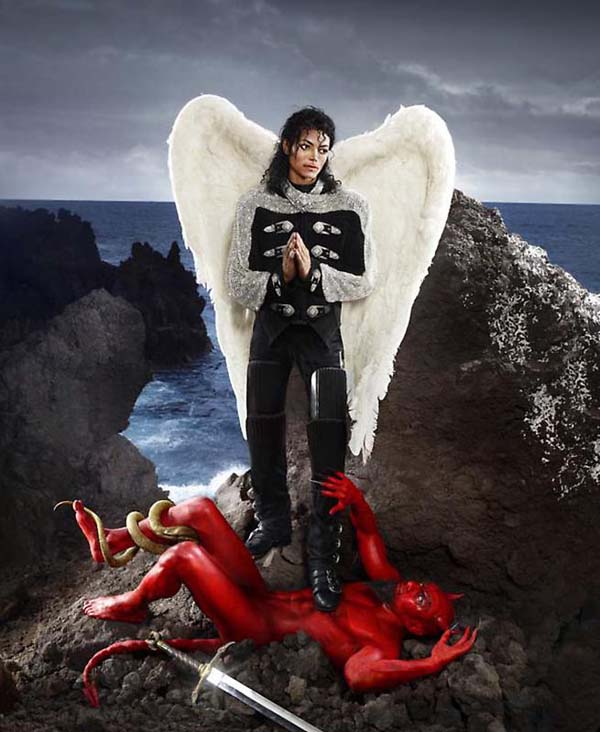
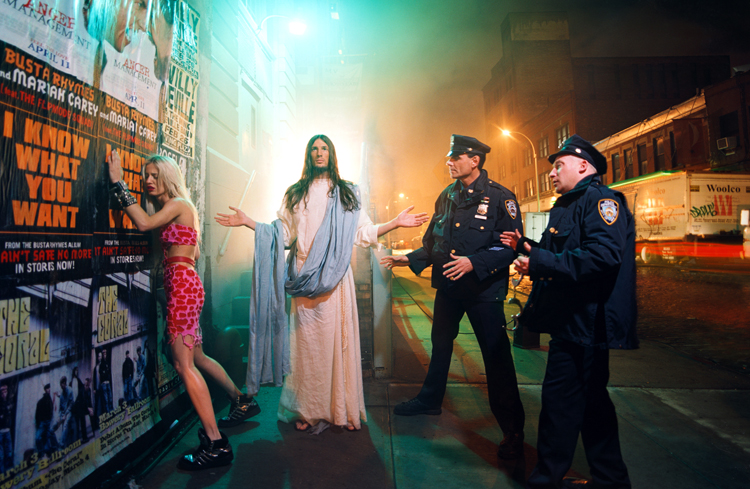
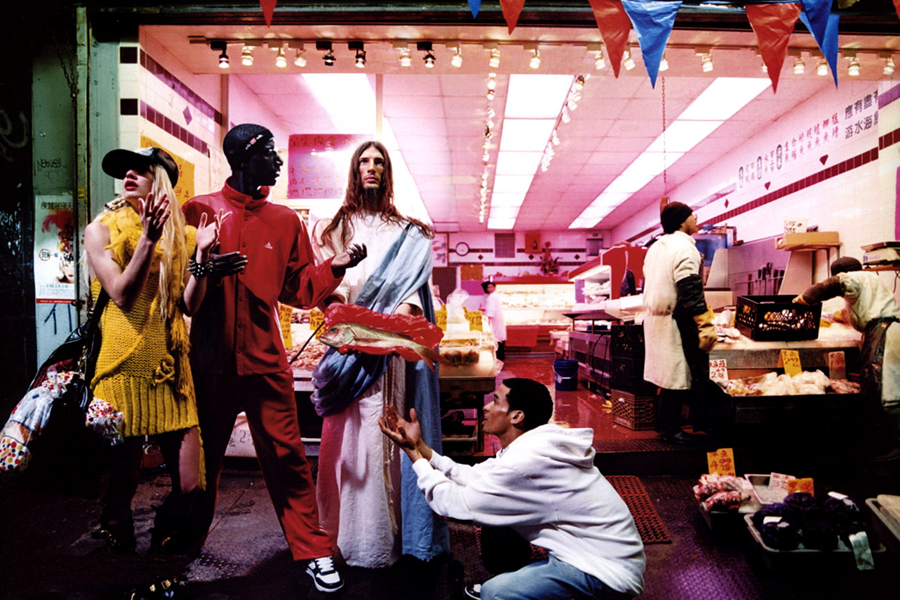
LaChapelle’s work displays a tremendous knowledge and admiration of western art’s history, and is peppered with Christian symbolism and imagery, as is shown especially by the ‘Jesus is My Homeboy’ and ‘American Jesus’ series.
The American Jesus series revolves around images of Michael Jackson (a lookalike that is), depicted in various Biblical and even typically Catholic scenes. If some Christians already find these questionable or offensive, they will really get irritated by the image entitled ‘Thy Kingdom Come’, which features a papal figure sitting on a throne before a pile of dead, naked men. The photographer seems to easily condemn the Catholic Church. However, when asked about his intentions behind his particular treatment of forms of corruption within the Church, LaChapelle answers with wit and nuance:
“I’m not condemning the Catholic Church — it’s too big, it’s like condemning a nation and that would be prejudiced. But what I’m doing here is pointing out an irony: Here you have an institution that has systematically protected pedophile priests and then you have an innocent Michael Jackson, who California spent millions of dollars trying to prosecute and could not do it because it was complete bulls–t.” (Taken from an interview for WWD, issue 07/13/2010, by Amanda Fitzsimons).
Moreover, LaChapelle has no problems whatsoever referring to his Catholic upbringing (the quote is taken from the same interview for WWD):
“I still go to church occasionally. I went the other day and found peace. I had this duality growing up with my dad being a strict Catholic and his brother being a priest and my mother finding God in nature, so I’ve taken a little from both [traditions].”
From the point of view of his Christian background, it’s no coincidence that LaChapelle has developed a special interest for two groups of people in particular: rich and famous celebrities on the one hand, and economically deprived young people on the other. His preoccupation with the Christ figure has led him to some enthralling insights. Those familiar with mimetic theory will find them fascinating as well.
I’m glad to share David LaChapelle’s views in the following two sections.
1. The sacrificial celebrity cults as producers of modern day ‘scapegoat-gods’
The biblical writings unanimously reject phenomena like gossip and the spread of false rumors about other people. Already one of the ten commandments forbids ‘to give false testimony against a neighbor’ (Exodus 20:16).
Those who gossip – and we are all tempted to do so from time to time – create alliances based on the exclusion of the one who is gossiped about. The Book of Proverbs warns for the seductive nature of voyeurism, and its destructive, dehumanizing consequences. People shouldn’t deliver themselves too easily to the delights of gossip:
Remove perverse speech from your mouth; keep devious talk far from your lips. (Proverbs 4:24).
The north wind brings forth rain, and a gossiping tongue brings forth an angry look. (Proverbs 25:23).
Where there is no wood, a fire goes out, and where there is no gossip, contention ceases. Like charcoal is to burning coals, and wood to fire, so is a contentious person to kindle strife. The words of a gossip are like delicious morsels; they go down into a person’s innermost being. Like a coating of glaze over earthenware are fervent lips with an evil heart. The one who hates others disguises it with his lips, but he stores up deceit within him. When he speaks graciously, do not believe him, for there are seven abominations within him. Though his hatred may be concealed by deceit, his evil will be uncovered in the assembly. The one who digs a pit will fall into it; the one who rolls a stone – it will come back on him. A lying tongue hates those crushed by it, and a flattering mouth works ruin. (Proverbs 26:20-28).
A gossiped-about person is either spoken of in unrealistically praiseful terms, or, on the contrary, in a non-proportional degrading way. In other words, gossiped-about persons become the ‘sacred’ glue that hold certain communities together. The gossiped-about persons become divinized idols or equally deceitfully presented demonized ‘monsters’. David LaChapelle, inspired by his Christian background, clearly understands these mechanisms, as is demonstrated in an interview with digital magazine Nowness:
It is definitely true that celebrities are our modern day gods and goddesses, and we build them up and tear them down.
Madonna has been torn down. Michael Jordan has been torn down. Michael Jackson was destroyed. Like no other person in our times. You have to remember that Michael Jackson was innocent. He was proved innocent in our courts. If you read the transcripts of the trial it is insanity, it should never have gone to court. We spent tens of millions of dollars to prosecute him when we don’t have money for schools in California.
Why is that?
Not because he was a celebrity but because he looked different. He was obsessive about privacy and it made him “other,” it made him different, and he went from being the most famous, most beloved singer to the most reviled, joked about—he couldn’t open a newspaper without reading horror stories about himself.
Judeo Christian Scripture unveils and denounces the mechanisms by which a human being’s true, imperfect ‘black-and-white’ nature is sacrificed for the sake of an unreal ‘image’. David LaChapelle saw this happening to Michael Jackson (in the aforementioned interview with WWD):
WWD: Why did you choose to photograph Michael in a variety of religious scenes?
David LaChapelle: Michael had paintings of himself at Neverland depicting himself as a knight and surrounded by cherubs and angels. People might think he’s an egomaniac, but he’s not. It’s because the world turned against him. I mean, Michael couldn’t even get B-listers to show up for the second trial. [With these pictures he’s saying] “I’m not the joke and the horror the media is making me out to be.”
WWD: Michael stars in the show’s title piece “American Jesus.” Do you believe him to be a modern-day Jesus?
D.L.: I believe Michael in a sense is an American martyr. Martyrs are persecuted and Michael was persecuted. Michael was innocent and martyrs are innocent. If you go on YouTube and watch interviews with Michael, you don’t see a crack in the facade. There’s this purity and this innocence that continued [throughout his life]. If it had been an act, he couldn’t have kept it up. If you watch his [1992] concerts from Budapest and compare it to a Madonna concert of today, you’ll see such uplifting beauty and a message that you won’t see in any other artist of our time.
In the interview with the aforementioned Nowness LaChapelle goes even further and states:
We persecuted Michael Jackson. Every person who ever bought a tabloid or watched the news, we all contributed to his death by taking in that form of gossip.
The Bible is concerned with ‘truth’ and takes sides with the wrongfully presented and the wrongfully accused persons – the scapegoats! The prophet Isaiah calls out to the people of Israel:
“You mustremovethe burdensome yokefrom amongyou and stop pointing fingers and speaking sinfully.” (Isaiah 58:9b).
Jesus, the one who is called the Christ, even goes so far as to bless the victims of gossip and false rumors:
“Blessed are you when people insult you and persecute you and say all kinds of evil things about you falsely on account of me.” (Matthew 5:11).
It is no coincidence then that the easily gossiped-about persons in the Jewish community at the time of the New Testament, like prostitutes or the infamous tax collectors, are among Christ’s favorites. He shares meals with these ‘sinners’, like with the tax collector Zacchaeus (Luke 19:1-10). Even one of his apostles – Levi or ‘Matthew’ – is known to be a former tax collector (Luke 5:27-39).
The apostle Paul asks us to transform our imitative, mimetic abilities in order to become ‘children of God’. Instead of reinforcing processes of victimization by imitating the ones who gossip and ‘point fingers’, he asks us to become ‘imitators of Christ’. Christ is the One who was eventually sacrificed, because he completely delivered himself to Compassion:
Be imitators of God as dearly loved children and live in love, just as Christ also loved us and gave himself for us, a sacrificial and fragrant offering to God. […] There should be no vulgar speech, foolish talk, or coarse jesting – all of which are out of character – but rather thanksgiving. For you can be confident of this one thing: that no person who is immoral, impure, or greedy (such a person is an idolater) has any inheritance in the kingdom of Christ and God. (Ephesians 5:1-5).
Christ completely imitated and ‘incarnated’ his ‘Father’ – a Love which ‘refuses sacrifice and desires mercy’ – see for instance Matthew 9:13. Therefore Christ could not defend himself by starting some sort of ‘civil war’, because that would imply sacrifices of others. In any case, Christ doesn’t want us to be suicidal, but he is very much aware of the risks in taking sides with the excluded and the outcasts. It might mean that these become members of the community again, but it might also have as a consequence that the outcast’s defender is excluded oneself and that he ‘has to take up his cross’ to be ‘crucified’. Christ’s preference for the victims of gossip and rumors indeed often meant he himself became gossiped-about. Nevertheless, he kept approaching people like tax collectors in liberating ways. Many a victim of gossip, like these tax collectors at the time of Jesus, imitates the reasoning of his attackers and thinks it’s ‘part of the deal’ of being a ‘celebrity’. Jesus points out that people shouldn’t accept being gossiped about by the self-declared ‘righteous’ and ‘elected’:
Jesus told this parable to some who were confident that they were righteous and looked down on everyone else. “Two men went up to the temple to pray, one a Pharisee and the other a tax collector. The Pharisee stood and prayed about himself like this: ‘God, I thank you that I am not like other people: extortionists, unrighteous people, adulterers – or even like this tax collector. I fast twice a week; I give a tenth of everything I get.’ The tax collector, however, stood far off and would not even look up to heaven, but beat his breast and said, ‘God, be merciful to me, sinner that I am!’ I tell you that this man went down to his home justified rather than the Pharisee. For everyone who exalts himself will be humbled, but he who humbles himself will be exalted.” (Luke 18:9-14).
2. The ‘richness’ of ‘poor’ people and the ‘poverty’ of the ‘rich’
Jesus distinguishes two kinds of motivations to give (of) oneself: there are those who give and sacrifice in order to receive some kind of ‘reward’, and there are those who give in order to let others come to life. The first are the real ‘poor people’ in the eyes of Jesus because they worryingly adhere and enslave themselves to ‘material’, ‘worldly’ things like ‘wealth’ or ‘social status’. They also have the ‘mimetic’ (i.e. imitative) tendency to enviously compare themselves to others and to compete with their thus conceived ‘enemies’ in order to ‘rise above’ them. In the above mentioned parable, Jesus denounces this mechanism wherein people not only sacrifice themselves to a deceitful self-image, but also sacrifice others in presenting them in an equally deceitful and degrading way. Real richness, according to Jesus, comes with those who develop a realistic, ‘truthful’ view about themselves and who are able to give whatever they received:
Jesus looked up and saw the rich putting their gifts into the offering box. He also saw a poor widow put in two small copper coins. He said, “I tell you the truth, this poor widow has put in more than all of them. For they all offered their gifts out of their wealth. But she, out of her poverty, put in everything she had to live on.” (Luke 21:1-4).
David LaChapelle pays particular attention to this kind of unconditional life bringing and therefore community enhancing way of ‘giving’ in his film Rize. Therein socially and economically deprived youngsters aren’t reduced to their situation, but are shown as talented people who are able to rebuild their communities in new, joyful and colorful ways. They really are ‘Church builders’, able to ‘give back’ inspired by the love they experience from each other. From the point of view of mimetic theory, their dancing not only ritualizes mimetic rivalry and restrains violence, but it also celebrates the grateful experience of life itself. Here’s what the synopsis of the film has to say:
“Rize” reveals a groundbreaking dance phenomenon that’s exploding on the streets of South Central, Los Angeles. Taking advantage of unprecedented access, this documentary film brings to first light a revolutionary form of artistic expression borne from oppression. The aggressive and visually stunning dance modernizes moves indigenous to African tribal rituals and features mind-blowing, athletic movement sped up to impossible speeds. “Rize” tracks the fascinating evolution of the dance: we meet Tommy Johnson (Tommy the Clown), who first created the style as a response to the 1992 Rodney King riots and named it “Clowning”, as well as the kids who developed the movement into what they now call Krumping. The kids use dance as an alternative to gangs and hustling: they form their own troupes and paint their faces like warriors, meeting to outperform rival gangs of dancers or just to hone their skills. For the dancers, Krumping becomes a way of life – and, because it’s authentic expression (in complete opposition to the bling-bling hip-hop culture), the dance becomes a vital part of who they are.
Like “Paris is Burning” or “Style Wars” before it, “Rize” illuminates an entire community by focusing on an artform as a movement that the disenfranchised have created. But the true stars of the film are the dancers themselves: surrounded by drug addiction, gang activity, and impoverishment, they have managed to somehow rise above. The film offers an intimate, completely fresh portrayal of kids in South Central as they reveal their spirit and creativity. These kids have created art – and often family – where before there was none.
It is evident that the young dancers are able to found communities in non-exclusive ways. In this way, they really are building the Church – the Community – Jesus dreamt of:
Realizing THOMAS “TOMMY THE CLOWN” JOHNSON had become a positive role model for the kids in South Central, he created the Battle Zone to provide an alternative outlet for the kids in the community to battle it out on the dance floor instead of on the streets. In 2003, Tommy the Clown’s Battle Zone hosted a sold-out performance at the Los Angeles Forum. Tommy continues the battles every third Saturday of every month at Debbie Allen Dance Academy – a non-profit dance studio where kids from the community can learn all forms of dance training. Tommy the Clown emerged as a community icon and was asked to be a spokesperson for Governor Gray Davis’ Census Campaign which involved outreach to schools, neighborhood questionnaire assistance centers and statewide agencies which succeeded with the highest mail-in response rates in four decades. He formed strategic partnerships with counties and cities, all while delivering smiles and laughter. […] Truly an entertainer for all ages, Tommy the Clown’s mission is to reach out to communities across the world that are in need of a positive alternative lifestyle.
DRAGON was born Jason Green in Frankfurt on November 2, 1981. A military baby, he spent his initial years living throughout Germany, his very first in a hospital, the result of being born prematurely. His family eventually moved to California and settled in Compton. Dragon first crossed paths with Tommy the Clown while dancing for Platinum Clowns, a rival clown group, in competition. Dancing since the age of 19, Dragon has appeared in such music videos as Blink 182’s “I’m Feelin’ It,” and in various awards shows including the Choreographer Awards and the 2005 NAACP Awards. Outside of the Clowning world, Dragon is also an accomplished artist whose experience spans across fashion design, the graphic arts, multi-media, airbrushing, and comic book art. Now residing in Carson, CA, Dragon is currently studying to be a minister. He rediscovered the church after years of distancing himself from it, only to realize how truly unhappy he was with his life. Dragon now believes that the principles our nation was established upon – religion, principle, respect – have been compromised by our drive for material things which have no true value. Through the church, he hopes to someday help others find their own spiritual foundation for a happy life.
TIGHT EYEZ, real name Ceasare Willis, is one of the founders of Krumping. He created the Krump movement in 2000 with his brothers and Lil C and Mijo. While living in New York, Tight Eyez dreamed of launching a dance that would get everyone “hyped up.” He soon moved to Los Angeles and founded Clown dancing, which thereafter evolved into Krumping. He went on to perform with many clown groups before finally meeting and joining creative forces with Tommy the Clown. Tight Eyez has turned his life over to God and changed his life through Jesus. He uses the Krump movement to help young people in faith to change their lives. His goal is to establish his own Krump Organization, of which he would be the CEO, and hopes to open schools for youth to dance, exercise their talent and utilize their inner gifts. Hopefully, by the age of 23…
Christian Jones, a/k/a BABY TIGHT EYEZ, was born and raised in the Church. His grandfather was the founder of the Christian Tabernacle of Love, Faith and Deliverance, and his Aunt is now Pastor of Christian Tabernacle Ministries. After his grandfather passed on in 1998, he took up the organ, which he plays at services. Baby Tight Eyez learned how to Krump dance at the heels of Tight Eyez, Lil C, Mijo, and Dragon, and considers them among his closest friends in the Krump movement. When he is not dancing, he loves to hang with his homies. His goal is to launch a big dance studio where everyone could Krump for free. He would also like to buy his pastors a new church. He hopes to give back to those who do not have, to give back to his neighborhood, to give those who are as he once was.
I compiled a film with some of the documentary’s testimonies, and combined them with fragments of pop diva Madonna‘s 2006 Confessions Tour. I know that her allusion to the crucifixion of Christ – as shown at the ending of this compilation – stirred a lot of controversy, but I hope people are able to see it as an artistic commentary on what happens when deprived people are given voice and rediscover their dignity: it means that the love of Christ, Christ himself, is in our midst. Although some of the youngsters explain their life story in a sacrificial way (in the sense of ‘I had to endure what happened to me to receive a rewarding insight or gift’ – the Nietzschean ‘What doesn’t kill me, makes me stronger’ type of explanation), above all they try to ‘enlighten’ the world with their dance talents. These are really ‘tales of resurrection’ wherein the gift of life is passed on to others. Watch my video compilation right here
William Blake (1757 – 1827) is one of the most intriguing artists ever to have walked the face of this earth. An English poet and painter, he conceived his own mythology, rich in symbolism and meaning, based on a thorough knowledge of Classical Antiquity and the Biblical traditions.
I first became attracted to his work by reading Gil Bailie’s book Violence Unveiled – Humanity at the Crossroads. The cover showed The Body of Abel Found by Adam and Eve, one of William Blake’s later paintings.
Struck by this powerful image and the equally powerful writings of Bailie, I delved into some of Blake’s poems. I knew he took a critical stance toward organised religion, as well as toward an idealization or ‘idolization’ of Reason.
Reading his poems, I soon discovered a human soul who was concerned with and moved by ‘the core business of Christ’: the refusal of sacrifice in the name of some ‘Higher Entity’ (be it a God, an Institution, a State or an Idea). Of course, this refusal might paradoxically imply that one is sacrificed by those who don’t respond to the call of a Love which desires ‘mercy, not sacrifice’ (Matthew 9:13). The Everlasting Gospel seems especially challenging, with sentences like these: God wants not man to humble himself: That is the trick of the Ancient Elf. This is the race that Jesus ran: Humble to God, haughty to man…
Perhaps most remarkable, William Blake shows a profound understanding with regard to the origin of ‘resentment’ in this poem. We all have the tendency to look out for what is socially acceptable, be it consciously or unconsciously. Depending on the particular group we want to be part of, we imitate certain behaviors and clothing styles. Likewise, we even hang on to certain ideas, rules and norms, defining what is morally ‘good’ or ‘bad’ for our particular group. It’s, in a sense, ironic and even funny that one of the best propagated ideas in our western society today is the idea we should be independent and not easily manipulated individuals. So, it has become the social norm to say of oneself “I’m an autonomous, critical individual, not easily imitating others”. But, by presenting such images of our own ‘independency’, we precisely imitate everyone else desiring a similar autonomy and boasting of themselves in a similar way. René Girard has called the denial of the imitative or ‘mimetic’ nature of a certain, but basic, type of human desire a ‘romantic illusion’ (see Deceit, Desire and the Novel).
Anyway, if we frustrate ourselves by adhering an acceptable ‘image’ (and, for example, refuse to recognize our ‘relational, non-independent nature’ as human beings), we might get frustrated by others who don’t seem to follow that image. For frustrating certain desires in order to satisfy our need to obtain a social status only makes these desires grow stronger. So others, who do follow the desires we suppress for ourselves, become a ‘stumbling block’ we want to get rid of. Very often, we can’t stand the confrontation with the fulfillment of our deepest, frustrated desires by these others. We become jealous of them. We would like to imitate their way of behaving, but precisely because we fear to lose our socially acceptable image, we deny being jealous of them. In the end, we’ll even state we find their behavior morally repulsive. Of course, this is a self-deception to comfort oneself. This process is exactly what Friedrich Nietzsche (1844-1900) called ‘resentment’. In Girard’s terms this resentment is part of the ‘romantic lie’, as this feeling once again denounces the mimetic nature of desire – the resentful individual doesn’t recognize being jealous of the one whose behavior he resents. Unlike Nietzsche, Girard doesn’t consider Judeo-Christian tradition as the source of a morality based on resentment, but, on the contrary, as a tradition which precisely uncovers the mimetic tendencies underlying our hate towards others.
By expulsing or ‘sacrificing’ the others we consider ‘morally wrong’, we actually try to conjure our own, ‘secret’ desire to be ‘morally wrong’. We try to convince ourselves and the ones of our own ‘group’ that we in no way resemble the ‘others’ we’re expulsing. As a tragic consequence of our enslavement to a dishonest self-image, we will not only victimize others, but we will also develop ways to secretly fulfill our frustrated desires – as they do have become ‘unmanageable’ and ‘too big’ to handle. So our desire to be ‘morally just and socially acceptable’ (‘chaste’) ignites a hypocritical lifestyle. This can be prevented if we are honest about ourselves and acknowledge certain desires in healthy, non-destructive ways – in other words if we, like Mary Magdalen or the adulteress from John’s gospel (John 8:1-11), look at ourselves through the eyes of Grace, and no longer through the eyes of those who might ‘press charges’ against us and who want us to ‘humble’ ourselves ‘in dark pretence to chastity’. That Grace, embodied so eminently by Jesus who ‘loved the sinner but condemned the sin’, indeed ‘reshapes’ sinners and empowers them to ‘sin no more’.
Like René Girard, Max Scheler (1874-1928) and other Christian thinkers, William Blake once again points to the origin of ‘bad’ i.e. ‘envious’ desire (covet), resentment and sacrificial impulses – all part of the ‘original sin’ – in his magnificent poem:
Blake, as a Christian visionary, became very sensitive toward processes of victimization, as this is shown by yet another illustration of his to J. G. Stedman’s Narrative of a Five Years’ Expedition against the Revolted Negroes of Surinam (1796).
The Little Black Boy, a poem addressing a similar theme as this shocking, indeed ‘unveiling’ image, can be found by clicking here. In this poem, Blake first and foremost explores the dynamics of Divine Love and Grace, which call for ‘imitation’, once more…
Divine Love is different from Envy which Blake, time and again, considers the source of all evil (the original sin). A fragment from his poem Visions of the Daughters of Albion puts it this way:
Can that be Love, that drinks another as a sponge drinks water, That clouds with jealousy his nights, with weepings all the day, To spin a web of age around him, grey and hoary, dark; Till his eyes sicken at the fruit that hangs before his sight? Such is self-love that envies all, a creeping skeleton, With lamplike eyes watching around the frozen marriage bed!












 SCAPEGOAT SHADOWS