In 2005, René Girard (1923-2015) became immortel of the Académie française. On that occasion, philosopher Michel Serres (1930-2019) called him, during the solemn inauguration, “the new Darwin of the human sciences.” Girard would have turned a century old this year, on Christmas Day. This is being celebrated in many places, providing an opportunity to seek out the traces of Girard’s spiritual legacy, as well as to explore the treasures of his intense reflections.
THE TREASURES OF RENÉ GIRARD
Erik Buys
“The Christian religion is an anti-religion”
“Some reflections on my work are impossible for me to read without feeling a kind of anxiety. An essay by Sonja Pos on De donkere kamer van Damokles made me feel afraid of myself when I read it. Well, I’m exaggerating a bit. It is one of the best reflections ever published on that much-discussed story.” This is what famous Dutch author Willem Frederik Hermans (1921-1995) wrote to a friend. The half-Jewish Dutch writer Sonja Pos (1936-2020) had shed René Girard’s light on his novel, and it had apparently touched him. Even today, Girard remains an intriguing thinker.
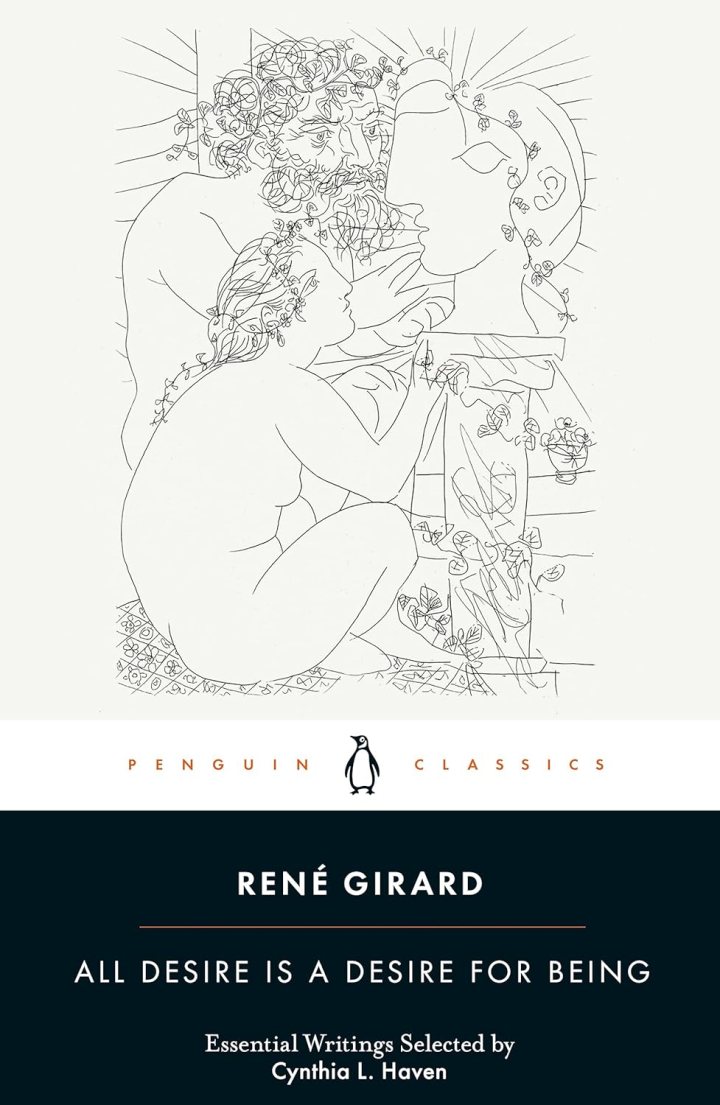
There is no shortage of excellent publications on René Girard this year. Cynthia Haven, who received rave reviews in 2018 for a first biography of Girard, released All Desire Is a Desire for Being, a carefully selected anthology. A collection of inspirational quotes at the end of the book, which characterize Girard as an often paradoxical thinker, certainly is one of its assets. In addition, Benoît Chantre (b. 1963) published an intellectual biography, a massive work of about a thousand pages. Those who do not feel comfortable reading that as an introduction to Girard’s work can count on philosopher Guido Vanheeswijck. “I interviewed Girard in 1995 on the occasion of his honorary doctorate at Antwerp’s UFSIA,” Vanheeswijck begins, “and I also met him later on.” At the request of Tertio magazine, he steps into the shoes of the French-American professor emeritus of Stanford University. Confronted with quotes from various thinkers, Vanheeswijck clarifies how Girard is both indebted to others and formulated innovative insights himself.

A first quote is from Aristotle (384-324 B.C.), from his Poetics (IV):
“To imitate others is peculiar to man from birth. Man differs from other living beings in that he has the greatest aptitude for imitation and learns his first lessons already by imitation.”
Guido Vanheeswijck: “René Girard concurs. His first well-known book has in its title mensonge romantique, which refers to the romantic but equally enlightened lie that man is an autonomous individual. You are always connected to others, and that connection gives you an identity. For example, you adopt the language and certain views of your environment. Plato also points out the importance of mimesis, of imitation. He even sees the sensory world as a flawed mimesis of an ideal, more real world. Classical education is based on mimesis. Initially, teachers demonstrate something, and children imitate. Girard therefore has a nuanced view of self-determination, characterizing human beings as interdividuals: individuals who are essentially in relation to other individuals. How you relate to others always has an impact on yourself. This is especially evident in what Girard calls mimetic desire. You not only adopt habits, language and ideas from your environment, but also imitate the desires of others. At least, insofar as those desires are not innate. The need for water is innate, but the ambition to, say, become a lawyer is culturally determined. That is a counter-intuitive idea for many modern people, that you do not desire something from within yourself, but on the basis of mimesis. However, an everyday phenomenon like fashion shows this. If there are enough copies of a coveted good available and people want to share those, then mimetic desire does not pose a problem. It becomes problematic when that is not the case.”
A quote from the opening lines of Romeo and Juliet by William Shakespeare (1564-1616) seems appropriate in that regard:
“Two households, both alike in dignity
(In fair Verona, where we lay our scene),
From ancient grudge break to new mutiny,
Where civil blood makes civil hands unclean.”
Vanheeswijck: “That quote points out that conflicts arise not so much on the basis of differences between people, but on the contrary, as those differences start to disappear. Perhaps you might call that a second counterintuitive idea, which Girard finds in the works of Shakespeare, among others. Allow me to give an example to clarify this. As a player from an amateur soccer team you might admire Kevin De Bruyne, but he does not become your rival. He makes you want to play soccer, which of course is a form of mimetic desire. De Bruyne is a role model who inspires you. But if you consider yourself one of the better players of the amateur team you are part of, you will find it hard to accept that your coach benches you. Jealous rivalry may arise as you and your replacement imitate each other, thus enhancing each other’s ambition. In general, quarrels, feuds and wars often begin when people enter each other’s territory, when they covet the same water and food supplies, desire the same partner, aspire to the same job or social position, or have an inheritance to divide. The obsession with outdoing the other makes rivals blind to what there is to share.”
Is there too much room for mimetic desire nowadays?
Vanheeswijck: “Premodern societies had a much greater awareness of the violent chaos to which mimetic desire can lead than today’s society. Hence they instituted hierarchical distinctions, even in families, because family quarrels are the worst. Not coincidentally, the Old Testament is full of fratricidal and generational conflict. Girard believes that the modern pursuit of equality is something positive insofar as it does away with descent-based power structures, but he simultaneously points out the price you pay for that: mimetic desire can show its negative sides. A premodern man does not envy the king because he cannot become king anyway. There is a hierarchical distance that keeps mimetic desire in check. In contrast, today anyone can become prime minister or president, at least in principle. That kind of equality leads to much more competition, and to frustration and possibly low self-esteem in those who do not experience success, or to backbiting about people with success. Forms of resentment run rampant in tabloid and other media: those who don’t have the careers or the kind of relationships as so-called winners feel comforted when those winners fall off their pedestals because of scandal. That makes it easier to claim that you don’t want to be like the people you secretly envy. Girard, as an anthropological researcher, describes how premodern religious institutions, which protected communities from the violent excesses of mimetic rivalry, have disappeared.”
When La violence et le sacré, Girard’s main anthropological work, was published in 1972, a review in French paper Le Monde described it as “a very important book, the first truly atheistic theory of the religious and the sacred.” How are we to understand this claim?
Vanheeswijck: “Religious practices, according to Girard, go back to a scapegoating mechanism. When violence escalates in early human communities as a result of mimetic tensions, peace can be re-established when one of the rivals becomes the common enemy of the other group members, and thus, as a scapegoat, becomes a target for jealousy and frustration. Those who deviate in some way from the average are more easily targeted. As a victim of collective murder, that person then takes on an ambiguous meaning: on the one hand, he is the embodiment of violence, and on the other, by dying, of peace. In reality, of course, the source of violence and peace lies elsewhere, namely in the operation of a mimetic desire that first sows division and then in the imitation of enmity that reunites a group. The victim, then, is a scapegoat to whom power over violence and peace is falsely attributed. And that supposed power turns the scapegoat into a sacred being, a god. The community, meanwhile, disregards its resemblance to the victim and its own part in the violence. Based on the difference the community makes between itself and the scapegoat-god, institutions are created to avoid crises. Girard unmasks such belief in gods as a product of the scapegoat mechanism. In that sense, his mimetic theory is atheistic. He shows how mimetic processes explain the emergence and evolution of cultural customs, customs that were initially religious.”
Is that why he is called “the Darwin of the humanities?”
Vanheeswijck: “Indeed. The violence associated with the scapegoat-god must be avoided. That explains the emergence of prohibitions or taboos around anything associated with that sacred violence. At the same time, collective murder had brought peace again. Sacrificial rituals repeat that event. They constitute a vaccine of controlled violence designed to resist the epidemic of violent crises. Other rituals function in a similar way. Food and sexual partners, for example, are not freely available. After all, they can be objects of rivalry. In that sense, they are taboo. But in a controlled way, in the context of ritual, a meal brings people together and sexuality within a relationship is given a fruitful place in life. Today there are still things like table manners and the celebratory ordination of relationships. Adolescents are another example of traditional sacred phenomena. They can challenge the leadership position of elders. Hence, they are traditionally taboo until they have undergone a rite of initiation. Today, some celebrate Sweet 16, a distant descendant of much more brutal initiations. Nature is also traditionally among the sacred phenomena due to its ambiguous and potentially violent characteristics. A pleasant campfire coexists with uncontrollable forest fires.”
In the book God in Pain. Inversions of Apocalypse, atheist philosopher Slavoj Žižek, following Girard, characterizes the Judeo-Christian impact on history as follows:
“Concerning Christianity, it is not a morality but an epistemology: it says the truth about the sacred, and thereby deprives it of its creative power, for better or for worse.”
Vanheeswijck: “Girard points out a crucial difference between the sacrifices in traditional religions and the sacrifice of Jesus. Traditional gods demand sacrificial violence to defuse a crisis. The Oedipus myth, for example, reflects this. Oedipus impermissibly violated taboos concerning leadership and sexuality outside the context of rituals. That is why the myth holds him responsible for the plague epidemic with which the god Apollo strikes the community of Thebes. To save the community, Oedipus must be removed.”
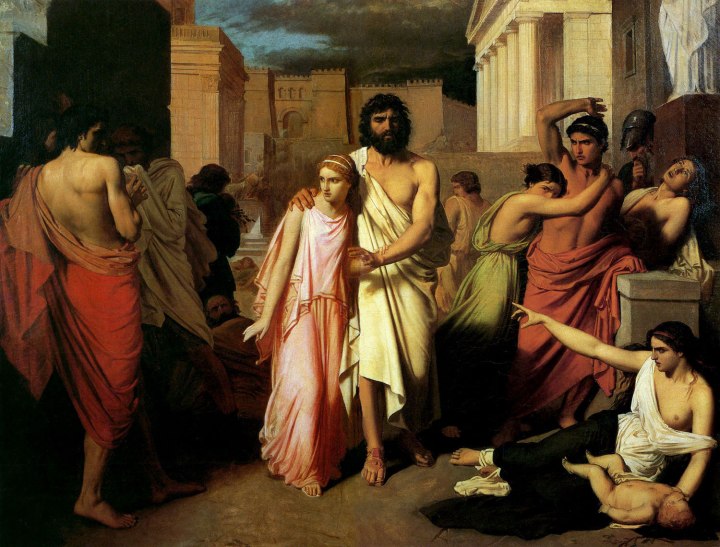
“In myths, time and again exemplary heroes appear who save others by eliminating a so-called monster. Oedipus discovers himself as that monster and goes into exile. Jesus, on the other hand, saves others by refusing to kill, which is the opposite of what a suicide bomber does. Among other things, Girard reads the story of Solomon’s judgment as a foreshadowing of the salvation offered by Jesus. When King Solomon proposes to cut in two a baby over which two women are arguing, one of the women is willing to relinquish the child so that it may live. She is willing to sacrifice a life in the presence of her child to prevent the sacrifice of her child. Thereupon Solomon judges that she is the true mother figure and grants her the child. That kind of love, which gives itself nonviolently to save and give life to the other, is the heart of the gospel. Like that mother, Jesus also steps out of mimetic rivalry again and again, refusing to unleash violence in which people would die. The gospel therefore presents him as an innocent victim. Jesus is in no way responsible for a violent crisis. Myth does the opposite with a figure like Oedipus, in order to justify the latter’s sacrifice.”

“Jesus becomes the embodiment of a vulnerable transcendence, a nonviolent love that gives itself despite often violent circumstances, all the way up to the cross. That is how the gospel reveals that it is not God who demands sacrifice, but man. There are no sacred beings who cause natural disasters, epidemics or wars that you can manipulate by making sacrifices. That kind of belief was a consequence of a scapegoating mechanism by which communities denied their own part in violent crises. Unlike classical myth or contemporary conspiracy theories, which continue to look for the major culprit from a fear-mongering desire for control, the gospel brings that truth to light. The Christian religion is actually an anti-religion that breaks with the mythical representation of the victim: Jesus is a scapegoat who in reality is not guilty of the evil imputed to him. Myth, on the other hand, lacks the insight that someone like Oedipus, despite his transgressions, cannot be guilty of the plague epidemic.”
And all of that happens for better or for worse, as Žižek claims?
Vanheeswijck: “Religion traditionally constitutes a dam against violence, which again might sound like a counterintuitive idea. If the divine foundation of traditional religious systems is exposed as an illusion, among others by the Christian narrative, then the classical institutions that channel violence also erode. On the one hand, that paves the way for an order based on charity, contrary to violently enforced respect for authority. Classical institutions can take on a new meaning in the service of that charity or love, as opposed to the service of power. On the other hand, new forms of mimetic rivalry are given free rein. Woke and anti-woke movements, for example, have different principles, but the way they put them forward makes them mirror images. They both justify forms of censorship to safeguard society from what they consider socially disruptive views. By doing so, you create new taboos in a supposedly taboo-free society, where conversations with dissenters become difficult. And anyone who takes a nuanced position is branded a traitor. You also notice this in education. When I asked a colleague what struck him the most in the evolution of teaching practices, he told me that he used to often hear from a student, “Sir, I disagree!” Now he hears more, “Sir, you can’t say that!” That’s an important difference. As philosopher Hans Achterhuis claims in a book deeply influenced by Girard, democracy is the art of peaceful struggle. In a democracy, you allow each other’s differences to be discussed to the benefit of everyone involved.”
What can we learn from the gospel in that regard, according to René Girard?
Vanheeswijck: “A community that makes discussions impossible in the name of a utopian peace opens the door to hypocritical abuses of power. The gospel criticizes such tendencies and points out their consequences. You can see those consequences in secular contexts, but certainly also in church settings. Those who vindictively fight so-called monsters who defile society easily become monsters themselves. To a victim of sexual abuse in the Church, clerical moralistic preaching is of no use, but neither is anticlerical moralism. Whoever claims purity sooner or later makes a whole group a scapegoat and spontaneously associates Catholic clergy, for example, with child abuse or Muslims with terrorism. Moreover, you then have to keep the stinking pots in your own ranks covered, imitating the violence and abuse of power you thought you were fighting. At the heart of the Christian conversion experience is the discovery of yourself as a persecutor in the light of a forgiving love. Peter realized that he had been defending his own reputation at the expense of Jesus, just as you ignore a victim of bullying for fear of being bullied yourself. Only at that point did he become a follower of Jesus. And Paul discovered himself as an evildoer in his zeal to eliminate so-called evildoers. Following Jesus means stopping the logic of violence and revenge and refusing to destroy others, especially the most vulnerable. Child abuse in the Church is, of course, diametrically opposed to that. It is to René Girard’s credit that, like many before him, he has once again shown the power of the gospel in all its sharpness, and that he has reminded us why classic literary works are classics. They reveal who we truly are, and no theory, Girard’s mimetic theory included, can match that.”
Literary Resources
“Always that mimetic desire. The love embrace of leaders. One wants to be admired, swept up by fairy tales, by that one beatific myth. Yes? Because in that hypnosis reality slips away, fear melts away.”
Speaking is a character from Hugo Claus’ novel Het verdriet van België, a Jesuit nicknamed the Boulder. He addresses Louis Seynaeve, the protagonist of the story. The Boulder refers to the hypnotized masses who adore Adolf Hitler, and to the role that mimetic desire plays in this. Authoritarian leaders like Hitler give direction to the dreams of their citizens.
For some, Hugo Claus (1929-2008) is an obscene provocateur, for others he is the liberator of a stifling clerical morality. His mentioning of mimetic desire, a key concept in the work of René Girard, might be a reason for the former to disregard Girard’s work, while, on the contrary, it might be an incentive for the latter to delve into that work. Our desire indeed is imitative or mimetic. The acclaimed poet Miriam Van hee (b. 1952) acknowledged that about her own desire when she read Girard: we allow ourselves to be influenced by prestigious examples that we follow or, on the contrary, oppose. Van hee is by no means the only author with whom Girard has left some traces.
Novelistic Truth
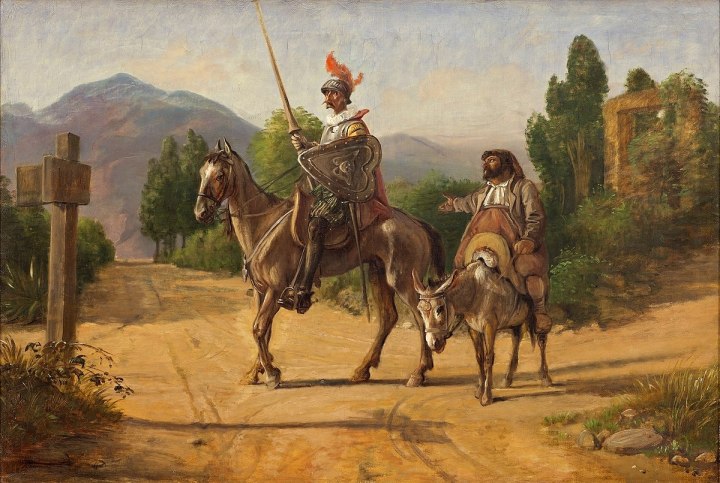
When Girard taught European literature at American universities, although he was a trained historian, he discovered that the great novelists puncture the illusion of autonomous desire. They write about characters who are fascinated by others, which degenerates into love-hate relationships on the one hand, and rivalry on the other when the protagonists cannot or will not share the object of their shared desire. The more the antagonists deny that they are imitating each other, the more they become each other’s doubles. In some, madness strikes. With Don Quixote, Cervantes (1547-1616) created the tragicomic archetype of someone who loses himself in his attempts to give himself an identity, in this case by following the example of Amadis, a knight. In his identification with Amadis, Don Quixote even fights windmills, which he perceives as giant monsters. Cervantes is one of the writers who unmasks the romantic lie of an autonomous desire and reveals the truth about its mimetic nature in his novels.
Mimetic Processes
Girard’s book on literature garnered critical acclaim. French-Czech author Milan Kundera (1929-2023) wrote, “Mensonge romantique et vérité romanesque (1961) is the best thing I have ever read about the art of the novel.” Like Claus, Kundera and many others incorporated Girard’s insights into their novels. And so a fascinating mimetic process emerges: Girard turned to classics, upon which a new generation of literati took inspiration from his ideas. This includes J.M. Coetzee (b. 1940), the South African Nobel Prize winner for Literature. And Arnon Grunberg (b. 1971), winner of the P.C. Hooft Prize, mentions Girard in a column as one of his favorite thinkers.
Ambiguous Scapegoat
More recently, Connie Palmen (b. 1955) and Tommy Wieringa (b. 1967) have taken up Girard. In an interview for de Volkskrant, Palmen confesses about De wetten, her lauded debut novel, “In every chapter there was a love triangle based on René Girard’s theory, the triangle of desire.” In Dit zijn de namen, the novel with which Wieringa won the 2013 Libris Literature Prize, the focus turns to yet another pillar of Girard’s mimetic theory: the scapegoat mechanism as the basis for sacrificial religions that seek to control violence. Wieringa outlines the background for his novel in an interview for Volzin: “For René Girard, almost every religion begins with ritual murder. Not only was the murdered able to divide the community while he was alive, but he is also able to unite the community again after his death. So he is powerful twice. Afterwards, such ritual sacrifices are often given the face of a deity or an ancestor at the birth of a nation.”
Interdisciplinary Meanders
Tommy Wieringa, among others, became familiar with René Girard’s work thanks to Dutch Dominican André Lascaris (1939-2017). The writer stayed several times in the monastery of Huissen, where the Father lived at the end of his life. In 1981, Lascaris co-founded the Dutch Girard Society in Amsterdam, the first of many interdisciplinary societies worldwide to further explore, critique and implement Girard’s work.
Academic and socially engaged societies around Girard have sprung up like mushrooms over the past decades in Australia, Japan, England, Austria, Italy, Spain, Latin America, the U.S. and, of course, France. Perhaps the best known is the international Colloquium on Violence & Religion (COV&R), which meets annually, alternately in Europe and outside of Europe. In theology, the University of Innsbruck stands out, where Raymund Schwager, s.j. (1935-2004) taught. His correspondence with Girard gave a new theological impetus, which was elaborated further by, among others, James Alison (b. 1959) (see Tertio no. 1156 of 4/6/’22 and no. 1208 of 4/5). That type of theology undermines a one-sidedly understood Greek metaphysics by referring to a Judeo-Christian denunciation of the violence that results from that metaphysical framework. With Plato, the reality of the tangible edifice that is man depends on an ideal architectural plan. The nonviolent love of the gospel, embodied in Christ, grants existence to those aspects of the edifice that are different from that ideally planned straitjacket.
Peace Work
André Lascaris applied Girard’s psychosocial insights to peace work, specifically to break the cycle of revenge in civil war-ravaged Northern Ireland. From the U.S., the unRival Network takes Girard’s theory as an educational starting point for interfaith peacebuilding. Also special are the testimonies of Dutchmen Michael Elias (b. 1948) and Berry Vorstenbosch (b. 1959) about their struggle for inner peace. They found in Girard a guide who contributed to their liberation from the caverns of psychotic episodes. Elias wrote the autobiographical novel Hanesteen about it. Vorstenbosch delivered a philosophical look at psychosis with De overtocht, winning the 2022 Van Helsdingen Prize for Psychiatry and Philosophy. Understanding the mimetic shaping of an identity, at the collective as well as individual level, can apparently enhance inter- and intra-personal life.
From Economics to Quantum Mechanics
Researchers such as Paul Dumouchel (b. 1951) and Jean-Pierre Dupuy (b. 1941) illuminate modern economics from the perspective of mimetic theory. In it, scarcity appears as a social construction: in a free market with an abundance of goods, desire must be mimetically stimulated, for example through advertising. Having enough is out of the question, which of course increases the ecological footprint of consumers. Premodern societies, on the other hand, curb mimetic desire, as they are well aware of the violence that may result from it. The anthropological field research of Simon Simonse (b. 1943) and Wiel Eggen (b. 1942) in traditional African communities provided concrete data in that regard, supporting Girard’s hypothesis about the scapegoat mechanism as the foundation of cultural practices. And since mirror neurons were discovered in the brain, neuroscientists such as Vittorio Gallese (b. 1959) have also engaged Girard’s work more deeply. Even quantum mechanics may find in Girard’s characterization of the individual – as an intrinsically relational reality – new ways to describe the role of the observer in measurements. NASA engineer Pablo Bandera (b. 1968) showed that much with his book Reflection in the Waves. The Interdividual Observer in a Quantum Mechanical World.
Film and Popular Culture
René Girard himself, of course, did not escape the finitude of existence, despite his title of immortel, but his spiritual legacy remains. Increasingly, it also appears in the world of film and popular culture. Already in Dekalog (1989-1990), the monumental, award-winning film series by Polish director Krzysztof Kieślowski (1941-1996), its pervasiveness is evident from a statement by Dekalog screenwriter Krzysztof Piesiewicz (b. 1945): “At the basis of all my reflections are the books of René Girard!” More recently, a scene from the second season of HBO series The White Lotus stands out. Ethan, one of the main characters, accuses his friend Cameron of wanting to sleep with every girl Ethan is attracted to. “You have a bad case of something called mimetic desire,” Ethan says. “If someone with higher status than you wants something, it means it’s more likely you’ll want it too.” Lifestyle magazines like Cosmopolitan took it as a cue to write about Girard’s mimetic theory. When Girard died in 2015, he was applauded for his work all over the world, especially in intellectual circles. The site of vrt nws reported, “The French-American intellectual is considered one of the greatest thinkers of the past 100 years.” Now that he is gradually becoming known to a wider audience, Girard awaits the same fate that befalls other leading thinkers: that of caricature. But even in that case, imitation is “the sincerest form of flattery.”

OM HET DOSSIER DE SCHATKAMER VAN RENÉ GIRARD TE LEZEN DAT VERSCHEEN IN TERTIO, KLIK OP VOLGENDE LINKS:

 SCAPEGOAT SHADOWS