The following is a collection of (tragic) comical references to some of the cornerstones of René Girard’s mimetic theory, especially its analysis of the reality of mimetic desire and rivalry in human relationships. They appeared on Mimetic Margins throughout the years.

Have fun with the short videoclips from Mr Bean, Chris Rock, The Fresh Prince of Bel Air, Seinfeld and The Big Bang Theory!

***

MIMETIC MR BEAN

It’s all there below, in this classic piece of British humour – some of the basic elements of René Girard’s mimetic theory: mimetic desire, mimetic competition or rivalry and the haunting nightmare of the mimetic double. Rowan Atkinson’s Mr Bean really is the master of ceremonies here. Indeed, we often take more than we need when there are other people circling around the same buffet.

Moreover, mimetic dynamics generally are at work in the development of our eating habits. It would be very interesting to create an intensified dialogue between Paul Rozin’s research on the acquisition of likes and dislikes of foods and René Girard’s mimetic theory. Although some scholars already made some connections between the two (for instance in Culinary Cultures of Europe: Identity, Diversity and Dialogue, ed. by Darra Goldstein & Kathrin Merkle, Council of Europe Publication, 2005), much promising work remains to be done. Click here for a previous post on the subject, Mimetic Food Habits.

Enjoy this clever excerpt from Mr Bean in Room 426 (first broadcast 17th Feb 1993):

***

CHRIS ROCK ROCKS MIMETICALLY

American comedian Chris Rock refers to yet another example of mimetic dynamics (in the TV Special Never Scared, 2004), the potential rivalry between two good friends over the same potential partner:

***

WILL SMITH’S FRESH PHILOSOPHY

“I hate all this philosophical mumbo-jumbo! It just doesn’t make any sense!”

I’ve experienced reactions like these from my students quite often while trying to teach them some philosophy. They express the normal frustration people get when they just don’t seem to succeed in mastering the issues they’re facing. To be honest, I more than once imitated their feelings of despair by getting frustrated and impatient myself about their inability to understand what I was trying to say. The story of students blaming teachers for not explaining things well enough, and of teachers responding that their students just don’t try hard enough, is all too familiar. But, at the end of the day, having worked through some negative emotions, I somehow always manage to sit down at my desk and try to improve upon my part of communicating. I can only hope it stays that way.

The writings of Jewish philosopher Emmanuel Levinas are not always easy to understand, let alone agree with. Roger Burggraeve, one of my professors at the University of Leuven, has proven to be an excellent guide to introduce me to the philosophy of Levinas (click here for an excellent summary by Burggraeve). But explanations at an academic level are not always easily transferable to a high school level. Regarding Levinas I’m faced with the challenge to explain something about his thoughts on “the Other” and “the Other’s face”. Although Levinas’ musings often appear to be highly abstract for someone who didn’t receive any proper philosophical training, his thinking springs from very “earthly”, even dark realities and experiences – especially the experience of the Holocaust. Levinas’ response to the threat of totalitarianism is actually very down to earth, but because it wants to be “fundamental”, I can imagine it indeed sometimes comes across as mumbo-jumbo to sixteen year olds.

Luckily enough for me, as a teacher, an episode of The Fresh Prince of Bel Air (season 3, episode 12 The Cold War) can help to make clear what “the encounter with the Other” could be like in a particular situation. Moreover, it also serves as a good way to connect René Girard’s mimetic theory with some of Levinas’ main insights. Here’s the story:

Will and his nephew Carlton have a crush on the same girl, Paula. Carlton had been the first to date Paula, but after introducing her to Will, she also becomes Will’s object of interest. Will imitates the desire of Carlton and, upon noticing this, Carlton in turn reinforces his desire for Paula by imitating his new rival Will. This is a prime and archetypal example of what Girard has labeled mimetic (or imitative) desire, which potentially leads to mimetic rivalry. Will and Carlton become each other’s obstacles in the pursuit of an object (in this case a person, Paula) they point to each other as desirable. They become jealous of each other and try to out compete one another. They both fear the other as a threat to their self-esteem and independency. Ironically however, as they try to differ themselves from each other by unwittingly imitating each other’s desire, they resemble each other more and more. In fact, their sense of “being” becomes truly dependent on the other they despise. They end up dueling each other in a pillow fight, trying to settle the score.
At one moment, near the end of Will and Carlton’s fight, something happens which indeed illustrates what Levinas means with “response to the Other’s face” (click here for some excerpts from Levinas’ Ethics as First Philosophy). Will pretends to be severely injured (“My eye!”), whereon Carlton totally withdraws from the fight. Carlton finds himself confronted with Will’s vulnerability, and is genuinely concerned for his nephew’s well-being. The Other he was fighting turns out to be more than his rival, more than the product of his (worst) imaginations. Indeed, before being a rival the Other “is simply there“, not reducible to any of our concerns, desires or anxieties. Carlton is not concerned for his own sake: he doesn’t seem to fear any punishment, nor does he seem to desire any reward while showing his care for Will. He abandons all actions of self-interest “in the wink of an eye”.

This is an ethical moment, as Levinas understands it. It goes beyond utilitarianism which, as it turns out, justifies itself as being “good” by arguing that self-interest (i.e. what proves useful for one’s own well-being) eventually serves the interest (well-being) of others as well. Putting forward the effect on the well-being of others as justification for utilitarianism is telling, and shows that utilitarianism in itself doesn’t seem to be “enough” as a foundation for ethics. Moreover, utilitarianism serves the interests of “the majority”, which threatens to overlook what happens to minorities “other than” that majority. Sometimes sacrificing a minority might seem “logical” from this point of view. By contrast, in what is “the ethical moment” according to Levinas, one fears being a murderer more than one’s own death. In other words, provoked by the Other’s “nakedness” and “vulnerability” (the Other’s face which lies beyond our visible descriptions and labeling of the Other), OUR FEAR OF THE OTHER IS TRANSFORMED IN FEAR FOR THE OTHER. The mimetic rivalry between Will and Carlton is thus interrupted until, of course, Will reveals he was only joking about his injury… and the pillow fight continues.

CLICK TO WATCH:

Eventually, Will and Carlton quit fighting and start confessing their wrongdoings towards one another. They no longer imitate each other’s desire to assert themselves over against one another, but they imitate each other in being vulnerable and forgiving, recognizing “each Other”. They imitate each other’s withdrawal from mimetically converging desire and rivalry. It is by becoming “Other” to one another that they paradoxically gain a new sense of “self”, as an unexpected consequence…

Enjoy that grand twist of humor in Will Smith’s unexpected philosophy class…

CLICK TO WATCH:

***

SHAKESPEARE MUSTA LOVED SEINFELD

In the book Evolution and Conversion – Dialogues on the Origins of Culture (Continuum, London, New York, 2007), René Girard talks about popular culture and discusses the power of mass media. His approach is very nuanced, as he distinguishes between positive and negative aspects of these phenomena. He even dares to compare television series Seinfeld to the works of William Shakespeare (1564-1616). Girard develops his thoughts in a conversation with Pierpaolo Antonello and João Cezar de Castro Rocha. The seventh chapter, Modernity, Postmodernity and Beyond, reads the following (pp. 249-250):

Guy Debord wrote that ‘the spectacle is the material reconstruction of the religious illusion’ brought down to earth. Could we consider the expansion of the mass-media system, and the ideological use of it, as a ‘kathechetic’ instrument as well?

Of course, because it is based on a false form of transcendence, and therefore it has a containing power, but it is an unstable one. The conformism and the ethical agnosticism induced by media such as television could also produce forms of mimetic polarization at the mass level, making people more prone to be swayed by mimetic dynamics, inducing the much-feared populism in Western democracies.

Do you agree, however, that movies, TV and advertising draw heavily on mimetic principle, therefore increasing our awareness on this score?

Yes and no, because the majority of Hollywood or TV productions are very much based on the false romantic notion of the autonomy of the individual and the authenticity of his/her own desire. Of course there are exceptions, like the popular sit-com Seinfeld, which uses mimetic mechanisms constantly and depicts its characters as puppets of mimetic desire. I do not like the fact that Seinfeld constantly makes fun of high culture, which is nothing but mimetic snobbery, but it is a very clever and powerful show. It is also the only show which can afford to make fun of political correctness and can talk about important current phenomena such as the anorexia and bulimia epidemic, which clearly have strong mimetic components. From a moral point of view, it is a hellish description of our contemporary world, but at the same time, it shows a tremendous amount of talent and there are powerful insights regarding our mimetic situations.

Seinfeld is a show that gets closer to the mimetic mechanism than most, and indeed is also hugely successful. How do you explain that?

In order to be successful an artist must come as close as he can to some important social truth without inciting painful self-criticism in the spectators. This is what this show did. People do not have to understand fully in order to appreciate. They must not understand. They identify themselves with what these characters do because they do it too. They recognize something that is very common and very true, but they cannot define it. Probably the contemporaries of Shakespeare appreciated his portrayal of human relations in the same way we enjoy Seinfeld, without really understanding his perspicaciousness regarding mimetic interaction. I must say that there is more social reality in Seinfeld than in most academic sociology.”
Maybe a small example can lift a tip of the veil. I chose a short excerpt from Seinfeld’s episode 88 (season 6, episode 2, The Big Salad). Jerry Seinfeld is dating a nice lady. However, when he finds out his annoying neighbor Newman is her former lover, his face darkens… One doesn’t have to watch the whole episode to know what will happen next. Indeed, Jerry eventually breaks up with his date, imitating what Newman did and ‘ending it’. The reason Jerry’s desire for his girlfriend diminishes precisely lies in the often imitative or, as Girard would call it, ‘mimetic’ nature of desire. Jerry just doesn’t desire his date directly all the way, but he is – like all of us – sometimes heavily influenced by certain models who point out what he should or should not desire. In this case, Newman turns out to be a model who negatively influences Jerry’s desire…

This scene is fun, because it’s all too recognizable and it mirrors some aspects of our tragic comic behavior – good, refined humor as it should be!

Click to watch:

***

MIMETIC BIG BANG THEORY

Sometimes, just sometimes, quite revealing scientific insights slip into popular culture. I was watching a rerun of an episode of The Big Bang Theory sitcom on Belgian television. More specifically, I found out, I was watching The White Asparagus Triangulation (episode 9, season 2 ).
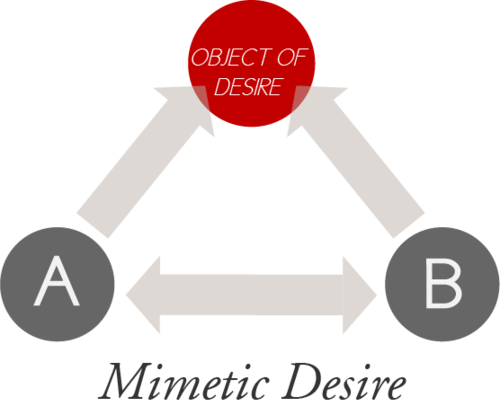
Mimetic DesireThe title itself can already be connected to a basic concept of René Girard’s mimetic theory, namely mimetic desire. As it turns out, “triangulation” indeed refers to the triangular nature of human desire (beyond instinctive needs) as described by Girard: the desire of a subject towards a certain object is positively or negatively influenced by mediators or models (click here to watch an example of negatively mediated desire from another popular sitcom, Seinfeld). Humans imitate others in orienting their desires – their desire thus is mimetic.

In the case of this episode from The Big Bang Theory: Sheldon tries to positively influence the desire of Leonard’s new girlfriend, Stephanie. After all, she is the first of Leonard’s dates to meet Sheldon’s high intellectual standards, so Sheldon does everything to increase Stephanie’s desire for Leonard. At some point he tries to persuade the girl next door, Penny, to present herself as a rival/model for Stephanie. Here’s the script for this scene.

Scene: Outside Penny’s door.

Sheldon (Knock, knock, knock) : Penny (knock, knock, knock) Penny.

Penny: What?

Sheldon (Knock, knock, knock) : Penny. Zucchini bread.

Penny: Oh, thank you.

Sheldon: May I come in?

Penny: No.

The White Asparagus Triangulation Penny and Sheldon Zucchini

Sheldon: I see. Apparently my earlier inquiry regarding you and Leonard crossed some sort of line. I apologize.

Penny: Well, thank you.

Sheldon: So, have you and I returned to a social equilibrium?

Penny: Yes.

Sheldon: Great. New topic. Where are you in your menstrual cycle?

Penny: What?

Error
This video doesn’t exist

Sheldon: I’ve been doing some research online, and apparently female primates, you know, uh, apes, chimpanzees, you, they find their mate more desirable when he’s being courted by another female. Now, this effect is intensified when the rival female is secreting the pheromones associated with ovulation. Which brings me back to my question, where are you in (Penny slams door). Clearly, I’m 14 days too early.

Female Chimpanzee Sexual Swelling KanyawaraSeveral lines of evidence indicate some female competition over mating. First, at Mahale, females sometimes directly interfered in the mating attempts of their rivals by forcing themselves between a copulating pair. In some cases, the aggressive female went on to mate with the male. At Gombe, during a day-long series of attacks by Mitumba females on a fully swollen new immigrant female, the most active attackers were also swollen and their behaviour was interpreted as ‘sexual jealousy’ by the observers. Townsend et al. found that females at Budongo suppressed copulation calls when in the presence of the dominant female, possibly to prevent direct interference in their copulations. Second, females occasionally seem to respond to the sexual swellings of others by swelling themselves. Goodall described an unusual incident in which a dominant, lactating female suddenly appeared with a full swelling a day after a young oestrous female had been followed by many males. Nishida described cases at Mahale in which a female would produce isolated swellings that were not part of her regular cycles when a second oestrous female was present in the group.
The White Asparagus Triangulation eventually gets its title from another scene in the episode. Sheldon tries to establish Leonard as “the alpha male”. Sheldon will pretend that he is unable to open a jar of asparagus. If Leonard then opens the jar he will have won the mimetic competition over the question “who is the strongest?”, resulting in an increase of his sex appeal. Of course, for the sake of comedy, things go terribly wrong :). Here’s the script for this scene.

Scene: The apartment.

Leonard: All I’m saying is if they can cure yellow fever and malaria, why can’t they do something about lactose intolerance?

Steph: Leonard, you’re going to have to let this go. You had a little cheese dip, you farted, I thought it was cute.

Sheldon: Oh, hi Stephanie.

Steph: Hi.

Leonard: Want some more wine?

Steph: Yeah, I assume I’m not driving anywhere tonight. (Sheldon lets out a loud noise).

Leonard: What are you doing?

Sheldon: I have a craving for white asparagus that apparently is destined to go unsatisfied.

Leonard: Excuse me. What the hell is wrong with you?

Sheldon: I’m helping you with Stephanie.

Leonard: By making constipated moose sounds?

The White Asparagus Triangulation Big Bang Theory

Sheldon: When I fail to open this jar and you succeed it will establish you as the alpha male. You see, when a female witnesses an exhibition of physical domination she produces the hormone oxytocin. If the two of you then engage in intercourse this will create the biochemical reaction in the brain which lay people naively interpret as falling in love.

Leonard: Huh? Would it work if I just punched you in the face?

Sheldon: Yes, actually it would, but let’s see how the lid goes. I’m not strong enough, Leonard, you’ll have to do it.

Leonard: Oh, for god’s sakes.

Sheldon: Go ahead, it’s pre-loosened.

Steph: Do you want some help with that?

Leonard: No, no, no, I got it.

Sheldon: No, yeah, yeah, he’s got it, and that’s not surprising. This is something I long ago came to peace with in my role as the beta male. Open it. (Leonard tries again. Then taps jar on counter. Jar breaks.)

Error
This video doesn’t exist

Steph: Oh my god, are you okay?

Leonard: No, I’m not. I’m bleeding.

Sheldon: Like a gladiator!

Steph: Oh, honey, you’re going to need stitches.

Leonard: Stitches? With a needle?

Steph: Well, yeah, I mean, just a few.

Leonard: Oh, okay, yeah, hang on a sec. (Throws up in sink)

Sheldon: FYI, I was defrosting a steak in there.

Rebecca Mead wrote an article for The New Yorker (April 17, 2017) on one of today’s most famous writers, Margaret Atwood, the Prophet of Dystopia. The article particularly focuses on Atwood’s dystopian novel The Handmaid’s Tale:The Handmaid's Tale (Cover)

In writing “The Handmaid’s Tale,” Atwood was scrupulous about including nothing that did not have a historical antecedent or a modern point of comparison. (She prefers that her future-fantasy books be labelled “speculative fiction” rather than “science fiction.” “Not because I don’t like Martians . . . they just don’t fall within my skill set,” she wrote in the introduction to “In Other Worlds: SF and the Human Imagination,” an essay collection that she published in 2011.) […]

With the novel, she intended not just to pose the essential question of dystopian fiction—”Could it happen here?”—but also to suggest ways that it had already happened, here or elsewhere.

As Mead’s article shows, the timeliness of The Handmaid’s Tale could very well rely on the novel’s depiction of women as typical scapegoats:

The U.S. in 2017 does not show immediate signs of becoming Gilead, Atwood’s imagined theocratic American republic. President Trump is not an adherent of traditional family values; he is a serial divorcer. He is not known to be a man of religious faith; his Sundays are spent on the golf course.

What does feel familiar in “The Handmaid’s Tale” is the blunt misogyny of the society that Atwood portrays, and which Trump’s vocal repudiation of “political correctness” has loosed into common parlance today. Trump’s vilification of Hillary Clinton, Atwood believes, is more explicable when seen through the lens of the Puritan witch-hunts. “You can find Web sites that say Hillary was actually a Satanist with demonic powers,” she said. “It is so seventeenth-century that you can hardly believe it. It’s right out of the subconscious—just lying there, waiting to be applied to people.” The legacy of witch-hunting, and the sense of shame that it engendered, Atwood suggests, is an enduring American blight. “Only one of the judges ever apologized for the witch trials, and only one of the accusers ever apologized,” she said. Whenever tyranny is exercised, Atwood warns, it is wise to ask, “Cui bono?” Who profits by it? Even when those who survived the accusations levelled against them were later exonerated, only meagre reparations were made. “One of the keys to America is that your neighbor may be a Communist, a serial killer, or in league with satanic forces,” Atwood said. “You really don’t trust your fellow-citizens very much.”


Error
This video doesn’t exist

In 2006 Margaret Atwood was interviewed by Bill Moyers for his Faith & Reason series. Talking about her novel The Handmaid’s Tale, Atwood already expressed the idea contained in the above mentioned interview, an idea that could have come straight from the work of René Girard. Here are some transcribed quotes from Margaret Atwood during her interview with Bill Moyers:

Quote 1:

“[The Handmaid’s Tale] is a blueprint of the kind of thing that human beings do when they’re put under a certain sort of pressure. And I made it a rule for the writing of this book that I would not put anything into it that human societies have not already done.”

Quote 2:

Salem Witch Trial Bridget Bishop HangedThe Salem witchcraft trial is in my opinion one of the foundation events of American history. And it was an event where you can call it a clash between mythology and politics if you like. Because it depended very much on a belief in the invisible world. Cotton Mather, who was a very prominent divine at the time, wrote a book called The Wonders of the Invisible World, which was all about the behavior of witches.

Bridget Bishop TombstoneAnd the devil. And this is what people believed. They weren’t being hypocrites when they did these things. They were actually scared of witchcraft and the devil. And they believed that the devil could work his way into their community through witches, so it was serious business. But it was also a hysteria. The surprise to me has been all of the stuff I learned long ago. I thought, ‘Nobody’s going to be interested in this again. You know what good is knowing 17th-century theology ever going to be to me? Or anybody else. Surely nobody’s interested.’ And now suddenly it’s all come back. Because things do go around in cycles.”

Quote 3:

“I think the Salem witchcraft trial is the kind of event that replays itself throughout history when cultures come under stress. When societies come under stress these kinds of things happen. People start looking around for essentially human sacrifices. They start looking around for somebody they can blame. And they feel if only they can demolish that person, then everything’s going to be okay. And it’s of course never true, but there are these periods in history. If things aren’t going well, it must be the Communists. Let’s have Joe McCarthy. You know things aren’t going well. It must be them liberals. Whoever it may be.”

In the words of René Girard (from The Scapegoat – thanks to Brandon J. Brown for providing the quote): “Ultimately, the persecutors always convince themselves that a small number of people, or even a single individual, despite his relative weakness, is extremely harmful to the whole of society. The stereotypical accusation justifies and facilitates this belief by ostensibly acting the role of mediator.”

And here’s one last quote from Margaret Atwood on mimetic rivalry:

“What has amazed me is the theocracy that I’ve put in Handmaid’s Tale never calls itself Christian. And in fact it never says anything about Christianity whatsoever. Its slogans, etc., etc., are all from the Old Testament. So what has amazed me was the rapidity with which a number of Christians put up their hands and said, “This is an insult to us.” What did it mean? It meant they hadn’t read the book. You know they hadn’t read the book.

Because in the book the regime does what all such [totalitarian] regimes immediately do. It eliminates the opposition. The Bolsheviks got rid of their nearest ideological neighbors, the Mensheviks, as soon as they had the power. They killed the lot. You know? Too close to them. They got rid of any other socialists. They wanted to be the only true church brand of socialists. So any theocracy in this country would immediately eliminate all other competing religions if they could. So the Quakers in my book have gone underground.”

For more on women as scapegoats, the gradual Biblical revelation of the scapegoat mechanism and the so-called mimetic theory of René Girard, suggested reading includes:

“The Devils Are Come Down Upon Us”: Myth, History and the Witch as Scapegoat (by Martha J. Reineke)

Pleasantville and Biblical Feminism

A Woman’s Uncanny Valley

Temptresses

The Handmaid's Tale Art Installation (Paula Scher and Abbott Miller)

Here are some highlights from Martha Reineke’s above mentioned brilliant article “The Devils Are Come Down Upon Us: Myth, History and the Witch as Scapegoat:

When we ask of a woman accused of witchcraft, “Was she who her accuser said she was?” and, by appeal to analyses such as those reviewed in this essay, gather evidence, put her on trial again, and pronounce her innocent, we play a strange game with truth. We say that the accuser, speaking as he did about demons, diabolic contagion, and the witch’s pact, was unaware of what he was doing: he was frustrated by changing marriage patterns, confused by economic instability, angered by plague and famine, and embattled over claims to political turf. Angered, frustrated, confused, and embattled, he picked out an innocent woman and killed her. What we do not say in all of this language is that this man was a persecutor. The reason we do not say this is that the language of witch persecution had only one home: sacred myth. If we alter the language of witch persecution, severing it from its roots in myth in order to render its meaning in other terms, we will never unpack the meaning of the word “scapegoat.”

[…]

Two stories highlight René Girard’s analysis of the stereotypes of persecution. In one story a Jewish woman is depicted contemplating two pigs to whom she has just given birth. In another story, a woman has intercourse with a dog and gives birth to six puppies. Her tribe banishes her and she is forced to hunt for her own food. The first story is from a 1575 German text describing the Jewish proclivity for witchcraft. The second is from a myth of the Dogrib people. Each story bears the marks of the stereotypes of persecution. The background for each, explicit in the former and implicit in the latter, is crisis. The women flaunt cultural distinctions, engaging in bestiality. Because they are women, they bear essential victim marks. Moreover, they fail to differ as they should from others, inviting the scapegoat mechanism. That lack of difference is implicit in the former story of the Jewish woman and explicit in the Dogrib myth, which tells us that the puppy children are really human, having the ability to remove their fur coats at will and reenter the world of human society.

With these examples, we begin to see that lines separating history and myth are arbitrary in stories of persecution. The structure of persecution is indifferent to such categorical distinctions, for the Dogrib and the author of the 1575 German text are telling the same story. Yet we want to read them differently. We want to deny the mythic meaning of the story from Germany and translate its meaning, following rules of witchcraft interpretation represented by scholars such as Midelfort, Klaits, and Larner.

[…]

The key dynamic of the witches’ ordeal is not “brainwashing,” but “ritual.” And the end to be achieved is not psychological catharsis or successful thought reform, but the expiation of sin and the restoration of cosmic order.

This mythic model accounts best for an accuser’s confidence in the truthfulness of his victim’s confession. How could he believe that the witch had real power, that all initiative came from her, that she alone was responsible for the cure as she was for the sickness in the society? Proper neither to political ideology nor to psychological thought control, the logic of his discourse expressed the sacred and appealed to a pattern of causality proper to it: expiatory powers had to cross the threshold of death, and only that which was transcendent and supernatural could cross that line. The witch had to be made to appeal to powers beyond herself if, at her death, those powers were to live on after her. The woman accused of witchcraft had to be tortured and killed because only those actions followed the trail of death and summoned the transcendent powers of good to do battle with the powers of evil, so that sin could be vanquished and godly order reign again.

[…]

If we resist the mythic reading of the witch craze, the persecutors cease to be persecutors. If the persecutors were not persecutors, then the women whose innocence we wish to proclaim were not victims. We must read the tales of persecution through the eyes of the persecutors because in their eyes alone lies the full structure of persecution undisguised.

We will not save the victims of the witch craze by snatching them from the grip of history to put them on trial again and to declare them the innocent victims of economic unrest, political change, or psychological manipulation. Rather we will save them by putting their persecutors on trial. Such a trial will be as much or more the task of the theologian as of the historian or sociologist, for the primary texts of human sacrifice are religious texts whose myths plumb the human spirit at its innermost depths. To truly challenge the persecutors we must challenge them there, on their own turf. Only then will we be able to name the myth that has fueled their violence and to free the victims from the place of their incarceration. Only then will we know enough about the persecutor — his motives and his weapons — to condemn him. We must turn to myth if we are to grasp the persecutory structure at its roots and break its power.

If we are to protect victims of scapegoating we must examine why the religions of the West and, in particular, Christianity, have been religions of sacrifice. We must find out why humans live by myths of persecution, and we must seek alternate myths to live by that can account for crisis, anomie, and angst in human life without need for the expiatory sacrifice. Vigilance is required to protect victims: past and potential. But we practice vigilance on behalf of victims only by turning toward the persecutors and the myths by which they live, seeking them out wherever they may be. Ironically, faithfulness to history is possible only if we embrace myth.

[…]

In a movement directly opposed to that taken by the physicians who viewed the new theory of the plague as part of a persecutory myth, and sought real causes elsewhere, we deny to the witch craze its mythic elements, confident in the truths offered by the social sciences. Both we and the medieval physicians have denied myth in order to make room for truth. The medieval physicians got it backwards. Have we?

My confidence in the adequacy of the discourse of the social sciences to the phenomenon of witch hunting has been profoundly challenged by Girard, who writes that, “if our ancestors had thought in the same mode as do today’s masters, they would never have put an end to the witch trials.”  Challenged by his vision, I believe increasingly that, only if feminist scholars look at the mythic investment humans have in the scapegoat, will we be able to come to terms with the terrors of persecution and recount our foresisters’ stories in memoriam.

Even so, when we work to redeem the past on behalf of a future freed from terror, we must wonder whether, in our own time, if humans have not lost the capacity to create scapegoats, we may have lost the capacity to recognize that a scapegoat who has no expiatory powers is no scapegoat. Unless we can confront that problem directly, and take its lessons to heart, the risk of new witch hunts remains high, for we continue to live in a society that searches for scapegoats and lives by the scapegoat myth, even as its capacity to recognize myth fades from memory. The tragedy of this cultural amnesia may be not only that our society can recognize everyone’s scapegoats but its own. The tragedy may be also that, no longer at home in a mythic universe, yet still in need of scapegoats, those who live in the modern age, more than those of the past, may seek them in evermore virulent ways.


Some stories are more true than others. This statement runs the risk of being loaded so much with criticisms by postmodern epistemologies that it might ultimately be abandoned, destined to become a lone voice crying in the wilderness of supposedly interchangeable cultural narratives. And yet the idea that there are different degrees of truth in storytelling is one of the major claims made by René Girard’s so-called mimetic theory. His work basically explores two sides of the storytelling process regarding the origin and maintenance of culture.

First, human beings make up stories for a number of reasons. On a formal level, however, this make-up seems to maintain some general characteristics, regardless of the specific contexts in which it appears. As a mimesis of reality storytelling always relates to actual events with different degrees of interconnectedness. Stories can represent actual events, can represent a fictional situation that shows what potentially happens in the actual world, or can represent a fictional situation whose fictitious character is realized precisely because it exceeds the limits of what could happen in the actual world. Each representation reveals its own character in a comparison with the actual world. From this comparison we may conclude in what sense a certain representation is true. In any case, every narrative representation always also includes, as a mimesis of reality, a distance from reality. No story is reality itself (outside the story). One of the questions that could be addressed is how and to what extent this distance can be considered positive or negative.

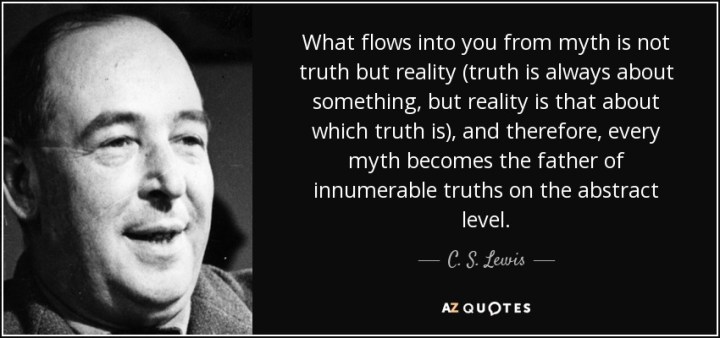
C.S. Lewis on Myth

It should be stressed that the acute awareness of a distance, or even a divide, between different representations of reality and reality itself is not as old as humanity itself. It probably coincides with the birth of Western philosophy in ancient Greece. From that time onwards, the cultural experience of reality becomes an issue. Whereas in archaic cultures man seems to mainly consider himself as a receiver or transmitter of truthful stories forged by sacred powers (great ancestors, spirits or gods), in Western culture man begins to discover himself as the author of stories (and gradually as a historical being). This also means that he becomes more aware of his potential to deceive others. Hence traditional stories, as they are told by man, should not necessarily be considered true anymore. Those stories become unreliable myths, while the search for truth becomes the quest for a language that uncovers reality from behind particular cultural deceptions.

The shift from a mythological to a philosophical worldview thus is twofold:

  • In mythological cultures stories represent the subject of meaningful speech, while man is the object that is spoken to. In other words, man is shaped by the stories of his culture. In post-mythological cultures man gradually becomes the subject of meaning, while stories become objects of inquiry. In other words, man shapes the stories of his culture.
  • In mythological cultures truth is only accessible to man insofar as sacred powers don’t trick him and grant him knowledge and truth. In post-mythological cultures man himself becomes capable of and responsible for gaining knowledge and truth.

The pinnacle of the belief that there is a culturally independent, universal language for accessing an objective truth is reached in the Age of Enlightenment. Of course, as is known, that universal language is provided by a so-called transcendent reason and the modern scientific method. Today, however, there is a well-established tradition in the humanities where the enlightened reason is believed to have overstepped itself. Enlightened reason not only claimed objectivity regarding the explanation of the natural world, but also regarding the justification and evaluation of cultural values, which became highly problematic on the political level. For indeed, by reducing reality to a so-called objective and inevitable truth, modern political ideologies like fascism and communism became violent totalitarianisms. One could say that, in these contexts, reason became violently unreasonable in ‘forgetting’ that it doesn’t escape being embedded in a cultural narrative as well (a ‘made up’ story).

The unprecedented scale of the violence of modern political ideologies in a paradoxical way reveals the second side of the storytelling process regarding the origin and maintenance of culture. Cultural narratives serve as an attempt to escape social disintegration by distinguishing so-called justified sacrificial violence from so-called unjustified escalating violence. This is essentially René Girard’s definition of myth.

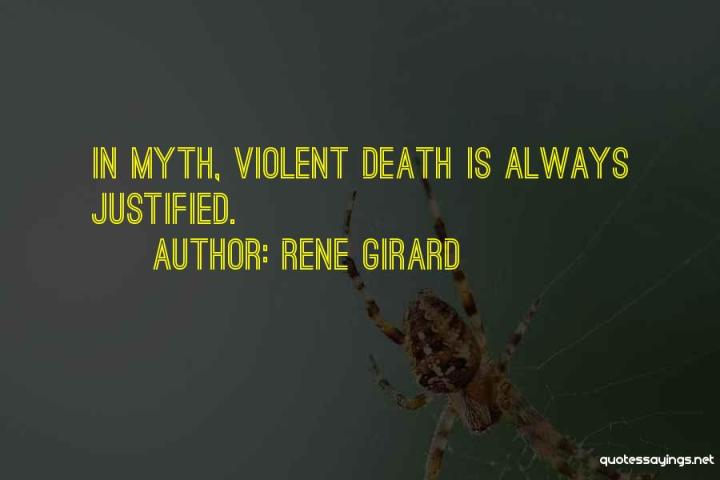
René Girard on Myth

In other words, cultural narratives contain violence. They keep violence in check… by violent means. From the perspective of Girard’s mimetic theory, modern totalitarianisms therefore can be interpreted as failed myths. They were stories that could not ‘make up’ human beings, meaning that they produced more violence than that they provided human beings with protections against violence. Exactly why this kind of mythmaking increasingly fails in the course of history is yet another issue that could be explored.

In short, man and his culture are not only the cause of potential mimetic representations of reality, they are also the result of mimetic dynamics represented in mythic storytelling. As René Girard shows, mythic representations exteriorize the potentially violent nature of those mimetic dynamics (violence in this context is understood as a possible outcome of mimetic desire). This exteriorization at the same time is a kind of exorcism of uncontrollable violence. Through myths man claims to ‘know’ which habits, desires and creatures are taboo or should be ritually sacrificed in order to prevent (social) chaos. The cultural order thus not only produces sacrificial violence, it is itself also the product of such violence; it is the result of violence ‘kept in check’.

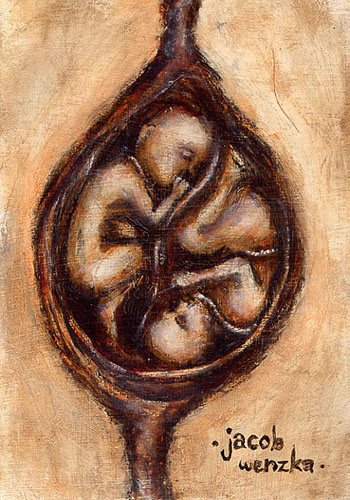
René Girard on Tomb as First Cultural Symbol

Today, however, we find ourselves confronted with the opportunity to be highly suspicious of whatever cultural justification (i.e. myth) for taboos or sacrifices. According to René Girard, Judeo-Christian tradition especially revealed archaic cultural justifications as part of a scapegoat mechanism. Cultural justifications, in other words, were discovered as at least partly blaming the wrong phenomena for certain events. In this sense, Judeo-Christian tradition hurts the ‘ego’ or narcissistic identity of any cultural order, insofar as this order is maintained through scapegoat mechanisms. It is perhaps possible to understand and examine the heritage of Judeo-Christian spirituality, and other spiritual traditions, as a criticism of individual and collective narcissism (as this narcissism is shaped by particular cultures and preserved by their narratives). I would like to show that a spiritual realm of forgiveness allows for individual self-honesty as an epistemic device for truth, as it also allows for freedom and responsibility beyond guilt. If man acknowledges his initial vulnerability and powerlessness in the face of what happens beyond his control, he might neither punish himself nor others to regain power over a certain situation. Instead, he might start looking for the real causes of what happened and no longer exteriorize his fears and frustrations as entities apart from him.

Finally, in this regard it could be investigated how stories can function as ‘safeguards of transcendence’. This could be a major concern. In other words, the question could be how stories do not get locked up in themselves as a kind of tautological reduction of reality (a deviated transcendence). The history of science-fiction stories, and especially the influence of the graphic novel Watchmen as a ‘meta-story’, might be a good way to address this issue. More specifically those stories, under certain circumstances, might help to transform (physically or mentally) violent sacrifice into non-violent sacrifice (a concept that could be developed).

As for now, it seems there are two major pitfalls in storytelling. On the one hand, there is the temptation of using modern technical reason and the scientific method to establish a totalitarian story of universalism wherein individuality is defined within limits relevant to a system of ‘technical management’ (politically speaking this is the temptation of a communist or neo-liberal globalism). On the other hand, there is the temptation of making truth wholly relative of individual particularities and thus establish a totalitarian story of particularism (politically speaking this is the temptation of nationalism). This totalitarian particularism refuses to acknowledge the sameness with others and therefore, paradoxically, excludes otherness. In this context, it would be interesting to bring scientific insights into mimetic processes to the table and also explore what happens when these processes are denied.


Ode To My Bullies


Barbie Saying GoodbyeAt first you called me gay behind my back

As if I would be troubled ’bout such fame.

I kissed a man before your eyes – you came –,

Fulfilled desire that grows from greater lack.


Obsessed with sex you seem to be to shame.

You play with people like words and do attack,

Launched “Barbie-fucker” to drive me in my shack.

It drove me nuts to paths of psycho’s frame.


Yet in the end forgiveness is my plea:

oh beg for your approval I won’t do

– the narcissist too small he lives in me.


This sonnet is my only ode to you

in hopes that you from now live happily

for I forever wave a toodeloo.

Barbie Waving Goodbye

In a previous post I considered “The Jesus Treatment of Bullying”. I guess this is my attempt to illustrate what an imitation of that example could look like.

Dossier: Pesten – Vlaanderen.be (pdf)

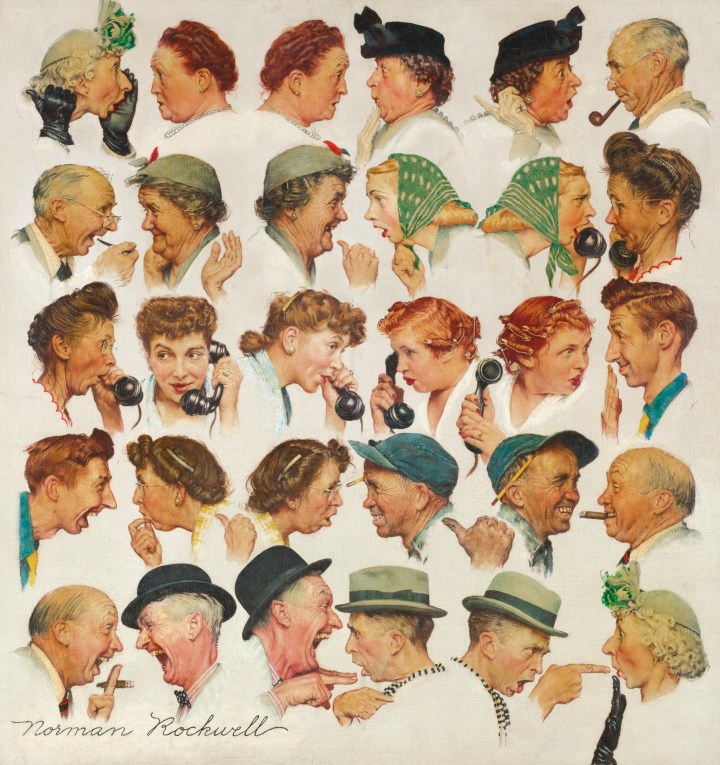
The_gossips_large

Bij veel fervente lezers is René Girard en zijn gedachtegoed al eens langs geweest zonder dat ze ooit van hem hebben gehoord. De geest van Girard waart niet alleen rond in het werk van grote filosofen. Ook grote romanschrijvers laven zich regelmatig aan zijn inspirerende ideeën. De Tsjechisch-Franse auteur Milan Kundera beweert niet toevallig over Girards eerste grote werk – in Verraden Testamenten, Baarn, Ambo, 1994, p. 160: Mensonge romantique et vérité romanesque is het beste dat ik ooit over de romankunst heb gelezen.” Daarnaast is ook iemand als J.M. Coetzee, de Zuid-Afrikaanse Nobelprijswinnaar voor Literatuur, een auteur die uitdrukkelijk met René Girard aan de slag is gegaan.

In het Nederlandse taalgebied heeft academisch onderzoek van de afgelopen decennia meer en meer literaire analyses ontplooid vanuit Girardiaans perspectief. Tegelijk wordt duidelijker gewezen op de expliciete invloed van René Girard op verscheidene literaire meesterwerken, bijvoorbeeld op Het verdriet van België.

Het is alweer tien jaar geleden dat uitgeverij De Bezige Bij het zilveren jubileum vierde van Het verdriet van België, een hoogtepunt uit het oeuvre van Hugo Claus. Naar aanleiding van die verjaardag verscheen volgende samenvatting op de website van de uitgeverij:

‘Het moet een boek worden over het leven in Vlaanderen zoals ik dat gekend heb, maar zoals het nu niet meer bestaat.’ Dat zei Hugo Claus een kleine tien jaar voordat hij Het verdriet van België voltooide: gedeeltelijk een bildungsroman gebaseerd op zijn eigen jeugd, gedeeltelijk ook een boek dat een beeld geeft van de politieke verhoudingen in België tijdens de Tweede Wereldoorlog. Maar bovenal een boek over de groezeligheid van de waarneming, de onbetrouwbaarheid, de twijfel en het verraad.

De hoofdpersoon van het verhaal, Louis Seynaeve, is elf jaar en leerling op een nonneninternaat. Verwarring, hunkering en bedrog vormen zijn jongensjaren en alleen door te fantaseren, de werkelijkheid geweld aan te doen kan hij overleven. Het leven in de Tweede Wereldoorlog wordt door Claus opgeroepen in een even complexe als meeslepende roman, die met recht het hoofdwerk uit zijn oeuvre mag worden genoemd.

De publicatie in maart 1983 zorgde in de pers voor een nooit eerder geziene hype. Het boek werd onmiddellijk een grote bestseller en heeft in de voorbije decennia ook in het buitenland veel succes geoogst. Het verdriet van België kan met recht tot een van de klassiekers uit de moderne internationale literatuur worden gerekend.

Op dinsdag 19 september 2006 verdedigde Gwennie Debergh aan de Vrije Universiteit Brussel (VUB) haar proefschrift over het verband tussen René Girard en Hugo Claus. Haar doctoraat kreeg volgende titel (klik hier voor een overzicht van haar hand – pdf): “Zie ik nu dubbel, of word ik zot?” Statische en dynamische mimesis in Het verdriet van België (Hugo Claus).

Hierna volgen twee fragmenten uit Het verdriet van België (Amsterdam: De Bezige Bij – achtentwintigste druk, april 2008) die telkens expliciet een belangrijke pijler vermelden uit het gedachtegoed van René Girard. In het eerste fragment valt de term mimetische begeerte, en in het tweede wordt gewezen op de blijkbaar steeds terugkerende rol van zondebokken bij het creëren van maatschappelijke orde. Betekenisvol in het licht van Girards “mimetische theorie” is ook de manier waarop het joods-christelijke denken over God ter sprake wordt gebracht.

Het hoofdpersonage Louis Seynaeve is in gesprek met zijn mentor op het college, een jezuïet bijgenaamd “De Kei”. De Kei vraagt Louis naar zijn ervaringen in Duitsland, waar Louis een tijdje verbleef – pp. 458-459:

De Kei vroeg: ‘Hoe was het daar?’ en bedoelde: daar in het land van de vijand. Hij zag er steeds minder als een leraar uit, in zijn vlottende toog uitgemergeld als Pater de Foucauld, verteerd in een woestijn, en ontroostbaar.

‘Hebben zij het moeilijk, de gewone mensen? Waar logeerden de Vlaamse jongens? Ik dacht dat ze in kampen zaten, dat alleen de kleintjes tot tien jaar bij pleegouders terechtkwamen? Hoe waren de mensen daar in dat dorp?’

                ‘Zoals bij ons,’ zei Louis.

                ‘Dat kunt ge niet nader bepalen?’

                ‘Neen.’

                ‘Zijn zij bijvoorbeeld onderworpen? Meer dan de Belgen. Ja? Goed. Zijn ze irrationeler, onverdraagzamer, megalomaner? Ja? Goed. De boer waar ge bij hebt gewoond, bewonderde hij Hitler?’

                ‘Hij aanbad hem.’

                ‘Precies.’

                ‘Er zullen altijd leiders zijn, Eerwaarde.’

                ‘Ja. Altijd die mimetische begeerte. De liefdesomhelzing van leiders. Men wil bewonderen, opgezweept worden door sprookjes, door die ene zaligmakende mythe. Ja? Omdat in die hypnose de werkelijkheid wegslipt, de angst verdooft. Ja. Ga nu maar.’

Het verdriet van BelgiëIn een chronologisch later fragment beklaagt Louis Seynaeve zich over het lot van de joden, voor wie hij gaandeweg meer sympathie krijgt. Louis is in gesprek met zijn Papa, die daarentegen sympathiseert met de Duitse vijand – pp. 516-517:
             ‘De joden die overal in de weg zitten, die overal weggejaagd worden, het is onrechtvaardig.’

                ‘Staat dat in dat boek?’

                ‘Nee. Maar ge voelt het.’

                ‘Joden kunnen het goed zeggen.’

                ‘Maar wat ze zeggen is waar.’

                ‘Ge moet de waarheid van een jood altijd met een korreltje zout nemen.’

                ‘En die van u niet zeker!’

                ‘Ge moet daarom niet schreien.’

                Louis wist zeker dat dit zijn vader niet was. Ik ben ook het kind van Mama niet. Zij weten het zelf niet dat ik, toen ik in windsels lag in ‘t moederhuis, verwisseld ben met een ander kind. Alleen Peter weet het en die houdt zijn mond hierover, of heeft het alleen aan zijn lieveling, Tante Mona, verklapt, zij doet altijd zo raar tegen mij.

                ‘En de Boeren in Zuid-Afrika die door de Engelsen in concentratiekampen uitgehongerd en gemarteld zijn? De Ieren, de Indiërs door de Engelsman uitgemoord. En onze jongens in de loopgraven van Veertien-Achttien? Daar spreekt ge niet over. Daar hebt ge geen traantje voor over. Er moeten altijd zondebokken zijn, en nu zijn dat de joden.’

                ‘Altijd, Papa?’

             ‘Omdat er altijd zondebokken moeten zijn, hoort ge niet goed? Dat is het leven. ‘t Is hard als ge ‘t zelf moet zijn, maar er is iets als geluk en geen geluk in ‘t leven.’

              ‘De meeste wetten zijn op geluk gebaseerd, heel de orde van de Staat,’ zei Peter.

                ‘En de zondebok was een Lam,’ zei de Kei.

                ‘Nee! Nee!’ riep Louis koppig.

De Kei sprak trager dan ooit, die dag. ‘Hoe onrechtvaardig onze gemeenschap kan zijn, kijk rondom u, toch is zij onze mogelijke redding. Ik zal het niet meer meemaken, maar zij kan gered worden. Gelijkheid en rechtvaardigheid, die begrippen die zo kunstig worden rondgestrooid door precies diegenen die ze elke dag vertrappen, kunnen alleen door de gemeenschap komen, door de staat, maar welke staat? Die van God? Welke God? Hij die het gezicht heeft van de ander. Welke revelatie hebben wij te verwachten voor wij erkennen dat er in de werken van de mensen iets goddelijks is? Géén revelatie? Neen? Toch? Nee. Het beestachtige dat ons overvalt, jongens, de gruwelen zonder weerga waarvan men geen weet wil hebben, ik geef toe, daar valt geen sprankeltje in waar te nemen van het licht dat ik God noem, en dat ik dacht in elke mens te zien gloeien. En toch die God die, zoals Paulus zegt, onbekend zal blijven, waar kan hij zijn als wij willen dat hij er ooit is? In de vernederdsten onder ons.’

Voor meer over de verbanden tussen Hugo Claus en René Girard, zie ook:

Een andere literaire grootheid uit het Nederlandse taalgebied, Willem Frederik Hermans, behandelde dan weer die aspecten van de werkelijkheid die in het werk van René Girard centraal staan, maar dan zonder het werk van Girard zelf te kennen. Daarin kwam verandering toen de halfjoodse Amsterdamse schrijfster Sonja Pos analyses van het werk van Hermans begon te maken vanuit Girardiaanse invalshoek. Uiteindelijk publiceerde ze daarover een proefschrift. Willem Frederik Hermans schreef over haar werk onder andere het volgende aan een vriend, meer in het bijzonder over haar analyse van zijn roman De donkere kamer van Damokles:

Sommige beschouwingen over mijn werk kan ik niet lezen zonder angstgevoelens. Ken jij: Mimese en geweld, beschouwingen over het werk van René Girard, Kampen 1988? Hierin staat een opstel van Sonja Pos over De donkere kamer van Damokles, dat me bang van mijzelf liet worden toen ik het las. Nou ja, ik overdrijf een beetje. Het is een van de beste beschouwingen die er ooit over dat veelbesproken verhaal zijn verschenen.

Tommy Wieringa, een recentere coryfee aan het firmament van grote Nederlandstalige romanschrijvers, heeft dan weer zijn kennis van het werk van René Girard verwerkt in zijn roman Dit zijn de namen (klik hier voor meer en klik hier voor een recensie van Gwennie Debergh). Hij heeft daar in verscheidene interviews op gewezen, onder andere in het onderstaande, waarin hij verwijst naar “het werk van René Girard” (vanaf 25:30):

Op de vraag waar hij zichzelf situeert op het vlak van geloof antwoordt Tommy Wieringa in een interview het volgende:

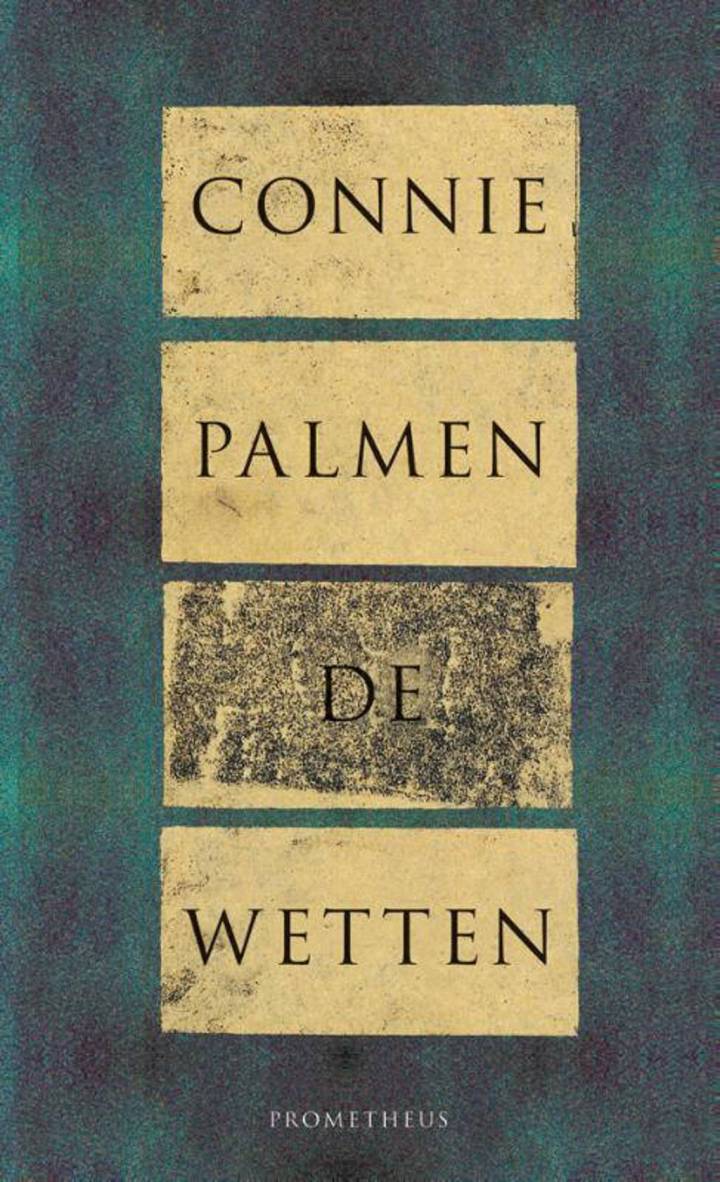
Een andere bekende Nederlandse auteur die met Girard aan de slag is gegaan, is Connie Palmen. In een interview met de Volkskrant (29 januari, 2021), naar aanleiding van dertig jaar schrijverschap, vermeldt ze dat het denken van René Girard een prominente rol speelt in De wetten, haar weergaloze debuut:

Verder speelde in elk hoofdstuk een driehoeksverhouding die gebaseerd was op de theorie van René Girard, de triangel van de begeerte. En het getal zeven natuurlijk: zeven jaar, zeven mannen, de zeven ‘consten’ uit Mariken van Nimwegen. Dat speelde allemaal een rol.’ Ze lacht. ‘Dat het boek er nog zo eenvoudig uitziet, is een wonder.’

Connie Palmen_De wetten (cover)

Charles Ducal, een van de beste hedendaagse dichters in het Nederlandse taalgebied, doet sterk vermoeden dat ook hij bekend is met het werk van René Girard, en dan vooral in het gedicht Mimesis (Alsof ik er haast ben – verzamelde gedichten 1987-2012, atlas contact: Amsterdam/Antwerpen 2012 – derde druk april 2014; p. 249). Hij krijgt het voorlopig laatste woord in deze korte verkenning van Girards invloed op de Nederlandse letteren (wordt ongetwijfeld vervolgd):

Mimesis

Ergens in een ander huis zit iemand

net als ik, schrijvend tegen mij,

zoals ik schrijf aan zijn gedicht.

Ik ken hem niet, alleen de razernij

die ons gelijkmaakt, ik of hij,

alleen de dwang, de afgunst en de schrik

de regel te verraden die hem schikt.

Er kan maar één de sterkste zijn.

Altijd en overal hijgt de score,

in elke krant, elke zaal, elke blik:

God stukgevallen in duizend goden,

en allen zo machtig als ik.

gabriel-garridoSaturday, February 23, 2008. Gabriel Garrido, a renowned conductor of Latin American baroque music, is about to begin an evening concert at Cité de la Musique, Paris. His equally famous Ensemble Elyma is ready, together with eleven members of the Belgian boy and men choir Schola Cantorum Cantate Domino. All of a sudden, maestro Garrido turns around and addresses the audience:

“We are saddened to inform you that two days ago, on Thursday, Reverend Michaël Ghijs, the widely acclaimed conductor of the Schola Cantorum Cantate Domino from Aalst, Belgium, passed away. We would like to dedicate this concert to his memory.”

Then he turns again and looks us straight in the eyes. We, the members of the Cantate Domino choir, all have a lump in the throat. We all try to hold back our tears. Finally, maestro Garrido raises his hands and off we go to sing Cantate Domino’s first concert after the death of its founder. We all know things will never be the same again (footage from the concert):

Only 5 months before, on October 8, 2007, on his 74th birthday, Reverend Michaël Ghijs got diagnosed with pancreatic cancer. I still remember it vividly, because we used to celebrate our birthdays together (mine is on October 6).

Michaël Ghijs conducts his choir one last time during Mass on Sunday, February 3, 2008, in the Cathedral of St. Michael and St. Gudula in Brussels. He is literally deathly sick at the time, no longer able to accompany his boys during the entrance procession, but still he manages to direct them for the remainder of the Mass. It is but one example of his tremendous willpower and passion. Of course, these personality traits make him stubborn at times. For instance, during a concert tour in Asia he asks me wether or not to include Beethoven’s Choral Fantasy for an afternoon programme. My answer is not to include it, because I have the impression that the young trebles don’t seem sure about themselves. From his reaction I immediately know I shouldn’t have said that. He starts rehearsal with the Choral Fantasy, saying that the sopranos will show everyone who doubts them what they are capable of. Eventually, he shows me wrong. He is, as always, proud of the achievements of his singers. It is no coincidence that many former members of Cantate Domino have a career in music.

philippe-herrewegheMichaël Ghijs is proud of and grateful for the hard work and successes of the people he works with, yet he is not driven by pride. Although he can be stubborn, he can also say that he is sorry and admit to making mistakes. It is characteristic of the way he leads the choir. Conflicts are possible, meaning that Michaël Ghijs is not just a commander-in-chief who expects blind obedience. On the other hand, great discipline is needed and established because he wants to perform the often difficult music the best he can. Not because he wants to make a career or because he chases some kind of success, but simply because he loves the (mostly religious) music and the message it contains. His love of music itself and his artistic motivations became clear, for instance, when he compared different recordings of the same work. I remember very vividly, during my first year in the choir, that he really disliked a recording of Mendelssohn’s St. Paul oratorio by Rafael Frühbeck de Burgos. It’s the recording some of my friends and I had bought. He thought the overall interpretation didn’t serve the music nor the message. Also, after concerts, he could be very dissatisfied with our performance even when the crowd had given us a standing ovation.

I guess this is difficult to understand for people who are primarily driven by a desire to make a career and/or to become rich. True, eventually the Schola Cantorum Cantate Domino works with famous conductors like Colin Davis, Laszlo Heltay, Ronald Zollman, Philippe Herreweghe, Michael Tilson Thomas, Pierre Cao, Claudio Abbado, Alexander Rahbari, Johan Duijck, Rudolf Werthen and Dirk Brossé; with musicians like Vladimir Ashkenazy, José van Dam and even Toots Thielemans; with ensembles like Capilla Flamenca and the above mentioned Ensemble Elyma – listen to an excerpt from the collaboration on the CD Corpus Christi à Cusco (K617, 2006):

The choir even participates in the movies Daens and In BrugesNothing of the choir’s impressive resume, however, has ever been a goal. It’s just been a consequence of passion and hard work (the trebles alone practice up to 15 hours a week!). Moreover, Cantate Domino has never been a merely artistic project.

jose-van-damtoots-thielemans

in-bruges

Michaël Ghijs has a hard time refusing boys who can’t really sing. Those who persevere find a way of making themselves helpful in the practical organisation of the choir. They are welcome to join the choir on its concert tours. Regarding these tours, Michaël Ghijs also has a hard time refusing members who don’t really deserve to come along because of longer periods of absence. Sometimes the yearly concert tours are undertaken by a group of around eighty individuals, making them a financially challenging operation. Yet Reverend Ghijs often pays the entire trip out of his own pocket for members whose financial situation doesn’t otherwise allow them to travel. The choir indeed is open to people of all sorts of cultural and social backgrounds. Reverend Ghijs also makes it a point to look after members and former members when they experience difficulties in their lives. For instance, he provides shelter for a young man who came out of the closet as a homosexual and whose parents threw him out because of that. Or he gives daily calls to a former member of the choir who is in the hospital for a treatment of meningitis. There are so many situations to mention… Perhaps it is in these social aspects that the priestly vocation of Ghijs is most apparent. The choir never is a money making machine. Singing at funerals and marriages, or performing in care homes, prisons, whatever: the choir often just receives enough to pay the bill of the bus (sometimes to the chagrin of the older members who are in charge of the finances).

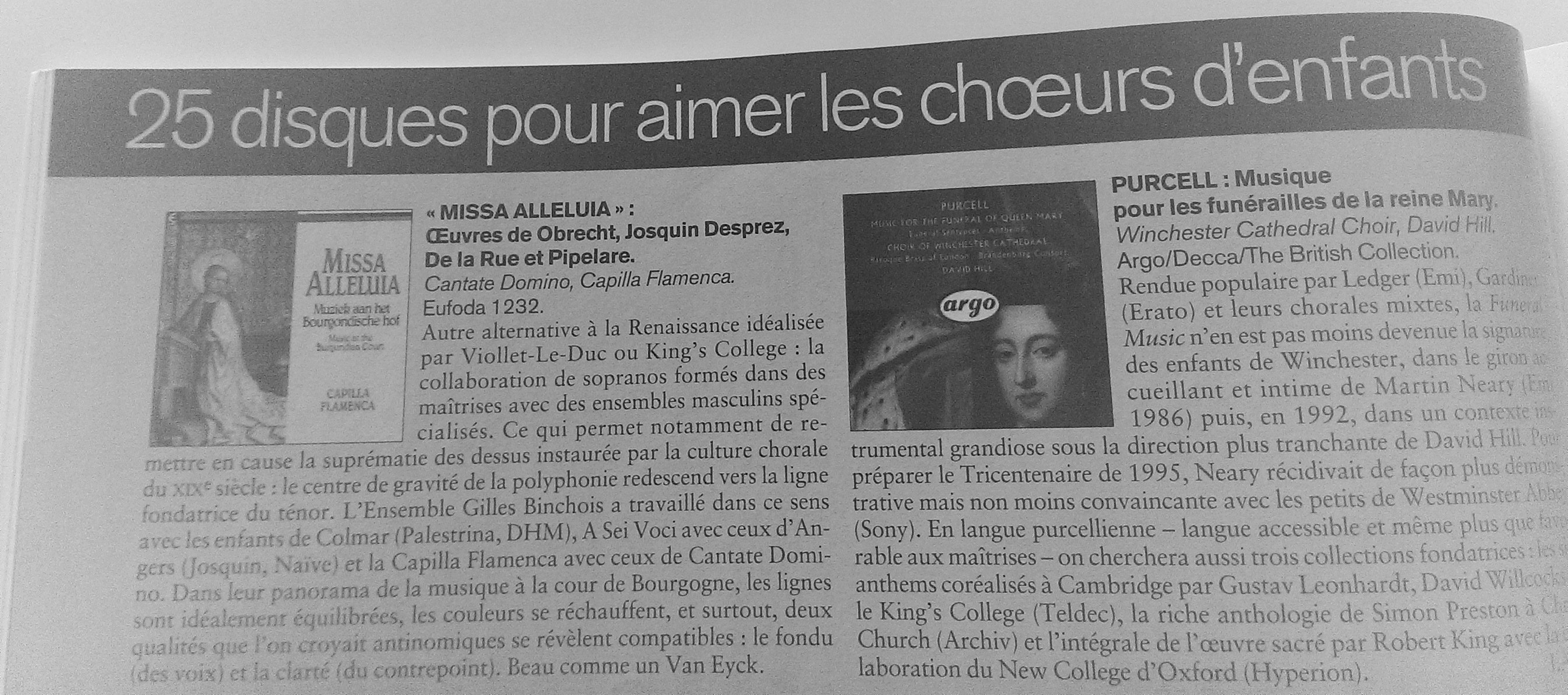
diapason-cover-june-2005In any case, what Michaël Ghijs achieves with his choir, with boys who often don’t have any proper education in music, is nothing short of a miracle. One of his best qualities is his firm belief in the abilities of young people before they even believe in themselves. When some of us think we will never be able to properly perform Amen by Henryk Mikolaj Górecki, Michaël Ghijs pulls us through. He even wants us to sing it at the Belgian provincial choir tournaments, next to, among other music, Bach’s motet Singet dem Herrn ein neues Lied. In the end he is right. Our perfomance places us, once again, in the highest division. In the same period an album is recorded by Capilla Flamenca together with some trebles of Schola Cantorum Cantate Domino. Ten years later, this CD is listed among “the 25 most beautiful recordings of boy choirs” by renowned French magazine Diapason (June, 2005):

diapason-review-of-cantate-domino-aalst

Listen to an excerpt from the CD Missa Alleluia (Eufoda, 1996):

If anything, these things prove that Michaël Ghijs above all educated young people to enable them to shine and to share their talents with the world. Of course, there will always be cynical minds who regard the work of a priest with young boys and men with suspicion. I know Reverend Ghijs got called names sometimes by so-called rebellious teenagers when he crossed the street with his boy sopranos. The words are not worth repeating. Reverend Ghijs, unlike me, ignored them and always continued his work with the same energy, passion, eagerness to learn and genuine concern for what happened in the lives of his singers.

I’ve had the privilege to have known this man, a true friend and mentor, for almost twenty years. Like everyone else, he was a complex human being with flaws and weaknesses, with doubts and frustrations. He dared to be vulnerable. He kept reading and studying, knowing that he never knew enough. He questioned the personal assumptions of his Christian faith and developed his theology in a different direction over the years (in no small part because he discovered the work of James Alison). He loved the good life and could enjoy delicious food and drinks in good company.

Michaël Ghijs is missed by friends all over the world, from the Americas over Spain, Italy, Bulgaria and a range of other European countries to South Africa, Israel, Japan, South Korea, the Philippines and many other places. In the course of his lifetime, Reverend Michaël Ghijs discovered his own limits and cultural boundaries, not as ends in themselves to separate himself from others, but, on the contrary, as means to encounter others. His legacy is a spirituality to be imitated and a work to be continued, in whatever context, in true friendship and in gratitude.

May God bless him.

My trip down memory lane, compiled from different tv performances, pictures and records – life in Schola Cantorum Cantate Domino:

‘Bent u zover, heer?’ fluisterde ze hem toe, volhardend in haar rol. Hij ging over haar heen liggen, kwam in haar, en begon kort en ritmisch te stoten, steeds vuriger en feller. En toen ze met evenveel hartstocht reageerde, zakte haar sluier af en werd haar gezicht volledig zichtbaar. Zal hij me nu herkennen? vroeg Tamar zich af. Zal hij zich terugtrekken of – zoals Tamar het zich voorstelde in een vermetel soort dagdroom – zal hij doorgaan, zelfs al had hij haar herkend? Ja, zou hij misschien met nog grotere hartstocht doorgaan, juist omdát hij haar had herkend? (Kirsch, p. 151).

The Harlot by the Side of the Road (Jonathan Kirsch) coverJaren geleden kocht ik het boek De Ongehoorde Bijbel (Servire, Utrecht, 1997) van Jonathan Kirsch. De titel in het Engels luidt The Harlot by the Side of the Road – Forbidden Tales of the Bible (Ballantine Books, New York, 1997) en verwijst naar het verhaal over Tamar en Juda (Genesis 38). Het bovenstaande tekstfragment komt uit een hervertelling van dit verhaal door Kirsch. Het is maar een van de eigenaardige, weinig gekende en eerder schokkende verhalen uit het Oude Testament die de auteur voor het voetlicht brengt. Interessant is dat de hervertelde verhalen niet alleen telkens naast de vertaalde Bijbeltekst worden geplaatst, maar ook worden gevolgd door historische en culturele achtergrondinformatie.

De incest van Lot en zijn dochters, de verkrachting van Dina, de seksuele gemeenschap tussen Tamar en haar schoonvader Juda, Jefta die zijn dochter offert aan God voor een militaire overwinning van Israël op de Ammonieten, en allerlei andere Bijbelverhalen over geweld, volkerenmoorden en seksuele uitspattingen – het passeert allemaal de revue in het boek van Kirsch. De commentaren die deze verhalen telkens in een historische context plaatsen, maken de verhalen vaak nog vreemder dan ze al zijn, maar openen tegelijk verrassende perspectieven. Het is alsof je als buitenlander uitleg krijgt bij de toespelingen van een stand-up comedian op de politieke situatie van zijn land, zodat je kan meelachen met zijn publiek. Of dat je, meer in het algemeen, vertrouwd geraakt met een cultureel en taal-specifiek idioom, zodat je naast vreugde om wat je leest ook verwondering, verbijstering, woede of verdriet kan voelen.

Kirsch verwijst meermaals naar de manier waarop de joden sinds het prille ontstaan van de Hebreeuwse Bijbel (het Oude Testament) met deze teksten zijn omgesprongen, en dat maakt van die Bijbel een boeiende literaire inspiratiebron. De joodse wijzen – de rabbi’s – uit de Oudheid zijn de eerste beoefenaars van de zogenaamde midrasj: “een meditatie over of beschouwing van de Schrift waarin de boodschap wordt aangepast aan de hedendaagse behoeften” (Geza Vermes). Daarbij putten zij rijkelijk uit de Haggadah (joodse sagen en legenden) en presenteren zij hun uitleg of exegese als een hervertelling die tal van nieuwe betekenissen en associaties oproept. Verzamelingen van zulke exegeses zijn bekend geworden als de Talmoed en de Midrasj.

Het joodse gebruik om verhalen uit te leggen door ze opnieuw te vertellen is natuurlijk ook aanwezig bij andere volkeren. Mensen houden nu eenmaal van verhalen. Het is eveneens aanwezig bij de jood Jezus van Nazaret – niet toevallig soms “rabbi” genoemd – en de schrijvers van het Nieuwe Testament. Jezus’ parabels en uitspraken, alsook de verhalen over hem, staan dan ook bol van vaak nadrukkelijke, soms ook subtiele verwijzingen naar verhalen en teksten uit de Hebreeuwse Bijbel. Deze traditie van intertekstuele verwijzingen heeft zich ook doorgezet in de literaire en bredere artistieke geschiedenis, van de Oudheid, over de middeleeuwen tot nu. Eigenlijk wordt het Nieuwe Testament pas begrijpelijk vanuit de intertekstualiteit: als een interpretatie van de Hebreeuwse Bijbel vanuit bepaalde ervaringen met Jezus van Nazaret.

Het verhaal over Tamar en Juda, uit de titel van Kirsch’ boek, kan als voorbeeld dienen om een en ander te verduidelijken.

Op weg met hoeren en broers

Tamar is de weduwe van Er, de oudste zoon van Juda. Na de dood van haar man wordt zij, volgens het toenmalige gebruik, aan haar schoonbroer Onan toevertrouwd. Als ook hij haar niet zwanger maakt en sterft, wacht haar een twijfelachtig lot. Juda beschouwt Tamar als een onheilsbrenger en doet er alles aan om zijn derde zoon Sela van haar weg te houden. Daardoor dreigt Tamar een kinderloze weduwe te blijven en in een levensgevaarlijke marginaliteit terecht te komen. Jonathan Kirsch verduidelijkt (p. 176-177):

Volgens de Bijbelse wetten, ging het bezit van een man rechtstreeks over op zijn kinderen (Deut 21, 16-17) of zijn andere bloedverwanten (Num 27, 8-11). Een kinderloze weduwe als Tamar had dus geen acceptabele, vaste plaats in de gemeenschap waarin ze leefde; ze kon zich niet zonder grote risico’s wagen aan seksuele gemeenschap, kinderen krijgen of grootbrengen of zelf de kost verdienen; ze was aan handen en voeten gebonden.

Als een vrouw als Tamar het waagde toch met iemand gemeenschap te hebben, werd ze gezien als zo’n groot gevaar voor de maatschappelijke en zedelijke orde van de samenleving uit die tijd dat ze letterlijk moest worden ‘uitgewist’. Een ongetrouwde vrouw die met een man naar bed ging, moest volgens de strenge Bijbelse wetten ter dood worden gebracht (Deut 22, 21), net als de echtgenote die het waagde om vreemd te gaan (Lev 20, 10). Het is veelbetekenend dat de steniging van een ongehuwde vrouw die zich schuldig had gemaakt aan verboden seks, geacht werd te worden uitgevoerd ‘bij het huis van haar vader’; alsof dit bedoeld was om te onderstrepen dat een vrouw zonder acceptabele mannelijke beschermer – haar vader, echtgenoot of volwassen zoon – eenvoudigweg veel te gevaarlijk was om in leven te laten.

Bovendien is Tamar een Kanaänitische vrouw, alleen door haar vroegere huwelijk met Er verbonden aan het volk van Israël. Vreemdelinge, weduwe en kinderloze vrouw: de uitzichtloze, “vervloekte” situatie van Tamar schijnt compleet. Op basis van deze kenmerken alleen al wordt ze door het patriarchale Israël van haar tijd feitelijk verstoten en is ze ten dode opgeschreven. Israël is niet anders dan andere menselijke gemeenschappen die de neiging hebben om hun voortbestaan te verzekeren ten koste van slachtoffers. Tot Tamar een list verzint. Ze vermomt zich als een hoer en slaagt erin om op die manier haar schoonvader Juda te verleiden tot seksuele gemeenschap met haar. De zwangerschap die daarop volgt zal twee zonen voortbrengen: de tweeling Peres en Zerach. Juda kan uiteindelijk niets anders doen dan deze kinderen te erkennen als zijn nageslacht.

Het klinkt misschien eigenaardig, maar door zich als een hoer te vermommen en haar schoonvader te verleiden tot seksuele gemeenschap, zet Tamar de mannenwereld waarin ze vertoeft een hak. Jonathan Kirsch besluit (p. 177-178):

Tamars seksuele hinderlaag voor Juda op de weg naar Timna was de daad van een dappere, vindingrijke vrouw, die weigerde zich neer te leggen bij het lot dat het patriarchaat van het Bijbelse Israël een kinderloze weduwe voorschreef. Ze was niet zomaar een verleidster die door de hoer te spelen haar schoonvader listig ertoe bracht kinderen bij haar te verwekken. Ze was veeleer een vrouw die voor haar rechten opkwam, op de enige manier die voor een vrouw in haar tijdsgewricht en samenleving open stond.

Het verhaal van Tamar is één voorbeeld van “de eigenzinnige vrouw”. In de Hebreeuwse Bijbel is dit een nadrukkelijk aanwezig thema. Het Nieuwe Testament zal er uitgebreid op terugkomen en het ook in verband brengen met een ander thema uit de Hebreeuwse Bijbel, namelijk de rivaliteit tussen broers (al dan niet om het eerstgeboorterecht). Er zij hierbij gedacht aan Kaïn en Abel, Ismaël en Isaak, Esau en Jakob en Jozef en zijn broers. In het verhaal over Tamar is dit thema ook aanwezig. Bij de geboorte van haar zonen is het Zerach die Peres, die net iets eerder geboren zal worden, te slim af is (Gen 38, 28-30):

Perez and ZerahTijdens het baren stak een van de beide kinderen een handje naar buiten; de vroedvrouw greep dit, bond er een rode draad omheen en zei: ‘Deze is het eerst gekomen.’ Maar het kind trok zijn hand terug, en toen kwam zijn broer tevoorschijn. Toen sprak zij: ‘Jij hebt voor een flinke bres gezorgd.’ Daarom noemde men hem Peres. Daarna kwam zijn broer met de scharlaken draad om zijn hand. Hem noemde men Zerach.

De rabbijnse tradities met hun hervertellende uitleg brengen Tamar en haar zonen in verband met een andere, opmerkelijke Kanaänitische: de hoer Rachab. In het Bijbelse boek Jozua speelt deze vrouw een sleutelrol bij de verovering van de stad Jericho en het land Kanaän door de Israëlieten. Zij verbergt immers twee Israëlitische verkenners voor een patrouille die door de koning van Jericho was uitgestuurd. Uit dankbaarheid beloven de verkenners Rachab dat ze haar leven en dat van haar familie zullen sparen. Het enige wat ze daarvoor moet doen is het rode koord, waarmee ze de verkenners van de stadsmuren liet zakken, aan haar raam hangen. Op die manier zullen de Israëlieten haar huis herkennen en weten dat daar een van hun bondgenoten woont. De rabbijnse geleerden beschouwen de niet nader genoemde verkenners vaak als Peres en Zerach. En van het rode koord weten ze te vertellen dat het de rode draad is die om de pols van Zerach was gebonden bij zijn geboorte!

In het Nieuwe Testament, meer bepaald in het evangelie volgens Matteüs, komen Tamar en Rachab samen met twee andere vrouwen – Ruth en Batseba – terecht in de stamboomlijst van Jezus. Het zijn de enige vier vrouwen die in deze lijst vermeld worden en dat is opmerkelijk. Ze hebben met elkaar hun vaak sterke karakters en niet onbesproken seksuele levenswandel gemeen. Hen als de verre moeders van de zogenaamde Christus portretteren is op zijn minst gewaagd. Helemaal provocerend wordt Matteüs als hij Jezus het volgende laat zeggen tegen de hogepriesters en de oudsten van het Joodse volk, nadat hij – en dat is ook niet onbelangrijk in het licht van het voorgaande – een parabel over twee broers heeft verteld (Mt 21, 31):

‘Ik verzeker u, tollenaars en hoeren gaan u voor naar het koninkrijk van God.’

De stamboomlijst met “hoeren” is dus met andere woorden geen toeval. De evangelist Matteüs wil zijn lezers blijkbaar al bij de aanvang van zijn werk duidelijk maken dat de God waarin hij gelooft – die zich te kennen zou geven in Jezus van Nazaret – iets te maken heeft met het perspectief van mensen die doorgaans “in de marge” van de samenleving vertoeven. De stamboomlijst van Jezus is dan ook als het ware een “code”, een “interpretatiesleutel” die de lezer meekrijgt om zowel het evangelie zelf als de Hebreeuwse Bijbel met een bepaalde bril te lezen. Gooi je de stamboomlijst overboord, dan gooi je essentiële informatie overboord om tot een goed begrip van het Matteüsevangelie en de Bijbel in zijn geheel te komen.

Er zijn natuurlijk nog andere interpretatiesleutels aanwezig in zowel de Hebreeuwse Bijbel als het Nieuwe Testament, maar alle wijzen ze in een gelijkaardige richting. In het evangelie volgens Lucas staat bijvoorbeeld het welbekende verhaal over “de Emmaüsgangers”: leerlingen van Jezus die, teleurgesteld en gedesoriënteerd door de kruisiging en dood van hun geliefde meester, wegtrekken van Jeruzalem naar het dorp Emmaüs. Onderweg komen ze een vreemdeling tegen. Deze man is eigenlijk Jezus – die Lucas voorstelt als verrezen –, maar ze herkennen hem niet. Ze geraken aan de praat en eten met hem. Uiteindelijk herkennen ze hem, nadat hij hun de Hebreeuwse Bijbel vanuit een bepaald perspectief heeft uitgelegd, namelijk (Luc 24, 27):

Jezus legde hun uit wat in heel de Schrift op Hemzelf betrekking had, te beginnen bij Mozes en alle Profeten.

Als je de Hebreeuwse Bijbel uitlegt vanuit het perspectief van iemand die verstoten en gekruisigd is, én vanuit de overtuiging dat God zich in deze gekruisigde openbaart, levert je lectuur opmerkelijke resultaten op. Neem bijvoorbeeld het wreedaardige relaas in het zevende hoofdstuk van het al eerder vermelde boek Jozua. Daarin draagt “de Heer” Jozua op om een zekere Achan en al zijn bezittingen te vernietigen nadat Israël een militaire nederlaag heeft geleden. Achan zou goederen in zijn bezit hebben die hem niet toebehoren, en dat zou onheil brengen. Dit is het einde van het verhaal (Jozua 7, 25-26):

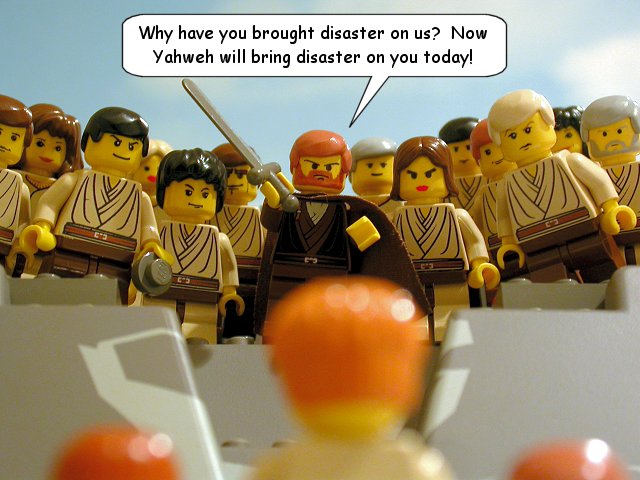
Jozua sprak: ‘Omdat je ons in het ongeluk hebt gestort, stort de heer jou vandaag in het ongeluk!’ En heel Israël stenigde hen; zij verbrandden hen en wierpen stenen naar hen. Daarna richtten zij boven hen een grote steenhoop op, die er vandaag nog ligt. Toen bedaarde de hevige toorn van de heer. Daarom heet die plaats nu nog het Achordal.

Joshua 7 25 Brick BibleJoshua 7 25b Brick BibleJoshua 7 25c Brick Bible

Als je dit verhaal leest vanuit het perspectief van wat op “een verstotene” of “een gekruisigde” (Jezus) betrekking heeft van wie je gelooft dat God aan zijn zijde staat, dan moet je wel tot het besluit komen dat Achan, de gestenigde en verbrande, in dit verhaal de persoon is met wie Jezus kan worden geïdentificeerd. En dan kom je ook tot het besluit dat die God allesbehalve de steniging van Achan goedkeurt. Vandaar dat Jezus ook zal zeggen dat hij, in de lijn van bepaalde profeten en psalmen uit de Hebreeuwse Bijbel, gelooft in een God die “barmhartigheid wil, en geen offer” (Mt 9, 13). Vandaar ook dat Jezus als interpretatiesleutel en zelfs leefsleutel meegeeft:

‘U zult de Heer uw God liefhebben met heel uw hart en met heel uw ziel en met heel uw verstand. Dat is het grootste en eerste gebod. Het tweede is daaraan gelijk: U zult uw naaste liefhebben als uzelf. Aan deze twee geboden hangen heel de Wet en de Profeten.’

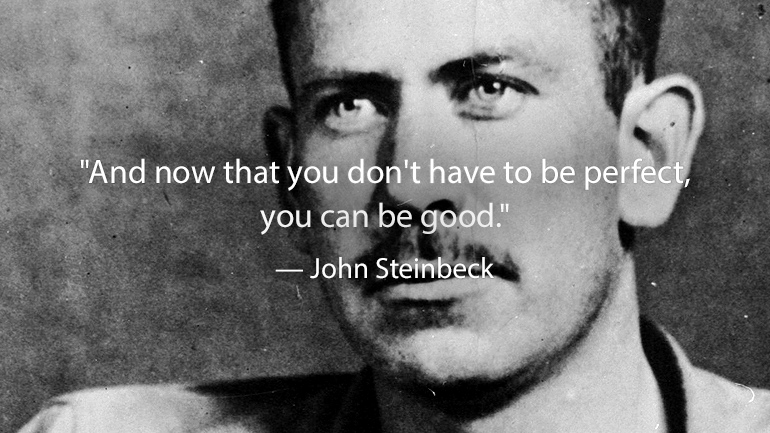
John Steinbeck And now that you don't have to be perfect you can be goodDeze naastenliefde is misschien wel ethisch, maar allesbehalve moralistisch. Het zijn immers de moraalridders die, vaak met de beste bedoelingen, doorheen de geschiedenis van de mensheid uiteindelijk de grootste wreedheden begaan. Zowel de Hebreeuwse Bijbel als het Nieuwe Testament vormen een kritiek op al te utopische en al te romantische denkbeelden. Wanneer Petrus zijn vriend Jezus verzekert dat hij hem nooit in de steek zal laten, zet Jezus hem met zijn voetjes op de grond – geparafraseerd: “Als puntje bij paaltje komt, als ik gevangen ben en ter dood veroordeeld zal worden, ga je mij in de steek laten; je bent niet de held die je denkt te zijn.” Zulke boodschappen zijn niet altijd aangenaam om te horen. De waarheid kwetst. Petrus is geen superman. En ook de zogenaamd grote figuren uit de Hebreeuwse Bijbel zijn allesbehalve onberispelijk.

De teksten in de Bijbel bevatten in de eerste plaats dan ook een antropologie: ze tonen de mens zoals hij is. In het verlengde daarvan tonen ze vaak ook een God die niet meer blijkt dan een bekrachtiging van kleinmenselijke verzuchtingen. Maar het is precies door dit soort context zonder voorbehoud te schetsen dat ook de kritiek erop zich kan manifesteren of openbaren. In die grote bibliotheek die de Bijbel is, met allerlei verschillende soorten boeken en teksten (die elk een eigen aanpak vergen), breekt gaandeweg een fundamentele kritiek door op de al te grote vooruitgangsdromen en morele superioriteitsgevoelens die mensen kunnen hebben. En dit vanuit het perspectief van de slachtoffers daarvan.

Wat overblijft is een Bijbelse spiritualiteit: je kan regels manipuleren om anderen te onderdrukken, of je kan regels manipuleren om op te komen voor je eigen waardigheid als mogelijkheidsvoorwaarde om op te komen voor de waardigheid van anderen (zie Jezus’ uitspraken: “De sabbat is er voor de mens en niet de mens voor de sabbat” en “Bemin je naaste als jezelf”). Zowel Juda als Tamar zijn corrupte en sluwe kinderen van hun tijd en cultuur, maar het is precies in die corruptie en historische beperktheid dat zich, in het geval van Tamar, iets van een emancipatorische humaniteit manifesteert.

Op weg met Verhulst en Steinbeck, literaire broers

Bloedboek Dimitri Verhulst CoverZoals zijn verhalen en personages is de Bijbel in zijn geheel te rijk, te genuanceerd en te paradoxaal om “helemaal slecht” of “helemaal goed” te zijn. Ik ben dan ook razend benieuwd hoe Dimitri Verhulst, wiens werk ik telkens met graagte lees, de eerste vijf boeken van de Bijbel heeft herverteld in zijn nieuwe roman Bloedboek. Jammer wel dat hij blijkbaar niets doet met de stamboomlijsten in de Pentateuch. Die zouden immers boeiende interpretatieve impulsen kunnen geven, zoals Matteüs dat doet met de stamboomlijst van Jezus in zijn evangelie (zie hoger).

Verhulst bevindt zich met dit project alvast in een kransje van grote literatoren die iets gelijkaardigs hebben gedaan. De lijvigste roman van de Amerikaanse Nobelprijswinnaar John Steinbeck, East of Eden, is bijvoorbeeld een hervertelling van het verhaal over Kaïn en Abel (Gen 4, 1-16). Geen vijf boeken dus, maar één verhaal dat vanuit een inherente rijkdom aan allerlei mogelijke motieven en consequenties wordt “herdacht” voor de periode tussen de Amerikaanse Burgeroorlog en de Eerste Wereldoorlog. Eén van de personages uit de roman (een Chinese butler genaamd “Lee”) vat het universele thema van het Bijbelverhaal en de roman zelf samen, in een antwoord op de vraag op welke manier het verhaal van Kaïn en Abel over ieder mens gaat (John Steinbeck, East of Eden, Penguin Books, p. 271):

East of Eden John Steinbeck Cover“I think this is the best-known story in the world because it is everybody’s story. I think it is the symbol story of the human soul. I’m feeling my way now – don’t jump on me if I’m not clear. The greatest terror a child can have is that he is not loved, and rejection is the hell he fears. I think everyone in the world to a large or small extent has felt rejection. And with rejection comes anger, and with anger some kind of crime in revenge for the rejection, and with the crime guilt – and there is the story of mankind. I think that if rejection could be amputated, the human would not be what he is. Maybe there would be fewer crazy people. I am sure in myself there would not be many jails. It is all there – the start, the beginning. One child, refused the love he craves, kicks the cat and hides the secret guilt; and another steals so that money will make him loved; and a third conquers the world – and always the guilt and revenge and more guilt. The human is the only guilty animal. Now wait! Therefore I think this old and terrible story is important because it is a chart of the soul – the secret, rejected, guilty soul.”

Dimitri VerhulstMeer dan ooit heeft onze wereld nood aan zulke erudiete, literaire benaderingen van Bijbelteksten om aan de valkuilen van fundamentalisme en levensbeschouwelijk extremisme (van zowel gelovige als atheïstische zijde) te kunnen ontsnappen. De Angelsaksische wereld kent liedschrijvers als Bruce Springsteen (met een katholieke achtergrond) en Leonard Cohen (met joodse wortels), om er maar twee te noemen. En wij hebben iemand als Dimitri Verhulst. Ik kan haast niet wachten om te lezen wat hij heeft gedaan met deze universele verhalen over broedermoorden, corrumperende machtsspelletjes, bloedige oorlogen en… moedige vrouwen uit wie een nieuw soort leven aanbreekt. Misschien heeft hij wel de hoer ontdekt die ons “voorgaat naar het koninkrijk van God.” Niet over haar schrijven zou alleszins zonde zijn.

Erik Buys

P.S.: OPEN BRIEF AAN PATRICK LOOBUYCK EN DE PLEITBEZORGERS VAN LEF (PDF; klik hier)

Meer hierover op de Thomas-site (KU Leuven); klik hier.

René Girard devotes six chapters to A Midsummer Night’s Dream in A Theater of Envy, his book on William Shakespeare (for references I use the edition of St. Augustine’s Press, South Bend, Indiana, 2004 – originally this title was edited by Oxford University Press, 1991). I’ve tried to rework some of Girard’s insights by using the diagrams I’ve developed (for more information, click here for “Types of the Scapegoat Mechanism”). But first things first: a plot summary.

1. PLOT OF A MIDSUMMER NIGHT’S DREAM

A Midsummer Night's Dream by MukilteoCasualtie

A Midsummer Night’s Dream, one of Shakespeare’s most beloved comedies, portrays some strange events surrounding the wedding of Theseus, Duke of Athens, and Hippolyta, queen of the Amazons. The play consists of three plots, interconnected by the noble marriage.

First there is the story of four young Athenian lovers who are invited to the celebration. Fair Hermia is in love with Lysander and refuses to submit to her father Egeus’ demand that she wed Demetrius. Meanwhile, her childhood friend Helena desperately falls for Demetrius. Hermia and Lysander escape to an enchanted forest outside Athens. Informed by the still desperate Helena, Demetrius follows them in hopes of killing Lysander. Helena chases Demetrius, promising to love him more than Hermia, but he rejects her offer with cruel insults.

Oberon, king of the fairies and at that time in an envious quarrel over a changeling with his wife and queen Titania, observes the cruelty of Demetrius. This second plot about the fairies intervenes with the first one when Oberon asks his servant, Robin “Puck” Goodfellow, to apply a magical juice to the eyelids of the sleeping Demetrius. The juice is derived from a flower called “love-in-idleness” and causes awakening persons to fall in love with the first creature they see. Oberon hopes to let Demetrius fall in love with Helena. However, Puck mistakes Lysander for Demetrius and Lysander falls in love with Helena. Oberon is able to correct Puck’s mistake and uses the magic to let Demetrius fall in love with Helena as well. Rivaling Lysander and Demetrius then end up seeking a place to duel each other, leaving Hermia enraged and desperate as she accuses Helena of stealing Lysander away from her. Puck, following Oberon’s orders, prevents the duel from happening and removes the charm from Lysander. Lysander returns to loving Hermia, while Demetrius now loves Helena.

The four young lovers return to Athens to witness the celebration of Theseus’ wedding. A group of six amateur actors performs “Pyramus and Thisbe”. These six craftsmen (among them a guy named Bottom who is eager to play nearly every role) prepared themselves in the enchanted forest and went through some upheaval as well. Like the tale of the four lovers, this third plot again is connected to the world of the fairies by Puck’s magical love potion. Oberon lets his wife fall in love with Bottom so he can blackmail her and claim her changeling. He succeeds and after removing the spell from his wife he goes to Athens with her to bless the house of Theseus. All’s well that ends well, so it seems…

2. MIMETIC INTERPLAYS IN THE TALE OF THE FOUR LOVERS

O hell to choose love by another's eyes (Shakespeare quote A Midsummer Night's Dream)I will focus on the subplot of the four young Athenian lovers. René Girard, in the aforementioned book A Theater of Envy, interprets the love shenanigans during the fairy night as consequences of the mimetic nature of the young lovers’ desires. Surprise, surprise. Each individual competes with another one for the recognition or love of a third party. Girard argues that this kind of competition is eventually based on mimetic (i.e. imitative) interplays, and he demonstrates how Shakespeare, throughout his works, developed fundamental insights in this essential human interaction. The lovers in A Midsummer Night’s Dream don’t compete with each other because they accidentally desire the same person, but they desire the same person because they imitate one another. They are led by mimetic desire. Ever more rapidly during the play they all take another person as model or mediator for their desire. This results in self-loathing (a form of auto-aggression) and divinization of their model on the one hand, or in self-aggrandizement and loathing (a form of hetero-aggression) of their model on the other. In the words of Hermia, which summarize the guiding mimetic principles of the play (in Act I, Scene 1):

O hell! to choose love by another’s eyes.

Of course, no one is eager to admit that his or her desire is not his or her own. Although the play at first glance lends itself to a romantic interpretation of the ties between the four lovers, Shakespeare comically undermines the belief in “true love” and “true love’s desire” (understood as “unmediated desire”). In the words of René Girard (A Theater of Envy, p.34-35 & p.36-37):

The history of the night continues its prehistory with different characters in the various mimetic roles. Before the midsummer night began, in other words, it had already begun. First Demetrius was unfaithful to Helena, then Hermia was unfaithful to Demetrius, then Lysander to Hermia, and finally Demetrius to Hermia. The four infidelities are arranged in such a way that the minimum number of incidents illustrates the maximum amount of mimetic theory.

It is important to observe that the love juice cannot be invoked as an excuse for the infidelities that occur before the midsummer night. Everything can and must be explained mimetically, that is, rationally. If we had only the infidelities that occur before our eyes, the examples would be too few to lead us unquestionably to the mimetic law, but the addition of the prehistory and the history is sufficient to the purpose. So instead of a single triangular conflict that remains unchanged until the conclusion, A Midsummer Night’s Dream suggests a kaleidoscope, a number of combinations that generate one another at an accelerating pace. Shakespeare gives several objects in succession to the same mimetic rivals for a comic demonstration of the mediator’s predominance in the triangle of mimetic desire.

[…]

A Theater of Envy (1991)Shakespeare satirizes a society of would-be individualists completely enslaved to one another. He is mocking a desire that always seeks to differentiate and distinguish itself through the imitation of someone else but always achieves the opposite result: A Midsummer Night’s Dream is an early triumph of unisex and uni-everything else. It involves a process of increasing symmetry among all characters, yet not so obviously perfect a one that the demonstration becomes heavy-handed.

Unlike the skeptical Puck, who mocks the lovers because he understands everything, Oberon is full of reverence for “true love,” but his language plays occasional tricks upon him and suggests the very reverse of what he intends to say. After Puck has picked the wrong man for his dispensations of love juice, Oberon sounds indignant, as if the difference between “true” and “false” love were so huge that Puck’s mistaking the two were unforgivable. His actual words suggest the very reverse [from Act III, Scene 2]:

What hast thou done? thou hast mistaken quite
And laid the love-juice on some true-love’s sight:
Of thy misprision must perforce ensue
Some true love turn’d and not a false turn’d true.

Who will tell the difference between some “true love turned” and “a false turned true”? It all sounds the same, and the distinction upon which the pious Oberon insists is humorously undermined. The supposed discrepancy between “true love” and its mimetic counterfeit echoes the inferiority of the copy versus the original in traditional aesthetics. The problem is that no original is available: everything is imitation.

The cacophonic circularity of “true love turned” and “false turned true” ironically suggests the paradoxical contribution of differential and individualistic ideologies to the growing mimetic uniformity; differentialism is the ideology of the mimetic urge at its most comically self-defeating. All this amazingly resembles our own contemporary world.

THE AUTO-AGGRESSION OF HELENA

The first mimetic triangle we encounter in the play structures itself from Helena’s perspective. Helena compares herself to Hermia and this reinforces her desire to obtain (the recognition of) Demetrius – the object of her desire [the left side of the diagram]. All this eventually results in Helena’s self-loathing (a form of auto-aggression) and the divinization of her “model”, Hermia – Helena wants to erase (the confrontation with) the difference between herself and Hermia, she wants to be Hermia [the right side of the diagram]. The desire for Hermia’s being – the mediator – turns out to be more important than the desire for Demetrius.


MND Autoaggression of Helena

Again, in the words of Girard himself (ibid., p.43-44):

Being is what mimetic desire is really after, and Helena says so explicitly.

Helena wants to be “translated” to Hermia.

[…]

Helena is desperately in love with Demetrius, but he is hardly mentioned; gigantic in the absence of Hermia, his stature shrinks to almost nothing in her presence. Thus the real priorities of mimetic desire are revealed: however desirable the object may be, it pales in comparison with the model who gives it its value.

Hermia and Helena (Washington Allston 1818)A remarkable aspect of our text is its sensuousness. Helena wants to catch Hermia’s “favour” as she would a disease, contagiously, through physical contact. She wants every part of her body to match Hermia’s corresponding part. She wants the whole body of Hermia. The homosexual connotations of this text are not “unconscious” but deliberate, and it is difficult to see what kind of help psychoanalysis could provide. Shakespeare portrays the tendency of unsuccessful desire to focus more and more on the cause of its failure and to turn the mediator into a second erotic object – necessarily homosexual, if the original desire is heterosexual; the erotic rival is an individual of the same sex as the subject. The homosexual connotations are inseparable from the growing emphasis on the mediator.

Helena will show a little later that she has not forgotten Demetrius; her behavior with him is more “masochistically” erotic during the night than that of any other character.

[…]

What Helena is going through is part of her “midsummer night.” Many adolescents experience an intense fascination for successful school friends, and it may or it may not affect them permanently.

Girard explores the love/hate – dynamics generated by the mimetic interactions between the four lovers more extensively further on (ibid., p.50-51):

We must examine a striking feature in the amorous language of A Midsummer Night’s Dream: the proliferation of animal images. In order to express her self-abasement, Helena compares herself to various beasts. In opposition to these metaphors of lowliness, images of sublimity and divinity express the transcendence of the inaccessible object, Demetrius, and of the triumphant mediator, Hermia.

[…]

In all intensely mimetic relations, the subject tries to combat the self-contempt that necessarily accompanies the overvaluation of the mediator. Helena reveres her mediator but also hates her as a rival, and vainly tries to regain the upper hand in a relationship that has become completely unbalanced. The more divine Hermia and Demetrius seem to Helena, the more beastly she herself feels. The animal images are a privileged means of expressing the self-abasement that mimetic desire generates. Instead of rising to the near-divinity that they perceive in their models, the subjects of desire sink to the level of animality.

It’s time to put Girard’s analysis to the test and to take a look at how The Bard himself portrays Helena’s self-loathing in relation to Hermia and Demetrius.

From Act I, Scene I

HERMIA
God speed fair Helena! whither away?

HELENA
Call you me fair? that fair again unsay.
Demetrius loves your fair: O happy fair!
Your eyes are lode-stars; and your tongue’s sweet air
More tuneable than lark to shepherd’s ear,
When wheat is green, when hawthorn buds appear.
Sickness is catching: O, were favour so,
Yours would I catch, fair Hermia, ere I go;
My ear should catch your voice, my eye your eye,
My tongue should catch your tongue’s sweet melody.
Were the world mine, Demetrius being bated,
The rest I’d give to be to you translated.
O, teach me how you look, and with what art
You sway the motion of Demetrius’ heart.

HERMIA
I frown upon him, yet he loves me still.

HELENA
O that your frowns would teach my smiles such skill!

HERMIA
I give him curses, yet he gives me love.

HELENA
O that my prayers could such affection move!

HERMIA
The more I hate, the more he follows me.

HELENA
The more I love, the more he hateth me.

HERMIA
His folly, Helena, is no fault of mine.

HELENA
None, but your beauty: would that fault were mine!

Hermia and Lysander (John Simmons 1870)HERMIA
Take comfort: he no more shall see my face;
Lysander and myself will fly this place.
Before the time I did Lysander see,
Seem’d Athens as a paradise to me:
O, then, what graces in my love do dwell,
That he hath turn’d a heaven unto a hell!

From Act II, Scene I

DEMETRIUS
I love thee not, therefore pursue me not.
Where is Lysander and fair Hermia?
The one I’ll slay, the other slayeth me.
Thou told’st me they were stolen unto this wood;
And here am I, and wode within this wood,
Because I cannot meet my Hermia.
Hence, get thee gone, and follow me no more.

HELENA
You draw me, you hard-hearted adamant;
But yet you draw not iron, for my heart
Is true as steel: leave you your power to draw,
And I shall have no power to follow you.

DEMETRIUS
Do I entice you? do I speak you fair?
Or, rather, do I not in plainest truth
Tell you, I do not, nor I cannot love you?

HELENA
And even for that do I love you the more.
I am your spaniel; and, Demetrius,
The more you beat me, I will fawn on you:
Use me but as your spaniel, spurn me, strike me,
Neglect me, lose me; only give me leave,
Unworthy as I am, to follow you.
What worser place can I beg in your love,–
And yet a place of high respect with me,–
Than to be used as you use your dog?

One of the strongest arguments for the kind of interpretation of the play we’ve been exploring, i.e. in terms of mimetic interactions, is Girard’s reference to what happened before the play begins. The prehistory of the midsummer night is summarized in the very first scene of the play. Girard (ibid., p.33-34):

In the beginning Helena was in love with Demetrius and Demetrius with her. This happy state of affairs did not last. The gentle Helena explains in a soliloquy that her love affair was destroyed by Hermia:

For ere Demetrius look’d on Hermia’s eyne,
He hail’d down oaths that he was only mine;
And when this hail some heat from Hermia felt,
So he dissolved, and showers of oaths did melt.

Why should Hermia attempt to seduce Demetrius away from her best friend? Since Hermia now wants to marry the other boy, Lysander, she could not be motivated by genuine “true love.” What else could it be? Do we have to ask? The mimetic nature of the enterprise is suggested by the close similarity […] with The Two Gentlemen of Verona. Hermia and Helena are the same type of friends as Valentine and Proteus: they have lived together since infancy; they have been educated together; they always act, think, feel, and desire alike.

In our prehistory we have a first mimetic triangle. […]

Demetrius is still very much in love with Hermia because she is the one who jilted him, just as Demetrius himself had jilted Helena a little before. The enterprising Hermia first stole the lover of her best friend and then lost interest in him, thus making two people hysterically unhappy instead of one. If Hermia lived in our time, she would probably claim that a bright, modern, independent young woman like herself needs “more challenging friends” than Demetrius and Helena. Demetrius and Helena seem insufficiently challenging to Hermia because she found it too easy to dominate them. First, she roundly defeated Helena in the battle for Demetrius, which destroyed the prestige of this friend as a mediator. Being no longer transfigured by the power of mimetic rivalry, Demetrius too lost his prestige and did not seem desirable any longer. Whenever an imitator successfully appropriates the object designated by his or her model, the transfiguration machine ceases to function. With no threatening rival in sight, Hermia found Demetrius uninspiring and turned to the more exotic Lysander.

This explanation is also valid for Demetrius, our first example of infidelity. He yielded to Hermia’s blandishments because Helena was too gentle and loving; she did not make things difficult enough for her lover. When mimetic desire is thwarted, it intensifies and, when it succeeds, it withers away. A Midsummer Night’s Dream is the play in which these two aspects are discreetly but systematically exploited. The two together make up the dynamics of the midsummer night.

THE HETERO- (AND AUTO-) AGGRESSION OF HERMIA

Indeed, from the observations about the prehistory of the midsummer night it is plausible to consider the alternative love triangle at the climax of the midsummer night as a consequence of (Shakespeare’s insight into) mimetic logic. Puck’s love potion hardly conceals Shakespeare’s deconstruction of the “true love” illusion. The reality of mimetic desire brings any stable “forever and ever” romanticism to an end. Once again, René Girard (ibid., p.51):

god dogAs the end approaches, the metaphysical absolute shifts from character to character and the mimetic relation loses all stability. When the two boys abandon Hermia and turn to Helena, the entire configuration is reorganized on the basis of the same polarities but with a new distribution of roles. A formerly despised member of the group has become its idol, and a former idol has lost all prestige; in the language of our metaphoric polarity, it really means that a beast has turned into a god and, reciprocally, a god has turned into a beast. Up is down and down is up. When Lysander and Demetrius fall in love with Helena, it is Hermia’s turn to feel like a dog.

The diagram from the perspective of Hermia thus looks like this:


MND Heteroaggression of Hermia

Helena cannot believe that the two boys now rival each other to obtain her (all the while, of course, mimetically reinforcing each other’s desire). Of course Hermia is not happy with this turn of events. At the same time as she “masochistically” loathes her own “dwarfish stature”, she loathes Helena. Hermia, comparing herself with Helena, is even prepared to fight her friend. The Bard:

From Act III, Scene II

HELENA
O spite! O hell! I see you all are bent
To set against me for your merriment:
If you were civil and knew courtesy,
You would not do me thus much injury.
Can you not hate me, as I know you do,
But you must join in souls to mock me too?
If you were men, as men you are in show,
You would not use a gentle lady so;
To vow, and swear, and superpraise my parts,
When I am sure you hate me with your hearts.
You both are rivals, and love Hermia;
And now both rivals, to mock Helena:
A trim exploit, a manly enterprise,
To conjure tears up in a poor maid’s eyes
With your derision! none of noble sort
Would so offend a virgin, and extort
A poor soul’s patience, all to make you sport.

[…]

HERMIA
What, can you do me greater harm than hate?
Hate me! wherefore? O me! what news, my love!
Am not I Hermia? are not you Lysander?
I am as fair now as I was erewhile.
Since night you loved me; yet since night you left me:
Why, then you left me–O, the gods forbid!–
In earnest, shall I say?

LYSANDER
Ay, by my life;
And never did desire to see thee more.
Therefore be out of hope, of question, of doubt;
Be certain, nothing truer; ’tis no jest
That I do hate thee and love Helena.

HERMIA
O me! you juggler! you canker-blossom!
You thief of love! what, have you come by night
And stolen my love’s heart from him?

HELENA
Fine, i’faith!
Have you no modesty, no maiden shame,
No touch of bashfulness? What, will you tear
Impatient answers from my gentle tongue?
Fie, fie! you counterfeit, you puppet, you!

HERMIA
Puppet? why so? ay, that way goes the game.
Now I perceive that she hath made compare
Between our statures; she hath urged her height;
And with her personage, her tall personage,
Her height, forsooth, she hath prevail’d with him.
And are you grown so high in his esteem;
Because I am so dwarfish and so low?
How low am I, thou painted maypole? speak;
How low am I? I am not yet so low
But that my nails can reach unto thine eyes.

THE HETERO-AGGRESSION OF DEMETRIUS

Finally, the mimetic logic is also at work in the behavior of the two boys. René Girard (ibid., p.32-33):

The first thing to observe is that, even though the two boys are never in love with any girl for very long, both of them at any given time are always in love with the same girl. We can also observe great similarities in their two discourses, which remain unchanged when both of them shift from one girl to the other, except, of course, for the minor adjustments required by the fact that Helena is a tall blonde, whereas Hermia is short and dark-haired.

[…]

[Demetrius] imitates Lysander because Lysander took Hermia away from him, and like all defeated rivals, he is horribly mediated by his victorious opponent. His desire for Hermia remains intense as long as Lysander provides it with a model; as soon as Lysander shifts to Helena, Demetrius also shifts. This perfect parrot is a more comic version of Proteus [from The Two Gentlemen of Verona]. Imitation is so compulsive with him that, were there a third girl in the group, he would certainly fall in love with her, but not before Lysander did.

In short, Demetrius compares himself to Lysander, and this reinforces his desire for Hermia [the left side of the diagram]. All this results in Demetrius’ desire to erase (the confrontation with the difference between him and) Lysander [the right side of the diagram]. Hence the full diagram:

MND Heteroaggression of Demetrius

In the words of The Bard:

From Act II, Scene I

DEMETRIUS
I love thee not, therefore pursue me not.
Where is Lysander and fair Hermia?
The one I’ll slay, the other slayeth me.
Thou told’st me they were stolen unto this wood;
And here am I, and wode within this wood,
Because I cannot meet my Hermia.
Hence, get thee gone, and follow me no more.

HELENA
You draw me, you hard-hearted adamant;
But yet you draw not iron, for my heart
Is true as steel: leave you your power to draw,
And I shall have no power to follow you.

THE HETERO-AGGRESSION OF LYSANDER

Lysander at first seems more independent than Demetrius, but we should not be fooled. René Girard (ibid., p.33-34):

What about Lysander himself? When he shifts to Helena, he has no possible model, since no one is in love with the poor girl. Does that mean that his desire is truly spontaneous?

[…]

the chase is better than the catchIn The Two Gentlemen of Verona, Shakespeare emphasized the strength and stability of unfulfilled desire. In A Midsummer Night’s Dream this emphasis remains, but it is supplemented by an equal emphasis on the instability of fulfilled desire. We can now understand why Lysander abandons Hermia, for all desertions are rooted in the disenchantment of peaceful possession. Lysander has triumphed over his mimetic rival Demetrius. Hermia truly belongs to him, so he lacks the indispensable stimulus of mimetic rivalry. Helena must seem attractive at this point because she has given no indication of being interested in Lysander; besides, there is no one else to turn to.

In other words, Lysander compares himself to Demetrius and reinforces his desire for (the recognition of) Helena, to the point where he wants to get rid of Demetrius. Hence the diagram:

MND Heteroaggression of Lysander

From Act II, Scene II

HELENA
O, I am out of breath in this fond chase!
The more my prayer, the lesser is my grace.
Happy is Hermia, wheresoe’er she lies;
For she hath blessed and attractive eyes.
How came her eyes so bright? Not with salt tears:
If so, my eyes are oftener wash’d than hers.
No, no, I am as ugly as a bear;
For beasts that meet me run away for fear:
Therefore no marvel though Demetrius
Do, as a monster fly my presence thus.
What wicked and dissembling glass of mine
Made me compare with Hermia’s sphery eyne?
But who is here? Lysander! on the ground!
Dead? or asleep? I see no blood, no wound.
Lysander if you live, good sir, awake.

LYSANDER
[Awaking] And run through fire I will for thy sweet sake.
Transparent Helena! Nature shows art,
That through thy bosom makes me see thy heart.
Where is Demetrius? O, how fit a word
Is that vile name to perish on my sword!

HELENA
Do not say so, Lysander; say not so
What though he love your Hermia? Lord, what though?
Yet Hermia still loves you: then be content.

LYSANDER
Content with Hermia! No; I do repent
The tedious minutes I with her have spent.
Not Hermia but Helena I love:
Who will not change a raven for a dove?
The will of man is by his reason sway’d;
And reason says you are the worthier maid.
Things growing are not ripe until their season
So I, being young, till now ripe not to reason;
And touching now the point of human skill,
Reason becomes the marshal to my will
And leads me to your eyes, where I o’erlook
Love’s stories written in love’s richest book.

3. MIMESIS AND EROS

Without further ado, René Girard’s main conclusion on A Midsummer Night’s Dream (ibid., p.64):

The symmetry of the two human subplots suggests that aesthetic imitation and the mimetic Eros are two modalities of the same principle. Bottom’s desire for mimesis spreads as contagiously among the craftsmen as erotic desire among the lovers and has the same disruptive effects upon the two groups; it produces the same mythology [the midsummer night’s dream].

In his theatrical subplot, Shakespeare reinjects the ingredient that the aestheticians always leave out – competitive desire. In the lovers’ subplot he reinjects the ingredient that the students of desire never take into account – imitation. This double restitution turns the two subplots into faithful mirrors of each other, the two complementary halves of a single challenge against the Western philosophical and anthropological tradition.

[…]

The enormous force of Shakespeare comes from his ability to rid himself of two bad abstractions simultaneously: solipsistic desire and the bland, disembodied imitation of the aestheticians. The love of mimesis that sustains the aesthetic enterprise is one and the same with mimetic desire. This is the real message of A Midsummer Night’s Dream.

The Western philosophical and scientific tradition is based on the opposite principle. Mimesis and Eros are seen as separate. The myth of their mutual independence goes back to Plato, who never associates the two concepts, even though his frantic fear of mimetic contagion and his distrust of art, more particularly of the theater, points to the unity that his formal system repudiates.

[…]

Shakespeare’s spectacular marriage of mimesis and desire is the unity of the three subplots and the unity of A Midsummer Night’s Dream.

__________________________________________________________________________________

Lord What Fools these Mortals be

The play ends with Puck addressing the audience. It seems he tries to reassure us that “true love” can only be disturbed by a magical dream. As if a certain configuration of relationships is true and “real” and an alternative one can only be false and “dreamlike appearance”. We don’t like to admit that our desires are subject to mimetic antics. We would like to escape the realization that our desires are guided by emotions like envy and jealousy, or pride. And yet, Puck ironically reveals that there indeed is a “serpent’s tongue” (i.e. the principle of mimetic comparing, as the serpent refers to the creature that seduces Adam and Eve to compare themselves to God in the Genesis story of the Garden of Eden). Thus Puck is the liar (“merely a character in a play”) who tells the truth. And so he gets the last laugh…

From Act V, Scene I

PuckPUCK
If we shadows have offended,
Think but this, and all is mended,
That you have but slumber’d here
While these visions did appear.
And this weak and idle theme,
No more yielding but a dream,
Gentles, do not reprehend:
if you pardon, we will mend:
And, as I am an honest Puck,
If we have unearned luck
Now to ‘scape the serpent’s tongue,
We will make amends ere long;
Else the Puck a liar call;
So, good night unto you all.
Give me your hands, if we be friends,
And Robin shall restore amends.

CLICK HERE FOR A PDF-FILE OF THE DIAGRAMS

Here are some previous posts concerning the same issues:

  1. Mimetic Theory in High School (click to read)
  2. Types of the Scapegoat Mechanism (click to read)
  3. Scapegoating in American Beauty (click to read)
  4. Philosophy in American Beauty (click to read)
  5. Real Life Cases of Ressentiment (click to read)
  6. Eminem Reads the Bible (click to read)
  7. The Grace of Prostitutes (click to read)

See also: Achever… the Social Sciences (click to read)

Benoît Chantre, co-author of René Girard’s Achever Clausewitz (Battling to the End), made a reference to the fable of Les Deux Coqs (The Two Cocks) by Jean de La Fontaine (1621-1695) at a conference in Paris. René Girard gave a lecture at the Centre Pompidou (March 30, 2005) a good week after he became one of the “immortals” of the Académie française (March 17, 2005). Benoît Chantre humorously and aptly ended the gathering by quoting some lines of the famous French poet, one of Girard’s predecessors in the Academy.

The fable is about mimetic rivalry between two men (“cocks”) over a woman (a “hen”) – indeed a rivalry that sparked more than one (“Trojan”) war in human history. Note that, at the end, La Fontaine suggests a new potential cycle of mimetic rivalry, this time of women over a man…

Deux Coqs vivaient en paix: une Poule survint,
Et voilà la guerre allumée.
Amour, tu perdis Troie; et c’est de toi que vint
Cette querelle envenimée,
Où du sang des Dieux même on vit le Xanthe teint.
Longtemps entre nos Coqs le combat se maintint:
Le bruit s’en répandit par tout le voisinage.
La gent qui porte crête au spectacle accourut.
Plus d’une Hélène au beau plumage
Fut le prix du vainqueur ; le vaincu disparut.
Il alla se cacher au fond de sa retraite,
Pleura sa gloire et ses amours,
Ses amours qu’un rival tout fier de sa défaite
Possédait à ses yeux. Il voyait tous les jours
Cet objet rallumer sa haine et son courage.
Il aiguisait son bec, battait l’air et ses flancs,
Et s’exerçant contre les vents
S’armait d’une jalouse rage.
Il n’en eut pas besoin. Son vainqueur sur les toits
S’alla percher, et chanter sa victoire.
Un Vautour entendit sa voix:
Adieu les amours et la gloire.
Tout cet orgueil périt sous l’ongle du Vautour.
Enfin par un fatal retour
Son rival autour de la Poule
S’en revint faire le coquet:
Je laisse à penser quel caquet,
Car il eut des femmes en foule.
La Fortune se plaît à faire de ces coups;
Tout vainqueur insolent à sa perte travaille.
Défions-nous du sort, et prenons garde à nous
Après le gain d’une bataille.

English translation:

Two cocks had lived in peace, till from afar
A hen came in, and kindled up a war.
          0 love! thou wert the curse of Troy;
By thee were troubled the abodes of joy,
Where strife arose, and god opposed to god,
Till Xanthus flowed with their celestial blood.
          Long time the cocks maintained the fight,
Les Deux Coqs (Gustave Doré)The noise of which spread everywhere around;
The crested tribes came flocking to the sight.
Many a Helen plumed the victor crowned;
          The vanquished hero blushing fled
          To his retreat to hide his head—
There wept his honour and his mistress lost;
          Hearing his happy rival boast
His mistress lost and in his rival’s power,
Which he must see and suffer every hour!
The sight his courage kindled into rage;
His beak and claws he whetted to engage,
          And flapped his sides, and fought the air,
          In his excess of wild despair,
          Burning with jealous wrath to bleed,
          For which at last there was no need.
          The victor cock sat perched on high,
          Proudly chanting victory.
          A vulture heard him as he crew—
          To all his gallantry adieu.
His pride was crushed beneath the vulture’s claws,
And thus by fortune’s unexpected laws,
          Behold, the rival cock again
          Come back to gallant with the hen.
          I leave to guess what tattling lives;
          For there he found a mob of wives.
          Thus Fortune lays the fatal snare:
          The haughty victor seeks to be undone.
Then Fate distrust—be humble, and take care
          After the victory is won.

Nederlandse vertaling:

Twee hanen leefden kalm; een hoentje kwam erbij
En plots was d’oorlog uitgebroken.
Gij, Liefde, hebt den fakkel ook ontstoken
Voor Troje’s brand; van u kwam deze razernij,
Die zelfs met godenbloed den Xanthus kleurde.
Lang duurde der twee hanen felle strijd.
Door gansch de buurt werd het rumoer verspreid,
En al wat kammen droeg, kwam kijken hoe ‘t gebeurde.
Ook menig Helena met fraai gevedert
Werd ‘s overwinnaars loon; de andre haan verdween,Les Deux Coqs (Jean-Jacques Grandville)
Hij hield zich schuil, verslagen en vernederd,
Treurde om zijn glorie en zijn lief, met droef geween,
‘t Lief, dat de medeminnaar voor zijn oogen
Trotsch op zijn overwinning, nu bezat.
Het daaglijksch schouwspel kwam zijn haat en kracht
Die hij voorheen te weinig had. [verhoogen,
Hij scherpte nu zijn bek, sloeg met de vleuglen,
Zich oefnend tegen ‘t windgeblaas,
In woede en jaloezie, niet te beteuglen.
Het was niet noodig. D’andre vechtersbaas
Vloog op het dak en kraaide er zijn victorie.
Een gier, die loerde, hoorde ‘t nauw,
Of uit was ‘t met zijn liefde en zijn glorie,

‘t Bleef alles in de scherpe gierenklauw.
Toen kwam, natuurlijk wisselspel,
Weer d’ander om het hoentje draaien;
Men kan begrijpen wat een kakelen en kraaien,
Want nu beviel hij haar en d’andre wijfjes wel.
Vaak heeft Fortuin dus wraak genomen,
Elk onbeschaamd verwinnaar komt ten val;
Voorzichtig dus; want na gewonnen spel vooral,
Is ‘t zaak, de fierheid in te toomen.

Klik hier voor pdf fabels van La Fontaine

Watch the fable, remade for children, here:


Regisseur Darren Aronofsky schetst de manier waarop het verhaal voor zijn film Black Swan (2010) vorm kreeg in een interview met Dave Mestdach (Knack Focus, 5 september 2010, op het filmfestival van Venetië):

“Eigenlijk ging het zo. Aangezien mijn zus vroeger danseres was, ben ik altijd in ballet geïnteresseerd geweest zonder daarom een kenner te zijn. Alleen vond ik lange tijd geen geschikt scenario of een juiste invalshoek voor een film. Tien jaar geleden – tijdens het monteren van Requiem for a Dream – las ik echter The Understudy van Andres Heinz. Dat script ging over de intriges achter de schermen van een Broadway-theatergezelschap. Wat later las ik ook De dubbelganger, een kortverhaal van Dostojevski over een man die er van overtuigd is dat zijn collega zijn identiteit heeft overgenomen. Dat vond ik een heel enge en fascinerende gedachte. Nog wat later zag ik een opvoering van Het Zwanenmeer van Tsjaikovski waarin de soliste zowel de rol van de Witte als de Zwarte Zwaan danste. Uit al die dingen samen is uiteindelijk het concept voor Black Swan ontstaan.”

Black SwanMet De dubbelganger van Fjodor Dostojevski (1821-1881) en het ballet Het Zwanenmeer van Pjotr Iljitsj Tsjaikovski (1840-1893) plaatst Aronofsky zijn film in een rijk cultuurhistorisch en literair perspectief, dat gaat van de Metamorfosen van Ovidius (43 v. Chr. – 17 na Chr.), over Duitse, Russische en Deense sprookjes, tot de Engelse gothic novel en Richard Wagners opera Lohengrin. Daardoor bevat het verhaal van Black Swan ook een aantal geliefkoosde kernthema’s uit het werk van René Girard. Het leek mij interessant om die thema’s, en de manier waarop ze in de film aan bod komen, een beetje meer uit te spitten. Het resultaat is een filmfiche met cultuurhistorische en literaire achtergronden:

KLIK HIER OM DE FILMFICHE TE LEZEN (PDF)

VRAGEN BIJ DE FILMFICHE (PDF)

KLIK HIER OM DE VOLLEDIGE LITERAIRE TEKSTEN TE LEZEN VOOR DE VOORNAAMSTE MOTIEVEN IN BLACK SWAN (PDF)

Ik maakte ook een videocompilatie met de eindscènes uit Black Swan, gecombineerd met fragmenten uit enkele literaire werken die in de filmfiche worden besproken.

SPOILER ALERT!

If you haven’t seen the movie Black Swan, you shouldn’t watch this. Otherwise:

CLICK TO WATCH: