“Cutting off hands, Congo is ours!”

These words are sung regularly nowadays by certain young people across Flanders, Belgium. I heard them last year during a sporting event organized by the school I’m working in. The following is an example of a sticker found at my school:

Handjes kappen de Congo is van ons (sticker in SJC)

I also heard the racist chant on Congo more recently on a TV news report. Amateur footage showed how a young Belgian-Rwandese woman suffered harassment at a music festival from a group of young men. The men were singing “Handjes kappen, de Congo is van ons” (“Cutting off hands, Congo is ours”). They of course refer to a horrible practice by colonists in former Belgian Congo: colonists sometimes cut the hands of workers who tried to escape oppressive labor conditions. In short, “Handjes kappen, de Congo is van ons” is a very racist song, referring to barbaric aspects of western history and culture.

Leopold II and Congolese hands cut off

Apart from plain racist statements, nationalist claims are also a hype. “This is Flemish soil” are words which often come from the very same people who sometimes sing the Congo song, thereby jeopardizing the cause of those Flemish nationalists who want nothing to do with racism. At least at the already mentioned sporting event this was the case. “Handjes kappen, de Congo is van ons” was uttered by students who write “Dit is Vlaamse grond” (“This is Flemish soil”) everywhere they can (on walls and desks, in notebooks, etcetera). It is quite ironic that people who claim to defend “the Flemish cause” associate themselves with a brutal practice of Belgium’s colonial past.

Godwin's LawIf the racist song is merely a self-proclaimed (however horribly misguided) “joke”, then the singers are really taking a basic element of a so-called politically correct framework as their moral reference point: racism should be rejected. If it is not a joke, then the singers truly reject what is often loathed as “political correctness”. In the latter case, the singers carry out Adolf Hitler’s worldview. Before going any further with this, it should be stressed that Godwin’s law is not at work here.

Claiming that “Flanders is for the Flemish” or, say, “Sweden belongs to the Swedes” on the one hand, and that “Congo belongs to the (Flemish) Europeans” on the other, is the same as claiming that some people have more rights than others. Apparently it is believed that Congo does not belong to the Congolese but to the Flemish.

Black Earth (book cover)To understand how those claims are connected to Hitler’s worldview it is recommended to read the work of historian Timothy Snyder (who was the first to deliver the René Girard Lecture at Stanford University, organized by Imitatio). Snyder explains Hitler’s worldview also in an interview with The Atlantic:

What Hitler says is that abstract thought—whether it’s normative or whether it’s scientific—is inherently Jewish. There is in fact no way of thinking about the world, says Hitler, which allows us to see human beings as human beings. Any idea which allows us to see each other as human beings—whether it’s a social contract; whether it’s a legal contract; whether it’s working-class solidarity; whether it’s Christianity—all these ideas come from Jews. And so for people to be people, for people to return to their essence, for them to represent their race, as Hitler sees things, you have to strip away all those ideas. And the only way to strip away all those ideas is to eradicate the Jews. And if you eradicate the Jews, then the world snaps back into what Hitler sees as its primeval, correct state: races struggle against each other, kill each other, starve each other to death, and try to take land.

[…]

It’s a very dark, empty universe. I mean, that’s how Hitler describes it to himself. There are really no values in the world except for the stark reality that we are born in order to take things from other people. And so Hitler sees the only good thing as removing the Jews who pervert, as he says it, human nature and physical nature. […] Unnatur is actually a term that Hitler uses, and I think it’s a really telling term. […] He sees the Jews as being the thing which destroys the world, which infects the world. He uses the term “pestilence” in this sense—the Jews have infected the world. They’ve made the world not just impure in some kind of metaphorical sense—he really means it. And so the only way to purify the world—to make things go back to the way they’re supposed to be, to have a natural ecology, to go back to this struggle between races, which Hitler thinks is natural—the only way to do that is to physically eliminate the Jews.

[…]

I went back and reread [Hitler’s manifesto] Mein Kampf, and reread the second book, and read all the major Hitler primary sources, and I was really astonished at how clearly these ideas came out—that, in fact, Hitler’s quite explicitly an ecological thinker, that the planetary level is the most important level. This is something that he says right from the beginning of Mein Kampf, all the way through. And likewise, I was struck that Hitler explicitly said that states are temporary, state borders will be washed away in the struggle for nature. In other words, the anarchy that he creates was actually there in the theory from the beginning. Hitler says from the very beginning, what we have to do is destroy the Jews; strip away the artificial political creations that the Jews are responsible for; and let nature just take its course. And what he means by nature’s course is [that] the stronger races destroy the weaker races.

[…]

In short, the “natural order”, according to Hitler, is the struggle between races, whereby the stronger “races” take land from the weaker. And so it happens that people to this day can claim that “Congo belongs to the Flemish” (which means that the Congolese are seen as belonging to a “weaker race”). Also according to Hitler, the so-called “natural order” is “morally preferable”. The Jews, in Hitler’s view, challenge the idea of a direct causality between a so-called “natural physical order of things” and “what is morally preferable”. I think Hitler is quite right about the latter case.

The Jews eventually, in the course of their history, question any determination of human beings by the physical forces that govern our universe. In ancient “pagan” (in this context “non-Jewish”) cultures these forces were deified and worshipped as “gods” (or “the divine” – “the sacred”). They were the authors of human life, whose laws prescribed the ultimate meaning and destiny of that life. Hitler re-interprets those forces in a somewhat pseudo-Darwinian sense, likewise claiming that the goal of human life is necessarily determined by the “laws of nature” as he defines them (see above). By contrast, the God of Israel ultimately calls human beings to become the authors of their own life and to understand themselves as relatively independent of “the given order of things”. To “the given order of things” belong our spontaneous inclinations, which also do not automatically determine our behavior (and the very fact that we can choose to follow our inclinations or not proves that we are relatively free and not determined by them). Even allegiance to a family, to a “father” and a “mother” becomes something that is not naturally, automatically given in a Jewish sense: it becomes a revealed commandment in the Ten Commandments. This might encourage us to focus our attention on those people who truly are father and mother figures in our lives, those who are not necessarily our biological father or mother (see The Judgment of Solomon in 1 Kings 3:16-28). Jesus maybe goes even further, as he invites us to question our attachment to our own family and culture (see previous post: Jesus Christ, Narcissist?) in order to love our neighbor and “love our enemy”. In any case, to many people, like victims of incest, it is probably a relief that abusive family members or oppressive cultural customs do not determine their identity.

What is ultimately at stake in the ideological battle between Judaism and, for lack of a better word, (neo)paganism is a question about what it means to be a cultural animal. Some people would say that the identity of every human being is determined by a particular culture and its history. In this case, any attempt to overcome our paradoxical so-called natural attachment to “our own cultural in-group” is perceived as a “perversion of nature” that is bound to tragically fail. From this perspective we are born into a culture whose given traditions, customs, norms and values we should deeply respect. It is also believed that history shows whose culture is “superior” to other cultures. Again paradoxically, it seems like an endless and necessary law that we are committed to deify our history and cultural heritage.

Contrary to the traditional pagan notions of identity, the Judeo-Christian influence on history instills us with the idea that we are also free individuals. In other words, our identity is not determined by any particular cultural group, history, sexual orientation or even gender we’re born into. As individuals we do not necessarily belong to any particular group except, paradoxically, to humanity. Thus Judaism indeed opens up the possibility to perceive the other as “other human being” (as Hitler would have it and detests it, see above), irreducible to the particular characteristics of any “group”.

the-very-relationship-with-the-other-is-the-relationship-with-the-future-quote-1

To be a cultural animal from a (neo)pagan viewpoint means that a human being is born into a given culture that he naturally tries to maintain and develop.

[Anarchy in this context is the ability to exist without being dominated and determined by other cultures. This usually results in the exclusion or destruction of other cultures, understood as a “natural evolution” in the cyclical order of things. There is no goal in this context but the goal to “preserve” and “obey” the endless laws governing human history.]

To be a cultural animal from a Jewish or Judeo-Christian viewpoint means that a human being is born with natural gifts to adapt to and create any culture.

[Anarchy in this context is the ability to exist without being dominated and determined by the physical order of things, and to consider the possibility of the beyond, the revolutionary and truly new “meta-physical”; it is a consideration of a non-cyclical, linear future.]

Cyclical vs Linear

It is clear that Judaism warns against the deification of any particular culture or history. Claiming the moral high ground by thinking that one’s culture is “superior” leads to the oppression of “others” who are perceived as “less human”, and Judaism battles this inhumane outcome. In this sense, Judaism is directly opposed to many far right identity politics. Ecclesiastes very nicely points to the futility of any human culture – generations and kings come and go (Ecclesiastes 1:11 & 4:14-16):

No one remembers the former generations, and even those yet to come will not be remembered by those who follow them.

The youth may have come from prison to the kingship, or he may have been born in poverty within his kingdom. I saw that all who lived and walked under the sun followed the youth, the king’s successor. There was no end to all the people who were before them. But those who came later were not pleased with the successor. This is meaningless, a chasing after the wind.

On the other hand, Judaism also warns against the deification of individuality and human freedom. Claiming the moral high ground by thinking that one is “enlightened” and free from particular cultural traditions and historical influences unlike “backward others” leads to stores of rage and resentment from those others (who are merely “tolerated” but not really engaged in dialogue). In this sense, Judaism is directly opposed to far left-wing and all too liberal identity politics, which feed the resentment right-wing identity politics thrive upon.

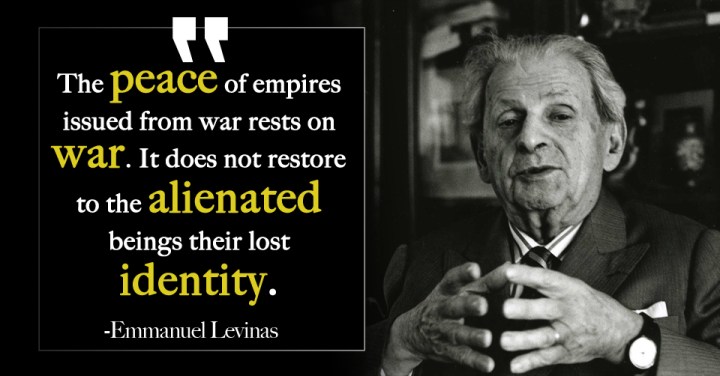
Levinas Quote on War

Jesus warns his fellow Jews against the illusion that they are not dependent on historical influences like their ancestors. To think that we would not have made the mistakes our ancestors made in their time, is to deny the inescapable historicity of our humanity, and again leads to a rejection of the other as “other human being”. Again we then show the tendency to reduce others to the particular characteristics of a “group” different from “us”. In the words of Jesus (Matthew 23:29-32):

“Woe to you, teachers of the law and Pharisees, you hypocrites! You build tombs for the prophets and decorate the graves of the righteous. And you say, ‘If we had lived in the days of our ancestors, we would not have taken part with them in shedding the blood of the prophets.’ So you testify against yourselves that you are the descendants of those who murdered the prophets. Go ahead, then, and complete what your ancestors started!”

In short, Judeo-Christian tradition acknowledges that there are physical forces and cultural laws which precede our existence, but they are merely starting points. They do not determine the goals and destiny of our lives. We are called to live an existence as individuals who ultimately belong to no particular group but humanity. Thus we are called “to love our neighbor as ourselves”. Therein lies the essence of “human nature” in a Judeo-Christian sense.

P.S. 1 It remains to be seen if a young Flemish nationalist movement like Schild & Vrienden is also a racist movement. Dries Van Langenhove, leader of the movement, called the above mentioned racist Congo song “an edgy student song, sung at nearly every party”. I hope he doesn’t mean that it should therefore be accepted. The supposed racism of “other cultures” doesn’t in any way justify racism in one’s own quarters (although it might make it comprehensible). To be proud of your own culture means that you don’t imitate morally questionable practices of other cultures, and that you don’t take those practices as a reference point to justify your own practices. In the case of responding to the racism of others, we are responsible for our own behavior, and we shouldn’t blame others for the way we act – that would be hiding behind a scapegoat mechanism.

Anyway, here is an interview with Dries Van Langenhove by Lana Lokteff of Red Ice. It reveals some of the suppositions of Schild & Vrienden concerning “identity formation” and some of their views on what it means to be part of a cultural realm:

P.S. 2 For more on the word culture and its etymology click here for slides on Australian pop culture (assembled by Angela Ballas – Yaryalitsa). Or watch the powerpoint:

In Catholicism, A Journey to the Heart of the Faith (Image Books, 2011) Robert Barron explains the nonviolent way of Jesus in the face of evil as a “third” way, apart from violently fighting or fleeing the evil (pp. 48-51):

In words that still take our breath away, Jesus says, “You have heard that it was said, ‘You shall love your neighbor and hate your enemy.’ But I say to you, love your enemies and pray for those who persecute you” (Mt 5:43-44). In order to understand this radical teaching, we have to be clear on what Jesus means by “love” (agape in Matthew’s Greek). Love is not a sentiment or feeling, not merely a tribal loyalty or family devotion. Love is actively willing the good of the other as other. Often we are good or kind or just to others so that they might be good, kind, or just to us in return. But this is indirect egotism, not love. And this is why loving one’s enemies is the surest test of love. If I am good to someone who is sure to repay me, then I might simply be engaging in an act of disguised or implicit self-interest. But if I am generous to someone who is my enemy, who is not the least bit interested in responding to me in kind, then I can be sure that I have truly willed his good and not my own. And this is why Jesus says, “For if you love those who love you, what recompense will you have? … And if you greet your brothers only, what is unusual about that? Do not the pagans do the same?” (Mt 5:46-47). Jesus wants his followers to rise above the imperfect forms of benevolence that obtain among the general run of human beings and to aspire to love the way that God loves: “for he makes his sun rise on the bad and the good, and causes rain to fall on the just and the unjust” (Mt 5:45). […] If we are truly free from our attachments, especially from the attachment to approval, then we can become “sons and daughters” of [this Love], this God and hence conduits of his peculiar grace. […]

The already radical teaching on loving one’s enemies becomes even more intensely focused as Jesus turns his attention to the practice of nonviolence. Giving voice to the common consensus among law-abiding Jews, Jesus declares, “You have heard that it was said, ‘An eye for an eye and a tooth for a tooth.’ But I say to you, offer no resistance to one who is evil. When someone strikes you on [your] right cheek, turn the other one to him as well. If anyone wants to go to law with you over your tunic, hand him your cloak as well” (Mt 5:38-40). It is most important not to overlook the fact that this was, for its time, quite an enlightened, compassionate rule, for many individuals and nations would have felt justified in answering a violent affront with a devastating and disproportionate counterviolence. The seemingly brutal “eye for an eye” rule was in fact an attempt to delimit the retaliatory instinct. But, as we can see, Jesus is uneasy even with this relatively benign recommendation. I fully realize that Jesus’s instruction can sound like simple acquiescence to the power of violence, but we have to probe further. There are two classical responses to evil: fight or flight. When confronted with injustice or violence, we can answer in kind – and sometimes in our sinful world that is all that we can reasonably do. But as every playground bully and every geopolitical aggressor knows, this usually leads to an act of counterviolence, and then still another retaliation until the opponents are locked in an endless round of fighting. Gandhi expressed it this way: “an eye for an eye makes the whole world blind.” The other typical responses to aggression are running away or submitting – and sometimes, given our finite, sinful situation, that is all we can do. But, finally, we all know that ceding to violence tends only to justify the aggressor and encourage even more injustice. And therefore it appears as though, in regard to solving the problem of violence, we are locked in a no-win situation, compelled to oscillate back and forth between two deeply unsatisfactory strategies.

In his instruction on nonviolence Jesus is giving us a way out, and we will grasp this if we attend carefully to the famous example he uses: “To the person who strikes you on one cheek, offer the other one as well” (Lk 6:29). In the society of the time, one would never have used one’s left hand for any form of social interaction, since it was considered unclean. Thus, if someone strikes you on the right cheek, he is hitting you with the back of his hand, and this was the manner in which one would strike a slave or a child or a social inferior. In the face of this kind of violence, Jesus is recommending neither fighting back nor fleeing, but rather standing one’s ground. To turn the other cheek is to prevent him from hitting you the same way again. It is not to run or to acquiesce, but rather to signal to the aggressor that you refuse to accept the set of assumptions that have made his aggression possible. It is to show that you are occupying a different moral space. It is also, consequently, a manner of mirroring back to the violent person the deep injustice of what he is doing. The great promise of this approach is that it might not only stop the violence but also transform the perpetrator of it.

Robert Barron then gives some examples of this strategy, as it was used by Mother Teresa, Desmond Tutu and Pope John Paul II (see the video fragment below):

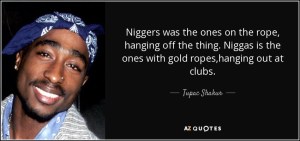
The award winning social skills educator Brooks Gibbs, who tries to educate people to live by the Golden Rule, took the “mirroring strategy” of Jesus as a way to deal with bullying. What the mirroring strategy does, basically, is to take away the power of the bully to humiliate the victim. The words of the bully are received as “badges of honor”. It is comparable to the way the word “nigga” is sometimes used nowadays among African-American youngsters themselves, so the word gradually loses its power to have a derogatory meaning. I remember being called “homo” one time and thanking the one who yelled it for “the compliment”. In other words, the mirroring strategy in the face of evil is a kind of transformative mimetic practice that invites evildoers to imitate another set of practices and assumptions to end the evil. It could be an example of what René Girard calls “good mimesis”.Tupac on Niggas

Does it work? Not always, but if it does, the results are stunning, as is shown in the video below by Brooks Gibbs:

[KLIK HIER VOOR SAMENVATTING IN HET NEDERLANDS – PDF]

Skeptic Brian Dunning sharply observes the following:

“Who has been the worst throughout history: atheist regimes or religious regimes? Obviously the big numbers come from the 20th century superpowers (China, Russia, Germany) so the answer depends on how you classify those. And this is where the meat of these debates is usually found, splitting hairs on which regime is atheist, which is merely secular, which is non-Christian and thus fair game to be called atheist. […] In summary, the winner of these debates is the one who can convince the other that the big 20th century genocidal maniacs were motivated either by religion or by a desire to destroy religion. The entire debate is the logical fallacy of the excluded middle.

[…]

I’m convinced that arguing either side is merely an opportunistic way to tingle sensitive nerves and sell a lot of books. And, I’m convinced that any discussion of the religious causes of genocide is a divisive distraction from the more worthwhile investigation into the true cultural and psychological causes. We are human beings, and we need to understand our human motivations.

So I am no longer going to participate in the childish debate of what religion has killed more people in history, because it doesn’t matter. The way I see it, you might as well debate what color underpants are worn by the largest number of killers, and try to draw a causal relationship there as well. Religion does not cause you to kill people, and it certainly doesn’t prevent you from killing people. Let’s stop pretending that it does either.”

Dunning, B. “Who Kills More, Religion or Atheism?” Skeptoid Podcast. Skeptoid Media, 27 Nov 2007. Web. 7 Nov 2017. http://skeptoid.com/episodes/4076

See also: http://worldwithoutgenocide.org/

It is strange, indeed, how some people express their outrage about “violent Islam” or “violent religion” on Facebook after an ISIS terror attack in New York that killed eight people (November 3, 2017), while those very same people remain silent about the mass killer in Las Vegas who slaughtered 58 people (October 1, 2017). Makes you wonder if the victims are a primary concern. Maybe victims are primarily used to make political statements?

The problem of violence lies within man himself and in his tendency to deify human preoccupations. Man’s addictive attachment to wealth, pleasure, power and/or honor often creates a deadly cocktail of (self-)destructive behavior. The deification of wealth, pleasure, power and/or honor means that they are considered as ends in themselves. It means that they are considered as goals of mimetically driven desires; as parts of a love for a mimetically constructed psychosocial (self-)image, and not as means to or consequences of a love for one”self” (a self that is, paradoxically maybe, always “relational”) and one’s neighbor.

The deification of wealth, pleasure, power and/or honor prevents the (truly divine) reality of neighborly love. For instance, a capitalist who accepts cheap child labor in his factories is not concerned with his neighbors (in casu the children), but only in the fulfilment of his (mimetically driven) desire for, and love of wealth and social status (“honor”) because of that wealth. Equally, a child molester, like a pedophile priest, is not interested in loving children, but in the fulfilment of his love for pleasure and power. Or another example: a student who is only interested in courses when they are “not boring” is primarily interested in the fulfilment of the desire for pleasure. True love is a learning process, though, which is not always and automatically accompanied by “good feelings”. If, for instance, you want to develop the freedom to play whatever piano piece, you will at first have to develop the discipline to obey certain rules about music theory and piano playing techniques. Which might be boring at times, but you will never learn to enjoy the reality of certain music as a player if you are simply driven by a desire for pleasure. The fact that love is more than “feeling good” also appears when you are sad because of the death of a dearly beloved – and yet you are willing to bear sadness because of love (and not, in a masochistic way, because of sadness itself).

Throughout history, there have been numerous attempts to create a utopian peace that could fully satisfy any one of those aforementioned addictions, or a combination of them. The attempts have always led to large numbers of despair, oppression and bloodshed. Utopias turn to dystopias. It’s a law of human history. Those utopias have been religious as well as secular. Indeed, the addiction to wealth, pleasure, power and/or honor is a universal human temptation, which has nothing to do with defining yourself as a theist or an atheist. Theists as well as atheists sometimes deify wealth, pleasure, power and/or honor.

So, it is no coincidence that:

  • Human history has witnessed the temptation to deify the pursuit of wealth and pleasure. Remember, for instance, the war between Mexican drug cartels?
  • Human history has witnessed the temptation to deify a cultural religious and ethnic identity in order to defend or expand one’s honor and power over against others. Remember, for instance, the Yugoslav wars (1991-2001)? It’s religion and nationalism gone mad.
  • Human history has witnessed the temptation to deify the pursuit of wealth and capital through power. Remember, for instance, colonialism (15th – 20th century)? Or remember, for instance, the so-called “Great Leap Forward” in China (1958-1962)? It’s socioeconomic relations gone mad.
  • Human history has witnessed the temptation to deify an ethnic identity and a so-called “natural order of racial competition” in order to defend or expand one’s honor and power over against others. Remember, for instance, the Holocaust (1933-1945)? It’s nationalism and pseudo-Darwinian ideology gone mad.

It’s in light of these facts that we can reconsider the beginning of the Ten Commandments (Exodus 20, 3-5a):
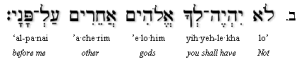
2commandment“You shall have no other gods before me. You shall not make for yourself an image in the form of anything in heaven above or on the earth beneath or in the waters below. You shall not bow down to them or worship them…”

In other words, nothing should be deified. Deification (whether of a material object, an ideological system or a combination of both) leads to slavery and all kinds of mental and physical violence. Expressed paradoxically: in a Jewish sense, to love God means refusing to consider anything as divine (in order to become “children of God”, which is “deification” in a totally different sense!). It is the paradoxically absolute refusal of absolutism, totalitarianism and idolatry, in order to make way for the reality of love. There is no middle ground here. Christians believe that Jesus of Nazareth embodied the absolute refusal of absolutism. That’s why, for instance, Matthew the Evangelist let’s Jesus proclaim (Matthew 12:30a): “Whoever is not with me, is against me…”

[Note: I could have made the following considerations perhaps from a different spiritual tradition, or at least I could have made similar ones. To me, Judeo-Christian tradition is not an end in itself. It is a starting point. So I don’t want to absolutize this religion. On the other hand, I accept that I am a historical creature and I also don’t want to absolutize a so-called self-sufficient a-historical identity. The Judeo-Christian tradition is the woman I coincidentally met and have a relationship with. I don’t need to see all other women first to have an inspiring relationship with this one, enabling me to creatively meet other people as well, men and women.]

Love ultimately is a concern for the reality of the (human and non-human) other because of the other, which is only possible if people are concerned with… their own freedom! In the words of Robert Barron: “Love is not a sentiment or feeling. It is actively willing the good of the other.” Only if you are not fully defined by and attached to your biological need for survival, or your mimetically driven psychosocial desire for safety from potential rivals (power), for entertainment (pleasure), or for approval (honor), can you become free to experience reality more fully (no longer approaching it from any particular need). A scientist is truly a scientist when he is interested in reality because of reality itself, and not, for instance, because of his biological need for survival or because of a psychosocially mediated desire to become famous for his discoveries. What is true is true apart from whatever “need” or “desire”. Truth transcends those circumstances. Moreover, the refusal to deify yourself (which is, in other words, to love God) means that you might lessen the temptation to sacrifice others to or use them for your mimetically driven desire for approval, as you learn to love the reality of who you are. This is “the logic of Jesus” in his conversation with a lawyer (Matthew 22:35-40):

A lawyer asked Jesus a question to test him. “Teacher, which is the great commandment in the Law?” And Jesus said to him, “You shall love the Lord your God with all your heart and with all your soul and with all your mind. This is the great and first commandment. And a second is like it: You shall love your neighbor as yourself. On these two commandments depend all the Law and the Prophets.”

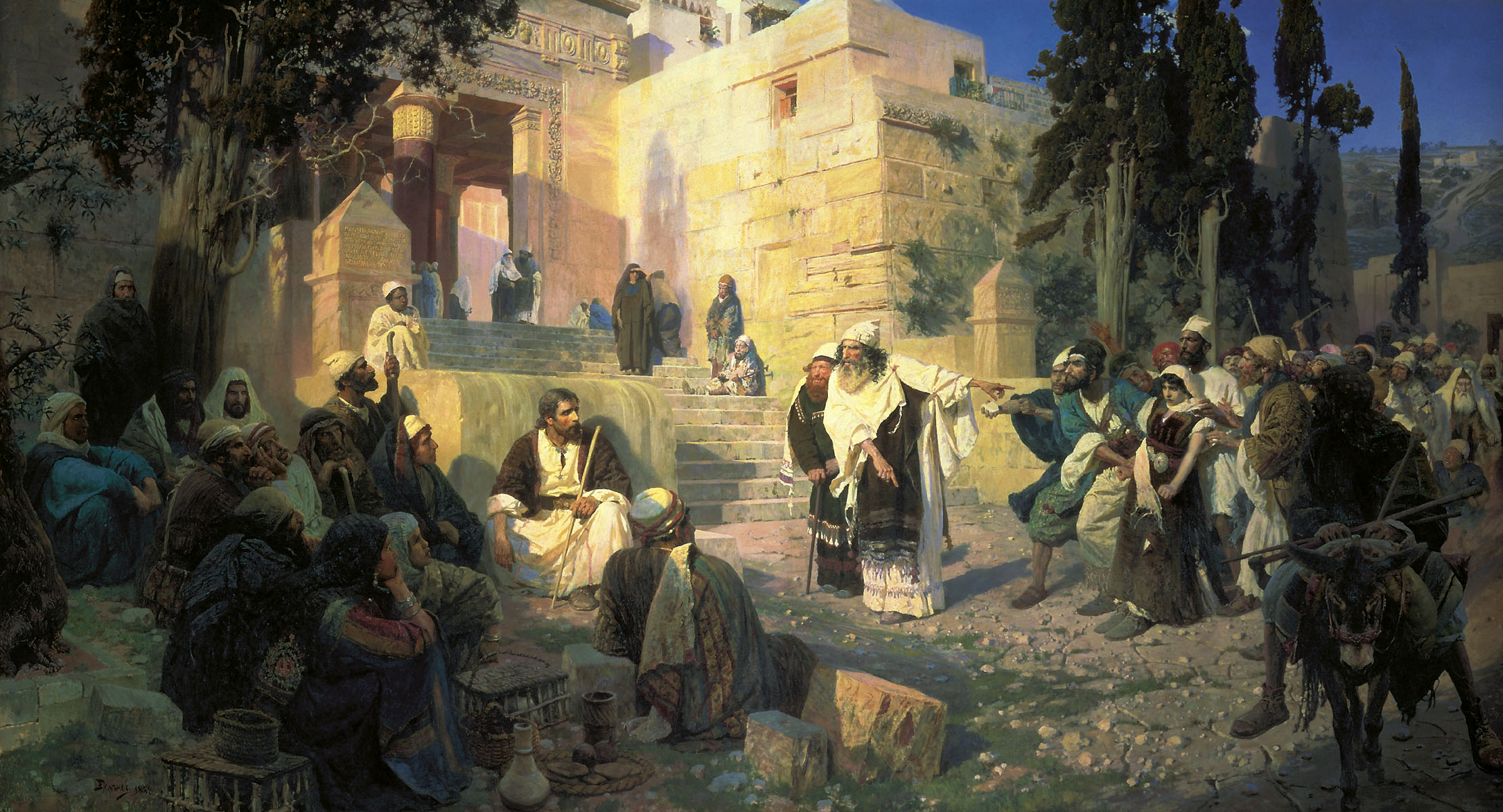
A Depiction of Jesus and the Woman taken in Adultery (Vasily Polenov)Jesus often confronts people with their narcissistic tendencies, or, in other words, with their tendency to deify themselves. For instance, when he is surrounded by people who are about to stone a woman caught in the act of adultery (John 8:1-11), Jesus awakens a sense of reality in each individual. He asks people to consider whether they themselves are “without sin”. After which he decides that “whoever is without sin may cast the first stone”. At first sight this is merely a clever trick that allows Jesus to take control of the situation. Indeed, no Jew would claim to be perfect. That would mean that he claims to be like God, and then he would trespass the first of the ten commandments. So no one can cast the first stone, because that would be one of the greatest sins in the light of Jesus’ saying. At a deeper level, it is precisely Jesus’ constant “iconoclasm” of false self-concepts that, apart from the social position Jesus himself receives for doing so, opens up possibilities for new relationships between people. If you don’t deify yourself, if you don’t surrender to idolatry (of illusionary ideas of yourself), then you become able of accepting yourself more realistically (with your limits and mistakes), and then you might also be more able to accept others (with their limits and mistakes). In other words, if you “love God” (i.e. refuse to deify anything, including yourself), then you open up the possibility of “loving yourself”, which is the condition to “love others”.

Jesus is convinced that the source from which he lives “desires mercy, and not sacrifice” (Matthew 9:13). The consequences of this conviction are paradoxical. It implies that Jesus refuses to merely sacrifice the existing worldly structures to establish his own rule. Jesus acts non-dualistically. Hence he says (Matthew 5:17):

“Do not think that I have come to abolish the Law or the Prophets; I have not come to abolish them but to fulfill them.”

The priority of love implies that existing laws, structures and rituals should be tested against the extent to which they help to avoid making victims and to which they allow for authentic human lives. Man should not live according to rules, as if preserving a social system and its rules would be an end in itself, but rules should be means at the service of individual human beings and society as a whole. When Jesus and his disciples are criticized for doing things that are, strictly speaking, forbidden on the rest day – the Sabbath – Jesus answers (Mark 2:27):

“The Sabbath was made for man, not man for the Sabbath.”

Again, this is a refusal to deify any worldly or human reality. It is a refusal to deify religion, in this case the Jewish one.

BeatitudesOne of the most impressive summaries of the teachings of Jesus is, without a doubt, the Sermon on the Mount. Father Robert Barron makes some very inspiring observations about the eight beatitudes, especially about the four seemingly more “negative” prescriptions (all the following fragments from Robert Barron are taken from Barron, Robert. Catholicism: A Journey to the Heart of the Faith. New York: Image Books, 2011, pp.43-47):

“Thomas Aquinas said that the four typical substitutes for God are wealth, pleasure, power, and honor. Sensing the void within, we attempt to fill it up with some combination of these four things, but only by emptying out the self in love can we make the space for God to fill us. The classical tradition referred to this errant desire as ‘concupiscence,’ but I believe that we could neatly express the same idea with the more contemporary term ‘addiction.’ When we try to satisfy the hunger for God with something less than God, we will naturally be frustrated, and then in our frustration, we will convince ourselves that we need more of that finite good, so we will struggle to achieve it, only to find ourselves again, necessarily, dissatisfied. At this point, a sort of spiritual panic sets in, and we can find ourselves turning obsessively around this creaturely good that can never in principle make us happy.

And so Jesus says: ‘Blessed are the poor in spirit, for theirs is the kingdom of heaven’ (Mt 5:3). This is neither a romanticizing of economic poverty nor a demonization of wealth, but rather a formula for detachment. Might I suggest a somewhat variant rendition: how blessed are you if you are not attached to material things, if you have not placed the goods that wealth can buy at the center of your concern? When the Kingdom of God [love, mercy, grace] is your ultimate concern, not only will you not become addicted to material things; you will, in fact, be able to use them with great effectiveness for God’s purposes [love]. Under this same rubric of detachment consider the beatitude ‘Blessed are they who mourn, for they will be comforted’ (Mt 5:4). Again, this can sound like the worst sort of masochism, but we have to dig deeper. We could render this adage as how blessed, how ‘lucky’… you are if you are not addicted to good feelings. Pleasant sensations – physical, emotional, psychological – are wonderful, but since they are only a finite good, they can easily drive an addiction, as can clearly be seen in the prevalence of psychotropic drugs, gluttonous habits of consumption, and pornography in our culture. Again, Jesus’s saying hasn’t a thing to do with puritanism; it has to do with detachment and hence with spiritual freedom. Unaddicted to sensual pleasure, one can unreservedly follow the will of God, even when such a path involves psychological or physical suffering.”

I wrote an earlier post on this blog about the religious vows (click here for more). It joins the previous considerations by Father Barron:

Saint Francis of AssisiBefore I got to know the Christian faith I always thought the three religious vows were an abomination. Why would anyone deliberately choose a seemingly masochistic way of a life in “poverty, chastity and obedience”? Only after I saw a documentary on the Franciscan Friars of the Renewal in New York and only after I delved into the Gospels more carefully I discovered that these vows were not ends in themselves, but should actually be understood as means to seeming antitheses of those very vows. It turns out that the three religious vows are anything but masochistic. They should be based on the paradox of the Gospel:

For whoever wants to save their life will lose it… What good is it for someone to gain the whole world, and yet lose or forfeit their very self?” (Luke 9:24a-25).

Concerning the vow of poverty: For whoever wants to save their life will lose it… translates to For whoever wants to become rich will become poor… Indeed. Ever met those people who “wanted it all” – perhaps in the mirror? Those who want to enjoy as much parties as possible? If you want all the clothes in the world and go out shopping all the time you won’t ever fully enjoy any of your clothes. If you want to attend ten parties in just one night you will not have enjoyed any of them, because you will constantly worry about the next party you might be missing. If you want to love all the women in the world, you won’t have loved any of them in the end.

The challenge is to choose life where it’s present. As a present. To quote John Lennon: “Life is what happens to you while you’re busy making other plans.” The challenge is to live in the here and the now. To choose quality instead of worrying about quantity. Intensity. NON MULTA SED MULTUM. Epicurus (BC 341-270) already warns against discomposing desires: “Do not spoil what you have by desiring what you have not; remember that what you now have was once among the things you only hoped for.” If you stop trying to possess what others have (which is the same as no longer surrendering to mimetic desire), you will become aware of the things you do have and discover that there’s a world of plenty in one single moment, at one place.

Saint Francis of Assisi (Regina Ammerman)Imagine what this attitude of “having enough” could mean for the natural environment! It’s no surprise Saint Francis of Assisi (1181-1226) deeply respected and enjoyed the riches of nature… If only we could follow his example a little better.

Concerning the vow of chastity: For whoever wants to save their life will lose it… translates to For whoever wants to love everyone will not be able to love anyone… If you are a heterosexual bachelor who tries to develop a friendly relationship with a woman, you might soon find out that the woman herself or others fear you’re friendly because you want “something more”. This fear might prevent the possibility of more intimate relationships. On the other hand, when people know you’re married or that you took another voSaint Francis and the Sultanw of chastity, they will not have to fear you’re “after something more than friendship”. This opens up the possibility of more authentic and intimate relationships. It opens up the possibility of meeting the other as “other”, of true personal care – CURA PERSONALIS. Of course, we all know that in human relationships there is no black and white. There’s lots of colors in between the limits of a “grey zone”.

In yet other words, using another formula from the Gospels (the aforementioned “The Sabbath was made for man, not man for the Sabbath”):

Wealth is there for man (in service of neighborly love – considering wealth as a means to help our neighbor), not man for wealth (we shouldn’t exploit our neighbor to become wealthy – considering wealth as our goal, and not our neighbor). That’s why Jesus says: “Blessed are the poor in spirit, for theirs is the kingdom of heaven [the reality of love]” (Mt 5:3).

The development of a sexual relationship might be a consequence of our love for the other, as it is not the end of our relationship. The other should not be a means to satisfy our sexual desires, but our sexual desires are, in ideal circumstances, consequences of a very intimate friendship. True love accepts to bear sadness when beloved others are unhappy, it does not seek pleasure at the expense of others (a child molester, for instance, doesn’t care about the brokenness of his victim as he is addicted to pleasure).

If you don’t flee sadness because of the loss of a dearly beloved by “drinking away ‘bad feelings’ with alcohol”, you might allow the source of your sadness, which is the reality of the love for the person you lost. And by allowing that love, you also allow the comforting gratitude for what that person gave you and meant to you. That’s why Jesus says: “Blessed are they who mourn, for they will be comforted” (Mt 5:4).

Father Barron again:

“Jesus says, ‘Blessed are the meek, for they will inherit the land’ (Mt 5:5). I don’t know of any culture at any time that would be tempted to embrace this beatitude as a practical program of world conquest! Meek people don’t come to positions of political or institutional influence. But once more, Jesus is not so much passing judgment on institutions of power as he is showing a path of detachment. How lucky you are if you are not attached to the finite good of worldly power. Many people up and down the centuries have felt that the acquisition of power is the key to beatitude. In the temptation scene in the Gospel of Matthew, the devil, after luring Christ with the relatively low-level temptations toward sensual pleasure and pride, brings Jesus to the top of a tall mountain and reveals to him all of the kingdoms of the world in their glory and offers them to Jesus. Matthew’s implication is that the drive to power is perhaps the strongest, most irresistible temptation of all. In the twentieth century, J.R.R. Tolkien, who had tasted at first hand the horrors of the First World War and had witnessed those of the Second, conceived a ring of power as the most tempting talisman in his Lord of the Rings trilogy. But if you are detached from worldly power, you can follow the will of God, even when that path involves extreme powerlessness. Meek – free from the addiction to ordinary power – you can become a conduit of true divine power to the world.

The last of the ‘negative’ beatitudes is ‘Blessed are they who are persecuted for the sake of righteousness, for theirs is the kingdom of heaven’ (Mt 5:10). We must read this, once again, in light of Thomas Aquinas’s analysis. If the call to poverty holds off the addiction to material things, and the summons to mourn counters the addiction to good feelings, and the valorization of meekness blocks the addiction to power, this last beatitude gets in the way of the addictive attachment to honor. Honor is a good thing in the measure that it is a “flag of virtue,” signaling to others the presence of some excellence, but when love of honor becomes the center of one’s concern, it, like any other finite good, becomes a source of suffering. Many people who are not terribly attracted to wealth, pleasure, or power are held captive by their desire for the approval of others, and they will accordingly, order their lives, arrange their work, and plot their careers with the single value in mind of being noticed, honored and endowed with titles. But this again involves the attempt to fill up the infinite longing with a finite good, and it produces, by the laws of spiritual physics, addiction. Therefore, how lucky are you if you are not attached to honor and hence are able to follow the will of God even when that path involves being ignored, dishonored, and, at the limit, persecuted.”

agape loveTo gain social recognition often means that you’re accepted not for who you are, but for the image you’re presenting of yourself. Indeed, you’re losing your life while trying to “gain the whole world”. This process might also imply that you’re sacrificing others to protect that socially acceptable image. The apostle Peter denies knowing Jesus when the latter is arrested, instead of defending Jesus. Fearing that his association with Jesus will make him socially unacceptable as well, Peter presents an untruthful image of himself. From this angle Jesus rightfully says: “But whoever loses their life for me will save it…” (Luke 9:24b). If you lose your socially acceptable image to defend the one who is socially deprived, you will gain a truer identity as an unexpected and surprising consequence. To (re)establish relationships with the excluded is to take part in the dynamic of agape (love for one’s neighbor). It is making the “Body of Christ” – which is a body of Love – transparent. In short, if you lose the love for your image, then you gain love for yourself and others.

Faces of Christ (Body of Christ)

Concerning the vow of obedience: For whoever wants to save their life will lose it… translates to For whoever wants to be free will be imprisoned… Oh yes, we tend to listen to the ones who are promising us a great future, a beautiful career, happiness etc. – in one word: “paradise”. But if a workaholic keeps on listening to his boss, he will remain a puppet of a degrading work ethic. If a drug addict keeps on believing the drug dealer who tells him that he doesn’t really have any problem, he will remain an enslaved human being for the rest of his life… In contrast, the vow of obedience means that you will try to obey to the Voice of a Love that wants what’s best for you. It means listening to a Voice that liberates you and enables you to be who you are… Only if you’re capable of accepting and loving yourself, you will be capable of loving others as well. The drug addict is so in need of drugs that he will approach others because of this need. He will use others to satisfy his needs and he won’t be able to approach them as ends in themselves. But if he frees himself from these needs and takes responsibility for himself he will be able to take responsibility for others as well. FREEDOM AND RESPONSIBILITY are twin brothers, or sisters…

Father Barron has the last word:

Thomas Aquinas (Gentile da Fabriano)“Thomas Aquinas said that if you want to see the perfect exemplification of the beatitudes, you should look to Christ crucified. The saint specified this observation as follows: if you want beatitude (happiness), despise what Jesus despised on the cross and love what he loved on the cross. What did he despise on the cross but the four classical addictions? The crucified Jesus was utterly detached from wealth and worldly goods. He was stripped naked, and his hands, fixed to the wood of the cross, could grasp at nothing. More to it, he was detached from pleasure. On the cross, Jesus underwent the most agonizing kind of physical torment, a pain that was literally excruciating (ex cruce, from the cross), but he also experienced the extreme of psychological and even spiritual suffering (‘My God, my God, why have you forsaken me?’). And he was bereft of power, even to the point of being unable to move or defend himself in any way. Finally on that terrible cross he was completely detached from the esteem of others. In a public place not far from the gate of Jerusalem, he hung from an instrument of torture, exposed to the mockery of the crowd, displayed as a common criminal. In this, he endured the ultimate of dishonor. In the most dramatic way possible, therefore, the crucified Jesus demonstrates a liberation from the four principal temptations that lead us away from God. […]

But what did Jesus love on the cross? He loved the will of his Father [Love]. […] What he loved and what he despised were in a strange balance on the cross. Poor in spirit, meek, mourning, and persecuted, he was able to be pure of heart, to seek righteousness utterly, to become the ultimate peacemaker, and to be the perfect conduit of the divine mercy to the world. Though it is supremely paradoxical to say so, the crucified Jesus is the man of beatitude, a truly happy man. And if we recall our discussion of freedom, we can say that Jesus nailed to the cross is the very icon of liberty, for he is free from those attachments that would prevent him from attaining the true good, which is doing the will of his Father [Love].

One of the most brutally realistic and spiritually powerful depictions of the crucifixion is the central panel of the Isenheim Altarpiece painted in the late fifteenth century by the German artist Matthias Grünewald. Jesus’s body is covered with sores and wounds, his head is surrounded by a particularly brutal crown of thorns, his hands and feet are pierced, not with tiny nails, but with enormous spikes, and, perhaps most terribly, his mouth is agape in worldless agony. The viewer is spared none of the horror of this most horrible of deaths. To the right of the figure of Jesus, Grünewald has painted, in an eloquent anachronism, John the Baptist, the herald and forerunner of the Messiah. John is indicating Jesus as the Lamb of God, but he does so in the most peculiar way. Instead of pointing directly at the Lord, John’s arm and hand are oddly twisted, as though he had to contort himself in order to perform his task. One wonders whether Grünewald was suggesting that our distorted expectations of what constitutes a joyful and free life have to be twisted out of shape (and hence back into proper shape) in order for us to grasp the strange truth revealed in the crucified Christ.”

Isenheim Altarpiece (Matthias Grünewald)

Original Latin text Robert Barron refers to:

Sancti Thomae de Aquino Expositio in Symbolum Apostolorum (reportatio Reginaldi de Piperno)

(Textum Taurini 1954 editum ac automato translatum a Roberto Busa SJ in taenias magneticas denuo recognovit Enrique Alarcón atque instruxit)

Articulus 4

Passus sub Pontio Pilato, crucifixus, mortuus et sepultus

[…]

Nam, sicut dicit beatus Augustinus, passio Christi sufficit ad informandum totaliter vitam nostram. Quicumque enim vult perfecte vivere, nihil aliud faciat nisi quod contemnat quae Christus in cruce contempsit, et appetat quae Christus appetiit. Nullum enim exemplum virtutis abest a cruce.

[…]

Si quaeris exemplum contemnendi terrena, sequere eum qui est rex regum et dominus dominantium, in quo sunt thesauri sapientiae; in cruce tamen nudatum, illusum, consputum, caesum, spinis coronatum, et felle et aceto potatum, et mortuum. Igitur non afficiaris ad vestes, et ad divitias: quia diviserunt sibi vestimenta mea, Psal. XXI, 19; non ad honores, quia ego ludibria et verbera expertus sum; non ad dignitates, quia plectentes coronam de spinis imposuerunt capiti meo; non ad delicias, quia in siti mea potaverunt me aceto, Psal. LXVIII, 22.

Dutch Translation – Vertaling:

Artikel 4

Geleden onder Pontius Pilatus, gekruisigd, gestorven en begraven

[…]

Want zoals de zalige Augustinus zegt, de passie van Christus volstaat om de totaliteit van ons leven vorm te geven. Wie volmaakt wil leven, zou niets anders moeten doen dan verachten wat Christus verachtte op het kruis, en verlangen wat Christus verlangde [op het kruis].

[…]

Als je een voorbeeld zoekt van de verachting van aardse dingen, volg dan hem die de koning der koningen is en de heer der heerscharen, in wie zich de schatten bevinden van de wijsheid; op het kruis werd hij ontkleed, bespot, bespuwd, geslagen, gekroond met doornen, en gelaafd met azijn en gal, en is er gestorven. Daarom, wees niet gehecht aan kledij, en aan rijkdommen: want ze verdeelden mijn kleren onder hen, Psalm 21, 19; [wees] ook niet [gehecht] aan eer(bewijzen), want ik heb harde woorden en verwijten ondergaan; [wees] ook niet [gehecht] aan sociale rang (waardigheid, macht), want een doornen kroon wevend plaatsten ze die op mijn hoofd; [wees] ook niet [gehecht] aan genotvolle dingen, want in mijn dorst gaven ze mij azijn te drinken, Psalm 68, 22.

Sherin Khankan (°1974), Denmark’s first female imam and one of the leaders of the Mariam Mosque in Copenhagen, was interviewed for Belgian television (May 29th, 2017).

The full interview can be watched here – definitely a MUST SEE:

Here are some transcripted excerpts from the interview:

Interviewer Bart Schols: Did you get some bad reactions on what you’re doing? Because every religion has a very traditional side sometimes, probably also in Denmark?

Sherin Khankan: Actually, I never focus on the bad reactions. I always focus on the support, and we have a lot of support from all over the world. Actually, recently we had a visitor, from one of the world’s largest mosques, the world’s third largest mosque – it’s the Grand Mosque in Indonesia –, and the grand imam he came and he blessed our mosque, and he prayed in our mosque, and he made a written document, saying that female imams are of course a possibility, and it’s a part of our Islamic tradition and theology… So, but of course, when you create change… When you change the structure, when you change the fundamentals, when you challenge the patriarchal structure, you challenge the power balance. And when you do that, people will get upset, it’s natural.

So we are prepared for opposition, but actually the worst opposition that we met so far was not from Muslims. The reactions from Muslims were quite moderate, but from the right wing parties, Islamophobes, Nazi-parties… we had very bad reactions.

Interviewer: More than from the inside?

Sherin Khankan: Yeah, I think it’s because… to Islamophobes progressive Muslims are a greater threat than Islamists are, because we are actually able to change the narrative on Islam in Europe.

Interviewer: Okay. You are traveling around the world with a message, if I may call it like that. What is the fight that you are fighting?

Sherin Khankan: First of all we want to give women the chance to disseminate the Islamic message. We want to create a place where women are equal to men. We want to challenge the patriarchal structure. We want to challenge the growing Islamophobia, and we wish to unite or unify all the great forces throughout the world who are fighting for women’s rights.

Interviewer: That’s in general, but if you, like in different countries, because you travel around the world, around Europe… you have different issues. There’s the headscarf, that’s a discussion about everywhere, also here in Belgium. What is your position on that?

Sherin Khankan: I do believe that, it’s stated very clearly in the Declaration of Human Rights, that any person has the right to practice his or her religion in the public sphere and in the private sphere. So if a person chooses to wear the headscarf of her own free will, it’s her choice and nobody should be able to touch that woman.

Interviewer: Also a police officer, for example?

Sherin Khankan: Of course, why not? A police officer, a doctor, a lawyer, a judge, anyone, because what’s important is not what you wear on your head. It’s what you have inside your head. So even if you ban the scarf, people will still have the same opinions inside. So it’s not a matter of the scarf, it’s a matter of realizing that we are living in a world and we have to accept pluralism as a factor, as a fundament for our societies. If not we are becoming oppressive. So I’m fighting for any woman’s right to wear the hijab and not to wear the hijab…

From a rational point of view, you would expect that Western extreme right-wing parties are delighted with the kind of Islam Sherin Khankan is advocating. After all, their message to people from other cultures has always been: “Adapt or go back to your country!” Exactly what culture people should adapt to or how that culture is defined is never quite clear, but anyways: here you have a kind of Islam that is perfectly compatible with the principles of a Western political, secularized culture, respecting the separation of Church and State. This separation goes both ways, of course. Article 18 of the Universal Declaration of Human Rights makes it very clear:

Everyone has the right to freedom of thought, conscience and religion; this right includes freedom to change his religion or belief, and freedom, either alone or in community with others and in public or private, to manifest his religion or belief in teaching, practice, worship and observance.

Sherin Khankan defends an Islam that does not interfere with the fundamental rights in a modern, Western democracy, so what are some extreme right-wing parties making such a fuss about? Aren’t they defending their “own” Western culture and values? Apparently, we shouldn’t expect too much rationality from them. What happens is quite simple: extreme right-wing parties partly need an “enemy monster” to justify and manage their own existence. If the so-called monster that is Islam turns out not to be such a monster after all, their reason for existence is threatened. That’s why extreme right-wing parties always make reasonable Muslim voices “the exception”. Sometimes they also argue that those reasonable Muslim voices are to blame for the infiltration of Islamist extremists in Western society, as if they function as “hosts” for extremist “parasites”.

What extreme right-wing parties rarely notice, of course, is the result of research done by security services all over the world: when people feel very oppressed or frustrated, they can radicalize very quickly one way or the other (extreme right-wing parties, as advocates of the reasoning that “our own culture is under threat”, are also an example). So to suppress a religion like Islam and Muslims is a very bad idea. The British Security Service MI5 (Military Intelligence, Section 5) claims there is evidence that a well-established religious identity actually protects against violent radicalization. Indeed, as the research by MI5 reveals, the vast majority of extremists participating in terrorist attacks in the UK, are British nationals. They are not illegal immigrants and, far from having received a religious upbringing, most are religious novices.

Ah, well… Are we strong enough to create identities beyond the need for an enemy monster? What if “the Wicked Witch of the West” isn’t wicked after all? I can’t help but mention in this context a great book that deals with the recurring dynamic of the need for a monstrous enemy: The Wicked Truth: When Good People Do Bad Things by Suzanne Ross. It is about the musical Wicked, the subversive and challenging prequel to the well-known story of The Wizard of Oz. Indeed, today we could ask the question: “What if the Wicked Witch of Islam isn’t wicked after all?” Maybe we remain anti-rational weaklings who need witches… Or maybe there’s hope, if we just listen to women like Sherin Khankan.


Who or what is to blame for the massacre at Pulse, a gay night club in Orlando, Florida (June 12, 2016)? Muslims? Religious people in general? Islam? Religion in general? Or just the twisted mindset of a troubled individual?

Omar Mateen, a 29 year old American Muslim of Afghan descent leaves 49 people dead and 53 injured after opening fire at Pulse, the gay night club he allegedly visited himself on a regular basis. He was eventually shot by the police. Being a regular visitor of the club, as well as his use of gay dating sites, suggest Mateen was gay himself. His ex-wife also made the claim that he was gay. So maybe it was ressentiment that drove him (for similar examples, click here)?

Whatever the case, there is no doubt that religion often advocates intolerance and hatred against LGBT people. Religious leaders past and present have discriminated against LGBT people. For instance, two days after the 9/11 terrorist attacks, Christian evangelicals Jerry Falwell and Pat Robertson blamed gays and lesbians, among other people, for the attacks (which they interpreted as “the wrath of God”). Jerry Falwell stated (for more on this, click here):

Muslim Lesbian Gay HappyI really believe that the pagans, and the abortionists, and the feminists, and the gays and the lesbians who are actively trying to make that an alternative lifestyle, the ACLU, People For the American Way – all of them who have tried to secularize America – I point the finger in their face and say “you helped this happen.”

In other words, some religious people hold LGBT people themselves responsible for the oppression and violence they have to endure, allegedly “because they don’t respect God and His laws”. Seen from the perspective of René Girard’s mimetic theory, this is a form of scapegoating: instead of taking responsibility for their own intolerant and sometimes violent attitude, the perpetrators of hate crimes blame the victims and even God for their own terrorist behavior.

The aversion to LGBT people and their sexuality by certain religious people is sometimes mirrored by an aversion to religion by certain “anti-theists”. In the words of Girard, this makes the latter doubles of their theist counterparts. Because religion is seen as one of the main causes of evil, hatred and violence in the world, certain people would rather eradicate religion, blaming religious people for fostering one of the main breeding grounds for evil, and thus start scapegoating themselves. Bill Maher, for example, in the mockumentary Religulous:

LGBT MuslimsThis is why rational people, anti-religionists, must end their timidity and come out of the closet and assert themselves. And those who consider themselves only moderately religious really need to look in the mirror and realize that the solace and comfort that religion brings you actually comes at a terrible price. […] If you belonged to a political party or a social club that was tied to as much bigotry, misogyny, homophobia, violence and sheer ignorance as religion is, you’d resign in protest. To do otherwise is to be an enabler, a Mafia wife, with the true devils of extremism that draw their legitimacy from the billions of their fellow travelers. If the world does come to an end here or wherever, or if it limps into the future, decimated by the effects of a religion-inspired nuclear terrorism, let’s remember what the real problem was: That we learned how to precipitate mass death before we got past the neurological disorder of wishing for it. That’s it. Grow up or die.

Well, seen from Bill Maher’s perspective, you’re in big trouble if you are gay and Muslim. You shouldn’t be surprised that you experience violence because being a Muslim, being religious is, in the words of Bill Maher, being “an enabler of homophobia and violence”. Once again the (potential) victim, in this case the gay Muslim, is held responsible, this time by so-called anti-religionists, for the violence the victim might have to endure.

In short, some people scapegoat people for being gay, others scapegoat people for being religious. Being gay and muslim means running the risk of being twice the scapegoat.

I am Gay and Muslim

From a spiritual perspective we are challenged to criticize ourselves by listening to the Voice of our (potential) Victim, by listening to the voice of the scapegoat, in order to become “the change we want to see”. Maybe “true Islam” is not a religion of bigotry, misogyny, homophobia and violence. Maybe “true Islam” is the religion of a “radical minority” that testifies to the Love of “the Merciful One”.

In the words of a gay Muslim man from the documentary I am Gay and Muslim:

No one has the right to tell me whether I’m a good Muslim or not.


To put things in perspective, an overview of mass shootings in the US of the last decades shows that most of the murderers didn’t need religion to get them to kill people. Some even hated religion. All they needed was easy access to guns and all too human characteristics played out in the wrong circumstances:

July 18, 1984: unemployed security guard James Oliver Huberty kills 21 people at a McDonald’s in San Ysidro, California. He is killed himself by a police sniper.

October 16, 1991: George Jo Hennard crashes his pickup into a Luby’s cafetaria and begins firing, killing 22 people before taking his own life.

April 20, 1999: Columbine High School students Eric Harris and Dylan Klebold kill 13 people before taking their own lives.

April 16, 2007: student Seung-hui Cho kills 32 people on Virginia Tech campus and eventually commits suicide.

April 3, 2009: Jiverly Voong kills 13 people when attacking Binghampton immigration center in New York state.

November 5, 2009: Major Nidal Malik Hasan, an Army psychiatrist, attacks Fort Hood in Texas and kills 13 people.

July 20, 2012: James Holmes kills 12 people in what became known as the Colorado cinema shooting, during the screening of the new Batman movie.

December 14, 2012: Adam Lanza kills 27 people, including himself, during an attack on Newtown school in Connecticut.

September 16, 2013: Aaron Alexis, a Navy contractor, kills 12 people at Washington Navy Yard.

June 18, 2015: Dylann Roof kills 9 people at Charleston prayer meeting.

December 2, 2015: Syed Farook and his wife Tashfeen Malik kill 14 people at a community centre in San Bernardino. They die in police shootout.

June 12, 2016: Omar Mateen kills 49 people and injures another 53 at a gay nightclub in Orlando, Florida.

no to homophobia islamophobia

[READ A PDF-VERSION OF THIS ARTICLE HERE]

Even before the terrorist shootings at Charlie Hebdo and later this year at other sites in Paris, quality labeled Belgian magazines and newspapers reported on the socially precarious situation in certain areas of Brussels, especially in Molenbeek. I’ve translated parts of an article that appeared in Knack magazine concerning the issue. Next to this article I’ve translated parts of other articles as well (from Knack magazine and De Standaard newspaper). These appeared in the aftermath of the Charlie Hebdo shootings. I will use some findings of these articles to answer a few questions on the nature of the conflict we’re dealing with when we’re talking about “homegrown terrorism”.

  • FIRST QUESTION: IS IT A “CLASH OF CIVILIZATIONS”?

FROM AN ARTICLE BY HAN RENARD:

Rachid Zegzaoui is a blogger of Moroccan descent living in Sint-Joost-ten-Node [another municipality of Brussels]. Rachid notices how many youngsters turn their back on the society they grew up in. “Second and third generation migrants no longer believe that a life of study, career and retirement is fit for them and consider their parents losers. They accuse their parents of being slaves to the West and the infidels. So it is a generational conflict as well, a revolt against their family. Parents are dead worried but no longer understand their offspring. They don’t know what their children are doing on the internet. In many Muslim families there is a complete sense of disunity. Young people reject the society in which they grew up. Religion guides their life, it is the meaning of their existence. But Islam as they understand it is not practiced here in Belgium.” […]

Call of Duty ISISZeguendi Khalil, editor in chief of Le Maroxellois, a magazine aimed at the Moroccan community, joins in. During one month and a half, Khalil listened to sermons with regard to the war in Syria in about twenty Mosques in Brussels. He concludes that imams warn their young audience against Jihad ideology and that imams sharply condemn ISIS terrorism. “However”, he says, “from our inquiry we know that members for Jihad are recruited through the internet nowadays, while this used to happen on the streets or in the near of Mosques.” Imported imams from Morocco or Turkey in Brussels don’t understand the young, Khalil explains. They don’t speak their language, nor know their culture and don’t have any clue whatsoever about Facebook or WhatsApp. “Imams fail. And so young Muslims, looking for meaning, construct their own version of Islam aided by Jihadist websites.”

We need positive role models, according to Khalil. Young Muslims who made it one way or the other should be put forward.

Young Islamologist Jessika Soors works as an official against radicalization in Vilvoorde. […] Although Jihadists justify their departure with the ideal of a holy war, many of them hardly knew anything about Islam and the Quran just before their sudden radicalization. “They’re religiously illiterate in many cases”, Soors says. […] ISIS appeals to vulnerable young people who are looking for a sense of self-worth and an all-encompassing identity.” […]

Young people who are bored here or who feel rejected, become members of ISIS in a quest for adventure. […] ISIS propaganda promises superstardom to those who feel lost in the West – all in the name of Allah.

MORE IN Knack, September 24, 2015, Voor Allah én het avontuur (p. 28-32), by Han Renard.

ISIS Hipster BeardPERSONAL COMMENTS

ANSWER TO THE FIRST QUESTION: NO. It is a clash within civilizations and cultures, not between them. Radicalized young Muslims seem to reject western society (although things like ISIS propaganda films borrow their look from western action movies and video games), but they also turn their back on the culture of their family and the imported imams from Morocco and Turkey. They create a new counter-culture which thrives on the internet. Their religion is mainly a consequence, not a cause of their violent tendencies. And the terror boys grow beards like hipsters (or was it the other way around?).

  • SECOND QUESTION: IS IT A “CLASH BETWEEN THE SEXES”?

FROM AN ARTICLE BY HAN RENARD:

Ahmed El Khanouss (CDH) is a jurat in Molenbeek, an impoverished municipality of Brussels and home to many migrants. Most of them are of Moroccan descent. […]

Khanouss notices how radicalization of youngsters expresses itself in two ways. “Some of them totally change their attitude. All of a sudden they become very demanding towards the women in their family, particularly with regard to their clothing, and they rebel against their parents. Others show no sign of radicalization until the day they leave. They wear brands and behave themselves like any western kid.” […]

MORE IN Knack, September 24, 2015, Voor Allah én het avontuur (p. 28-32), by Han Renard.

FROM AN ARTICLE BY TINNEKE BEECKMAN:

“Porn-watching losers”. That’s how London mayor Boris Johnson described the Jihadists psychological profile. He claims paraphrasing a confidential report from intelligence service MI5. Jihadists don’t know how to approach women and feel rejected. To compensate for their lack of self-esteem they go to war. They could have equally become members of a youth gang. Johnson’s subtle analysis doesn’t get you very far in understanding a phenomenon like extremism, but he does point to another current topic: the fact that a sense of identity goes hand in hand with sexuality. And also the fact that many people feel lost when temptations and romantic feelings are the ultimate measure.

Radicalized young people are not capable of dealing with that kind of freedom. They look for a social framework with clearly established roles for men and women. They long for stable patterns. They loathe LGBT’s and women’s rights because they consider these to be disrupting. They want to go back to a clear definition of the masculine and the feminine. But the West has dismantled such definitions. It’s because of this context that any kind of extremism becomes attractive: it offers a simple solution, a clarity which leaves no room for doubt.

Loneliness and sexuality are also major themes in Michel Houellebecq’s “Soumission” (Submission), a novel displaying the advantages of a patriarchal society. The author considers the hypothesis that leftist parties in France form a coalition with an Islamic party led by Mohammed Ben Abbes. Ben Abbes thus becomes president of France in 2022. The paradox is that in the final round only rightwing conservative parties remain: Marine Le Pen (FN) is the opponent of Ben Abbes.Soumission Michel Houellebecq

Houellebecq’s talent consists in capturing the spirit of the age like some contemporary Balzac or de Maupassant. His novel is about the difficult heritage of a free, libertarian consumerist society brought by May 1968. Islam plays an important part in resisting this new society. It fills an ideological void. France so eagerly destroyed part of its own tradition that neither Catholicism nor the proud Republican morality offer an alternative. Ben Abbes and his moderate Islam thus embody the possibility of a political conservatism, with more stable family relationships, law and order in the outskirts of the city and less unemployment: women stay at home. No more disruptions, no more failing romantic love affairs. Religion even answers the riddles of the universe.

Houellebecq suggests that many men would be prepared to get rid of feminism. Many of them don’t care about a postmodernist ideology that leaves every individual the possibility to define its own (sexual) identity. […]

MORE IN De Standaard, February 2, 2015, Over radicale jongeren en seks (Column Tinneke Beeckman).

male dominated cultures cartoon

PERSONAL COMMENTS

ANSWER TO THE SECOND QUESTION: MAYBE. At least it seems part of it. Western society seems liberating for women but it has its own forms of sexism. The question whether or not a certain image of women is oppressive depends on the motivations that guide women to uphold that image. If women conduct themselves in a certain way to gain social recognition or because of a fear of social rejection, they actually don’t accept themselves and they will tend to look down on women who make other choices (forms of auto-aggression lead to forms of hetero-aggression).

More generally, from a patriarchal viewpoint, socially and sexually emancipated women (who make their own choices, in whatever direction – “chaste” or “not so chaste”) are often experienced as a threat. René Girard helps us understand why women are depicted as troublemakers and how they, more specifically (sexually) emancipated women, become scapegoats, unjustly held responsible for all kinds of evil in the world. The sexist reasoning often goes something like this. Emancipated women are no longer dependent on their husbands. This means that they can more easily divorce them. Divorces potentially trouble the mind of children and youngsters, who might lose the security of a “home”. Hence juvenile delinquency could increase as young people get together in gangs to create a sense of self-worth and identity. Thus the stability of society as a whole is threatened by women who refuse to remain faithful to the man they’re married off to. Moreover, sexually independent women can stir rivalry and violence between men, which once again destabilizes the internal cohesion of a community. Indeed, sex (eros) might lead to death (thanatos).

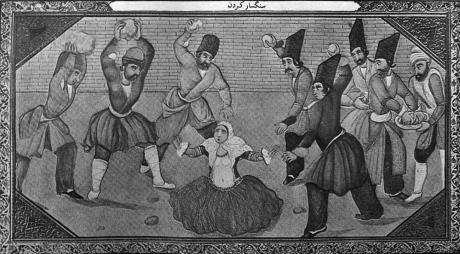
Stoning a Woman for Adultery (Qajar Era)To avoid these potential troubles patriarchal societies have the tendency to suppress the freedom of women. This means women have to pay for the potential rivalry between men and the potential lack of responsibility of other members of the society. Instead of taking responsibility for their rivalrous and even violent desires and instead of taking control of them, patriarchal men blame women for their own behavior. And instead of taking more responsibility as a parent, patriarchal men also blame women if their offspring ends up on the wrong track… Peace and order in society, according to the patriarchal system, can only be obtained by keeping women in check. In other words, women and their freedom are violently sacrificed in order to establish “peace and quiet”.

It is no surprise that emancipated women are targeted as “symbols” of a “decadent western society”. Radicalized young Muslims who grew up with the “great expectations” sold by the West’s consumerist society but who started resenting that very same society once they felt rejected, come to the same conclusions as some old white conservative fundamentalist Christians. Jerry Falwell and Pat Robertson blamed “the gays and the lesbians and the feminists” for 9/11 (click here for more on this).

Apart from pointing to the West’s hypocritical stance towards the suffering of Muslims in the world, young radicalized Muslims justify their terrorist actions by pointing to the so-called decadence of western society’s tolerance for “the gays and the lesbians and the feminists”. Some fundamentalist Christians claim the West has to blame itself for the terrorist attacks it experiences, as some radicalized Muslims claim the West has to blame itself for the terrorist attacks it experiences. Once again, it is not “the Christian West” against “the Islamic East”, it is NOT A CLASH BETWEEN CIVILIZATIONS, but a clash within a globalizing consumerist world. Indeed, economic interests are often the key factors in international policymaking decisions, more than a concern for human rights – although the West always claims it defends “modern democracy”. This doesn’t mean that terrorists are justified in using this hypocrisy to violate human rights themselves, but the fact remains they do justify their actions in this way. Terrorists often don’t belong to “the poorest of the poor”, but also to relatively “wealthy” people who feel western society creates “injustices”. Of course a so-called “individualist” society is good for the economy (instead of selling one car to a family you sell three as a car dealer since Mum, Dad and Son or Daughter are all busy developing their very own “project” in life), but it also destabilizes “traditional” family relationships (Mum, Dad and Son or Daughter are doing “their own thing”). And more consumption might lead to more environmental issues. Hell, from the viewpoint of some twisted patriarchal minds, the emancipation of women and other individuals might even cause a catastrophic apocalyptic climate change!

A Depiction of Jesus and the Woman taken in Adultery (Vasily Polenov)As for the Jesus Christ of the Gospels: he is a “destabilizer”. How about that, Pat Robertson? Throughout the Gospels it becomes clear that Jesus criticizes the universal tendency of human communities to structure themselves according to the identification of a common enemy or a common victim (be it an individual or a group). So on the one hand, concerning the group people are part of and that often manifests itself at the expense of a common enemy (for instance an adulteress who is about to be stoned – see John 8:1-11), it is no surprise that Jesus sows discord. It is no coincidence that he claims (Matthew 10:34-36): “Do not think that I have come to bring peace to the earth. I have not come to bring peace, but a sword. For I have come to set a man against his father, and a daughter against her mother, and a daughter-in-law against her mother-in-law. And a person’s enemies will be those of his own household.” This intention of Jesus, to create conflict where there is a certain order, is actually and paradoxically a plea against violence. Family members who slavishly obey a pater familias, tribe members who harmoniously feel superior to other groups, criminal gangs who blindly pledge allegiance to the mob boss, cult members and fundamentalist believers who are prepared to fight for their leader and their God till death, anxious employees who sell their soul to keep their job in a sick working environment, (youthful) cliques who strengthen their internal cohesion by bullying someone, whole nations who bow to the demands of a populist dictator and execute so-called “traitors” – Jesus doesn’t like it one bit.

Peace I leave with youOpposed to the small and big forms of “peace” based on oppression and violence, of which the Pax Romana in the time of Jesus is an obvious case of course, Jesus challenges people to build peace differently. Family members who belong to a “home” where they can have debates with each other, members of enemy tribes who end age old feuds by questioning their own perception of “the other tribe”, former criminals who start to behave like “moles” to clear their violent Mafia gang, fundamentalists who – realizing what they do to those who supposedly don’t belong to “the chosen ones” – liberate themselves from religious indoctrination, employees who address a reign of terror at their workplace, individuals who criticize the bullying of their own clique, pacifists who dare to dissent with the violent rule of a dictatorship and unveil its enemy images as grotesque caricatures – Jesus likes it. “Love your enemies”, Jesus says. Everyone who no longer condemns the external enemy of his own particular group because of a stirred up feeling of superiority, generates internal discord: “A person’s enemies will be those of his own household.” It’s only logical.

In short, Jesus argues in favor of non-violent conflict in order to end violent peace. That’s why he can say on the other hand, eventually (John 14:27): “Peace I leave with you; my peace I give to you. Not as the world gives do I give to you.”

  • THIRD QUESTION: IS IT A “SPIRITUAL CLASH” WITHIN HUMAN NATURE?

FROM AN ARTICLE BY CHRIS DESTOOP:

Ernst Kat, a convert, is active as an “Islamic psychologist” who treats lots of radicalized youngsters. […] “Part of the Jihadists have serious mental issues”, he says. “Many of them suffer from paranoia. They distrust others and they heavily engage in conspiracy theories. They feel rejected by society and have developed hypersensitivity. […] Their problems can also cause an enormous depression. They remain motionless, feel banned and are at a dead end. When recruiters approach these psychologically vulnerable young people and offer them an orderly model like Jihad this can be very attractive. It can cause a rapid radicalization. But most of them are not violent towards others. They become auto-aggressive.”

MORE IN Knack, January 14, 2015, Het monster zit vanbinnen (p. 36-37), by Chris Destoop.

FROM AN ARTICLE IN DE STANDAARD:

Since a couple of years Marion Van San has been conducting a research into families of young people who went to war in Syria, implying that she is closely connected to about ninety such families. […]

Van San defends the idea that “the more young people are integrated, the more they are susceptible to radicalization”. Children and grandchildren of immigrants are born and raised here, and they want to be accepted. “The consequence is that their social expectations are higher than those of others and that they are often more sensitive about (supposed and real) discrimination”, Van San writes.

MORE IN De Standaard, February 2, 2015, Radicalisering dreigt vooral bij geïntegreerde jongeren (Politiek, p. 5).

PERSONAL COMMENTS

ANSWER TO THE THIRD QUESTION: YES. It is a clash within and between human beings who feel rejected by and reject each other. Instead of discovering a Love that allows them to accept themselves even if they are rejected (or feel rejected) by their social environment, they develop forms of auto- and hetero-aggression to create a sense of “pride” and “social status”. To put things Biblically (and in the words of Bruce Springsteen), “Adam raised a Cain” (click to watch). John Steinbeck magnificently summarizes the universal meaning of the Cain and Abel story in his novel East of Eden.

Adam raised a Cain (Bruce Springsteen)

All of us are like Cain, one way or the other, but young radicalized ISIS terrorists commit the sin of murder and show the lack of neighborly love in the most gruesome way. As the Chinese butler Lee explains in Steinbeck’s novel in his comments on the meaning of the Cain and Abel story, the individual biography of many a young ISIS terrorist and the history of the world would have looked quite different without the feeling of rejection and with the acceptance of Love:

East of Eden John Steinbeck Cover“I think this is the best-known story in the world because it is everybody’s story. I think it is the symbol story of the human soul. I’m feeling my way now – don’t jump on me if I’m not clear. The greatest terror a child can have is that he is not loved, and rejection is the hell he fears. I think everyone in the world to a large or small extent has felt rejection. And with rejection comes anger, and with anger some kind of crime in revenge for the rejection, and with the crime guilt – and there is the story of mankind. I think that if rejection could be amputated, the human would not be what he is. Maybe there would be fewer crazy people. I am sure in myself there would not be many jails. It is all there – the start, the beginning. One child, refused the love he craves, kicks the cat and hides the secret guilt; and another steals so that money will make him loved; and a third conquers the world – and always the guilt and revenge and more guilt. The human is the only guilty animal. Now wait! Therefore I think this old and terrible story is important because it is a chart of the soul – the secret, rejected, guilty soul.”

Possessed by the Demon of Social Shame and Guilt

Bob was called to the principal’s office. Together with other students he took part in a display of troublesome behavior while being presented a movie in the school’s theater. He knew that the principal would punish him severely if the principal would find out that he had damaged some of the seats together with his friends. But Bob was clever in presenting his story. He could convince the principal that he and his classmates suffered from the bad influence of one student in particular: Oedipus. Oedipus, a rich, arrogant and bothersome boy eventually took the biggest chunk of the blame, although he had only yelled a bit together with the others. He certainly hadn’t damaged anything. So in fact he was a scapegoat, as he was wrongfully accused for being the worst perpetrator. But of course Oedipus bore his punishment with pride: he wouldn’t want to be called a detector by his friends. He’d rather be “the hero” who “took it like a man” than be known as a “coward” – that would be too shameful.

Oedipus stabs out his eyesIn short, what happens in this case is that Bob’s protection of his social profile and self-image leads to the scapegoating of Oedipus. And Oedipus, desiring to protect his social prestige as well, is willing to sacrifice himself for the group.

So the supposed “hetero-aggression” of the principal towards Bob leads to Bob’s “auto-aggression”: Bob cannot be honest about himself because he is too afraid of what will happen to him. Furthermore, because he is ashamed in front of his principal, Bob develops a kind of shamelessness towards his friend Oedipus. Backed-up by his friends, Bob is able to harm the reputation of Oedipus even more. Oedipus, in turn, on experiencing this “hetero-aggression” by his friends, is willing to perform a sort of “auto-aggression”. His “self-sacrifice” thus is an imitation of his sacrifice by the group of friends. Oedipus looks at himself through the eyes of the group who betrays him, and instead of standing up for himself he becomes ashamed of himself, eventually betraying himself in favor of a “social idol” that should gain him “respect”.

cool laughing stockThe story continues… Bob and his friends always looked at Oedipus as “the crazy one”, but also “the audacious one” and “the one who was way too cool to study for school”. And Oedipus was more than willing to meet the expectations of his class-mates, acting like the funny guy, doing all sorts of crazy things – in class, on the playground, with his locker, etc. After all, Oedipus truly was “different”, wasn’t he?

Well, that’s what all of them thought until they met Mahatma. Mahatma was an exchange student from India. He came from a poor family, but he studied very hard and had earned a scholarship to come to the States. Mahatma could have easily become the new laughing stock, but he simply was too fascinating, funny and caring to not be taken seriously one way or the other. Everybody ended up listening to what he, who appeared to be indeed very “different” at first glance, had to say.

Mahatma noticed how Bob, Oedipus and their friends all showed the tendency to cultivate the idea that “it is not cool to work hard for school”. Mahatma was quite sure that some of them studied hard, but it was like they were intercepting any possible disappointment and shame about themselves. No one likes to acknowledge that one studied hard when the grades are bad eventually – for it could be interpreted as a lack of intelligence or talent for a particular subject. Moreover, Mahatma noticed, whenever someone did acknowledge that he worked hard he was immediately somewhat excluded as a laughing stock. “Well,” Mahatma said, “I don’t understand why studying hard for school should be anything to be ashamed of. Even if it turns out that you are not performing too well for one particular subject, it still allows you to discover what your true talents are. And if you can be honest about yourself and realize that you are not that different from the hard working ‘nerd’ you’re making fun of, you can be more loving towards others – allowing them to be honest about themselves as well.”

How about that? Mahatma is doing nothing else than imitating the Christ of the Gospels. Jesus of Nazareth, the one who is called the Christ, reminds people of who they really are: not at all that different from the people they look down on. That’s why he says, “let him who is without sin cast the first stone.”

Jesus wants to replace the love for our untruthful self-image and the adherence to our “reputation” with the love for ourselves and others. We can be like the hard working student who feels ashamed of himself, even guilty of studying hard, and indeed develop the tendency to publicly and hypocritically loath or exclude other hard working students. On the other hand, if we no longer feel ashamed of ourselves, we can start feeling ashamed of the hurt we brought to others because we were too preoccupied with our social profile. That is what happens to Peter: after denying Jesus when the latter is imprisoned, Peter eventually feels ashamed because of the hurt he brought to his friend.

To get back to the story of Bob, Oedipus and Mahatma… Mahatma made something similar happen to his new friends from the States. He made Bob and the others see that they were not at all that different from Oedipus, and that they were all “addicted” to the same negative attitude towards “studying hard for school”. It was an attitude which possessed them like a demon. Mahatma was able to make them look at themselves through the eyes of the ones who were always mocked for being “nerds”. Confronted with the “cool nerd” that Mahatma was, those nerds turned out to be not that “uncool”, “boring” or “hypocritical” after all. Besides, from the point of view of the nerds Bob and his friends were the often uncool and boring hypocrites!

Jesus and Demoniac (Peter Howson)All of this dawned on Bob, Oedipus and their friends. Mahatma was THE nerd who enabled them to be honest about themselves. He could have easily condemned them for what they did to other nerds and other excluded people, but instead he forgave them before they even fully realized how they had hurt themselves and others because of their addiction to a “social idol”. What Mahatma did to them was confronting and liberating at the same time. The truth about how they had lived their lives hurt at first, but set them free as well. It made them independent of the shame others would try to transfer on them, and at the same time allowed them to take sides with and love the oppressed and vulnerable.

So Bob, Oedipus and the others became Mahatmas in their own way, imitating the love he gave them, and trying to reconcile people with each other. Their contagious work of creating a realm of forgiveness allowed people to acknowledge what they had done to others. It allowed people to no longer be ashamed of themselves in favor of a “social idol”. On the contrary, it allowed people to be ashamed and remorseful without being crushed under guilt, and to newly love the ones they had hurt. And finally, it allowed people to free themselves from the traumas they had suffered themselves. As more people experienced the forgiving love that enabled them to accept themselves, those people no longer felt the need to defend a certain self-image and became more capable (though not totally) of living lives without excluding or judging others.

Salvation by a Contamination with Divine Grace:

“Father, Son, Holy Spirit”

We are truly “godlike”

As hinted at earlier, the “Spirit” that “contaminated” the group of Bob and his friends, and that was created by the self-confident “Son” of India Mahatma (who is indeed carried by a “Fatherly” or “Motherly” Love that allows him to love himself in spite of possible social exclusion), was also the Spirit that contaminated the followers of Jesus. It was the “forgiving nerd” Mahatma – a forgiving “other” – that allowed Bob and his friends to “come to themselves” and “change”: acknowledging their “addictions”, they could free themselves and discover their own talents, paradoxically becoming like the “forgiving nerd” themselves in loving and reconciling people.

The New Testament writers believe that what Mahatma did for his new classmates, Jesus did for the whole of humanity. Jesus is the one who calls for the end of the sacrifice of every possible “Oedipus” by running the risk of being sacrificed himself. He is the ultimate “Other”, the “Mahatma par excellence” who, forgiving, enables us to be honest about ourselves. This makes possible the reconciliation and salvation of humanity as a whole, as there would be no need for a final “One Big Human Oedipus” (one big common enemy or sacrificed victim) to accomplish this. Resurrected, The Forgiving Crucified Jesus who does not simply avenge all the other “excluded” or “sacrificed” allows his disciples and all the rest of us to “do justice” to the ones we hurt, and to imitate him by forgiving those who hurt us – creating the possibility that they might do justice to us as well.

the weak can never forgive (Mahatma Gandhi)Jesus kills every “social idol”, meaning that he is guided by a Love which “desires mercy, not sacrifice.” He allows us to see ourselves through the loving eyes of “the One who cannot be reduced to our man-made world.” As Mahatma allows Bob and his friends to look at themselves through the eyes of a “loving nerd” who does not “crush them under guilt” (that would lead to the temptation to brush off the blame on a scapegoat again), Jesus allows us to look at ourselves through the eyes of a “Loving God” who “believes in us.” Like Mahatma allowed Bob and his friends to discover they were somewhat “nerds” themselves, Jesus allows us to discover we are truly “godlike”. The forgiveness of Jesus paradoxically “re-creates” and “changes” us by bringing us to our”selves”.

Of course, in this broken world we never fully realize our self-acceptance and the acceptance of others – the experience of God as Love (i.e. the experience of God at a human level) –, but we can follow the example of Christ the best we can (as far as it is possible for each of us): forgiving each other time and again, “seventy times seven”. For indeed, realistically speaking, none of us is perfect. So contrary to the famous line of one popular movie from 1970 (Love Story), “love means having to say you’re sorry…” It means being forgiven, “as we forgive those who trespass against us…”

The Prodigal Son (Rembrandt c1669)

“In the end, she’s just a mere mortal, just like all the rest of us, just like me…” It’s something we hear quite often, explicitly or implicitly, when people talk about “the rich, the famous and/or the geniuses” of this world. Why is it that we often like to read what tabloid newspapers write about these people? Why is it that we often like to gossip about our local or global heroes or celebrities? What kind of desire is satisfied that we enjoy this kind of thing?

Well, for one thing, we’re living in a world of internal mediation (René Girard). Modern democracy got rid of a social hierarchy – in principle that is – and now everyone can take everyone else as a model or mediator for personal ambitions. Premodern societies would not allow “the lower ranks” to compare themselves to the higher-ups, thus trying to keep an internal order and stability. Today, however, everyone can rival the position of everyone else, based on the premise of equal rights and chances for all. Thomas Hobbes (1588-1679) sharply characterizes this situation and its potential destructive consequences in his work Leviathan, at the dawn of modernity:

“From this equality of ability ariseth equality of hope in the attaining of our ends. And therefore, if any two men desire the same thing which nevertheless they cannot both enjoy, they become enemies; and, in the way to their end, which is principally their own conservation and sometimes their delectation only, endeavour to destroy or subdue one another.” – Thomas Hobbes, Leviathan (XIII).

“Competition of riches, honour, command, or other power, inclineth to contention, enmity, and war; because the way of one competitor, to the attaining of his desire, is to kill, subdue, supplant, or repel the other. Particularly, competition of praise inclineth to a reverence of antiquity. For men contend with the living, not with the dead, to these ascribing more than due, that they may obscure the glory of the other.” – Thomas Hobbes, Leviathan (XI).

StarsWe constantly receive the message that “everything is possible with hard work and perseverance”. On the other hand we also experience that some people seem “ahead of others”. These so-called “winners” are often admired, but in other circumstances they’re envied (also by some of their admirers!) as they seem to frustrate the ambitions they awaken in other people. One way to deal with the frustrations arising out of the comparison with “the people ahead of others” is to downplay their status or success by convincing ourselves that “they are just like us” – mere mortals, with flaws, everyday struggles and problems. Or by convincing ourselves that “they are even less like us, we’re superior to them” – in moral terms, for instance, by portraying them as “decadent” or “corrupt”. One could say that the sociological function of the tabloid newspaper or of gossip in general is precisely that. It helps us deal with the fact that we are not part of the world of “the rich, the famous and/or the geniuses” by comforting ourselves with the thought that those people are, at least, “just like us”.

they're not like usBy downplaying the status of “stars” we try to elevate our own position, we try to reach the status we desire. We try to surpass the status we initially (sometimes subconsciously) admired and idolized, then came to envy and eventually resented. In yet other words, the position of others we sometimes initially idolized is replaced by a feeling of superiority of ourselves. Instead of idolizing the image of others, we idolize a certain self-image. That’s why we quite easily distance ourselves from those others who are perceived as “marginal people” – be it criminals, poor people, crazy people, certain sick people, refugees, drug addicts, or “sinners”. Contrary to our often initial reaction to “the stars” in the tabloids, our first response to a confrontation with “the marginal people” is often the feeling that “they are not like us”.

In both instances our sense of identity and self-idolatry arise from our spontaneous tendency to compare ourselves to others (made possible by our mimetic – i.e. imitative – abilities). One of the main reasons why people are scandalized by Jesus of Nazareth is that he constantly challenges these narcissistic self-concepts. See, for instance, Luke 18:9-14:

To some who were confident of their own righteousness and looked down on everyone else, Jesus told this parable: “Two men went up to the temple to pray, one a Pharisee and the other a tax collector. The Pharisee stood by himself and prayed: ‘God, I thank you that I am not like other people—robbers, evildoers, adulterers—or even like this tax collector. I fast twice a week and give a tenth of all I get.’

But the tax collector stood at a distance. He would not even look up to heaven, but beat his breast and said, ‘God, have mercy on me, a sinner.’

I tell you that this man, rather than the other, went home justified before God. For all those who exalt themselves will be humbled, and those who humble themselves will be exalted.”

In short, the narcissist – like the Pharisee in the parable of Jesus – distances himself from “the bad guys” (they’re not like me) while he downplays the geniuses around him (they’re like me), in order to idolize his self-image. Our ideologies and all sorts of so-called “spirituality” or “meditation” are often at the service of the untruthful, non-realistic ideas of ourselves. They make us “feel good” and “happy”, like some antidepressant pills we take, and they alienate us from ourselves and others. The ideology of a terrorist group like ISIS is but one extreme example of a false spirituality. “Snobbery” and the “bourgeois mentality” another. On the other hand, every true spirituality has to do with some kind of permanent crisis of the narcissistic self-concept or “Ego”. It shatters our self-righteousness and complacency, and makes us realize that we are never perfect, never complete, never finished.

While all of this might seem devastating at first, it is also liberating, especially when experienced in the realm of forgiveness. Once you realize that you are not that unique, that you are more like “the sinners” (the majority of mankind) than you would acknowledge previously, and that you are less like “the righteous” than you thought you were, you become less ashamed of yourself. If there is shame in this realization, then it is the shame of the hurt you brought to others while you were practicing the idolatry of a certain (self-)image. “To kill the idol of self-complacent narcissism” thus might be the beginning of a restoration of the love in and between ourselves and others.

René Girard explains how this realization in forgiveness  (that people are more like “sinners” than they would acknowledge) is at the core of the conversion experience of Peter, Paul and the other disciples of Jesus. What enables Peter, Paul and others to become “saints” thus precisely and paradoxically is their realization that they are not “saints” (i.e. that they are far from ever being “perfect”). This truly spiritual experience, which enables people to face reality, is also the experience that guided René Girard himself throughout his life. René Girard gets to the essence of what a conversion to Christ should be all about in his explanation of the denial of Peter (click to watch):

An anecdote of C.S. Lewis (who converted from atheism to Christianity, as is well-known) also illustrates quite nicely how the acknowledgement that we are more like the so-called “bad people who bring misery upon themselves” restores neighborly love – thus is the inspiration of Christ:

C S LewisOne day, Lewis and a friend were walking down the road and came upon a street person who reached out to them for help. While his friend kept walking, Lewis stopped and proceeded to empty his wallet. When they resumed their journey, his friend asked, “What are you doing giving him your money like that? Don’t you know he’s just going to squander all that on ale (beer)?” Lewis paused and replied, “That’s all I was going to do with it.”

“To kill the idol of self-complacent narcissism” also opens up the possibility of further personal growth (contrary to the situation of the self-complacent person who thinks he “has arrived”) and a more truthful connection to reality as a whole. Indeed, our mimetic ability might stir some frustrations as we compare ourselves to others and find that we cannot achieve what they achieved, but it also allows us to discover the other as “other” than ourselves. Instead of reducing the other to a mere idol or puppet at the service of non-realistic ideas of ourselves (be it ideas of unworthiness or superiority, or both), we then also might discover the other as a source of inspiration. Once we find ourselves loved for who we are, we can enjoy the talents of others without feeling threatened, or without the tendency to downplay the unique gift they bring to the table. Instead of bowing to the false (because untruthful) transcendence of narcissistic self-concepts, we can then be inspired by the other who is not like us – and in that sense truly transcends us. The paradox is that this kind of relationship allows the other and ourselves to be uniquely “our own”. To put it simply: I don’t have to be the next Lionel Messi in soccer to be inspired by the dedication he brings to his craft. I can imitate his kind of dedication in my own “field” without becoming him, or rivaling him. On the contrary, loyal to my own unique “vocation” I can take his genius as a model, becoming more “who I am” than before. In short, next to all the variants of idolatry and detestation in our relationship to others, there is the attitude of inspiration and being inspired. The first find their source in love for one’s self-image, the second in love for oneself and others.

So yes, Mahatma Gandhi, Martin Luther King, Dietrich Bonhoeffer, Albert Einstein, Charles Darwin, Blaise Pascal, Wolfgang Amadeus Mozart, Johann Sebastian Bach, Francis of Assisi, Jesus of Nazareth and the Buddha are geniuses. They are “not like us”, they are “not like me”. And yes, they are “mortals” one way or the other, but they also gave something to the world from a realm “that lasts”. To be inspired by them is to be inspired to a life of an often demanding and difficult, but also enduring and eventually fulfilling love. A love that allows us “to find our own voice and genius” and enables us “to add something that lasts, even if it’s not directly visible or measurable”.

René Girard (December 25, 1923 – November 4, 2015), his person and his work, testified to Love in unique and humble ways. He will be among the sources of inspiration, together with “all God’s children” – the meek and lowly in heart.

In the Gospel of John, the devil is a personification of the scapegoat mechanism (which means that an innocent individual or group is wrongfully accused). Jesus knows that the leaders of the Jewish people, the Pharisees and the chief priests, want him dead and that they try to justify his death with certain lies. They obey “the devil” – indeed the mechanism that justifies the elimination of people based on lies. [Note that Jesus does not believe that God wants him dead. If Jesus paradoxically sacrifices himself eventually, it is a consequence of his obedience to a Love that “desires mercy, not sacrifice”. He does not want to live at the expense of others, not even his “enemies”…]

John 8: 39-44

“If you, Pharisees, were Abraham’s children,” said Jesus, “then you would do what Abraham did. As it is, you are looking for a way to kill me, a man who has told you the truth that I heard from God. Abraham did not do such things. You are doing the works of your own father.”
“We are not illegitimate children,” they protested. “The only Father we have is God himself.”
Jesus said to them, “If God were your Father, you would love me, for I have come here from God. I have not come on my own; God sent me. Why is my language not clear to you? Because you are unable to hear what I say. You belong to your father, the devil, and you want to carry out your father’s desires. He was a murderer from the beginning, not holding to the truth, for there is no truth in him. When he lies, he speaks his native language, for he is a liar and the father of lies.

The Pharisees and chief priests are afraid that the growing popularity of Jesus might become a threat to their power. That’s why they try to present him as a rebel leader who could lead an uprising against the Roman occupier of Judea. A war with the Romans would mean the end of the Jewish nation and culture. Therefore the Jewish leaders see no other solution than to get rid of Jesus. It’s their way of justifying his elimination.

John 11: 45-50

Many of the Jews who had seen what Jesus did, believed in him. But some of them went to the Pharisees and told them what Jesus had done. Then the chief priests and the Pharisees called a meeting of the Sanhedrin.
“What are we accomplishing?” they asked. “Here is this man performing many signs. If we let him go on like this, everyone will believe in him, and then the Romans will come and take away both our temple and our nation.”
Then one of them, named Caiaphas, who was high priest that year, spoke up, “You know nothing at all! You do not realize that it is better for you that one man die for the people than that the whole nation perish.”

Some voices in Europe and the USA try to present the current Muslim refugees, coming from war zones like Syria and Iraq, as a cover-up, a “Trojan Horse” for Islamist terrorists who aim for world domination. The refugees are seen as a threat to the survival of “western nations” and “western culture”. In other words, they experience similar allegations as Jesus.

Syrian Refugees Trojan Horse for ISIS

In the case of Jesus, the Gospel of John leaves no doubt that these allegations are false. The Evangelist lets Pontius Pilate, the Roman prefect, unwittingly declare “the truth” about the arrested Jesus, namely that Jesus is innocent. Jesus does not wish to establish a “kingdom” or “peace” in competition with “the kings of this world” (whose kingdoms are based on sacrifices and the expulsion of certain people – like the “Pax Romana”). In other words, the Gospel of John reveals the plot against Jesus by the Pharisees and the chief priests as a scapegoat mechanism: Jesus is wrongfully accused. He refuses to start a civil war that would mean the end of the Jewish nation and culture.

John 18: 33-38

Pilate summoned Jesus and asked him, “Are you the king of the Jews?”
“Is that your own idea,” Jesus asked, “or did others talk to you about me?”
“Am I a Jew?” Pilate replied. “Your own people and chief priests handed you over to me. What is it you have done?”
Jesus said, “My kingdom is not of this world. If it were, my servants would fight to prevent my arrest by the Jewish leaders. But now my kingdom is from another place.”
“You are a king, then!” said Pilate.
Jesus answered, “You say that I am a king. In fact, the reason I was born and came into the world is to testify to the truth. Everyone on the side of truth listens to me.”
“What is truth?” retorted Pilate. With this he went out again to the Jews gathered there and said, “I find no basis for a charge against him.”

The equivalent question, from this perspective, is whether we have “a basis for a charge” against the Muslim refugees coming from war zones. Are they really part of a plot for Muslim world domination? Are they really a threat to the survival of western culture? Well, this is the truth, and this sacrifice (this Sacrifice) is unjustifiable:

Aylan amidst United Nations

Viktor Orban Hungarian national galleryGermany’s Frankfurter Allgemeine newspaper published an op-ed by Orban in which he claimed that he was defending European Christianity against a Muslim influx by stopping thousands of refugees from leaving Hungary. […] “We shouldn’t forget that the people who are coming here grew up in a different religion and represent a completely different culture. Most are not Christian, but Muslim… That is an important question, because Europe and European culture have Christian roots,” he wrote. (From Muslims threaten Europe’s Christian identity, Hungary’s leader says by Rick Noack, The Washington Post, September 3, 2015).

Dear Mr. Viktor Orban, Prime Minister of Hungary,

I know you grew up in a former communist regime and that you were educated as an atheist. Maybe that’s one of the reasons why you display a certain view of Christianity that could be questioned by the very sources of Christianity itself.

There is no such thing as a Christian culture or nation. True, this is a provocative statement that needs some clarification and nuance. It would be better to write that, from a Christian point of view, some cultures are Christianized and others are not. If you want to know what that means, you should take a look at the Gospels, Paul’s letters or, in short, the New Testament as a whole. These writings are about a Jew, Jesus of Nazareth, who approaches his own Jewish culture in a particular way.

First of all, this Jesus, considered by many as a great spiritual leader, has great respect for the habits, traditions, scriptures and laws of his people. Hence he says (Matthew 5:17):

“Do not think that I have come to abolish the Law or the Prophets; I have not come to abolish them but to fulfill them.”

However, by claiming that he wants to fulfill the cultural traditions of his people, Jesus already implies that these traditions are not ends in themselves but that they are directed towards a goal surpassing them. In other words, the cultural traditions are means relative to the goal they should help to accomplish. Jesus is very clear about that goal in a conversation with a lawyer (Matthew 22:35-40):

A lawyer asked Jesus a question to test him. “Teacher, which is the great commandment in the Law?” And Jesus said to him, “You shall love the Lord your God with all your heart and with all your soul and with all your mind. This is the great and first commandment. And a second is like it: You shall love your neighbor as yourself. On these two commandments depend all the Law and the Prophets.”

The priority of neighborly love implies that the existing culture is tested against the extent to which it helps to avoid making victims and to which it allows for authentic human lives. According to Jesus of Nazareth, man should not live according to rules, as if preserving a (cultural or social) system and its rules would be an end in itself, but according to the demands of neighborly love. Rules (in whatever way they are defined) should be means at the service of individual human beings and society as a whole. When Jesus and his disciples are criticized for doing things that are, strictly speaking, forbidden on the rest day – the Sabbath – Jesus answers (Mark 2:27):

“The Sabbath was made for man, not man for the Sabbath.”

Christians are convinced that the salvation of the world lies in the imitation of the way Jesus, a Jew, lived his life and approached his own culture. Because of his salvific character, at least in principle, they call him “the Christ”. As a Jew, Jesus reached for the sources in the Jewish tradition that hierarchically structured the relation between neighborly love and the particular culture of his people. To imitate Jesus means that you should look within your own culture or social organization to the sources that allow you to make your cultural or social traditions relative to the goal of neighborly love. Note that Jesus never competes with existing social, political and cultural systems. He does not abolish these systems. The following scene magnificently illustrates this (Matthew 22:15-21):

The Pharisees went out and laid plans to trap Jesus in his words. They sent their disciples to him along with the Herodians. “Teacher,” they said, “we know that you are a man of integrity and that you teach the way of God in accordance with the truth. You aren’t swayed by others, because you pay no attention to who they are. Tell us then, what is your opinion? Is it right to pay the imperial tax to Caesar or not?” But Jesus, knowing their evil intent, said, “You hypocrites, why are you trying to trap me? Show me the coin used for paying the tax.” They brought him a denarius, and he asked them, “Whose image is this? And whose inscription?” “Caesar’s,” they replied. Then he said to them, “So give back to Caesar what is Caesar’s, and to God what is God’s.”

According to the Jesus of the Gospels, to serve God means to love one’s neighbor, and this can be done in a myriad of social and cultural ways. Christianity is universalist but this universalism in no way implies a monoculturalism. It is universalist and transcultural because it challenges every culture to question itself from the perspective of neighborly love. On the other hand it is also multicultural because it does not compete with nor merely abolishes existing social and cultural systems but transforms them by (re)orienting them to the goal of neighborly love. Hence, from a Christian point of view, cultures, communities and societies are Christianized or they are not Christianized, meaning that they do or do not question themselves from the perspective of neighborly love. This also implies that so-called Christian communities are called to question themselves from this perspective. A Christianity that imposes itself by merely suppressing or destroying particular cultures and communities betrays itself. We all know that it has done so, many times during its history.

Of course, in order to practice neighborly love like Jesus we should know what he means by it. Once again he is very clear on the issue in question (Matthew 5:43-48):

“You have heard that it was said, ‘Love your neighbor and hate your enemy.’ But I tell you, love your enemies and pray for those who persecute you, that you may be children of your Father in heaven. He causes his sun to rise on the evil and the good, and sends rain on the righteous and the unrighteous. If you love those who love you, what reward will you get? Are not even the tax collectors doing that? And if you greet only your own people, what are you doing more than others? Do not even pagans do that? Be perfect, therefore, as your heavenly Father is perfect.”

Well, how about that? Our neighbors are not just our own people. They are also “other” people, not of our own, “strangers”. Jesus even considers our “enemies” to be our neighbors.

Throughout the Gospels it becomes clear that Jesus criticizes the universal tendency of human communities to structure themselves according to the identification of a common enemy or a common victim (be it an individual or a group). So on the one hand, concerning the group people are part of and that often manifests itself at the expense of a common enemy (for instance an adulteress who is about to be stoned – see John 8:1-11), it is no surprise that Jesus sows discord. It is no coincidence that he claims (Matthew 10:34-36): “Do not think that I have come to bring peace to the earth. I have not come to bring peace, but a sword. For I have come to set a man against his father, and a daughter against her mother, and a daughter-in-law against her mother-in-law. And a person’s enemies will be those of his own household.” This intention of Jesus, to create conflict where there is a certain order, is actually and paradoxically a plea against violence. Family members who slavishly obey a pater familias, tribe members who harmoniously feel superior to other groups, criminal gangs who blindly pledge allegiance to the mob boss, cult members and fundamentalist believers who are prepared to fight for their leader till death, anxious employees who sell their soul to keep their job in a sick working environment, (youthful) cliques who strengthen their internal cohesion by bullying someone, whole nations who bow to the demands of a populist dictator and execute so-called “traitors” – Jesus doesn’t like it one bit.

Opposed to the small and big forms of “peace” based on oppression and violence, of which the Pax Romana in the time of Jesus is an obvious case of course, Jesus challenges people to build peace differently. Family members who belong to a “home” where they can have debates with each other, members of enemy tribes who end age old feuds by questioning their own perception of “the other tribe”, former criminals who start to behave like “moles” to clear their violent Mafia gang, fundamentalists who – realizing what they do to those who supposedly don’t belong to “the chosen ones” – liberate themselves from religious indoctrinations, employees who address a reign of terror at their workplace, individuals who criticize the bullying of their own clique, pacifists who dare to dissent with the violent rule of a dictatorship and unveil its enemy images as grotesque caricatures – Jesus likes it. “Love your enemies”, Jesus says. Everyone who no longer condemns the external enemy of his own particular group because of a stirred up feeling of superiority, generates internal discord: “A person’s enemies will be those of his own household.” It’s only logical.

In short, Jesus argues in favor of non-violent conflict in order to end violent peace. That’s why he can say on the other hand, eventually (John 14:27): “Peace I leave with you; my peace I give to you. Not as the world gives do I give to you.”

So, dear Mr. Orban, if you want your nation or Europe as a whole to act like a “Christian” nation or continent, you should not build a peace and order based on the exclusion (or even destruction) of a people because of their culture or religion. To quote Jesus once more, “If you greet only your own people, what are you doing more than others?” Maybe we could challenge each other to discover our own cultural resources that criticize our all too human tendency to build communities and cultures at the expense of victims and sacrifices. To speak to you once more, from “our” shared paradoxical cultural resources (as a Christian “culture” does not really exist because Christianity belongs and does not belong to any one culture), from one Christian to the next (Colossians 3:8-11):

Now you must rid yourselves of all such things as these: anger, rage, malice, slander, and filthy language from your lips. Do not lie to each other, since you have taken off your old self with its practices and have put on the new self, which is being renewed in knowledge in the image of its Creator. Here there is no Gentile or Jew, circumcised or uncircumcised, barbarian, Scythian, slave or free, but Christ is all, and is in all.

Sincerely,

E. Buys