Shane Koyczan is a spiritual man. A man of poetry and gentle madness. A man of stories, a man of truth. A man of beauty. His poem To This Day would be a great way to end a first part of a journey with mimetic theory in high school, especially regarding what I’ve written so far on the film American Beauty. It could follow these posts:

  1. Mimetic Theory in High School (click to read)
  2. Types of the Scapegoat Mechanism (click to read)
  3. Scapegoating in American Beauty (click to read)
  4. Philosophy in American Beauty (click to read)
  5. Real Life Cases of Ressentiment (click to read)

quote A weed is but an unloved flower Ella Wheeler WilcoxTo This Day and Shane’s TED-talk contain many themes I’ve written about before, for instance in a post entitled Atheism: a lack of unbelief?:

A person’s worth cannot be determined solely by human perception and judgment. Man is not simply the child of a “social other”, i.e. the product of a man-made social environment in which he gains or loses a sense of (self-) worth. He’s also, following the thoughts of people like James Alison and Emmanuel Levinas, a child of “the other Other”, and we should postpone any final judgment on other people and ourselves.

It also reminded me of this famous quote: “Every finite spirit believes either in a God or in an idol” (Max Scheler, 1874-1928). I wrote about this in several posts before, for instance in a post entitled That is (not) the question, about rap star Diam’s conversion to Islam – it talks about how we have the tendency to sacrifice ourselves and others to the demands of a so-called admirable (self-)image that seeks confirmation and recognition:

quote Shane Koyczan Be the weedDiam’s discovered how she tried to live up to the expectations of her fans, and how this enslaved her. She was kneeling to an image of herself as the admirable idol her fans wanted her to be. Kneeling to Allah, on the other hand, apparently meant that Diam’s no longer bowed to the demands of the music and entertainment industry. It was a turning point in her life. It enabled her to free herself, and to criticize the priorities in her life. From now on, she would seek and explore another source of motivations for her life.

Finally, Shane Koyczan’s story is reminiscent of Peter Howson’s story in a post entitled Desert Moments with Peter Howson:

“I used to be very badly bullied at school and when I was a bouncer in a nightclub for quite a few years I changed in a false sense then, and became a bully myself.” In other words: Howson became the imitator of his persecutors… He followed the mimetic principle of vengeance.

CLICK TO WATCH the video To This Day (click here to read the lyrics in pdf):

I’d like to give some quotes from his TED-talk as well, because they illustrate some key insights from René Girard’s mimetic theory and they reminded me of those previous posts:

quote do not be conformed by this world RomansWe were expected to define ourselves at such an early age, and if we didn’t do it, others did it for us. Geek. Fatty. Slut. Fag. And at the same time we were being told what we were, we were being asked, “What do you want to be when you grow up?” I always thought that was an unfair question. It presupposes that we can’t be what we already are.

See, they asked me what I wanted to be, then told me what not to be. And I wasn’t the only one. We were being told that we somehow must become what we are not, sacrificing what we are to inherit the masquerade of what we will be. I was being told to accept the identity that others will give me.

quote be this guyOne of the first lines of poetry I can remember writing was in response to a world that demanded I hate myself. From age 15 to 18, I hated myself for becoming the thing that I loathed: a bully. When I was 19, I wrote, “I will love myself despite the ease with which I lean toward the opposite.

CLICK TO WATCH Shane’s TED-talk:

This post aims at providing some more background information on a previous post regarding the film American Beauty (click to read “Scapegoating in American Beauty”). It explores the philosophical foundations of ressentiment.

In the world of philosophy there are two German names that automatically pop up regarding the discussion on ressentiment, namely Friedrich Nietzsche (1844-1900) and Max Scheler (1874-1928).

Zur Genealogie der MoralFriedrich Nietzsche discussed ressentiment primarily in his work Zur Genealogie der Moral (On the Genealogy of Morals/Morality – click here for pdf version of this book in English). In Nietzsche’s view, the Jewish-Christian foundation of morality grew out of the weaker men’s pride when these were confronted with a noble and aristocratic ruling group of stronger men. The weaker men, the slaves, reject the morals of the stronger men, the masters. The slave denies being envious of the master and develops a sense of superiority by claiming that the values the master lives by are not desirable at all. According to Nietzsche, Jewish-Christian slave morality triumphs over the master morality of Greco-Roman Antiquity when people start feeling guilty and ashamed about belonging to the group of masters. This is the ultimate revenge of the slaves for not being able to aspire to the same values as the masters. The slaves convince themselves and the masters that the slave morality (the inverse of the master morality) is the desirable model of life, and that the master morality is contemptible.

Das Ressentiment im Aufbau der MoralenMax Scheler critiqued Nietzsche on these issues in his work Ressentiment. According to Scheler, Nietzsche’s account of ressentiment is very convincing, but he is wrong to consider it as the main source of Judeo-Christian tradition.

This is not the moment to discuss Scheler’s critique on Nietzsche. Regarding a further reflection on the film American Beauty and other examples of ressentiment, it is useful to merely focus on the characterization of ressentiment by Nietzsche and Scheler. In an article entitled Ressentiment and Rationality for the online philosophical and anthropological magazine Paideia, Elizabeth Murray Morelli summarizes as follows:

“Drawing on Nietzsche’s and Scheler’s accounts of ressentiment, we can sum up its internal structure. It is a cycle with the following constitutive elements: an original sense of self-worth; the apprehension of and desire for certain values; the frustration of one’s desire for those values; a sense of impotence to achieve those values: a sense of the unfairness or injustice of not being able to attain them; anger, resentment, hatred towards the bearer of those values, and often a desire to seek revenge; the devaluation of the originally sought values; repression of the desire for the devalued values and of negative affects such as hatred, envy, desire for revenge; a feeling of superiority over those who seek and possess the now devalued values; and a confirmed sense of self-worth. Ressentiment is a cycle inasmuch as it recurs. The person of ressentiment relives the desires and feelings which constitute the condition even as these affects are repressed. The cycle of ressentiment, significantly, begins and ends with a sense of self-worth.”

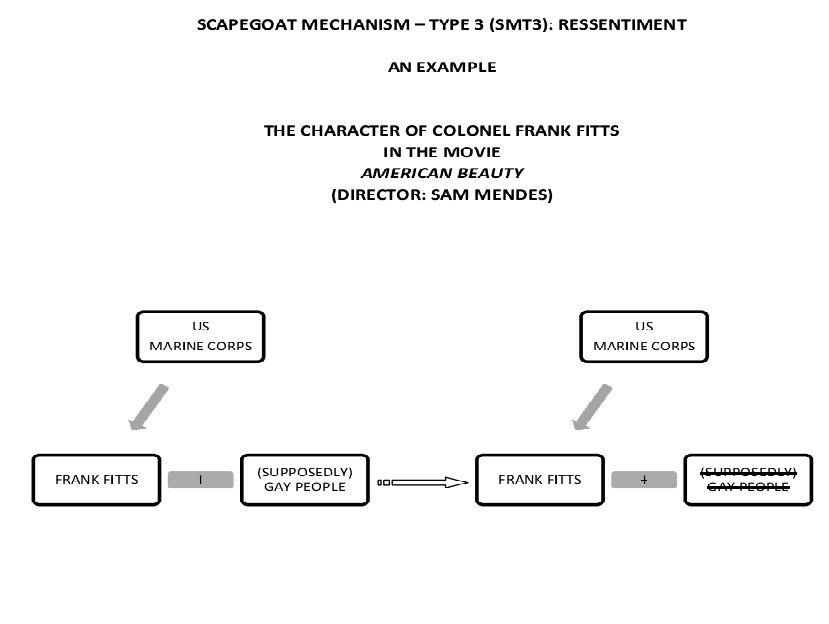
Applied to the character Frank Fitts in the film American Beauty, ressentiment is directed at the life of homosexual couples. The cycle of ressentiment then can be specified as follows: Frank Fitts gains his sense of self-worth by the social recognition he gets from the US Marine Corps (hence he presents himself continuously as “Colonel Frank Fitts, US Marine Corps”); he realizes that he actually desires certain relationships, namely homosexual relationships; he gets frustrated because he cannot fulfill this desire out of fear to lose his social recognition; he develops a sense of injustice: it’s not fair that certain people would enjoy a life as homosexuals and he seeks revenge for this injustice; he devaluates the originally desired life as a homosexual; finally he despises homosexuals in general and is convinced that they should feel ashamed; thus Frank Fitts develops a feeling of superiority over those who possess a life as homosexual couple, and this confirms his sense of self-worth.

Frank Fitts sad old man

From the point of view of René Girard’s mimetic theory, two important observations can be made:

  1. Ressentiment, as the result of envy, relies on mimesis and mimetic desire.
  2. When a mimetically ignited desire cannot be fulfilled, the resentful person justifies mental or physical violence towards a model who possesses what the resentful person secretly desires – this is a form of scapegoating. Hence, according to Cuong Nguyen in an article for the online philosophical journal Prometheus (October 19, 2008): Ressentiment is a reassignment of the pain that accompanies a sense of one’s own inferiority/failure onto an external scapegoat. The ego creates the illusion of an enemy, a cause that can be ‘blamed’ for one’s own inferiority/failure. Thus, one was thwarted not by a failure in oneself, but rather by an external ‘evil’. This issuing of ‘blame’ leads one to desire revenge, or at least believe in the possibility of revenge.”

Scapegoat Mechanism – Type 3 (SMT3): ressentiment

[see previous post “Types of the Scapegoat Mechanism”]


an example


THE CHARACTER OF COLONEL FRANK FITTS

IN THE Movie

american beauty

(DIRECTOR: SAM MENDES)


American Beauty Ricky Fitts FilmingAlan Ball, who wrote the story, said the following about the main theme of the movie:

“I think I was writing about … how it’s becoming harder and harder to live an authentic life when we live in a world that seems to focus on appearance … For all the differences between now and the [1950s], in a lot of ways this is just as oppressively conformist a time … You see so many people who strive to live the unauthentic life and then they get there and they wonder why they’re not happy … I didn’t realize it when I sat down to write [American Beauty], but these ideas are important to me.”

– Alan Ball in Chumo II, Peter N. (January 2000). “American Beauty: An Interview with Alan Ball”. Creative Screenwriting Magazine (Los Angeles: Creative Screenwriters Group) 7 (1): 26–35 (p.32).


The character of “Colonel Frank Fitts, US Marine Corps” certainly is one poignant example of someone who is “keeping up appearances” at a very high price. His situation can be summarized as follows:

CLICK TO SEE THE SCHEME (PDF)

Frank Fitts

American Beauty Rose Plastic BagThroughout the film it becomes clear that Frank Fitts is secretly gay and that he is jealous of gay people who “came out of the closet.” He dares not reveal himself as a homosexual, though, for fear of being cast out by the social environment whose recognition he has mimetically learned to desire. Frank Fitts always presents himself as “Colonel Frank Fitts, US Marine Corps” and apparently this self-concept considers homosexuality as “something to be ashamed of.” He can’t stand being around openly gay people, like his two neighbors Jim and Jim, because they awaken his hidden homosexual desires. Frank Fitts resents and hates what he actually desires. When he thinks that his son Ricky is in a gay relationship with his neighbor Lester Burnham, he threatens to throw him out of the house and to banish him forever. Frank Fitts constantly justifies his acts of terror by making his victims responsible for the violence they have to endure. He constantly applies some sort of scapegoat mechanism, his victims “should be ashamed!” They should feel guilty about something they actually shouldn’t feel guilty about…

Frank Fitts is willing to do anything to protect his socially mediated (self-)image. His scapegoating of openly gay people helps him to be somewhat  at peace with his own life, although he is a bitter man. Finally, he reveals himself as a homosexual to his neighbor Lester Burnham, whom he wrongfully considers gay. Frank tries to kiss Lester, but Lester turns him down. Afraid of what might happen, Frank ends up murdering Lester in order to prevent the loss of his so-called acceptable (self-)image. In other words, the sacrifice of Lester – in no ways responsible for what happened to Frank, hence a scapegoat – seems necessary for Frank to fulfill his desire for recognition. In still other words, eros – a mimetically ignited love for some image or social status – leads to thanatos (death) to put an end to some identity crisis.

BE SURE TO WATCH THE EXCERPTS FROM AMERICAN BEAUTY WITH ADDITIONAL NOTES TO SEE HOW THE DIFFERENT CHARACTERS DEAL WITH

“THE LOSS OF APPEARANCES”


– CLICK TO WATCH:

Some of us working on mimetic theory would like to develop some material that could be useful in high school curricula, in different disciplines. I’ll be posting some ideas and present some possible content in the months to come. This is how an introduction to a high school course on mimetic theory could look like. Any suggestions are welcome!

CLICK HERE TO READ A PDF VERSION

A.      HUMAN BEINGS AS CRISIS MANAGERS

We all have to deal with crisis situations. A crisis happens when we are challenged to renew or change the order of things as we know it. Therefore it is always a threat, big or small, to the systems that bring stability to our lives. A crisis is a time to make decisions in order to preserve a given system of stability or to create a new one. As such it is not just an event which forces us to adjust to its course, but also an opportunity to imagine other ways of being in the world. A crisis is violent when it is primarily experienced as an assault on our personal integrity and our socially defined identity. On the other hand, a crisis might contain the promise of a better protected personal integrity and an enhanced social identity when it is experienced as an assault on systems of stability that actually suppress us. In short, the crisis situations that befall us and subvert the world as we know it are experienced either as a curse or a blessing, either as doom or chance.

Confronted with crisis situations, every human being is able to ask three clusters of questions, one scientific and two philosophical. Here’s what the crisis manager named human might think about:

  • SCIENTIFIC QUESTIONS:

How can a crisis situation be explained? What are its causes and consequences? How do we, people, deal with it and what explains our behavior?

To use a business analogy:

How do people behave within the company and what problems arise out of this behavior?

  • A FIRST SET OF PHILOSOPHICAL QUESTIONS (MEANING):

Where do we want to go from here, confronted with this crisis? What is the ultimate goal of what we are trying to do? What are we hoping for?

To use the business analogy:

What does this company stand for? What goals does it hope to accomplish?

  • A SECOND SET OF PHILOSOPHICAL QUESTIONS (ETHICS):

How should we behave ourselves if we want to accomplish our goal, dealing with this crisis? Should we deal with the crisis situation like we normally do, or should we change our behavior?

To use the business analogy:

How should people behave within the company in order to accomplish its goals?

Once the two sets of philosophical questions are answered, science of course functions as a means to make the fulfillment possible of thought-through goals which transcend (and therefore guide) the merely scientific endeavor.

B.      MIMETIC THEORY – INSPIRATIONAL THINKING IN TIMES OF CRISIS

I.                    CONSIDERING “CRISIS MANAGEMENT” QUESTIONS

As long as we are alive and well as human beings, we are mimetically connected to each other. It is because of our mimetic (i.e. imitative) ability that we are social creatures. Mimetic theory, as it was initially developed by René Girard, tries to understand and explain the possibilities and pitfalls of human social behavior by studying its mimetic interactions. It attempts to answer the three clusters of questions, identified previously, concerning “crisis management” as the condition humaine:

  • SCIENTIFIC QUESTIONS:

How do crisis situations in human life arise out of mimetic interactions? How are these mimetic interactions influenced by conditions of the natural environment? Or, on the other hand, how do mimetic interactions construct patterns of human behavior that influence the natural environment in negative or positive ways? How do we normally deal with crisis situations arising out of mimetic interactions?

  • PHILOSOPHICAL QUESTIONS (MEANING):

What goals are desirable for human life, considering the mimetic nature of human beings? What are we trying to accomplish by studying mimetic interactions?

  • PHILOSOPHICAL QUESTIONS (ETHICS):

How should we behave if we want to accomplish our goals? Should we deal with crisis situations, arising out of mimetic interactions, like we normally do – like our ancestors did, for instance? Should we accept certain morals (of which the origins can be scientifically explained)? Or should we try to change our behavior?

II.                  OUTLINE FOR A COURSE USING MIMETIC THEORY

  • MIMESIS AND EMPATHY

Any course using mimetic theory starts with a simple observation: the way we think about ourselves and the way we develop a sense of identity is always mediated by our social environment. And that which makes something like a social environment possible precisely is our – indeed mimetic – ability to put ourselves in each other’s shoes.

Man as Social Being (Wolfgang Palaver)

Neuroscientists have discovered that so-called mirror neurons in our brains play a very important role in this regard. These brain cells allow us to imitate others. They allow us to pretend that we’re someone else and to take another person’s point of view. And this allows us to imagine what others are experiencing, thinking, expecting or even desiring. In short, our mimetic ability is the conditio sine qua non to empathize and bond with others, and to develop a sense of self.
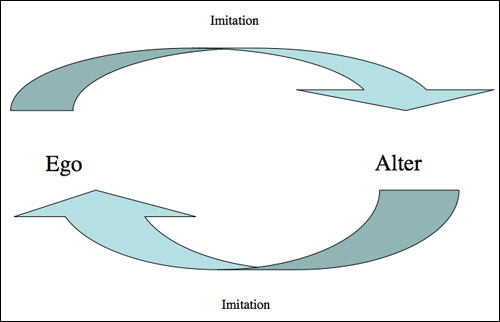
double mediation

Of course our imaginative projections about others can be wrong. That’s why we, rather unwittingly, constantly look for the confirmation of mutually established social expectations. The question “Am I doing this right?” seems to be the ever present subtext to our behavior. It really structures the interaction between ourselves and others. As it happens though, the recognition we get from one social group might be of more importance to us than that of another. We might empathize more with the members of the San Francisco symphony orchestra we’re part of than with the homeless of that same city. Or we might feel so close to our favorite football team that we become really hostile to its adversaries.

So our ability to empathize with others turns out to be a two-edged sword. It connects us with and disconnects us from others at the same time. It can connect us to the members of a group we want to be part of against a common enemy. Even more so, it can stir rivalry between members of the same group or the same social environment. That might be surprising, but on second view it will turn out to be quite logical. Our mimetic ability allows us to take other people as models for our behavior. It allows us to learn from them in all sorts of ways, but it also plays a significant role in structuring our desires and ambitions. For instance, there’s more than one twelve year old soccer player walking around with a shirt of Lionel Messi or some other soccer idol, secretly dreaming of being the next soccer sensation.

  • MIMESIS AND RIVALRY – THE PROBLEM OF MIMETIC DESIRE

There seems to be no harm in identifying with someone you admire and take as an inspiration for your own desires and ambitions in life. At first glance, that is. As long as the model you imitate belongs to quite another world than your own, as long as there is a significant distance between yourself and your model – in space, in time, or both –, chances of a conflictual relationship with the model are reduced. On the other hand, when that distance is no longer experienced, things might turn ugly, both for yourself and your model. As a twelve year old forward in a soccer team, it’s fairly easy to admire Lionel Messi, but it might be a hell of a lot harder to appreciate the talents of the new teammate who comes in and takes your spot. Identifying yourself as being the forward (or even “the Messi of the team”) immediately complicates your relationship with this newcomer, as he arouses the desire for your former status and the recognition it is supposed to bring. You might, for instance, try to get rid of the new guy by locking him out. Good coaches, though, know how to deal with these types of situations, even strengthening their team in the process. When two or more forwards imitate and thereby reinforce each other’s desire to be the best player on their position, it indeed can make them all better players in a consequently better team.

Mimetic Rivalry

Good coaches and managers are able to use mimetic rivalry in constructive ways, allowing their employees to recognize and respect that “the best has won.” However, all management efforts aside, mimetic rivalry remains a tricky thing. It is literally rivalry based on the imitation of desires for certain material and/or immaterial objects (e.g. a trophy, some sort of social recognition or status, power within a company, wealth, etc.).

Envy Pride Mimetic Desire

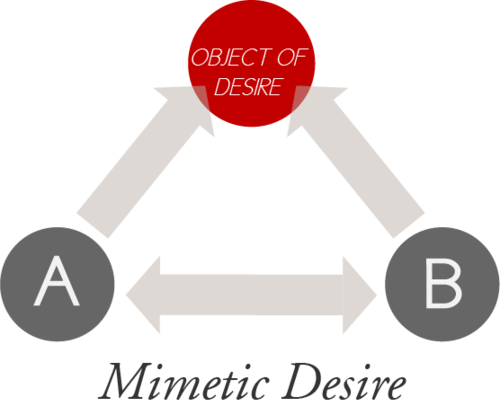
Human desire is, beyond instinctive needs and wants, highly mimetic (i.e. based on imitation). True, we’re all born with certain physical needs (for food, water, oxygen, etc.). But no one is born with the desire to become, say, a culinary chef. That is a socially (and therefore mimetically) mediated ambition that gets different cultural expressions. Mimetic desire and mimetically mediated ambition can easily lead to frustrations and destructive conflicts between people who take each other as model.

Mimetic Desire

When two or more people, consciously or more often rather unwittingly, imitate each other’s desire, they become each other’s annoying obstacle when they cannot or do not want to share the object of their desire. In short, they become antagonists because of mimetic desire. Paradoxically, it is because people are close to each other and can imagine what it is like to be in the other’s shoes, that they can become each other’s archrivals in the context of a mutually shared desire. As said, our mimetic ability connects and disconnects.

  • THE SCAPEGOAT MECHANISM AS RESPONSE TO MIMETIC CRISES

The mimetic building blocks of our psychosocial fabric are at once responsible for the preservation and disintegration of that very same fabric. One of the well-tried means to restore a social order that is in crisis because of escalating mimetic rivalry, is the so-called scapegoat mechanism. This restoration again rests on mimetic processes. Let’s turn to the example of the soccer team once more. When a team loses time and again, that’s normally no favorable factor for the group atmosphere. Teammates start blaming each other for bad results, maybe even sabotaging each other. There also might be ill-will towards the coach by players who feel they’re not given enough opportunities to play matches. And when the coach becomes part of the rivalry and frustrations within the team, that’s usually the end of his career there. As more players imitate the ill-will of some teammates towards their coach, the latter becomes the one held responsible for all the major problems within the team, and he’ll be fired by the board in the end. Instead of recognizing the mimetic origins of social disorder, people tend to blame one outsider or a group of outsiders. This scenario is well-known. Coaches indeed often function as convenient scapegoats, unjustly blamed for a crisis they’re not or only partly responsible for. Like other scapegoats they’re interpreted in a twofold manner by the group they’re expelled from: perceived as the main cause for the tensions, divisions and disorder within the group, and experienced as the main cure while being sacrificed (expelled, or worse) to restore unity and order within that same group. Scapegoats are at once villain and hero, monster and savior, hated and loved, unwanted and wanted, scorned yet needed. Think, for example, of dictatorial regimes who blame all their domestic problems on foreign enemies. As long as a dictator can unite his citizens against some outside enemy, he can at least prevent them from uniting against himself and remain in the saddle. This means that he cannot completely destroy the enemy he publicly loathes. Dictators need the periodic sacrifice of their scapegoat in order to preserve the social fabric on a very large scale, but human beings in general tend to use the scapegoat mechanism on a day-to-day basis, albeit often in smaller ways.

Scapegoat Team Building

  • GOALS OF THIS COURSE

Because of the widespread presence of the scapegoat mechanism and the sacrifices that go along with it in the preservation of social order and peace, it is a real challenge to imagine other ways of building human communities. The question is how to create communities where differences between people don’t lead to escalating rivalries that tend to leave no difference at all – except for the violently established difference between a group and its scapegoat or sacrificial victim. In other words, are there ways to create a social order and peace that leaves room for non-violent, creative conflicts that originate in the irreducible yet fascinating differences between ourselves and other human beings?

The goal of this course is, first, to become more aware of the psychological and social mechanisms this introduction already briefly touched upon. Among others, it will present three ways by which mimetic connections between ourselves and other human beings might become mentally and/or physically violent and destructive. Some stories, old and new and from different media, will function as mirrors that reveal some of those important aspects of who we are as human beings. It will allow participants to analyze actual events and to reflect upon their own life. For those interested, extracurricular background information is given, including some scientific and philosophical material. Secondly, this course invites participants to actively grow into a way of being that prospers non-sacrificial peace and a way of life that is giving and joyous.

Dan wil je eens even niet bezig zijn met de onderwerpen van de mimetische theorie, stuurt Arno Couwenbergh – een kersverse oudleerling – dit artikel op uit Knack. Waarvoor dank :)!

KLIK HIER OM HET INTERVIEW MET CHRISTIAN KEYSERS TE LEZEN (PDF)

Wie nog meer wil weten over Het empathische brein kan hier terecht.Keysers-Het empatische brein@7.indd

To my English reading friends: The Empathic Brain first appeared in English. It might be enlightening to read it together with Mimesis and Science – click here for more information on that book.

It is important to notice that empathy (developed through mimetic ability) is a two-edged sword. For more, click here.The Empathic Brain

In times of financial and economic crisis people seem more susceptible to unrealistic promises of immediate wealth. Indeed, more people play the lottery, losing more money while desperately trying to get rich. Tragic.

advertising on tv and mimesis cartoonBut even when people do win the lottery, chances of a happier and more fulfilling life are not guaranteed. This becomes clear in a documentary, made by the Belgian television network RTBF (from the French speaking part of the country). Lottery winners fall in between because of myriad mimetic interplays. People dream of living the good life like the jetset. When they are finally able to imitate that kind of life, they are not at ease with the culture of the rich and famous. At the same time they often fall victim to the jealousy of their peers. It’s easier to admire those who do not belong to your own social environment than those who are close to you. It’s – as René Girard would have it – a mimetic law, which Plato already refers to in his dialogue Lysis (215d) when Socrates says:

“By a universal and infallible law the nearer any two things resemble each other, the fuller do they become of envy, strife and hatred…”

Or, as Jesus puts it in the Gospel (Mark 6:4):

“A prophet is not without honor except in his own town, among his relatives and in his own home.”

I thought of these insights while watching the documentary Les millionnaires de hasard-lotto. Watch it here.

But I also thought of it when I heard one of my friends complain about the fact that Muslim girls apparently could wear a veil in a photograph for some official banking documents, while at the same time and place “ordinary Flemish girls” could not wear a headband… Well, that’s a major problem, isn’t it? Anyway, it’s true after all that the biblical story of Cain and Abel keeps on reflecting a very basic aspect of this world order…

Reading tip: Les Millionnaires de la chance. Rêve et réalité, Michel Pinçon et Monique Pinçon-Charlot.

In het tv-programma Reyers Laat van 2 mei 2013 werd speciale aandacht besteed aan… de Liefde.

Reyers LoveAls godsdienstleraar vind ik het interessant om te zien hoe een aantal inzichten die behoren tot de kern van het joods-christelijke denken ook aanwezig zijn in een seculiere context. Dat is niet zo verwonderlijk. Het gaat in de Bijbel, zoals in iedere grote spirituele traditie, om een zoektocht naar de uiteindelijke bestemming van mens en wereld, en die zoektocht vertrekt vanuit een karakterisering van “de mens”. Blijkbaar komen de pogingen van de Bijbelse auteurs om de mens en zijn voornaamste problematieken te karakteriseren overeen met de pogingen van hedendaagse menswetenschappers die hetzelfde doen. Bovendien verwijst psychiater Dirk De Wachter naar Emmanuel Levinas, een Franse filosoof inderdaad, maar vooral ook een joodse denker (ook bekend om zijn lezingen van de Talmoed). En dan is het natuurlijk al helemaal niet toevallig dat een Bijbelse antropologie doorklinkt in het spreken van dokter De Wachter. Het bleek voor de leerlingen uit de 6GRWIb, 6LAWIb, 6ECMT1, 6ECWI en 6ECWE aan wie ik vandaag lesgaf helemaal niet moeilijk om de overeenkomsten tussen de boodschap van de evangeliën en die van Clara Cleymans, Kristien Hemmerechts en Dirk De Wachter aan te duiden. Dank aan Reyers Laat voor het onverwachte didactische materiaal :)! Klik aan:

BEKIJK HIER EEN FRAGMENT: WAT IS LIEFDE?

En voor wie wil weten hoe een godsdienstleraar een en ander over de liefde beschouwt vanuit het Nieuwe Testament, is er volgende link – een inkijk in mijn lessen :), jawel – klik aan:

VAN EROS NAAR THANATOS NAAR AGAPÈ (PDF)

In mijn boek, uitgegeven bij Averbode in 2009, worden deze thema’s verder uitgewerkt – klik hier voor meer informatie over Vrouwen, Jezus en rock-‘n-roll.

sacrificial peaceTot slot geef ik nog enkele citaten uit het gesprek. Wie het pdf-document gelezen heeft, zal merken dat de nieuwtestamentische opvatting over vrede aansluit bij de karakterisering van de liefde in het gesprek uit Reyers Laat.

De Jezusfiguur van de canonieke evangeliën heeft het niet zo begrepen op een “vrede” of “harmonie” die gebaseerd is op offers, op geweld. Hij heeft het niet begrepen op een slaafse gehoorzaamheid of blinde loyauteit aan een eigen “(familie)clan”, waarbij “de vijand” van die clan automatisch de vijand wordt van eenieder die ertoe behoort, zonder dat de vraag gesteld wordt of de clan het wel bij het rechte eind heeft.

I did not come to bring peaceDe Jezusfiguur uit de canonieke evangeliën plaatst een vraagteken bij relaties waarin conflicten niet op een vruchtbare wijze aan bod kunnen komen. Mensen kunnen pas “thuis” zijn bij elkaar als ze ook het verschil tussen zichzelf en anderen een plaats kunnen geven – en verschillen in opvattingen en persoonlijkheden zullen onvermijdelijk spanningen teweegbrengen; de kunst is om er op een creatieve manier mee om te gaan. Jezus brengt “het zwaard”, maar het is wel duidelijk dat hij dit niet letterlijk bedoelt als een oproep tot geweld – zie Mt10,34-36: “Denk niet dat Ik op aarde vrede ben komen brengen. Ik ben geen vrede komen brengen, maar een zwaard. Want Ik ben gekomen om een wig te drijven tussen zoon en vader, tussen dochter en moeder, tussen schoondochter en schoonmoeder; ja, huisgenoten worden vijanden.”

Put away your swordKortom, de Jezusfiguur uit de canonieke evangeliën pleit vóór de mogelijkheid van conflicten (als vruchtbare spanningen voortkomende uit het verschil tussen mensen), maar is tégen gewelddadige conflicten.

Enkele citaten uit het gesprek in Reyers Laat ‘Reyers Love’ (2 mei 2013)

Dirk De Wachter: “Mijn stelling is dat de duurzame liefde – niet de verliefdheid of het hormonale gebeuren – bestaat uit het erkennen van de ander als ander. Dat juist in het verschil, het onoverbrugbare verschil, de continuïteit zich stelt. Dat is een theorie die ik niet zelf heb uitgevonden, maar die komt van de Franse filosoof Levinas. Dus: de ander als ander, de ander niet willen veranderen; de ander niet willen maken tot wat ge zelf zou wensen, tot uw eigen beeld of verlangen, maar de ander ‘laten zijn’.

Hoe kan men de ander beminnen zonder hem of haar tot zijn bezit te maken? […] De geliefde wordt vandaag vaak beschouwd als een soort consumptieproduct – als iets dat men zich kan aanschaffen en dan naar zijn verlangen kan modelleren, en dan ook opzij zetten als het niet meer echt voldoet aan dat wat men zo graag zou hebben.

Het is bijna een noodzaak. Het is omdat de ander anders is dat er steeds een verlangen blijft. Het is in die onvervuldheid dat we steeds blijven doorgaan. Dat is de paradox.”

Clara Cleymans: “Liefde stoelt altijd op eigenliefde. Daar wil ik niet mee zeggen dat liefde zich zou baseren op egoïsme of narcisme, want dat staat daar natuurlijk haaks tegenover, maar wel dat ge uzelf moet respecteren en uzelf ergens moet graag zien om de juiste partner te vinden of om ‘juist’ lief te hebben.”

Dirk De Wachter: “Dat is zeer juist. Als de ander moet dienen om u goed te voelen, dan zit ge met een probleem. Maar als ge u goed voelt, en de ander kan ook zichzelf zijn, dan is er duurzaamheid – niet gegarandeerd want dat bestaat niet – mogelijk.”

Clara Cleymans: “Als ge uzelf niet graag ziet, dan kunt ge ook heel moeilijk alleen zijn, en dan vlucht ge vaak in iemands armen; en als liefde een vlucht wordt dan houdt het op om liefde te zijn. […] Ik denk dat elke relatie mis kan gaan bij een lage eigenwaarde, omdat het zo een lelijke symptomen heeft. Ge wordt vaak heel jaloers, ge wordt heel bezitterig, heel hebberig… Ge laat helemaal geen vrijheid naar uw partner toe. Maar ook, als ge uzelf niet goed voelt, dan bouwt ge soms een hele dikke stugge muur rondom u, en dan kunt ge niet in een relatie stappen want een relatie is juist een hele intieme vorm van communicatie – waar ge iemand toelaat in uw meest intieme, hyperpersoonlijke ruimte, en ge hebt een soort van openheid nodig daarvoor.”

Kristien Hemmerechts: “Je mag niet afhankelijk zijn van iemand. Je moet je eerst goed in je eigen vel voelen voordat je een relatie kan aangaan. Want anders ga je die ander gebruiken om dat gat in jou te vullen, om die leegte in jou te vullen.”

Als mensen elkaar niet herleiden tot een louter middel ter bevrediging van bepaalde behoeftes en verlangens, kunnen ze het onuitwisbare verschil tussen zichzelf en anderen op het spoor komen dat liefde mogelijk maakt als respect voor de ander als ander. Christenen herkennen daarin de werkzame tegenwoordigheid van de Geest Gods, die uit de gespletenheid van het verschil het scheppende Woord baart dat een mens tot zijn medemens spreekt.


OLYMPUS DIGITAL CAMERA

I just had to share this amazing story! It is told by Adam Ericksen at the Raven Foundation website. Here it is, republished with kind permission:

The Internet can be a very mean place. But it can also lead us to grace.

BalpreetThe dichotomy of meanness and grace was recently displayed on the website reddit.com. The backstory goes like this: A man was waiting in line at airport security. He spotted Balpreet Kaur, a young woman who is a baptized Sikh and a student at Ohio State University. The man surreptitiously took out his phone, positioned the camera, and while Balpreet looked away, he took her picture. Then he posted it to Reddit’s humor section, called r/funny, with the caption, “i’m not sure what to conclude from this.” The picture quickly went viral and people made demeaning comments about Balpreet’s appearance.

What was “humorous” about Balpreet’s appearance? She has facial hair.

It’s a classic example of Internet scapegoating. The original poster, whose reddit username was “european_douchebag,” (Seriously! You couldn’t make that up!) wanted to invite his Reddit community to join him in demeaning Balpreet’s appearance, and his community was happy to join. Balpreet became their scapegoat. As the picture went viral, people began posting degrading comments about her. They accused her of being ugly, and in that accusation they began to feel a sense of their own beauty.

Are You Imitating or IdolizingBut scapegoating always provides a false sense of beauty. Scapegoating boils down to this: We know that we are “beautiful” by comparing ourselves with someone else that we consider “ugly.” Unfortunately, scapegoating in this way can be seen throughout human cultures. Every culture has arbitrary standards of beauty that lead to scapegoating. When our sense of beauty is based on these arbitrary standards, it leads us into the trap of scapegoating. This is the trap that “european_douchebag” and his community fell into, and it is a trap that we all fall into. Until someone has the sense to pull us out.

And that’s exactly what Balpreet did. A Facebook friend informed her about the picture on Reddit. After she found the image and read through some of the comments, she posted her own response to her image and the demeaning comments:

Hey, guys. This is Balpreet Kaur, the girl from the picture. I actually didn’t know about this until one of my friends told on facebook. If the OP [original poster] wanted a picture, they could have just asked and I could have smiled :) However, I’m not embarrassed or even humiliated by the attention [negative and positive] that this picture is getting because, it’s who I am. Yes, I’m a baptized Sikh woman with facial hair. Yes, I realize that my gender is often confused and I look different than most women. However, baptized Sikhs believe in the sacredness of this body – it is a gift that has been given to us by the Divine Being [which is genderless, actually] and, must keep it intact as a submission to the divine will. Just as a child doesn’t reject the gift of his/her parents, Sikhs do not reject the body that has been given to us. By crying ‘mine, mine’ and changing this body-tool, we are essentially living in ego and creating a separateness between ourselves and the divinity within us. By transcending societal views of beauty, I believe that I can focus more on my actions. My attitude and thoughts and actions have more value in them than my body because I recognize that this body is just going to become ash in the end, so why fuss about it? When I die, no one is going to remember what I looked like, heck, my kids will forget my voice, and slowly, all physical memory will fade away. However, my impact and legacy will remain: and, by not focusing on the physical beauty, I have time to cultivate those inner virtues and hopefully, focus my life on creating change and progress for this world in any way I can. So, to me, my face isn’t important but the smile and the happiness that lie behind the face are. :-) So, if anyone sees me at OSU, please come up and say hello. I appreciate all of the comments here, both positive and less positive because I’ve gotten a better understanding of myself and others from this. Also, the yoga pants are quite comfortable and the Better Together t-shirt is actually from Interfaith Youth Core, an organization that focuses on storytelling and engagement between different faiths. :) I hope this explains everything a bit more, and I apologize for causing such confusion and uttering anything that hurt anyone.
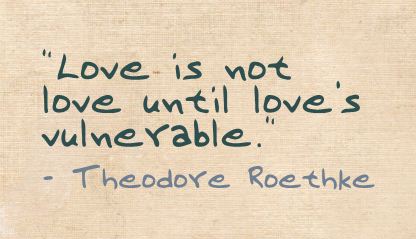
Love is not love until love is vulnerable (Theodore Roethke)Balpreet’s response was so powerful. It nearly brought me to tears for two reasons. First, Balpreet has a strong sense of her own beauty. She knows her beauty is not dependent upon arbitrary cultural standards. Rather, her beauty is dependent upon something else: The “Divine Being” that has made her body beautifully sacred – and has made everyone’s body beautifully sacred.

The second reason that my 33 year old eyes nearly teared up was that because Balpreet believes in the sacredness of all human bodies, she broke the cycle of scapegoating. Now, I could easily understand if she responded to “european_douchebag” with her own resentful meanness by saying, “your username is appropriate, you freakin’ jerk!” But if she did, she would simply be imitating “european_douchebag” in defining her own goodness against his meanness. Fortunately, Balpreet didn’t imitate him. Instead, she imitated the “Divine Being” who doesn’t reject any body, but rather makes all bodies beautifully sacred. Even the body of a man with the username “european_douchebag.”

Here’s where the story gets even better – her gracious response softened his heart. He actually imitated her response by responding with a gracious apology on his Reddit account:

I know that this post ISN’T a funny post but I felt the need to apologize to the Sikhs, Balpreet, and anyone else I offended when I posted that picture. Put simply it was stupid. Making fun of people is funny to some but incredibly degrading to the people you’re making fun of. It was an incredibly rude, judgmental, and ignorant thing to post.

The Imitation of Christ (Thomas à Kempis)When we imitate someone else’s meanness by responding with our own meanness, it only hardens both our hearts and makes us all mean. Fortunately for us, Balpreet is focusing her “life on creating change and progress for this world.” That change and progress is the courage to end the cycle of scapegoating. We learn from her that when we respond to scapegoating with the spirit of grace and forgiveness, believing in our own sacredness and the sacredness of the other, then our hearts can soften and we have the chance for a better imitation – the imitation of grace.

– by Adam Ericksen

I explored this dynamic of “the imitation of grace” also, in an earlier post. Click here for “Turn the other cheek.”

In the inaugural René Girard Lecture, Timothy Snyder presents his latest research, placing the Holocaust in global perspective. “We have scarcely begun to comprehend the Holocaust,” he says. “This is not just an intellectual problem, but a deep danger if we wrongly assume that simply acknowledging the catastrophe is enough to prevent something similar from happening again.”

Timothy Snyder is Professor of History at Yale University. He is the author of The Reconstruction of Nations, Sketches from a Secret War, and The Red Prince. He’s probably best known for his book Bloodlands (click the title for more information), and for collaborating with the great and late historian Tony Judt on the latter’s intellectual testament Thinking the Twentieth Century.

For further context on this lecture, click here to read what a fellow blogger has to say.

Click here for more information on Timothy Snyder’s BloodlandsBloedlanden – in Dutch.

Bloodlands (Timothy Snyder) Cover

From the Institute for New Economic Thinking (INET) comes this lecture on René Girard’s mimetic theory in relation to economics and ecology. Excellent panelists include Edward Fullbrook, Jean-Pierre Dupuy, Mark Anspach, Paul Dumouchel, and André Orléan (click the names of these people for more information on their work).

Be inspired!

CLICK TO WATCH: