Dear guest, It all started with… dinosaurs. From an early age I was fascinated by those strange creatures that walked the earth millions of years ago. Not surprisingly, as a young boy I wanted to become a paleontologist. This initial plan concerning my future took a slight turn from the moment I met Michaël Ghijs (1933-2008), a Catholic priest and teacher at the high school I was attending. He was also the founding conductor of the boys’ and men’s choir Schola Cantorum Cantate Domino. He enabled his singers, me being one of them, to broaden their horizon on many levels: on the geographical and cultural level by literally travelling the world with us, but also spiritually by living out the message of the Gospel. Inspired by his example and my experiences within his choir, I decided to commit myself to a further exploration of The Christian Story. I hold a master’s degree in Religious Studies at the Catholic University of Leuven (Belgium). It was in Leuven I first encountered the work of René Girard (1923-2015), one of the great intellectuals of our time and immortel of the Académie française. A little book by a great theologian, Knowing Jesus by James Alison, set me on track to discover Girard’s further developed Mimetic Theory. For me, this became an anthropological and interdisciplinary starting point to challenge the richness of the Christian tradition. It affected me in a very profound way, and I’m convinced that the thought provoking power of Mimetic Theory can support our multi-layered human society on the road to ‘post-sacrificial’ peace. Eventually, I published several books and articles on René Girard, Mimetic Theory, culture and religion. I also became a member of the Dutch Girard Society and of COV&R (the Colloquium on Violence & Religion). In 2019, I became an elected member of the board of COV&R for several years. In 2011, I started Mimetic Margins, a blog to explore the work of René Girard (and many others) further. Scapegoat Shadows, this website, is a reboot of my first online activity in that regard. It contains the Mimetic Margins Archives (with lots of instructive debates under certain posts), as well as new material. I’m currently teaching at a Jesuit High School, Sint-Jozefscollege, in Aalst (Belgium). I am also a journalist and editor-at-large for Tertio, a weekly magazine. In my spare time I keep on singing, as an alto or countertenor, trained at Schola Cantorum Cantate Domino as I mentioned (I was a member from 1991-2010). I took part in several recordings, both as a choir member and as a soloist.

Dan wil je eens even niet bezig zijn met de onderwerpen van de mimetische theorie, stuurt Arno Couwenbergh – een kersverse oudleerling – dit artikel op uit Knack. Waarvoor dank :)!

KLIK HIER OM HET INTERVIEW MET CHRISTIAN KEYSERS TE LEZEN (PDF)

Wie nog meer wil weten over Het empathische brein kan hier terecht.Keysers-Het empatische brein@7.indd

To my English reading friends: The Empathic Brain first appeared in English. It might be enlightening to read it together with Mimesis and Science – click here for more information on that book.

It is important to notice that empathy (developed through mimetic ability) is a two-edged sword. For more, click here.The Empathic Brain

In times of financial and economic crisis people seem more susceptible to unrealistic promises of immediate wealth. Indeed, more people play the lottery, losing more money while desperately trying to get rich. Tragic.

advertising on tv and mimesis cartoonBut even when people do win the lottery, chances of a happier and more fulfilling life are not guaranteed. This becomes clear in a documentary, made by the Belgian television network RTBF (from the French speaking part of the country). Lottery winners fall in between because of myriad mimetic interplays. People dream of living the good life like the jetset. When they are finally able to imitate that kind of life, they are not at ease with the culture of the rich and famous. At the same time they often fall victim to the jealousy of their peers. It’s easier to admire those who do not belong to your own social environment than those who are close to you. It’s – as René Girard would have it – a mimetic law, which Plato already refers to in his dialogue Lysis (215d) when Socrates says:

“By a universal and infallible law the nearer any two things resemble each other, the fuller do they become of envy, strife and hatred…”

Or, as Jesus puts it in the Gospel (Mark 6:4):

“A prophet is not without honor except in his own town, among his relatives and in his own home.”

I thought of these insights while watching the documentary Les millionnaires de hasard-lotto. Watch it here.

But I also thought of it when I heard one of my friends complain about the fact that Muslim girls apparently could wear a veil in a photograph for some official banking documents, while at the same time and place “ordinary Flemish girls” could not wear a headband… Well, that’s a major problem, isn’t it? Anyway, it’s true after all that the biblical story of Cain and Abel keeps on reflecting a very basic aspect of this world order…

Reading tip: Les Millionnaires de la chance. Rêve et réalité, Michel Pinçon et Monique Pinçon-Charlot.

KLIK HIER VOOR PPT ALS SLIDESHARE NIET WERKT

Voor de inleefreis naar India van onze school (Sint-Jozefscollege, Aalst) maakte ik een powerpoint over hindoeïsme en boeddhisme. Daarbij heb ik de voornaamste verschillen trachten aan te duiden tussen ‘oosterse’ en ‘westerse’ levensbeschouwingen (hoewel het onderscheid natuurlijk moet worden genuanceerd omwille van wederzijdse beïnvloeding). Het gaat dan over denkwijzen die respectievelijk schatplichtig zijn aan een cyclische tijdsopvatting (bewaard in het Verre Oosten), en aan een lineaire tijdsopvatting (ontstaan in het Nabije Oosten, en verder ontwikkeld in de Abrahamitische godsdiensten).

child playing next to cobras in their baskets in Indiaritual-man swinging by rope from hooks in back in IndiaShaman or Guru in India

In het tv-programma Reyers Laat van 2 mei 2013 werd speciale aandacht besteed aan… de Liefde.

Reyers LoveAls godsdienstleraar vind ik het interessant om te zien hoe een aantal inzichten die behoren tot de kern van het joods-christelijke denken ook aanwezig zijn in een seculiere context. Dat is niet zo verwonderlijk. Het gaat in de Bijbel, zoals in iedere grote spirituele traditie, om een zoektocht naar de uiteindelijke bestemming van mens en wereld, en die zoektocht vertrekt vanuit een karakterisering van “de mens”. Blijkbaar komen de pogingen van de Bijbelse auteurs om de mens en zijn voornaamste problematieken te karakteriseren overeen met de pogingen van hedendaagse menswetenschappers die hetzelfde doen. Bovendien verwijst psychiater Dirk De Wachter naar Emmanuel Levinas, een Franse filosoof inderdaad, maar vooral ook een joodse denker (ook bekend om zijn lezingen van de Talmoed). En dan is het natuurlijk al helemaal niet toevallig dat een Bijbelse antropologie doorklinkt in het spreken van dokter De Wachter. Het bleek voor de leerlingen uit de 6GRWIb, 6LAWIb, 6ECMT1, 6ECWI en 6ECWE aan wie ik vandaag lesgaf helemaal niet moeilijk om de overeenkomsten tussen de boodschap van de evangeliën en die van Clara Cleymans, Kristien Hemmerechts en Dirk De Wachter aan te duiden. Dank aan Reyers Laat voor het onverwachte didactische materiaal :)! Klik aan:

BEKIJK HIER EEN FRAGMENT: WAT IS LIEFDE?

En voor wie wil weten hoe een godsdienstleraar een en ander over de liefde beschouwt vanuit het Nieuwe Testament, is er volgende link – een inkijk in mijn lessen :), jawel – klik aan:

VAN EROS NAAR THANATOS NAAR AGAPÈ (PDF)

In mijn boek, uitgegeven bij Averbode in 2009, worden deze thema’s verder uitgewerkt – klik hier voor meer informatie over Vrouwen, Jezus en rock-‘n-roll.

sacrificial peaceTot slot geef ik nog enkele citaten uit het gesprek. Wie het pdf-document gelezen heeft, zal merken dat de nieuwtestamentische opvatting over vrede aansluit bij de karakterisering van de liefde in het gesprek uit Reyers Laat.

De Jezusfiguur van de canonieke evangeliën heeft het niet zo begrepen op een “vrede” of “harmonie” die gebaseerd is op offers, op geweld. Hij heeft het niet begrepen op een slaafse gehoorzaamheid of blinde loyauteit aan een eigen “(familie)clan”, waarbij “de vijand” van die clan automatisch de vijand wordt van eenieder die ertoe behoort, zonder dat de vraag gesteld wordt of de clan het wel bij het rechte eind heeft.

I did not come to bring peaceDe Jezusfiguur uit de canonieke evangeliën plaatst een vraagteken bij relaties waarin conflicten niet op een vruchtbare wijze aan bod kunnen komen. Mensen kunnen pas “thuis” zijn bij elkaar als ze ook het verschil tussen zichzelf en anderen een plaats kunnen geven – en verschillen in opvattingen en persoonlijkheden zullen onvermijdelijk spanningen teweegbrengen; de kunst is om er op een creatieve manier mee om te gaan. Jezus brengt “het zwaard”, maar het is wel duidelijk dat hij dit niet letterlijk bedoelt als een oproep tot geweld – zie Mt10,34-36: “Denk niet dat Ik op aarde vrede ben komen brengen. Ik ben geen vrede komen brengen, maar een zwaard. Want Ik ben gekomen om een wig te drijven tussen zoon en vader, tussen dochter en moeder, tussen schoondochter en schoonmoeder; ja, huisgenoten worden vijanden.”

Put away your swordKortom, de Jezusfiguur uit de canonieke evangeliën pleit vóór de mogelijkheid van conflicten (als vruchtbare spanningen voortkomende uit het verschil tussen mensen), maar is tégen gewelddadige conflicten.

Enkele citaten uit het gesprek in Reyers Laat ‘Reyers Love’ (2 mei 2013)

Dirk De Wachter: “Mijn stelling is dat de duurzame liefde – niet de verliefdheid of het hormonale gebeuren – bestaat uit het erkennen van de ander als ander. Dat juist in het verschil, het onoverbrugbare verschil, de continuïteit zich stelt. Dat is een theorie die ik niet zelf heb uitgevonden, maar die komt van de Franse filosoof Levinas. Dus: de ander als ander, de ander niet willen veranderen; de ander niet willen maken tot wat ge zelf zou wensen, tot uw eigen beeld of verlangen, maar de ander ‘laten zijn’.

Hoe kan men de ander beminnen zonder hem of haar tot zijn bezit te maken? […] De geliefde wordt vandaag vaak beschouwd als een soort consumptieproduct – als iets dat men zich kan aanschaffen en dan naar zijn verlangen kan modelleren, en dan ook opzij zetten als het niet meer echt voldoet aan dat wat men zo graag zou hebben.

Het is bijna een noodzaak. Het is omdat de ander anders is dat er steeds een verlangen blijft. Het is in die onvervuldheid dat we steeds blijven doorgaan. Dat is de paradox.”

Clara Cleymans: “Liefde stoelt altijd op eigenliefde. Daar wil ik niet mee zeggen dat liefde zich zou baseren op egoïsme of narcisme, want dat staat daar natuurlijk haaks tegenover, maar wel dat ge uzelf moet respecteren en uzelf ergens moet graag zien om de juiste partner te vinden of om ‘juist’ lief te hebben.”

Dirk De Wachter: “Dat is zeer juist. Als de ander moet dienen om u goed te voelen, dan zit ge met een probleem. Maar als ge u goed voelt, en de ander kan ook zichzelf zijn, dan is er duurzaamheid – niet gegarandeerd want dat bestaat niet – mogelijk.”

Clara Cleymans: “Als ge uzelf niet graag ziet, dan kunt ge ook heel moeilijk alleen zijn, en dan vlucht ge vaak in iemands armen; en als liefde een vlucht wordt dan houdt het op om liefde te zijn. […] Ik denk dat elke relatie mis kan gaan bij een lage eigenwaarde, omdat het zo een lelijke symptomen heeft. Ge wordt vaak heel jaloers, ge wordt heel bezitterig, heel hebberig… Ge laat helemaal geen vrijheid naar uw partner toe. Maar ook, als ge uzelf niet goed voelt, dan bouwt ge soms een hele dikke stugge muur rondom u, en dan kunt ge niet in een relatie stappen want een relatie is juist een hele intieme vorm van communicatie – waar ge iemand toelaat in uw meest intieme, hyperpersoonlijke ruimte, en ge hebt een soort van openheid nodig daarvoor.”

Kristien Hemmerechts: “Je mag niet afhankelijk zijn van iemand. Je moet je eerst goed in je eigen vel voelen voordat je een relatie kan aangaan. Want anders ga je die ander gebruiken om dat gat in jou te vullen, om die leegte in jou te vullen.”

Als mensen elkaar niet herleiden tot een louter middel ter bevrediging van bepaalde behoeftes en verlangens, kunnen ze het onuitwisbare verschil tussen zichzelf en anderen op het spoor komen dat liefde mogelijk maakt als respect voor de ander als ander. Christenen herkennen daarin de werkzame tegenwoordigheid van de Geest Gods, die uit de gespletenheid van het verschil het scheppende Woord baart dat een mens tot zijn medemens spreekt.


OLYMPUS DIGITAL CAMERA

I just had to share this amazing story! It is told by Adam Ericksen at the Raven Foundation website. Here it is, republished with kind permission:

The Internet can be a very mean place. But it can also lead us to grace.

BalpreetThe dichotomy of meanness and grace was recently displayed on the website reddit.com. The backstory goes like this: A man was waiting in line at airport security. He spotted Balpreet Kaur, a young woman who is a baptized Sikh and a student at Ohio State University. The man surreptitiously took out his phone, positioned the camera, and while Balpreet looked away, he took her picture. Then he posted it to Reddit’s humor section, called r/funny, with the caption, “i’m not sure what to conclude from this.” The picture quickly went viral and people made demeaning comments about Balpreet’s appearance.

What was “humorous” about Balpreet’s appearance? She has facial hair.

It’s a classic example of Internet scapegoating. The original poster, whose reddit username was “european_douchebag,” (Seriously! You couldn’t make that up!) wanted to invite his Reddit community to join him in demeaning Balpreet’s appearance, and his community was happy to join. Balpreet became their scapegoat. As the picture went viral, people began posting degrading comments about her. They accused her of being ugly, and in that accusation they began to feel a sense of their own beauty.

Are You Imitating or IdolizingBut scapegoating always provides a false sense of beauty. Scapegoating boils down to this: We know that we are “beautiful” by comparing ourselves with someone else that we consider “ugly.” Unfortunately, scapegoating in this way can be seen throughout human cultures. Every culture has arbitrary standards of beauty that lead to scapegoating. When our sense of beauty is based on these arbitrary standards, it leads us into the trap of scapegoating. This is the trap that “european_douchebag” and his community fell into, and it is a trap that we all fall into. Until someone has the sense to pull us out.

And that’s exactly what Balpreet did. A Facebook friend informed her about the picture on Reddit. After she found the image and read through some of the comments, she posted her own response to her image and the demeaning comments:

Hey, guys. This is Balpreet Kaur, the girl from the picture. I actually didn’t know about this until one of my friends told on facebook. If the OP [original poster] wanted a picture, they could have just asked and I could have smiled :) However, I’m not embarrassed or even humiliated by the attention [negative and positive] that this picture is getting because, it’s who I am. Yes, I’m a baptized Sikh woman with facial hair. Yes, I realize that my gender is often confused and I look different than most women. However, baptized Sikhs believe in the sacredness of this body – it is a gift that has been given to us by the Divine Being [which is genderless, actually] and, must keep it intact as a submission to the divine will. Just as a child doesn’t reject the gift of his/her parents, Sikhs do not reject the body that has been given to us. By crying ‘mine, mine’ and changing this body-tool, we are essentially living in ego and creating a separateness between ourselves and the divinity within us. By transcending societal views of beauty, I believe that I can focus more on my actions. My attitude and thoughts and actions have more value in them than my body because I recognize that this body is just going to become ash in the end, so why fuss about it? When I die, no one is going to remember what I looked like, heck, my kids will forget my voice, and slowly, all physical memory will fade away. However, my impact and legacy will remain: and, by not focusing on the physical beauty, I have time to cultivate those inner virtues and hopefully, focus my life on creating change and progress for this world in any way I can. So, to me, my face isn’t important but the smile and the happiness that lie behind the face are. :-) So, if anyone sees me at OSU, please come up and say hello. I appreciate all of the comments here, both positive and less positive because I’ve gotten a better understanding of myself and others from this. Also, the yoga pants are quite comfortable and the Better Together t-shirt is actually from Interfaith Youth Core, an organization that focuses on storytelling and engagement between different faiths. :) I hope this explains everything a bit more, and I apologize for causing such confusion and uttering anything that hurt anyone.

Love is not love until love is vulnerable (Theodore Roethke)Balpreet’s response was so powerful. It nearly brought me to tears for two reasons. First, Balpreet has a strong sense of her own beauty. She knows her beauty is not dependent upon arbitrary cultural standards. Rather, her beauty is dependent upon something else: The “Divine Being” that has made her body beautifully sacred – and has made everyone’s body beautifully sacred.

The second reason that my 33 year old eyes nearly teared up was that because Balpreet believes in the sacredness of all human bodies, she broke the cycle of scapegoating. Now, I could easily understand if she responded to “european_douchebag” with her own resentful meanness by saying, “your username is appropriate, you freakin’ jerk!” But if she did, she would simply be imitating “european_douchebag” in defining her own goodness against his meanness. Fortunately, Balpreet didn’t imitate him. Instead, she imitated the “Divine Being” who doesn’t reject any body, but rather makes all bodies beautifully sacred. Even the body of a man with the username “european_douchebag.”

Here’s where the story gets even better – her gracious response softened his heart. He actually imitated her response by responding with a gracious apology on his Reddit account:

I know that this post ISN’T a funny post but I felt the need to apologize to the Sikhs, Balpreet, and anyone else I offended when I posted that picture. Put simply it was stupid. Making fun of people is funny to some but incredibly degrading to the people you’re making fun of. It was an incredibly rude, judgmental, and ignorant thing to post.

The Imitation of Christ (Thomas à Kempis)When we imitate someone else’s meanness by responding with our own meanness, it only hardens both our hearts and makes us all mean. Fortunately for us, Balpreet is focusing her “life on creating change and progress for this world.” That change and progress is the courage to end the cycle of scapegoating. We learn from her that when we respond to scapegoating with the spirit of grace and forgiveness, believing in our own sacredness and the sacredness of the other, then our hearts can soften and we have the chance for a better imitation – the imitation of grace.

– by Adam Ericksen

I explored this dynamic of “the imitation of grace” also, in an earlier post. Click here for “Turn the other cheek.”

In the inaugural René Girard Lecture, Timothy Snyder presents his latest research, placing the Holocaust in global perspective. “We have scarcely begun to comprehend the Holocaust,” he says. “This is not just an intellectual problem, but a deep danger if we wrongly assume that simply acknowledging the catastrophe is enough to prevent something similar from happening again.”

Timothy Snyder is Professor of History at Yale University. He is the author of The Reconstruction of Nations, Sketches from a Secret War, and The Red Prince. He’s probably best known for his book Bloodlands (click the title for more information), and for collaborating with the great and late historian Tony Judt on the latter’s intellectual testament Thinking the Twentieth Century.

For further context on this lecture, click here to read what a fellow blogger has to say.

Click here for more information on Timothy Snyder’s BloodlandsBloedlanden – in Dutch.

Bloodlands (Timothy Snyder) Cover

From the Institute for New Economic Thinking (INET) comes this lecture on René Girard’s mimetic theory in relation to economics and ecology. Excellent panelists include Edward Fullbrook, Jean-Pierre Dupuy, Mark Anspach, Paul Dumouchel, and André Orléan (click the names of these people for more information on their work).

Be inspired!

CLICK TO WATCH:

The secret to creativity (Albert Einstein)

Well, Einstein isn’t the only one with quotes :). Through several years of teaching, I’ve developed some expressions myself. Of course, it’s only my attempt to transmit the ideas of others. Anyway, hope to make you think. Enjoy!

about Jesus and Christianity

Jesus is often called a leader whose words and deeds are too otherworldly to be imitated. Indeed, our world produces one illusion after the other, and Jesus is too much of a realist to aspire to be a king of this world.

There are some whose ultimate goal it is to be loved, and they are willing to suffer in order to get to their paradise of happiness. There are others whose ultimate goal it is to love, and they are willing to bear suffering as a possible consequence of their refusal to sacrifice others. The last ones can be considered followers of Christ. The first ones can be considered masochists.

It’s better and healthier – maybe more ‘Christian’ even – to discard Christianity because of a lack of understanding than to accept an untruthful, unhealthy version of it.

quote on Jesus (Albert Einstein)

about truth and lies

Although you might have the opposite impression, as long as you have to take medication, the disease you’re suffering from is not cured. Any doctor who makes you think you are cured by taking drugs is selling pharmaceutical lies. In the case of chronic, still incurable diseases, scientific progress is needed to prevent the pharmaceutical industry of becoming an end in itself. The economics of the pharmaceutical industry, and the medications it produces, should serve the ultimate goal of medicine: cure people, which means making them independent of medications.

One aspect of truth is like a real gift. It’s not immediately necessary are necessarily useful, but it opens unexpected possibilities. The truth has the potential to set you free because you don’t need it.

Although some consider it to be a sign of freedom to be able to approach reality from the perspective of their supposedly very own needs, desires and interests, this is actually a sign of enslavement; for the things you need or learned to need are things you are dependent upon (otherwise you wouldn’t need them).

The intuitive mind is a sacred gift (Albert Einstein)

One aspect of truth is like love. It can hurt, for it does not flee when aspects of reality strike that you would rather do away with.

Truth does not have to be useful. It has to be true.

Some people are primarily interested in what they need. Others are primarily interested in gaining knowledge and finding truth.

There are only two ways to live (Albert Einstein)

about education

Education begins where one’s primary interests and certainties end. It’s a call to adventure.

It is a miracle that curiosity survives formal education (Albert Einstein)

Some people think they know what’s true by pointing out what’s false. It’s the illusion of a man who dares not criticize and educate himself, afraid he’ll find out that he’s not a god.

The only sure way to avoid making mistakes... (Albert Einstein)

about scientism

Some give the impression that modern science will eventually answer all questions, thereby characterizing as irrelevant those questions science cannot answer. Well, that’s easy. If I can marginalize all questions that I cannot answer (by calling them “irrelevant”), I’ll be able to solve “all” questions immediately.

The important thing is not to stop questioning (Albert Einstein)

Strict scientism makes perfect sense, right? In the end, it considers “Butterflies evolve from caterpillars” a meaningful statement, while it considers “Butterflies are beautiful” meaningless. Should make perfect sense, but somewhere down the road, something apparently went wrong, nonetheless…

about desire and needs

If you desire to be everywhere, you end up being nowhere.

“I don’t need God!”, the atheist said, “I’m perfectly happy without Him!” – “I don’t need a house with electricity!”, the caveman cried, “I’m perfectly happy in my cave!”

[=> Okay, this one’s quite lame :); and of course, to love someone doesn’t mean that a desire for happiness drives you – love is ultimately concerned with the well-being of others, and we’re all unhappy if our beloved others are harmed; still, most of us won’t suppress love because of the possible sadness it provokes – meaning our desire to feel good and happy is less important than our desire for the well-being of the beloved others…].

about love (and utilitarianism)

If you love others, you’ll get hurt when you lose them, and feel sad when they suffer. Still, you will not stop loving them. Not because you enjoy sadness or suffering, but because you are willing to accept that your own happiness can only be a consequence of the happiness of others, and never an end in itself (contrary to utilitarianism).

I never said half the crap people said I did (Albert Einstein)

“The public has a distorted view of science because children are taught in school that science is a collection of firmly established truths. In fact, science is not a collection of truths. It is a continuing exploration of mysteries.”

Freeman John Dyson (born 1923).

1. THE INTRO

I don't need youLast week, one of my pupils said something what countless others already said before him, and what countless others will repeat after him – it’s a cultural thing foremost, in our so-called secularized Belgian society:

“I don’t need any theological speculation. I’m an atheist. I don’t need God! I don’t need to go any further than psychology and the social sciences…”

In the same week, on Monday (April 15th, 2013), I read an article in the newspaper about a young professor who had tampered with data and search results (read the article here, in Dutch; for more information in English click here). He allegedly committed large-scale fraud, investigating the causes of epilepsy.

One might ask what one observation has to do with the other. Well, for one, it’s clear that the young scientist was especially interested in the things he needed to promote his career. His desire for recognition and for prestige became more important than science itself. He used scientific research as a means to another end, to satisfy his pride. In the end, he accomplished exactly what he was trying to avoid. Instead of promoting his career and his own future in academia, he ruined it. Jesus points to the tragic nature of attempts like these:
It is a strange desire... (Francis Bacon)For whoever wants to save their life will lose it… What good is it for someone to gain the whole world, and yet lose or forfeit their very self?” (Luke 9:24a-25).

But there’s more. According to Christian tradition, whenever we are guided by pride we not only tend to ruin ourselves. We also tend to ruin our surroundings. Indeed, the young ambitious scientist violated the scientific truth in order to protect his self-image, next to endangering the career of his co-workers. Once again, the Christian tradition is spot-on: the person who cannot love himself, and seeks comfort in the creation of an admirable image, cannot truly love others, for he is primarily interested in others insofar as they are useful for developing and recognizing that image. Our desire for mutual, social recognition – understood as the ultimate goal of our efforts, which is vanity – often gets in the way of our capacity to perceive what is actually happening. This truth is retold in a magnificent way by Hans Christian Andersen’s fairytale The Emperor’s New Clothes.

Precisely because we very often approach reality from the perspective of its eventual usefulness, and from the question whether we need it or not, we remain blind for a fuller understanding of reality. This one’s for my pupils:

THE TRUTH DOES NOT PRIMARILY HAVE TO BE USEFUL

(ALTHOUGH IT CAN BE), THE TRUTH HAS TO BE TRUE!

For instance, if we only focus on the aspects of another person that seem useful to us, we might miss out on other aspects that can actually turn out to be more fundamental than the ones we’re focusing on. More generally, we might get a better picture of reality if we not only focus on purely scientific questions and explanations, but also deal with more philosophical issues and questions.

Rationality should not be restricted to scientific rationality. Actually, we never do this on a day-to-day basis. For instance, scientific rationality might explain why we become jealous sometimes, but we need the more philosophical rationality of ethics to discuss whether or not and to what degree jealousy is a good thing.

Ian Hutchinson on ScientismAnother example: scientific rationality might explain how the universe came into being, but we need philosophical rationality to deal with the question whether or not there is an ultimate purpose of “all that is”, whether or not there will be some “perfection” of the universe. Scientifically speaking, there is none, but it’s logically very debatable that the scientific answer is the only meaningful or true answer to this question. The belief that only scientific claims are true or meaningful is known as scientism, which is problematic. From The Skeptic’s Dictionary: “Scientism, in the strong sense, is the self-annihilating view that only scientific claims are meaningful, which is not a scientific claim and hence, if true, not meaningful. Thus, scientism is either false or meaningless.”

Again, in order to understand reality more fully – in its ethical, aesthetic, and mysterious (non-manipulable) aspects -, we might have to go beyond merely scientific concerns, and also go beyond our immediate “needs”. We might even have to pose theological questions. Moreover, it’s not because we can scientifically explain why we pose certain questions that these questions themselves can be answered by science. To “understand” reality is to contemplate it in all its aspects.

Science is but an image of the truth (Francis Bacon)It is no coincidence that, from a Christian point of view, there are prayers like the one ascribed to Saint Francis of Assisi, containing the words:

“O Divine Master, grant that I may not so much seek to be understood as to understand…”

Although some consider it to be a sign of freedom to be able to approach reality from the perspective of their supposedly very own needs, desires and interests, this is actually a sign of enslavement…

FOR THE THINGS YOU NEED OR LEARNED TO NEED

ARE THINGS YOU ARE DEPENDENT UPON

(OTHERWISE YOU WOULDN’T NEED THEM)

2. THE MIDDLE

“Need” is a complicated affair when it comes to humans.
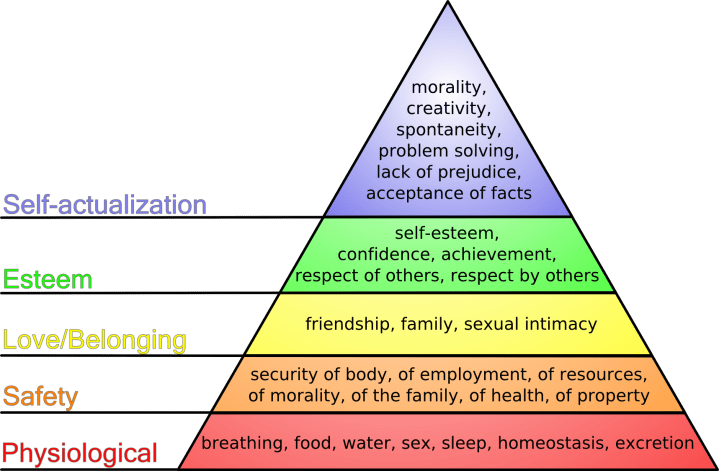
Maslow's Hierarchy of Needs

Psychologist Abraham Maslow (1908-1970) became famous for mapping our needs in a veritable Hierarchy of Needs – a five-stage model, originally. Once physiological and basic survival needs are met, other needs come to the fore. It is interesting to notice that Maslow characterizes the stages we normally associate with “human freedom” as “needs”. Although we might have the impression that we are free to choose whom we want to belong to, we didn’t choose the need to belong to a group or a person. The same goes for the two highest stages of human needs. We can seemingly choose the things that bring us self-esteem, status or prestige, but we can’t escape the desire for these matters. The biggest paradox, of course, is Maslow’s characterization of self-actualization as a need: we are bound to be free. In other words, reminiscing the thought of Jean-Paul Sartre (1905-1980) and other existentialist philosophers, we face the command to develop ourselves.

Several questions arise here, namely, how do we know who we are, who we want to be, how to gain prestige and self-esteem? René Girard’s answer is quite simple: we imitate others in modeling our desires, ambitions, and sense of self. More specifically those others we’ve (mimetically, i.e. imitatively) learned to appreciate and whose appreciation we’ve (again, mimetically) learned to desire.

As Emmanuel Levinas (1906-1995) pointed out time and again, we tend to approach reality as a whole and fellow human beings in particular from the perspective of our needs. We’re often interested in other people basically because they are experienced as “useful” one way or the other (as friends, as suppliers of security and/or happiness, as financial support, etc.). In fact, we tend to reduce others to their “usefulness”, and to apply this as a criterion to decide whether or not someone or something is valuable. Utilitarian ethics are actually an attempt to found morality on the tendency to focus on our needs. For instance, we should help the poor, not necessarily because we love them, but because not helping them could ultimately cause problems to ourselves. We “need” to help them because we – or the majority of human beings – benefit from it. On a collective level, helping the poor could be one of the roads to a more secure and safer world. On an individual level it could perhaps be a way to gain some status or prestige as “hero”.

Levinas fundamentally criticizes the utilitarian approach to reality. The Other, our fellow human being, our “neighbor”, transcends our needs and desires. If we reduce the Other to the question how he can be useful to us, we will never get to “know” anything about the Other. Moreover, before we can reduce the Other to his usefulness, the Other is simply there, and he might in no way answer to the demands of our actual needs and desires. On the contrary, the Other might reveal himself as a burden or even an enemy to our interests.

The same applies to reality as a whole. It is even said that “reality hits us” whenever we are confronted with aspects of it that we don’t need at all! Reality often reveals itself in shapes we failed to foresee or manipulate according to our needs.

The search for truth therefore begins with the question whether or not we can free ourselves partially from our immediate needs, and from the tendency to control our environment. Are we able to honestly face reality in all its fearful as well as promising possibilities? This is especially challenging in encountering the reality of other persons. For only if we become relatively free from our own needs, anxieties, interests, and prejudices, can we allow the other to freely approach us as “Other” – meaning that we don’t mold him according to the contours of our self-image and our desire for recognition.

3. THE OUTRO

It’s important to notice that, although Christianity reveals the pitfalls of our desire for recognition, it is not about sacrificing this desire. It’s about giving it the right place. I often explain this to my pupils by describing two basic types of students:

  • Student A is basically motivated by the desire to get good grades, because he believes these are his “ticket to paradise” (i.e. recognition by his parents and teachers, and all kinds of “rewards”). In other words, student A is only interested in his courses insofar as he can use them to gain an admirable self-image – which is his ultimate goal. He is guided by his pride. He has lost the capacity to enjoy many of the things he is doing, and that’s why he generally needs to be compensated for what he’s done. Kneeling to the idol of an admirable self-image, student A is no longer capable of loving himself, let alone love others (it’s the kind of student that will pay his teachers some respect because he expects some reward, but who will also tend to get angry if the reward is not granted – which means that his self-image is stained). He finds solace in the recognition for his good grades. However, while focusing on “getting to paradise” (or, in other words, while focusing on the desire to “save his life” and “get into heaven”), he’ll find himself less and less able to study properly, and his grades will go down (he’ll “lose his life” and “get into hell”).

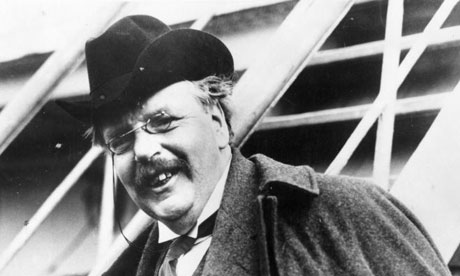
G.K. ChestertonIn the words of the great and late Christian writer, G.K. Chesterton (1874-1936), the situation of student A can be characterized as follows:

“The moment men begin to care more for education than for religion they begin to care more for ambition than for education. It is no longer a world in which the souls of all are equal before heaven, but a world in which the mind of each is bent on achieving unequal advantage over the other. There begins to be a mere vanity in being educated whether it be self-educated or merely state-educated. Education ought to be a searchlight given to a man to explore everything, but very specially the things most distant from himself. Education tends to be a spotlight; which is centered entirely on himself. Some improvement may be made by turning equally vivid and perhaps vulgar spotlights upon a large number of other people as well. But the only final cure is to turn off the limelight and let him realize the stars.”

  • Student B is basically motivated by the desire to know and understand his courses. As a consequence, he’ll often get good grades (“get into heaven”), but this never was his primary goal. Precisely because he considers his courses as ends in themselves, he’ll eventually get and enjoy recognition. Of course, being proud of an achievement is not a crime. It becomes malicious, though, when it is the goal and not the consequence of one’s actions.

Whenever Jesus talks about heaven or hell in the Gospels, he presents them as possible consequences of one’s actions and not as goals. He even says that we shouldn’t do good and help our neighbor in order to gain some kind of heavenly reward and to avoid hell, but that we should help our neighbor because of our neighbor (as end in himself). Then we’ll get “heaven” as a quite unexpected reward, as a logical consequence. The same reasoning applies to his approach of reality as a whole.

gun lobbyFalse prophets or false messiahs (in religion, politics, health care, etc.) are people who try to tell us what we need to get to paradise (a nice house, a good career, a healthy body, a safe but entertaining life etc.), and also scare us with the evil dangers that could send us to hell. They are doctors who constantly produce the disease they supposedly liberate us from. But, of course, they never really liberate us, for they are dependent on the disease to be able to manifest themselves as “liberators” or “messiahs”. They produce one self-fulfilling prophecy after the other. For instance, the more a gun lobby convinces us that we should protect ourselves with weapons to keep safe in an “evil, ugly world”, the more people will get killed because of gun fire, the more we will feel unsafe, the more the gun lobby will be able to convince us of “the unsafe world”, the more we buy guns, etc.

Jesus, on the other hand, points out that “Satan cannot cast out Satan”. We cannot free ourselves and the world if the means we use to make this world a better place actually (and tragically) continue the diseases we try to cure the world from. Contrary to all kinds of false prophets, he advises us – as a fundamental attitude towards life – “not to be afraid” and “not to worry” too much.

I guess he is right, also in the case of the two types of students.

In short,

  • Student A becomes a SLAVE of an ambition he has learned to aspire for himself. The system of “getting good grades” is more important to him than anything else in class. Everything, including himself, is subjected to this GOAL. Student A might become a scientific investigator who uses scientific research to promote his career and thereby satisfy his pride.
  • Student B remains FREE. The system of “getting good grades” is not important in itself. It is a means to check whether or not the studied courses are sufficiently understood. Student B might become a scientific investigator who really gets a better scientific understanding of reality, and therefore gets his academic career going as a logical CONSEQUENCE.

Student B imitates Jesus’ approach to all kinds of laws and regulations (more specifically the Mosaic Law in the case of Jesus). Jesus says that he didn’t come to abolish the Law just like that, but that he came to fulfill it, meaning that rules should always be relative to the end they help to accomplish. A system of rules and laws should never be an end in itself. It should be considered a means to another end. What counts for Jesus is love for one’s neighbor, and if rules become obstacles in accomplishing this goal, they should be adapted or even suspended.

Student B uses the grade system to get more information on his knowledge of the courses he’s presented with, because he tries to respect what the courses are saying (without, however, automatically agreeing with their statements). This indeed is analogous to Jesus’ approach of the Mosaic Law. Jesus tries to create mutual respect between fellow human beings, thereby constantly evaluating if regulations allow others to live fully. Jesus criticizes any use of the Mosaic Law that justifies the sacrifice of others to satisfy one’s (or a group’s) pride or self-image.

Mark 2:23-27 puts it this way – and I’ll leave it at that:

Jesus Lord of Sabbath (grainfield)One Sabbath Jesus was going through the grainfields, and as his disciples walked along, they began to pick some heads of grain. The Pharisees said to him, “Look, why are they doing what is unlawful on the Sabbath?”

He answered, “Have you never read what David did when he and his companions were hungry and in need? In the days of Abiathar the high priest, he entered the house of God and ate the consecrated bread, which is lawful only for priests to eat. And he also gave some to his companions.”

Then he said to them, “The Sabbath was made for man, not man for the Sabbath. So the Son of Man is Lord even of the Sabbath.”

A while ago I had a conversation with two atheist colleagues of mine at the school where I’m teaching religion. I asked them the following question:

“Do you believe that things become valuable only if people accord them some value, and, on the other hand, that they no longer possess any value once people stop according them value?”

My colleagues answered: “Yes, we do…”

I went further: “So, if no one grants an individual any respect at all, including the individual himself, that individual actually doesn’t have any value? He’s worth nothing because no human being acknowledges him?”

They said: “Yes, of course…”

I’m sorry, but I cannot believe this. I cannot believe that the weight of what’s valuable and what’s not in the universe rests on our tiny, petty little shoulders. It’s too heavy a burden to be carried by mere mortals, who appear and disappear in the blink of an eye. I don’t believe that someone is worth nothing if he’s considered worthless by the human community, including himself. In short, I don’t believe, unlike the old Greek philosopher Protagoras, that “man is the measure of all things” in these matters.

Sir Thomas Browne on judging people

A person’s worth cannot be determined solely by human perception and judgment. Man is not simply the child of a “social other”, i.e. the product of a man-made social environment in which he gains or loses a sense of (self-) worth. He’s also, following the thoughts of people like James Alison and Emmanuel Levinas, a child of “the other Other”, and we should postpone any final judgment on other people and ourselves.

Theologically speaking, this kind of “eschatological reservation” is quite liberating, not just for ourselves, but also for our neighbors. The lurking alternative seems human totalitarianism, meaning the aspiration of man – on an individual or collective level – to have total control in determining what and who is valuable, and what and who is worthless. I’d say we better accept the limitedness of our existence, and leave the perfection of the world to “the Infinite One”, you know, “God”.

Unlike my atheist colleagues, I don’t believe we should try to occupy His kind of place. This unbelief makes me a believer, I believe… And indeed: “Every finite spirit believes either in a God or in an idol” (Max Scheler, 1874-1928). Right on, Max!

don't judge