It would be very interesting to create an intensified dialogue between Paul Rozin‘s research on the acquisition of likes and dislikes of foods and René Girard’s mimetic theory. Although some scholars already made some connections between the two (for instance in Culinary Cultures of Europe: Identity, Diversity and Dialogue, ed. by Darra Goldstein & Kathrin Merkle, Council of Europe Publication, 2005), much promising work remains to be done.
Children (N = 54) ranging in age from one year four months to five years were offered over 30 items to eat. The items included normal adult foods and exemplars of different adult rejection categories: disgust (e.g. grasshopper, hair), danger (liquid dish soap), inappropriate (e.g. paper, leaf) and unacceptable combinations (e.g. ketchup and cookie). We report a high to moderate level of acceptance (item put into mouth) of substances from all of these categories in the youngest children. Acceptance of disgusting and dangerous substances decreases with increasing age, while acceptance of inappropriate substances remains at moderate levels across the age range studied. Although the youngest children accepted more disgust items, the majority rejected most of the disgust choices. Almost all children at all ages tested accept combinations of foods which, although individually accepted by adults, are rejected in combination. No significant differences were observed between ‘normal’ children and those with a history of toxin ingestion, although there was a tendency of ingesters to accept more inedible items. In general, the results suggest that a major feature of the development of food selection is learning what not to eat.
“A major feature of the development of food selection is learning what not to eat.” In other words, disgust is not just a biological thing, a matter of nature. It is a cultural thing too, a matter of nurture. In yet other words, a huge part of our development concerning likes and dislikes of food lies in the imitation of others. If disgust is a matter of nurture it is also a matter of mimesis. Powerful social models have the potential to increase or decrease the disgust for certain foods. For instance, the disgust for organ meat is decreasing since it is increasingly perceived as food served to the beau monde in fancy restaurants. Organ meat thus becomes an object of mimetic desire, while at the beginning of the nineteenth century, it used to be something undesirable for the rich as it was “meat for the poor”.
Further considerations by Paul Rozin on the origin of disgust as a specifically human trait include the possibility that disgust arose around things that were (considered to be) contagious. Which brings us back to René Girard, whose mimetic theory could explain why things that are not actually contaminating on a purely biological, “natural” level are indeed considered disgusting to the extent that they were once associated with “contaminating” violence (on the “cultural” level).
Sometimes, just sometimes, quite revealing scientific insights slip into popular culture. I was watching a rerun of an episode of The Big Bang Theory sitcom on Belgian television. More specifically, I found out, I was watching The White Asparagus Triangulation (episode 9, season 2 – click to watch).
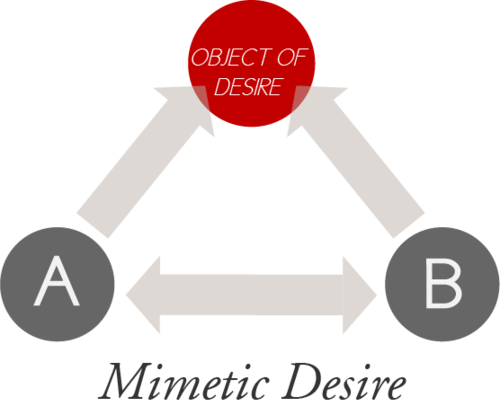
The title itself can already be connected to a basic concept of René Girard’s mimetic theory, namely mimetic desire. As it turns out, “triangulation” indeed refers to the triangular nature of human desire (beyond instinctive needs) as described by Girard: the desire of a subject towards a certain object is positively or negatively influenced by mediators or models (click here to watch an example of negatively mediated desire from another popular sitcom,Seinfeld). Humans imitate others in orienting their desires – their desire thus is mimetic.
In the case of this episode from The Big Bang Theory: Sheldon tries to positively influence the desire of Leonard’s new girlfriend, Stephanie. After all, she is the first of Leonard’s dates to meet Sheldon’s high intellectual standards, so Sheldon does everything to increase Stephanie’s desire for Leonard. At some point he tries to persuade the girl next door, Penny, to present herself as a rival/model for Stephanie. Here’s the script for this scene.
Sheldon: I see. Apparently my earlier inquiry regarding you and Leonard crossed some sort of line. I apologize.
Penny: Well, thank you.
Sheldon: So, have you and I returned to a social equilibrium?
Penny: Yes.
Sheldon: Great. New topic. Where are you in your menstrual cycle?
Penny: What?
Error
This video doesn’t exist
Sheldon: I’ve been doing some research online, and apparently female primates, you know, uh, apes, chimpanzees, you, they find their mate more desirable when he’s being courted by another female. Now, this effect is intensified when the rival female is secreting the pheromones associated with ovulation. Which brings me back to my question, where are you in (Penny slams door). Clearly, I’m 14 days too early.
Anne E.Pusey andKaraSchroepfer-Walker wrote an interesting article on the subject mentioned by Sheldon, Female Competition in Chimpanzees (find a PDF by clicking here). Apparently, the closer to humans, the more mimetic desire and competition can be found in mammals. Chimpanzee females indeed sometimes develop a “desire” for sexual intercourse with male chimpanzees when potential competitors arrive at the scene, even disrupting their normal biological cycle! From the article:
Several lines of evidence indicate some female competition over mating. First, at Mahale, females sometimes directly interfered in the mating attempts of their rivals by forcing themselves between a copulating pair. In some cases, the aggressive female went on to mate with the male. At Gombe, during a day-long series of attacks by Mitumba females on a fully swollen new immigrant female, the most active attackers were also swollen and their behaviour was interpreted as ‘sexual jealousy’ by the observers. Townsend et al. found that females at Budongo suppressed copulation calls when in the presence of the dominant female, possibly to prevent direct interference in their copulations. Second, females occasionally seem to respond to the sexual swellings of others by swelling themselves. Goodall described an unusual incident in which a dominant, lactating female suddenly appeared with a full swelling a day after a young oestrous female had been followed by many males. Nishida described cases at Mahale in which a female would produce isolated swellings that were not part of her regular cycles when a second oestrous female was present in the group.
The White Asparagus Triangulation eventually gets its title from another scene in the episode. Sheldon tries to establish Leonard as “the alpha male”. Sheldon will pretend that he is unable to open a jar of asparagus. If Leonard then opens the jar he will have won the mimetic competition over the question “who is the strongest?”, resulting in an increase of his sex appeal. Of course, for the sake of comedy, things go terribly wrong :). Here’s the script for this scene.
Scene: The apartment.
Leonard: All I’m saying is if they can cure yellow fever and malaria, why can’t they do something about lactose intolerance?
Steph: Leonard, you’re going to have to let this go. You had a little cheese dip, you farted, I thought it was cute.
Sheldon: Oh, hi Stephanie.
Steph: Hi.
Leonard: Want some more wine?
Steph: Yeah, I assume I’m not driving anywhere tonight. (Sheldon lets out a loud noise).
Leonard: What are you doing?
Sheldon: I have a craving for white asparagus that apparently is destined to go unsatisfied.
Leonard: Excuse me. What the hell is wrong with you?
Sheldon: I’m helping you with Stephanie.
Leonard: By making constipated moose sounds?
Sheldon: When I fail to open this jar and you succeed it will establish you as the alpha male. You see, when a female witnesses an exhibition of physical domination she produces the hormone oxytocin. If the two of you then engage in intercourse this will create the biochemical reaction in the brain which lay people naively interpret as falling in love.
Leonard: Huh? Would it work if I just punched you in the face?
Sheldon: Yes, actually it would, but let’s see how the lid goes. I’m not strong enough, Leonard, you’ll have to do it.
Leonard: Oh, for god’s sakes.
Sheldon: Go ahead, it’s pre-loosened.
Steph: Do you want some help with that?
Leonard: No, no, no, I got it.
Sheldon: No, yeah, yeah, he’s got it, and that’s not surprising. This is something I long ago came to peace with in my role as the beta male. Open it. (Leonard tries again. Then taps jar on counter. Jar breaks.)
Error
This video doesn’t exist
Steph: Oh my god, are you okay?
Leonard: No, I’m not. I’m bleeding.
Sheldon: Like a gladiator!
Steph: Oh, honey, you’re going to need stitches.
Leonard: Stitches? With a needle?
Steph: Well, yeah, I mean, just a few.
Leonard: Oh, okay, yeah, hang on a sec. (Throws up in sink)
“In the end, she’s just a mere mortal, just like all the rest of us, just like me…” It’s something we hear quite often, explicitly or implicitly, when people talk about “the rich, the famous and/or the geniuses” of this world. Why is it that we often like to read what tabloid newspapers write about these people? Why is it that we often like to gossip about our local or global heroes or celebrities? What kind of desire is satisfied that we enjoy this kind of thing?
Well, for one thing, we’re living in a world of internal mediation (René Girard). Modern democracy got rid of a social hierarchy – in principle that is – and now everyone can take everyone else as a model or mediator for personal ambitions. Premodern societies would not allow “the lower ranks” to compare themselves to the higher-ups, thus trying to keep an internal order and stability. Today, however, everyone can rival the position of everyone else, based on the premise of equal rights and chances for all. Thomas Hobbes (1588-1679) sharply characterizes this situation and its potential destructive consequences in his work Leviathan, at the dawn of modernity:
“From this equality of ability ariseth equality of hope in the attaining of our ends. And therefore, if any two men desire the same thing which nevertheless they cannot both enjoy, they become enemies; and, in the way to their end, which is principally their own conservation and sometimes their delectation only, endeavour to destroy or subdue one another.” – Thomas Hobbes, Leviathan (XIII).
“Competition of riches, honour, command, or other power, inclineth to contention, enmity, and war; because the way of one competitor, to the attaining of his desire, is to kill, subdue, supplant, or repel the other. Particularly, competition of praise inclineth to a reverence of antiquity. For men contend with the living, not with the dead, to these ascribing more than due, that they may obscure the glory of the other.” – Thomas Hobbes, Leviathan (XI).
We constantly receive the message that “everything is possible with hard work and perseverance”. On the other hand we also experience that some people seem “ahead of others”. These so-called “winners” are often admired, but in other circumstances they’re envied (also by some of their admirers!) as they seem to frustrate the ambitions they awaken in other people. One way to deal with the frustrations arising out of the comparison with “the people ahead of others” is to downplay their status or success by convincing ourselves that “they are just like us” – mere mortals, with flaws, everyday struggles and problems. Or by convincing ourselves that “they are even less like us, we’re superior to them” – in moral terms, for instance, by portraying them as “decadent” or “corrupt”. One could say that the sociological function of the tabloid newspaper or of gossip in general is precisely that. It helps us deal with the fact that we are not part of the world of “the rich, the famous and/or the geniuses” by comforting ourselves with the thought that those people are, at least, “just like us”.
By downplaying the status of “stars” we try to elevate our own position, we try to reach the status we desire. We try to surpass the status we initially (sometimes subconsciously) admired and idolized, then came to envy and eventually resented. In yet other words, the position of others we sometimes initially idolized is replaced by a feeling of superiority of ourselves. Instead of idolizing the image of others, we idolize a certain self-image. That’s why we quite easily distance ourselves from those others who are perceived as “marginal people” – be it criminals, poor people, crazy people, certain sick people, refugees, drug addicts, or “sinners”. Contrary to our often initial reaction to “the stars” in the tabloids, our first response to a confrontation with “the marginal people” is often the feeling that “they are not like us”.
In both instances our sense of identity and self-idolatry arise from our spontaneous tendency to compare ourselves to others (made possible by our mimetic – i.e. imitative – abilities). One of the main reasons why people are scandalized by Jesus of Nazareth is that he constantly challenges these narcissistic self-concepts. See, for instance, Luke 18:9-14:
To some who were confident of their own righteousness and looked down on everyone else, Jesus told this parable:“Two men went up to the temple to pray, one a Pharisee and the other a tax collector.The Pharisee stood by himself and prayed: ‘God, I thank you that I am not like other people—robbers, evildoers, adulterers—or even like this tax collector.I fast twice a week and give a tenth of all I get.’
But the tax collector stood at a distance. He would not even look up to heaven, but beat his breast and said, ‘God, have mercy on me, a sinner.’
I tell you that this man, rather than the other, went home justified before God. For all those who exalt themselves will be humbled, and those who humble themselves will be exalted.”
In short, the narcissist – like the Pharisee in the parable of Jesus – distances himself from “the bad guys” (they’re not like me) while he downplays the geniuses around him (they’re like me), in order to idolize his self-image.Our ideologies and all sorts of so-called “spirituality” or “meditation” are often at the service of the untruthful, non-realistic ideas of ourselves. They make us “feel good” and “happy”, like some antidepressant pills we take, and they alienate us from ourselves and others. The ideology of a terrorist group like ISIS is but one extreme example of a false spirituality. “Snobbery” and the “bourgeois mentality” another.On the other hand, every true spirituality has to do with some kind of permanent crisis of the narcissistic self-concept or “Ego”. It shatters our self-righteousness and complacency, and makes us realize that we are never perfect, never complete, never finished.
While all of this might seem devastating at first, it is also liberating, especially when experienced in the realm of forgiveness. Once you realize that you are not that unique, that you are more like “the sinners” (the majority of mankind) than you would acknowledge previously, and that you are less like “the righteous” than you thought you were, you become less ashamed of yourself. If there is shame in this realization, then it is the shame of the hurt you brought to others while you were practicing the idolatry of a certain (self-)image. “To kill the idol of self-complacent narcissism” thus might be the beginning of a restoration of the love in and between ourselves and others.
René Girard explains how this realization in forgiveness (that people are more like “sinners” than they would acknowledge) is at the core of the conversion experience of Peter, Paul and the other disciples of Jesus. What enables Peter, Paul and others to become “saints” thus precisely and paradoxically is their realization that they are not “saints” (i.e. that they are far from ever being “perfect”). This truly spiritual experience, which enables people to face reality, is also the experience that guided René Girard himself throughout his life. René Girard gets to the essence of what a conversion to Christ should be all about in his explanation of the denial of Peter (click to watch):
An anecdote of C.S. Lewis (who converted from atheism to Christianity, as is well-known) also illustrates quite nicely how the acknowledgement that we are more like the so-called “bad people who bring misery upon themselves” restores neighborly love – thus is the inspiration of Christ:
One day, Lewis and a friend were walking down the road and came upon a street person who reached out to them for help. While his friend kept walking, Lewis stopped and proceeded to empty his wallet. When they resumed their journey, his friend asked, “What are you doing giving him your money like that? Don’t you know he’s just going to squander all that on ale (beer)?” Lewis paused and replied, “That’s all I was going to do with it.”
“To kill the idol of self-complacent narcissism” also opens up the possibility of further personal growth (contrary to the situation of the self-complacent person who thinks he “has arrived”) and a more truthful connection to reality as a whole. Indeed, our mimetic ability might stir some frustrations as we compare ourselves to others and find that we cannot achieve what they achieved, but it also allows us to discover the other as “other” than ourselves. Instead of reducing the other to a mere idol or puppet at the service of non-realistic ideas of ourselves (be it ideas of unworthiness or superiority, or both), we then also might discover the other as a source of inspiration. Once we find ourselves loved for who we are, we can enjoy the talents of others without feeling threatened, or without the tendency to downplay the unique gift they bring to the table. Instead of bowing to the false (because untruthful) transcendence of narcissistic self-concepts, we can then be inspired by the other who is not like us – and in that sense truly transcends us. The paradox is that this kind of relationship allows the other and ourselves to be uniquely “our own”. To put it simply: I don’t have to be the next Lionel Messi in soccer to be inspired by the dedication he brings to his craft. I can imitate his kind of dedication in my own “field” without becoming him, or rivaling him. On the contrary, loyal to my own unique “vocation” I can take his genius as a model, becoming more “who I am” than before. In short, next to all the variants of idolatry and detestation in our relationship to others, there is the attitude of inspiration and being inspired. The first find their source in love for one’s self-image, the second in love for oneself and others.
So yes, Mahatma Gandhi, Martin Luther King, Dietrich Bonhoeffer, Albert Einstein, Charles Darwin, Blaise Pascal, Wolfgang Amadeus Mozart, Johann Sebastian Bach, Francis of Assisi, Jesus of Nazareth and the Buddha are geniuses. They are “not like us”, they are “not like me”. And yes, they are “mortals” one way or the other, but they also gave something to the world from a realm “that lasts”. To be inspired by them is to be inspired to a life of an often demanding and difficult, but also enduring and eventually fulfilling love. A love that allows us “to find our own voice and genius” and enables us “to add something that lasts, even if it’s not directly visible or measurable”.
René Girard (December 25, 1923 – November 4, 2015), his person and his work, testified to Love in unique and humble ways. He will be among the sources of inspiration, together with “all God’s children” – the meek and lowly in heart.
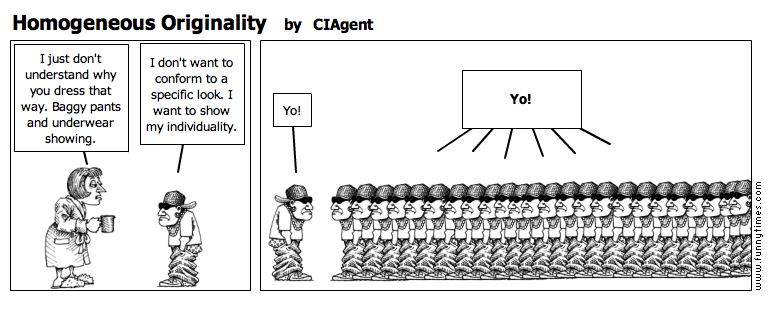
Modern democracy makes it possible for each individual citizen to hold, express and exercise ‘own’ opinions and ethical principles, ‘own’ religious views and ‘own’ cultural preferences as long as they do not go against the democratically established laws of a particular state. A society of such individuals should, by its very nature, become ‘multicultural’ and ‘multi-religious’. And yet, what often happens is that many people insist on having their very ‘own’ opinion while the specific content of that opinion is the same as nearly everyone else’s. So the paradox is that a mono-culture arises of citizens who all understand themselves in the same way: as being autonomous individuals who make their own choices and pursue their own projects. This is the cultural mantra of the West. The very idea of having ‘own ideas’ is more important than really having them.
In reality, ‘diversity’ is often not defined in terms of specific values or belief systems (be it theist or atheist convictions and opinions), but in terms of economic value. Hence ‘culture’ becomes a matter of ‘taste’ and ‘lifestyle’ more than anything else. The more people believe that they have their own individuality to construct or to express, the more manufacturers and producers can launch something ‘original’ to satisfy the self-concept of potential consumers.
It should be noted that producers want to make money. They want to launch ‘the next trend’ rather than satisfy the supposedly very specific demands of one very unique individual. In other words, the illusion that we are autonomous individuals (mensonge romantique in the words of René Girard) who constantly have to make own choices keeps us at the marketplace where we are offered competing choices by different producers. [Moreover, we wouldn’t experience the desire to be original if we were.] Commercials make use of powerful models to guide these choices and that’s how, eventually and again paradoxically, new types of conformity are established (as people imitate those powerful models and each other – for more on this, read La Mode(rnity), a previous post).
It is remarkable how some people, who are convinced that they have very own individual opinions and views, all of a sudden make reference to something like “our culture, our values, our convictions and our habits” when they are confronted with “strangers”. Some voices in Europe consider the refugees as a threat to their particular state, both economically and culturally. Moreover, it is often the so-called ‘cultural difference’ that is presented as one of the main obstacles to social and economic integration of refugees. Once again, as so many times in the history of mankind, it is the perception of a common threat or enemy that structures a common identity – past internal differences that, in light of that common threat, eventually don’t seem very fundamental. See, for instance, how the German Emperor Wilhelm II (1859-1941) begins his speech at the outbreak of the first world war (Source: Kriegs-Rundschau I, p. 43 – Original German text reprinted in Wolfdieter Bihl, ed. Deutsche Quellen zur Geschichte des Ersten Weltkrieges [German Sources on the History of the First World War]. Darmstadt, 1991, p. 49; Translation: Jeffrey Verhey) – Berlin, August 1, 1914:
“I thank all of you for the love and loyalty that you have shown me these past days. These were serious days, like seldom before. Should it now come to a battle, then there will be no more political parties. I, too, was attacked by the one or the other party. That was in peace. I forgive you now from the depths of my heart. I no longer recognize any parties or any confessions; today we are all German brothers and only German brothers. If our neighbors want it no other way, if our neighbors do not grant us peace, then I hope to God that our good German sword will see us through to victory in these difficult battles.”
Let us hope that we Europeans, faced with the refugees coming to Europe, do acknowledge our internal cultural diversity so that we might discover in a new light our shared humanity as living out the possibility that the other may be truly ‘other’.
René Girard is among those scholars who like to point to the similarities between myths from around the globe. In this regard his work follows in the footsteps of people like James Frazer, Carl Jung, Joseph Campbell and Mircea Eliade. Girard’s explanation of the source of mythological structures and motives, however, is quite different from the approaches of his colleagues. Girard maintains that the archetypal mythological pattern is eventually rooted in a so-called scapegoat mechanism, following a typical ritualistic pattern that is rooted in the same mechanism (for more on this, click here).
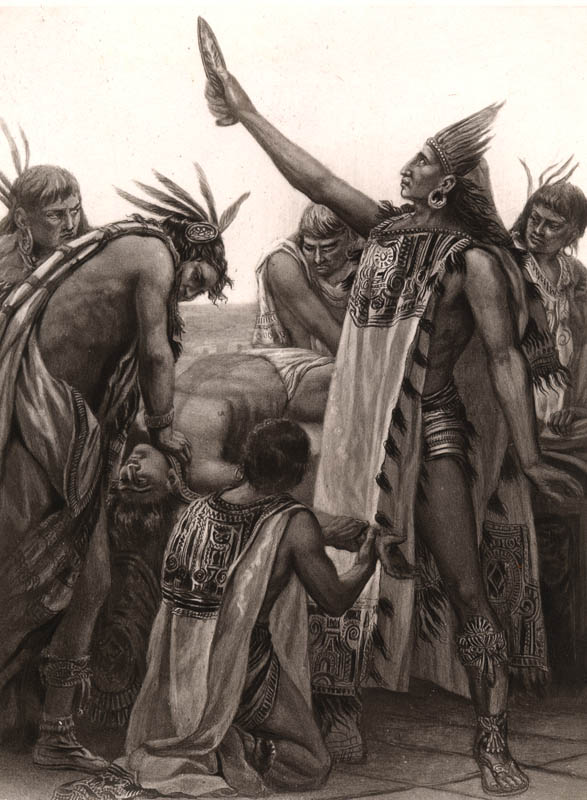
Myths can be considered as tales which contain the worldview of a culture, transmitting from generation to generation the belief that certain phenomena (from certain things to certain persons and acts) are sacred or belong to the gods. Traditionally, the realm of the gods or the sacred is also the realm of violence. If the sacred order of things is not respected or approached in a proper (i.e. ritualistic) way it brings about violent chaos, diseases, death and destruction in the (human) world. Next to connecting chaotic situations to the realm of the sacred (portraying chaos as “the wrath of god(s)” or “bad karma”), myths also contain messages on how to transform sacred disorder into sacred order. Following René Girard, myths can thus be understood, more specifically, as justifications of certain taboos and of certain types of sacrifice which should help to conserve or renew order in the world.
In short, according to René Girard, mythical thinking consists in connecting violent mayhem, natural disasters and contagious diseases to “god(s)” or “a sacred realm”. As such, violent mayhem etc. are explained as necessary moments of disorder from which a new order is generated. This never ending mythical cycle of “disorder – order – disorder – order – …” at the same time often functions as justification of the sacrifice of certain people whose death should bring about order.
A comparison between some ancient myths and contemporary interpretations of today’s international terrorism makes clear that mythical thinking as Girard understands it is on the rise again, especially in an eschatological sense and also in secular circles that hold on to a naïve version of the myth of human progress. Just take a look at the schematic presentation below presenting the mythical structure, time and again… (for more on the sexist implications of many myths, click here).
A) The Greek myth of Prometheus stealing fire from the gods
1) A WORLD ORDER
(“ORDO” or “COSMOS”)
with a clear distinction between different realms
=> Fire belongs to the gods and is considered TABOO
2) (TRANSGRESSION OF TABOOS brings about) A MOMENT OF DISORDER
(“MANQUE” or “CHAOS”/“CRISIS”)
with a challenge (the “call”) to restore the balance in the world
=> Prometheus steals the fire from the gods
3) Some kind of SACRIFICE (as the pinnacle of a “HERO’S JOURNEY” or “QUEST”)
with a transformation of the identity of the hero figure(s) – into “monster(s)” or “savior(s)”
=> Prometheus is banned to the Caucasus mountains, where he is chained and tortured
4) GOAL = A (RE)NEW(ED) WORLD ORDER
(“ORDO”)
again with clear distinctions between different realms
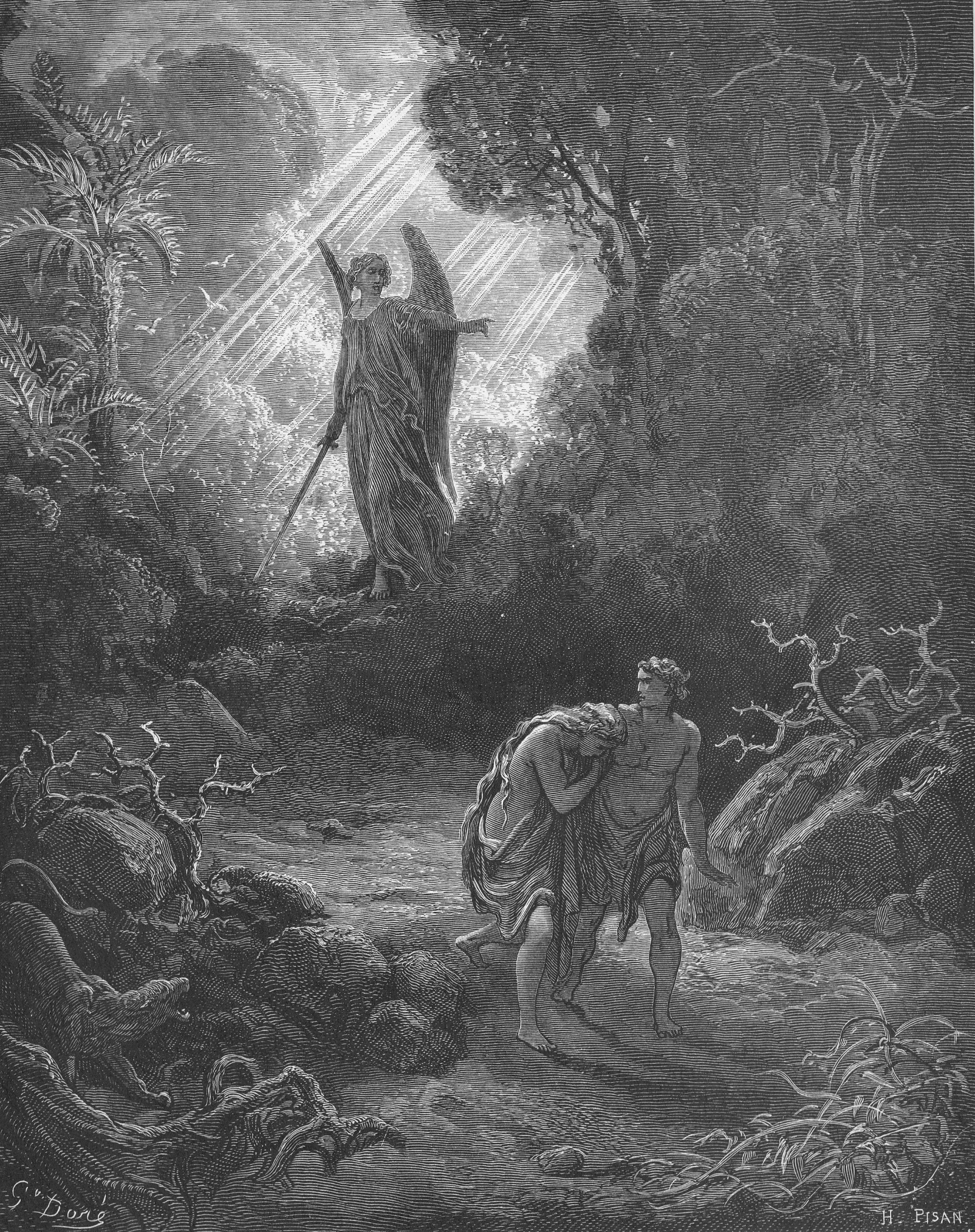
B) The Hebrew myth of Adam and Eve in the Garden of Eden
• A WORLD ORDER
(“ORDO” or “COSMOS”)
with a clear distinction between different realms
=> Fruits of the Tree of Knowledge belong to God and are considered TABOO
• (TRANSGRESSION OF TABOOS brings about) A MOMENT OF DISORDER
(“MANQUE” or “CHAOS”/“CRISIS”)
with a challenge (the “call”) to restore the balance in the world
=> Adam and Eve “eat from the forbidden fruit”
[from a comparison with the Song of Songs: this is a transgression of the taboo on sex]
• Some kind of SACRIFICE (as the pinnacle of a “HERO’S JOURNEY” or “QUEST”)
with a transformation of the identity of the hero figure(s) – into “monster(s)” or “savior(s)”
=> Adam and Eve are banned from Eden and have to accept a life with suffering and death
• GOAL = A (RE)NEW(ED) WORLD ORDER
(“ORDO”)
again with clear distinctions between different realms
C) The Greek myth of Oedipus
• A WORLD ORDER
(“ORDO” or “COSMOS”)
with a clear distinction between different realms
=> Killing the “father-king” and taking the “mother-queen” is considered TABOO
[Note: “thanatos” and “eros” motif]
• (TRANSGRESSION OF TABOOS brings about) A MOMENT OF DISORDER
(“MANQUE” or “CHAOS”/“CRISIS”)
with a challenge (the “call”) to restore the balance in the world
=> Oedipus kills his father, the king, and marries his mother, the queen and allegedly causes a plague in the city of Thebes
• Some kind of SACRIFICE (as the pinnacle of a “HERO’S JOURNEY” or “QUEST”)
with a transformation of the identity of the hero figure(s) – into “monster(s)” or “savior(s)”
=> Oedipus stabs out his eyes and goes into exile
• GOAL = A (RE)NEW(ED) WORLD ORDER
(“ORDO”)
again with clear distinctions between different realms
D) A religious fundamentalist mythical interpretation of 9/11 (“end times”)
(Jerry Falwell & Pat Robertson)
• A WORLD ORDER
(“ORDO” or “COSMOS”)
with a clear distinction between different realms
=> Types of relationships which differ from the “traditional”, patriarchal family are TABOO
• (TRANSGRESSION OF TABOOS brings about) A MOMENT OF DISORDER
(“MANQUE” or “CHAOS”/“CRISIS”)
with a challenge (the “call”) to restore the balance in the world
=> Feminists, gays, lesbians and other “liberals” challenge the patriarchal family structure
• Some kind of SACRIFICE(as the pinnacle of a “HERO’S JOURNEY” or “QUEST”)
with a transformation of the identity of the hero figure(s) – into “monster(s)” or “savior(s)”
=> Two days after the terrorist attacks of 9/11, Jerry Falwell and Pat Robertson, two evangelicals, shared their “theological” views on the terrorist violence (transcript from the 700 club, a well-known evangelical television program in the States – September 13, 2001). Especially these comments are telling (for more, watch the video below the transcripts): JERRY FALWELL: The ACLU’s got to take a lot of blame for this.
PAT ROBERTSON: Well yes.
JERRY FALWELL: And, I know that I’ll hear from them for this. But, throwing God out successfully with the help of the federal court system, throwing God out of the public square, out of the schools. The abortionists have got to bear some burden for this because God will not be mocked. And when we destroy 40 million little innocent babies, we make God mad. I really believe that the pagans, and the abortionists, and the feminists, and the gays and the lesbians who are actively trying to make that an alternative lifestyle, the ACLU, People For the American Way – all of them who have tried to secularize America – I point the finger in their face and say “you helped this happen.”
PAT ROBERTSON: Well, I totally concur…
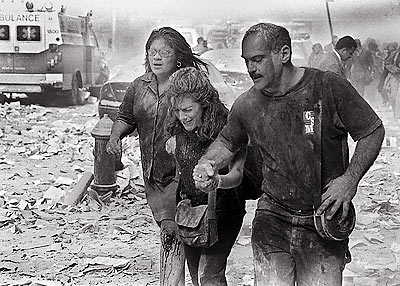
In other words, 9/11 is interpreted as an unavoidable SACRIFICE, sanctioned by God; it is “the wrath of God” caused by people who keep on transgressing “sacred” laws and taboos. This sacrifice manifests itself in a twofold manner: the autoaggression of the terrorists’ suicide implies the heteroaggression against the victims in the planes and the twin towers.
Conclusion: “Secularists” or “the secularist lifestyle” (as Falwell and Robertson understand this – which corresponds to the Islamic fundamentalists’ notion of “the satanic West”) should be abandoned or banned.
• GOAL = A (RE)NEW(ED) WORLD ORDER
(“ORDO”)
again with clear distinctions between different realms
To conclude this post, I’d like to mention an article by John Gray on the book The Pursuit of the Millenium by Norman Cohn. Gray points to the eschatological myths of religious and secular political ideologies, from Christian Millenarianism (especially in today’s context we might think of Islamic Millenarianism as well) to Nazism and Communism. All these ideologies have justified sacrifices and massacres to bring about a new world order, a “paradise” – hence every utopia turns into dystopia… At the end of his article, Gray also warns for new versions of the eschatological myth in “liberal humanism”:
There is a line of reasoning which accepts that totalitarian ideologies were shaped by apocalyptic and utopian thinking, while insisting that liberal humanism is entirely different. They – the Nazis and communists – may have been deluded and irrational; we – enlightened meliorists – have purged our minds of myth. In fact, the belief in progress in ethics and politics, which animates liberal rationalism, is itself a myth: a view of history as a process of redemption without the Christian belief in a single transforming event, but nonetheless a faith-based narrative of human salvation. It is obvious that human life can sometimes be improved. Equally, however, such gains are normally lost in the course of time. The idea that history is a process of amelioration is an article of faith, not the result of observation or reasoning.
Reading Cohn will not lead secular thinkers to relinquish their cherished myths. The need to believe in them is far more powerful than intellectual curiosity. But, for those who want to understand the origins of the conflicts of the past century and the present time, The Pursuit of the Millennium may be, as it was for me, a life-changing book.
Considering all this, we might want to rethink the concept of “eschatological battle” as a struggle we have to face within ourselves, in the depths of our soul… The true fight is a spiritual one, as we are converted from our human violence (and all our man-made gods, idols and ideologies justifying that violence) to the absolute non-violence of the God of Love, The Merciful One…
The challenge is to build an order and a “peace” that is not built on the violence of sacrifices, but to build a peace that allows for “non-violent conflicts…” (a “non-totalitarian peace”).
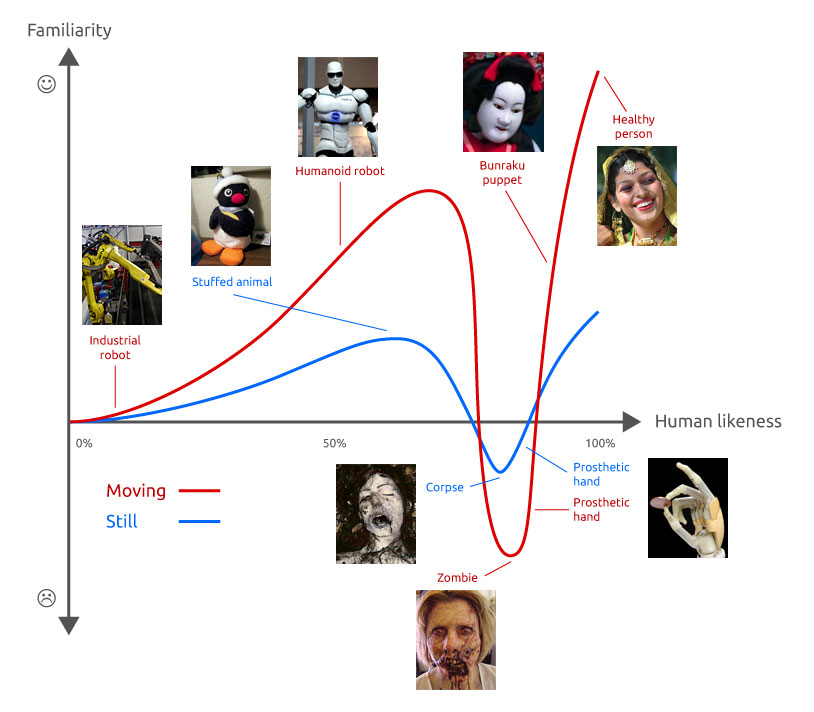
Originally I just wanted to write a post on the uncanny valley, a phenomenon first described by Masahiro Mori (former robotics professor at the Tokyo Institute of Technology) in an essay for Japanese magazine Energy (vol. 7, no. 4, pp. 33–35, 1970) – READ THE ARTICLE ON THE UNCANNY VALLEY BY MASAHIRO MORI IN ENGLISH BY CLICKING HERE (OR PDF VERSION HERE). But as you will notice, dear reader, it made me think about some other stuff as well 🙂 …
Mori predicted that we would respond with a heightened sense of affinity to robots that act or look like humans until a certain threshold of similarity is reached. Apparently, when it becomes too difficult to make a direct and clear distinction between humans and robots, humanoid robots become uncanny and we experience an eerie sensation. In the words of Mori, we indeed come to an uncanny valley.
Mori ended his article by raising a few questions: “Why were we equipped with this eerie sensation? Is it essential for human beings? I have not yet considered these questions deeply, but I have no doubt it is an integral part of our instinct for self-preservation.”
Mori also provides a preliminary answer to these questions in a footnote:
“The sense of eeriness is probably a form of instinct that protects us from proximal, rather than distal, sources of danger. Proximal sources of danger are corpses, members of different species, and other entities we can closely approach. Distal sources of danger include windstorms and floods.”
This is all very interesting from the perspective of René Girard’s mimetic theory. It helps in providing an answer to Mori’s questions.
René Girard considers man’s increased mimetic (i.e. imitative) ability as a source of empathy as well as enmity, as a force responsible for order as well as disorder. For instance, children tend to take older people as their example. By imitating elders (and others in general) young people not only learn how to live in a certain culture, but they also learn what to desire. Others also function as models for desires and ambitions.
Of course, when the gap between an imitator and a model is big enough, there won’t be any problem between them. The relationship between a mentor and a pupil will then be one of admiration from the part of the pupil. However, when an imitator’s skills increase he might become a threat to the position of his model. As he has learned to desire the same objects as his model, his model might become an obstacle to his ambitions. Adolescents indeed often show a tendency to no longer respect a former hierarchy. They tend to become rivals to adults whose authority they no longer automatically accept. They as well as the adults thus experience an identity crisis. In other words, the gap between youngsters and adults threatens to disappear and this potentially destabilizes human communities. Following Mori’s terminology we can call this gap where the distinction between young and old seems to disappear an uncanny valley. Girard observes that, in order to avoid a crisis resulting from this kind of intra-group rivalry, cultures have developed initiation rituals. These rituals often allow for types of violence against “new adults” in a controlled, structured way (for instance in a certain time frame) in order to give them “a proper place” and to avoid destructive rivalries and violence. It is no coincidence that student sororities and fraternities to this day make use of initiation ceremonies. Like many rituals in many cultures they paradoxically create an order by “organized disorder”. Sometimes these rituals are very violent, however, with girls being gang raped – to name but one of the terrors. That’s why some students are committed to end “frat-related violence”.
So to answer Mori’s questions already from the point of view of Girard’s mimetic theory: we have learned, in the course of our evolution as human species, to fear the disappearance of differences because we have learned to associate it with destructive types of rivalry and violence. That’s why, as Mori observes, “corpses, members of different species and other entities we can closely approach” (and identify with) are experienced as “sources of danger”. Youngsters can take the place of adults, robots of humans… and rotting corpses (similar to but not quite the same as living human beings) can generate diseases and death where once there was life. Indeed violence itself is like a disease, contagious.
Apart from the potential rivalry between and among youngsters and adults there’s another type of rivalry that has been experienced as a fundamental threat to the survival and stability of human communities: the rivalry between men to obtain “the best females” of a group. No wonder then that sexuality, and in particular female sexuality, has been perceived as a potential destructive force across different cultures. Because of its association with rivalry and violence, sexuality could easily become a taboo. On the other hand however, sexuality is also needed to guarantee a community’s survival. As is the case with adolescence, sexuality became a ritualized cultural phenomenon in human life (from courtship dances to temple prostitution to marriage). Rituals in general allow for a transgression of that which is taboo in everyday life.
Traditionally, a collection of taboos and rituals in a particular culture is justified by referring to a sacred realm (with supernatural deities, ghosts or magic forces). Mimetic theory explains how violence became associated with “invisible persons” through the scapegoat mechanism (READ MORE ON THE ORIGIN OF RELIGION BY CLICKING HERE). Hence everything that can be associated with violence had the potential to become associated with “invisible persons” or “gods” as well. Sadly the sacralization of sexuality often meant that women became scapegoats, unjustly held responsible for a potential crisis in the life of their respective communities. Women had (or have) to prevent men from desiring them, thereby preventing rivalries between men. In some cultures they had (or have) to wear a veil in public, in others they were (or are) circumcized. The reasons to this day given for female genital mutilation indeed hardly conceal the underlying sexism – taken from the European Campaign to end FGM: “FGM, in particular infibulation, is defended in this context as it is assumed to reduce a woman’s sexual desire and lessen temptations to have extramarital sex thereby preserving a girl’s virginity.” Extramarital sex is considered taboo in this context since it could stir rivalry between men, destabilize family life and hence destabilize community life as a whole. Female sexuality, taboo because it is perceived as a potential violent force, thus is highly ritualized: female circumcision is a form of sacrificial violence to prevent destructive violence (perceived as “the wrath of the gods”) from happening.
In short, human history shows that women all over the world, in different times and in different cultures, have been perceived as “dangerous life-bringers”. They are feared and adored at the same time (read more on this by clicking here – post on TEMPTRESSES). Important and well-known myths from all over the world have transmitted the perception of women as potential troublemakers. I’d like to dedicate the second part of this post to a presentation of three versions of this perception of women. The message concerning Pandora, Eve and “uncircumcized women” should be clear. These women are considered to bring about “the uncanny valley”, the loss of differences that marks the breakdown of the normal social order. Indeed, chaos and disorder in communities is often perceived as a curse brought about by “bewitched women”. However, if the situation of women is read as a particular form of the scapegoat mechanism, the (whether or not ritualized) violence against women can be considered a curse or a “burden” women have to bear unjustly. Although the Bible is not without sexist tendencies, René Girard and others have argued that Judeo-Christian Scripture eventually reveals the truth of the scapegoating impulse behind our cultural institutions. In other words, according to Girard our ability to consider certain texts and habits as, for instance, “sexist” is a consequence of a knowledge gradually given to us through the biblical writings. But that’s another story… Let’s take a closer look at the women who are blamed for “the evils mankind has to endure…”
2. THE UNCANNY VALLEY – A WOMAN’S CURSE
Prometheus, Thief of Fire and God Challenger in Greek Mythology
The Myth
After Zeus hid fire from humans, Prometheus stole it from the gods to give it back to mankind. Prometheus did not respect the hierarchical distinction between the human and the divine and was therefore banned to a rock in the Caucasus. Chained, Prometheus was visited daily by an eagle who ate out his liver. It is said that his liver regenerated each night because of his immortality. Prometheus was eventually freed from his eternal punishment by the hero Heracles. At the same time, Zeus had also punished mankind with Pandora, the first woman. She became the wife of Epimetheus who could not resist her, although his brother Prometheus had warned him not to accept her gift. Pandora unleashed all the evils in the world by opening a box that should have remained closed. The Greek epic poet Hesiod (between 750-650 BC) writes of Pandora: “From her is the race of women and female kind, of her is the deadly race and tribe of women who live amongst mortal men to their great trouble, no helpmeets in hateful poverty, but only in wealth.”
Eve, Thief of Forbidden Fruit and God Challenger in Hebrew Mythology
The Myth
After God had forbidden man to eat from the tree of knowledge, the woman who was eventually named Eve nevertheless took some of its fruit and also gave some of it to Adam, the first man. Eve did not respect the hierarchical distinction between the human and the divine and was therefore banished from the Garden of Eden, to earth, together with Adam. Eve is considered to have cursed mankind with death, suffering and all kinds of evils and troubles. Genesis 3:16-19: “The Lord God said to the woman, ‘I will make your pains in childbearing very severe; with painful labor you will give birth to children. Your desire will be for your husband, and he will rule over you.’ To Adam God said, ‘Because you listened to your wife and ate fruit from the tree about which I commanded you, You must not eat from it, cursed is the ground because of you; through painful toil you will eat food from it all the days of your life. It will produce thorns and thistles for you, and you will eat the plants of the field. By the sweat of your brow you will eat your food until you return to the ground, since from it you were taken; for dust you are and to dust you will return.’”
The Thief of Women’s Clitoris and Preserver of Sacred Order in African Ritual
The Myth
Bruce Parry visited the Dassanech tribe in Ethiopia. Women of this tribe are circumcised. One of the women who circumcises the girls told Parry the story that justifies this type of ritualistic violence concerning female sexuality:
“Circumcision is our culture. If we stop our culture, we will all die. If a woman with a clitoris gives birth, she, her child, everyone will die. Her clitoris will come up to her head. It’ll come out of her nose, and back into her head. It’ll kill her, she’ll die. Her father will die, her mother will die. That’s why we cannot stop circumcising girls.”
Bruce Parry:
“I’m told if she doesn’t get circumcised, she won’t get married, and she’ll be cast out from the tribe.”
WATCH THE VIDEO FROM 1:38 HERE:
THE (SEXIST) MESSAGE, TIME AND AGAIN
There is a hierarchy in society, establishing order by making clear distinctions.
This hierarchy is to be respected; we shouldn’t compare ourselves to higher ups or compete with them. In other words, mimetic rivalry is taboo in everyday life. We should respect distinctions and differences. No hubris!
If a person does not respect a society’s prohibitions and customs, he or she is cast out from society as he or she is considered to potentially bring a crisis (or chaos) to life. A new order is established by sacrificing an outcast (found at the margins of society – high or low) ritualistically, again and again in an unescapable cycle of events. More generally speaking, rituals allow for so-called “good” controlled violence in order to avoid “bad” uncontrollable violence from happening.
Women are to be suspected as potential troublemakers, maybe even warmongers. The above mentioned stories claim in a sexist way: a crisis is never far away when women are around!
Order in society, established by maintaining certain taboos and (sacrificial) rituals, is considered sacred, as a divine commandment.
Rest assured, I’m getting there, but I have to tell a little story first…
Mary was watching a soap opera on a big screen TV in the living room. Her brother, Martin, came in and joined her on the sofa. “You know, there’s a lecture by Stephen Hawking on the Discovery Channel right now”, Martin said. And he continued: “It’s his explanation about the origin of the universe. Maybe we can watch it together?” “Oh, come on Martin”, his sister replied, “that’s so boring; I’d rather watch this soap, it’s really exciting and I’m curious how that new girl character will overcome the break up with her boyfriend…”
We can all imagine this type of situation. More often than not, people choose to enjoy stories that allow them to identify with certain characters and events over a desire to explain things. Most of us are no Nobel Prize winning scientists. Flash back to prehistoric times: would our so-called primitive ancestors be any different? I’ve always wondered why we would accept the notion that religion and belief in spirits and gods arose out of prehistoric man’s innate desire to explain things. I can imagine prehistoric man trying to survive in an often hostile, barren environment. I can also imagine prehistoric man, further on in evolution, listening to (sometimes contradictory) mythical stories that express and justify a certain world-view and way of doing things, allowing him to develop a sense of identity within his tribe (see the quote by the Indigenous Peoples of California below). But I cannot imagine prehistoric man as a would-be scientist. It goes against a day-to-day experience and observation of myself and fellow human beings. Showbizz websites with spectacular stories about celebrities get more views than academic websites…
I know that an argument based on intuition and personal experience might not be very convincing, but there are other problems connected to the idea that animism or primitive religion arose out of prehistoric man’s desire to explain things. Consider for a moment a reasoning that often goes something like this: “Because primitive man had not yet developed science, he tried to explain the world in which he lived by spiritual, invisible or supernatural forces…” The problem is that this reasoning already somewhat presupposes the belief in a spiritual or supernatural realm to explain the origins of such a belief. That’s a circular argument that, in this case, actually doesn’t explain anything about the origin of religion. Of course it is true that religion has been used to explain things, but before it can function like that it has to already exist. It is not because electricity has been used to bring trains into motion that electricity originated from the desire “to move trains”. It is not because religion has been used to explain things that religion arose from the desire “to explain”. And, once again, early mythology and storytelling is not concerned with the question “What really happened?” They are considered true in another sense, namely in that they (“archetypically”) express and mold life experiences and views on life.
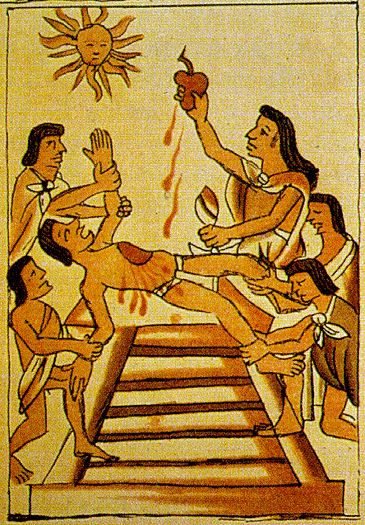
So let’s consider René Girard’s idea again that primitive religion arose out of certain associations made concerning the victims of group violence. From this point of view, it is no coincidence that sacrificial rituals belong to the oldest expressions of religious behavior. Moreover, seen from Girard’s perspective, it is no coincidence that creation myths or myths of heroes from all over the world contain the theme of sacrifice as a way to establish, renew or preserve a world order.
René Girard considers the very first sacrificial rituals as imitations of a scapegoat mechanism in groups of primitive humans whose internal (mimetic) rivalry threatened to destroy the group itself. Primitive human societies experienced the killing of one member of their group by a significant part of the community as something which restored calm and order. This must have happened so much in primitive human societies that they started making certain associations.
On the one hand primitive societies experience turmoil as long as ‘the common enemy’ is alive, while on the other hand they experience peace after he is beaten to death. Gradually they will associate new situations of disorder with the resurgence of a former victim of group violence. In other words, they experience a person who is not visibly present anymore, but whose presence is ‘felt’ in situations of turmoil. In other words still, one of the former victims of group violence has become a ‘ghost’ or a ‘god’. At the same time, primitive human societies also ‘learn’ that killing someone apparently restores order. So together with the belief in ghosts and gods considered responsible for all kinds of possible violent disasters, the belief originates concerning the effectiveness of sacrifices to restore, renew or keep order, life and stability in human society. If primitive societies would have seen that the victims of group violence are no more responsible for violence than other members of the group, they would not have developed these beliefs. Violence became something sacred because the victims of group violence were considered exclusively responsible for the violence they were associated with. Those victims were, in other words, scapegoats.
Girard argues that all other associations regarding ‘the sacred’ rest on this first association between violence and divinized victims of group violence. Everything that can be associated with violence had the potential to become sacred or divinized as well. Sexuality became sacred. Indeed, sometimes males fight over females. Food became sacred. Indeed, people fight over food sometimes. Territory became sacred. Indeed, people go to war sometimes because of territory. Nature as a whole became sacred. Indeed, natural disasters are ‘violent’ and provoke violence if they cause lack of food and water… And so the world and the experience of man became sacred.
Religions came and went, but the age-old associations regarding the sacred were transmitted down the generations, albeit in varying forms (human sacrifice becoming animal sacrifice, for instance). The Greeks still had Ares, god of war, as they had their goddess of love, Aphrodite. The Romans copied (indeed, ‘imitated’) the Greeks and spoke of Mars and Venus.
Asked why they perform their rituals and sacrifices and why they respect their taboos, primitive societies always answer: “Because our ancestors did it, and because we have to respect the ghosts and the gods in order to sustain our community…”
Could it really be true that the structure of ancient human sacrifice goes back to a mechanism that can still be observed in our ape cousins? And that this mechanism provides the foundation of the archaic sacred? Is it far-fetched to suspect that the former fact (the structure of ancient human sacrifice, which begins with a fight!) has something to do with the latter fact (the scapegoat mechanism)?
Girard has argued that the dividing line between human and ape lies in the way mimetic quarrels became a fearful threat to the survival of primitive human communities (it is no surprise that prehistoric massacre mass graves exist – click here for an example). Precisely because the mimetic ability of humans grew, their tendency towards near uncontrollable mimetic rivalry increased likewise. Hence it became possible that humans began to make associations that their ape cousins could not make regarding the communal killing of a group member. Compare to Pavlov’s dog: a dog who has only arbitrarily or sporadically heard a signal while getting food will not drool if he hears the signal, while Pavlov’s dog who has systematically heard the signal while getting food will at some point start to drool from the moment he merely hears the signal… Apes won’t associate turmoil with a victim, while primitive humans will start to do exactly that at some point. The consequences can be suspected: primitive humans will start to consciously ritualize the scapegoat mechanism, while apes only experience this mechanism sporadically. The above posted fragment of a documentary on monkeys shows a powerful example of the mechanism. The monkeys gather around the corpse of their former leader who has been killed after a fight for control over the group. “They are unusually silent as they gather around…” We can almost observe how it must have been like that ‘a loathed enemy’ became ‘a revered god’. This also explains why gods have a ‘dual’, ‘ambiguous’ quality.They’re good and bad… Good aspects of the gods can be allowed in rituals, while bad aspects of the gods are forbidden and taboo. For instance, sacrifice is a form of ‘good’ (controlled) sacred violence to be distinguished from ‘bad’ sacred violence, which is to be avoided and is taboo…
Already in 1961, publishing Mensonge romantique et vérité romanesque, René Girard made the world familiar with his concept of mimetic desire. Mimetic desire is literally desire based on imitation. Like so many others before and after him, Girard observes that human beings are highly mimetic creatures. Humans imitate each other in all sorts of ways and thereby learn from each other – they learn good as well as bad behavior… To name but one example, people imitate the sounds of their environment and learn to speak, for instance, with a Texan accent. I don’t know if that’s a good or a bad thing :).
By introducing the concept of mimetic desire, Girard stresses that our desire is structured by imitating others who function as models for our desire. It is important to distinguish this type of desire from our basic biological or physical needs. When you’re walking in the desert alone and your body is yearning for water, your desire for water is, of course, not based on the imitation of someone else’s desire. True, nature has its impact on human life. However, when our basic physical needs are met, our desire goes beyond them. Our basic need for water is transformed in what eventually became a supermarket world that asks us to choose between different types of water, juices and soft drinks. Growing up, we develop a certain taste, transmitted to us by our social and cultural surroundings. We might even develop desires that not only go further than our physical needs, but also against them (anorexia being one example).
So, it’s not just nature that defines human life, nurture has its way too… We all have the biological need for food, but if we were born in another part of the world we would probably have developed different eating habits. It’s as simple as that. We imitate others. We mimetically learn to quench our natural thirst and to satisfy our natural hunger in a certain, culturally dependent way. No one is born with the desire for the newest soft drink produced by The Coca-Cola Company (indeed, Thou Shalt Covet What Thy Neighbor Covets – click to read this article by famous marketeer Martin Lindstrom), as no one is born with the desire to become a police officer. Our identities are not ahistorically determined from birth, they’re co-created with others.
We always write our personal history together with others, and we mutually influence each other. Since we’re social creatures we cannot escape this influence. Relationships precede and shape our (sense of) identity. Even if we go against our tendency to imitate an immediate social environment that seems indifferent towards the victim of some crime or accident (see “Bystander Effect” – click for more), we probably still imitate heroic examples from stories we grew up with (“The Good Samaritan” may be one of them).
Two questions often appear after these considerations, which show just how hard it is to let go of any type of Ego Illusion:
We often imitate others to adjust to our social environment. We imitate others because we desire social recognition. So, our desire for social recognition must be more fundamental than our mimetic tendencies, no?
If we imitate each other’s desire for something, someone still has to be the first to desire that something. Surely, the latter’s desire cannot be based on imitation, can it?
I’ve answered the first question before, but I’ll repeat it here. Of course we often imitate others to ‘fit in’. However, we could not develop a desire to fit in if it weren’t for our mimetic abilities. Our mimetic abilities allow us to put ourselves in each other’s shoes. They allow us to pretend that we are someone else. For instance, a little girl playing with her dolls pretends being a mother by imitating real mothers. Our mimetic abilities allow us, thereby, to imagine – however preliminary – what others are experiencing, expecting and desiring. So our ability to empathize and to adjust to the expectations of others (maybe to gain their recognition) rests on mimetic ability.
The second question seems very logical. Confronted with real life cases, the quest for ‘the first model’ is not that easy to answer though. Even simple situations show it might be the wrong question. Think, for instance, about two babies in a room full of toys. Let’s name the two Bobby and Johnny. Bobby starts playing with a little ball. Note that he didn’t necessarily wake up with the desire to play with a ball. Already in this sense his desire isn’t his own. It is awakened by people who left him the ball to play with. After just ten seconds, Bobby gets tired of the ball. He doesn’t really enjoy playing with it. So he starts playing with some other toy. He has no desire to play with the ball whatsoever. In comes Johnny. He saw Bobby playing with the ball and this raised Johnny’s attention. Now that the ball is left, Johnny takes the opportunity to start playing with it himself. In this situation Johnny is the imitator. However, when Bobby notices Johnny playing with the ball, he immediately leaves the toy that was more fun to him and tries to lay his hands on the ball Johnny is playing with now. In this situation Bobby is the imitator. In short, Johnny’s desire rests on the imitation of Bobby as model for his desire, while Bobby’s desire rests on the imitation of Johnny as model for his desire. It’s no use asking “Who’s first?” Johnny and Bobby mutually reinforce each other’s desire by becoming each other’s model and imitator. Thereby they become each other’s rival. René Girard speaks of the rivalry between mimetic doubles. More generally, we become each other’s rival if we cannot or do not want to share the object of our mimetic desire. Here’s an example – it could have been Bobby and Johnny 🙂 – CLICK TO WATCH:
2. REGARDING RITUAL SACRIFICE
Some consider René Girard’s explanations on the origin and maintenance of human cultures far-fetched. Well, are they?
René Girard considers the very first sacrificial rituals as imitations of a scapegoat mechanism in groups of primitive humans whose internal (mimetic) rivalry threatened to destroy the group itself. Primitive human societies experienced the killing of one member of their group by a significant part of the community as something which restored calm and order. This must have happened so much in primitive human societies that they started making certain associations.
On the one hand primitive societies experience turmoil as long as ‘the common enemy’ is alive, while on the other hand they experience peace after he is beaten to death. Gradually they will associate new situations of disorder with the resurgence of a former victim of group violence. In other words, they experience a person who is not visibly present anymore, but whose presence is ‘felt’ in situations of turmoil. In other words still, one of the former victims of group violence has become a ‘ghost’ or a ‘god’. At the same time, primitive human societies also ‘learn’ that killing someone apparently restores order. So together with the belief in ghosts and gods considered responsible for all kinds of possible violent disasters, the belief originates concerning the effectiveness of sacrifices to restore, renew and/or keep order, life and stability in human society. If primitive societies would have seen that the victims of group violence are no more responsible for violence than other members of the group, they would not have developed these beliefs. Violence became something sacred because the victims of group violence were considered exclusively responsible for the violence they were associated with. Those victims were scapegoats.
Girard argues that all other associations regarding ‘the sacred’ rest on this first association between violence and divinized victims of group violence. Everything that can be associated with violence had the potential to become sacred or divinized as well. Sexuality became sacred. Indeed, sometimes males fight over females. Food became sacred. Indeed, people fight over food sometimes. Territory became sacred. Indeed, people go to war sometimes because of territory. Nature as a whole became sacred. Indeed, natural disasters are ‘violent’ and provoke violence if they cause lack of food and water… And so the world and the experience of man became sacred.
Religions came and went, but the age-old associations regarding the sacred were transmitted down the generations. The Greeks still had Ares, god of war, as they had their goddess of love, Aphrodite. The Romans copied (indeed, ‘imitated’) the Greeks and spoke of Mars and Venus.
Asked why they perform their rituals and sacrifices and why they respect their taboos, primitive societies always answer: “Because our ancestors did it, and because we have to respect the ghosts and the gods in order to sustain our community…”
Could it really be true that the structure of ancient human sacrifice goes back to a mechanism that can still be observed in our ape cousins? And that this mechanism provides the foundation of the archaic sacred? Is it far-fetched to suspect that the former fact (the structure of ancient human sacrifice, which begins with a fight!) has something to do with the latter fact (the scapegoat mechanism)?
Girard has argued that the dividing line between human and ape lies in the way mimetic quarrels became a threat to the survival of primitive human communities. Precisely because the mimetic ability of humans grew, their tendency towards near uncontrollable mimetic rivalry increased likewise. Hence it became possible that humans began to make associations that their ape cousins could not make regarding the communal killing of a group member. Compare to Pavlov’s dog: a dog who has only arbitrarily or sporadically heard a signal while getting food will not drool if he hears the signal, while Pavlov’s dog who has systematically heard the signal while getting food will at some point start to drool from the moment he merely hears the signal… Apes won’t associate turmoil with a victim, while primitive humans will start to do exactly that at some point. The consequences can be suspected: primitive humans will start to consciously ritualize the scapegoat mechanism, while apes only experience this mechanism sporadically. Here’s a powerful example of the mechanism, nonetheless, observed in a group of monkeys. We can almost observe how it must have been like that ‘a loathed enemy’ became ‘a revered god’. This also explains why gods have a ‘dual’, ‘ambiguous’ quality.They’re good and bad…
Voor de inleefreis naar India van onze school (Sint-Jozefscollege, Aalst) maakte ik een powerpoint over hindoeïsme en boeddhisme. Daarbij heb ik de voornaamste verschillen trachten aan te duiden tussen ‘oosterse’ en ‘westerse’ levensbeschouwingen (hoewel het onderscheid natuurlijk moet worden genuanceerd omwille van wederzijdse beïnvloeding). Het gaat dan over denkwijzen die respectievelijk schatplichtig zijn aan een cyclische tijdsopvatting (bewaard in het Verre Oosten), en aan een lineaire tijdsopvatting (ontstaan in het Nabije Oosten, en verder ontwikkeld in de Abrahamitische godsdiensten).
“Eigenlijk ging het zo. Aangezien mijn zus vroeger danseres was, ben ik altijd in ballet geïnteresseerd geweest zonder daarom een kenner te zijn. Alleen vond ik lange tijd geen geschikt scenario of een juiste invalshoek voor een film. Tien jaar geleden – tijdens het monteren van Requiem for a Dream – las ik echter The Understudy van Andres Heinz. Dat script ging over de intriges achter de schermen van een Broadway-theatergezelschap. Wat later las ik ook De dubbelganger, een kortverhaal van Dostojevski over een man die er van overtuigd is dat zijn collega zijn identiteit heeft overgenomen. Dat vond ik een heel enge en fascinerende gedachte. Nog wat later zag ik een opvoering van Het Zwanenmeer van Tsjaikovski waarin de soliste zowel de rol van de Witte als de Zwarte Zwaan danste. Uit al die dingen samen is uiteindelijk het concept voor Black Swan ontstaan.”
Met De dubbelganger van Fjodor Dostojevski (1821-1881) en het ballet Het Zwanenmeer van Pjotr Iljitsj Tsjaikovski (1840-1893)plaatst Aronofsky zijn film in een rijk cultuurhistorisch en literair perspectief, dat gaat van de Metamorfosen van Ovidius (43 v. Chr. – 17 na Chr.), over Duitse, Russische en Deense sprookjes, tot de Engelse gothic novel en Richard Wagners opera Lohengrin. Daardoor bevat het verhaal van Black Swan ook een aantal geliefkoosde kernthema’s uit het werk van René Girard. Het leek mij interessant om die thema’s, en de manier waarop ze in de film aan bod komen, een beetje meer uit te spitten. Het resultaat is een filmfiche met cultuurhistorische en literaire achtergronden:
Ik maakte ook een videocompilatie met de eindscènes uit Black Swan, gecombineerd met fragmenten uit enkele literaire werken die in de filmfiche worden besproken.
SPOILER ALERT!
If you haven’t seen the movie Black Swan, you shouldn’t watch this. Otherwise:
 It would be very interesting to create an intensified dialogue between Paul Rozin‘s research on the acquisition of likes and dislikes of foods and René Girard’s mimetic theory. Although some scholars already made some connections between the two (for instance in Culinary Cultures of Europe: Identity, Diversity and Dialogue, ed. by Darra Goldstein & Kathrin Merkle, Council of Europe Publication, 2005), much promising work remains to be done.
 Among other things, biology and psychology professor Paul Rozin conducted a research with children from 16 months to five years of age. This resulted in a paper first published in Appetite (7: 141-151; June 1986), The Child’s Conception of Food: Differentiation of Categories of Rejected Substances in the 16 Months to 5 Year Age Range (click for pdf). The abstract from the article:
 “A major feature of the development of food selection is learning what not to eat.” In other words, disgust is not just a biological thing, a matter of nature. It is a cultural thing too, a matter of nurture. In yet other words, a huge part of our development concerning likes and dislikes of food lies in the imitation of others. If disgust is a matter of nurture it is also a matter of mimesis. Powerful social models have the potential to increase or decrease the disgust for certain foods. For instance, the disgust for organ meat is decreasing since it is increasingly perceived as food served to the beau monde in fancy restaurants. Organ meat thus becomes an object of mimetic desire, while at the beginning of the nineteenth century, it used to be something undesirable for the rich as it was “meat for the poor”.

 Several lines of evidence indicate some female competition over mating. First, at Mahale,
























 SCAPEGOAT SHADOWS